A Long Day At City Hall

Tuesday, June 2 was a long day for members of Toronto Council’s Executive Committee.  Many transportation issues were on the agenda including Union Station Revitalization, Western Waterfront Master Plan, Queen’s Quay redesign, and the Gardiner Expressway replacement EA.

As if that wasn’t enough, an open house for the Scarborough RT extension took me out for a ride on the Milner bus.

This transit blogging is harder than my pre-retirement work! Continue reading

Weston Corridor Update

Metrolinx has now released Part 2 of the Draft Environmental Report for the Georgetown South Service Expansion Project, and will hold a series of Open Houses over the next few weeks.

I will add more details to this post once I have a chance to digest several hundred pages of online information.

Updated 6:15 pm:

Mark Dowling sent along a note about a rather bizarre statement in the Metrolinx document:

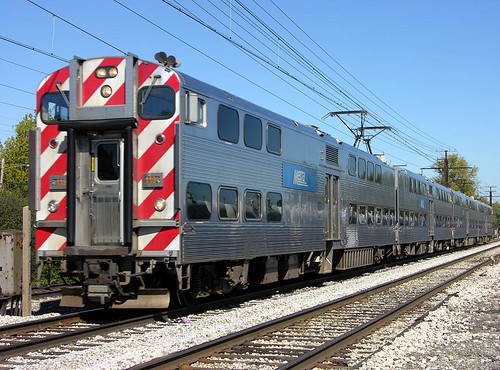
Are Metrolinx trying to pull a fast one?  Section 5.1.7 Page 204 (page 216 of the PDF):

“At present there are no electric double-deck commuter cars that can legally operate on North America railway lines.”

What would they call these then? Or has this fleet been retired by METRA since 02?

In any case, nobody said they had to be EMUs, did they? (Although EMU would have its advantages, obviously).

It’s this sort of thing that makes one wonder about the accuracy of so much else Metrolinx produces, or of the (possibly unintentional) bias in their studies.

Union Station Revitalization Update

Disclaimer:  Although I am the Vice-Chair of Toronto’s Union Station Revitalization Public Advisory Group, this article represents my own opinions, not necessarily those of USRPAG who have not had a chance to discuss this matter since the release of the report linked below.

On June 2, Toronto’s Executive Committee will consider a staff report recommending that the Union Station Revitalization project proceed at a total cost of $640-million.  This project is dependent on funding approvals from Queen’s Park and Ottawa which are expected to materialize over the coming months. Continue reading

Electrifying News for GO Transit

According to today’s Star, Metrolinx will today announce the commencement of a study of electrification.  Although this had been planned sometime in the future, the dates were vague depending on which report one read.  Indeed, GO seemed to be leaning more to continued diesel operation with a mix of local and express trains rather than using inherently faster electric trains for all services.

This is a great victory for the Clean Train Coalition who will release “The Better Move”, a response to Metrolinx’ Regional Plan, “The Big Move”, at a press conference on Wednesday (May 27).

The West Toronto Chapter of the Professional Engineers of Ontario plans to set up a subcommittee to study the electrification issue, and will hold a meeting on the evening of May 27.  Mike Sullivan from the Weston Community Coalition will be speaking.  The meeting is open to the public, but pre-registration is required.  For information, please see the PEO Chapter’s flyer.

Another GO Transit Grade Separation Project (Updated)

Updated May 14:  The display panels from the April 22 open house are available on GO Transit’s website.

Original post from April 15:

Construction is already underway for the grade separation project at the West Toronto diamond, and the residents are mightly upset about the noise from pile driving.  This project will continue disrupting the neighbourhood until late this year.

GO Transit has announced a public meeting on April 22, 2009 that will kick off another project in the same area, this time to remove the diamond where the Newmarket Subdivision (Barrie GO line) crosses the CPR North Toronto Subdivision.

(Thanks to Vic Gedris for passing along a copy of the notice.)

Staging the Electrification of GO Transit

For a good part of today, April 18, a conversation has flown back and forth via email between me, Karl Junkin of TRAC, Mike Sullivan and Rick Ciccarelli of the Weston Coalition, and Robert Wightman (a frequent contributor to comments here and a member of the original Streetcars for Toronto Committee).  I will not attempt to précis all of the threads, but thought it worthwhile to bring the discussion out into a broader context in this blog.

The problem, in brief, is to ensure that the electrification of the Weston/Georgetown corridor happens sooner rather than later and that the number of diesel trains operated on that corridor is kept to a minimum as service builds up to projected levels.

We had quite a discussion about dual mode locomotives with the major points pro and con boiling down to:

  • Bombardier produces a dual mode locomotive which is operating or on order in a few cities.
  • This locomotive could handle a 10-car GO train, but not a 12-car consist.
  • Dual mode would allow electrification to proceed in smaller increments with diesel operation beyond the end of the electrified territory.
  • These locomotives are very expensive, and the added capital spent on them must be weighed against the cost of electrification.
  • They need both diesel power and the power conversion equipment to convert the 25KV distribution voltage for use by the train.  Because there are, in effect, equipment for two power plants, you are always towing around one that isn’t doing anything, but both have to be maintained.

The idea lurking behind this is to maximize the amount of electric operation in the Weston corridor at least as far as the airport in keeping with the desire of communities along the corridor to minimize diesel operation, noise and fumes.

Various links of interest:

Railway Age article (quoted on another site).

Bombardier specification sheets for existing New Jersey and on-order Montreal equipment.

Specification sheets for GO’s current equipment (here and here, similar content).

Recently, I threw a new variation into the discussion by suggesting that there could be two separate fleets of locomotives.  Purely electric locomotives would be used to hall the service on the all-day section of the Lakeshore and Georgetown lines, and diesels would be used for peak period express trips running on the extended routes.

This arrangement would mean that all off-peak service would be electric, and diesel operations would remain only for peak extensions and for lines that had not been converted for electric operation.

There are downsides to this, notably that more infrastructure would be needed to get to the point where electric service could start, but it would achieve much of the goal of reduced diesel operation in the major corridors without requiring electrification to the end of service territory.  It would also eliminate the need for dual mode locomotives — whether this is a “benefit” depends a lot on where you stand on this type of operation.

Finally, all of this assumes that “Blue 22” would be electrified from day 1.  This seems highly unlikely given current arrangements with the proponent, SNC Lavalin, who are not even providing new equipment for their service.  Whether the proposed structures for the airport access tracks can even accommodate future electrification is unknown, and I would not be surprised to hear how we couldn’t possibly force SNC Lavalin to include this in the initial build.

Metrolinx is showing its usual colours on this whole issue saying that the project to get new service on the Weston corridor is far to important to delay, and that electrification is something for the future.  They are not making a lot of friends along the line on this count as well as on other structural issues involving neighbourhood impacts.  I will explore those in a separate post.

Weston Corridor Meetings Start Tonight

Metrolinx and GO begin their series of open houses for the expansion of tracks and service in the Weston corridor tonight.  Politically, this project has moved from a concern just in the town of Weston to a growing controversy along the line as neighbourhoods learn of the potential impact on them.

Among the issues are:

  • How many tracks are required to handle the planned service
  • To what degree does the proposed Air Rail link (Blue 22) affect track layouts
  • What pollution will be caused by a high level of diesel-hauled trains in the corridor
  • Why isn’t the line being electrified, and what effect would this have on track and equipment needs
  • What is the effect of increased service on existing grade crossings in Weston and at Strachan Avenue

GO Transit fought a long battle with the Weston Community Coalition over issues in their neighbourhood during an earlier GO-managed study of the line.  GO used the term “NIMBY” in an attempt to marginalize this opposition, and that term crept into recent provincial announcements about the need for an enhanced (read less vulnerable to opposition) transit environmental assessment process.  Sadly GO and their new partner, Metrolinx, do not seem to have learned much about meaningful public participation, but now face opposition from other neighbourhoods and possibly from the City of Toronto itself.

The open house schedule is available at the project website.

GO Transit Contemplates Customer Satisfaction and Station Design

Today’s GO Transit board meeting (yes, that Board still exists) included presentations on two related items:

  • Customer Satisfaction and Loyalty Survey
  • Station Access Strategy

The link between these, although they were separate items on the agenda, is that people who cannot conveniently get to GO services won’t use them.

Board members were in a chatty mood, and asked many questions of the presenter, a Transportation Planner from GO’s staff who acquitted herself well on a variety of topics.  I could not help noticing how many questions with a direct relevance to customer experiences, to feelings people have about GO, to problems of convincing more people to use the system, came from the politicians on the Board.  These are members who have a direct relationship with GO customers and potential new riders.  Other members spoke too, but the preponderance of questions informed by a direct link to constituents and municipal issues was quite striking.

All of this will be lost on the new consolidated Metrolinx board where, we are told, politicians would just get in the way. Continue reading

GO Transit Buys CN Weston Subdivision

GO Transit announced today that it will purchase the CN Weston Subdivision for $160-million.  The line in question runs from roughly the Strachan Avenue grade crossing to the junction with the CN York Subdivision at Steeles Avenue.

CN and VIA run comparatively few trains (3 and 6 respectively) each day on the line, although VIA has planned improved service in this corridor for some time.  GO plans greatly expanded service both in frequency and in destination (extending to Kitchener), and this corridor will also host the Blue 22 Airport link should that line ever get beyond the drawing boards.

By purchasing the corridor, GO will not only have better control of train operations, it will be able to retain ownership of the substantial improvements needed to accommodate all of the new services.

The press release is silent on the matter of funding.

Ottawa & Queen’s Park Announce GO Transit Improvements

A joint federal-provincial announcement today added a long list of GO transit improvements to the parking lot and the Hamilton Junction grade separation projects.

Among today’s improvements are:

  • Extension of GO Rail service into downtown Barrie (completion in 2011)
  • Expansion of the tunnel at Exhibition Station to provide a new north access, and additional track capacity at this station (completion in 2011)
  • Widening of the Credit River bridge on the Georgetown line to a capacity of three tracks, with two tracks initially on the new structure
  • Refurbishing existing locomotives to improve reliability
  • Adding 20 bi-level coaches to the fleet

Regular readers will know that I railed [sorry about that] against the amount of spending on parking lots announced in February.  Today’s project list is much more oriented to improvement of service and passenger facilities.  Yes, I know that to car commuters, parking is an important part of those facilities, but it’s not the only one.

From a longer range point of view, the planning issue of how parking lots and structures poison station locations remains a big problem.  The Metrolinx plan for “Mobility Hubs” doesn’t work very well without pedestrian-oriented stations and good local bus services.