Metrolinx Reveals Preferred Revenue Tools, But Says Little About Investment

On April 2, 2013, Metrolinx released a list of the preferred “revenue tools” in its forthcoming “Investment Strategy”.

Public consultation until today featured a longer list, and several of the options fell off of the table thanks to public and political feedback.  The complete list and a detailed analysis of each option can be found in a 225-page report “Big Move Implementation Economics Revenue Tool Profiles” produced by AECOM and KPMG in March 2013.

At a press conference, Metrolinx CEO Bruce McCuaig emphasized that the duty of his organization is to make recommendations, to offer advice, but that the final choice on tools and the amount of revenue to be sought will be up to the politicians at Queen’s Park.  This neatly shifts the focus of detailed questions, but avoids the question of just how much detail will be included in those recommendations.

A handout we are sure to see during the next round of consultations outlines the general philosophy and gives details of what might be achieved with each short-listed tool.

InvToolsShortlistP1c InvToolsShortlistP2c

The most important statement here is that

An Investment Strategy is about more than just raising revenues for transportation; it’s about implementing mechanisms that grow a more livable, prosperous and sustainable region.

To this I would add that a “strategy” also includes important components such as the staging of projects and discussions about the speed (or lack thereof) with which the full Big Move network is implemented.  Today and in the past weeks leading up to the announcement, we have heard a lot about new revenues, but little about how they should be “invested”.

Continue reading

What Should Be In The Metrolinx Investment Strategy?

With much talk about “new revenue tools” and debates over the least objectionable way to extract $2-billion or more from taxpayers in southern Ontario, the actual purpose of the Metrolinx “Investment Strategy” has faded into the background.  Somehow the act of collecting all that money has become more important than figuring out what, exactly, we are going to do with it.

But, you say, don’t we have the Quick Wins?  The Big Seven?  The Second Wave?  Shovels are in the ground and all we need is the will to spend!

Things are not quite that simple.

What we do not have is a clear sense of what we will achieve and when we will achieve it.  In 2008 Metrolinx produced The Big Move, our regional transportation plan with two very broad objectives — a 15 and a 25 year plan.  Demand projections, including a vision of what traffic and transit might look like, only considered the fully-built 25-year plan, something we already know will not be finished (if ever) within the projected time span.

Some projects received a “Benefits Case Analysis”, but these studies considered each line in isolation rather than looking at what subsets of the whole plan would contribute to the network.  Indeed, the biggest “benefit” of many lines would be the money spent to build them, not their contribution to transit overall.  This would follow the tradition of transit projects in the GTHA as economic and job stimulus packages first, with transportation improvements as an afterthought.

An “Investment Strategy” is not simply a matter of figuring out where new revenues might be found, but of recommending the best way to use them, to “invest” in the future of the region. Continue reading

Metrolinx Meeting Preview: February 14, 2013 (Update 2)

The Metrolinx Board meets on February 14 with an agenda that, as usual, features a rather long private session followed by a shorter public one.  There will be brief updates on GO Transit and the PRESTO farecard project, a Customer Service Committee update, and one substantive item – updates to the regional plan, The Big Move, and feedback from the public consultation sessions now in progress.

Updated February 15, 2013 at 9:10 am:  Notes from discussions at and after the Board meeting have been added to this article.

Update 2 at 12:45 pm:  The date for Board approval of the Investment Strategy has been clarified.

Continue reading

Metrolinx Math

In a recent comment, a reader questioned the disparity between the $34-billion cost of the Metrolinx “Next Wave” projects and the sum of the individual projects listed on the website.  These projects are:

Brampton-Queen BRT     $  600 million
Dundas BRT                600
Durham BRT                500
GO Expansion            4,900
GO Lakeshore Express    1,700
GO KW Electrification     900
Hamilton RT             1,000
Hurontario LRT          1,600
Downtown Relief Line    7,400
Yonge North Subway      3,400
Total                 $22,600 million

A big chunk of the difference between these two numbers can be explained by a factor which is new in the “Next Wave”, a provision of 25% of whatever funding is available for local transit, regional highways and other smaller projects.  This would eat up $8.5b out of the total leaving $25.5b for the next wave of “Big Move” projects.

I wrote to Metrolinx asking for an explanation of the remaining $2.9b, and this is their response.

Transforming the transportation network in the Greater Toronto and Hamilton Area is similar to any renovation project, and $50 billion was a planning number that was developed in 2008 for the Regional Transportation Plan, also known as The Big Move. As we move through assessments and delivery, we will have harder numbers, so that figure will change.

However, prior to the assessments and delivery, we’ve built a contingency into the $34 billion cost of the Next Wave projects, which accounts for a difference in numbers.

It should be noted that more than $16 billion from all three levels of government has been allocated to the “first wave” of projects drawn from The Big Moves list of top priorities. This is the largest financial commitment to transit expansion in Canadian history. [Email from Metrolinx February 5, 2013]

I will take at face value the statement that the $2.9b is “contingency”, but note that this was not mentioned in any of the presentation materials nor on the website.  To me it looks more like an “oops”.

This is not simply a question of catching Metrolinx out on an incomplete or inaccurate presentation.  We are now engaged in a debate about regional transportation and funding, and it is vital that this take place in a fully informed context.  An amount of $2b/year is commonly used as a reference point for the amount of funding that must be delivered by any new revenue tools.  This was in the original “Big Move” budget of $50b delivered over 25 years, and shows up most recently in the City of Toronto’s “Feeling Congested” outreach program.

That original number was in 2008$ and it included some provision for future operating costs.  However, it did not include inflation, nor did it include the recently added provision for local transit and road projects which would take 25% off the top of any new revenue stream.

The $50b was supposed to finance 52 separate projects listed in The Big Move, but between the “first wave” and “next wave” list, many still remain outside of funding plans.

If the Investment Strategy report expected from Metrolinx late this spring is to have any relevance to the discussion, it must include current estimates of capital and operating costs to be funded from new revenues, and must provide for inflation.  Either the capital provisions must be escalated to future dollars, or the future revenue from new tools must be discounted to present day.  We cannot discuss our long-term funding needs with a mixture of dollar values spanning decades.

Public transit projects have a long history of coming in over budget for various reasons.  Some of this is bad planning and some is scope creep, although it could be argued that these are often related.  There is always the issue of unexpected circumstances, not to mention the treatment of large public transit projects as an opportunity for every nearby utility to have their plant upgraded at the project’s expense.  Past funding for Metrolinx projects has always been announced as $x-billion plus inflation so that a $16b or $34b “commitment” may actually be much larger in as-spent dollars.

A further wrinkle is the use of private sector financing, construction and operation through “AFP” (Alternate Finance and Procurement), a methodology now in favour both in Ottawa and at Queen’s Park.  In this scheme, part of the capital cost of a project is assumed by a private partner, and this can reduce the capital outlay required during construction by the public sector.  However, that money has to be paid someday, and the payments show up on the operating budgets through mechanisms such as leases and revenue guarantees.  That will be a future call on the new revenue streams, and it must be built into the long range Investment Strategy.

Finally, some transit costs have been borne through non-Metrolinx budgets including various transfers to municipalities (now mainly the gas tax, although the infrastructure fund may be revived in a future budget) and a clawback to GO transit via a tithe to help pay for its capital program ($20m from Toronto this year).  All of these funding streams need to be sorted out and presented in one place so that a rational view of what is needed going forward is available for everyone to see.

Metrolinx should take greater care with its announcements and fiscal plans so that its credibility is not undermined by simple questions about arithmetic, and so that the funding they seek will actually match the funding they will need.

New Premier, New Policies? (Updated)

Updated February 2, 2013 at 12:30 am:  The costing for Next Wave projects has been corrected to reflect that spending for local projects and roads is included in the total of $34-billion rather than as an additional cost on top of that number.

The Ontario Liberal Party has a new leader, and soon the province will have a new Premier.  Although I am not a Liberal supporter, I am extremely pleased by Kathleen Wynne’s rise to head our provincial government.  She represents the progressive wing of the party, and a fresh outlook after the increasingly frustrating reign of Dalton McGuinty.  A change of focus is already evident with social services, education labour relations, job creation and transportation infrastructure getting prominent mention.

Transportation is not first on the list, but it is vital to the GTHA.  Mobility has many benefits for business and for individuals.  Transportation infrastructure, especially transit, has far too often been treated as a cost to be avoided, to be offloaded, to be deferred while we strangle in congestion.  That congestion isn’t just on roads, plugged highways and arterials, but on the very transit systems we keep telling drivers can be our way out of the mess of 21st century gridlock.

The scope of what we need is enormous.  Within Toronto, we are accustomed to annual ridership figures now over half a billion, although this is well below half of all the journeys in the city.  Elsewhere in the greater Toronto area, transit does well to carry 10% of all travel.  The GTHA requires much, much more investment in transit infrastructure and in service to attract a larger share of the market.  Making transit a credible alternative to the automobile will not be easy, and reaching a target of 1/3 of work trips by transit in 2031 requires far more than a few trains and buses.

“More of the same” is not an option for a new government, especially one with a tenuous minority in the legislature.  Transportation problems are too big and have been set aside for another day for far too long.

Later this year, we will see the long-awaited Metrolinx “Investment Strategy”, a document that should have been published at least two years ago.  The necessary background information has been available for some time, but nobody at Queen’s Park wanted to talk about new “revenue tools”.  This lack of political fortitude and leadership, coupled with project funding delays and scope changes, cost the GTHA more lost time and compounded the deficit in transit building.

Fortunately Ontario now has a Premier-designate who is willing to talk about raising the money necessary to improve transit.  The challenge will be to actually go from talk to implementation and the creation of a funded transit plan.

We are at an important time in the political and economic cycle for the debate and real progress to begin.  Too many big announcements came just at high points when the economy boomed, only to lose the momentum to a downturn, retrenchment, and a shift of focus away from transit expansion, let alone changes in government. This pattern stretches back to the early 1970s and the Davis government’s aim to build cities for people with transit rather than with cars.

We are having the difficult, “mature” conversation about new taxes (whatever we might call them) when times are tougher.  Building transit funds into the base of government spending rather than as good-time baubles will be a major change, if it happens.

Continue reading

Metrolinx and the Auditor General (Updated)

Updated December 14, 2012 at 1:40pm:

Additional information regarding Presto and Metrolinx’ response to the Auditor General’s report has been added at the end of that section in this article.

Original post from December 13:

The Auditor General of Ontario released his Annual Report on December 12, 2012, and it includes a section on Metrolinx.  For those of us who have wrestled with the secrecy of Metrolinx, some of the information and recommendations in this report are a breath of fresh air.

Metrolinx’ overall reaction to the report is much of the same boilerplate about the wonderful job they are doing and how important they are to the region.  In some cases, Metrolinx dodges the questions raised by the Auditor in a way familiar to anyone who has ever attended one of their press conferences.

The report should be read in the context of March 31, 2012, the end of the period to which the audit applies.

Continue reading

Metrolinx Meeting Wrapup — December 2012

The Metrolinx Board met on December 5, 2012.  Most of its business was conducted in private, an unfortunate habit of this provincial agency, but some items emerged on the public agenda.

I have already reported on the “Next Wave” of transit projects and the amendments proposed for The Big Move regional plan.  In other news …

Continue reading

Metrolinx Updates The Big Move, Announces Priorities for Phase 2 Projects (Updated)

Updated December 6, 2012 at 11:20 am:

A warmed over version of the Board of Trade presentation was given to the Metrolinx Board by President & CEO Bruce McCuaig at the Board meeting on December 5.  There were a few clarifications of note:

  • The list of “Next Wave” projects will not be nailed down until the February 2013 Board meeting following a round of public consultation.
  • That consultation will also include a review of the proposed amendments to The Big Move and yet another round of talks about potential revenue tools.  The meetings will probably take place in January at 12 public round tables, as well as a 36-member “Residents’ Reference Panel” doing “deep dives” into the issues at weekend sessions.  This process will report back to the Board in spring 2013.  (There is no info about how the 36 “residents” will be selected for the panel.)
  • It is likely that construction of the Downtown Relief and Yonge Extension subway projects would take place concurrently with Yonge to Steeles opening at roughly the same time as the DRL from Downtown to Danforth.  “Phase 2” of each project would follow.  At this time there is no commitment to going north of Danforth or to any specific route either through downtown or through the east end of Toronto.  This will be the subject of an Environmental Assessment for the project.
  • The goal of TBM was described by McCuaig as having 75% of GTAH residents within 2km of rapid transit at their origin or destination.  That “or” is an important distinction I don’t remember hearing before.  It’s child’s play to have lots of people close to rapid transit at one end of their trip — anyone who works in major centres within Toronto or lives along a subway, LRT, BRT or GO line will qualify.  The more difficult target is to have such access at both ends of the trip because “convenience” is meaningless if only one end is well-served.
  • In an apparent contradiction to the implied 1/3 local funding described in the Star’s article about Mississauga having second thoughts on the LRT project, McCuaig said that we cannot look at traditional federal/provincial/municipal financing models.  Presumably the Investment Strategy will address this problem.

The actual timing of the Next Wave projects varies depending on which document one reads or how one parses the announcements.

  • In the Next Wave handout (linked later in this article), this is described as a 15-year, $34-billion project.
  • The spend rate implied by another part of the same handout is only $1.2b/year, and this translates to a 28+ year timeframe.
  • Metrolinx, in an email responding to this article and my concerns about the status of projects such as the Eglinton LRT to the Airport, said that there would be a “Third Wave” in 2025.
  • At the press briefing following the Board meeting, McCuaig confirmed that for the “15 year plan”, year zero has been reset to 2012.  This implies that TBM’s original 15 year timeframe is now stretched to roughly 20.  Moreover, McCuaig hinted that projects started within the next 15 years may not finish by then.
  • Despite all of the delays, the year 2031 is still the target for completing all of The Big Move.

In previous discussions of the Investment Strategy, Metrolinx has included an allowance for operating the new facilities as they come into service.  This is missing from the $34b of the Next Wave, but will have to be incorporated into the IS discussions.  Moreover operating costs are ongoing while capital are one-time.

In all of this discussion it was amusing to listen to Metrolinx talk about revenue tools, code for the very things some politicians in Toronto find utterly unacceptable preferring to imagine that pools of private capital are available at little or no cost.

The presentation materials from the Board meeting are not yet online, but the hard copy version comes under the unhappy title of “The Big Move In Action”.  Deleting only one space would give a good description of the treatment of project schedules for Transit City by Queen’s Park.  The presentation ends with a page titled “Keep the wheels moving” and a picture of a stone wheel and hammer.  Ontario makes a lot of claims for its triumphs in transportation technology, and I can’t help wondering if this is an early product of the Ontario Transportation Development Corporation.

I mention this because Metrolinx appears to have embraced a new, quaint graphic style for their Big Move and Union Pearson Express websites.

Continue reading

TTC Rediscovers the Downtown Relief Line (Update 4)

Update 4 October 21, 2012 at 8:30 pm:

It’s intriguing to look back at coverage of the DRL the last time this was a major issue.  Mike Filey passed along a clipping from the Star from December 2, 1982 that makes interesting reading.  My comments are at the end in Postscript 2.

Update 3 October 20, 2012 at 3:20 pm:

A postscript has been added discussing the various demand simulations as a group rather than individually.  Charts of total demand southbound from Bloor Station as well as pedestrian activity at Bloor-Yonge are provided to consolidate information from several exhibits in the background paper.

Update 2 October 19, 2012 at 11:00 am:

This article has been reformatted to merge additional information from the background study as well as illustrations into the text.

At its meeting on October 24, 2012, the TTC will consider a report on the Downtown Rapid Transit Expansion Study.  The full background paper is also available on the TTC’s website.

A study by the City of Toronto and TTC, including consultations with Metrolinx, concludes that transit demand to the core by 2031 will grow at a rate that exceeds the capacity of all of the current and planned transit facilities.  Ridership will be 51% higher than today.  The residential population south of College from Bathurst to Parliament will grow by 83%, and employment by 28%.

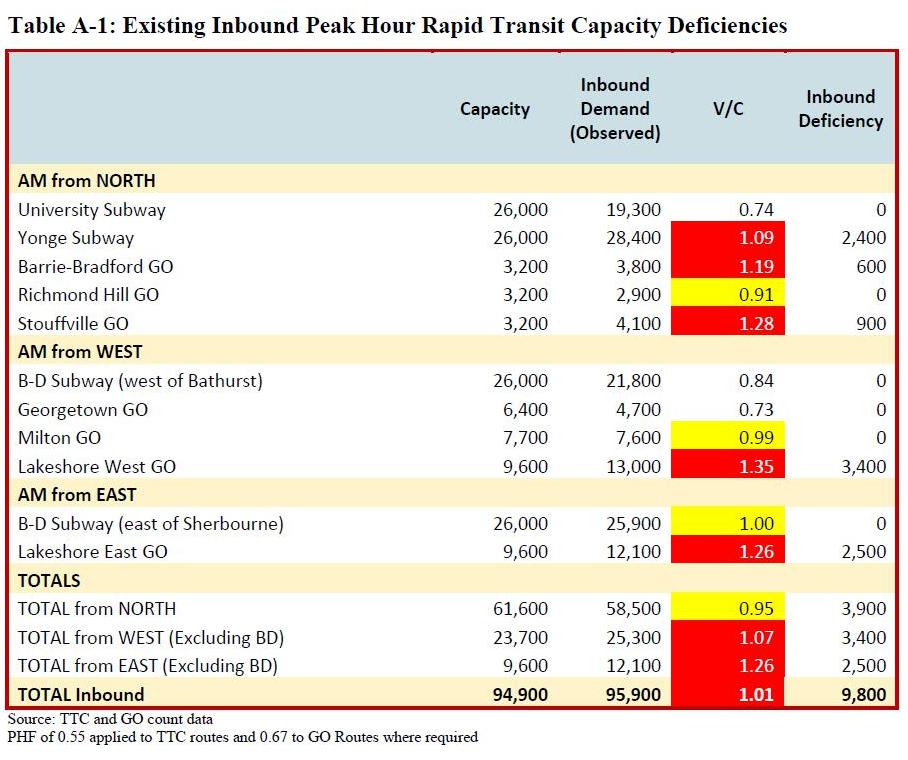
Capacity is an issue today as Table A-1 in the background paper shows.  Several corridors into downtown are already operating over their design capacity.  This is particularly the case on GO where the target is to have few standees, and there is more room for additional passengers in the design capacity than on the TTC subway services.

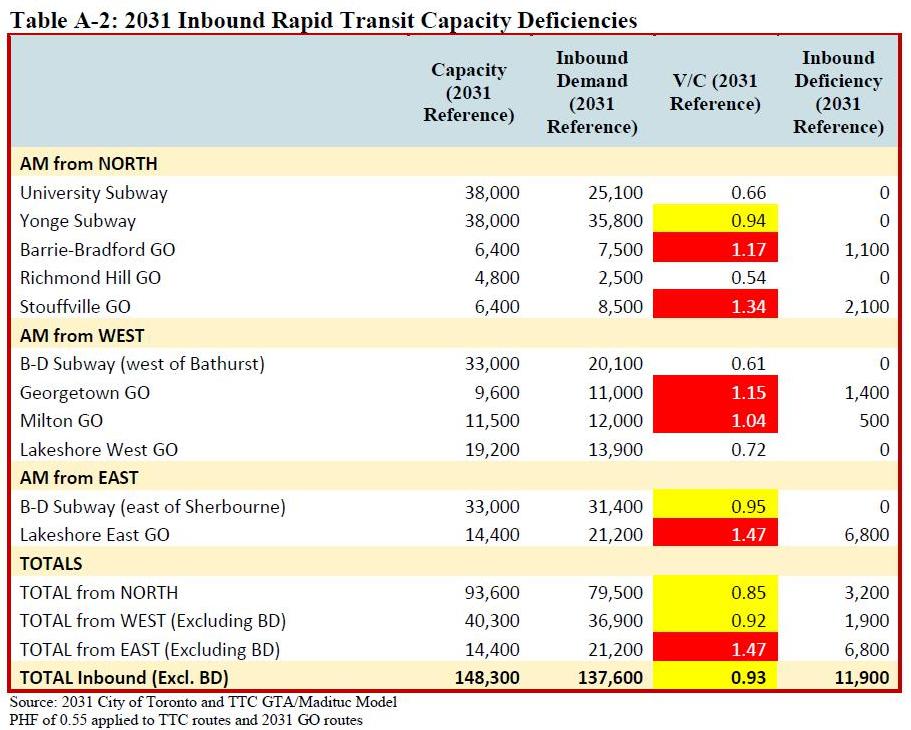
Table A-2 shows the projections for 2031.  All of the shortfalls are on GO, but the TTC lines are close to saturation.  This presumes a considerable increase in the capacity of various lines.  For example, the YUS goes from a design capacity of 26,000 to 38,000 passengers per hour (pphpd), an increase of 46% which may not actually be achievable.  Similarly, the BD line goes to 33,000 pphpd, an increase of 27%.

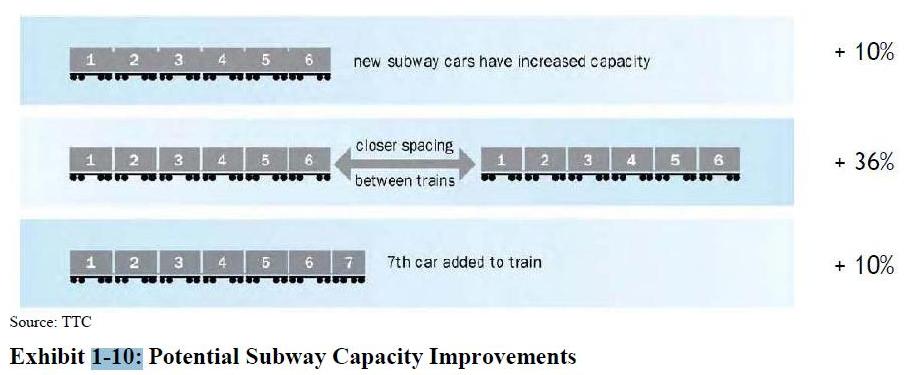
Exhibit 1-10 shows the components of projected capacity increase including 36% from running trains closer together.  As discussed at some length on this site previously, the constraints on headways arise at terminal stations.  A 36% increase in trains/hour implies a headway of about 100 seconds as compared with 140 today.  This cannot be achieved with existing terminal track geometry, not to mention the leisurely crew practices at terminals.

On the GO lines, the projected capacity on Lakeshore West doubles, and smaller increases are seen on other routes.  It is worth noting that the projected capacity of the north-south corridors to Stouffville, Richmond Hill and Barrie are nowhere near the level of service implied by The Big Move, probably because these lines are not targets for early electrification.  This contributes to the capacity shortfall in the northern sector.  Recommendation 1 of the study includes encouragement that Metrolinx review the possibility of increased capacity in those three corridors.

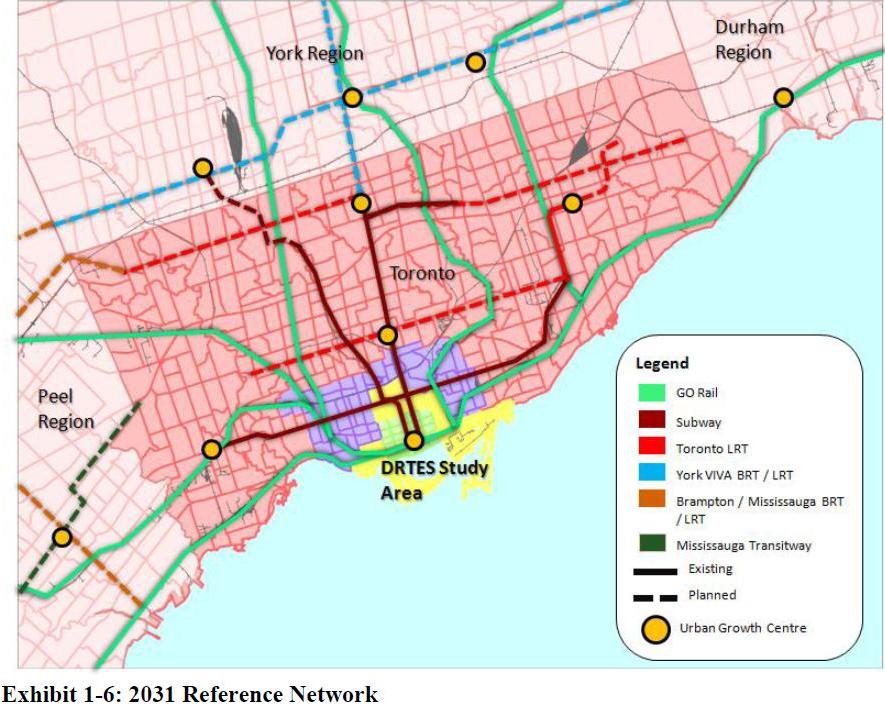
The full list of lines included in the modelled network can be found in the background study at section 1.2.1.

Continue reading

Toronto Contemplates Transit Funding / Reviews Transit Plans (Updated)

Updated October 9, 2012 at 5:30 pm

Toronto’s Executive Committee considered a report on transit funding mechanisms today.  In the following report, I have included only the most interesting or important of comments to give the flavour of the debate.

The proceedings were rather odd in that a presentation, cued up for City Staff, was never heard, but a “private citizen” managed to give a half-hour long deputation thanks to many friendly questions from Committee members.  That “citizen” was Dr. Gordon Chong, former head of Toronto Transit Infrastructure Limited, an all-but-bankrupt subsidiary of the TTC used to conduct a study of the Sheppard East subway extension for Mayor Ford.

Chong liberally drew on his transit experience including years as head of the Greater Toronto Services Board, a provincial agency predating Metrolinx.  Throughout his deputation, the highly misleading map of four cities’ subway system was projected to emphasize how little Toronto has done.  (That map purports to show how little Toronto has in comparison with London, New York and Madrid while ignoring the fact that these were much larger cities, much sooner.)

A “glaring omission” from the collection of transit plans in the staff report, Chong said, was his own Sheppard report and the information produced by KPMG about tax increment financing (TIF).  Chong clearly implied that the report was biased, but missed the fact that the Council motion directed the inclusion of “approved” plans for review, something Chong’s most emphatically was not.  As for TIF, it is mentioned, but rejected as a funding mechanism as staff argue that such revenue is needed for general support of city services and should not be earmarked just for transit capital projects.

Councillor Michael Thompson pursued the scheme of a Scarborough subway with a BD extension that would loop back along Sheppard to close the loop at Don Mills Station.  Chong replied that if Toronto could deal with the “money issue”, then there is no reason we can’t have the best in transit.  Thompson observed that a casino might bring in $75-100m annually and could fund transit projects.  The oddity here is that both treat any new money as a bonanza to be used for the best possible transit (where they want it) when fiscal conservatives might be expected to argue for careful husbanding of whatever loot might come their way.  There is also the small problem that the municipal share of projected revenue for a Toronto casino is probably an order of magnitude lower than the Councillor’s claim.

Various Councillors mused about a regional agency to dispense transit dollars and decide which projects should be built.  An underlying assumption was that, of course, the network of suburban Toronto subways would rank high on the list, and nobody seemed to contemplate that a 905-dominated agency might have other more pressing needs or think that the investment in all those subways was of dubious value.

Chong had only veiled contempt for the “expert panel” who reviewed his report and recommended, instead, for the LRT option on Sheppard.  He strongly supports subway construction presuming the money is available, supported by the best possible feeder bus network.  Councillor Norm Kelly asked whether the LRT plan was “an aberration”, and Chong replied that all previous TTC Chief General Managers had supported subways.  Although he invoked the name of David Gunn, he neglected to mention that Gunn boycotted the opening ceremonies of the Sheppard line.

Next the Committee turned to questions of staff. Continue reading