Who Will Ride the Yonge Subway?

Updated January 9:  The 2009 Subway Fleet Plan has been scanned and linked from this post.

Toronto’s Executive Committee voted on Monday to approve submission of the EA for the Richmond Hill extension to Queen’s Park, but added a number of riders on their support for the line.  This parallels actions taken at the last TTC meeting to strengthen the pre-requisites for City participation in this project.  The conditions include:

  • Full funding for construction and operation of the extension beyond Steeles Avenue at no cost to Toronto.
  • Full funding for any cost of an additional subway yard.
  • Completion of the Automatic Train Control system on the YUS line, including the Vaughan extension.
  • Any measures to relieve capacity problems at Bloor-Yonge would be funded as part of this project.

City and TTC staff have been requested to report directly to the January 27 Council meeting on various potential ancilliary costs including:

  • Bloor-Yonge station expansion
  • Fleet expansion and subway yard costs
  • Second entrances to other downtown stations
  • Need for an eastern Downtown Relief Line
  • Need for extending the Sheppard line west to Downsview
  • Sequencing of these options relative to the Richmond Hill line’s construction

Notable by its absence from this list is any reference to GO Transit’s Richmond Hill service.  This must be included because the level of GO service has a big impact on the modelled ridership for any future TTC network.

Karl Junkin, who comments here regularly, presented a deputation on this item which is supposed to be linked from the City’s site.  However, that link is currently not working.

Karl Junkin Yonge Analysis

Karl covers a lot of the ground that was in my own report on TTC fleet planning and other posts about the Richmond Hill extension.   Staff have been directed to meet with Karl and provide comments on his concerns in a report to Council.

Much of this turns on hte question of how many people will actually be riding the subway in 2017 when the Richmond Hill extension is planned to open.  TTC staff have, to their considerable discredit, played fast and loose with teh relevant data depending on the argument of the moment.

When it suits their purpose to conjure up a need for vastly more trains on the line and increased capacity at Bloor-Yonge, then the estimates can be stratospheric.  When the goal is to pretend that the Richmond Hill extension can be accommodated with no increase in service, then — Presto! Chango! — more riders but no more service.  The word “bamboozle” comes to mind here, although somewhat less Parliamentary language might be more appropriate.

Let’s review the estimates we have seen recently. Continue reading

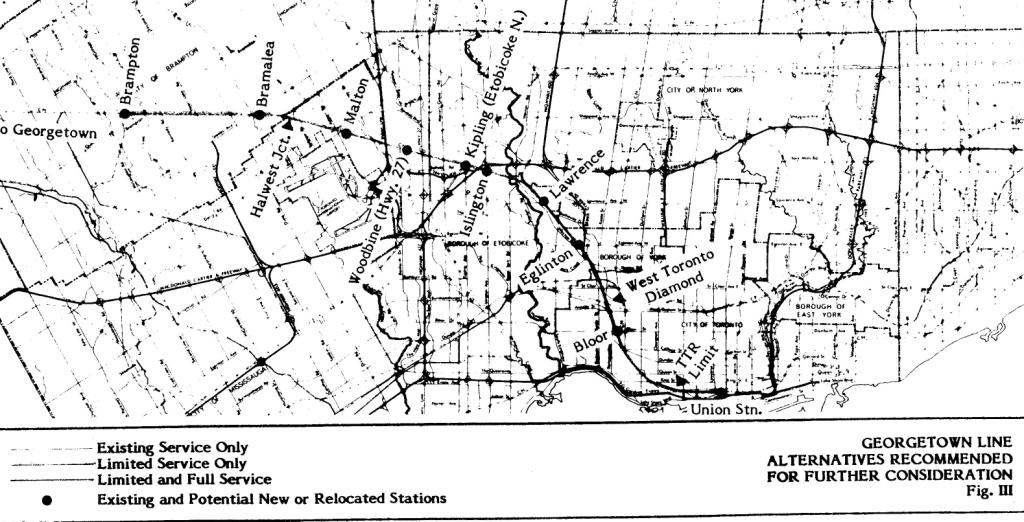
GO Transit’s Relief Line: The 1986 Study

This post continues a series looking at old proposals for ways to get commuters into downtown Toronto.  This isn’t a new problem, and as we have already seen, the TTC and Metro Planning were contemplating various alternatives four decades ago.

In response to the proposed Downtown Relief Line and other subway schemes, GO Transit commissioned a study of the possibilities for GO Rail service.  This study recommended frequent, all-day service between Halwest (the point where the York Subdivision, CN’s Toronto bypass, meets the line to Brampton) to Doncaster (the point where the CN Bala Subdivision, used by the Richmond Hill train, crosses the York Sub).

As is quite evident from any GO timetable, this didn’t get built.  One reason was that interest in the DRL waned as the political dynamic and planning focus turned away from downtown to the so-called “centres” that would grow within Toronto’s suburbs.  Travel into downtown continued to grow, and the GO Lake Shore service handled much of the transit-based increase.

A few points worth noting:

  • The option of using the connecting track from the CN to the CP between Oriole and Leaside was considered to be the superior route, although it had its problems including a potential conflict with the proposed Leslie Street extension.
  • For reasons that are not explained, the equipment cost for the most limited of services is higher than for all-day service.  In general, I would treat the cost estimates with some suspicion because (a) they are two decades old and (b) ancilliary costs such as connections to the TTC at Dundas West don’t appear to be included.
  • The inclusion of a cost comparison between subway and GO construction was clearly intended to plump for GO as the much cheaper alternative.  However, the study does not address the variation in origins and destinations that requires both local and express services in any corridor as discussed here previously.
  • There are no demand projections, only a feasibility study of what service could be operated.

Richmond Hill Georgetown Study June 1986

Figure II: Richmond Hill Line

Figure III: Georgetown Line

Richmond Hill or Bust? The Yonge Subway Extension (Part 3)

Posts in this thread have examined the general design proposed for the Richmond Hill subway and the many demand estimates for this line.  Now I will turn to the impact of this line on the larger network.

As many have pointed out in comments to the previous items, the Spadina/VCC extension was supposed to offload the Yonge subway.  We now know, according to the TTC’s estimates, that the effect will be a reduction of less than 10% of the existing demand southbound at the peak point, Wellesley Station.  Meanwhile, the availability of a competing subway line in the established Yonge Street corridor will attract many more riders.

The TTC manages a rabbit-in-the-hat trick by claiming that demand relative to capacity on the subway in 2017 will be the same as it is today thanks to Spadina diversion and more commodious trains.  That’s a very big, very fat rabbit, and I suspect it’s more of a canard.

Development will continue in York Region, and if anything the availability of frequent transit service, both on GO and on the TTC, will offset any effect that long-term increases in energy costs and commuting might have on travel demand and the decision to live far out of the core area.  Demand will grow on the subway both from the 905 and from within the 416. Continue reading

Richmond Hill or Bust? The Yonge Subway Extension (Part 2)

In the first part of this series, I reviewed the general layout of the Richmond Hill subway extension.  Now I will turn to the question of demand on the new and existing portions of the Yonge line.

Information on current and projected demands is very hard to nail down.  Transit agencies have a bad habit of fiddling the demand models to produce the results they want depending on available funding, political imperatives and the phases of the moon.  Small changes in the assumptions in any model can produce huge swings in the outcome.

Probably the single most flagrant problem with Metrolinx is that the demand model is proprietary to a consultant, IBI, and is not available for general “what if” use.  At the very time we are making decisions about network structures and spending priorities, we are told (by Metrolinx) that budget constraints limit the number of model runs.  Detailed parameters such as the capacity and speed of modelled lines are hard to come by.

In this vacuum, any plausible scheme for transit gains political traction even though it may rest on dubious planning foundations.  I say this not to knock the Richmond Hill proposal itself, but to urge caution in looking at the numbers particularly where the interaction between several alternative lines is concerned.

Projections for riding on both the Richmond Hill extension and the rest of the rapid transit network appear in various documents.  One of them even changed between the point where it was presented at a public TTC meeting and its publication on the TTC’s website. Continue reading

Richmond Hill or Bust? The Yonge Subway Extension (Part 1)

The proposed subway to Richmond Hill has an odd history as transit projects in the GTA go.  Normally, we are lucky to see anyone pay attention to any scheme for a decade or more, but this subway has gone from a gleam in local organizers’ eyes (and a website) to a top priority transit project with amazing speed.

Along the way, the whole idea of “alternatives analysis”, that pesky part of an “Environment Assessment” that is only a memory, is completely absent.  It’s a subway or nothing.  That’s unfortunate, to say the least, because the whole idea of Metrolinx was to plan on a regional basis, to see how everything fits together and where money would be best spent to improve a transportation network.

The Richmond Hill subway snuck through into the new, fast-track transit project assessment process before Metrolinx had even approved the final version of the Regional Plan.  Somebody wants a subway really, really badly.

As I have said in a comment thread elsewhere, I am not convinced that this line is a good idea especially when there are alternative ways to get people into central Toronto from the same catchment area as the subway extension.  York Region itself has (had?) plans for an LRT network as an end state for VIVA, although I have never taken them particularly seriously.  This may change once there is some real LRT running within Toronto, but as long as it’s an unknown quantity (or worse, something whose “best” example is on St. Clair West), nobody is going to take the mode seriously.

An argument can be made for an extension to Steeles as a way to relieve the bus congestion feeding into Finch Station, but there is some point where a subway has to end.  We cannot keep building a subway north on Yonge Street until we find ourselves in Lake Simcoe.  The demand simply isn’t there, and at some point the idea of a one-seat ride becomes laughable.  Indeed, even going to Richmond Hill, many travellers will depend on bus feeders or commuter parking to access the subway, and the quality of their trip will depend a lot on the amount of local transit or the scarcity of parking.  This problem is already familiar to GO Transit riders.

GO Transit, for their part, plans to upgrade service on their Richmond Hill line to 15 minutes peak, 30 minutes off peak.  This is not the same as frequent subway service, and it will only take people to Union Station, but this is an important part of the mix of services in the corridor.

All the same, any review of the proposal needs to assume that it will be built and that whatever impact this has on the network will have to be addressed.  If we are going down this path, we need to understand the consequences.

In the sections to follow, I will review the TTC report and presentation from December 17.  Parts of York Region’s original EA for this area make interesting reading, especially the ridership forecasts. Continue reading

Yonge Subway to Richmond Hill (Update 2)

Update 2:  The presentation from the Commission meeting is now online.  (4MB PDF)

I will write up comments on this project on the weekend.

Update 1:  Here is the text of the motion made by the Commission including the various caveats and requests for additional information.

Original Post:

The TTC staff report on the Richmond Hill subway is available online.  (Warning 15M PDF)

Today, the Commission voted to endorse this report in principle with futher discussion and deputations to follow at the January meeting.  The Commission also reaffirmed that Transit City was its first priority for system expansion, and sought a number of additional reports to clarify the impact of the subway extension on the existing network.

I do not have time now (Wednesday evening) to write this up in full, but will do so over the next few days.  Some material was presented at the meeting which is not in the linked file.

Of particular concern to the Commission is the haste with which this project is rolling forward based on an assessment launched by York Region that had very little consideration for how the line would fit in the overall scheme of the network.  I might be forgiven for thinking, only a month ago, that we had turned away from “my line first” planning to a network view thanks to the Metrolinx Regional Transportation Plan.

An argument can be made for extending the subway, but the true cost and impact are lowballed.  Yes, the staff report raises many caveats about service and capacity impacts, but there is no real alternatives analysis, no sense that anyone has looked seriously at larger issues.  I will turn to this when I discuss the report in detail.

Metrolinx Benefits Cases: VIVA First Out

Metrolinx has started the publication of its Benefits Case Analyses with the York VIVA system.  The SRT replacement study is also completed, and I expect to see it online soon.

These papers will appear in a section of the Projects Page on the Metrolinx site.

There is nothing too surprising in the VIVA study.  The map, excerpted from the full report, shows the staging options for the construction of exclusive bus lanes, here called “Rapidways”.

The core of the system radiating out from Richmond Hill Centre north to 19th, east to Unionville and west to Vaughan Corporate Centre would be finished by 2013.  In Option 1, the remainder of the network would be completed by 2018, or if Option 2 is chosen, by 2026.

A quite fascinating part of the BCA comes in the ridership estimates.  In the “Base Case” (just leave VIVA as it is with provision for modest fleet expansion), the projected 2021 ridership is 28.0-million per year.  This rises to only 30.3-million for either of the options studied.  Similarly, 2031 ridership is projected at 31.3-million for the Base Case, or 34.0-million for either of the optional networks.

Various factors are at work here.

The core of the demand falls on the first stage network that is common to both options, and the impact of the extensions is so small that it doesn’t make a difference (Before anyone accuses me of VIVA-bashing, that is a direct paraphrase from the report.)  Although the implementation of the Rapidways will give existing users a better riding experience, the comparatively small jump in riding suggests that most of the potential market is already using the system.

Updated:  In a comment posted following this post, “Dave R in the Beach” notes that the big jump in ridership is from current ridership of 6.8-million to the Base Case value of 28.0-million, and this is largely due to the subway extension.  In my response, I observed that the marginal gain from either BRT network is small and may reflect the comparatively small contribution the reserved bus lanes make to overall trip times when the much longer subway segment of the journey is included. [End of update]

An unknown acknowledged in the BCA is the question of land use planning.  Will York Region redevelop along the Rapidways, and how much will this contribute to future demand?

In the end, the BCA does not specifically recommend one option over the other, but the message about getting most of the benefit for 60% of the capital cost is quite clear.  We will see how this fares when Metrolinx puts together its detailed plan for project staging.

TTC’s October Supplementary Agenda

The supplementary agenda for this month has now been posted, and it contains some reports of interest.

At this point, I am only posting links here for information, but will comment on these after the meeting on October 23.

Queen Car Update:  No route changes at this time.  Continue attempts to improve line management.

Transit City Update

Yonge Subway Richmond Hill Extension

Local Road Planning: A Challenge for Metrolinx

In previous posts about the Metrolinx regional plan, I have written about the absence of local transit service other than something assumed to grow a lot, but not on Metrolinx’ dime.  Another aspect of local planning that pops up at Metrolinx Board meetings is the road network.

To nobody’s surprise, there are many projects to expand road capacity in the 905 given that the vast majority of travel there today and in the foreseeable future will be by private car.  Yes, there may be improvements through car pooling, park-and-ride and other schemes to lower the total passenger miles carried by autos, but there will still remain a huge demand for road space.

Recently, I received a note from a reader about the challenge of fighting Environmental Assessment battles in York Region.

Background

York Region has proposed a massive arterial road widening program. The base plan is to widen virtually all existing 4-5 lane arterial roads (2 lanes each way + left turn lane) to 6-7 lanes + wide median + bicycle lanes. The extra lane would be for HOV/bus during rush hour and general purpose the rest of the time. Different roads are at different stages in the EA process. Most are going through without citizen opposition.

However, in Markham, citizen concerns, lead by me, has resulted in the EA process being halted for 5 regional roads. The Region has agreed to model a broad range of alternatives and to form a citizens’ advisory committee. This work will commence this fall. They have also renamed the program “Transit Supportive Roads”, a very disingenuous name as you will see below.

Case Example – 16th Ave

Let me use 16th Ave in Markham, as I am most familiar with that regional road.

  • runs through established low density residential/parkland neighbourhoods (95%) or commercial (5%)
  • stable adjacent neighbourhoods unlikely to intensify in next 20 years
  • one YRT bus route (Route 85) with peak service every 20 mins
  • maximum current transit ridership say 50 people/hr/peak direction
  • VIVA BRT on dedicated right of way coming soon on Highway 7 ( 2 km south)
  • heavily congested by automobiles during peak hours

The idea that this road needs investment of scarce public dollars to build a “transit supportive road” is ludicrous. Until the built form of the area changes, this will remain as a low transit ridership route (< few hundred pphpd). The project is a road widening for cars with a fancy new name.

My Request of your Readers

However, let’s play along for a minute. Do your readers have any suggestions on what could be tried (or modelled) to improve transit within the existing footprint or with minor widening? At this point, the Region seems amenable to testing a broad range of ideas. Two ideas have surfaced so far:

  1. Build a single reversible bus-only lane in the centre of the road
  2. Use the “intermittent bus lane” concept cited in Metrolinx Green Paper on Transit (pg 11) and apparently giving 50% improvement in bus speeds in Lisbon with limited impact on general traffic movement

Has anyone seen #1 anywhere in North America? Has anyone been to Lisbon and observed #2? Does anyone have other ideas?

Peter Miasek

This raises at least two questions.  First, are we facing unbridled widening of roads in the 905 regardless of whatever efforts are made to woo people onto transit?  The current situation with VIVA is disheartening in that an entire network of BRT is shut down, but it carries only 35,000 people a day.  Those people are feeling the impact, but they’re a drop in the bucket of transportation demand.  How much political clout can transit plans muster?

Second, the Metrolinx Draft plan contains some fairly strong language about the need for local municipalities to bring their plans into line with the new regional plan.  Will Metrolinx have anything to say about road projects, some of which, as Durham’s Roger Anderson pointed out, are on the verge of construction but don’t even appear on the Metrolinx maps?  How can Metrolinx formulate a regional plan when it ignores the role and impact of local road and transit decisions?