New Trains for TTC’s Line 2 (Corrected)

Updated July 1 at 11:0 am:

  • The section on 2016 budgets has been corrected to show the then almost completed TR train delivery and the proposed T1 replacement project. These were conflated erroneously in the original text.
  • In the evolution of pricing for T1 replacement trains, I erroneously omitted a major change in cost estimates from a report in November 2023 which saw a roughly 50% jump in the cost of new trains. The text of the article has been modified accordingly with changes noted by text strikeouts and italics. My apologies for the error.

TTC’s need for a replacement Line 2 fleet has been known for many years. The “T1” cars were delivered between 1995 and 2001, and they will hit their 30-year design life through the latter 2020s. These cars are often talked of as if they will all be over the hill in 2026, but there actual range runs out to 2031. The important issue is to start deliveries of new cars so that the oldest and least reliable can be retired before they affect service.

Some of the T1s were originally used on Line 4 Sheppard, but they were displaced with the shift to Automatic Train Control on Line 1 Yonge-University-Spadina. Sheppard trains run on ATC to reach Davisville Carhouse even though Line 4 itself is manually operated. This change added to the surplus T1 fleet.

When the Scarborough Subway Extension was expected to open in 2026, the extra cars would have provided initial service there, but this is no longer possible because they will age out of use before the line opens.

In the 2018 Capital Budget, presented in the last months of Andy Byford’s tenure as CEO, there are three related items:

  • Purchase of 372 new subway cars (2018 to post 2026)
  • New Subway Maintenance Facility (Property acquisition)
  • Line 2 resignalling (ATC)

The new subway MSF would be on property southwest of Kipling Station, the former CPR Obico Yard, and this has been purchased by the City. At the time, the Relief Line trains were expected to use Greenwood Yard and displace part of the Line 2 fleet, hence the need for a second yard. Moreover, if the new trains were in six-car units like the TRs on Line 1, Greenwood Shops would not be suitable as it was designed for two-car sets.

The clear intent was complete replacement of the T1 fleet starting with design and prototypes, then production deliveries roughly in line with the projected T1 retirement dates.

An “Ooops” In Funding Advocacy?

Updated July 1 at 11:00am: This section has been revised in light of the November 2023 report which used a much higher unit cost/train for the T1 replacements than all previous estimates. If there is an “ooops”, it lies in the use of a lower cost estimate for new trains for an extended period with a very recent jump that increased the unfunded portion of the project. The original estimate would now only cover the cost of replacement trains for Line 2 at its pre-pandemic level of service, but not any expansion/extension trains.

For many years, the plan for new trains required 62 trains (372 cars), a one-for-one replacement of the T1s, to re-equip Line 2 Bloor-Danforth and 18 trains to provide extra trains for service improvements on Line 1. Of the 62 trains on Line 2, 55 would provide the existing Kennedy-Kipling service, and 7 were headed for the Scarborough extension. In the most recent iteration, there are 55 trains for Line 2. The 7 SSE trains are combined with the 18 Line 1 trains to give 25 trains for unspecified future needs.

The full history is tracked later in the article.

Between the 2023 and 2024 budgets the project went from 80 trains for $2.487 billion in 2023 to 55 trains for $2.4-2.5 billion in 2024. Materials produced in support of the purchase and of lobbying efforts to gain federal funding are quite clear that only 55 trains are involved, not 80. This effectively raises the price per train by 50 per cent.

The following text is no longer appropriate, but has been left as a matter of record. Apologies for the error.

Conversely, if the real intent is to buy 80 trains, then pitching the needed subsidy as being only for the Line 2 trains misrepresents what is really happening. This would be an order both for the Bloor-Danforth line’s state of good repair and for accommodation of future extensions and growth.

The TTC has yet to produce updated demand projections for its subway system in a post-covid environment, and it is unclear how many trains will be required to address demand growth and expansion.

Meanwhile, a call for one third federal funding for a 55 train project at $758 million misrepresents the scope and purpose of the new trains. The scope of the planned TTC order is shown below, but with all of the cost allocated against Line 2.

However, elsewhere the plan describes the purpose of this investment as:

Purchase of new subway trains to replace the aging T1 trains, meet ATC requirements and align the fleet with ridership growth forecasts [p. 44 of the 2024 15-Year Capital Plan].

There is a fundamental discrepancy between the claimed need for and funding of new trains between 2023 and 2024 budgets. If the pricing for an 80-train order in years 2023 and before is correct, then the available City and Provincial funding would pay for the 55 Line 2 trains.

The Capital Plan and Shifting Priorities

The 15-Year Capital Plan landed with a thud when it was introduced as part of the 2019 budget. Unlike previous versions of capital plans, it included everything the TTC thought was necessary whether money was available to fund it or not. The price tag was a big shock, over three times the size of the conventional capital plan. This has since grown to four times as the appetite for capital projects goes up, but funding does not.

Transit priority decisions were a very expensive shell game involving the timing and cost of transit projects. Until Premier Ford uploaded four major expansion schemes (Ontario Line, formerly the Relief Line, Eglinton Crosstown, Scarborough and Yonge North) in 2020, there simply was not enough money on the table to pay the City’s share for everything. Also competing for funding were SmartTrack stations, Eglinton East LRT and Waterfront East LRT, not to mention additional streetcars for service expansion, and bus replacements and migration to an all-electric fleet.

The 2019 plan shifted the purchase of new subway cars to post-2028. In its place was a 10-year life extension program for the T1 fleet stretching it out into the 2030s. The scope of the Line 2 ATC project was also adjusted because the T1 fleet cannot be modified to run with ATC signalling.

This achieved a reduction in capital requirements in the short term, but gambled on the viability of the T1s and the old block signal system on Line 2 surviving reliably into the late 2030s. This scheme was short-lived, but it served a purpose of reducing the TTC’s apparent capital requirements to make room for other projects, notably John Tory’s SmartTrack.

Both the provincial and federal government made commitments to some projects based on political considerations and the then-stated priorities of Toronto Council. One casualty of the proposal to defer new trains for ten years was funding for that project. For a time, it went from a “must have” to a future need.

By 2020, the plan included a proposal to buy replacement trains in the 2026-2030 time frame depending on funding, and deleted the life extension program for the T1s.

Ontario signed on for its share of a new fleet. Add-on orders will furnish trains for the Scarborough and Yonge North extensions that will cost less than they would as small, free-standing buys.

Replacement of the Line 2 fleet cannot proceed as a single project. The signal system dates from the 1960s and uses old technology. This presents both a maintenance and reliability challenge for the TTC and limits the frequency of service to what is possible with conventional block signals. That design holds trains further apart than an automatic train control system using “moving” blocks that can allow trains to pull closer together based on their speed and fine-grained location of their positions. Although new trains can be manually operated with old signals (as occurred on Line 1 during its transition to ATC), new signals require new trains.

By 2021, the new yard at Kipling had been pushed beyond the capital plan’s 10-year horizon. The Relief Line would have used TTC subway cars, but was replaced by the Ontario Line. Metrolinx claimed, falsely, that the OL would use newer up-to-date technology than the TTC would have provided. (This was a case of contrasting a brand new line with the oldest of TTC subway vehicles, signalling and operations.)

Originally the pressure for the Kipling yard came from using part of Greenwood Yard for the Downtown Relief Line, but the Ontario Line has its own Maintenance and Storage Facility at Thorncliffe Park. Trains for the Scarborough extension can be fitted within existing yards and spare tracks, but any service increase beyond pre-covid levels will trigger the need for a western yard. (A separate northern yard is under study as part of the Line 1 extension to Richmond Hill.)

Greenwood Shops, like the B-D line, is 60 years old and in need of overhaul and upgrades. Part of the original plan for a Kipling facility was to free up space for this work at Greenwood by reducing demand on the yard and shop space. However, with the deferral of Kipling, the Greenwood upgrades will occur while the yard is stuffed with the existing fleet and working through the transition to new trains. This saves money on a new yard at the expense of operational complexity and probably a longer period for upgrades than would otherwise be needed.

Federal Funding for T1 Replacements

The federal government has not yet committed funds to the T1 replacement project. Their current proposal involves a permanent transit fund available country-wide beginning in 2026. Whether the Trudeau government will still be in office to make any payments from such a fund is in some doubt.

Transit systems, not just Toronto’s, would like to pre-book payments from this fund so that they will be sure of the case flow in a few years and can launch major projects such as the T1 replacement now. The feds have been silent on that request although the TTC claims that discussions are underway.

The Federal Permanent Transit Fund (PTF) is set to provide new funding in 2026. Early commitments of funding under the Permanent Transit Fund (PTF) are needed this year, by opening up the intake process for critical in flight projects such as new subway trains. This is a request being made by all major transit agencies1 (STM, TransLink), and the Canadian Urban Transit Association2. Even if federal funding does not flow before 2026, having a firm approval of funding to be allocated from the PTF program will allow the TTC to launch the procurement. [Backgrounder, p. 2]

Even assuming that the fund will exist when it is needed, booking projects against it has a downside in that money earmarked for the subway cars will not be available for other projects. There is also a basic problem that the fund is thought to be too small, but that is a separate matter depending on government priorities well beyond the next election.

Local priorities can have their own effect in misdirecting spending. The SmartTrack Stations program will build five additional GO stations (East Harbour, Liberty Village, Bloor-Lansdowne, St. Clair-Old Weston and Finch-Kennedy) at a total cost of $1.689 billion of which $585 million comes from the Federal government and $878 million from the City. This arrangement came into effect in April 2018, the period when the TTC downplayed the importance of new trains thereby making room for John Tory’s signature project. A few years later, priorities changed again, but the federal money was already committed to SmartTrack.

Toronto is using scarce transit funds, regardless of their source, paying over $300 million per station for what should be a GO Transit project.

Shifting priorities have delayed other projects and/or changed their scope, and federal money that might have been scooped if projects actually were underway sat on the table. Some of this is now rolled into the overall transit fund, and it will be up to Toronto to actually launch projects to use whatever has been allocated. Toronto will have to actually decide what it can afford within available funding rather than assuming other governments will always shell out, and that they will keep funding “commitments” alive while Council dithers about whose ward gets the next transit project.

Evolution of the Proposed Purchase

The replacement of the T1 fleet is a high priority for the City and TTC. Two documents in the Board’s June 2024 agenda covered this in some detail:

There is a major change between past year budget presentations on the subject of new trains and information in these reports.

Updated July 1 at 11:00am: This change was first reported in November 2023 when the estimated cost of new trains was substantially higher than in all previous reports:

The table below summarizes the information.

Updated July 1 at 11:00am: Estimated cost of 62 T1 replacement trains in 2016 added. Updated pricing from November 2023 added.

($ billion)T1 Replacement TrainsLine 1 Growth TrainsT1 Life ExtensionNew Trains (Total)
2016$1.737 (62)
2019$0.068 (*)$0.430$0.720
2020$2.270 (62) (**)$0.500 (18)$0.710
2021$1.742 (62)$0.501 (18)$2.243B (80)
2022$1.600 (62)$0.720 (18)$2.320 (80)
2023$1.718 (62)$0.769 (18)$2.487 (80)
2023 (Nov)$2.222 (55)$1.010 (25)$3.232 (80)
2024$2.4-2.5B (55)

Notes:

  • (*) T1 payment in shown in the 2019 budget is a downpayment that would be made at the start of the procurement contract.
  • (**) The value of the T1 replacement shown in 2020 is high because this assumes the contract would not start until much later in the decade, and includes inflation.

Two things have happened:

  • 7 of the 62 Line 2 T1 replacement trains have become Line 1 growth trains. These were originally trains for Scarborough, but responsibility for them has shifted to Metrolinx. However, the TTC has not reduced the total order size to compensate for this.
  • The background information on the replacement trains talks only of the 55 Line 2 trains, but uses the full $2.4-$2.5 billion cost reflecting the revised unit cost from the November 2023 report.

In fact about one third of the train order would be used for Line 1 growth, but the total dollar value is erroneously claimed to be only for the Line 2 trains. This is a deeply misleading presentation.

The remainder of this article looks at the history of the T1 fleet and the shifting plans for its replacement including the budget and fleet plans for Lines 1 and 2. For an extensive discussion of subway fleet history, see Transit Toronto’s site.

Continue reading

100 Flemingdon Park: June 2023 – May 2024

In comments on a recent article, a reader asked me to review the 100 Flemingdon Park bus route. As it happens, I have been tracking the route for almost a year and so have lots of data.

The picture is not a pretty one. This route has been affected by construction at various times, but the major problem is with headway management, or rather a lack of any, on some days. Very large gaps with bunches of three or more buses are common.

If nothing else, the Flemingdon Park shows that you don’t need streetcars fighting downtown traffic to have chaotic service. Too often there are assumptions about “typical” problems without looking too hard for the details.

Service on this route is unreliable during most of the 11 months covered by the data here. Erratic headways also generate uneven loads on buses. The theoretical capacity of a route might be capable of providing comfortable service, but with bunching most riders have longer than scheduled waits and crowding that is worse than the theoretical average. Riders complain about actual service conditions. Management responds with averages that hide the problems while claiming that they meet the “board approved” service standards most of the time.

Scheduled Service

The schedules in effect on June 1, 2023, saw the Flemingdon Park buses running between Don Mills & Eglinton south to Broadview Station. A former link west to Eglinton Station was replaced by a separate 34C Eglinton East bus to isolate the 100 service from construction delays on Eglinton.

On June 18, 2023, the southern terminus shifted from Broadview Station to Pape Station and the route was interlined with 72A Pape. This change was part of a general restructuring of routes during construction at Broadview Station and the surrounding neighbourhood.

On November 19, 2023, the Flemingdon Park buses returned to Broadview Station, and this has been their terminus ever since. Although a new schedule was issued in May 2024, the service details are the same except that the route now operates from Eglinton rather than from Birchmount garage.

The remainder of this article looks at various months over the June 2023 to May 2024 period in detail to see what the service actually looked like from a rider’s point of view.

Continue reading

TTC Service Changes Effective June 23, 2024

The detailed list of changes arrived from the TTC quite late compared to normal practice, only a few days before they went into effect. Hence the delay in my regular detailed post here.

Many summer service reductions occur with the June 23 schedules. These are common, and the only question will be which of them will be fully reversed in the fall.

Construction

Ongoing construction projects continue to require diversions and bus replacements for streetcars. The timing and duration of these leaves a lot to be desired, but that is a topic for a separate article.

In previous articles, I covered the resumption of streetcar service on St. Clair and the suspension of service on Spadina. See:

Streetcar Network Configuration

The streetcar route layout is shown in the maps below for daytime and overnight service.

Jane Station Construction

Reconstruction of Jane Station Loop will shift the terminus of all services to Old Mill and Runnymede Stations. The work was planned to start with the new schedule period, but has been delayed, and so there will be interim arrangements. The route plan during this work is shown below:

The 35/935 Jane services will dead head to Old Mill Station and will not pick up or drop off passengers there. The 26 Dupont and 55 Warren Park will remain in service to Runnymede Station to provide an accessible connection.

The 71 Runnymede and 77 Swansea routes will be interlined and they will be interlined to free up platform space at Runnymede Station for other routes. The arrangements for Jane, Runnymede and Old Mill Stations are shown below.

The TTC’s construction page for Jane Station is on their “Updates” page and the information is not linked to the affected routes as a service advisory. This is a standard problem with the TTC’s website.

Bus Service to High Park

Although the TTC had planned to cancel the 203 High Park bus in 2024, it has been reinstated through efforts by the City. The route will operate with a Wheel-Trans bus from High Park Station providing accessibility to the park even though it is closed to regular vehicular traffic. The bus will run every 20 minutes on weekends from 8am to 7pm until Labour Day, Monday, September 2.

Continue reading

Mr. Leary Departs

At the TTC Board meeting on June 20, 2024, CEO Rick Leary announced his intention to resign effective August 30 saying:

“I believe there are some new opportunities and challenges that await me before I fully retire.”

That’s the polite sort of announcement made when someone overstays their welcome. It is no secret that there were earlier moves to oust Leary including a failed attempt in October 2023 and questions about his role in creating a poisoned workplace. [Links are to Toronto Star articles.] Neither Leary nor Board Chair Myers would answer questions from the media about the investigation into his behaviour beyond saying that this was not the reason for his departure.

In a dramatic change from the usual TTC Board meetings, there was a truly private, private session. Almost all of the management who normally sit in on these meetings left, including Leary himself. Eventually, the room reopened and was set up for a press conference. Leary announced his decision to resign, and TTC Chair Jamaal Myers made brief remarks thanking Leary for his work. The full Board meeting then resumed for other business, but with an odd air that nothing would top Leary’s announcement, not even the formal ratification of the three-year contract with Amalgamated Transit Union Local 113.

According to Myers, plans are that an Interim CEO will be named to take over from Leary pro tem at the end of August, and with a parallel search for a new permanent CEO. The sense is that this process will not be rushed. Further details are expected in a few weeks.

In his role as Chair, Myers praised Leary both at this and at the previous Board meeting when Leary’s 10-year TTC anniversary was celebrated. Among the accomplishments cited were “Performance Standards for service quality, vehicle reliability, cost control and personnel”.

Leary’s performance standards leave much to be desired as I have explained in previous articles. Service quality is measured only at terminals, and with enough leeway for “on time performance” that badly bunched service can meet standards. Service quality is reported only on a broad average basis with little relevance to actual rider experience

Vehicle reliability values are artificially capped and show exactly the same mean-distance-before-failure month after month. Comparison between vehicle types, and especially the performance of new battery buses, is impossible.

Cost control is laudable in the proper context, but when this leads to staffing constraints, falling maintenance standards and deferral of key capital programs, that is sweeping problems under the rug, not responsible fiscal management.

Myers also cited Leary’s work on creation of the TTC’s diversity program. Although this may have its benefits, too often this been the focus of CEO reports when other pressing issues stayed on the back burner. Good news to avoid the bad.

Other accomplishments Leary himself cited include improvement of surface operations, creation of the Capital Investment Plan, and prioritization of “greening” of the fleet with electric buses.

Leary’s surface operational improvements rest on a one-size-fixes-all solution: pad running times so that short turns are never required. In practice, this blocked the use of a valid tactic for service management and artificially sustained vehicle bunching. Another tactic, the use of “run as directed” buses looks good on paper, but many of these vehicles do little to improve service and their actual contribution is hard to track.

The Capital Investment Plan first appeared on Leary’s watch, but work on it dates to the Byford era. As for electric buses, repeated bragging about the fleet’s size is no substitute for good vehicle performance. Only the large size of the bus fleet with a spare ratio well over industry norms protects TTC from service cuts due to lack of vehicles.

Although the resignation appeared to be sudden, this was clearly in the works for some time. Leary’s statement includes:

Some will ask about the timing of this announcement, and that’s fair.

For me it was about seeing one last major undertaking over the finish line – that being the new Collective Agreement with ATU Local 113, our largest union partner.

I believed that it was my duty and obligation to ensure the new agreement was in place before I stepped down.

The challenge now is where to go from here. It is clear that some Commissioners are less than pleased with the current situation, especially Councillor Saxe who chairs the Audit and Risk Management Committee. She has seen up close the quality of management and reporting, and spoke on CBC’s Metro Morning (June 21) about the need for improvement. The Board overall has a better sense of the need for “Risk Management” after severe incidents including the SRT derailment and premature shutdown.

However, one aspect that the Board has not pursued is their duty to ensure that management practices are not, in themselves, a risk to the organization. Leary drove many senior people out of TTC, some with severance payouts and non-disclosure agreements. This depleted both management strength and institutional memory, while rewarding loyalty as a prime talent.

The ongoing failure to advise the TTC Board, and through them, Council on the true state of the TTC should have earned Leary an exit from his role even without considering his effect on the work environment. The Board was far too lenient, and Toronto will pay for this for years to come.

If the interim and eventually permanent CEO’s job will simply be to “preserve Leary’s legacy”, one might almost ask why bother. That legacy is a sham of misleading reporting and decay through operations and maintenance. More subtly, the Leary era has seen budgets trimmed to fit City spending targets with no public discussion (or apparent Board interest) in what these trade-offs entailed. This included deferral of the badly-needed Line 2 replacement fleet (and its associated new carhouse) that was on the books under Andy Byford, but pushed back under Leary. This “solved” a City budget problem, but exposed the TTC to the risk of not having a reliable fleet later this decade.

A timing challenge lies in the date when Leary will finally leave 1900 Yonge Street and a new, albeit interim CEO takes over. Building the 2025 budget and plans beyond requires attention now, including from the Board who in years past were content to receive a finished document at year end. We must not go into 2025 with yet another year of minor change and no real debate on transit’s capabilities and future.

Budgets and work plans going forward must not just keep pace with inflation and a small growth in service, but must tackle the maintenance backlog and decline in the TTC’s capability to look after its own assets. Much focus on the Capital budget, including for new trains, deflects attention from problems in the Operating budget. A new CEO must be willing to “look under rocks”, to find areas that need attention and improvement, not just continue with “good news” reports that everything is just fine, thank you.

A new CEO must inspire the full TTC even though rebuilding will be difficult and, for some, uncomfortable.

Streetcars Return to St. Clair

The TTC has announced that streetcar service will be restored on St. Clair with the June 23, 2024 schedule changes. This follows a long period of reconstruction at several points along the route:

  • Upgrade of overhead power systems for pantographs along the route, at loops and junctions.
  • Worn rail replacement at some stops.
  • Improved lubricators for Oakwood and Earlscourt loops to reduce wheel squeal.
  • City of Toronto work at the Barrie corridor west of Caledonia.
  • Toronto Water construction.

Reconstruction of St. Clair West Station loop will continue through the summer and fall, and streetcars, like the interim bus service, will not enter the station. Riders connecting to/from the subway will have to walk to nearby stops at Bathurst or Tweedsmuir.

This chart gives an overview of the various projects along St. Clair. For complete description of the project, see the TTC’s project page.

Full details of the service changes planned on June 23 have not yet been released, but the electronic version of schedules used by trip planning apps were posted recently.

WeekdaysSaturdaysSundays
AM Peak M-F
Early Morning S-S
8′10′11′
Midday M-F
Late Morning S-S
8′8′9′
PM Peak M-F
Afternoon S-S
8′8′8′
Early Evening8′9′9′
Late Evening10′10′10′

Night service will also change. Streetcars will operate as 312 St. Clair from Yonge Street to Gunn’s Loop west of Keele matching the daytime service. A separate 340 Junction night bus will operate from Gunn’s Loop to Dundas West Station via St. Clair, Jane and Dundas.

The State of Disrepair (III)

In a previous article, I wrote about problems with the TTC’s subway work car fleet that were revealed by a day-long shutdown of Line 2. See The State of Disrepair (II).

A series of question to the TTC brought little information and a reply suggesting my sources did not know what they were talking about when, in fact, the TTC misrepresented my question.

TTC management have not yet reported to the Board on the status of the work car fleet.

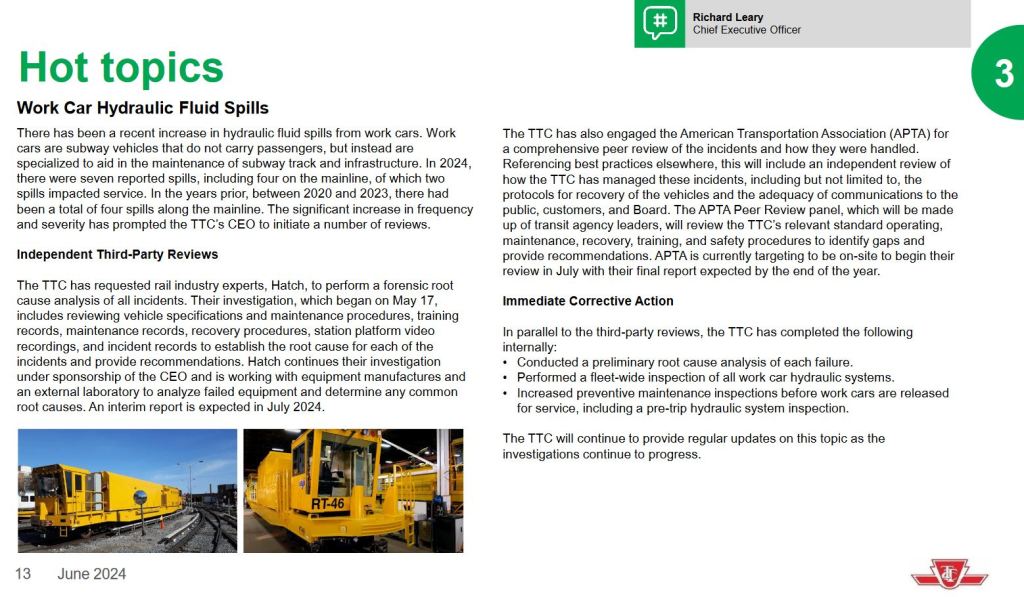
Updated: There is a one-page status update in the June 20, 2024 Board Meeting agenda in the CEO’s Report.

Work car condition and availability are key to the large off-hours program of infrastructure renewal. Many of these cars are specialized for their tasks and, unlike the passenger fleet, cannot be substituted for each other. The variety is shown in the chart below which was part of a TTC presentation at the May 2024 board meeting.

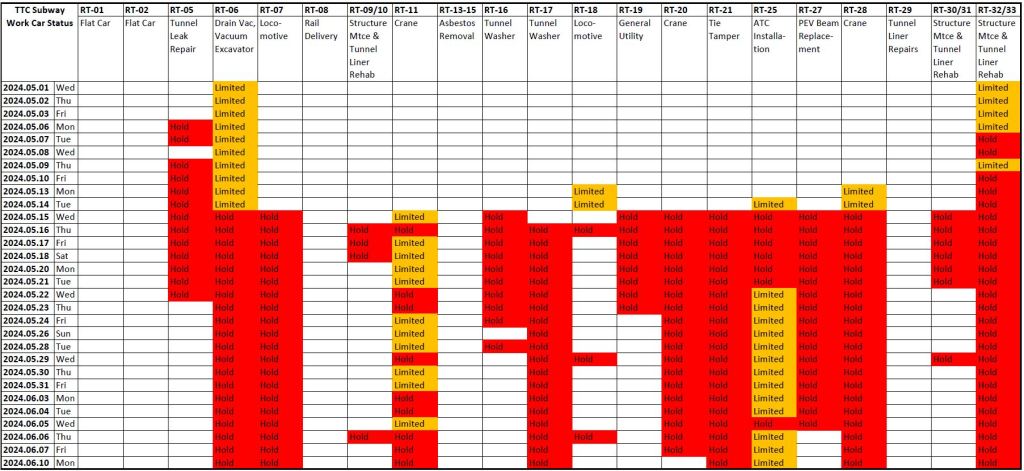
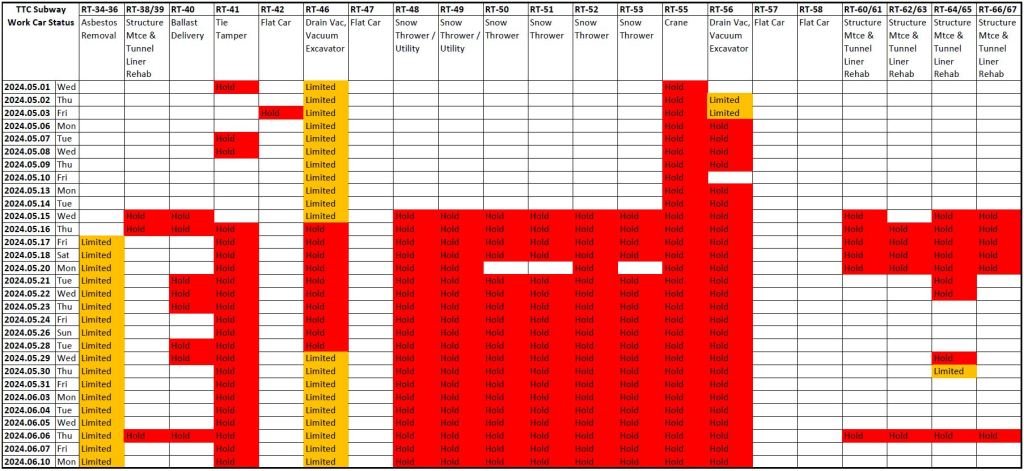
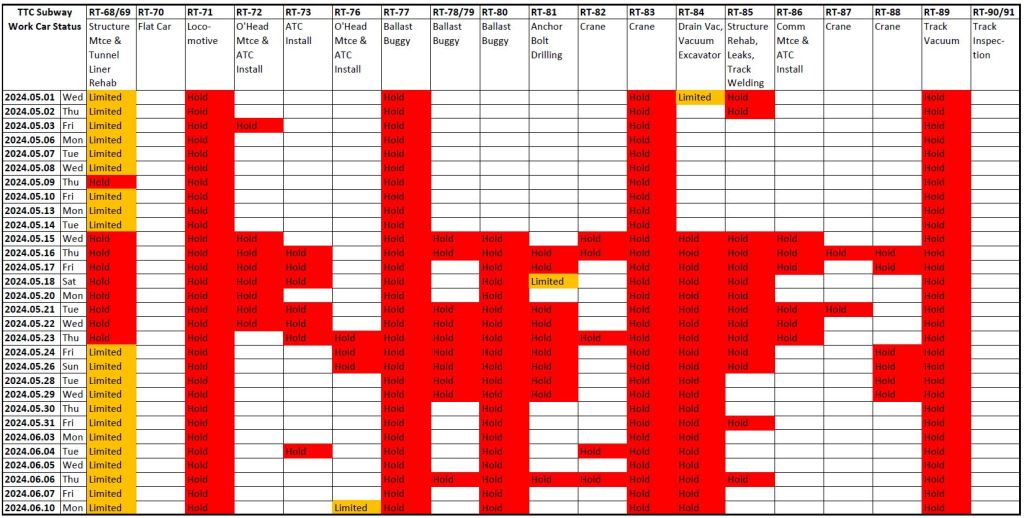
Immediately after the hydraulic fluid leak on May 13, much of the fleet was put through an inspection to determine how prevalent leaks and similar problems might be. Until they were deemed fit, cars that could have such problems were out of service. The sudden change in availability is shown in the charts below.

The red cells indicate that a car was held out of service either for repairs, or awaiting inspection. The amber cells indicate a car that can be used with some restrictions depending on the fault. On Wednesday, May 15, two days after the Line 2 shutdown, much of the fleet was put on hold for inspection with cars gradually returning. Details about individual cars follow later in the article.

This information is taken from daily reports of the work fleet’s status. Note that some days, mainly on weekends, are missing. Each page below covers the six-week interval for a group of cars.

Of particular concern are the two tie-tampers, RT-21 and RT-41 which are crucial for some major rail work. Both have been out of service since mid-May, and projects are rescheduled to work around the availability of needed cars.

There is a direct link between the availability of work cars and the TTC’s ability to keep up with ongoing maintenance, let alone to address a backlog. Scrimping on the budget for maintenance vehicles might solve a short term budget problem, but it exposes the system to disrepair through just getting by with available resources.

Continue reading

TTC Updates and Extends Spadina 510 Bus Replacement

Updated June 13, 2024 at 8:00 am: A table comparing scheduled service levels on Queens Quay has been added.

Updated June 13, 2024 at 2:00 pm: A table comparing scheduled service levels on the 510 streetcar with proposed bus service has been added.

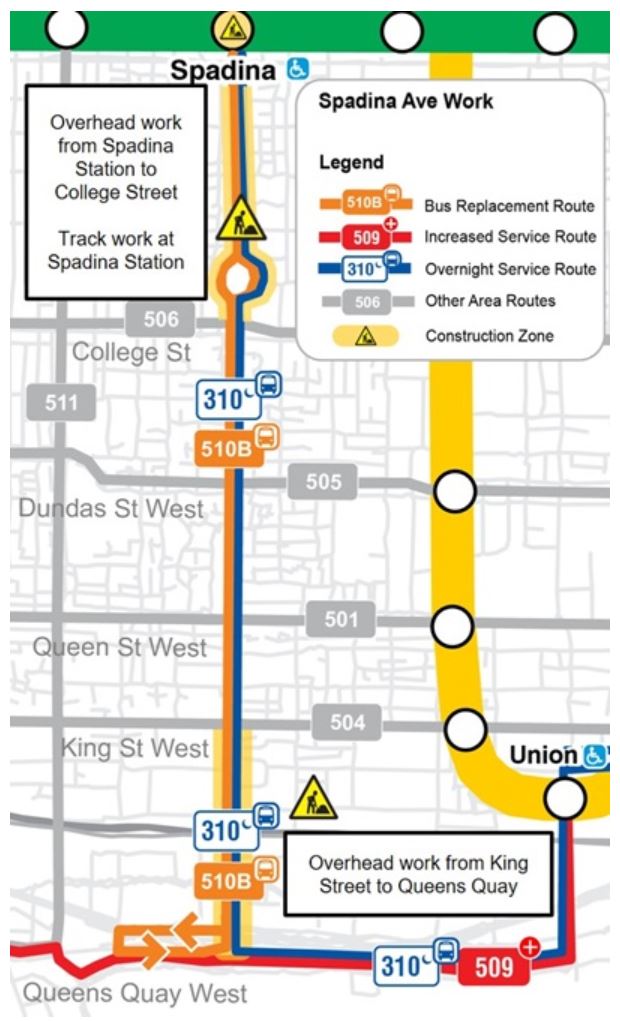
In April, I reported TTC plans to replace 510 Spadina Streetcars with buses from June 23 through the summer and fall. The TTC has now updated the announcement and extended the program from October into December. Here are the April (left) and June (right) versions of the maps for comparison.

The TTC’s construction notices can be found here:

The scope of work includes:

  • Track reconstruction at Spadina Station
  • Enabling works for Spadina Station Loop expansion. Condo construction east of the station will expose part of its structure, and the TTC will make provision for extending the streetcar loading platform.
  • Overhead reconstruction from Spadina Station to College Street, and from King to Queens Quay.

There is no information about the segment from College to King which was omitted due to resource limitations according to the TTC. It is unclear whether there will be another shutdown in 2025 to finish the work. I await clarification on that issue from the TTC.

Buses will operate in mixed traffic, not on the streetcar right-of-way. According to the Transit Notice:

  • The City will be deploying traffic wardens to assist bus operations on Spadina Avenue.
  • Narrow lane width and centre overhead poles in certain sections preclude bus service on the streetcar right-of-way.
  • Overhead crews will be actively working in the right-of-way in different sections of Spadina Avenue.
  • Operating in both the streetcar right-of-way and in mixed traffic lanes would require new signals and
    limit any travel time benefits.

Some of this does not entirely make sense. There are centre overhead poles only south of Front Street. No work is planned between College and King. It is not clear that completely new signals would be needed for buses to shift between the streetcar right-of-way and curb lanes, especially at College and at King where there are already priority signals for streetcar turns northbound and southbound. Some reprogramming would be necessary.

As for traffic wardens, they will be little use on lower Spadina where traffic is regularly backed up from the Gardiner Expressway. I would not be surprised to see many buses short turn at Adelaide rather than attempting the trip south to Queens Quay.

Service on 509 Harbourfront will be improved, but the details have not yet been published.

I will update this article as more information is available.

Comparison of Service Levels on Queens Quay

The table below shows the existing scheduled service on Queens Quay until June 22 with the 509 Harbourfront and 510 Spadina cars, and from June 23 with the revised 509 service. It is quite clear that there will be less service on Queens Quay from June 23 onward.

The values shown below are headways in minutes and seconds, and vehicles/hour e.g. “10′ (6)”.

509 Harbourfront to June 22510 Spadina to June 22Combined 509/510 to June 22509 Harbourfront effective June 23Percent Change
Weekdays
AM Peak7’15” (8.4)10′ (6)4’10” (14.4)6′ (10)-31%
Midday9’30” (6.3)10′ (6)4’53” (12.3)7′ (8.6)-30%
PM Peak9’30” (6.3)10′ (6)4’53” (12.3)6′ (10)-19%
Early Evening9’15” (6.5)10′ (6)4’48” (12.5)7′ (8.6)-31%
Late Evening10′ (6)9’30” (6.3)4’53” (12.3)8′ (7.5)-31%
Saturdays
Early Morning8’30” (7.1)9’30” (6.3)4’49” (13.4)8’30” (7.1)-47%
Late Morning9’15″(6.5)8’30” (7.1)4.25 (13.6)7′ (8.6)-37%
Afternoon8’15” (7.3)7’45” (7.7)4′ (15)4′ (15)Nil
Early Evening9’15” (6.5)5’15” (11.4)3’21” (17.9)7′ (8.6)-52%
Late Evening10′ (6)9’30” (6.3)4’53” (12.3)8′ (7.5)-39%
Sundays
Early Morning15′ (4)15′ (4)7’30” (8)10′ (6)-25%
Late Morning8’45” (6.9)9’45” (6.2)4’35” (13.1)7’30” (8)-39%
Afternoon8’15” (7.3)9′ (6.7)4’17” (14)5′ (12)-14%
Early Evening9’15” (6.5)6’15” (9.6)3’44” (16.1)7′ (8.6)-46%
Late Evening10′ (6)9’30” (6.3)4’53” (12.3)8′ (7.5)-39%

Comparison of Service Levels on Spadina

The table below compares the existing streetcar service on 510 Spadina between Spadina Station and Queens Quay with the proposed level of bus service. Note that streetcars carry two to three times the load of a standard bus. Values are shown in minutes and seconds, with vehicles per hour in brackets.

510 Spadina to June 22510B Spadina Bus effective June 23
Weekdays
AM Peak5′ (12)3’45” (16)
Midday5′ (12)3’30” (17.1)
PM Peak5′ (12)2’30” (24)
Early Evening5′ (12)3’30” (17.1)
Late Evening9’30” (6.3)6′ (10)
Saturdays
Early Morning9’30” (6.3)9′ (6.7)
Late Morning4’15” (14.1)2’45” (21.8)
Afternoon3’52” (15.5)2’45” (21.8)
Early Evening5’15” (11.4)4′ (15)
Late Evening9’30” (6.3)5′ (12)
Sundays
Early Morning15′ (4)9′ (6.7)
Late Morning4’53” (12.3)3′ (20)
Afternoon4’30” (13.3)3′ (20)
Early Evening6’15” (9.6)4′ (15)
Late Evening9’30” (6.3)6′ (10)

Josh Colle Returning to TTC

TTC CEO Rick Leary has announced that former Councillor and TTC Chair Josh Colle will return to the TTC in the position of Chief Strategy and Customer Officer effective July 15. He has several years of consulting work for various transit agencies in Canada and the US in a variety of roles.

Colle will come into a difficult position where the TTC faces much more serious problems than his term as chair ending in late 2018. There are severe challenges with ridership, service attractiveness, budget, operations, maintenance and capital funding. The City’s hopes for a strong TTC role in attracting travel from cars onto greener modes, notably transit, are not supported with funding and service beyond a stand-pat level.

Within the TTC there are issues in the management ranks, although “Strategy and Customer Service” is not first among them. Better and more reliable service sound like they should be customer service priorities. Without staff to drive and maintain vehicles, a reliable fleet and infrastructure, and an ethos that looks first within the TTC to solve problems, all the strategy and smiling faces will not get people on transit.

The TTC faces a severe backlog of maintenance and quality control problems that have been downplayed or hidden for some time. A near-miss subway incident, deteriorating track, the Scarborough RT derailment are only part of what is seen publicly. There are unseen issues such as subway work car reliability that contribute to infrastructure issues and recently an all-day shutdown of Line 2. Work is deferred for want of appropriate equipment. On the streetcar system, problems with track are “solved” with slow orders as streetcars tiptoe through problem areas, and we know from the Auditor General’s report that overhead maintenance planning and record-keeping leaves much to be desired.

We do not know if the passenger fleet condition — subway trains, streetcars and buses — constrains the amount of service that might operate. All three modes have considerably more spare vehicles than needed for routine maintenance, and this allows the less reliable ones to be set aside, a particular problem with the bus fleet. In theory, the TTC could run better service, but they do not have the budget to operate it, and we do not know if all of those spare vehicles could actually run if they were needed.

Hundreds of new hybrid and battery buses, plus 60 more streetcars are on their way. The TTC trumpets its green fleet initiatives, but is silent about vehicle reliability and durability. The recently published Five Year Plan foresees only modest growth with the system still running below pre-pandemic levels in 2028.

All of this leaves Josh Colle sitting in an organization he does not control. If he is truly going to handle “strategy” at more than a superficial level, the TTC must take the need for renewal and transparency to heart. Whether the current crop of managers can or will do this is quite another matter.

TTC Draft Financial Results for 2023

The TTC’s Audit & Risk Management Committee met on June 5, 2024 with a lengthy agenda. This article includes comments on:

For the financial statements, I have attempted to explain the difference in presentation under the Public Sector Accounting Standards the TTC uses and the more familiar annual budget. The standards require the capital and operating streams to be consolidated including showing assets such as vehicles and infrastructure on the balance sheet. This arrangement swamps the operating results with the much larger capital values even though TTC’s assets are almost entirely funded by subsidies, and they do not represent a value which can be used offset operating costs.

There is a new provision in the capital accounts this year for the disposal cost of assets. This recognizes the future cost of removal and remediation including environmental exposures.

Covid relief has been shown in the statements to distinguish revenues and costs specific to the pandemic, but future budgets and financial reports will no longer do this because the special provincial and federal subsidies ended in 2022.

There was a $38 million operating surplus in 2023 due to unused provision for opening of Lines 5 and 6, offset by extra costs to operate the SRT replacement service sooner than planned.

I have included tables from the financial statement notes showing the breakdown of various subsidies as this area is poorly understood. Provincial gas tax comes to the City and portion of this is allocated to TTC operations with the remainder going to capital. Federal gas tax, now renamed the Canada Community-Based Fund, goes entirely to the capital program.

The TTC accounts do not include provincial projects such as the Ontario Line, nor the City’s SmartTrack program which is implemented by Metrolinx with funding from various sources notably Toronto’s City Building Fund.

The Draft Annual Report does not contain much at this point, but will eventually include the approved financial statements. It is the usual collection of pretty pictures and good news stories sure to warm the hearts of TTC Board members who don’t look beyond the surface.

The report contains a 10-year summary of key system statistics which I have included in the article as well as percentage changes in various factors over time. One item of note is the growth in staffing over ten years to operate roughly the same amount of service. Part of this due to changes in system scope (a larger subway system) and the pandemic-era problem that the staff needed to support fleet and infrastructure does not decline even though there are fewer riders.

The bus fleet today is also larger than in 2014. This does not reflect increased service, but rather a higher proportion of buses idle as maintenance spares. The Annual report includes different claims about the fleet size and overstates the number of green buses the TTC actually owns. I have asked the TTC for clarification of these numbers, but they have not replied.

The TTC is taking delivery of hundreds of new buses through 2024-25 that will replace older inactive vehicles, but there is no budget plan to fund operation of more service. The report crows about the greening of the fleet while neglecting to address how it will be operated.

Continue reading

Moving Forward With Transit

Just before midnight on June 6, the Toronto Transit Commission and the Amalgamated Transit Union Local 113 announced that they had a tentative agreement for a new three-year contract. Further work continued beyond the midnight deadline to reach a proposal the union executive could support.

No information has been released, and the deal is described as a “framework” with details to be finalized before the package goes to union members and the TTC Board for ratification. However, both union leadership and TTC management sound hopeful for a settlement.

This was not the situation only days earlier when Local 113 stated that there was little progress on major issues, notably job security, and transit riders braced for a possible strike.

By comparison with previous TTC labour negotiations, this round did not spill over into public rounds of finger-pointing. At the political level, pressure was not overt, although behind the scenes guidance must have affected bargaining. This bodes well for a less contentious relationship than would exist with polarizing, blowhard media statements that can undermine whatever trust might exist between negotiators.

On CBC’s Metro Morning, Local 113 President Marvin Alfred noted a shift in TTC negotiating posture to remove management conditions attached to some union proposals that would have limited their benefit. This led to a tentative agreement. What triggered this change is not public, but that was key to unlocking the negotiations.

Assuming that the framework evolves quickly into an approved contract, the focus now must turn to the future of transit in Toronto. The TTC faces major financial problems, but lurking behind these are issues with service quality, maintenance and TTC management culture.

On the financial side, common discussions focus on the Capital budget including the backlog of “state of good repair” funding, notably for a new Line 2 fleet of trains. However, the more pressing challenge lies with the Operating budget that is funded primarily by the City of Toronto and fares. Through the pandemic, special federal and provincial funding allowed service to remain frequent, but this revenue has ended. Any policy to maintain, let alone improve service falls to the City and to riders.

The options are not fully understood, but with 2025 budget planning now underway, it is vital that any debate be well-informed. For many years, the TTC budget landed with a thud on the Board’s public agenda in December or January with all significant decisions about funding, service and maintenance solidly baked in. After the annual charade of public consultation, Board and Council tweaks, the budget sailed through. At best, one might see requests for options going into the the next year’s process.

TTC has been without a Budget Committee of any significance for years. Now is the time to create one and to ensure that it actually meets for substantive debate. There must be open discussion of options. The TTC’s Five Year Service Plan includes some costed proposals, but other issues such as fare structure, service quality and reliability need review at the same time. The Board has a bad habit of cherry-picking items for debate in isolation from the larger context.

Major issues for the union are wages, understandably, and job security. On the wage side, the recently published TTC 2023 draft annual report includes a table showing the hourly cost of wages and benefits from 2014 to 2023. Over that period, this value rose from $49.01 to $61.67, a ten-year increase of almost 26%. Individual annual changes varied considerably with some years seeing values well under 2%.

From a system cost point of view, the wage and benefit rate does not tell the whole story because the combined effect of traffic congestion and more generous terminal recovery times in schedules push down the amount of service delivered per vehicle hour. Putting it simply, if the average speed of buses goes down by 1%, then 1% more vehicle hours are needed just to maintain the same service. Unless there are offsetting service cuts, this adds to service costs beyond the basic hourly rates and benefits. Management can claim an improvement in service operated, measured in hours, while scheduled frequency and capacity can actually decline.

Job security is also important because of creeping outsourcing of work from formerly union jobs to outside contractors. This began with some of the simpler tasks such as bus cleaning, but more recently regional service integration schemes raise the question of which transit operators (and their respective staff) will provide service in Toronto. Current proposals involve minor parts of the system, but the clear intent is to shift TTC costs to other providers.

Service quality is a big issue for riders, and this is an area where both management and the union must co-operate for improvement. There is a need for honesty in reporting about crowding levels and reliability about which I have written many times before. Management cites all-day averages and uses a measure of reliability that does not reflect real-world rider experience. Crowding is directly related because bunching produces uneven vehicle loads with most riders on crowded buses. Management must accept the need to manage service and report on its actual quality. “On time” performance metrics disguise actual quality problems including vehicles running in groups for extended periods.

Options for increasing service must recognize the large pool of spare trains, buses and streetcars available to provide more frequent service today. “We don’t have enough resources” is a common response to calls for better service, and years ago this applied to vehicles and garage space. Today it applies mainly to budget constraints, not physical fleet and infrastructure. Toronto might not be able to afford to run all of the vehicles it owns, but that decision should be made openly recognizing implications for the attractiveness and future growth of the transit option.

Maintenance is a big issue both for the fleet and infrastructure. This affects both reliability and safety. Many factors are at work including budget limits and an extended period when the TTC did not have to field full service during the pandemic. Some maintenance can be put off for a short term, in a pinch, but when the new, lower quality becomes normal, climbing back to a once-demanded level can be hard. An organization can forget its standards, or adjust them to fit available funding and hope for the best.

There is no question that system inspection and maintenance are not keeping up with current conditions as we have seen in reviews of the Scarborough RT, subway track and streetcar overhead areas. What we do not know is how pervasive these issues are in other parts of the transit system, nor what other problems will threaten rider confidence in the TTC’s ability to provide safe, dependable service.

Finally, there is the long-standing matter of TTC culture. It is no secret that the top-down management style has hurt the organization, cost the system in lost expertise and corporate memory, and fostered a climate where appearance of success takes priority. TTC messaging overstates the progress in post-pandemic service recovery without acknowledging the decline in service riders actually experience. Maintenance problems are hidden until events force them into the open.

The Board, after years of ceding power to management, must now shift to a more hands-on role if only to ensure that the City and transit riders are not blind-sided, that key issues are not downplayed. This could work against a political incentive to get “back on track” and report good news as soon and as often as possible. The Board needs management it can trust, but also the political support to be open and honest about what the transit system needs.

With labour issues more-or-less settled, Toronto must turn to rebuilding and expanding its transit system. Speeches and plans about improvements are worthless without honesty, transparency, funding and sustained commitment. Plans for subway lines in the 2030s make for good press, at least among those who only look for the photos ops, but they don’t carry riders today, let alone address issues with changing travel demands where suburban travel is as important as trips downtown.

Does Toronto really want better transit?