Harbourfront Overhead Reconstruction

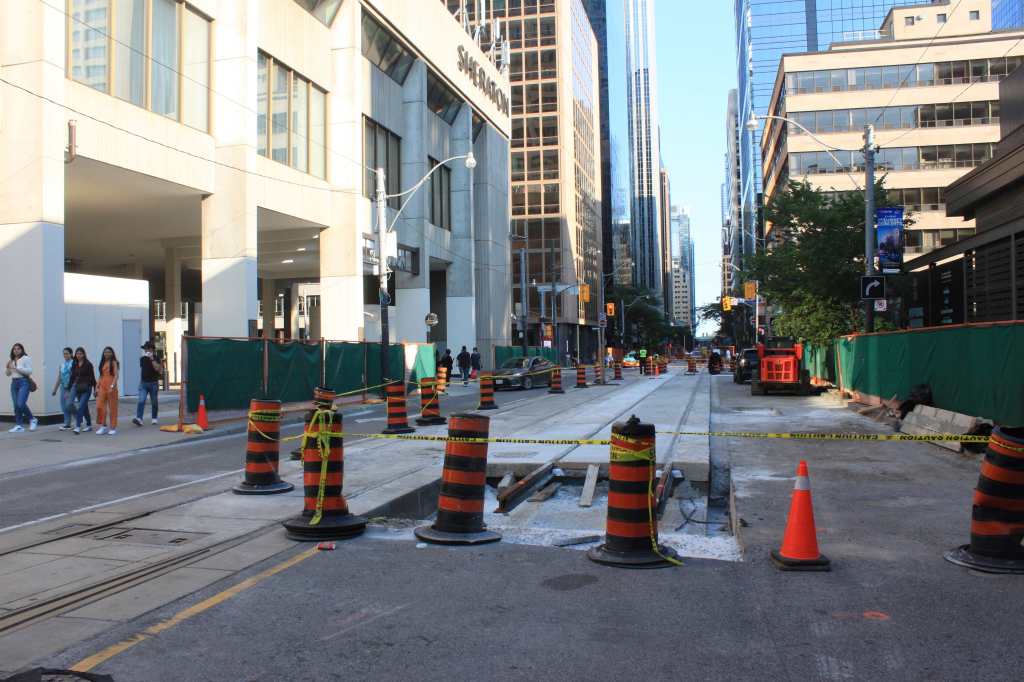
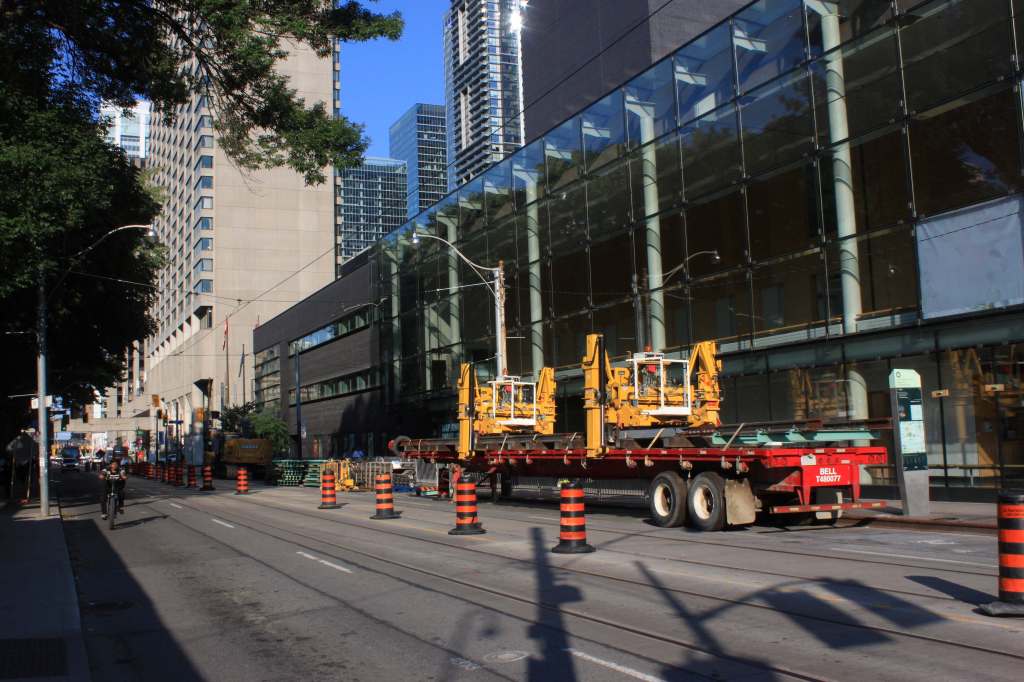
The TTC has announced that streetcar service will be suspended, in part, over the 509 Harbourfront and part of 511 Bathurst at various times between Tuesday, September 3 and January 2025. This will allow the reconstruction and upgrading of the overhead system between Union Station and Exhibition Loop to be fully pantograph-compliant.

Information is posted in three separate items on the TTC site with the first being the most extensive.

The work will be done in three stages:

  • Stage 1: September-Early October 2024
    • Overhead work will concentrate on the area from Spadina eastward.
    • 509 Harbourfront cars will be replaced by buses between Union Station and Exhibition.
    • Buses will use the streetcar right-of-way eastbound between Spadina and York, stopping at the curb at other locations, and at all stops westbound.
    • At Queens Quay Station, buses will serve the existing surface stops used by other routes.
    • At Union Station, buses will drop off on the southeast corner of Front & Bay, and pick up on Bay south of Front.
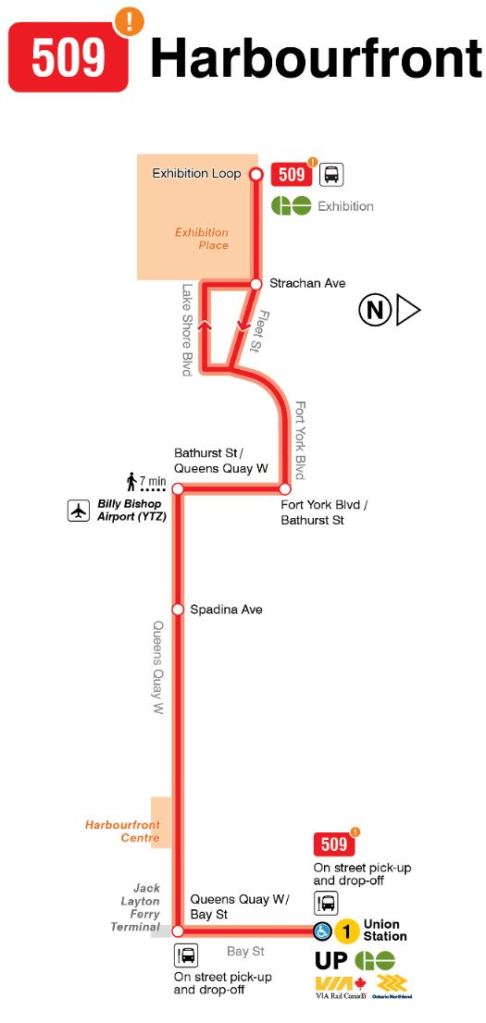
  • Stage 2: Early October to Late November 2024
    • Work will shift to the section between Spadina and Bathurst.
    • 509 Harbourfront streetcars will operate between Union Station and Spadina.
    • 510 Spadina buses will be extended west to Exhibition Place.
  • Stage 3: Late November 2024 to January 2025
    • Work will move to the section west of Bathurst.
    • 509 Harbourfront streetcars will continue to operate between Union Station and Spadina.
    • 510 Spadina buses will continue to run to the Exhibition.
    • 511 Bathurst streetcars will operate to Union Station instead of to the Exhibition.

In theory, based on the planned end date for work on 510 Spadina, everything should be back to normal just after New Year’s.

Greenwashing the TTC

The TTC seeks feedback on its Innovation and Sustainability Strategy. As I write this, the announcement has been posted on X/Twitter, but not on the main TTC page. Instead, it is well hidden, like so much on the TTC site, among many items on the “Riding the TTC” page under “Green Initiatives”. There is a link from the survey’s introductory page, but this is only available when launching the survey, not afterward. Within the Green Initiatives page is a link to the TTC’s 2024-2028 Draft Innovation and Sustainability Strategy, a 50-page document that puts the survey in a wider context, but which most readers are unlikely to access, let alone read.

The survey contains three sections addressing various aspects of a TTC strategy:

  • An “innovation pipeline”
  • Prioritizing climate actions
  • A culture of innovation and sustainability

Reading through the Draft Strategy, the overwhelming impression is of the creation of a bureaucracy within the TTC, not to mention a pervasive presence of an Innovation and Sustainability czar. Much of their work would focus on internal changes, only some of which actually address climate effects. This is not to say that innovation per se is a bad thing, but it is not defined. Moreover, it has been bundled with schemes to green the TTC that are really a separate project.

Continue reading

510 Spadina: Buses vs Streetcars Jan-July 2024

In a previous article, I reviewed travel times for the bus and streetcar operations on 510 Spadina Avenue at the north and south ends of the route where severe traffic congestion made bus operation extremely difficult. The north end problem resolved itself first with a diversion, then at least partly with completion of construction on Bloor Street, but the south end required a reserved bus lane to bypass the traffic queue for the Gardiner Expressway on ramp.

With all the attention on these areas, a separate factor is often overlooked in comparing the services: when and where there is little or no congestion, the buses are faster than the streetcars in spite of the “transit priority” treatment with dedicated lanes. The problem lies in a combination of different stopping patterns, traffic signals that do not favour streetcars, and operational practices requiring streetcars to creep through intersections.

This is the daily experience of regular riders on Spadina, and it is a “dirty little secret” that factors conspire to undermine the quality and speed of streetcar service. This is both a City and TTC problem because responsibility for road design and streetcar operations rest with the two organizations.

Updated August 11 at 2:20 pm: Charts have been added at the end comparing streetcar travel times over the central portion of the Spadina route in September 2014 and May 2024. The differences reflect both loading times, acceleration and operating practices of the former CLRVs compared to the current Flexitys,

Continue reading

Analysis of 510 Spadina Bus: July 2024

In a previous article, I reviewed the transition from streetcar to bus operation on 510 Spadina in mid-June. Since then, the route saw other changes:

The reserved lane has greatly reduced delays at the south end of the route, albeit at the expense of road capacity.

This article presents travel times over various segments of Spadina from Bloor Street to Queens Quay during July 2024 to show the effect of the changing route configuration.

A key factor evident in the tracking data is that congestion occurs outside of the peak periods, and not necessarily in the same way each day. It can be tempting to cherry pick the afternoon peak as a worst case target, but that does not solve all problems. The extent of congestion also varies, and transit priority must be on a sufficient scale to deal with the bad days, not simply to improve conditions a bit over a short distance.

What is quite clear is that the City and TTC reaction to congestion problems gave the impression of surprise rather than preparedness, and that weeks of delays for riders could have been avoided or at least reduced in severity at both ends of the route.

Continue reading

TTC Annual Service Plan 2025

The TTC has released the first draft of their 2025 Annual Service Plan for comment on their site. Readers with suggestions should use the TTC’s survey for input to the plan.

Updated August 9 at 5:20pm: The TTC has supplied new versions of maps for routes 49 and 405, as well as for the Etobicoke Blue Night service change proposals. On their behalf, thanks to readers who have flagged issues on the original versions.

The consultation looks at three areas of TTC service:

  • Proposed 2025 Changes
  • The One Fare Program
  • Community Bus Routes (4xx series)

There will also be pop-up consultations at various locations around the city.

DateTimeLocationRoutes
Aug 74:30 to 6:00 amBus ride-along395, 385 and other affected night routes
Aug 76:00 to 8:00 amKennedy Stn334
Aug 76:30 to 8:00 amRouge Hill GO385
Aug 9Noon to 2:30 pmDufferin Mall402
Aug 129:30 am to NoonNorth Park Plaza400
Aug 134:30 to 6:00 amBus ride-along337
Aug 136:00 to 8:00 amKiping Station45, 49, 337 and other affected night routes
Aug 1412:30 to 2:30 pmBus ride-along13B
Aug 19Noon to 2:00 pmCoxwell Station22, 70 and 404
Aug 19Noon to 2:00 pmMain Station87A

In a recent Stakeholders’ session which I attended, it became clear that some of the 2024 ASP proposals that had not yet shown up in service would be coming in fall 2024. I asked the TTC for details of the outstanding 2024 proposals, and this information is in a table at the end of the article.

A further problem is that the substantial changes already planned for the Line 5 and 6 openings cannot be implemented until Metrolinx actually begins service there.

One key item that is not addressed by this round of consultation is the matter of service frequency. Most of the routes TTC proposes to modify suffer from infrequent service, and the benefit of the route changes will be muted by the absence of buses as opposed to lines on the map.

Continue reading

Streetcar Stop Spacing

A recent X/Twitter thread began with a claim that the streetcar system suffers from slow operation because of closely spaced stops, specifically below 100 metres. I made a short reply showing the average spacing for each route, but have now generated charts showing all routes in detail.

There are only a handful of stops spaced closer to or below 100m, and so the claim that this is a source of much delay is easily disproved. The question then is what the typical spacings are, why, and how much “efficiency” could be obtained by eliminating some of them. I do not attempt to answer that question here, but simply present the actual stop spacing data so that there can be informed debate.

The TTC’s design goals for stops are set out in the Service Standards:

2.4 Surface Stop Spacing
Surface stops should be designed in accordance with the TTC’s Technical Criteria for the Placement of Transit Stops. When the locations of stops are being planned for a route, it is necessary to strike a balance between the competing objectives of passenger convenience, operating efficiency, safety and community impacts. In general, increasing the number of stops on a route results in shorter walking distances for passengers but it also slows down service. To achieve a proper balance, the TTC will place bus stops in accordance with the standard presented in Table 2 [below].

Service ClassificationStop Spacing Range
Streetcar300 – 400 metres
Bus – Local300 – 400 metres
Bus – Express (Tier 1)650 – 1,000 metres
Bus – Express (Tier 2, Limited Stop)650 – 1,000 metres
Bus – Express (Tier 2, Local/Express)650m for express portion;
300 – 400m for local portion
Bus – CommunityFlag stop

It’s important to remember that Toronto streets are not laid out on a repeating grid as in some cities, and one cannot simply stop at “every second street”, or whatever layout works. Existing pedestrian circulation patterns, transfer points, major origins/destinations all play a role in defining a “good” stop location. This is even more of a problem in suburban areas with longer blocks and poor opportunities to access transit stop from “nearby” (as the crow flies) neighbourhoods.

Methodology

The stop distances for each route have been taken from the GTFS versions of the schedules published regularly by the TTC. These are used by trip prediction and planning apps to understand the layout of the system. In a few cases where current operations do not match the historic route layout (e.g. 501 Queen, 504 King, 512 St. Clair), I have used older data sources from a period when routes operated normally.

Continue reading

GTA Transit Summit

I rarely post adverts on this site, but as I will be sitting on one of the panels at this event, here goes. The text below was supplied by the Transit Summit’s organizer.

GTHA Transit Summit: Riding Towards a Sustainable Future

Hosted by Transport Futures in partnership with TMU’s Ted Rogers School of Management (TRSM) and Urban Analytics Institute

September 4, 2024 : TRSM Commons Conference Hall, 55 Dundas Street West, 7th Floor, Toronto

Transit in the Greater Toronto and Hamilton Area is at a crossroads. On the surface, fluctuating ridership and revenue has resulted from COVID lockdowns as well as work-from-home, auto-dependency and safety issues. But there are also numerous capital and operational challenges that must be corrected: politics and governance, leadership and accountability, finance and procurement, maintenance and technology, human resources and customer service, land development and mobility management – to name a few. Please join me as well as 20 other speakers and 100 delegates as we examine transit?s many benefits and then make strategic recommendations so the future of bus, LRT, subway and rail travel is brighter than its recent past.

Check out the GTHA Transit Summit website for further details. SteveMunro.ca subscribers receive a 10% discount : use promo code SMTF8 when registering. Seating is limited and early bird rates end on August 8.

I will be speaking as part of the wrap-up panel reflecting on the day’s discussions and the perennial question: “where do we go from here?”

TTC Board Meeting: July 17, 2024

The July 17 Board meeting was extraordinarily long thanks to three in camera items, plus extended discussions of the CEO’s Report and of use of buses as homeless shelters during the winter.

The confidential session dealt with:

  • A collective bargaining update for two small groups of customer service and operations supervisor employees.
  • An update on advice from External Counsel. On a recorded vote, this was adopted with all Board members except Councillor Saxe in favour. As of the publication of this article (July 28), there have been no leaks about the subject of this report.
  • An update on the fare modernization program including the status of the Presto contract. The report was also discussed briefly in the public session later in the meeting.

The public meeting included:

  • The July 16 storm, flooding and hardening of infrastructure against climate change.
  • New subway trains and federal funding announced earlier the same day (July 17).
  • Prioritization of State of Good Repair projects. This item received scant attention although the report contains much interesting background on capital plans.
  • Safety on the TTC.
  • Use of shelter buses.
  • Transit network expansion update.
  • Fare Compliance Action Plan: See the updated version of my previous article on this report which includes the debate at the Board meeting.

Not discussed was the issue of hydraulic fluid leaks from subway work cars of which one quarter are still out of service. A report is supposed to be coming to the Board soon. It is not clear how much this situation is affecting the TTC’s ability to stay on top of track maintenance issues and the growing list of slow orders for track that cannot be safely operated at full speed.

Continue reading

Queen & York Update: July 28, 2024

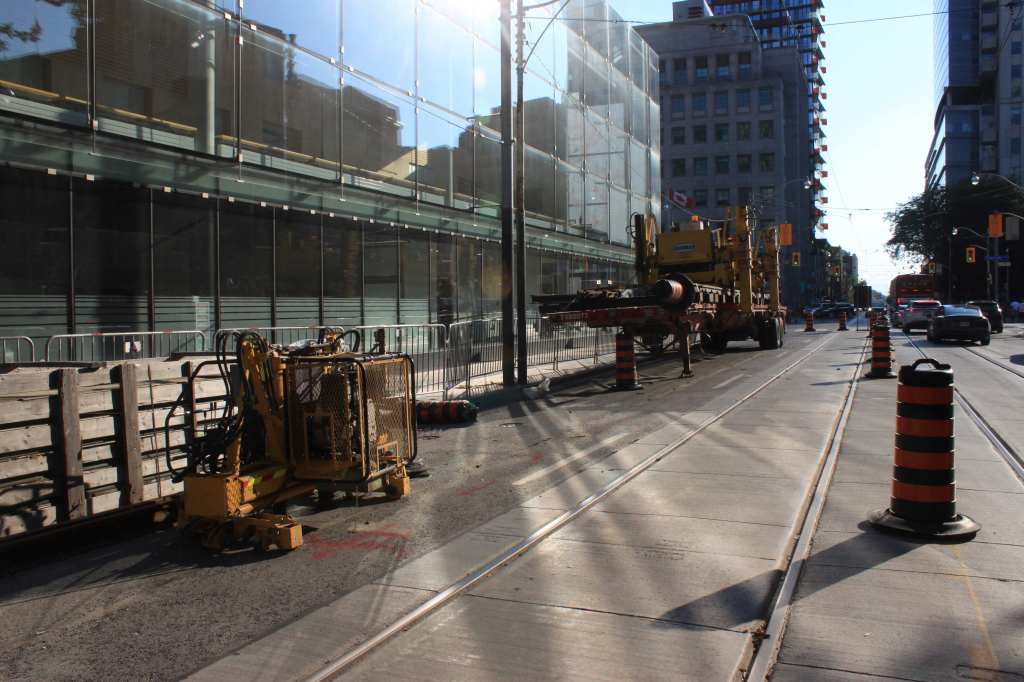
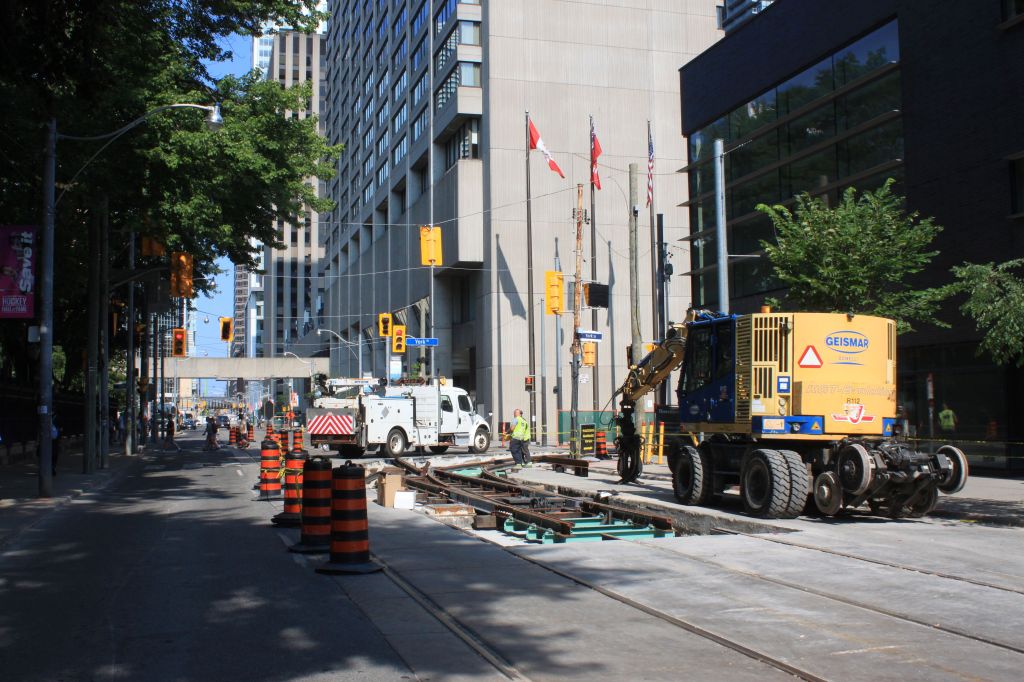
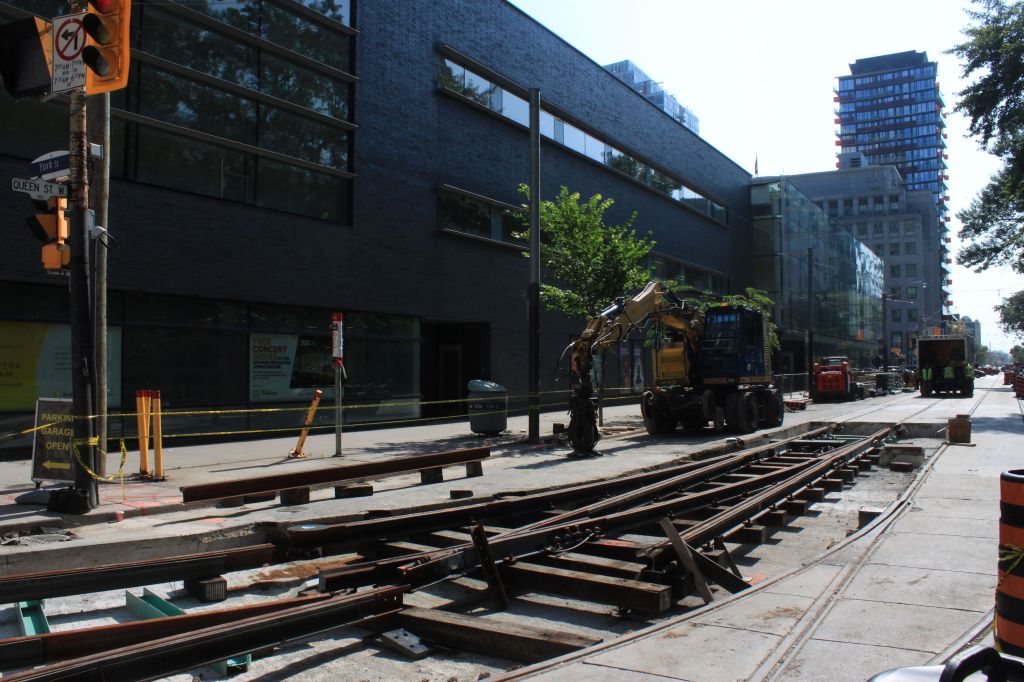
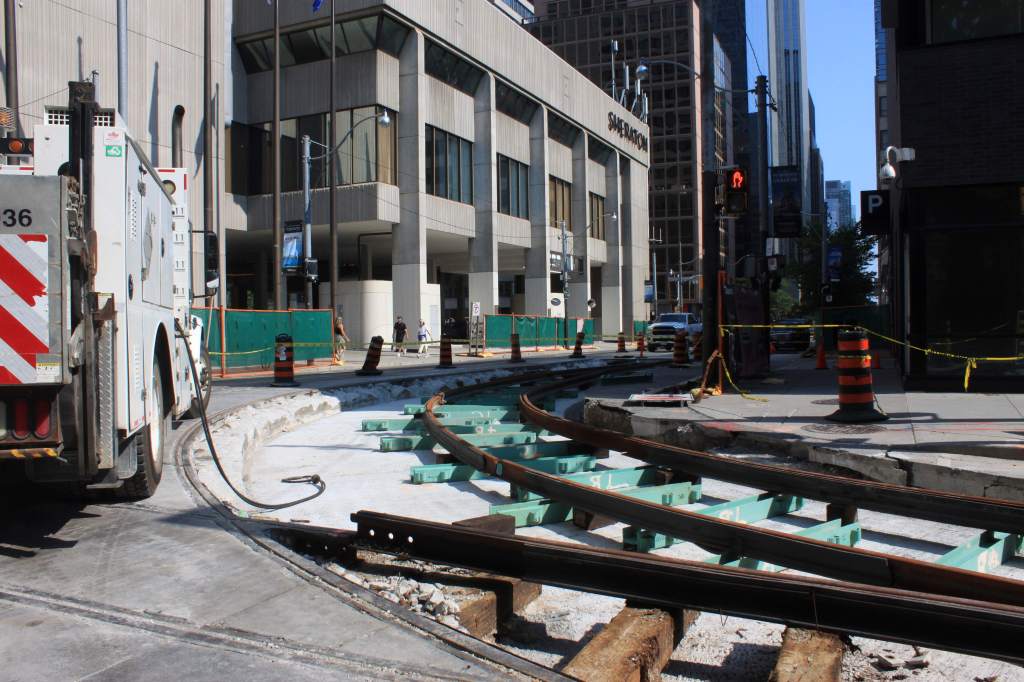
At long last, the new curve for a 501 Queen eastbound diversion via York Street south to Adelaide is being installed. Of course the entire diversion should have been operational before Metrolinx shut down Queen Street for the Ontario Line, but such careful planning is not what we expect from the agencies involved.

Indeed, the City took over the trackwork on Adelaide Street as part of other works in progress because Metrolinx was dragging its feet. Why they didn’t take the full project up to Queen & York is a mystery. With luck, the west and east ends of 501 Queen will be reunited before year-end 2024, but I am not making any bets.

Road and utility works for this project are contracted by the City and Metrolinx. Track installation is by the TTC.

Three weeks ago, on Sunday, July 7, the new switch was sitting at Queen and University ready for installation, but work on excavation and a new track foundation took some days afterward to begin.

Here is the state of installation as of Sunday, July 28.

TTC Service Changes: July 28, 2024

Only a few routes are changing at the end of July, although TTC has hinted that major service additions are coming in the fall. Given the state of the TTC’s budget, we will see in roughly a month just what that entails.

Rapid Transit Changes

2 Bloor-Danforth

Gap trains are removed from the weekday schedule due to a shortage of operators. This eliminates two trains in the AM and PM peaks, and five trains through the early and late evening periods. Four midday gap trains remain.

Night Service Changes

504/304 King

Three mid-evening trips eastbound from Humber Loop are added to provide a better transition between the 504B King and 501 Queen services west of Roncesvalles. There is no change to the 501 Queen nor to the 507 Long Branch schedule.

Schedules for the 304 King Night Car will be adjusted for reliability. Cars will continue on their present 20′ headway, but some driving time has been converted to terminal layover time.

305 Dundas

All-night service will be provided on Dundas over the same route as the daytime 505 with cars on a 30′ headway.

306 Carlton

Because Dundas is now a 24 hour route, the 306 Carlton Night Car will operate to High Park Loop, and will continue on a 20′ headway. (Note that although this is generally advertised as a 20′ headway, it actually widens to 30′ after 3am.)

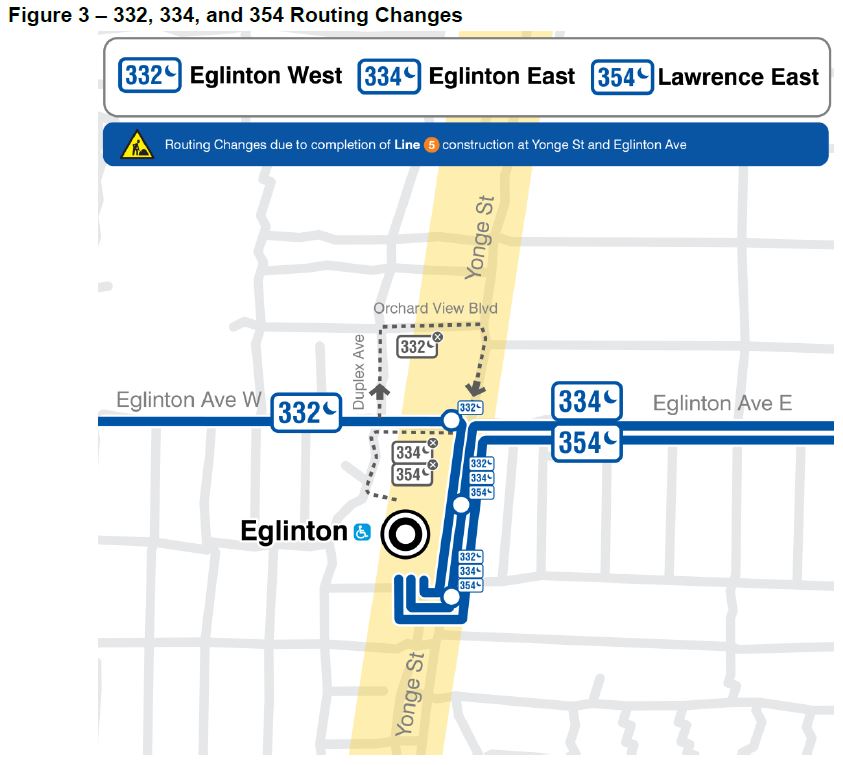
332 Eglinton West, 334 Eglinton East & 354 Lawrence East

These routes will be changed to enter Eglinton Station via Yonge and Berwick rather than via the western entrance at Duplex. Stops at the south entrance to the station and at Berwick to provide transfer connections between these routes.

363 Ossington

Buses will serve the stop at Strachan and Canniff to provide a transfer connection with 304 King, and to match the daytime service.

Bus Changes

36 Finch West

Additional trips will be added in the AM and PM peaks, and in weekday early evenings to provide more capacity on this route. These are factory trips deleted in error in the June schedule change.

114 Queens Quay East

The 114 Queens Quay East bus has been using Lake Shore Garage as its eastern terminal since early July. This change is now formally in the schedule.

Buses run out of service east of Carlaw, but serve the Logan, Lake Shore, Carlaw loop in both directions.

123 Sherway

A trip from Kipling Station on the 123D East Mall service will shift from 6:11 to 6:12am to even out departures.

203 High Park

The 203 High Park shuttle operated with a Wheel Trans bus will now run east to Keele Station which provides an accessible connection to the subway. Buses will loop through High Park Station enroute. The headway is changed from every 20 to every 30 minutes.

937 Islington Express

Stops added at Dundas and at Rathburn to provide transfers to 40 Junction and 48 Rathburn.

945 Kipling Express

Stops added at Burnhamthorpe and at Rathburn to provide transfers to 46 Martin Grove, 48 Rathburn and 50 Burnhamthorpe.

Continue reading