
In September, the TTC will launch public consultation on proposed changes to their Service Standards. Consultation on the 2027 Annual Network Plan is now underway.
The Service Standards are in a long document with many sections, and I am sure most members of the TTC Board have only a passing awareness of what it contains and how the standards work in practice. Given the timing of meetings and the coming municipal election, a revised set of standards will not come to the Board until the new year.
Other studies underway are the Ridership Growth Strategy (RGS), a review of the metrics used to monitor and report on the system, and a review of streetcar operations. These overlap in many ways, but given the siloed nature of TTC management are likely to come to the Board independently. This would not allow a consolidated review of goals and options for transit’s future together with current plans and the standards against which service is measured. This particularly important for any Ridership Growth Strategy which could be hamstrung by fiscal plans and approved standards that do not support meaningful growth.
See:
The public survey for the 2027 Annual Network Plan is now live until September 13. It deals with the following topics:
- Stop changes on express bus routes
- Routing changes to bus routes in the following areas:
- Morningside Heights
- Black Creek
- Dupont Corridor
- Sherway Gardens
- Islington South
Details of these proposals appear later in the article.
A future version of the plan will include proposals for dealing with major construction projects in 2027.
Ridership Growth and TransformTO
A discussion of the standards in isolation completely misses the question of what Toronto wants its transit system to achieve and any growth strategy to reach that goal. There is a TransformTO plan with ambitious goals for improving transit’s share of all travel, and it will require a very large investment in vehicles, facilities and operations to achieve this. That will not happen overnight, but there is no sense that this will be incorporated in a new RGS nor in standards reflecting a gradual buildup in service across the network.
By definition, any RGS will involve change to transit service because that, after all, is what the TTC is selling. This really will be a two-stage change. One is simply to admit and catalog the degree to which current service misses the target. A classic escape hatch built into any TTC policy is “subject to budget availability”, but we are never told what the shortfall is. TTC has not produced detailed reports of the shortfall between service quality and the existing standards since pre-pandemic days. The second stage, improving the standard, only makes sense if we will actually operate to that standard.
TransformTO in the 2026 Capital Budget:
The TTC to increase service frequency on all transit routes over 2016 levels by:
- 70% for bus
- 50% for streetcar
- Subway off-peak service increased to every three minutes
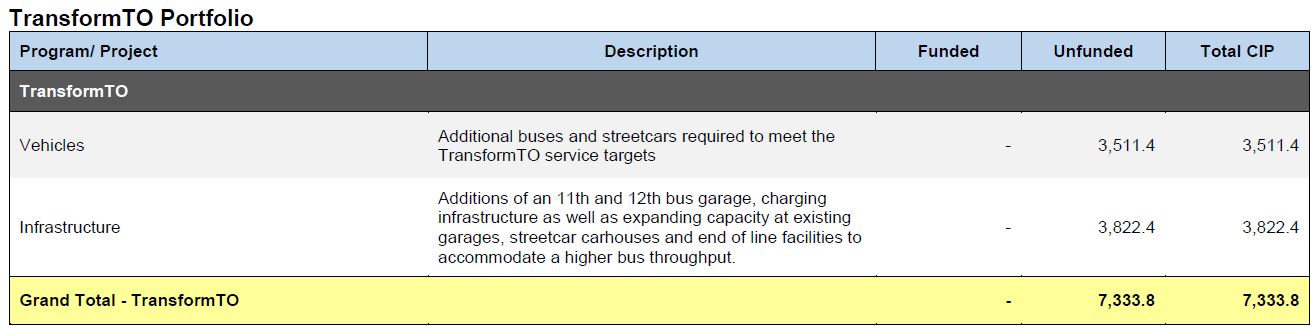
None of this is funded, nor is there a projection of future operating costs. The goal is 2040 but with no indication of how we get there.
Service Standards Review
We do not yet know what changes TTC will propose for the Service Standards, and I will leave a review of these until they surface. However, there is some sense of the scope from the page advising of the review.
The stated goals of the standards are:
- Maximize mobility: provide service in the right places, at the right times
- Efficient and cost effective: ensure that service is affordable to TTC customers and citizens
Note that there is no mention of encouraging additional ridership, nor of the unwritten desire that “cost effective” transit for citizens is code for “keeping taxes down”. This is particularly important now that farebox revenue only accounts for 40-50% of total income, down from 65-70% in years past. Recent City and TTC policies have favoured limiting or reducing fares, but without any discussion of attracting substantially more ridership through service quality. That approach works when there is surplus capacity, but hits a wall when buses are full and arrive unreliably.
The standards deal with five areas:
- Network design – how routes are designed and where they go
- Service quality – when service is provided and how frequent, crowded and reliable it is
- Performance targets – service productivity and effectiveness
- Service changes and warrants – how service is modified and when new services are introduced
- Service evaluation – how service is monitored and evaluated on an on-going basis
An ongoing problem is the metrics by which service quality is reported, and I have written about this before. Many Standards are based on overall averages, but that is not how riders experience service. There is no sense of variation in what riders actually experience. Measures of vehicle reliability and availability give no hint of whether these factors constrain service growth, and staffing headcount could also limit service expansion.
TTC can report that service meets standards, but they have enough of “wiggle room” to allow poor service from a rider’s point of view to get a gold star for management.
Most importantly, there is no detailed reporting of service improvements that might be justified by the standards or any growth plan, but which are not implemented thanks to budget constraints. Council can sound as pro-transit as it wants, but without funding, service remains at a “business as usual” level at best.
The goals of the 2026 review give some cause for hope if the Board and Council do not quash the more aspirational parts of transit planning:
- bring more transparency to how we plan, deliver, and monitor service delivery
- add and adjust standards or metrics to support service delivery and decision-making
- ensure the updated standards consider the perspectives and experiences of front-line staff
- better reflect and communicate customer’s day-to-day experiences in using transit
Consultations about a proposed review have already begun, and I have participated through the TTC’s Planning Advisory Group. I have not published details because these could change before the public round in September.
2027 Annual Network Plan Route Reviews
Note that the information currently available does not include a review of past route changes that have been approved by the TTC Board, but are not yet implemented.
There are no proposed implementation dates for these changes, and they are presented only for discussion. If you feel strongly about them, be sure to attend a public consultation session (list on the TTC site) or fill out the survey (linked from the TTC page).
Morningside Heights
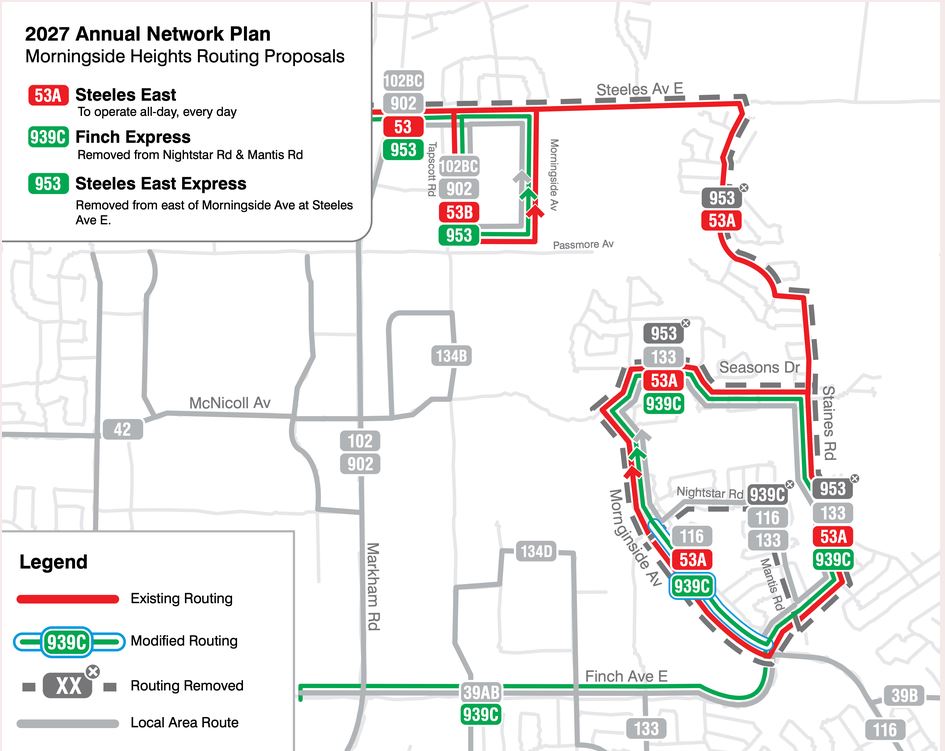
Services are modified to align service with demand, and reduce the number of buses on neighbourhood streets.
- 53A Steeles East will operate at all hours.
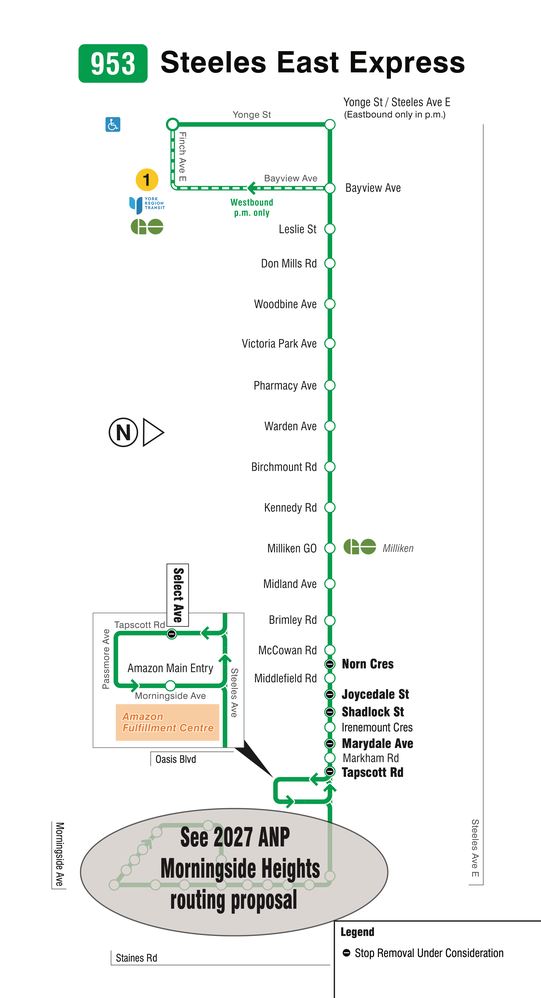
- 953 Steeles East Express removed east of Morningside. It will terminate at the Amazon Fulfillment Centre.
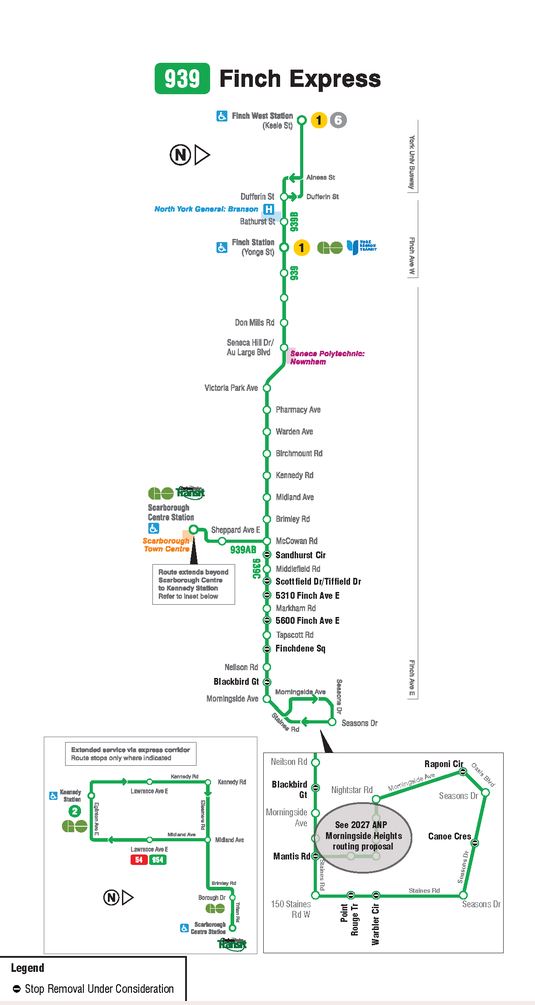
- The loop used by 939C Finch East Express will be expanded. Service will be removed from Nightstar and Mantis as shown in the map below.
Black Creek
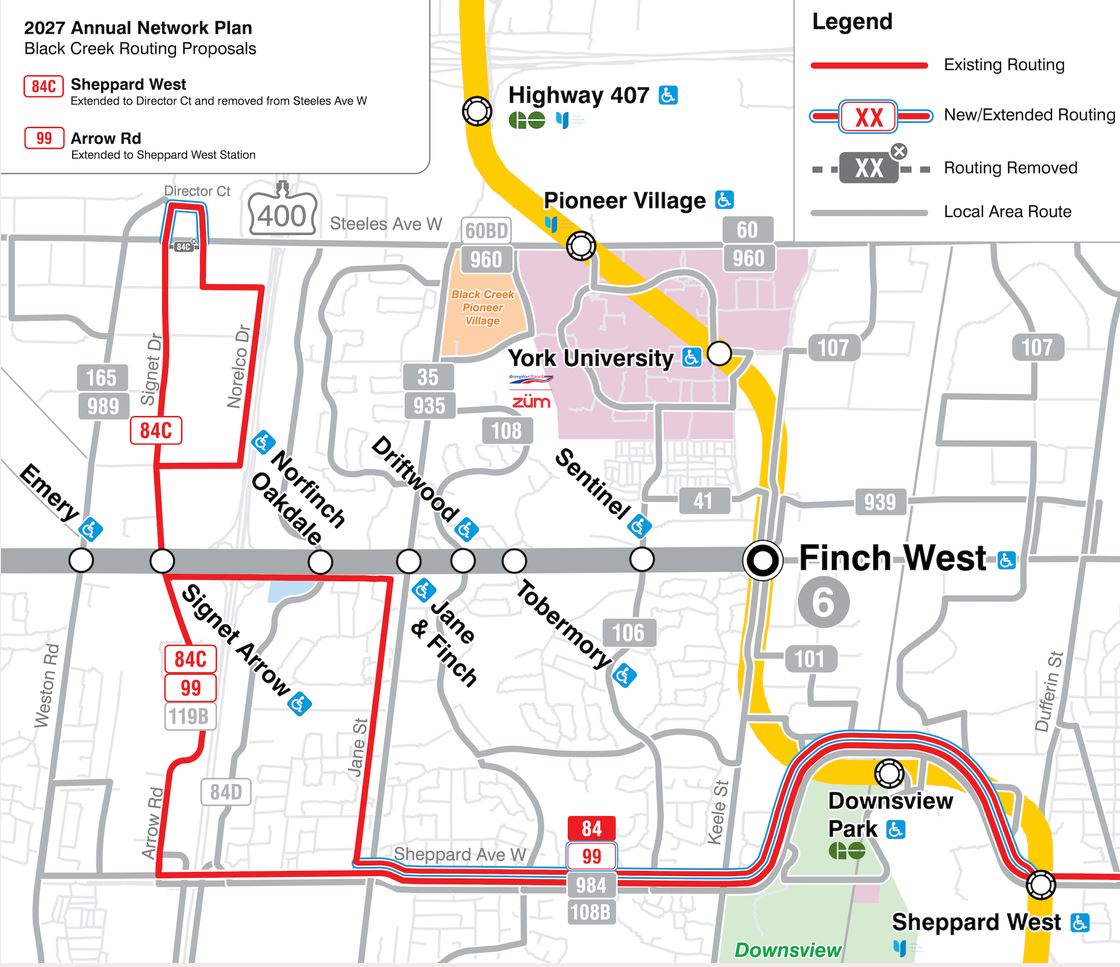
The 84C Sheppard West loop at Steeles would be changed to run via Director Court instead of Steeles.
Route 99 Arrow Road would be extended east from Jane and Sheppard to Sheppard West Station.
Dupont Corridor
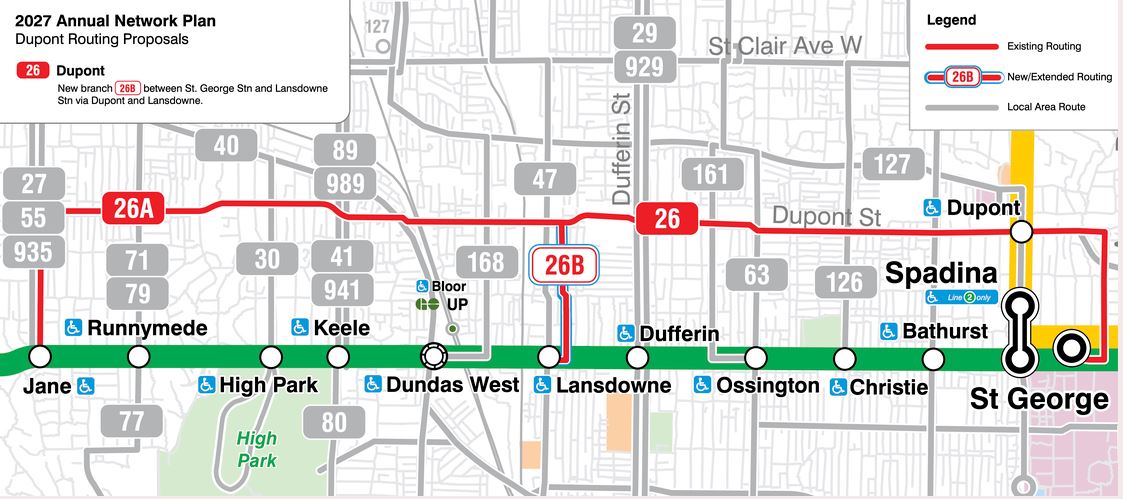
A new peak only branch of 26 Dupont would be added running to Lansdowne Station looping via Paton Road and Wade Avenue. This would improve frequency and reliability east of Lansdowne where population is growing.
Sherway Gardens
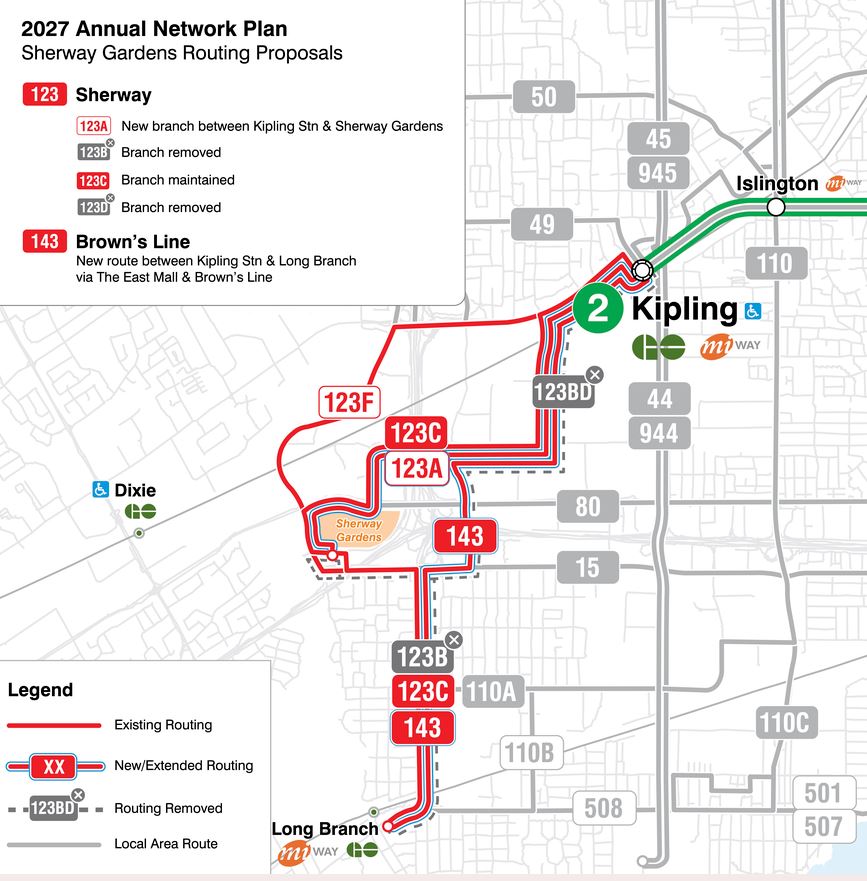
Service in the Sherway Gardens area would be modified by:
- Restoring the 123A branch from Kipling to Sherway Gardens (no late evening service)
- Replacing the 123B an 123D branches with a new 143 Brown’s Line bus between Kipling Station and Long Branch Loop that would not serve Sherway Gardens.
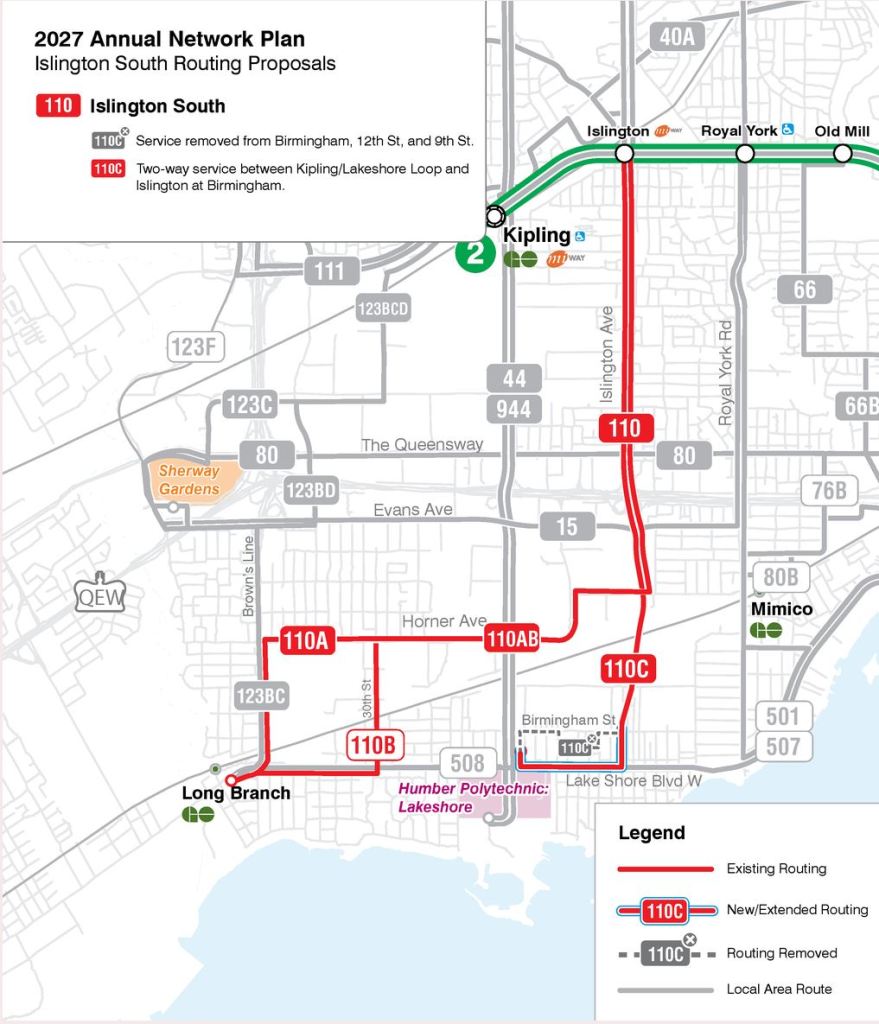
Islington South
The 110C service to Lake Shore would be modified to terminate at Kipling Loop.
Express Bus Reviews
The TTC has reviewed its express network against the existing service standards with respect to
- Scheduled travel times
- Actual travel times experienced by customers
- Boardings and alightings at each stop (i.e., customers getting on and off the bus), with an equity lens as per TTC’s Service Standards
- Distance between stops
- Service connectivity to major destinations and other connecting transit services (i.e., transfers to neighbouring transit agencies and GO)
Stops are reviewed with these guidlines:
- Stop spacing: Is the stop located less than 800 metres from the next stop? (Note: the stop spacing range for express routes outlined in TTC’s Service Standards is between 800 and 1,200 metres)
- Stop activity: Does the stop serve fewer customers than the average boardings and alightings established for that route? (See note below.)
- If the stop is located within or in the vicinity of a Neighbourhood Improvement Area (NIA).
- If the stop serves a major destination such as a school, hospital, shopping centre, community facility, or other significant trip generator(s).
- If the stop provides unique connections to other transit routes.
The average boardings and alightings for a route will obviously vary from route to route depending on demand patterns. In some cases, there will be a few major stops with many others having lower demand. In others, stop usage will be more uniform. Boardings per vehicle kilometre or per hour will vary depending on the turnover of riders and the average trip length. There is no sense of what would qualify a stop to be removed, nor of what threshold would justify adding stops.
According to the public survey the TTC heard feedback in the 2026 consultations from riders about the express routes:
- The Express Network is valued for the travel time savings it provides.
- Support for consolidating closely spaced and low-demand stops to speed up service on express routes, provided that local service coverage and accessibility are maintained.
- Need for a clear distinction between local and express routes.
- Changes on the express bus network need to be informed by data as well as local community needs.
- Lack of reliability, crowding, and traffic congestion undermine the effectiveness of express service.
This is not the same as the list provided in recent discussions with the Planning Advisory Group. In particular, the first bullet above was stated differently:
- Time savings are valued, but reliability and comfort matter just as much.
A point about reviewing routes against the 15% to 20% travel time savings standard was dropped in the public consultation list, but the information is included in the route reviews (see table below).
Almost all routes do not achieve this standard. For these routes, there is no indication of the projected before/after times to show how much this would be corrected, and over which portion of the routes.
An important point about speeding up routes is that buses are not just delayed by stop service time, but choice of stops is something which the TTC controls, unlike signal or traffic lane priority.
The routes with no changes proposed are:
- 900 Airport Express
- 905 Eglinton East Express
- 906 Airport-Humber College Express
- 927 Highway 27 Express
- 929 Dufferin Express
- 935 Jane Express
- 938 Highland Creek Express
Overview of Route Reviews
The information in this table is consolidated from the public survey.
In some cases routes are described as having stop usage “below threshold”, but this value is not defined.
| Route | Meets 15-20% Time Saving | Average Stop Spacing | Stop Activity | Connections | Local Service |
|---|---|---|---|---|---|
| 902 Markham Rd | No | 800m | Higher north of Kingston Rd and at Warden Stn | Line 2, GO and major EW bus routes. Many stops at unique transfer points or trip generators. | |
| 904 Sheppard-Kennedy Express | No | 1km | Higher east of Allanford | Lines 2 & 4, GO and major NS bus routes. Many stops at unique transfer points or trip generators. | |
| 924 Victoria Park | Yes | 980m | Higher south of York Mills | Lines 2 and 5, and major EW bus routes | |
| 925 Don Mills Express | No | 1km | Evenly spread, higher at key intersections | Lines 4, 5 and 2, and major EW bus routes | |
| 937 Islington | No | 1km S of Rexdale Blvd | Busier stops are south of Rexdale Blvd | Lines 6 and 2 | North of Rexdale Blvd |
| 939 Finch | No | 1km W of McCowan | Much busier W of McCowan | Lines 1, 6 and GO Transit. | East of McCowan |
| 941 Keele | No | 900m | High and evenly spread with only a few stops “below threshold” | Lines 1, 5 and 2, and major EW routes | |
| 944 Kipling S | No | 860m | High activity at Kipling Stn, Lake Shore and Humber College | Line and GO Transit, and major EW routes | |
| 945 Kipling | No | 1.3km S of Belfield | Evenly spead, busier at Dixon Rd | Lines 6, 2 and GO Transit. | North of Belfield |
| 952 Lawrence W | No | 1km | Higher E of Caledonia | Line 1, GO Transit and major NS routes. | |
| 953 Steeles E | No | 1km W of McCowan | Higher W of McCowan | Line 1, GO Transit and major NS routes. | East of McCowan |
| 954 Lawrence E | No | 715-830m | Higher W of Kingston Rd | Line 5 and major NS routes. | East of Kingston Rd |
| 960 Steeles W | No | 900m E of Pioneer Village Stn | Concentrated on the eastern portion of the route and on major stops on the local portion | Line 1, GO and YRT | West of Pioneer Village Stn |
| 968 Warden | Yes | 1.2km | Concentrated at Warden Stn, Finch, Sheppard and Lawrence | Line 2 | |
| 984 Sheppard W | No | 1km | Many stops “below the threshold” | Line 1 and major NS routes. | |
| 985 Sheppard E | No | 690m W of Morningside | Higher W of Morningside | Line 4, GO and major NS routes. | East of Morningside |
| 986 Scarborough | No | Highest at major intersections and termini | Lines 2, 5 and GO | From Sheppard East to Celeste Dr | |
| 989 Weston | No | 870m | Evenly distributed | Lines 2, 5 and 6 | |
| 995 York Mills | No | 800m | Lighter on eastern part of the route | Line 1 and major NS routes. | |
| 996 Wilson | No | 950m | Many stops “below threshold” | Lines 1, 6, GO and major NS routes. |
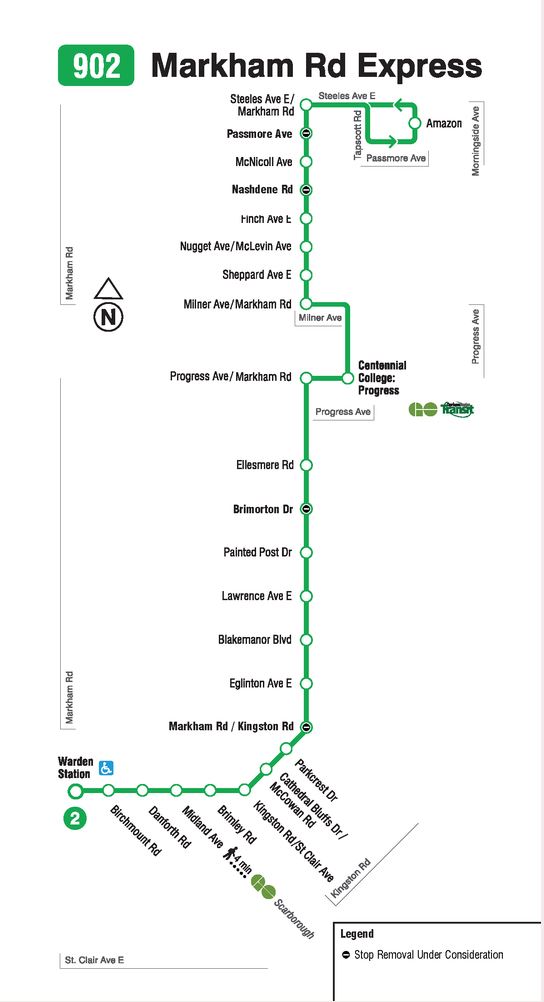
902 Markham Road
Stops to be removed at Passmore, Nashdene, Brimorton and Markham/Kingston Rd.
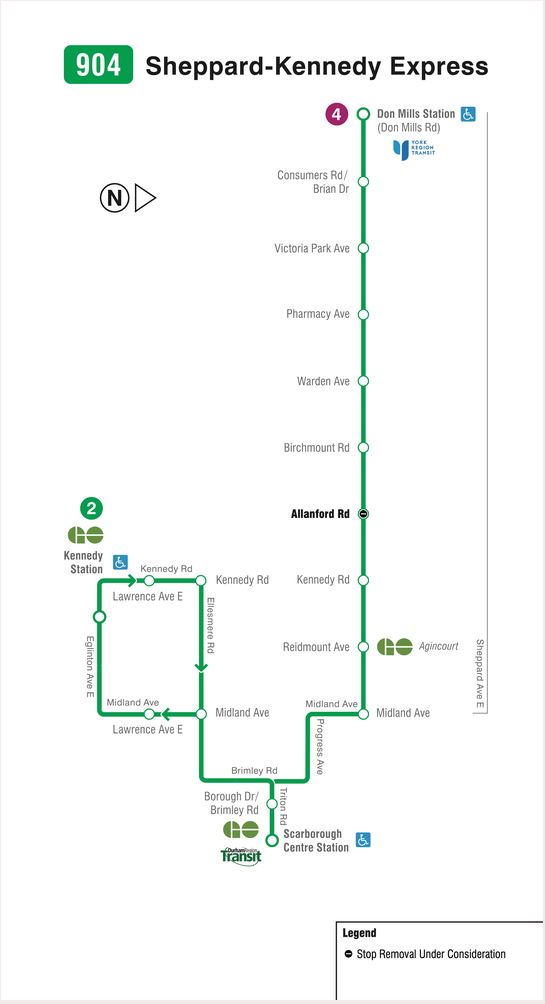
904 Sheppard-Kennedy Express
Stops to be removed at Allanford Road.
Note: This service will be shortened to STC in November 2026 following opening of the Scarborough busway.
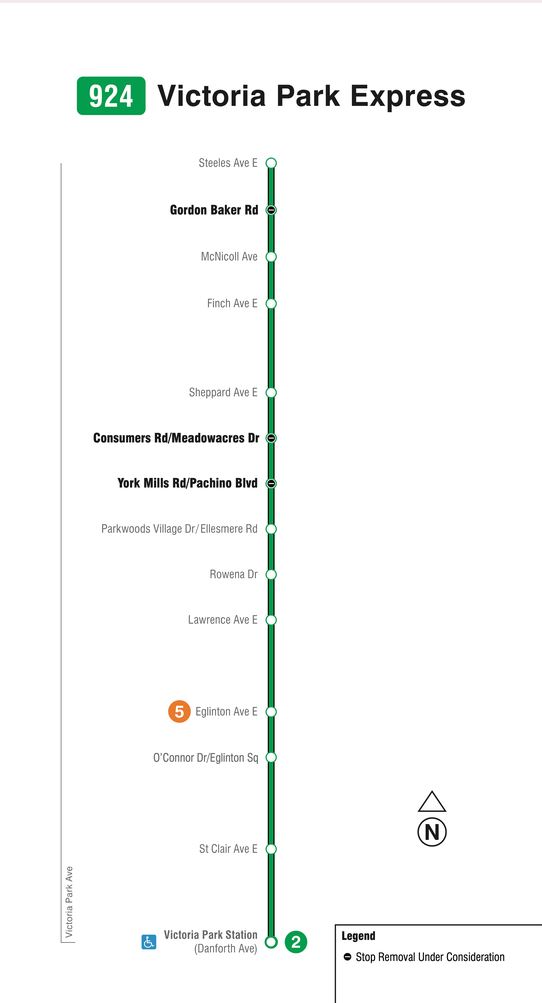
924 Victoria Park
Stops to be removed at Gordon Baker Rd, Consumers Rd/Meadowacres Dr, and York Mills Rd/Pachino Blvd.
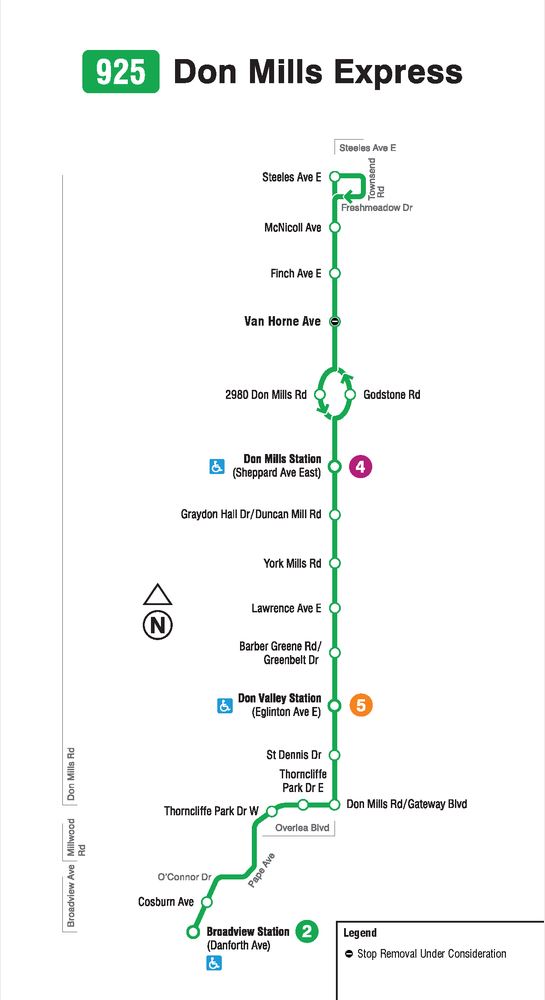
925 Don Mills Express
Stops to be removed at Van Horne.
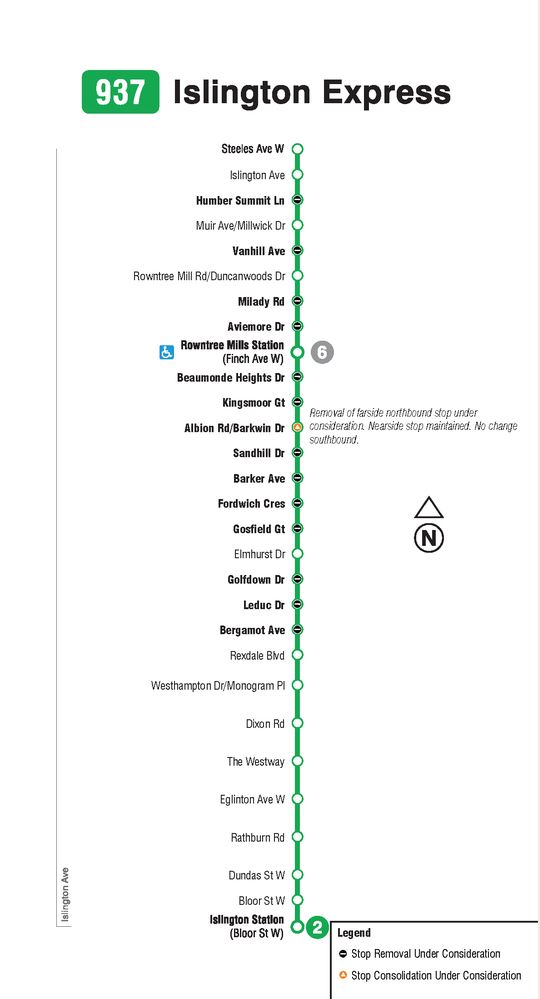
937 Islington
Service north of Rexdale would be converted from local to express operation. The local stops would be served only by 37 Islington.
939 Finch
The portion of the route east of McCowan which now operates as a local service would be converted to express. Local service would be provided by 39 Finch East.
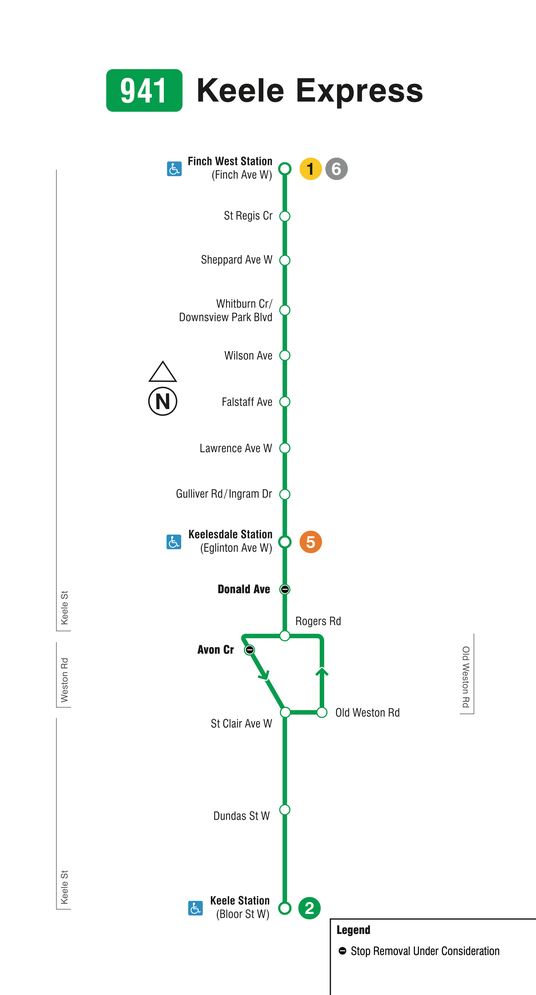
941 Keele
Stops to be removed at Keele St at Donald Ave both ways, and at Weston Rd at Avon Cr SB only.
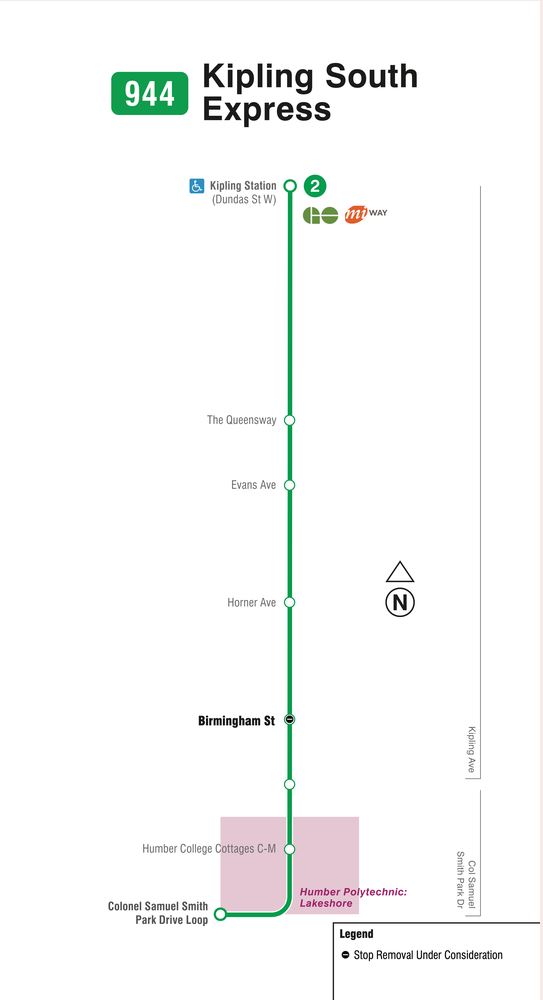
944 Kipling South
Stops to be removed at Birmingham Avenue.
945 Kipling
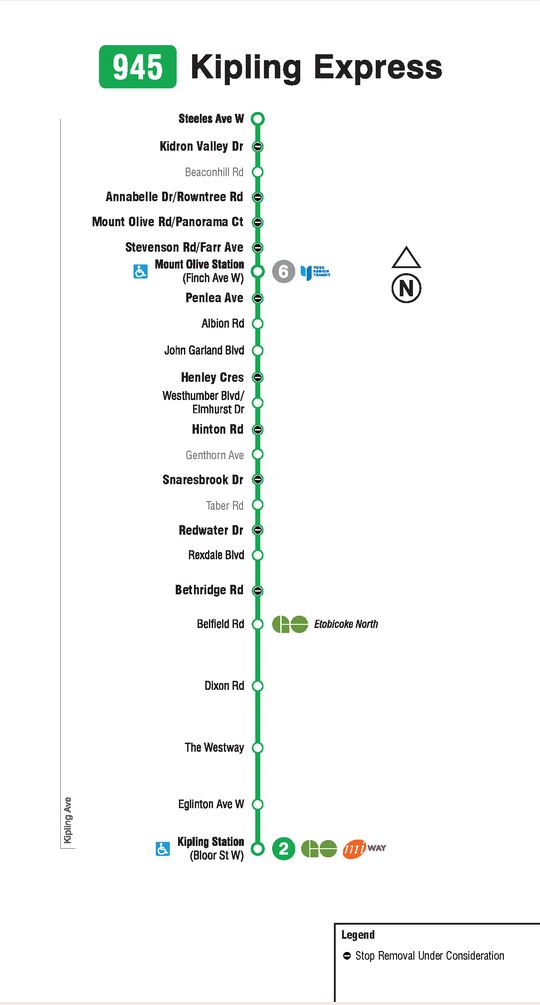
This route now operates local service north of Belfield Road. The TTC proposes to convert this to express operation leaving local service on 45 Kipling.
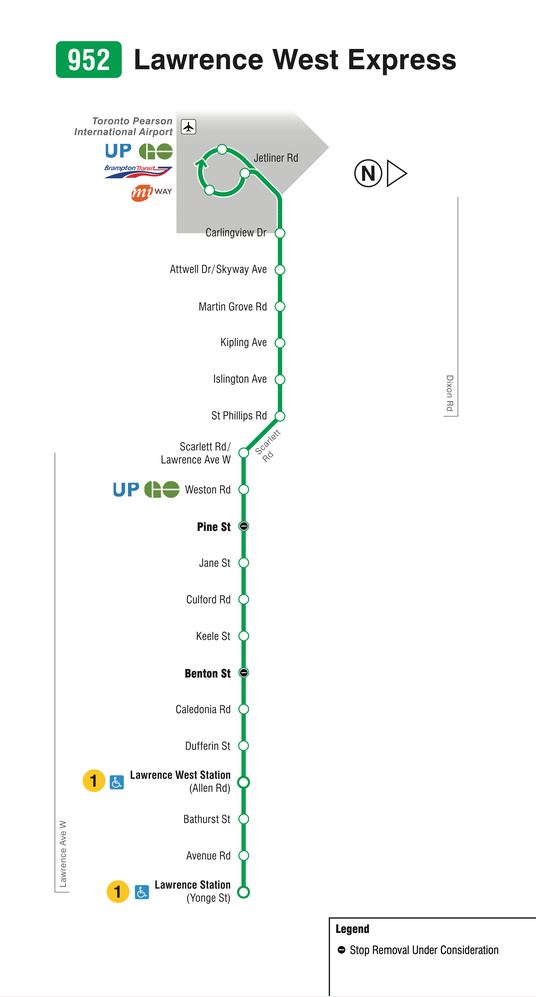
952 Lawrence West
Stops to be removed at Benton Street and Pine Street
953 Steeles East
This service now operates locally east of McCowan. The proposed route route be shortened to end at the Amazon Fulfillment Centre, and would run express east of McCowan. (See proposed route reorganization for this area later in the article.)
954 Lawrence East
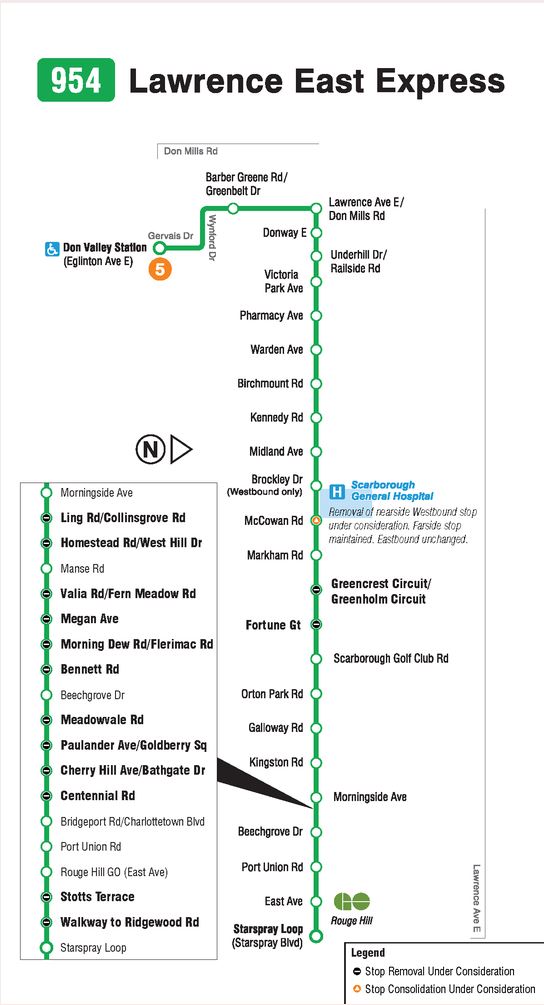
This service now operates locally east of Kingston Road to Starspray Loop. It would be changed to express over the entire line. Express stops east of Markham Road at Greencrest/Greenholm and Fortune Gate would be removed.
960 Steeles West
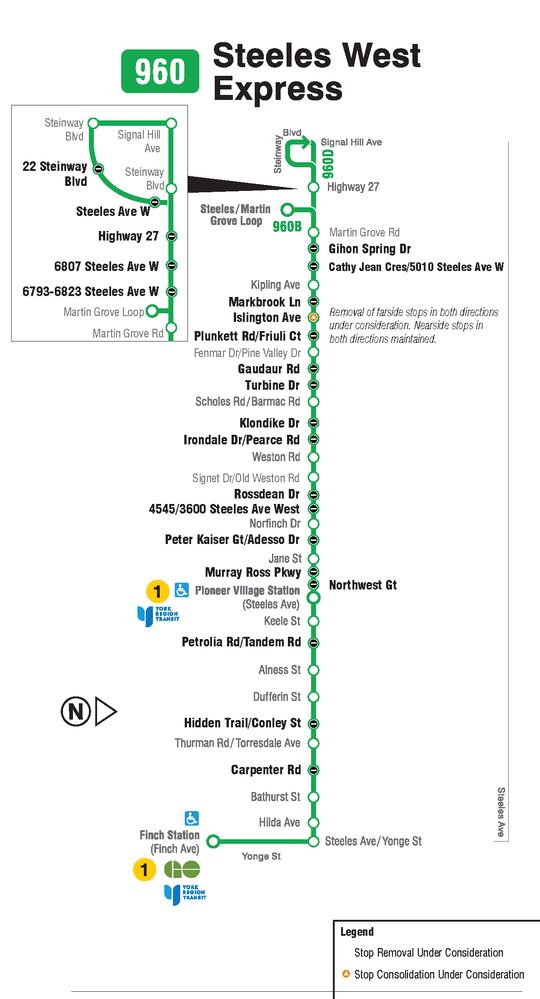
Service west of Pioneer Village Station now runs locally, but would be converted to express. A separate local service operating at all periods would be added.
968 Warden
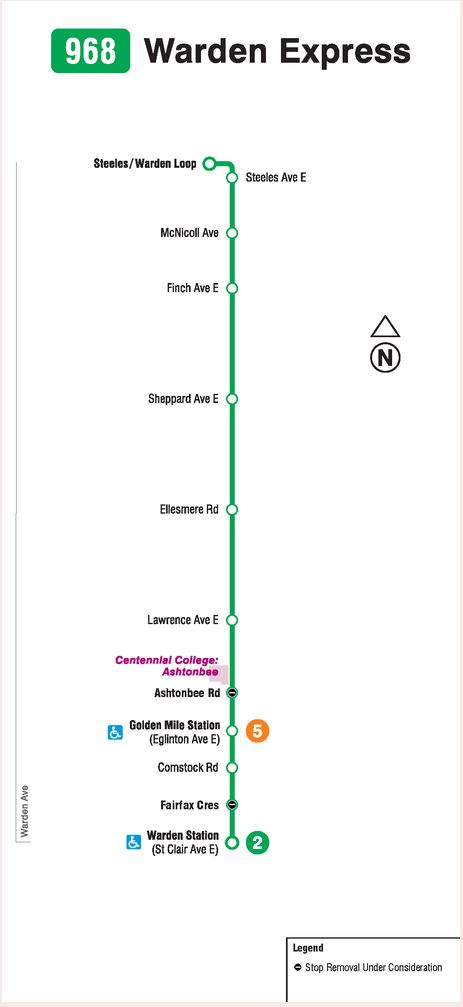
Stops to be removed at Fairfax Cres and at Ashtonbee Rd.
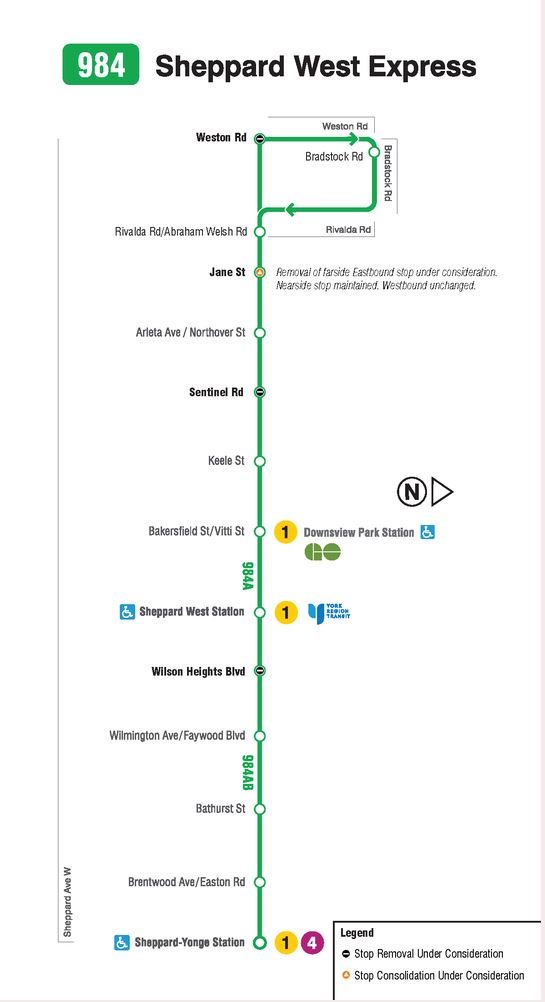
984 Sheppard West
Stops to be removed at Weston Rd (westbound only), Sentinel Rd and at Wilson Heights Blvd.
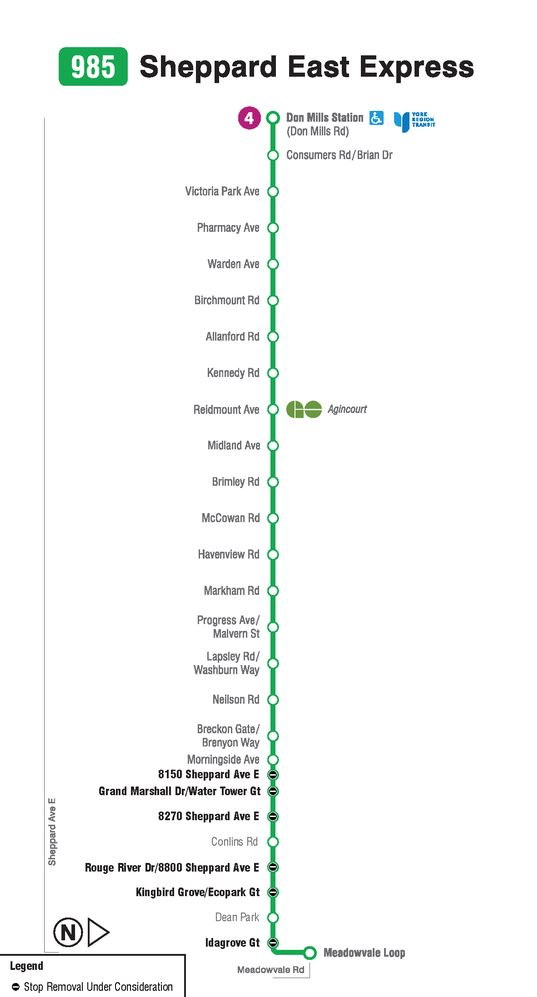
985 Sheppard East
Local service east of Morningside is proposed to be converted to express operation.
986 Scarborough
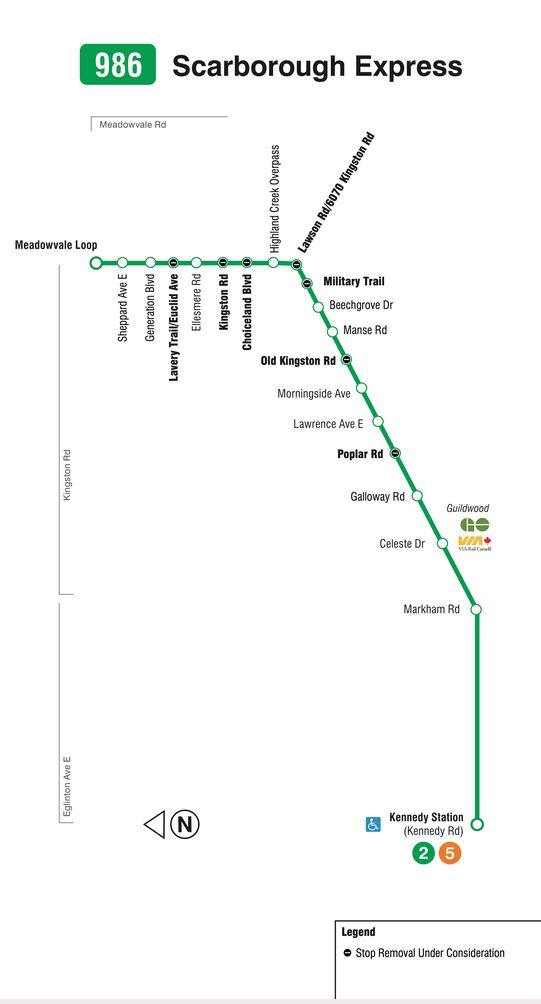
This route operates express east to GO Guildwood Station, and local from there east and north. TTC proposes to convert this to express over the whole route. Local service will be provided by 86 Scarborough.
989 Weston
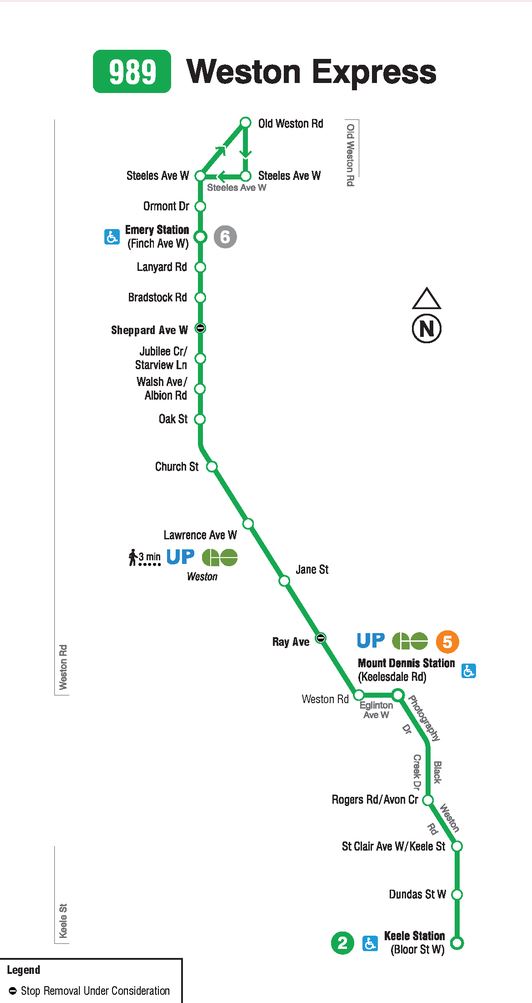
Two stops would be removed at Sheppard Avenue and at Ray Avenue.
The TTC notes:
Please note the new routing extension associated with the Line 5 Surface Network Plan was not included as part of this review. The new routing portion serving Mount Dennis Station via Photography Dr, Keelesdale Rd, Eglinton Ave West, and Black Creek Dr will be reviewed at a later date
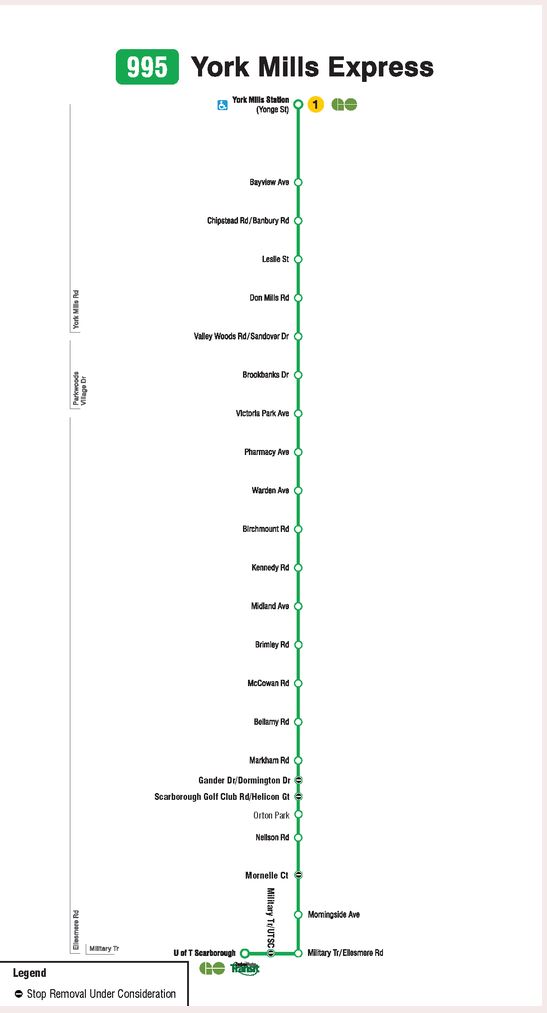
995 York Mills
Stops to be removed at Gander Dr/Dormington Dr, Scarborough Golf Club Rd/Helicon Gt, Mornelle Ct (WB stop only) and at Military Trail at U of T Scarborough (WB stop only).
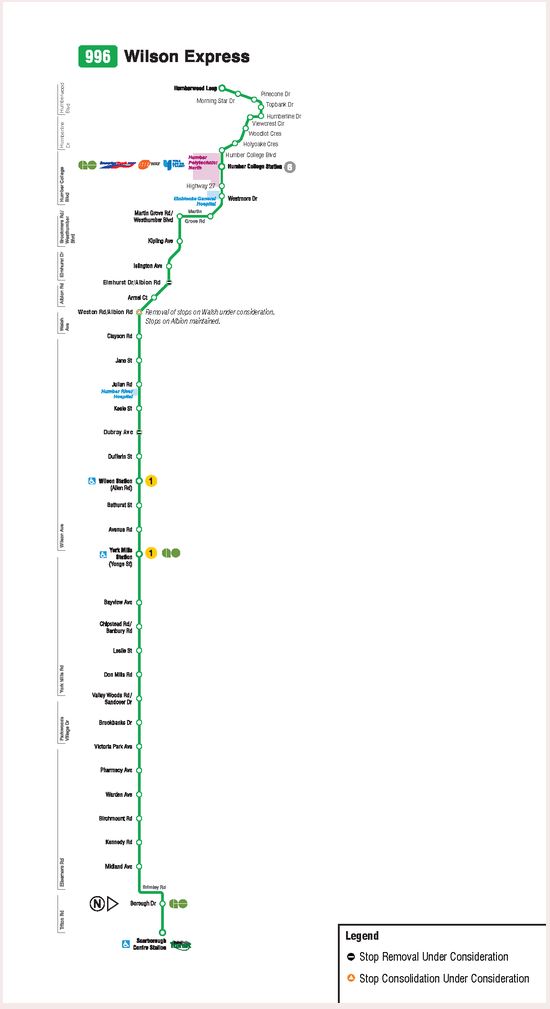
996 Wilson
Stops would be removed at Wilson Ave at Dubray Ave, and at Elmhurst St at Albion Rd.
At Walsh Ave/Albion Rd at Weston Rd, nearside eastbound and farside westbound stop removed (stops on Walsh Ave), farside eastbound and nearside westbound stop maintained (stops on Albion Rd).
 Steve Munro
Very interesting and some good route changes they put out here.
LikeLike
Wade Ave. is way too narrow for buses.
Steve: It was used as a loop at Lansdowne Station for decades.
LikeLike
Express bus routes should only stop at the major arterial roads with few exceptions like GO stations.
Steve: Historically it was common for the outer ends of express routes to run local. TTC is obviously changing their mind about this although the benefit will mainly flow to those who board on that part of the affected routes.
LikeLike
Why would the stop at Sheppard Ave West be removed for the 989 Weston Express?
Steve: That is baffling. I noticed it too.
LikeLike
Buses on Sheppard Ave West end at Weston Rd and loop at Bradstock Rd. So it makes sense to 989 serve the connection at Bradstock, where buses have their end of line breaks.
Steve: Thanks for that clarification.
LikeLike
Perhaps the stop on 989 at Weston is being removed because transferring at that stop to 84/984 doesn’t make sense since they will turn east on Bradstock anyway and one can transfer there. If 84/984 looped via west on Bradstock and south on Weston to Sheppard I would have expected the TTC to remove Bradstock and keep Sheppard.
Steve: Thanks for the update. You’re the second to mention this issue.
LikeLike
These express stop removals are a clear indication on how the new age of TTC management and capital projects in the past decade focus excessively on numbers whilst overlooking the actual service operations and first hand experiences of commuters.
What a lot of these arbitrary-looking removals do is disconnect major residential, recreational, or workplace subdivisions where lots of people truly travel to/from long distances. For example, the 924 Victoria Park Express is proposed to lose stops at Gordon Baker and at Consumers Road which are major office and industrial subdivisions with thousands of jobs. Or at Pachino Blvd on the same route, a stop surrounded by dozens of rental mid/high-rises with tens of thousands of people. People from other express stops are likely to go here.
It sounds like on textbook that people would simply walk ~1km to the next express stop to commence their long commute or transfer between express/local, but these inconveniences after a long work day, carrying lots of groceries, or going through inclement weather/temperatures is enough to drive regular TTC ridership from these popular locations away. New travel minutes and effort add up. Especially for the Victoria Park example with the 401/404 being right there, riders are going to truly prefer driving themselves regardless of traffic or parking conditions & expenses.
I could give more examples of stops the TTC plans to remove that Im familiar with that are popular for long distance travel:
– Allanford Rd on the 985 Sheppard East reducing access to Agincourt Mall & No Frills side popular with seniors across Sheppard;
– Scarborough Golf Club Road on the 995 York Mills cutting that far subdivision off popular with university students;
– Van Horne Ave on the 925 Don Mills express cutting off Peanut Plaza, thousands of housing units, AND the middle school – all popular for a variety of age groups, commuters for different industries and income levels;
– Sheppard/Weston on the 989 Weston cutting off the high rise rental community AND the recreation centre popular with youth/seniors. This forces them to transfer to/from south of Wilson Avenue.
It’s punishing the people are forced to rely on the TTC while giving people who don’t necessarily need to use the system much more reasons to drive themselves and not utilize it. Unfortunately, I’m the latter except when it comes to going to downtown Toronto or major events. I’ve seen comments on the website before of people beginning to drive more.
Express stops should go beyond connecting with other routes. People also go TO/FROM important locations like attractions, home, work, school. The table from the survey ignores this idea.
Some of these express routes shouldn’t have existed in the first place in favour of more frequent local service like the 968 Warden Express or the failed 943 Kennedy Express. And it appears the TTC is going to make the same mistake with the 960 Steeles West in the very dense workplace area west of Pioneer Village Station. As above comments stated, it appears the TTC is moving away from portions of an express route being local (typically the section furthest from the subway) – a very bad idea.
A non-express route also proposed to follow these terrible planning principles is 110 Islington South. It is no longer entering the dense Birmingham St subdivision, punishing TTC commuters in the name of efficiency based on numbers and adding extra minutes for those starting their day making it to the subway.
At least all these ideas are just proposals, but the TTC needs to stop focusing purely on numbers and generic business textbook ideas on its service planning and capital projects. I’ve talked to the young TTC planners at the consultation events and somehow they didn’t know much about operating procedures, collective bargaining agreements, or even have local knowledge of Toronto/GTA. If these proposals go through, it may give the illusion of more time being saved for lucky riders but I warn it likely will damage ridership whether immediately or gradually.
It cannot be a coincidence how TTC ridership is going down whilst the GTA is growing in size/population (and much longer distance GO Transit ridership is exploding even among car users).
Just express-ing my very strong views and warnings regarding these potentially detrimental changes.
LikeLiked by 1 person
Hi Steve, just a minor editorial note: for the 996 Wilson Express, the wording should be reversed, as the stops on Albion that the TTC intends on keeping are farside westbound and nearside eastbound (the stops on the bridge over Weston Rd itself).
Steve: The text is quoted directly from the survey page for the 996:
LikeLike
Given the number of Below the threshold stops on Sheppard West Express I don’t think there should be any consideration of Line 4 extension westward. If it can’t even have the ridership of a BRT lite how is a Subway going to make it any better? You might as well consider extending line 6 East to Finch station or if a big pot of money comes to extend Line 6 eastward to U of T Scarborough via Morningside as the Northern part of the ECLRT.
LikeLiked by 1 person