
The Metrolinx Board met on February 12 with an extensive agenda, but as usual almost none of it was discussed in public. Of particular interest was an explanation of the derailment at Union Station that snarled GO Transit operations for much of the past week. Although a detailed review continues and a full report is promised, Metrolinx was unusually forthcoming with a description of the event.
The public portion of the meeting began with a “safety moment” that focused on problems with pedestrian, cyclist and auto intrusions into the Eglinton and Finch rights-of-way. This was discussed in a tone reminiscent of GO mainline rail corridors which the new LRT lines definitely are not. In the case of Finch, the right-of-way has less physical protection than on Eglinton, and no areas of open track or grass to signal that this is not part of the overall roadway.
The very nature of a surface route, regardless of technology, is that people and vehicles will cross the tracks. They have been doing it for over a century on the streetcar system, and it is odd that Metrolinx finds this an unusual behaviour. It is not clear, other than the presence of two separate P3s on these projects, why the Eglinton and Finch designs are so different. This also contributed to the switching problems on Finch because of inadequate heaters and drainage.
Reviewing the operation of Finch, Metrolinx CEO Michael Lindsay made no mention of equipment reliability, a major problem on that line compared to Eglinton. As revealed in TTC delay logs, at times there were not enough working cars to operate the scheduled service. Delays due to “mechanical problems” continue to appear in Line 6 service alerts. The logs in the City’s Open Data website do not yet include January 2026, but when they do, I will publish a review.
Speaking of Finch, Lindsay spoke of recent improvements. At Metrolinx’ urging, the P3 partner, Mosaic, took steps to improve infrastructure maintenance. The line is now into a stage of “perfection” of operations and maintenance protocols as opposed to building issues. The issue is the readiness of private sector partners to deal with climate effects, and more generally to bring their supposed expertise from other systems to Toronto. Only recently has Mosaic hired someone with expertise in cold weather operations.
Lindsay reported that all 55 switch heaters on Finch have been checked, and drainage at 40 sites is improving. Performance stats are better since the record snowstorm of January 25 with 95% availability, and TTC on time performance is 70-80% over past couple of weeks. This may sound impressive, but any stats are bound to look better as weather improved. As for OTP, TTC standards allow for erratic service as discussed here many times.
In all the celebration of Eglinton’s recent opening, Lindsay made no mention of accessibility issues with several elevators out of service including at key interchanges like Don Valley, Eglinton and Mount Dennis. Further problems include long walks to transfer between routes and less than adequate signage. Metrolinx is supposed to have design standards, but if these lines are any indication, they desperately need review. In many ways, this was the usual Metrolinx “good news” presentation which skated around problems, or presented them as past events no longer of concern.
On the subject of “lessons learned”, Lindsay claimed that private sector partners underestimated complexity, risk, and challenge of the projects, but gave no indication that Metrolinx or Infrastructure Ontario bore responsibility for assuming more expertise within the P3s than might actually have existed. There was a hint that things might have gone better. Lindsay noted that Metrolinx has changed processes, a reference to the shift to an “alliance” model where the P3 are treated as collaborators.
Lindsay hinted at problems with the Metrolinx regime and its confrontational nature saying that all parties need to remain focused on project completion, not commercial claims. They must do the right things for the good of a project even if this compromises legal or commercial strategies. Design review and acceptance must be much more efficient and less bureaucratic in all hands. When unexpected issues such as cavities in the original 1950s Eglinton Station box are encountered, a quick regulatory process to respond is needed.
Lindsay noted that there must be an early and insistent focus on systems integration — bricks and mortar are only one milestone. More important are testing, commissioning and interoperability. This should be no surprise to anyone with transit experience. Construction is a large and impressive part of a project, but without well integrated, reliable systems and vehicles, billions of dollars worth of tunnels are useless.
He remarked on another aspect of P3s that is rarely discussed: procurement must ensure that joint ventures have a collaborative relationship without their own contentious internal issues.
Better public communications on construction, cost estimates and timelines are needed.
These remarks, for those reading between the lines, are not a ringing endorsement of how Metrolinx operated on two major projects. They might have learned lessons from the experience, but the proof will show in how work now underway actually proceeds.
Union Station Derailment: The Metrolinx Explanation
Michael Lindsay turned to the February 2 derailment in Union Station Rail Corridor (USRC), describing it as “minor”. Frustrated commuters might be forgiven for thinking this a poor choice of words. It is not merely that only a few cars left the rails, but the effects of the damage caused and the days of service disruption.
[Lindsay’s statement in the meeting recording is here.]
The investigation’s early findings reported that rail fastenings (lag screws) on south rail of depot track 3 failed at nine locations. They sheared off allowing a 1 1/8″ movement (just under 3cm) of rail that rolled allowing the locomotive and one coach to derail. The train kept moving, and cars pulled through the switch destroying track and signal infrastructure. In turn this blocked access to four platforms.
The problem was traced to the presence of only two lag screws per tie plate where there should have been four, a Metrolinx standard that has been in place for a decade. Full corridor inspection identified other locations, and some of these were severe enough that more than an overnight fix was required.
Lindsay spoke of communications challenges and the technical difficulty of keeping display screens up to date with the volume of constantly changing platform assignments and schedules. This skipped over the question of disinformation during the incident with conflicting and inadequate information provided to riders. Protocols for future incidents are under review.
As a good faith gesture, GO will refund all Presto tapped fares on February 2 and 3, and will also refund Lake Shore pm peak fares for February 4.
Thanks to slow orders due to “legacy condition” of infrastructure, there was no injury, Lindsay observed. This is a rather strange way to describe a situation at the USRC which has been under construction for years, and is reminiscent of major TTC disasters such as the Russell Hill subway crash and the more recent SRT derailment. Both of these identified lax maintenance and operating procedures that contributed to major failures, and fatalities at Russell Hill. Metrolinx takes great pride in GO Transit and their safety culture, but is clearly not immune to problems like those facing the TTC.
GO and Rapid Transit Capital Updates
The GO Transit Capital Update included two charts showing the many planned, in design and under construction works across the GO rail network. Impressive though this is, there are no dates attached for completion of any of these components, nor a sense of the critical path needed to reach actual changes in service levels on any corridor.
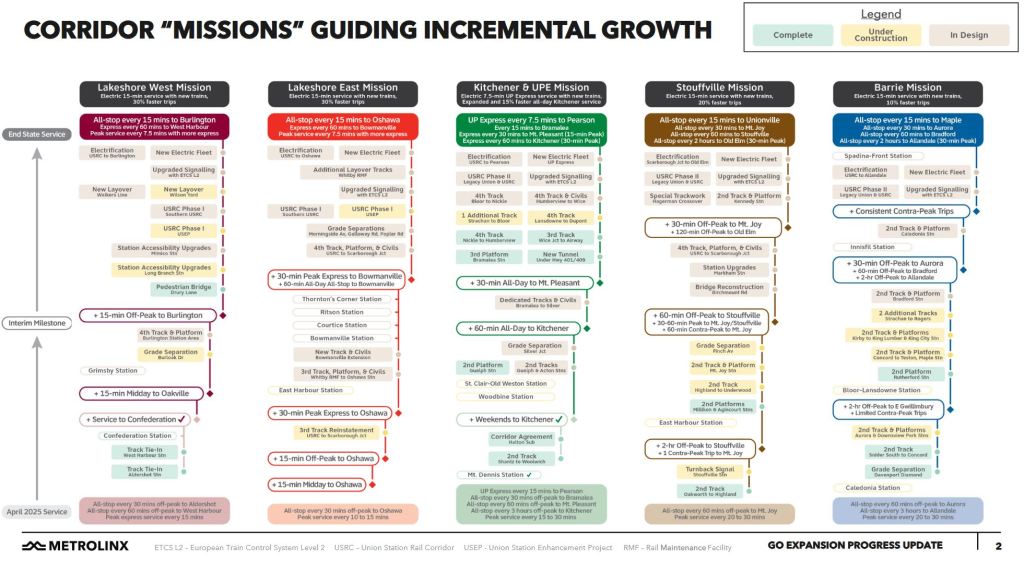
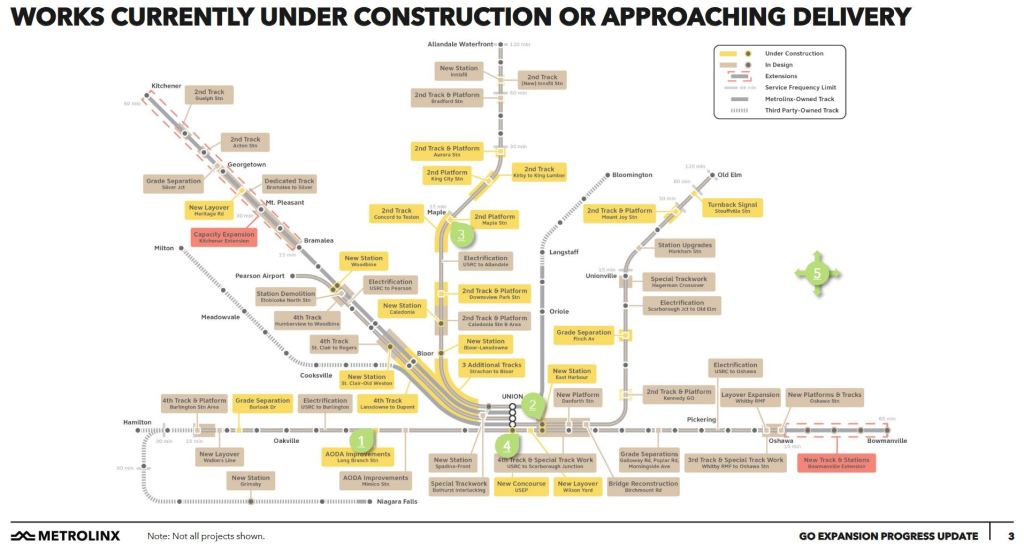
The Rapid Transit Capital Update contains some nice pictures and text describing each project, but no discussion of risk to project timelines or costs, a common issue at Metrolinx. Although there is an appendix giving a financial overview of projects (p. 17), the potential cost of current and future components is not shown. I will write in a future article about the evolution of rapid transit costs as reported by Metrolinx.
 Steve Munro
While Metrolinx are carrying the can here, isn’t the USRC the responsibility of Toronto Terminals Railway? At least some of the media I saw presented it as a failure of Metrolinx track walkers to identify missing tie attachment points but where exactly is the boundary between Metrolinx operations and TTR operations in that area?
Steve: TTR maintains the USRC on Metrolinx’ behalf, but Metrolinx has a responsibility to verify that they’re actually performing to spec.
LikeLike
“…all parties need to remain focused on project completion, not commercial claims. They must do the right things for the good of a project even if this compromises legal or commercial strategies.”
I’m not sure that fits well with involving private partners and their primary goal of making a profit. It almost seems like Mr. Lindsay is suggesting the public should be the only ones doing the building.
LikeLike
According to the legend beside the Map Metrolinx owns the entire Kitchener line. Also TTR is a wholly owned subsidiary of CN and CP. This is their maintenance contract with Metrolinx.
Steve: Metrolinx is buying some land from CN so that they can build their own tracks. See p. 11 of the GO Capital Update.
LikeLike
Haven’t the problems with Metrolinx’s confrontational nature been known for a long time? Isn’t the board’s failure to fix the problem an indication that the entire board should be fired and reconstituted? Isn’t the whole point of having a board is to watch over for stuff like this? If it’s in the Toronto Star, then they should have known about it and acted on it.
And these missing screws sound like a major safety issue. News reports state that these screws have been missing for six years! Why didn’t regular track inspections notice this flaw? Are there other latent safety issues that their safety procedures are overlooking? Is it a matter of time before a Spain catastrophe happens where the track fails at an inopportune time and many people die? Shouldn’t there be a safety code red across the entire organization to figure out why their safety practices failed and find better procedures before the next accident happens? Metrolinx seems pretty blasé over such an obvious warning sign of rot in the system. It’s a miracle that we had a derailment with no loss of life, yet Metrolinx is treating this blessing as an excuse for inaction.
Regarding track incursions, shouldn’t Metrolinx start using modern technology to help solve these problems? Caltrain started to use AI to identify track incursions, and they’ve reduced the number of incidents they’ve had as a result. They can use fixed cameras and LIDARs to identify potential problems and give advance warning to trains to slow down. Of course, knowing Metrolinx, they’ll just install a 10 ft fence along all of Finch and Eglinton and call it a day. They’ve always been obsessed with control without a complete disregard for their impacts on others.
LikeLike
Don Valley Station is a test case for Mr. Lindsay’s pledge that Metrolinx needs to “(stay) focused on doing the right things, even if it requires compromises in respect of commercial strategies, legal strategies in order to get it done, while still respecting taxpayer dollars.”
Doing the right thing would be re-staging the construction of the Ontario Line station at Don Valley in a way that allows the Eglinton Line station to operate barrier-free.
Relatedly, it appears to me that the temporary bus loop is actually in a better location for transfers to the Eglinton Line than the permanent terminal is, if it were to be directly connected to the concourse and built out for long-term use.
GO Transit:
Year after year, I notice that there is never a “mission” for the Richmond Hill train. If it is going to be discontinued south of Langstaff when the YNSE opens, I wish Metrolinx would just announce it. If it is not going to be discontinued, I wish Metrolinx would say that too. It does not seem credible that there are no plans for the line at all.
Union Station derailment:
I am old enough to remember when “screw problems” causing derailments caused passenger trains to be permanently shut down and replaced with buses.
LikeLike