
Today, Ontario announced that it would raise the Canadian content in 55 new Line 2 trains from roughly 25 to 50 percent. The provincial capital subsidy for this purchase will rise from $758-million to $950-million, and the increase will be matched by the federal government who are also funding this purchase. There is no change in the Toronto share.
It is not clear whether the federal contribution is net new money, or merely a reallocation within Toronto’s share of the ten-year transit funding program.
Updated January 16, 2026: According to the federal government announcement, the funding will come from an existing allocation stream and is not net new money.
This project is part of the previously announced 10-year funding commitment under the Baseline stream of the Canada Public Transit Fund (CPTF). Beginning in April 2026, the Toronto Transit Commission will receive up to $1.2 billion in CPTF funding over 10 years from 2026 to 2036.
A related question is which government(s) will be on the hook for the extra CanCon in future transit vehicles including those for the Scarborough and Richmond Hill extensions, and for added capacity to deal with expected growth. Collectively these account for a potential 57 more trains, doubling the size of the eventual order.
What the announcement did not address is a list of questions about the Toronto subway fleet overall:
- When will the cars be delivered, and how much work is needed to keep the old Line 2 trains operating in the interim?
- When will Metrolinx place the add-on orders to provide trains for the Line 2 Scarborough and Line 1 Richmond Hill extensions?
- How will delivery of the add-on trains affect opening dates for the extensions?
- Will complete replacement of Line 2 trains be delayed because new trains are needed to provide service on these extensions?
- Will the extensions have enough trains to provide full service to the new terminals, or will some trains have to short-turn in peak periods?
- How soon does the TTC project it will require more trains to improve capacity on Lines 1 and 2, and how will these be funded?
- What is the status of funding and timing for new maintenance facilities on Lines 1 and 2 to hold and service the additional trains?
- Will the Automatic Train Control (ATC) technology for Line 2 be the same as the existing system on Line 1, or will the two lines (and their fleets) be limited to use only their “own” trains?
The TTC produces a quarterly report on all its major capital projects with the intent of showing all planned work, but it does not produce a unified chart or timetable showing how everything fits together and where critical links might be in the overall plan. The TTC has a “Strategic Planning Committee”, and this is a complex piece of strategy that badly needs detailed, public review.
The Line 2 Fleet
Line 2 (Bloor-Danforth) operates with a fleet of 61 trains of which 46 are used in peak service. Allowing for 20% spares, the total need is for 55 trains, the size of the current order with Alstom.
TTC has more of the “T1” trains than it needs because some of that fleet was originally used on Lines 1 and 4, but were displaced with the conversion to ATC. Initial plans for the T1 replacements would have seen a 1-for-1 replacement that would provide for the Scarborough extension, but these were cut out of the contract to keep costs within available funding.
During the era with Rick Leary as TTC CEO and John Tory as Mayor, plans to launch a T1 replacement and convert signalling on Line 2 to ATC were put on hold. This allowed big capital budget items to be pushed off to the future, to be replaced with a less expensive overhaul program that would keep T1s running for another decade. That penny-wise decision created a potential crisis in subway service that has only been relieved short-term by the pandemic ridership drop and by the Scarborough extension’s delay to 2030 or later.
Seven new Scarborough trains will be bought by Metrolinx, but there will not be enough to provide full 2’20” service through to Sheppard. Half of the service will turn back at Kennedy.
With 7 new trains, the peak allocation would be 6 more than at present allowing for one spare In turn, a train every 2’20” implies the extension will have a round trip of 14 minutes (6 x 2’20”) which is woefully inadequate for the 7.8km distance. (By contrast, the Line 1 takes 12 minutes one way from Eglinton to Finch, a distance only slightly longer than the SSE.)
If there is a political demand for full service to Sheppard/McCowan Station, more trains will be needed.
The eventual size of the Line 2 fleet will also affect storage and maintenance facility needs on that line.
The Line 1 Fleet
Line 1 (Yonge-University-Spadina) operates with 65 trains at peak. Adding 20% spares brings the requirement to 78, although 2 of the 65 are “gap” trains that do not strictly have to operate if equipment is not available. There are no spare trains for Line 1 service improvement.
Metrolinx will buy eight new trains for the Richmond Hill extension which is comparable in length to Scarborough, but has more stops. The same calculation applies as on Line 2 showing that the new trains will only provide for 50% of subway service north of Finch in peak periods.
Evolving Fleet Plans
The TTC’s description of the subway fleet plan changed between the April 2025 and September 2025 versions in the target dates for specific groups of trains. Of particular concern is the 2035 date for the 55 replacement trains on Line 2. This implies that the existing T-1 fleet will have to be kept at least partly in operation for the next nine years, and that the trains for extensions will come earlier in the program. This will affect future maintenance budgets and train reliability on Line 2.
| Item | April Version Target Date | September Version Target Date |
|---|---|---|
| 25 Line 1 growth trains | “by 2032” | None |
| 15 Metrolinx trains for Lines 1 and 2 expansion | “early 2030s” | “early 2030s” |
| 17 future trains for Lines 1 and 2 growth | “post 2032 out to 2041” | None |
| Target headways for Lines 1 and 2 Capacity Enhancement Programs | “2041” | None |
| Completion year for 55 trains | “2035” | “2035” |
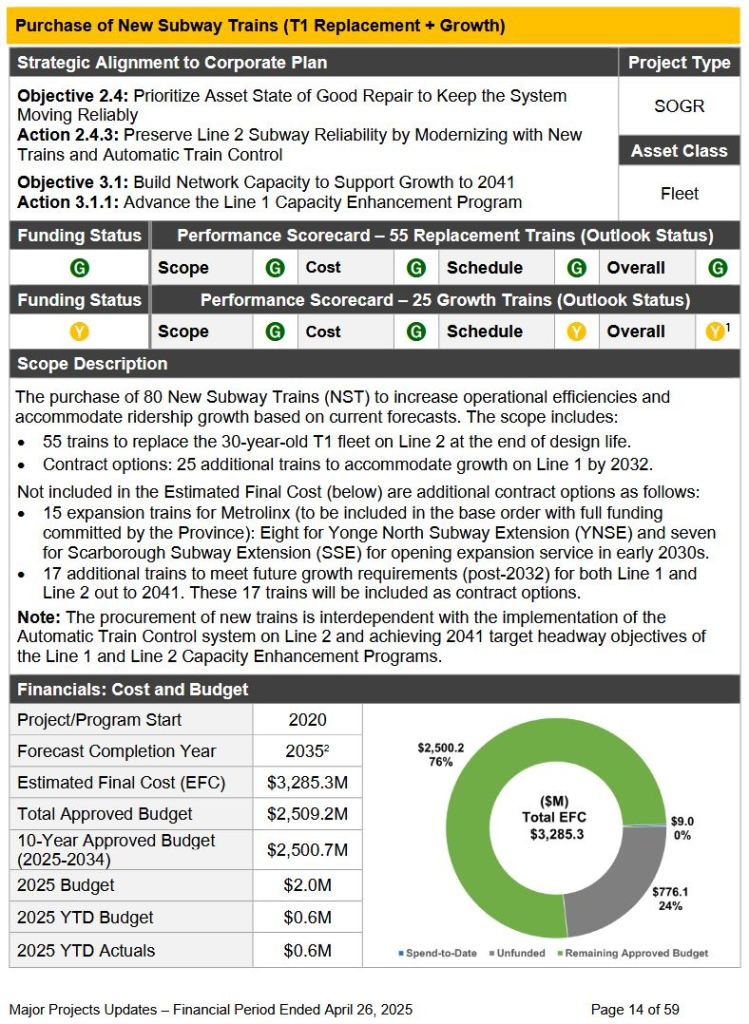
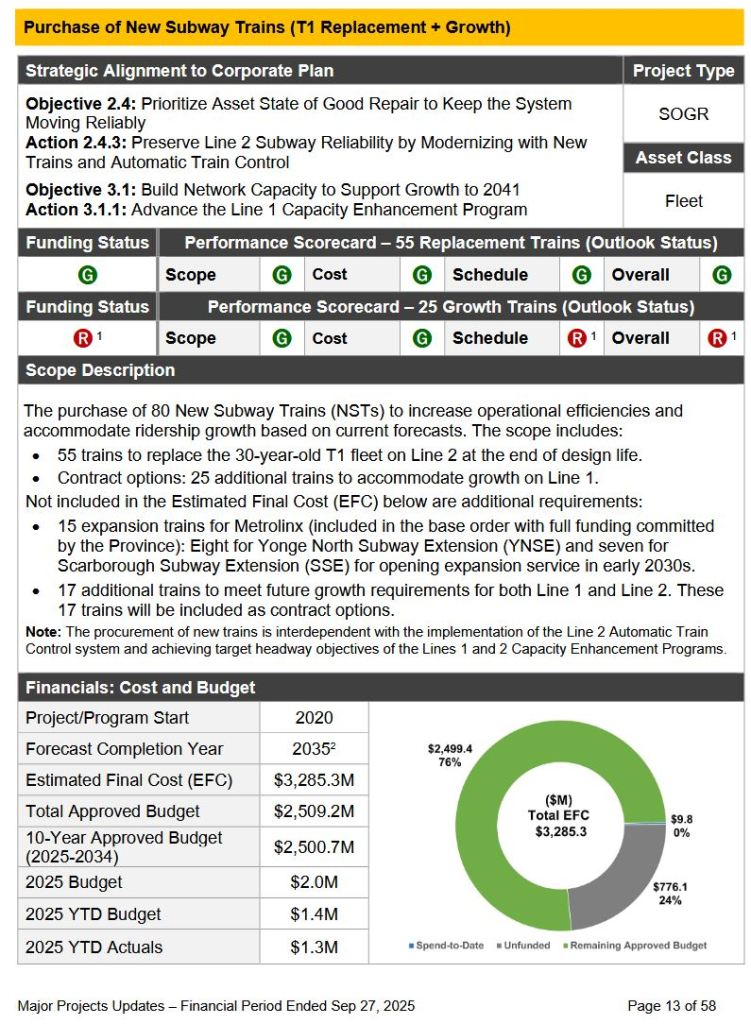

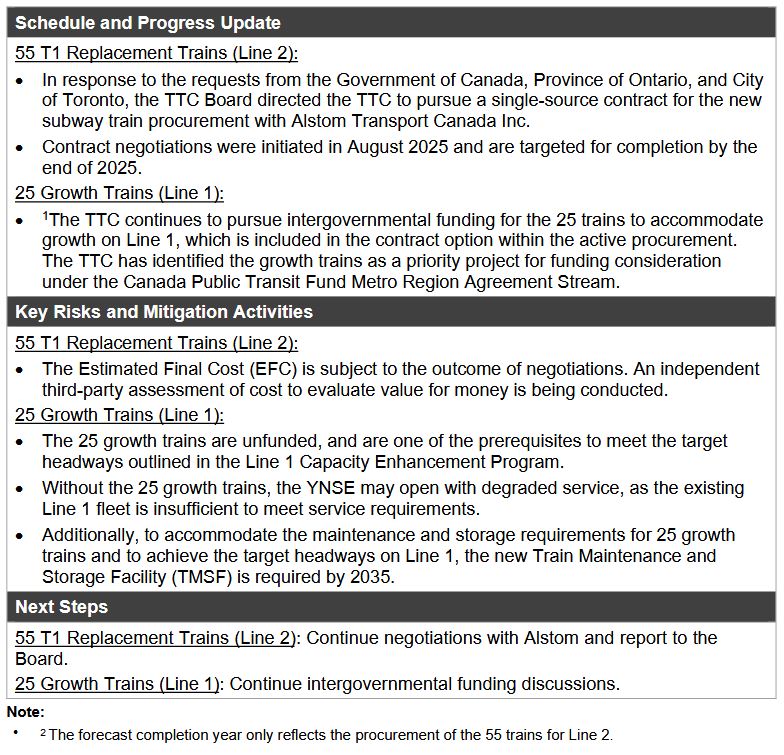
The changes in dates are in part because Toronto’s population and ridership numbers are under review, and TTC management has already indicated that more capacity will be needed even sooner than expected, particularly on Line 1. By contrast, current subway ridership is not expected to return to prepandemic levels, when both lines were badly overcrowded, within the 2020s. Somewhere there is a disconnect in the projections that should be reconciled.
Servicing and Maintaining the Fleets
There is room at Wilson Yard for modest expansion, but putting more trains on the western leg of the Line 1 “U” creates problems for service management. If most trains originate on one side, and they leave the yard at the scheduled headway, it will take the better part of two hours to build up all of the service, and two hours to build down again.
TTC is contemplating a new yard on the north end of Line 1, but this project is not funded. Moreover, it is not clear whether the province recognizes this as an integral part of the Richmond Hill extension no matter where it might be located.
On Line 2, the pressure for a new yard was reduced by conversion of the “Relief Line” to the “Ontario Line” with its own yard in Thorncliffe Park rather than at Greenwood. However, major changes are needed at Greenwood, and the arrival of new and more cars will force the construction of a western yard on lands the City already owns near Kipling Station.
Both Greenwood and Davisville Yards face pressure for more space to store the TTC’s growing fleet of work equipment that is essential to system maintenance.
Neither of the two new yards is a funded project, and between them the cost is over $4-billion.
Automatic Train Control
Line 1 operates with Alstom’s “Urbalis 400″computer based train control system (CBTC). All TR trains, including the 4-car sets used on Line 4 Sheppard, are equipped with this system. Moreover, the work fleet is gradually being converted so that CBTC can detect these trains and allow them to operate mixed in with the automated passenger fleet.
The TTC has an RFP in progress for ATC gear on Line 2, and has expressly not ruled out having a different system on that line. This means that the new Line 2 cars would have to be built with matching equipment and would not be able to operate except under special, manual arrangements on Line 1, and Line 1 trains could not run on Line 2. Work cars face an added problem because many are “one of” specialized units and they need to be able to operate on both lines.
There is no doubt pressure to open up the Line 2 technology choice, just as there was for the Line 2 cars, but this would be a foolhardy move. Not that vendor lobbying and influence are unknown at the TTC. Toronto cannot afford to add technical complexity to what would otherwise be a unified fleet and control system for the subway.
A Time for Transparency
For many years, the TTC’s subway planning has been complicated by changing priorities at the City and Province, and by poor understanding of the way that many technical factors are linked in renovation and expansion plans. There is a lot more at stake than drawing a few lines on a map and holding a press conference.
Too many projects turn into single-item lobbying efforts that fix one problem, like new subway trains, but leave many others behind. The TTC Board and City Council, even though they will be distracted in this election year, should demand a full, public exploration of the choices Toronto’s subway system faces, the implications for project funding and potential constraints on the TTC’s ability to improve service in the coming decade.
 Steve Munro
So… has the contract been awarded?
Steve: It’s in negotiation.
Regarding the question of when the cars will be delivered, the CityNews article mentions “later this decade”, or late 2020s, which is hopefully still doable.
Steve: That’s the start date, not the end date.
As to whether full replacement of Line 2 trains will be delayed because new trains are needed to provide service on these extensions, the answer should be almost certainly no, because the extensions themselves are far more likely to be even more delayed.
Steve: But if miraculously they’re on time, then some T1s will have to be kept alive longer in order to make service.
Hopefully no T1s will need to be kept until 2035, especially if new deliveries commence before 2030. The “end date” for 60 streetcars was listed as 2026, but was completed before 2026.
Steve: The final contract payments will be made in early 2026 although the last car got here in December. The problem in all of this is that changes have been made many times in target dates and linkages between projects without understanding the risk the changes create.
Regarding the fleet replacement ratio (55 new vs. 61 old), does it have to do not only with the higher spare ratio of the current fleet, but also with the post-pandemic ridership drop (is it expected to fully recover by the time the new cars arrive?) and the expectation that ATC will allow decreased headways? In other words, is 55 trains enough for line 2 without ATC, since ATC isn’t in the picture until 2036, while the last T1s will hopefully be retired well before 2035 (hopefully no later than 2033)?
LikeLike
I’m not sure that morning rush short-turning at Eglinton (or Kennedy, I suppose) is a bad thing. The resulting doubled headway beyond the short turn of ≅5 minutes is not bad, and the big benefit is that people boarding at Eglinton through Rosedale have at least some chance of getting on. Is this a political problem for Richmond Hill or just for whiny Scarberians?
Off-topic on ATC, I have to say I’m impressed what it can do on Line 1. I’m not typically at Bloor at busy times, but around 5pm yesterday a NB train’s last car was still fully in the station while the next train came in at close to full speed, and had doors open while the first train was still barely out of the station. I got off at Davisville and the third train was arriving before I left the platform. Well maybe this is just ATC-augmented bunching, but it feels like a huge improvement over pre ATC where the next driver would be just slowly creeping toward the red light near Wellesley. This very snappy service on a local scale seems as though it should be improving overall throughput.
Steve: Yes the ability to push through a tight group of trains is an important ATC benefit whether it is just dealing with a backlog from a delay or a gap train inserted into the regular service.
BTW, in the “old days” this sort of thing was also possible at Bloor because of how the signals treated closely spaced trains. Then there was an accident, and the single reds changed from “stop and proceed” to “stop and stay”. I remember seeing two trains on the Bloor platform at the same time before that rule was introduced.
LikeLike
Despite multiple readings, I still can’t confidently decipher exactly which words are missing.
Steve: Sorry, that was an editing error. It should read “in 55 new Line 2 trains”. Thanks for catching that. I have fixed the article.
It’s unclear what is implied. Is it this inadequacy that leads to the conclusion that half the trains will short turn at Kennedy? Or that this inadequacy still exists even though half the trains will short turn at Kennedy (and therefore the headway is exaggerated)?
Steve: If six trains are added to the full length of the line on a 2’20” headway, then the total travel time goes up by 14 minutes (6 times 2’20”). This is only slightly more than the 12 minute one way travel time on Line 1 over a comparable distance. It is physically impossible to operate every train past Kennedy with only 6 trains for the extra service.
The whole issue of a Kennedy short turn has been an on-and-off again thing. Originally it was part of the plan, then the pocket track east of Kennedy station was cut from the plan to save money. Then somebody realized this meant more trains at a cost well above building the pocket track and it was back in the plan. For a time, the province could claim that Scarborough would get full service on the extension, but they will only get half. If more is wanted, then Metrolinx will have to shell out for more than 7 addtional trains for the extension project.
LikeLike
I’m aware, but it’s still better than what was expected (2030). As long as this start date is met, an end date in the early 2030s should be doable.
Steve: The start date does not correspond to first train delivery. There is final design plus recreation of the production line at Thunder Bay, and production of a few trainsets for acceptance testing. This is all in the RFP which was covered on this site when it came out.
Hopefully the additional 15 trains would’ve already been ordered by the time the first 55 begin arriving, and all 70 will be delivered seamlessly, ensuring that by the time the extensions open there will be enough new trains to run on them.
Steve: It’s not very good planning to assume that projects will be late and save us from an embarrassing shortage of cars.
There was also a table in an older post (TTC 2026 Capital Budget and 2026-2040 Plan) which lists “60 Streetcars (2021-2028)”, unless the 2028 was a typo(?)
Steve: The streetcar project in the capital funding report at page 4 also includes the reconstruction at Harvey Shops to host two dozen cars. The vehicles are here, but the project continues.
LikeLike
Is there any reason regarding the switch to Alstom Metropolis instead of the Movia rolling stock?
Steve: Alstom shows the existing Line 1 TR cars as “Metropolis” on its website. The TTC spec for the new trains is based on the TRs. I think that this is partly marketing to use their new brand name consistently.
LikeLike
The federal money is net new under the Canada Public Transit Fund baseline stream. This is an allocation for Toronto that is separate from money for other priorities like the waterfront East LRT or Eglinton East, which Toronto is hoping to get funded under the Metro Region Agreements stream.
Steve: A big problem with the federal programs is tracking whether they add money for new projects, or just shuffle around existing allocations. There is also no indication of whether the same CanCon subsidy will apply to future vehicle orders for extensions and growth, or if Ontario and Toronto will have to absorb the extra in their capital budgets.
After tracking down the federal announcement, I find that this is not net new funding, but part of the already allocated stream.
This means that funds that might have been spent on other projects go to supporting the subway car order.
LikeLike
According to CityNews, the first trains “are expected to enter service later this decade”, and while I realize this statement should be taken with a grain of salt, I remain optimistic and hopeful. If the start date corresponds to the contract being awarded, that should happen later this year.
It’s even worse planning to repeatedly delay the purchase of new cars, then end up having to delay full replacement even after the replacement fleet is fully here, because additional cars are delayed even further. It’s just infuriating that no matter how much time passes, the completion date for this project only gets pushed further out of sight and always remains “10 years away from being 10 years away”.
In any case, they could certainly plan to delay full replacement and assume the extensions will open sooner rather than later (the target date for the first train delivery and the opening of the SSE were both pushed from 2026 to 2030), but in the highly likely event that the extensions will be delayed more than the new fleet, they should have no problem changing plans and completing full replacement ahead of the extensions opening.
Steve: The basic point of my article stands. There are a lot of moving parts to the TTC’s future subway plans and these are not well understood by people making decisions about them including the need for substantial funding beyond what is already available from various sources. If Toronto is going to lobby for more transit funding, this should be on the basis of an integrated plan, not one project at a time.
LikeLike
Why not use these new trains for Line 1 Downtown and use the old trains from Line 1 to serve the new Scarborough subway?
Steve: The new trains are functionally equivalent to the trains already running on Line 1. Also, switching trains between the lines will be a challenge if the TTC selects a different CBTC (computer based train control) vendor for Line 2. Yes, I know that sounds like a bad idea, but TTC is still entertaining the idea of having two separate systems on the two lines.
There are no spare “old trains” except for the few extra T-1s already on Line 2.
LikeLike
Isn’t the Richmond Hill train storage facility at a pretty advanced stage of planning? I’m sure YouTube recommended me a Metrolinx video where they had one of their public “consultation” video about how they’re going to bulldoze through their plan to extend the subway to 16th avenue and stick a noisy train storage facility beside several high rise apartment buildings. Because that’s definitely better than sticking it near highway 407, in the industrial area beside the cemetery where no track extension would be needed and where only a few (albeit richer) people live.
Steve: The train storage facility in Richmond Hill still appears as an unfunded project in the TTC’s Capital Plan. The province has not yet agreed to pay for it. Also, the total storage needs on Line 1 include not just eight extra trains for the extension, but trains to improve service over the entire line as demand grows. I have not yet seen a consolidated plan for the Line 1 and 2 fleets as they grow out to 2040 and beyond.
Presumably, the increased subway costs should flow back into government coffers as taxes and decreased costs needed to support unemployed auto/steel workers (since they can be employed to work on trains for the next couple of years).
Steve: That’s all fine, except it does not replenish the funding source used to pay the extra costs, nor is there any guarantee that the extra subsidy will be included in future purchases.
And isn’t the CBTC stuff at least mildly standardized? At least at the train level? I suppose the signaling contracts could even specify that the system must be designed so that trains can flow between both systems.
Steve: Possible but not desirable.
LikeLike
What’s wrong with line 2 NOT getting handmedowns for once??
Maybe it’d be better to just delay the opening of the extensions until the add-on trains are delivered (even assuming the extensions won’t be plagued by delays in the first place), rather than delaying the replacement of the line 2 cars. As far as I know, Yonge North is way behind the SSE & OL in its current phase.
Steve: Line 2 (and the SSE) won’t get hand-me-down trains for the simple reason that if the ATC system procured for Line 2 is different from that already installed on Line 1, the Line 1 trains won’t be able to run in automatic mode on Line 2.
A major issue raised by my article is that regardless of what we might think about possible delivery and opening dates, we need to see a consolidated plan showing the linkages and dependencies between the projects, and what happens if any of them do not hit their targets. For example, the delivery schedule for the Line 2 replacement trains cited in the RFP stretches into the early 2030s. It would be possible to operate the line with a mixture of old and new trains pending conversion of the line to automatic train control. However, claims about the benefits of ATC and more frequent service cannot be achieved without all trains being ATC capable and more trains (beyond the extension trains) procured to add service to fully exploit ATC.
LikeLike
Where will the new trains be housed, stored, cleaned, and maintained? Maybe at the proposed, wish-upon-a-star, fantasy Obico Yard? Maybe with a western extension of Line 2 somewhere?
Maybe sell off the current Greenwood Yard afterwards, if the price of housing development returns to new highs by then. Can help pay for the new yard.
Steve: In theory, new trains will replace old, and there is some end of line storage on the SSE. Also, seven of the existing T-1s are in theory surplus. However, Greenwood requires some major upgrades and that will inevitably take some space out of service. It’s going to be a difficult juggling act. And even with he Kipling Yard, Greenwood will still be needed.
LikeLike
Aren’t the new cars designed specifically for GW to be able to maintain them WITHOUT requiring major upgrades first? I sure hope the deliveries won’t be delayed even more because they decide to start rebuilding GW in advance.
Steve: Yes the new trains can be broken into pairs with hostler controls at the “blind” ends. However, Greenwood needs a lot of work anyhow and I don’t think they want to wait a decade until the H-1 and new train co-existence is ended. Greenwood is 60 years now.
LikeLike
Any word on door layout at this point? Obviously platform doors can handle multiple door layouts (and maybe should be designed to be able to for future order flexibility). But curious if this will limit the types of door layout that will be viable. Also curious if there is any options for the 1/2 car length that could allow for full usage of the platforms.
Steve: The door layout is the same as on the TRs. The “new” car spec is derived from the previous generation. I think that the idea of a seventh car has fallen off of the table.
LikeLike
With only 2 intermediate stations vs 4 on YUS, they should be able to get higher average speed. Although, 66km/h average speed over the SSE (vs 40km/h on YUS) does sound high given speeds we are seeing elsewhere on the subway lines these days.
Steve: The extra stations on Line 1 will add a bit, but won’t make up a difference of 24 minutes Eglinton-Finch (travel time only) and 14 minutes on SSE.
LikeLike