
TTC Misrepresents Growth in Streetcar Delays from Blocked Tracks

At the TTC Board meeting on November 3, management presented statistics on streetcar delays broken down by type of incident. TTC is quite fond of portraying external incidents, especially those related to congestion, as the root of (almost) all evil. The following page is from the CEO’s Report.
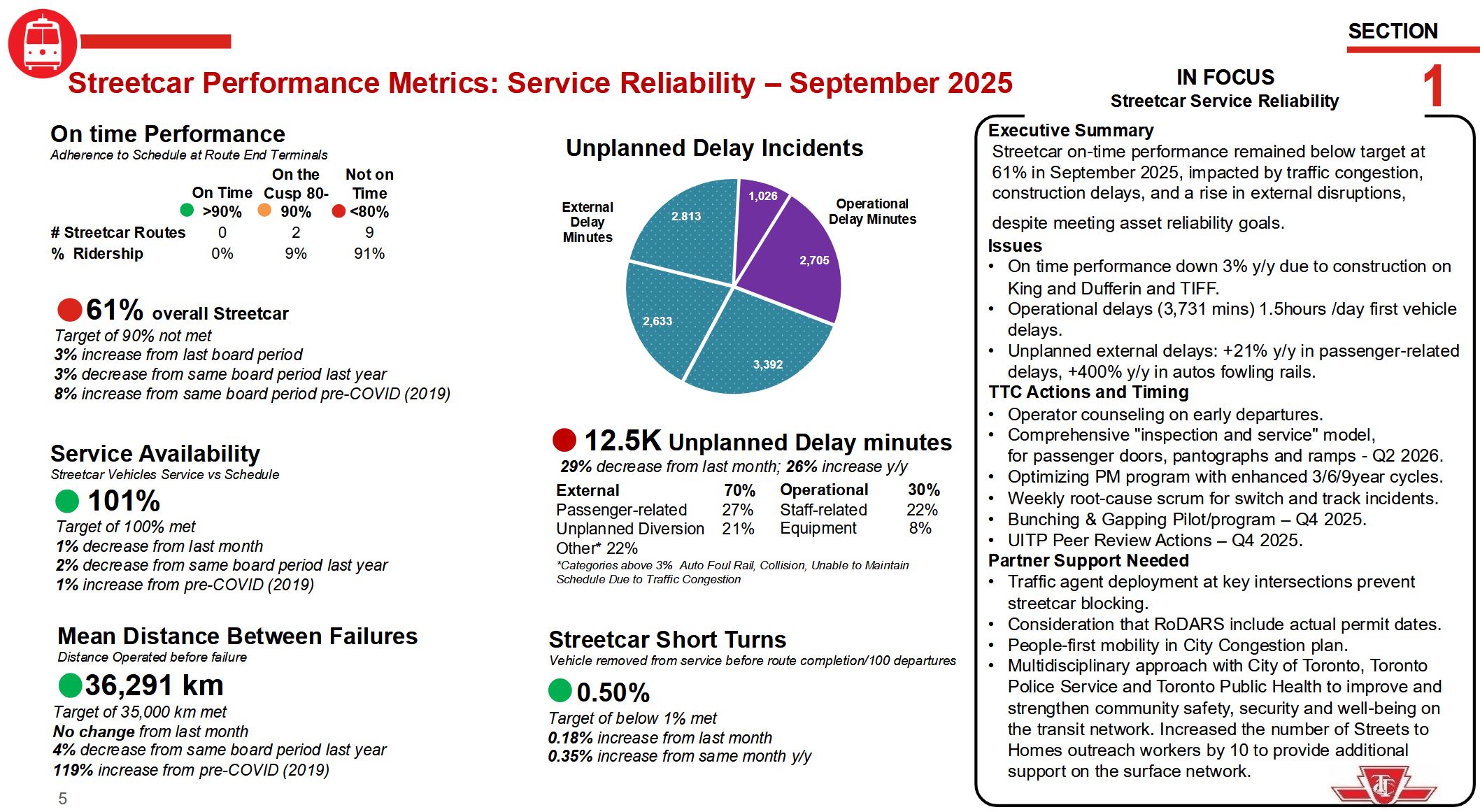
Note that external delays (turquoise) occupy the majority of the chart. During discussion of the problem of autos fouling rails, a passing remark by the Interim Chief Operating Officer piqued my curiosity when he said that there were many delays due to the winter storm.

This sent me to the TTC’s delay statistics which are available on the City’s Open Data site. There are codes for many types of delay including “MTAFR”, short for “Auto Fouling Rails”.

According to the “In Focus” box above there has been a 400% year-over-year increase in these delays, although they are styled as “fowling” implying a flock of chickens might be responsible for service issues.

Sorting the data by code and summarizing by date produces interesting results.

  • Between January 1 and September 30, 2025, there were 843 MTAFR events logged.
  • Of these, 586 fall between February 14 and 26 hitting a daily high of 65 on February 17.

These blockages were not caused by the typical traffic congestion, but by the City’s utter failure to clear snow on key streets.

  • 105 were on 501 Queen
  • 42 were on 503 Kingston Rd.
  • 84 were on 504 King
  • 93 were on 505 Dundas
  • 186 were on 506 Carlton
  • 3 were on 507 Long Branch
  • 1 was on 508 Lake Shore
  • 2 were on 509 Harbourfront
  • None were on 510 Spadina or 511 Bathurst
  • 6 were on 512 St. Clair
  • A few dozen were on various night cars

The pattern here is quite clear: routes on wide roads or rights-of-way were not seriously affected, but routes on regular 4-lane streets were hammered. (How 511 Bathurst was spared is a mystery. At the time it was running with streetcars from Bathurst Station to King & Spadina, and with buses on the south end of the route.)
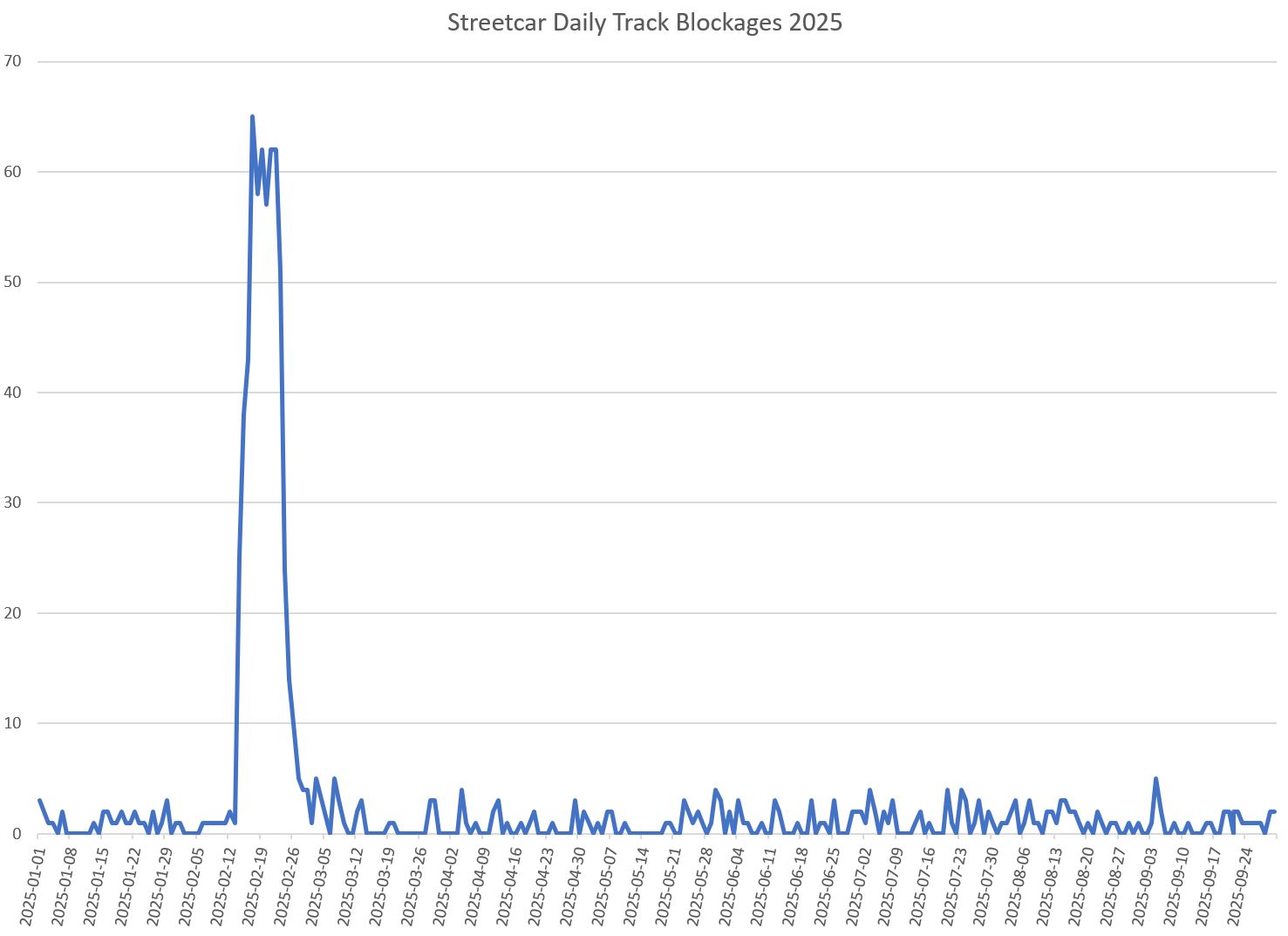
To claim that the 400% increase from 2024 is some indication of worsening traffic problems is gross misrepresentation of what actually happened. Although this is the CEO’s report and he almost certainly did not assemble the information himself, he wears this issue for having reported misleading data to the Board and public.

Direct comparison with published 2024 data is difficult because until 2025 the TTC used a much coarser set of delay codes that lumped many types of events under generic headings. There was a category “Held by” in which there were 625 incidents from January to September in 2024. The 843 MTAFR codes in 2025 are quite clearly not a 400% increase over 2024.

Whenever there is a discussion of unreliable service, we hear endlessly about traffic congestion. This definitely is a problem, but not the only one, and certainly not in the way presented by the CEO.

A question arose during the debate about the problem that performance stats are consolidated across all routes. Route-by-route service quality is presented in detail in the second part of this article for all streetcar routes. This shows that problems are widespread in the system, even on routes with reserved lanes.

As for the delay stats cited by the CEO, it is clear that we are not comparing September 2025 to one year earlier as the text implies, but using events from the entire year to date including a major snowstorm that had no equivalent a year earlier. The so-called 400% jump in delays from blocked tracks is due to snow and poor road clearance by the City.

TTC management owes the Board and the public an apology for blatant misrepresentation of the delay statistics.

Continue reading

TTC Bunching and Gapping Pilot

The TTC has a pilot program underway on several routes with increased supervision in an attempt to improve service quality by addressing service gaps and bunching. These are complementary effects in that a gap is often followed by a bunch, although gaps can also occur due to missing vehicles and short turns. See:

The pilot evolved over the year as some of the challenges and resource needs to manage service became apparent.

March 2025Pilot launched on 7 Bathurst, 24 Victoria Park, 924 Victoria Park Express, 25 Don Mills, 925 Don Mills Express, 29 Dufferin, 929 Dufferin Express, 100 Flemington Park, 165 Weston Road North, 506 Carlton, 512 St Clair.
Dedicated staff to manage each route were not used initially and results were poor.
June 2025The pilot was scaled back to 7 Bathurst, 24 Victoria Park, 924 Victoria Park Express, 506 Carlton, and 512 St Clair.
One route supervisor was assigned to each route.
September 2025100 Flemingdon Park and 165 Weston Road North were added.
October 2025Pilot “refined” to focus on the weekday peak periods.

The TTC recognizes that delays leading to gaps can be caused by several effects: “including including Operator behaviour, customer incidents, traffic congestion, city events, construction, and operational factors, such as door/ramp operations.” [p. 2]

Later in the report, there is mention of the effect of passenger loads and long traffic signal wait times.

If vehicles are crowded either because service is inadequate for demand, or because a gap creates an extra load, they will take longer at stops. Filling vehicles to the brim can be counter-productive and inefficient. Space limitations onboard can delay passenger movement especially for those with large objects (e.g. strollers, luggage) and mobility devices. Although ramp operations are mentioned, there are many other types of passengers with extra space and boarding time needs.

Transit signal priority is also mentioned, but there is no indication of where or what priority measures were added on the pilot routes.

The remainder of this article reviews the metrics used by the TTC to track the success of the pilot project, as well as problems and actions that might be taken to resolve them.

Continue reading

TTC Annual Network Plan 2026

At its November 3, 2025 meeting, the TTC Board will consider management’s proposed 2026 Network Plan. This is a very long set of documents, and this article will only cover the major points. Readers wishing more detail should refer to the reports.

The recommendations are quite simple:

  • Approve the 2026 plan and associated network changes, and
  • Forward the plan to City Councillors, sundry senior City officials, and the General Managers of various regional transit agencies.

The “key themes” of the plan are cited as enhancing connections to meet customer needs, reviewing the express bus network and planning for construction. The “enhanced connections” are very small scale, the express review will be in next year’s plan, and construction plans are not unlike what we saw for major projects in 2025.

Running in parallel with the Network Plan is work on a Ridership Growth Strategy “which is a cost-benefit analysis of service, fare, infrastructure, and customer experience initiatives aimed at increasing ridership, pending funding.” [Main report, p. 2] This exercise, like the Network Plan, too often is budget constrained, and that mindset, including the concept that if only TTC were more businesslike, financial problems would dwindle if not vanish completely.

The Ridership Growth Strategy has yet to appear even as a consultative proposal. There is no sense of the TTC’s ambitions and whether the “strategy” will consist of the lowest possible cost changes under the guise of making the system more attractive. In an election year when keeping taxes down is a political priority, bold schemes for transit spending are hard to find.

The concept of “cost-benefit” too often ignores the general economic worth of having a transit system in the first place. There is a deep gorge between capital megaprojects where a very high multiplier effect is claimed for investment in infrastructure, and operating expenses which are treated as a burden on the City and its funding partners. Calls for fare supports and better service are treated as irresponsible demands on the public purse, but billions spent so commuters can travel hither and yon across the region are not seen as a waste. Nobody ever asks subway advocates how we are supposed to pay for their dreams.

One part of the 2026 plan reviews “poor performing routes”, but past experience shows that this generally nibbles around the edges of financial problems while giving the impression of a hard-nosed review. It does not address questions of service capacity, latent demand and quality which, after all, should be primary concerns of any transit system.

At the same time, the plan claims to have a focus on social goods:

The 2026 ANP builds on the 5YSP [5 Year Service Plan], which continues to highlight the importance of equitable, reliable, safe, and timely access to transit for the three key priority groups: women, shift workers, and lower-income customers.

Many initiatives proposed in the 2026 ANP address travel patterns of the key priority groups who continue to depend on the transit network for getting around the city. [Main Report, p. 2]

The TTC cannot be both a penny-pinching, “efficient” business while also serving goals that may not, at least on the TTC’s books, be cost-effective. Arguments that efficiencies will help pay for better service miss a key point: there are already major problems with transit service affecting all riders, and they will not be fixed by cuts to a handful of minor routes.

The TTC serves everyone, not just “key priority groups”. Indeed it is strong demand from a wide range of riders that justifies good service, provides revenue to help fund it and generates political support for further improvements.

The reference to “many initiatives” is misleading. Few changes are proposed, and they are small scale.

Consultations with a wide variety of groups including politicians, community groups, day-to-day riders, special needs riders, transit advocates and transit operators revealed consistent complaints across the city about crowding, service reliability and the accuracy of public information. These are not issues just for a few squeaky wheels, advocates who are dismissed as having too much time on their hands to criticize transit, but for ordinary riders everywhere.

A favourite buzzword, “innovation” makes its appearance in an attempt to justify ongoing work:

A more efficient and customer-friendly TTC network encourages more people to choose transit, helping reduce car dependency, lower emissions in support of the City’s ransformTO Net Zero Strategy, and making better use of existing fleet and infrastructure.

The 2026 ANP will support ongoing and future planning processes that leverage innovation, particularly in enhancing ridership data analysis as well as monitoring and reporting KPIs. A key focus will be continued improvements in how route and system productivity is measured through data-driven decision-making.

Additionally, this plan supports the TTC’s transition to a zero-emissions network by making scheduling adjustments to accommodate the deployment of eBuses across the network. [Main Report, pp 3-4]

Customer friendliness and better data analysis are not “innovations” except for an organization that has forgotten its primary mission. As for scheduling adjustments for eBus deployment, this is actually a new cost because of the lower range of battery buses, a cost, not a benefit, of “innovation”.

The plan argues that it prepares “the network for long-term growth … by aligning with the TTC’s commitment to building a resilient, competitive, and sustainable transit system.” [Main Rport, p. 4] That will not happen with small scale route changes, budget-constrained service improvements, and an attitude to reliability that sees the primary obstacles as outside of the TTC, notably traffic congestion. Yes, that is a problem, but it is too conveniently cited while ignoring basics of scheduling and line management.

The plan cites 2026 budget costs of only $0.6 million for implementation of proposed changes. This is very small change. A further $13.2 million (net) is proposed to roll out service changes approved in the 2023 and 2024 plans, but not yet implemented. There is no sense of when these would occur and how much new service would actually operate in calendar 2026.

A further problem is that there is no reference to the cost of restoring service to levels set by the board-approved Service Standards for crowding. Although the TTC has trip level crowding data, system performance is reported on an aggregate, all-day basis giving a far-too rosy picture of actual conditions riders encounter. Honest, granular reporting of service quality is an “innovation” long overdue.

Continue reading