
At the TTC Board meeting on November 3, management presented statistics on streetcar delays broken down by type of incident. TTC is quite fond of portraying external incidents, especially those related to congestion, as the root of (almost) all evil. The following page is from the CEO’s Report.
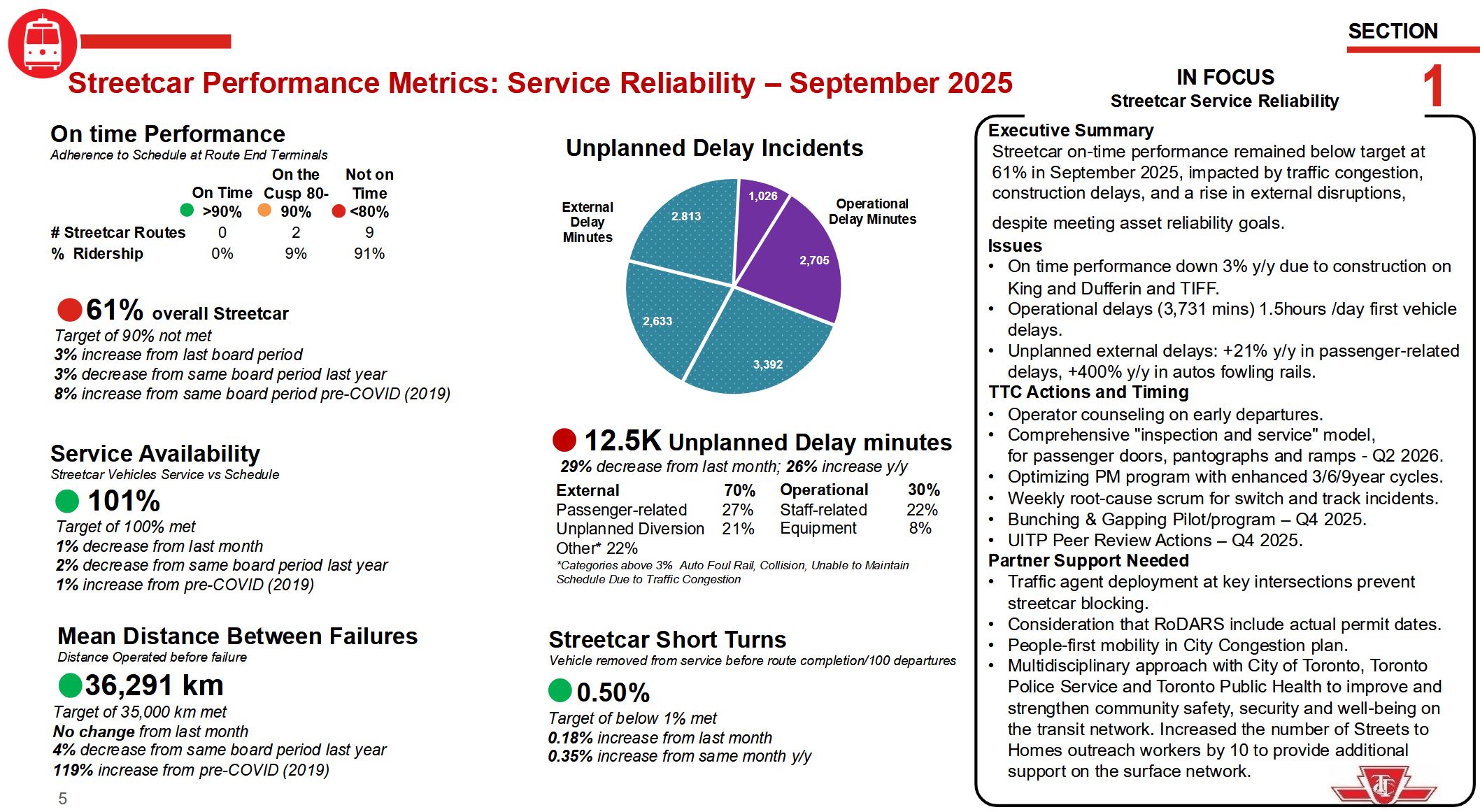
Note that external delays (turquoise) occupy the majority of the chart. During discussion of the problem of autos fouling rails, a passing remark by the Interim Chief Operating Officer piqued my curiosity when he said that there were many delays due to the winter storm.
This sent me to the TTC’s delay statistics which are available on the City’s Open Data site. There are codes for many types of delay including “MTAFR”, short for “Auto Fouling Rails”.
According to the “In Focus” box above there has been a 400% year-over-year increase in these delays, although they are styled as “fowling” implying a flock of chickens might be responsible for service issues.
Sorting the data by code and summarizing by date produces interesting results.
- Between January 1 and September 30, 2025, there were 843 MTAFR events logged.
- Of these, 586 fall between February 14 and 26 hitting a daily high of 65 on February 17.
These blockages were not caused by the typical traffic congestion, but by the City’s utter failure to clear snow on key streets.
- 105 were on 501 Queen
- 42 were on 503 Kingston Rd.
- 84 were on 504 King
- 93 were on 505 Dundas
- 186 were on 506 Carlton
- 3 were on 507 Long Branch
- 1 was on 508 Lake Shore
- 2 were on 509 Harbourfront
- None were on 510 Spadina or 511 Bathurst
- 6 were on 512 St. Clair
- A few dozen were on various night cars
The pattern here is quite clear: routes on wide roads or rights-of-way were not seriously affected, but routes on regular 4-lane streets were hammered. (How 511 Bathurst was spared is a mystery. At the time it was running with streetcars from Bathurst Station to King & Spadina, and with buses on the south end of the route.)
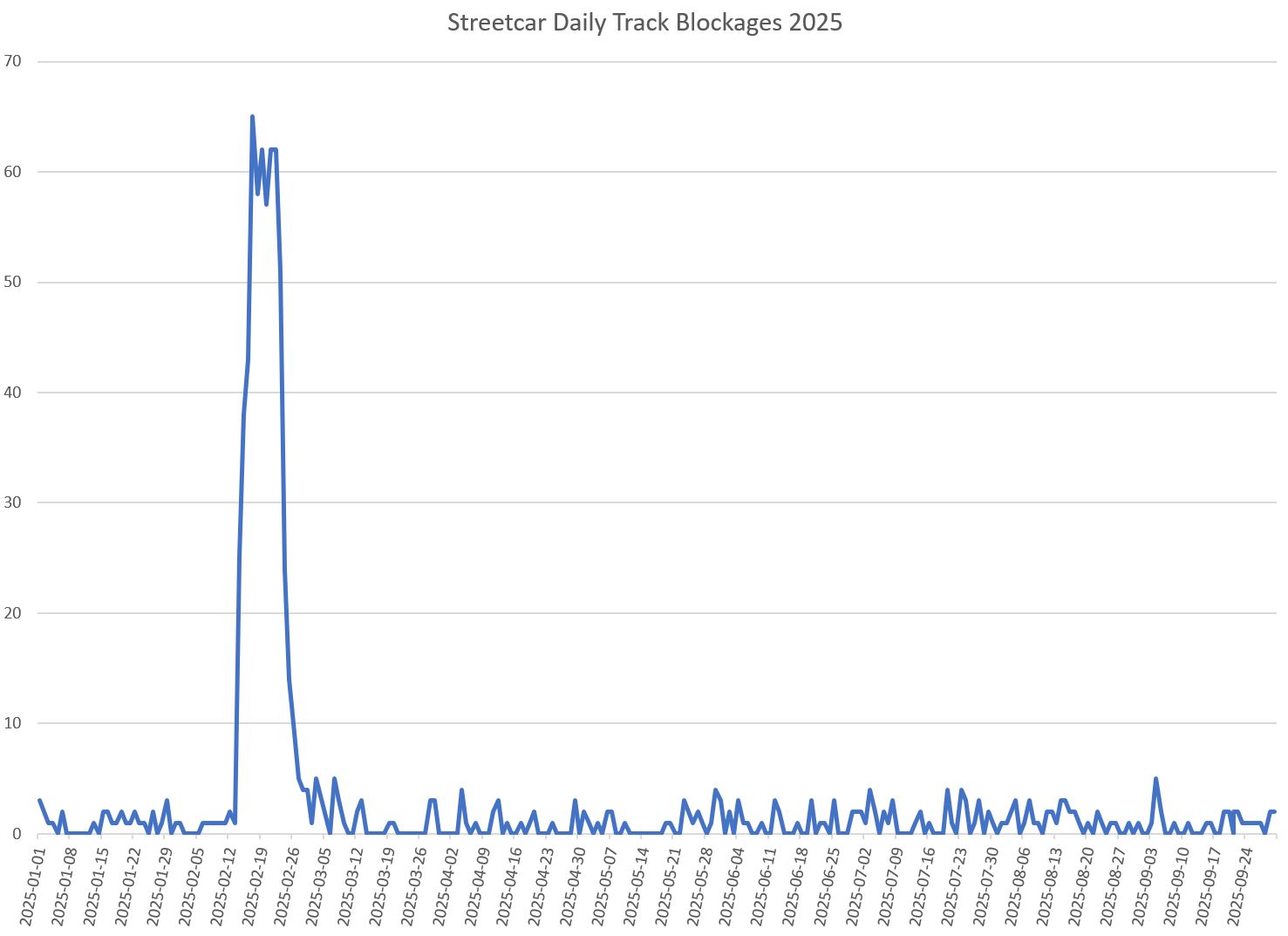
To claim that the 400% increase from 2024 is some indication of worsening traffic problems is gross misrepresentation of what actually happened. Although this is the CEO’s report and he almost certainly did not assemble the information himself, he wears this issue for having reported misleading data to the Board and public.
Direct comparison with published 2024 data is difficult because until 2025 the TTC used a much coarser set of delay codes that lumped many types of events under generic headings. There was a category “Held by” in which there were 625 incidents from January to September in 2024. The 843 MTAFR codes in 2025 are quite clearly not a 400% increase over 2024.
Whenever there is a discussion of unreliable service, we hear endlessly about traffic congestion. This definitely is a problem, but not the only one, and certainly not in the way presented by the CEO.
A question arose during the debate about the problem that performance stats are consolidated across all routes. Route-by-route service quality is presented in detail in the second part of this article for all streetcar routes. This shows that problems are widespread in the system, even on routes with reserved lanes.
As for the delay stats cited by the CEO, it is clear that we are not comparing September 2025 to one year earlier as the text implies, but using events from the entire year to date including a major snowstorm that had no equivalent a year earlier. The so-called 400% jump in delays from blocked tracks is due to snow and poor road clearance by the City.
TTC management owes the Board and the public an apology for blatant misrepresentation of the delay statistics.
Streetcar Service Quality
The question of route-by-route reliability is a separate one that management should have, but did not address. To save time waiting for them to churn through the details, the charts below show the distribution of headways from terminals and common short turn points on streetcar routes for week 3 of September 2025. This was chosen to avoid short weeks in the calendar, holidays, and to be clear of the Tiff diversions earlier in the month.
Reading the Charts
On these charts, each day’s headways are plotted in their own colour. A dot represents the headway for one vehicle passing a screenline at the location in the title. The solid lines are not moving averages, but trend lines interpolated through the data to show the overall pattern of values through each day. Many routes operate on the same scheduled headway all day, and so these lines tend to run straight across the charts unless there is a major disruption. All raw data are from the TTC’s vehicle tracking system.
The maximum y-value in all cases is 30 minutes. Higher data points do exist in a few cases, but they are not shown in the interest of keeping the view of the data fairly open. Points close to the x-axis are bunched vehicles running on very short headways.
501 Queen Westbound
These charts show the service just west of Neville Loop and just east of Coxwell. Note how the headways have spread out over this few kilometres of the route.


501 Queen Eastbound
These charts show the headway at Humber Loop eastbound, and then crossing Roncesvalles. Note the greater scatter in the latter only a few kilometres east of Humber on completely reserved track.


503 Kingston Road
The 503 was operating with buses in September. Here are the headways westbound from Bingham Loop for week 3. Note the wide spread in headways including a lot of bunched service and many wide gaps. Keep telling yourself that buses are so much more flexible and easy to manage.

504 King Westbound
These charts show the service southbound at Danforth from Broadview Station, northbound at Mill Street from Distillery Loop and the combined service westbound at Parliament & King. In theory, the two branches are supposed to mesh, but both terminals have such irregular headways that this cannot occur.
Note that TIFF affected route 504 in weeks 1 and 2, but by week 3 the route was back to normal, and construction at King & Dufferin had not yet started.


504 King Eastbound
These charts show the service southbound at Bloor from Dundas West Station, south/eastbound at The Queensway, and eastbound at Spadina where the 504B service has joined the route from Bathurst Street.
The trend lines at Bloor West for Monday and Wenesday show the effect of service interruptions on Roncesvalles. These are not seen at The Queensway because of service short turned at Sunnyside. At Spadina, the combined headways are spread over a wide range.


505 Dundas Westbound
The charts below show 505 Dundas service southbound on Broadview at Danforth, and westbound on Dundas from Broadview where short turns, if any, might have improved the service.


505 Dundas Eastbound
These charts show service southbound from Dundas West crossing Bloor, and east of a common short turn point, Lansdowne. The big rise in the Monday trend line was caused by the same incident that blocked 504 King service on the same day.


506 Carlton Westbound
These charts show the headways leaving Main Station southbound crossing Danforth, and westbound from Coxwell, a common short-turn location where the headway scatter is slightly better than at Main Street.


506 Carlton Eastbound
Service eastbound from High Park Loop (left) is notoriously erratic because of short turns at Lansdowne (right).


507 Long Branch
The 507 car operates between Humber and Long Branch Loops through the daytime and early evening. 501/301 Queen provide service west of Humber in the late evening and overnight.
Note that double headways appear regularly on Thursday due to a missing car. Even so, 507 Long Branch headways are much better behaved than the routes above because this is a short route that can recover even spacing at terminals often, and which is much less affected by traffic congestion on the wide Lake Shore Boulevard.


509 Harbourfront
509 Harbourfront runs entirely on reserved lanes from Union Station to Exhibition Loop. Notwithstanding this, headways can be quite erratic.


510 Spadina
510 Spadina operates entirely in reserved lanes and tunnel between Spadina and Union Stations. During most hours, half of the service short turns at Queens Quay Loop.
The chart on the left shows the service leaving Spadina Station southbound with several gaps much wider than the scheduled headway.
The middle chart shows service at York Street (just west of the ramp from the Bay Street tunnel) with a very wide range of headways. The chart on the right shows the service northbound at Front after the Queens Quay short turns have blended into the route. Even with the added cars there are still some wide gaps.


511 Bathurst
The Bathurst car runs from Bathurst Station south and west to Exhibition Loop. It runs on reserved lanes on Fleet Street and in the CNE grounds, but in mixed traffic on Bathurst Street. Departures from both terminals are better behaved than on most lines, but gaps do occur.


512 St. Clair
The chart on the left shows the headways crossing Yonge Street westbound from St. Clair Station. Bunching and gaps are quite evident through the afternoon and evening.
The middle chart shows service eastbound at Keele from Gunn’s Loop. Headways are scattered over a wide range. The scatter is slightly less in the chart on the right which shows the effect of short turns at Earlscourt Loop (Lansdowne).
This route operates almost entirely on reserved lanes, but service can be quite erratic.


 Steve Munro
How can there be bunching on the 512 crossing Yonge westbound? There is no stop between the terminal and Yonge, and it’s a very short run, so surely this means cars are leaving the station pre-bunched for our convenience. Or, more obviously, they are arriving in bunches from the west and allowed to leave as soon as they’re ready. Aren’t terminals supposed to be the places where bunches are re-spaced?
Back when I was a kid and there were four routes leaving the St Clair platform there was a dispatcher (sometimes even two or more) at busy times to manage this stuff. But of course there were a lot more smaller PCCs to look after, people getting on the wrong car and so on.
LikeLike
Not captured by these statistics are the smaller compounded delays caused by inept TTC management’s fake safety practices.
Greens are routinely missed every few minutes due to queuing at far side stops which only fit 1 streetcar along King, Spadina, St. Clair, etc., speed restrictions and prohibitions on passing while over track intersections which again cause queues and back ups at intersections across the city, and deliberately slowed door operation which regularly causes streetcars to miss greens and sit through more reds.
LikeLiked by 1 person
WOW. So that’s the new CEO??? The massive snow storm that took the City 3 weeks or more to clear is being generalized over the entire year??? That’s interesting. I hope this gets publicized in the news enough that ordinary citizens become aware. But these days, the response of the City or TTC to any complaints about any service seem to go directly to trash.
I personally am really angered by the streetcars who torment drivers or bikers by keeping the no passing lights on long beyond when people have gone on or off the streetcar. They make us wait in a power trip……. until say the green light has turned to red before releasing the stop lights. It can be a minute of no activity. This is common on the Gerrard line. Nothing we can do but wait. No one to complain to cause it goes directly to junk. So the few times that a driver actually behaves well and does things to allow a back up of traffic to move past gets a big thumbs up from me!
Steve: I don’t think that the misrepresentation is the new CEO per se, but that his staff have concocted an argument that he is foolishly touting. The effect, along with other parts of management responses to the whole issue of service quality and management, continues a long-standing problem that TTC refuses to accept responsibility for their own shortcomings. Mandeep Lali appears to have been “captured” by management for their own purposes and should have had the sense to ask for more background.
LikeLike
Reading this makes me think that the new priority lanes for the Bathurst St car are a waste of resources.
Steve: I suspect the improvement will not be as much as hoped, but we will be able to see fairly quickly through the tracking data what has changed. The problems of slow operation at intersections will remain.
LikeLike
AND motorist’s selfishness to park blocking the tracks.
The city has the power to tow on snow routes but rarely enforces it. Tow trucks should be on stand by for snow events, like we do with rush hour by-laws.
No parked cars, no fouled tracks.
Steve: In some cases, the snowbanks were right beside the streetcar lane blocking passengers from boarding or alighting. What is truly annoying is how many days after the event the snow was still blocking the road.
LikeLiked by 1 person
For what it’s worth I’ve noticed brand new snow route signage installed in recent weeks with a bright yellow rectangle depicting a tow truck. I think they’ll be much faster to start towing this winter.
LikeLike
I was appalled! at how inept the plowing actually was on the key east-west roads of west core old City, and the city/contractor focus should have been more to clear the snow off to the curb boundary, rather than ensuring the centre of the road became clear/fast for cars. The wider tires of the cars will do an adequate job of clearing that portion of the road, but the curb areas do need to have clear pavement for maximizing road surface availability, and yes, that can help cyclists too, though at times biking on King/Queen/Dundas/College is an exercise in being suicycle, even in summer.
One eg. of blocked transit on Queen W. took at least an hour to clear – a Mercedes had blocked the roadway just enough, and why can’t the TTC just use the weight and momentum of the transit to, like, shove the cars aside?
LikeLike