
At its November 3, 2025 meeting, the TTC Board will consider management’s proposed 2026 Network Plan. This is a very long set of documents, and this article will only cover the major points. Readers wishing more detail should refer to the reports.
- Report and Attachment 1 from the Chief Strategy and Customer Experience Officer on 2026 Annual Network Plan (a small introductory report)
- 2026 Annual Network Plan, and Appendices 1-5 (the details and analysis)
The recommendations are quite simple:
- Approve the 2026 plan and associated network changes, and
- Forward the plan to City Councillors, sundry senior City officials, and the General Managers of various regional transit agencies.
The “key themes” of the plan are cited as enhancing connections to meet customer needs, reviewing the express bus network and planning for construction. The “enhanced connections” are very small scale, the express review will be in next year’s plan, and construction plans are not unlike what we saw for major projects in 2025.
Running in parallel with the Network Plan is work on a Ridership Growth Strategy “which is a cost-benefit analysis of service, fare, infrastructure, and customer experience initiatives aimed at increasing ridership, pending funding.” [Main report, p. 2] This exercise, like the Network Plan, too often is budget constrained, and that mindset, including the concept that if only TTC were more businesslike, financial problems would dwindle if not vanish completely.
The Ridership Growth Strategy has yet to appear even as a consultative proposal. There is no sense of the TTC’s ambitions and whether the “strategy” will consist of the lowest possible cost changes under the guise of making the system more attractive. In an election year when keeping taxes down is a political priority, bold schemes for transit spending are hard to find.
The concept of “cost-benefit” too often ignores the general economic worth of having a transit system in the first place. There is a deep gorge between capital megaprojects where a very high multiplier effect is claimed for investment in infrastructure, and operating expenses which are treated as a burden on the City and its funding partners. Calls for fare supports and better service are treated as irresponsible demands on the public purse, but billions spent so commuters can travel hither and yon across the region are not seen as a waste. Nobody ever asks subway advocates how we are supposed to pay for their dreams.
One part of the 2026 plan reviews “poor performing routes”, but past experience shows that this generally nibbles around the edges of financial problems while giving the impression of a hard-nosed review. It does not address questions of service capacity, latent demand and quality which, after all, should be primary concerns of any transit system.
At the same time, the plan claims to have a focus on social goods:
The 2026 ANP builds on the 5YSP [5 Year Service Plan], which continues to highlight the importance of equitable, reliable, safe, and timely access to transit for the three key priority groups: women, shift workers, and lower-income customers.
Many initiatives proposed in the 2026 ANP address travel patterns of the key priority groups who continue to depend on the transit network for getting around the city. [Main Report, p. 2]
The TTC cannot be both a penny-pinching, “efficient” business while also serving goals that may not, at least on the TTC’s books, be cost-effective. Arguments that efficiencies will help pay for better service miss a key point: there are already major problems with transit service affecting all riders, and they will not be fixed by cuts to a handful of minor routes.
The TTC serves everyone, not just “key priority groups”. Indeed it is strong demand from a wide range of riders that justifies good service, provides revenue to help fund it and generates political support for further improvements.
The reference to “many initiatives” is misleading. Few changes are proposed, and they are small scale.
Consultations with a wide variety of groups including politicians, community groups, day-to-day riders, special needs riders, transit advocates and transit operators revealed consistent complaints across the city about crowding, service reliability and the accuracy of public information. These are not issues just for a few squeaky wheels, advocates who are dismissed as having too much time on their hands to criticize transit, but for ordinary riders everywhere.
A favourite buzzword, “innovation” makes its appearance in an attempt to justify ongoing work:
A more efficient and customer-friendly TTC network encourages more people to choose transit, helping reduce car dependency, lower emissions in support of the City’s ransformTO Net Zero Strategy, and making better use of existing fleet and infrastructure.
The 2026 ANP will support ongoing and future planning processes that leverage innovation, particularly in enhancing ridership data analysis as well as monitoring and reporting KPIs. A key focus will be continued improvements in how route and system productivity is measured through data-driven decision-making.
Additionally, this plan supports the TTC’s transition to a zero-emissions network by making scheduling adjustments to accommodate the deployment of eBuses across the network. [Main Report, pp 3-4]
Customer friendliness and better data analysis are not “innovations” except for an organization that has forgotten its primary mission. As for scheduling adjustments for eBus deployment, this is actually a new cost because of the lower range of battery buses, a cost, not a benefit, of “innovation”.
The plan argues that it prepares “the network for long-term growth … by aligning with the TTC’s commitment to building a resilient, competitive, and sustainable transit system.” [Main Rport, p. 4] That will not happen with small scale route changes, budget-constrained service improvements, and an attitude to reliability that sees the primary obstacles as outside of the TTC, notably traffic congestion. Yes, that is a problem, but it is too conveniently cited while ignoring basics of scheduling and line management.
The plan cites 2026 budget costs of only $0.6 million for implementation of proposed changes. This is very small change. A further $13.2 million (net) is proposed to roll out service changes approved in the 2023 and 2024 plans, but not yet implemented. There is no sense of when these would occur and how much new service would actually operate in calendar 2026.
A further problem is that there is no reference to the cost of restoring service to levels set by the board-approved Service Standards for crowding. Although the TTC has trip level crowding data, system performance is reported on an aggregate, all-day basis giving a far-too rosy picture of actual conditions riders encounter. Honest, granular reporting of service quality is an “innovation” long overdue.
A Review of 2025
Ridership in 2025 is running below budget projections. This has been reported elsewhere in the monthly CEO’s report. The question going forward both to year end and looking into 2026 is how much of the shortfall will be recaptured with return-to-office mandates in the two remaining months this year, and heading into 2026. Another major TTC market is student travel, and this has been affected by reductions in foreign student enrollments.
Although ridership may not be at expected levels, crowding is a common complaint on the TTC. This begs the question of whether growth is limited by perceived and/or actual shortfalls in service. That was a problem in pre-pandemic years when TTC growth stalled because surplus capacity was used up and service became less attractive.
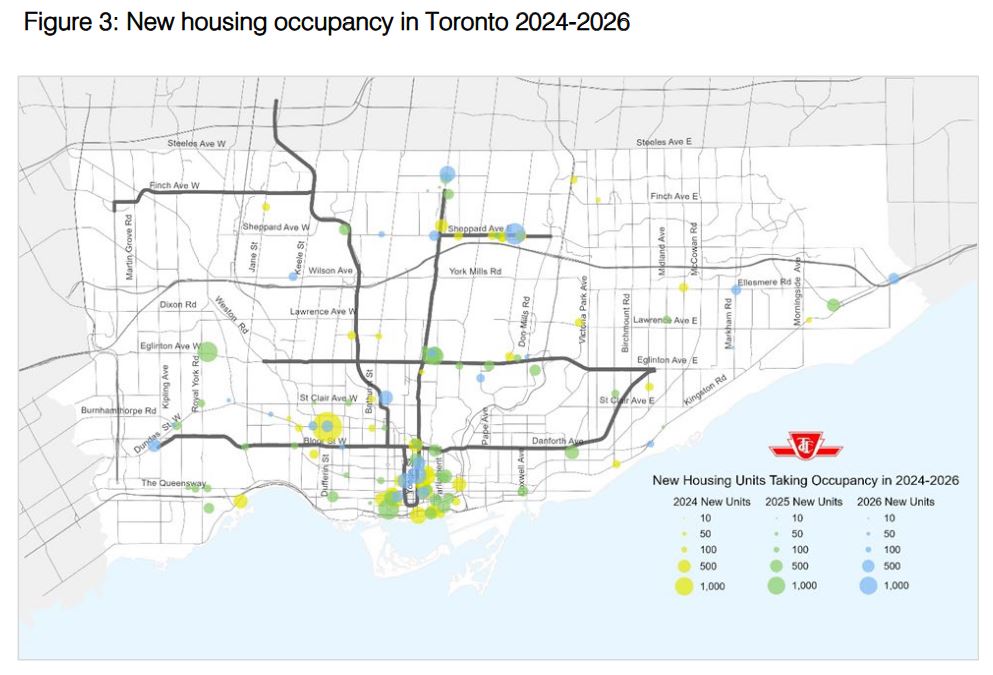
Housing developments affect riding, but only to the degree that transit serves the demand originating in new developments. There is a lot of talk of “transit oriented development”, but less of how well-oriented transit actually is to new and existing housing. Constraints flagged in the plan show the gap:
Integrating [travel demand forecasts] would allow the TTC to proactively adjust the transit network to match evolving housing and travel patterns across the city. A proactive approach would require additional investment to increase service prior to observed increases in demand. Given current fiscal constraints, the priority will continue to be adjusting service to observed demand. New services may be introduced on a trial basis if investment is made available through the operating budget process. [ANP p. 8]
The further one gets from the core, the more likely a resident’s destination will be in the outer 416 or in the 905 for work or school trips, but neither the local TTC nor regional GO services are oriented to serve this demand. “Transit oriented development” is an empty phrase if there is poor transit service to serve the potential new demand.
The TTC talks of “major service changes” in 2025, notably restoration of pre-pandemic service on the subway lines, and more frequent service on 512 St. Clair, 511 Bathurst and 505 Dundas. (Some of these are in place, some take effect on November 16.) However, the lion’s share of changes have been n response to travel time problems and congestion, not to provide additional capacity. Network changes in anticipation of new LRT lines are also in progress, but actual service levels are not yet known for all of them.
Bunching and Gapping Pilot
In 2025, the TTC began a pilot of increased supervision of several routes with the intent of improving reliability.
The Bunching and Gapping Pilot began in June 2025 with Divisional Supervisors deployed on-street to observe and recommend route management adjustments. Dedicated on-street supervisors can provide more targeted route management and frequent, real-time communication with operators.
In July 2025, a project manager was appointed and the Pilot was refined to focus on four routes: 7 Bathurst, 24/924 Victoria Park, 506 Carlton, and 512 St Clair. The selection criteria focused on poor performing routes while considering a variety of geographies and route types. Transit Control Supervisors are also deployed on 512 St Clair, while Divisional Supervisors support 7 Bathurst, 24/924 Victoria Park, 165 Weston Rd North and 29/929 Dufferin. Since transitioning to this new approach, schedule adherence has improved on these routes, delivering more reliable service to customers.
Looking ahead to 2026, the TTC plans to introduce new performance metrics, including mid-route OTP tracking for buses and streetcars to gain deeper insights into service reliability and support more responsive planning. [ANP p. 12]
The TTC’s analysis of “on time performance” is rather simplistic looking only at terminal departures, and averaging results over extended periods. This hides the variation in service quality riders typically encounter.
There is a separate report in the November 3 agenda on this, and I will discuss that in another article.
Construction Issues
Several construction projects affected TTC services, mainly downtown, through 2025, and plans to deal with these did not always work out as hoped.
- With City road and watermain projects bundled with TTC track work and diversion planning, a common problem was that the City aspects did not start and end on time. This meant that diversions and service changes were implemented before they were needed. After projected end dates, schedules reflected the “normal” configuration of routes even though diversions remained in effect longer than planned.
- Transit priority measures (aka “TPMs”) were planned for some diversions, but were not always implemented.
- Improved communication was limited to specific channels such as “Transit App”, and the TTC’s website continues to be a mixed bag with information scattered through several locations, and not always maintained consistently.
Looking ahead to 2026, the Plan states:
More effective bus replacement provisioning within streetcar replacement plans is a key mitigation tool, providing plans with a stronger focus on flexibility and responsiveness.
With the additional lens of the FIFA construction moratorium and simultaneous re-start of intensive construction work shortly thereafter, effective forecasting of resources (operator workforce, fleet, and capital funding) will be of particular importance. [ANP p. 13]
Doing things on time, and following the announced plans will be key. Riders should not have to depend on auxiliary sources of information such as this website to get accurate, timely information.
The 2026 Plan
“Enhancing Connections”
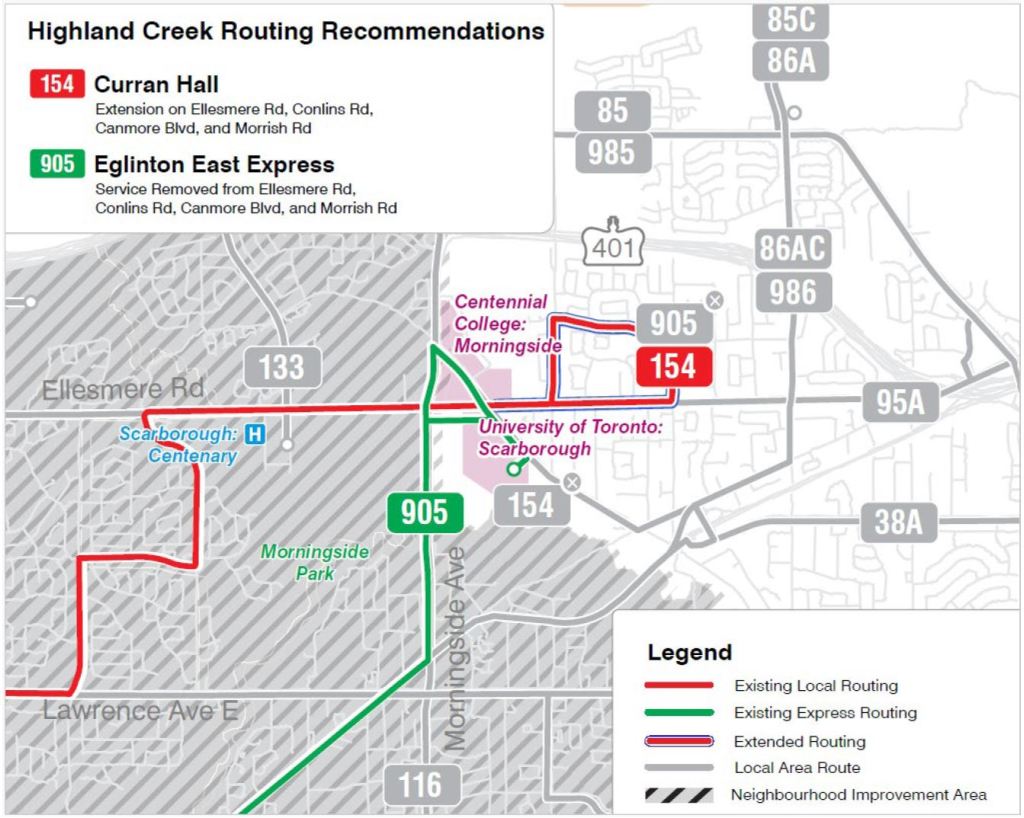
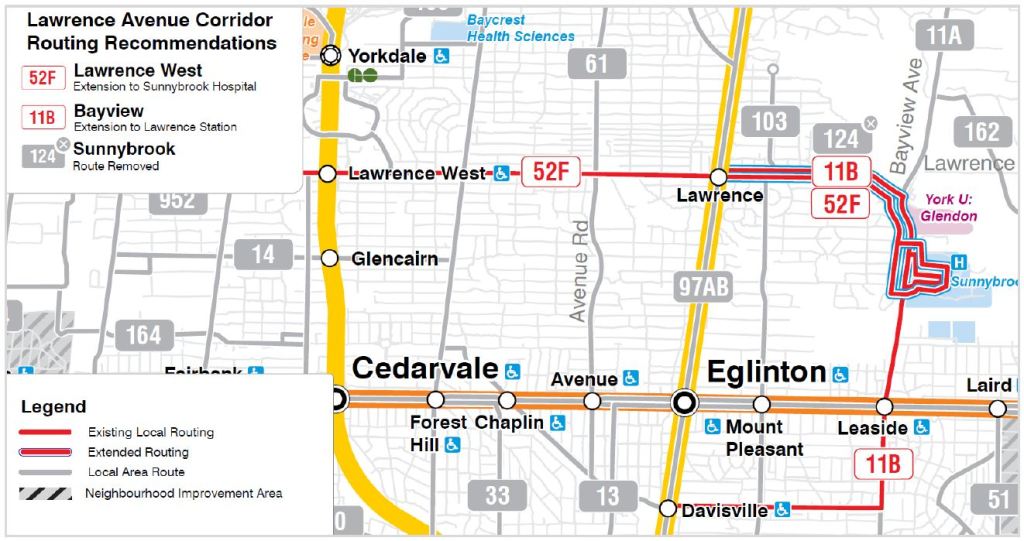
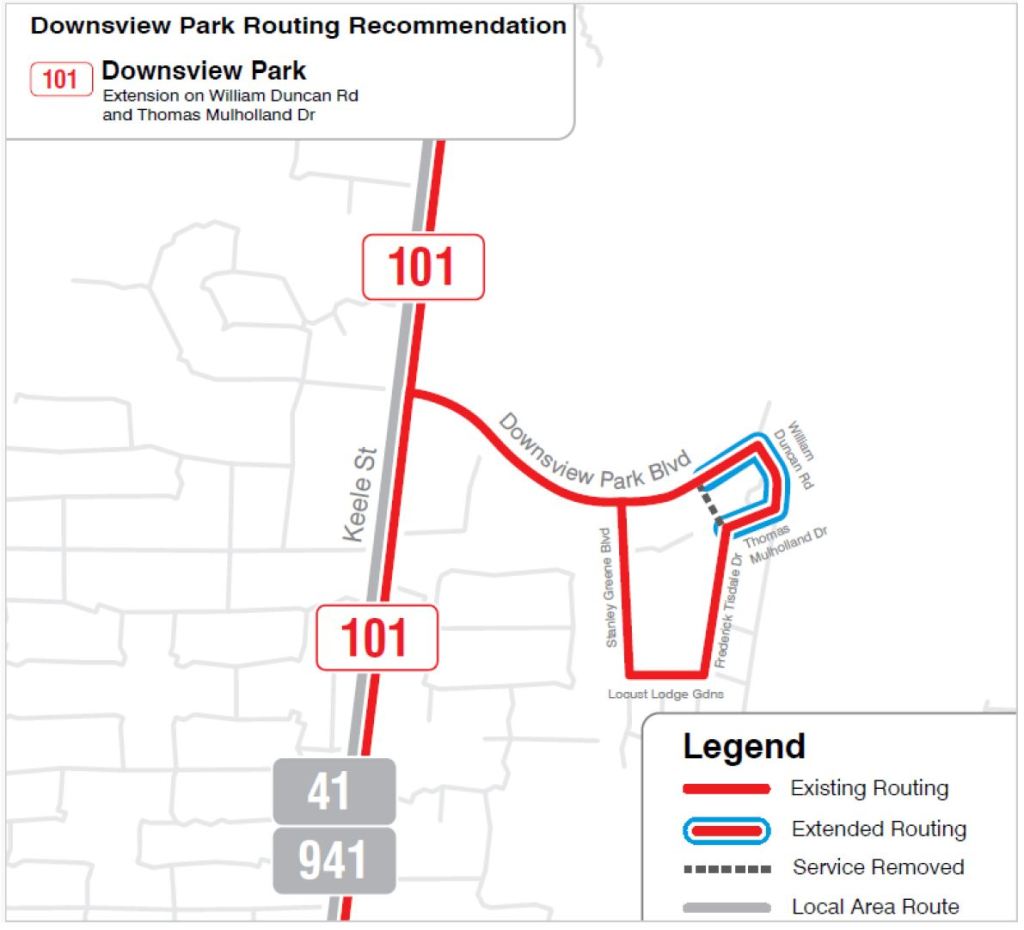
The plan touts that it will be making improvements in three areas: Lawrence Avenue, Highland Creek and Downsview Park. What is actually proposed is very low scale.
In Highland Creek, the termini of 154 Curran Hall and 905 Eglinton East Express would be swapped. The purpose is to replace an express bus that does not operate evenings and weekends with a route that operates full time. The problem with this scheme is that the 154 bus is extremely unreliable and infrequent. There would be “service” in the sense of a line on a map, but not something dependable.
In the Lawrence-Bayview area, the 124 Sunnybrook bus which operates between Lawrence Station and Sunnybrook Hospital would be replaced by extensions of the 52F Lawrence Royal York branch and the 11B Bayview service. The 52F now terminates at Lawrence Station while the 11B terminates at Sunnybrook. Note that the 52F does not run at all hours, but is an infrequent service during the daytime weekdays and Saturdays with headways of 18-22 minutes. It is also subject to disruption on Lawrence West.
In Downsview, the only change is a minor extension of the 101 Downsview Park loop as shown below.
All three of these are local changes with no effect beyond affected neighbourhoods. Much larger changes are, of course, pending for the opening of Lines 5 and 6.
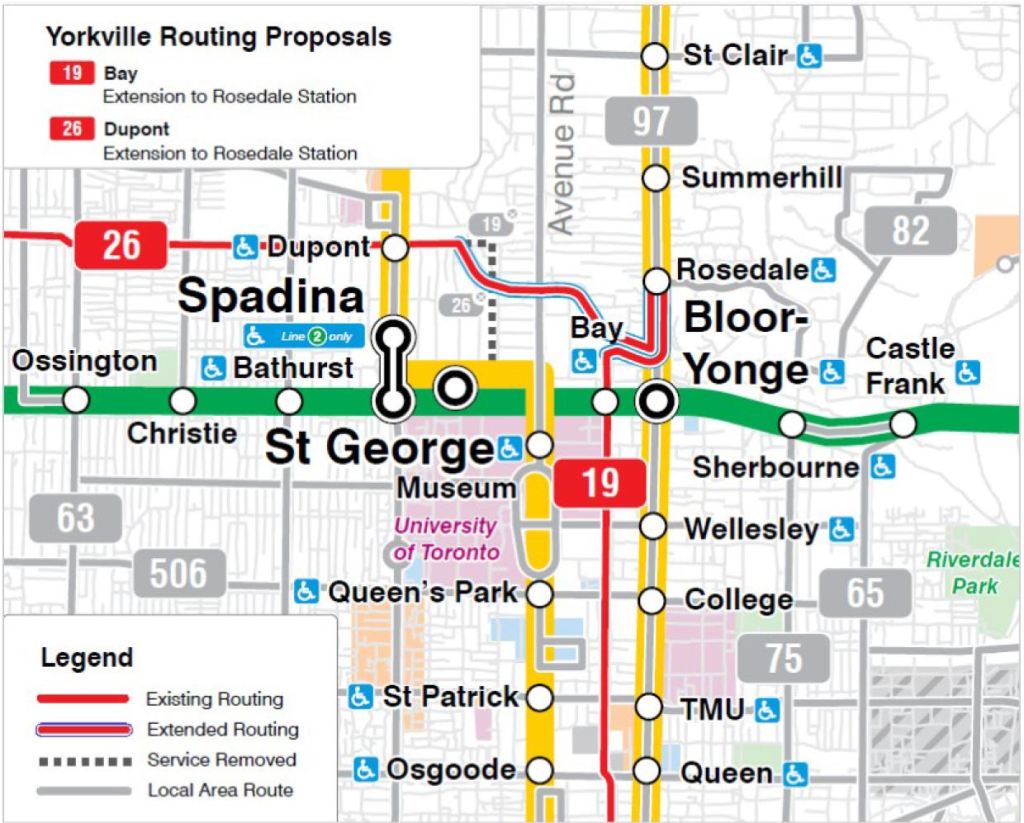
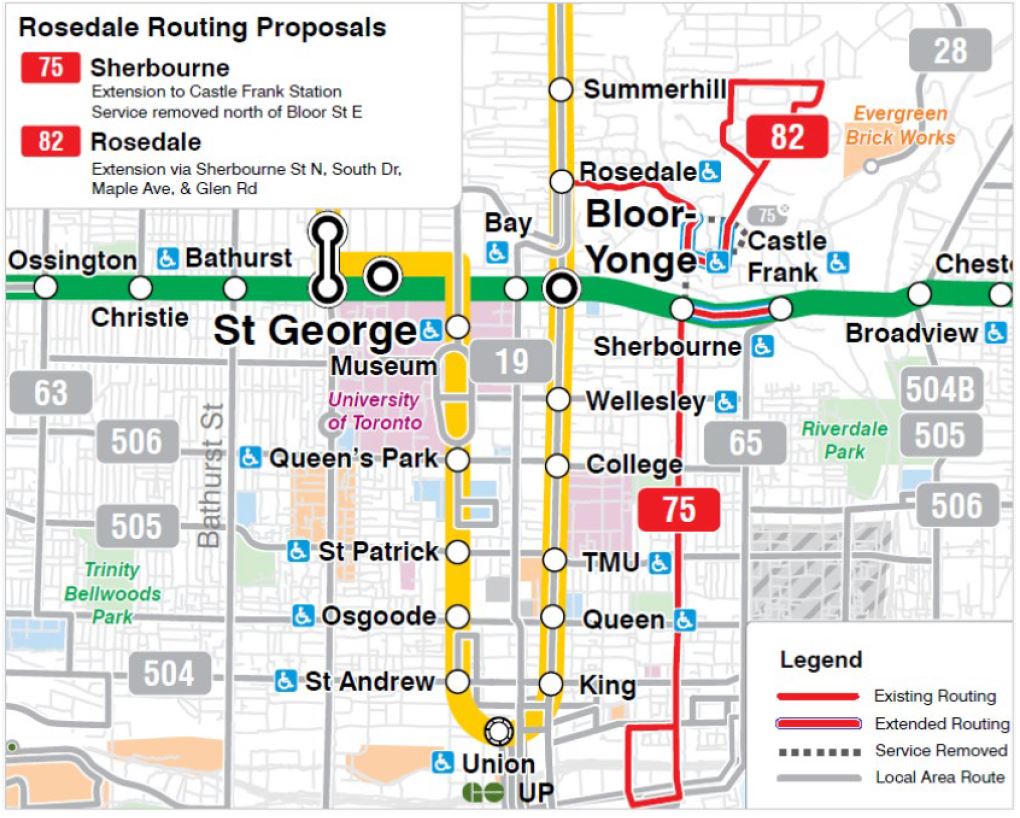
Two other changes were originally proposed, but were withdrawn due to negative rider feedback. These were a reorganization of 26 Dupont and 19 Bay to serve Rosedale Station, and of 75 Sherbourne and 82 Rosedale to shift the 75’s northern terminus to Castle Frank Station. Alternative schemes will be considered in future years.
In common with the recommended proposals, the affected routes have infrequent service (26 Dupont, 19 Bay and 82 Rosedale). The 26/19 Yorkville scheme would be more credible in bringing new service to Davenport Road if these routes were more frequent and reliable. An operational issue for both proposals is to provide an off-street loop for routes that do not now have one (19 Bay and 75 Sherbourne).
Several planned changes from the 2024 and 2025 plans have not been implemented because they await Line 5/6 openings, or require infrastructure (new stops) or because there was no operating budget headroom for them.
The budget effect of the 2026 proposals is only $0.6 million showing how small they really are. The cost of the 2024-25 changes would be $13.2 million. It is unclear whether any of these will actually be implemented beyond changes such as 191 Underhill which is already operating. (Note that some of the Line 5 changes were recently implemented, and more Line 5/6 changes are expected in the mid November schedules.)
| Constraint | 2024 Plan | 2025 Plan |
|---|---|---|
| Awaiting Funding | 42 Cummer, 78 St. Andrews, 130 Middlefield | 337 Islington, 345 Kipling, 353 Steeles, 373 Royal York, 386 Scarborough, 395 York Mills |
| Line 5 Opening | 73 Royal York, 191 Underhill, 901 Airport-Eglinton Express, | 334 Eglinton |
| Line 6 Opening | 906 Airport-Humber College Express | |
| Infrastructure | 49 Bloor West, 145 Belfield, 400 Lawrence Manor, 402 Parkdale, 404 East York, 405 Etobicoke |
Reviewing the Express Bus Network
In 2026, the TTC will review its Express Bus Network (900-series routes) with a view to reconciling them with service standards and goals. There are issues with schedule reliability, stop spacing and location, and time saving versus local service in the same corridor.
The Service Standard for express stop spacing is 800-1200m. In some cases, stops can be closer together because of major nodes such as transfer points or significant destinations, and there can be competing priorities for speed verses convenience and accessibility. Depending on traffic conditions, “express” buses might not be able to achieve the hoped-for travel time saving. Service frequency and reliability also has an effect because the wait time for an express can undo the benefit of a faster trip than on a local bus.
Based on the identified issues and performance gaps and findings from the 2026 ANP consultations, the express network review will focus on proposing performance, accessibility and customer experience as part of the 2027 ANP. Strategies will be developed to enhance travel time savings relative to local services and harmonize stop spacing to align with TTC service standards, ridership levels and customer needs. The proposals will aim to improve distinction between local and express services to reduce customer confusion. It will also include route adjustments where necessary to better serve key destinations and reflect actual customer travel patterns.
[…]
In Round 2 consultations, customers emphasized the need for strategic stop spacing to improve express bus speed while maintaining accessibility. They supported consolidating low-use or closely spaced stops while ensuring that local routes preserve coverage and accessibility for seniors and people with disabilities. Participants also stressed serving major destinations and cautioned against adding too many stops, recommending adjustments be guided by stop usage data and community needs. [ANP pp 28-29]
The important factor here is to avoid being doctrinaire about the standards while remaining aware of local conditions and needs along the routes. Getting quickly from “A” to “Z” is important, but there are many other places in between.
Ten corridors are flagged by the TTC as “high priority” for review for various factors.
| Travel Time & Reliability | 925 Don Mills, 938 Highland Creek, 944 Kipling South, 953 Steeles East, 984 Sheppard West |
| Stop Spacing | 954 Lawrence East |
| Local-Express Service Distinction | 937 Islington, 945 Kipling, 960 Steeles West, 986 Scarborough |
| Key Destinations Served | All of the above |
Planning for Construction
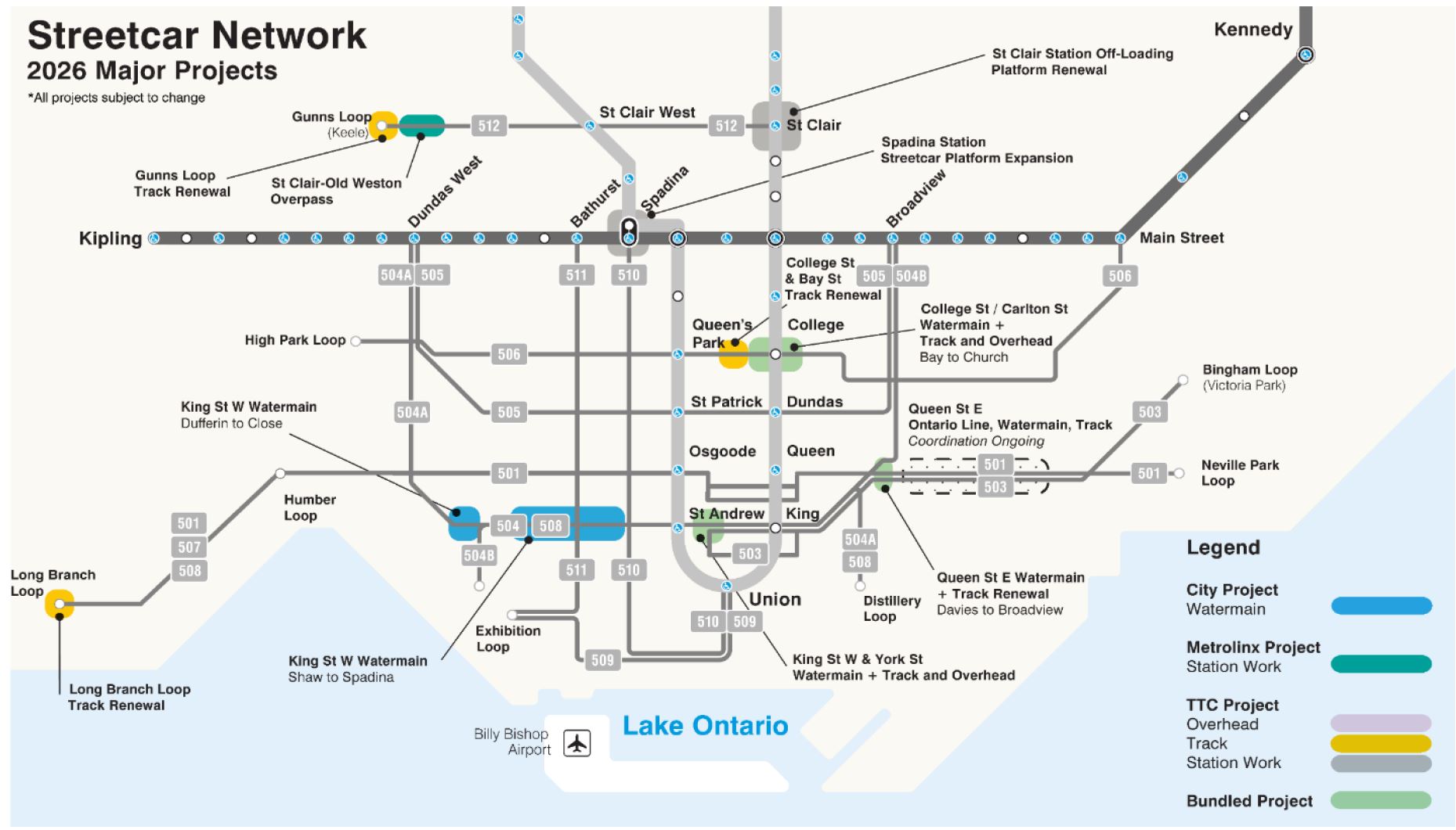
Construction, particularly of sewers and water mains, will continue to bedevil some streetcar routes in 2026. Plans for some projects are divided into two phases so that normal operation can resume for the duration of the FIFA World Cup games (June 12 to July 2, 2026).
King West
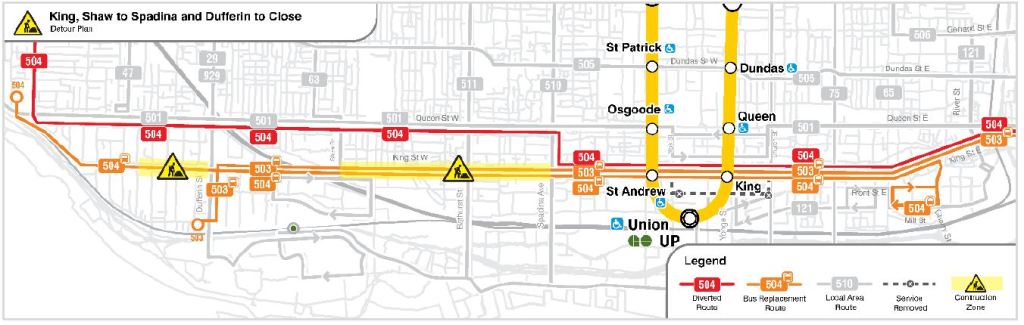
Water mains will be replaced on King between Dufferin and Close, and between Spadina and Shaw. This is a continuation of a multi-year project to replace infrastructure that is over a century old.
504 King will operate as one streetcar route from Broadview Station to Dundas West Station running via Spadina and Queen during Phase 1. A 504 bus will run from Sunnyside Loop to the Distillery, and the 503 Kingston Road bus will run to Dufferin Loop as it does currently (October 2025).
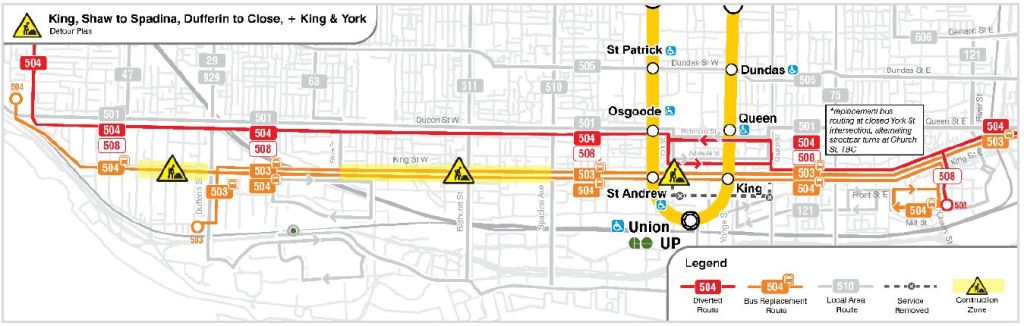
In Phase 2, the watermain and track work at King & York will be replaced. This will include addition of an east-to-north curve for greater flexibility with diversions. Current plans are for streetcars to divert via Church, Richmond/Adelaide, York and Queen, but this is to be confirmed due to issues with streetcar congestion on this diversion when both the 501 and 504 shared it before. The route for 504 and 503 buses on King around the work at York Street has not been decided.
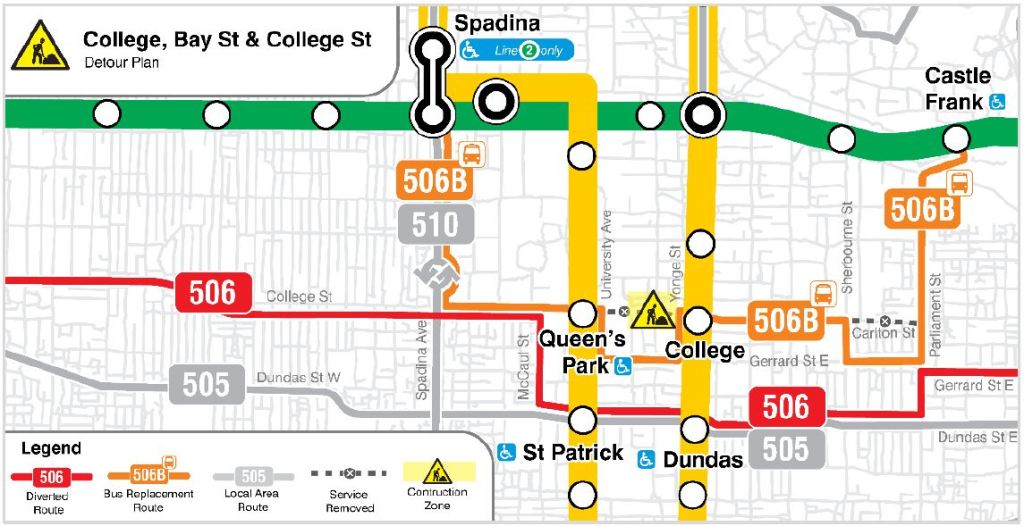
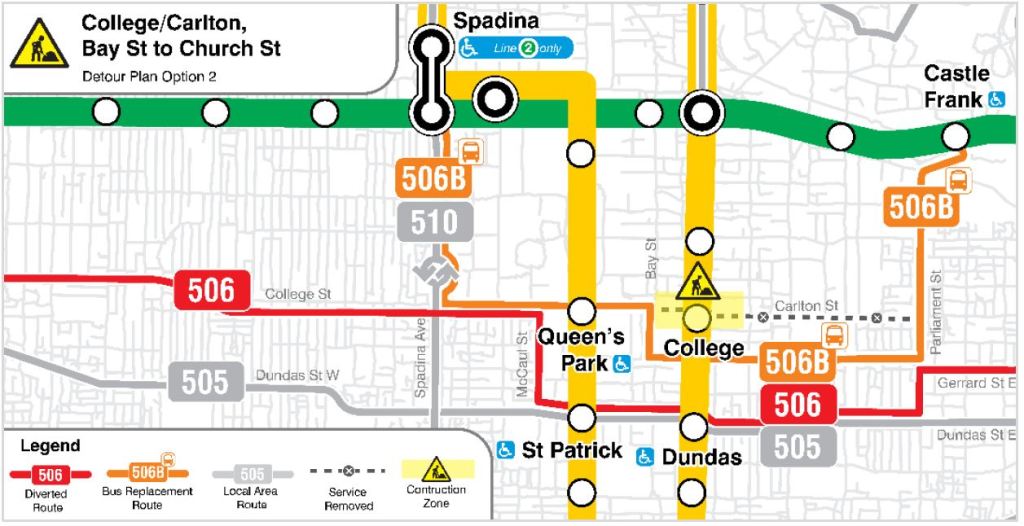
College/Carlton
Work on College and Carlton involves the replacement of track at Bay & College in Phase 1. In phase 2, track, overhead and sewers will be replaced on College/Carlton between Bay and Church.
In both phases, a 506 Carlton bus will operate from Castle Frank to Spadina Station diverting via Gerrard. During Phase 1, the diversion will operate between University and Yonge, returning to Carlton east to Sherbourne and then back south to Gerrard. This will preserve a transfer connection with the 506 streetcar diverting via McCaul, Dundas and Parliament. During Phase 2, the 506 bus will run via Gerrard between Bay and Parliament.
St. Clair/Old Weston
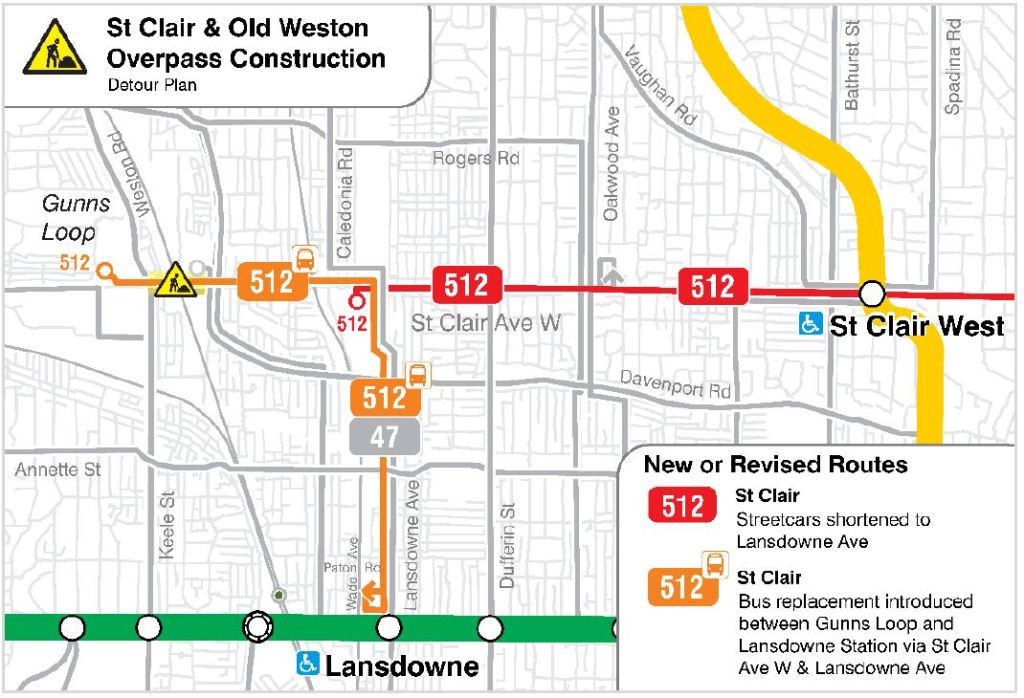
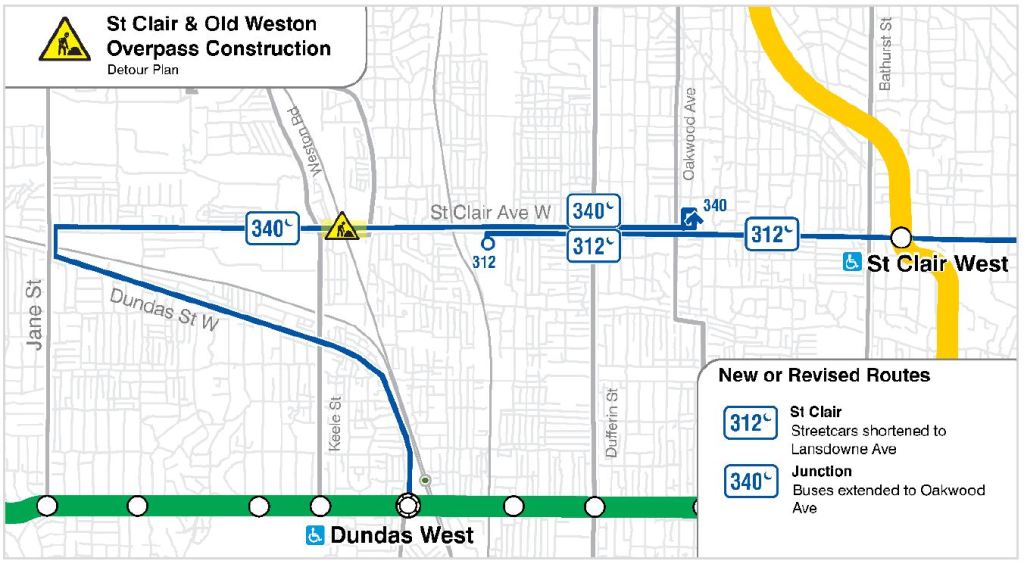
Construction between Old Weston Road and Keele Street for GO corridor expansion and the creation of a station will prevent streetcars from operating through the underpass under the rail corridor. 512 St. Clair cars will turn back from Earlscourt Loop at Lansdowne, while 512 buses run from Gunn’s Loop to Lansdowne Station. The 312 St. Clair night car will end at Earlscourt Loop, and the 340 Junction night bus will be extended east on St. Clair to Oakwood Loop.
Streetcar Construction Map
The map below summarizes all of the planned construction affecting the streetcar network in 2026. The Plan is silent on the need for replacement services during some of these projects such as Spadina Station platform expansion.
FIFA Service
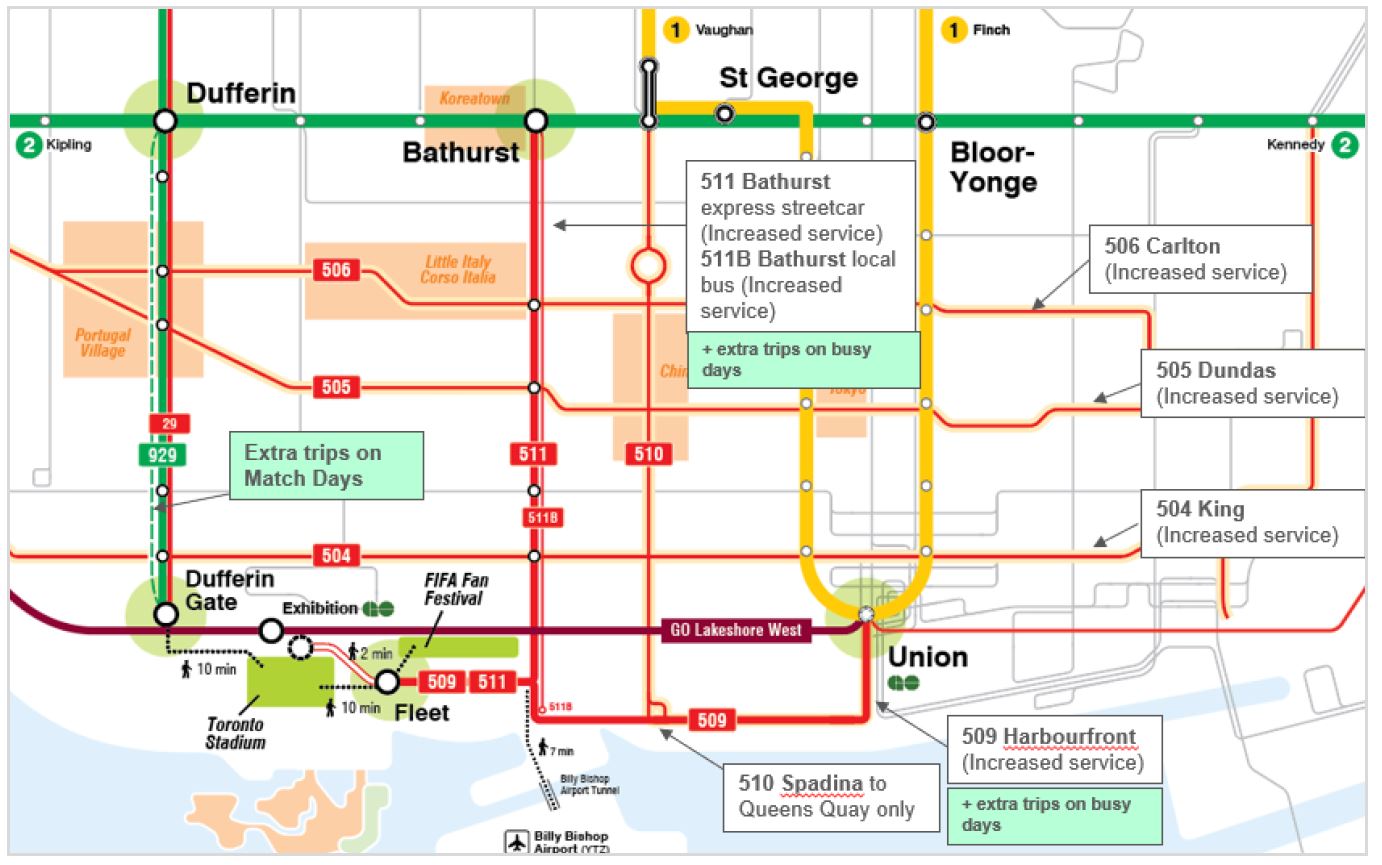
During the few weeks that the FIFA World Cup games will be in town (mid June to the beginning of July), the City and its transit system will be transformed to serve our thousands of visitors. Construction will magically vanish, and service downtown will improve.
The map below gives a preliminary idea of what is planned.
Of particular note is the fact that the delivery point for transit riders from the east will not be in Exhibition Loop, but at a temporary “Fleet Station” east of the CNE beside the FIFA Fan Festival area. Temporary platforms east of Strachan will serve arriving and departing streetcars. 511 Bathurst streetcars will run express, although this will be something of an amble unless the TTC deals with its long-standing slow orders at streetcar junctions. 511 Bathurst buses will provide local service.
Reviewing Underperforming Services
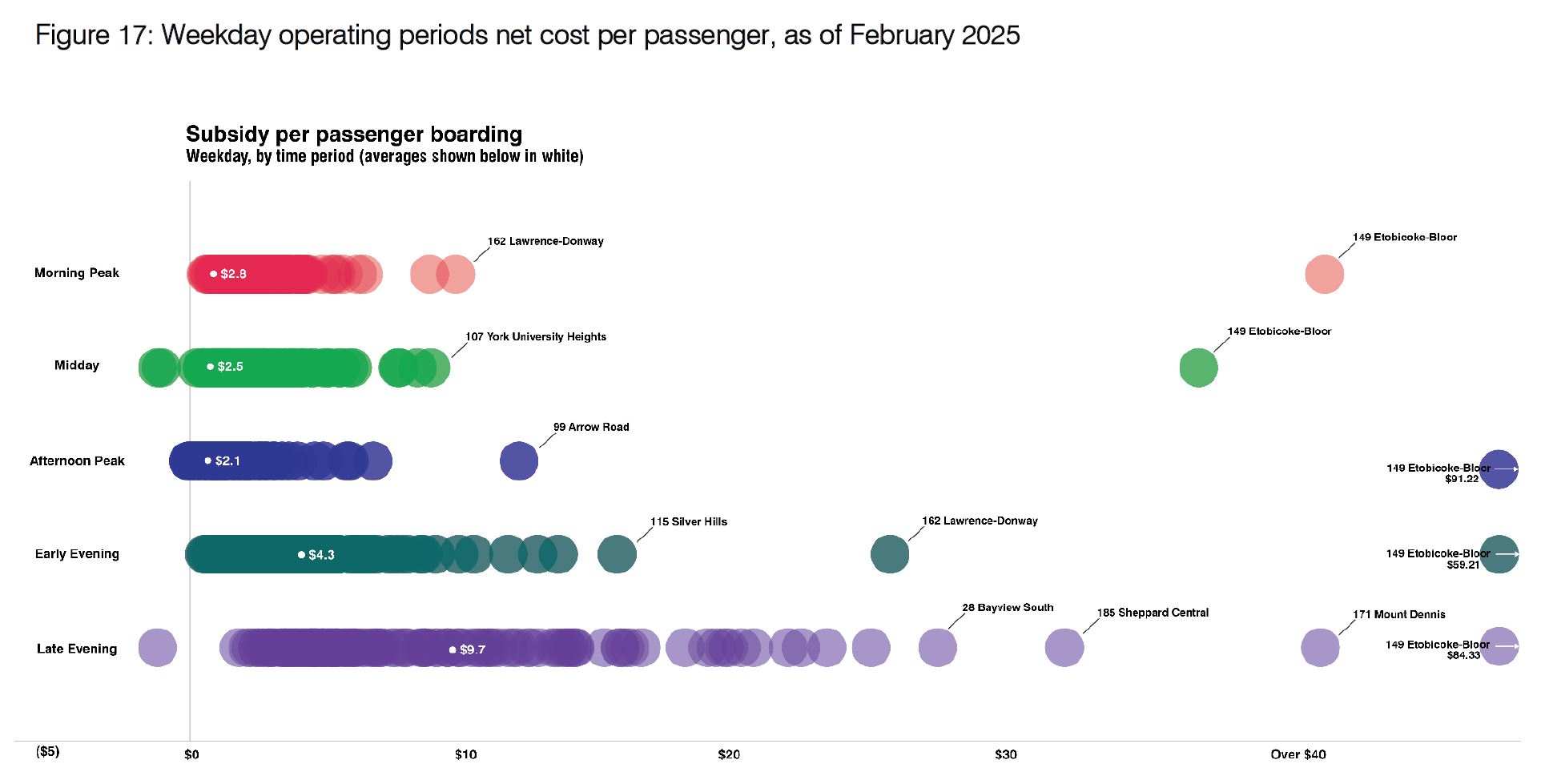
After many years when service design was based on “keeping the lights on” in the pandemic, the TTC has resumed attempting to identify poorly performing services for review. The chart below shows the distribution of subsidies per passenger with the outlying routes identified.
The very badly performing routes are little surprise especially 149 Etobicoke-Bloor which exists only as an accessible alternative on the west end of Line 2 where full station accessibility is incomplete. This route will vanish when the last elevator is finally activated. Other routes exist mainly as links to TTC garages such as Mount Dennis and Arrow Road, or fill specific network gaps. It is no surprise that on average the lowest cost/passenger occurs during the daytime when vehicles are well-utilized.
There is no indication of crowding levels to weigh against the financial data and whether good results stem from TTC packing in many riders even when this violates their own standards.
The methodology for calculating operating costs is not shown. This type of analysis contains a central flaw because some riders are inherently more expensive to serve than others.
On short routes, riders do not travel far and so the cost of serving them is low. On long routes where rides can stretch for many kilometres, the cost per ride can be high, although if a route has lots of turnover (individual riders taking short trips), the operating cost of the long route is diluted. Routes and time periods with strong bi-directional demand also fare better. Every route cannot be the Dufferin bus with strong, diverse all-day demand (not that other aspects of 29 Dufferin should be emulated).
The allocated fare revenue is the same in each case, but the net cost per rider gives no indication of how well used or needed the service might be. This show up on small routes like 22 Coxwell and 64 Main which have strong demand, but short trips. However, some longer routes also show up at the top of the cost recovery lists, notably 29/929 Dufferin. Strangely enough, the TTC does not take comparative profitability as a sign that they should run more service.
The Plan contains a table showing the purported cost/rider for each route in each time period. I imported this table to a spreadsheet and formatted as a PDF here.
Some of the numbers in this table do not make sense, but more generally they illustrate that there is no hard rule to identify “poor” routes. The worst of the worst will always do badly, but many routes with some poor periods are basic parts of the network and cannot be trimmed just because they have expensive riders at some periods.
Some routes have oddities such as very expensive AM peak riders, but reasonably priced PM peak riders. This is likely due to the early shoulder of the peak being included in the AM when there is frequent service, but fewer riders. By contrast, the PM peak is bounded on both sides by fairly the busy midday and early evening. It simply does not make sense that riders on 501 Queen cost $4 each in the AM peak, but only $1.07 in the PM peak; nor that 929 Dufferin Express riders cost $0.75 in the AM peak, but only $0.12 in the PM.
This table is an example of poor analysis that has beset the TTC’s attempt at service evaluation for many years.
The best performing routes in each time period are shown below. Note that the “best” two in midday actually do not operate during that period, and this is obviously an error in the TTC’s data.
| AM Peak | 64 Main, 135 Gerrard, 16 McCowan, 29 Dufferin, 929 Dufferin Express, 109 Ranee, 22 Coxwell, 41 Keele, 87 Cosburn, 113 Danforth |
| Midday | 938 Highland Creek Express (?), 508 Lake Shore (?), 64 Main, 22 Coxwell, 512 St. Clair, 16 McCowan, 41 Keele, 20 Cliffside, 505 Dundas, 65 Parliament |
| PM Peak | 64 Main, 22 Coxwell, 512 St. Clair, 504 King, 505 Dundas, 929 Dufferin Express, 16 McCowan, 65 Parliament, 41 Keele, 87 Cosburn |
| Early Evening | 64 Main, 505 Dundas, 75 Sherbourne, 65 Parliament, 504 King, 16 McCowan, 22 Coxwell, 113 Danforth, 512 St. Clair, 935 Jane Express |
| Late Evening | 905 Eglinton East Express, 16 McCowan, 29 Dufferin, 113 Danforth, 20 Cliffside, 36 Finch West, 505 Dundas, 75 Sherbourne, 24 Victoria Park, 67 Pharmacy |
The ten poorest performing routes by time period are shown below. The same routes appear in several time periods, but it is important to note that none of these uses many buses. Cutting service would produce only a small saving, and could not be touted as a major “efficiency drive”.
| AM Peak | 149 Etobicoke-Bloor, 162 Lawrence-Donway, 938 Highland Creek Express, 185 Sheppard Central, 97 Yonge, 171 Mount Dennis, 80 Queensway, 115 Silver Hills, 8 Broadview, 121 Esplanade-River |
| Midday | 149 Etobicoke-Bloor, 107 York University Heights, 184 Ancaster Park, 185 Sheppard Central, 162 Lawrence-Donway, 115 Silver Hills, 169 Huntingwood, 99 Arrow Road, 121 Esplanade-River, 171 Mount Dennis |
| PM Peak | 149 Etobicoke-Bloor, 99 Arrow Road, 185 Sheppard Central, 162 Lawrence-Donway, 184 Ancaster Park, 115 Silver Hills, 121 Esplanade-River, 114 Queens Quay East, 107 York University Heights, 127 Davenport |
| Early Evening | 149 Etobicoke-Bloor, 162 Lawrence-Donway, 115 Silver Hills, 99 Arrow Road, 185 Sheppard Central, 184 Ancaster Park, 107 York University Heights, 171 Mount Dennis, 62 Mortimer, 28 Bayview South |
| Late Evening | 149 Etobicoke-Bloor, 171 Mount Dennis, 185 Sheppard Central, 28 Bayview South, 33 Forest Hill, 13 Avenue Road, 184 Ancaster Park, 167 Pharmacy North, 114 Queens Quay East, 124 Sunnybrook |
Post-Implementation Service Reviews
Three recent route changes are reviewed to see if they achieve target performance levels:
- 200 Toronto Zoo
- 503 Kingston Road evening and weekend service to downtown
- Line 3 bus replacement service
200 Toronto Zoo
The 200 Zoo bus provides dedicated link between Rouge Hill GO station and the Zoo. It generally did not meet productivity or financial targets, and yet the service is valued by riders. Because riding patterns are in flux, the TTC will leave this route in operation with a further review after 2026 results are in.
503 Kingston Road
The 503 Kingston Road streetcar was originally a peak period service from Bingham Loop at Kingston Road & Victoria Park to York & King via Wellington Street. It was accompanied by a weekday daytime and peak 502 Downtowner car that ran to McCaul Loop via Queen Street. The 22 Coxwell bus provided service on evenings and weekends to Kingston Road.
The current operation sees all day service from Bingham Loop to various destinations downtown including York Street, Charlotte Loop (Spadina), Dufferin Loop and Roncesvalles depending on the many variations in diversion routes and construction projects. The Coxwell bus runs between Coxwell Station and Queen Street during all hours.
The TTC’s analysis shows that currently, the 503 does not meet productivity and financial targets, but they also observe that these can be affected by where the route ends downtown. The further west it goes, the better it penetrates the entertainment district and picks up more riders. The 503 also acts as a supplement to the 504 King streetcar service. Generally speaking, the metrics for the 503 extension have been worsening over time and this is likely due to the effect of various construction projects.
The TTC proposes to leave the route on probation pending further developments, although it is likely to remain a bus operation for some time given construction plans for the Queen and King corridors.
However, given the utility of the route in supplementing service along key corridors such as Queen St East and King St during disruptions due to construction, there is strategic value to maintaining the service within the current capital projects horizon. There are various construction projects anticipated along Queen St E and King St, both to support the implementation of new rapid transit infrastructure and the renewal of TTC and city owned assets, over the next several years. This will also allow further time for ridership growth. Should continued monitoring show the service still does not meet standard, it is recommended that it be removed.
A related question is whether the TTC will evaluate only the shorter (York Street) version of the route, or consider leaving an extended version in place to add capacity in the King Street West corridor.
Line 3 Bus Replacement
Riding on the consolidated bus routes replacing Line 3 SRT is reasonably strong at 21,395 o weekdays, 14,040 on Saturdays, and 10,452 trips on Sundays. These are not net new trips on the system, but simply trips that likely formerly used the SRT. Some journeys likely migrated to other routes, and some riding may have been lost. In any event, there is no meaningful cost or revenue per “new” rider.
According to the Plan, some of the service between STC and Kennedy Station is underused, and there are problems with bunching and gapping. Even without issues of line management, irregular headways are inevitable when several routes, each on its own schedule, are combined over a common corridor. “[…] the continuous and consistent blending of departures from both Scarborough Centre Station and Kennedy Station across all bus replacement routes is relatively infeasible given the scheduling complexity associated with a change of this magnitude.”
Meanwhile, crowding problems are reported on routes parallel to the corridor and also on some east-west routes. This suggests that demand has redistributed itself on the revised network over what are now more convenient paths now that the SRT is not available.
The TTC plans further review and consultation to determine what changes could improve the overall service in and near the SRT corridor.
Technical Assessments
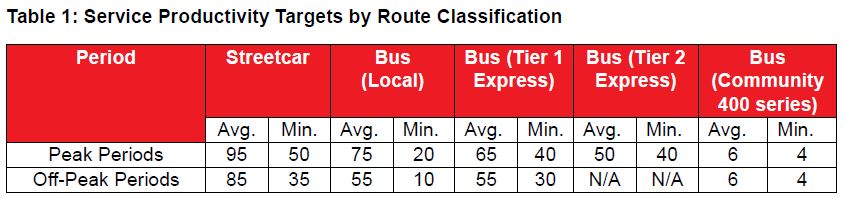
Proposed changes in the network are subject to a variety of criteria either for service additions or removals. The first of these is boardings/vehicle hour.
For example, a local bus route is expected to achieve at least 10 boardings/hour in off peak periods, while the target for streetcars is 35 reflecting their larger size. Note that at 10/hour, a bus can be far from full but still meet the productivity target. On a short route with a one hour round trip, only five riders need to board in each direction. The target is not to have vehicles packed to the rooftops especially in the off peak.
One irony in this target is that route amalgamations can reduce the apparent productivity by eliminating boardings created by transfers between vehicles. Similarly, splitting a route can add to boardings. This also affects revenue allocations based on boarding counts. One example is the split of 501 Queen into two routes, 501 and 507 Long Branch. Through riders now count as two separate, shorter rides, and they allocate twice as much “revenue” in the financial model as on a combined route. This is a nonsensical result of a bad model.
Another target is the change in ridership per net dollar gained or lost. This metric has been the object of debate over the years because it is not “dimensionless” in the same sense that a rider count is. Quite obviously, $100 buys less service every year as costs inflate, and fare levels today do not represent as high an income source as they did 10 years ago. This metric must be recalibrated each year to account for current conditions.
On the premise that a 10% fare reduction yields 11 new riders per $100 dollars spent, service changes are expected to generate at least that number of new rides per $100 of service cost. In past years, thanks to a failure to adjust this factor for inflation, it became increasingly difficult for any change to achieve the financial goals especially when fares did not rise at the same rate as operating costs.
Another metric is the travel time benefit to riders. If a change has a net benefit in travel times, then it passes the test. This is an example of how the good of the many can work against small scale changes that affect fewer riders. For example, making a route longer by distance or by adding stops will affect every passing rider, but will likely benefit far fewer who are “local” to the change. Similarly, removing stops will always benefit the many riders already on board compared to the few waiting for a bus. The problem lies in tradeoffs between speed of service and easy access to transit.
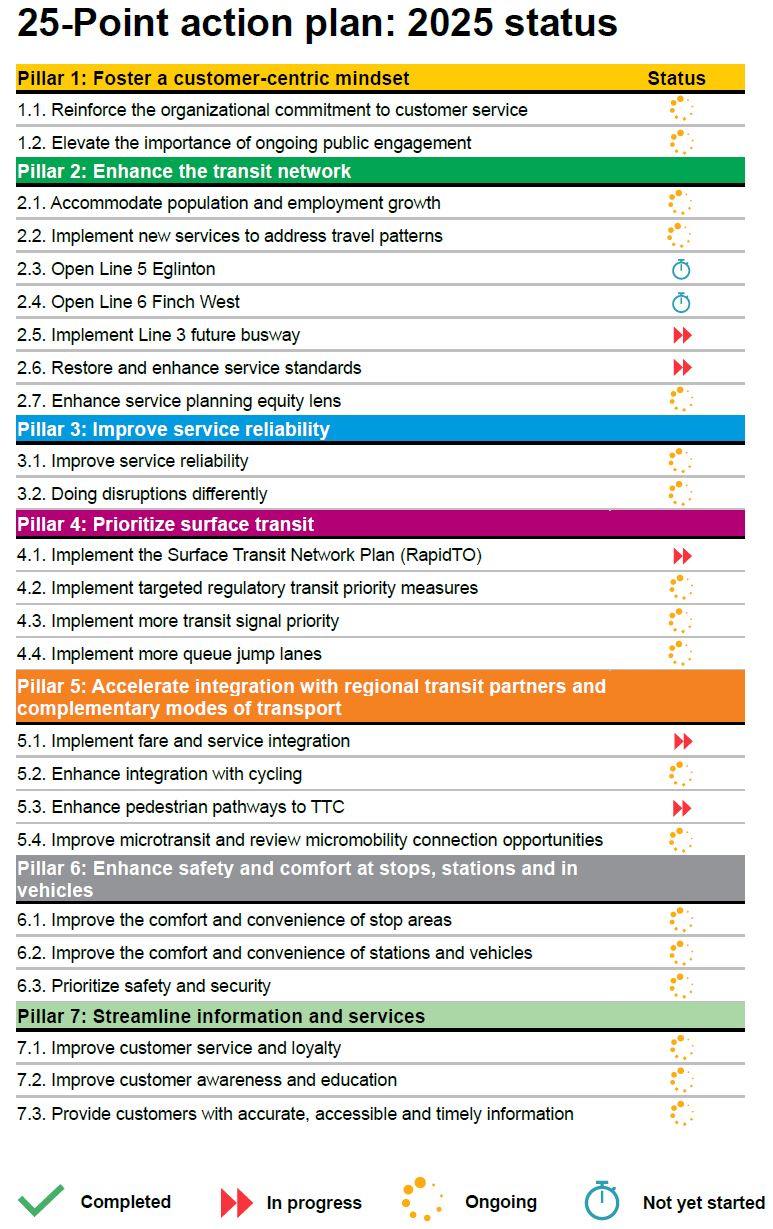
The 5-Year Service and Customer Experience Action Plan
This plan is separate from the Annual Network Plan, and deals with many aspects of making the system more attractive to riders. In that sense it will overlap the Ridership Growth Strategy whenever that is published.
The table below summarizes the status of 25 main points in this plan, and notably none of them is shown as “completed”. Many are “in progress” or “ongoing”. I will address this plan in a separate article.
 Steve Munro
I note that the 121 (Esplanade-River) bus is listed as a poor performer in the AM peak, at Midday and in PM peak. One reason is that it no longer has a stop adjacent to a subway station. At one time, the 121 looped so that it passed King Station going eastbound and picked up many passengers there. When it moved to its current route the stop “at Union Station” was on the east side of Bay Street – not that convenient to the Union Station subway exit but visible from it, if one squinted. Recently the stop location has been moved 50 meters further east (to the middle of the Bay-Yonge block of Front) so that it is further from Union and virtually invisible when exiting the station. (From a non-transit user view, this is a better location as buses laying over at this stop (which also serves the (new) 114) do not block Front but …) A far better loop would be south on Simcoe or University and then east on Front with a stop immediately in front of the Union Station subway exit. Of course, like all TTC services, the 121 would get far more passengers if it was properly managed and if the vehicles were properly spaced!
Steve: This is an example of how the TTC fouls up routes and deters ridership. They were so keen on the layover space for buses on Front that they forced the 121 further away. The situation with their analysis of the 503 Kingston Road car is similar. Much hand wringing about declining demand, and the eventual “fix” is to kill it off rather than structuring the route to improve its catchment area.
LikeLike
Too bad but it looks like the Kingston Rd streetcar 503 is dead or at least dying…..
Steve: The TTC seems bent on working against than for the streetcar system.
LikeLike
This may be off topic but for the 48A Rathburn school trip from Micheal Power/St Joseph High School, does actually show “48A” on the dest sign? I’m wondering this because when the 12E school trip was a non stop route, I don’t think it showed “12E” so I’m wondering if you know about the 48A?
Steve: Information about signage for school trips is generally not included in the monthly service memo, so I don’t see it.
LikeLike
Wow! A lot of work went into this, Steve. THANK YOU VERY MUCH!
Steve: You’re quite welcome!
LikeLike
Are there any plans to remove street car stops along the 512 route?
Steve: Yes. I will be covering this in the article about the bunching & gapping report. In brief they propose removing Stock Yards eastbound, Silverthorn/Hounslow Heath both ways, Northcliffe both ways, Tweedsmuir both ways and Dunvegan both ways.
Some of these changes violate the TTC’s own service standards, but management seems to make them up as they go along at times. It is not clear which of these will actually be cut.
LikeLike
Hey Steve, great review as always!
I was just wondering what the TTC was going to do with 953 Steeles East Express bus as well as what “travel time and reliability” meant? during the consultations the TTC was hosting me and a friend went to the people there and explained how the 953 being rush hour only severely hampered its usability especially compared to its Steeles West counterpart as well as the fact that it takes Bayview to Finch during the afternoon rush rather than continuing on Steeles and taking Yonge down to Finch so that it could stop at Yonge and Steeles and they said that people said that it was faster. I was just wondering if they were going to look at making it all day as well as weekends or if this is something else entirely.
Steve: Looking at the tracking data for September, yes, headways on the 953 are not particularly reliable, but they echo many other routes in that regard. The routing via Bayview was implemented many years ago to bypass congestion on Yonge Street.
It is not yet clear how thorough the review of express routes will be next year (all routes, or just ones considered “problems”) and how aggressive TTC management will be in proposing improvements that cost money. I look forward to public consultations.
LikeLike
Is the TTC still planning on merging the 22 coxwell and 70 o Connor bus routes?
Steve: I don’t know. Proposals like this come and go in service plans without any sense of their status. One obvious problem is that service on 22 Coxwell is better than on 70 O’Connor, and more buses would be needed to link the routes unless the 22 fell off of the 10-minute network.
LikeLike
In the last week or so all the Proterra buses have been ‘retired’. In any case they are sitting in North Queen yard where obviously they can’t operate out of.
These were the only buses that the TTC has with actual rear windows.
The thing is, on a street with both local and express buses, having a peek out the rear window can give a rider some idea if it’s possible to switch from one to another. For example hopping on a quicker express from the local; or switching to a local to get off at a stop not serviced by the express.
I suppose in theory some transit app might tell you this with some accuracy. The reality is that I have often enough been sitting on a bus only to see a less crowded bus zip by and vanish over the horizon in a cloud of dust.
LikeLike
The report features a section of proposals from councillors that were rejected. Do you have any opinions on these proposals? I’ve long wanted an Empress route.
Steve: There are four proposals: 28 Bayview South via Merton Street, Churchill-Empress, 927 Highway 27 Express to Queen’s Plate Drive, and 116 Morningside extension to McNicoll.
The 28 Bayview via Merton proposal has a problem with being relatively close to Davisville Avenue (under 300m to the south), but moreso that the 28 is an infrequent service. Running it on Merton would only be attractive to riders willing to “make an appointment” with the bus. A transfer connection to the regular 11 Bayview service would be needed to access the shopping district on Bayview or Sunnybrook Hospital. I am not sure this is practical.
The Churchill-Empress route covers a lot of territory with a meander from Leslie Station to Bathurst Street. I am surprised the TTC does not mention operational issues on narrow streets and the likely loss of parking spaces. There is a point to be made about access to parallel service considering barriers including a cemetery, and the idea that this bus would steal riders from the subway is really a stretch. There is no proposed service level, and it would likely be infrequent as a new route through residential neighbourhoods. This works against getting enough riders to meet the Service Standards criteria. The question here is how much of the route lies in a “transit desert” where nearby service is not easily accessible.
The Highway 27 express routing via Queen’s Plate Drive is interesting because the 927 is a rare case of a truly express route that has no local equivalent serving the area it passes through. There are no stops, indeed no destinations for riders, on Highway 27 between Bethridge and Queen’s Plate Drive. TTC claims significant delays to the riders whose trips would be diverted many of whom are likely bound to/from Humber College, but there are no hard numbers for the analysis. The issue with accessing Highway 27 from Bethridge southbound where there is no traffic signal is a legitimate concern. It would be interesting to see a more extensive review of the industrial area in northern Etobicoke and what unmet transit needs it has.
The 116 Morningside extension is, in effect, on hold pending road works, although the TTC recognizes the value of this once conditions permit.
Troubling in all four evaluations is the absence of specifics in the evaluation: service levels, incremental vehicle requirements if any, projected ridership both net new and diverted from other routes. There is also a mention of the need to construct stops on some of these routes. I have not seen this concern raised before, although it is likely related to accessibility issues and safety.
Generally I agree with the evaluations, although I think they could have been more convincingly presented. The absence of maps means that a reader (e.g. a Board member) who is unfamiliar with the affected areas has to trace the routes and determine what lies along them. I get the impression that management are counting on these being buried in a much longer report that hardly anyone will read.
LikeLike
You wrote “19 By” in this sentence. “In common with the recommended proposals, the affected routes have infrequent service (26 Dupont, 19 By, and 82 Rosedale).”
Steve: Fixed. Thanks.
LikeLike
I feel like the 19 Bay and 75 Sherbourne to Rosedale station could work, to keep the 75 service north of Bloor and I am guessing a big public disagreement to move the 26 Dupont as well away from St George Station as a comprimise. Be a nice Line 1 to Line 2 connection via bus for these routes, and Line 3 for Sherbourne whenever that opens.
Wouldn’t also cutting back the 149 Etobicoke-Bloor Bus help maybe frequency or operations if the segment to High Park got axed?
Seems that Islington and Old Mill are the only stations with no elevators, would it be better to just run them to Royal York that is in between them. Or possibly extend some buses to run to stations with elevators? I remember seeing the 35 Jane I think go to Old Mill after Jane, maybe something similar possibly for an Islington. Seems like 149 is a big waste, don’t particularly see anyone use it, or maybe a Community or Wheel-Trans bus replacement could suffice?
LikeLike
I seem to recall a recent attempt (last year? this year?) at running a St. Clair-to-Lansdowne Station bus that ended up being changed because the TTC discovered that there are speed humps on its planned loop via Paton Road and Wade Avenue. Have these been removed, or has the TTC policy on speed humps changed, or is this something that’s gone missing between planning and operations?
Steve: I’m not sure if they are still there. A site visit (or a knowledgeable local adding to this thread) would be needed to confirm.
LikeLike
Steve – what are your thoughts on the 137 Rexdale reference in the suggested changes?
And I don’t see any mention of the 150 Eastern – is it officially dead?
Steve: The 137 change is mainly a rebranding of a branch of 37 Islington, but with a separate number, there would no longer be any attempt to blend the services. 150 Eastern has been in part supplanted by 114 Queens Quay East. I suspect it is at the very least sleeping soundly.
LikeLike
Sorry Steve – one more post. The 200 is mentioned as returning in 2026. What about the other 200 series routes? And thanks for all of your work – as always!!
Steve: Yes, the others will be back too. The 200 went through re-evaluation because it was a “new” service.
LikeLike
The east end terminus could be extended to a subway station too.
LikeLike