
Updated October 21 at 4:20pm: The TTC posted an updated map and table of RSZs dated today. Information on the map and tables now match. There are only 9 active slow zones with target removal dates through to late November. The October 21 versions have been added to the end of this article.
Updated October 17 at 11:00pm: The TTC posted an updated map and table of Reduced Speed Zones dated October 17, but the info on the map is still out of sync with the info in the table of slow zones. The revised version is at the end of the article.
In previous articles, I have reported on the number, location and longevity of reduced speed zones on the subway. See:
A recent problem with the TTC website page where these are reported is that information is inconsistent between the map showing problem areas and the tables explaining each problem and its expected resolution.
Here is the current version of the RSZ map dated October 16 at 10:16am.
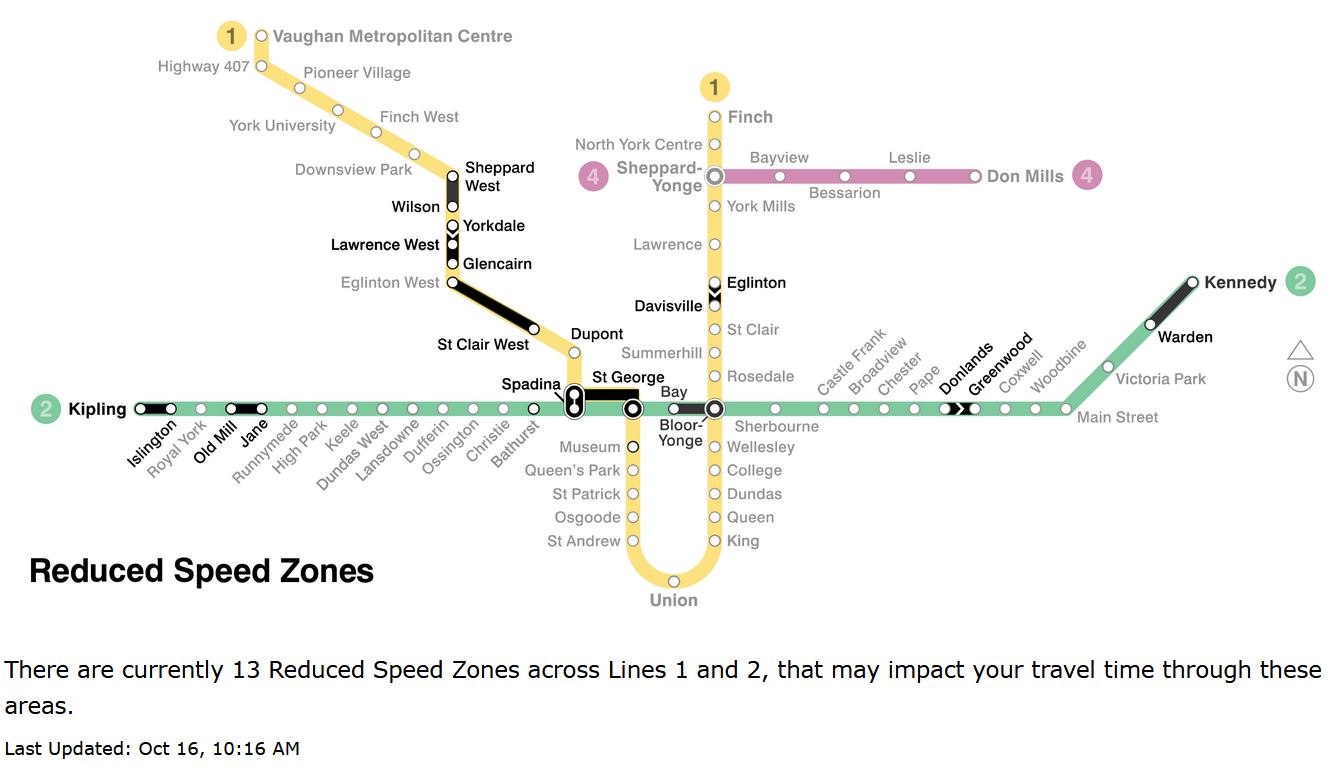
Here is the text describing these zones:
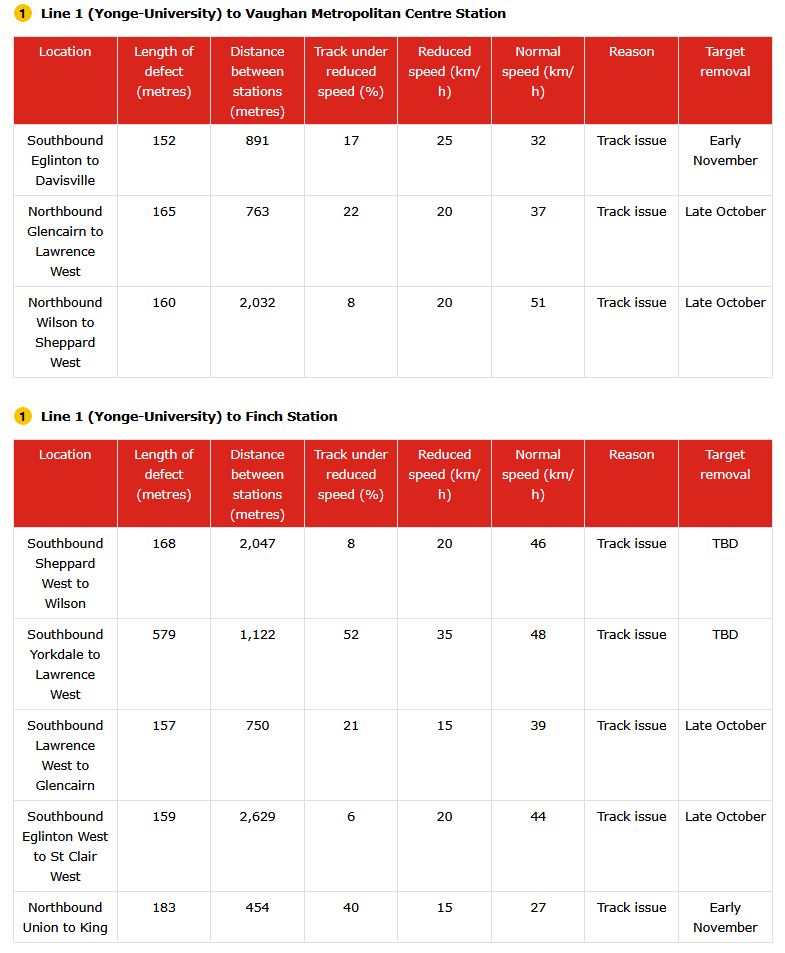
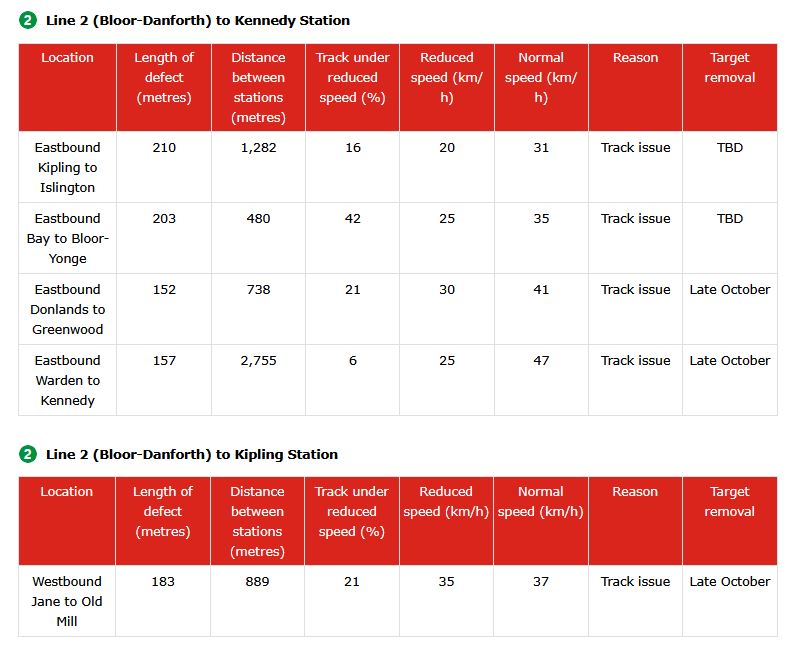
There are several inconsistencies between the current map and tables.
The statement that there are 13 zones appears to be based on the count of table entries. Note that for a “bothways” restriction, they count as two. Listing only a single direction in the table undercounts the number of locations. In this case the count, based on the same premise, should be 18 not 13.
In past versions each direction has counted independently, and in some cases more than one location was flagged in a track section (marked “X2” below).
There is a further problem if we compare the claimed completion dates with information shown on September 5.
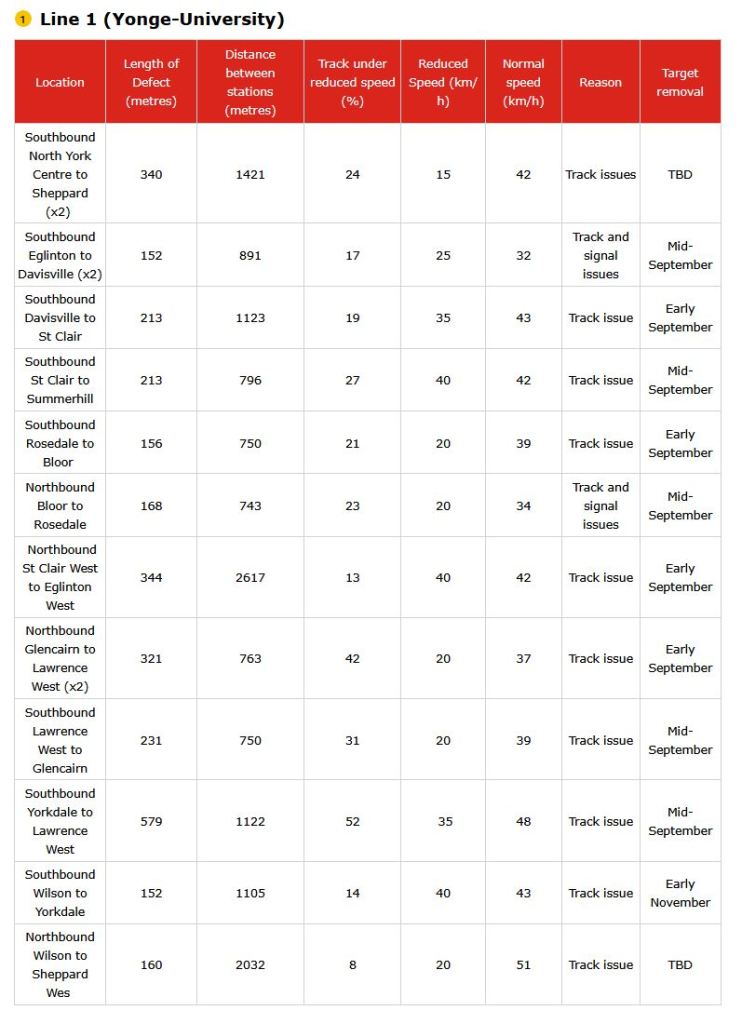
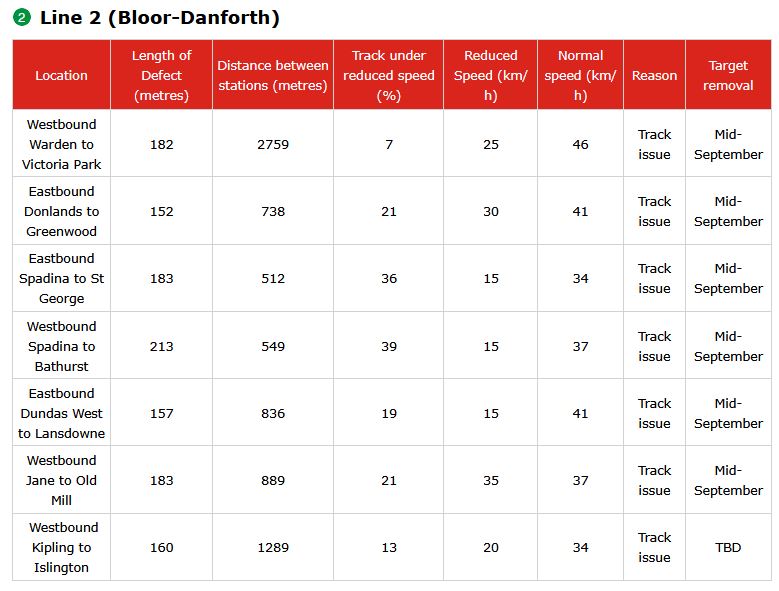
There are definitely more entries in September than in mid-October, and so the TTC has been working away at these issues. However, the projected dates have drifted in many cases.
| Location | On Map | In Table | Target as of Sept 6 | Target as of Oct 16 |
|---|---|---|---|---|
| Yonge SB Eglinton to Davisville | Yes | Yes | Mid Sept | Early Nov |
| Yonge NB Union to King | No | Yes | Early Nov | |
| University BW St. George to Spadina | Yes | No | ||
| Spadina BW St. Clair West to Eglinton West | Yes | SB Only | Early Sept (NB) | Late Oct |
| Spadina BW Glencairn to Lawrence West | Yes | Yes | September | Late Oct |
| Spadina SB Yorkdale to Lawrence West | Yes | Yes | Mid Sept | TBD |
| Spadina BW Sheppard West to Wilson | Yes | Yes | TBD | TBD |
| Bloor Kipling to Islington BW | Yes | EB Only | TBD (WB) | TBD |
| Bloor Old Mill to Jane BW | Yes | WB Only | Mid Sept (WB) | Late Oct |
| Bloor Bay to Yonge BW | Yes | EB Only | TBD | |
| Danforth Donlands to Greenwood EB | Yes | Yes | Mid Sept | Late Oct |
| Danforth Warden to Kennedy BW | Yes | EB Only | Late Oct |
The TTC needs to adopt a consistent way of reporting reduced speed zones, counting how many are active and projecting credible target dates for remediation. As thing now stand, the information in the maps and text differs, and the count of RSZs appears to be lower than what is actually in effect. In turn, this allows management to “hit” a lower target by under-reporting problems, and this is precisely the sort of behaviour that has bedevilled the TTC’s performance metrics for years.
Updated October 17 at 11:00pm: Here are the October 17 versions of the RSZ map and tables. The TTC still appears to be incapable of posting consistent data. On the bright side, some of the zones that had “TBD” target dates on October 16 now have October or November dates.
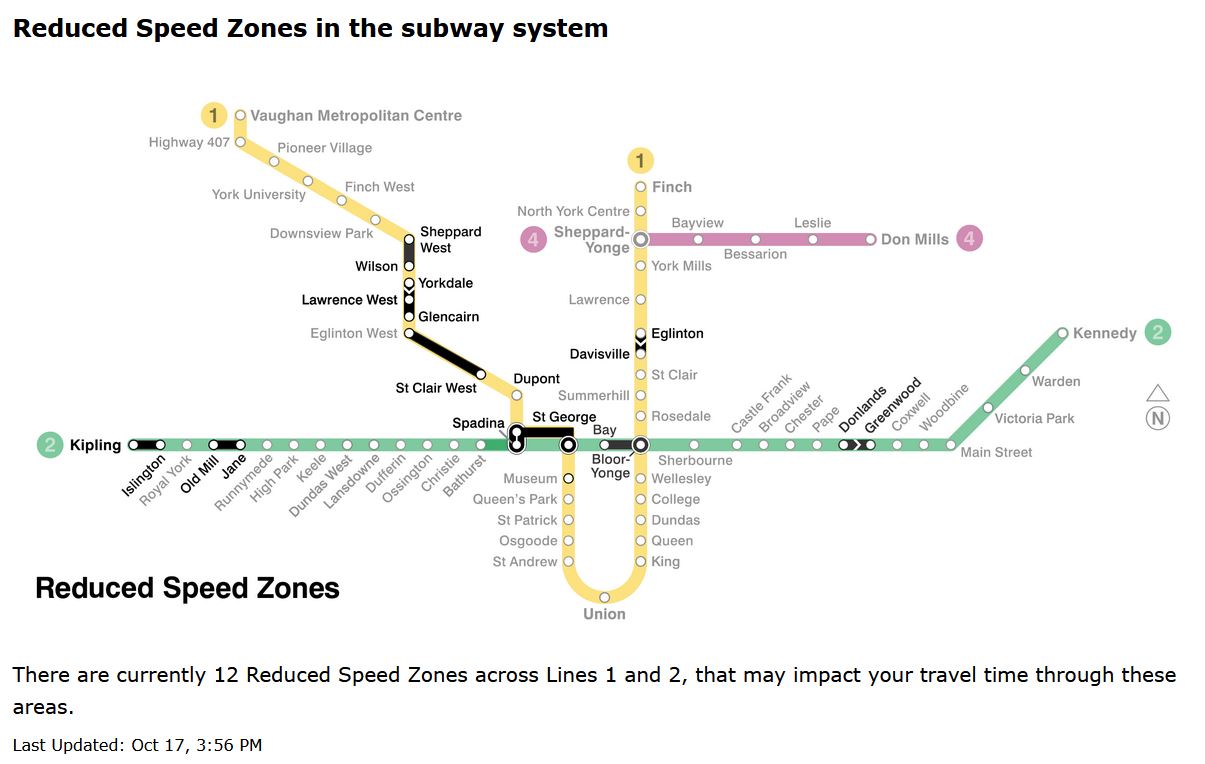
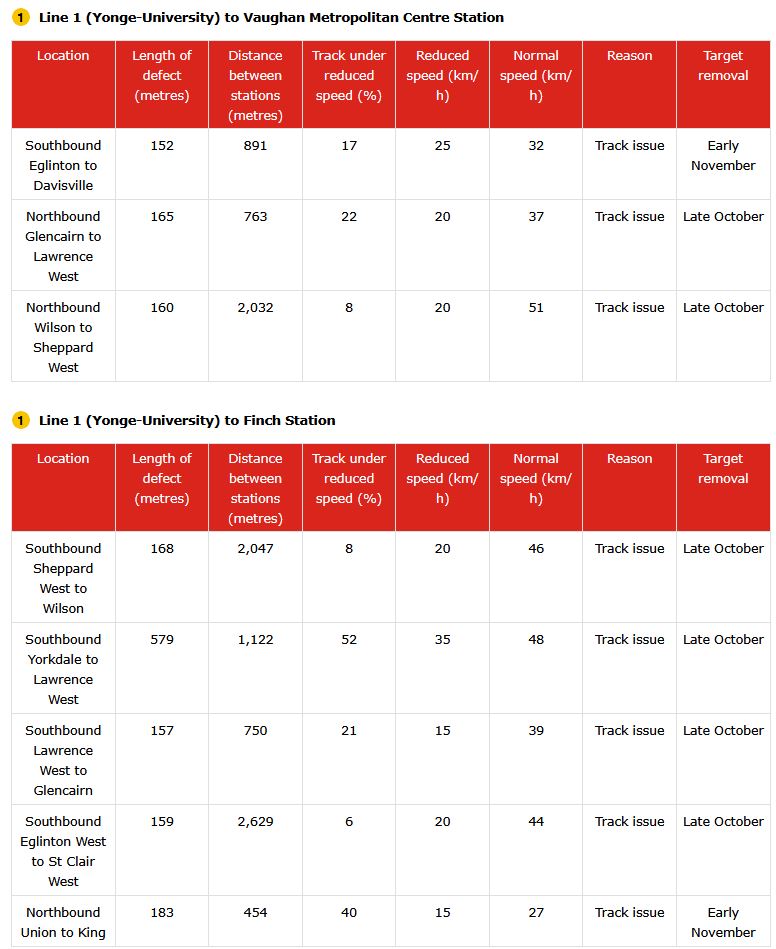
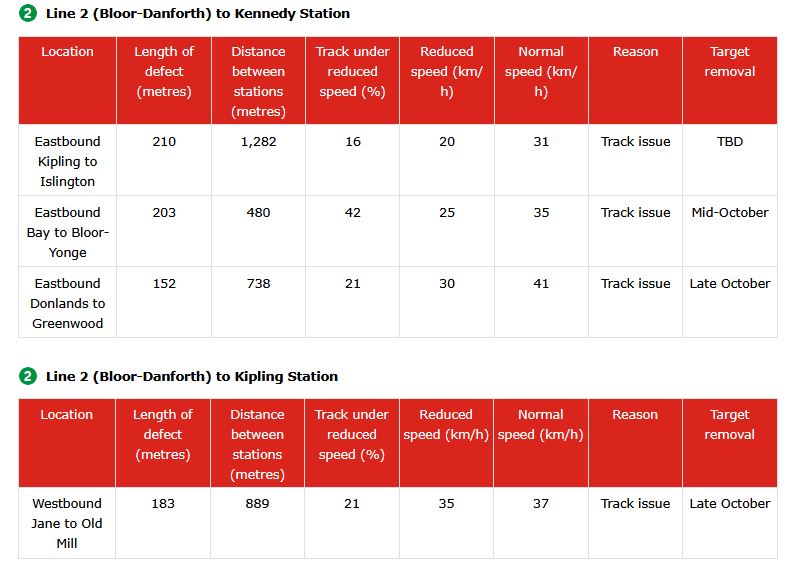
Updated October 21, 2025
Here are the current versions of the map and tables with the information now back in sync.
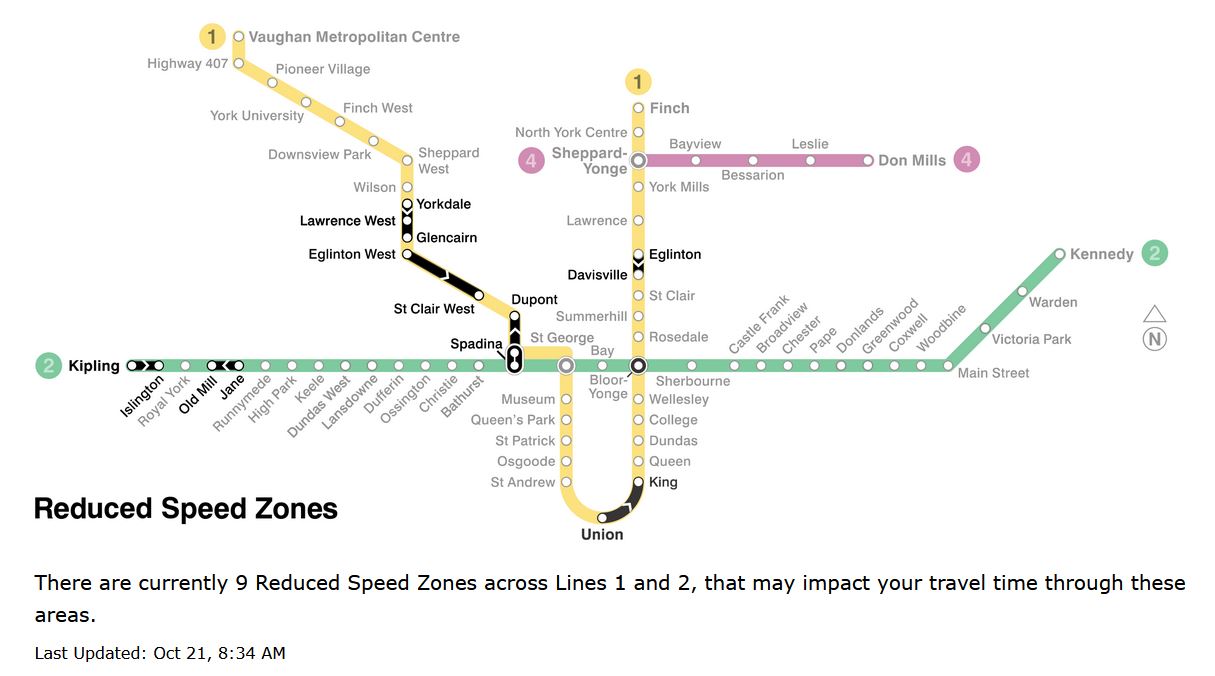
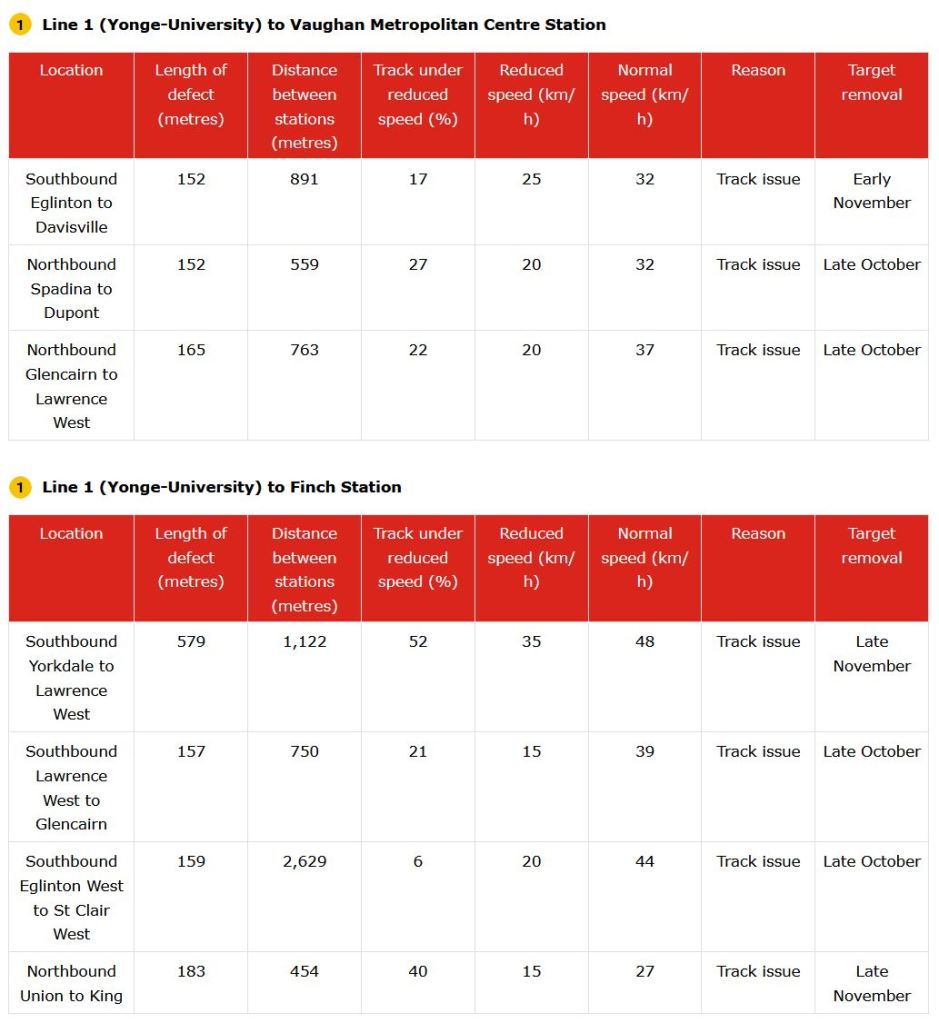
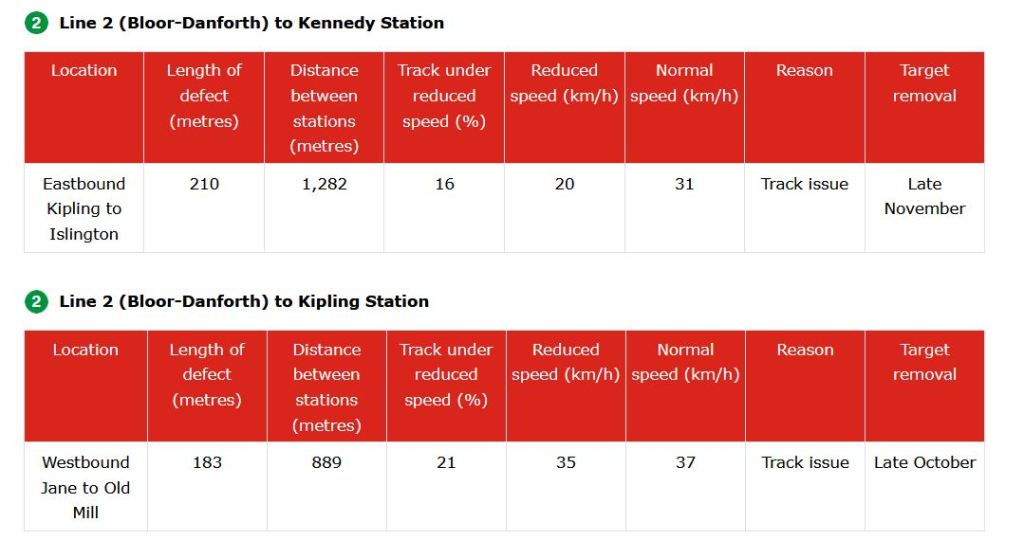
 Steve Munro
Steve said
I suspect the TTC has separate silos for east-bound and west-bound and south-bound and north-bound and probably there is a ‘table silo’ and map one! :->
I can understand why the Target date may change once one starts work an a problem is fully understood but not the discrepancy between table and map and (probably) reality!
LikeLike
Should be done for the streetcars as well…
LikeLike
Steve: Normally, when someone submits multiple comments from the same IP address and clearly under false names, I do not publish them. This is an exception because I wish to comment on several of the claims made here.
Who Broke the TTC?
Toronto used to have one of the best transit systems in North America. Now it’s overcrowded, underfunded, unreliable and dangerous. The inside story of what went wrong and who’s to blame.
Toronto’s transit system is a mess. In the past year, fares have increased, service has decreased and wait times have ballooned. A staff report from late 2022 showed that the Toronto Transit Commission’s bus and streetcar routes were particularly migraine-inducing. About two-thirds of riders were routinely getting stuck on vehicles that were either chronically late or mired in construction. A lucky 14 per cent rode routes that were classified as on-time. The rest were what the TTC calls “on the cusp,” meaning that they were mostly punctual, most of the time. Major projects are habitually completed years late and millions over budget. And then there’s the rise in violence throughout the system, the half-measured response to it and how both have combined to turn people away from public transit.
Steve: Fares have not increased in the past year. The recent history is 2019: $3.10, 2020: $3.20, 2023: $3.30. For some riders, the fare has gone down because of co-fare arrangements with GO and other GTA systems. Service hours have grown, although a chunk of that is compensating for traffic congestion. “On time” metrics used by the TTC have dubious value as I have often reported here. Late projects are mainly due to Metrolinx, not to the TTC, although the elevator project is well beyond its target date due to manufacturing delays and problems with some contractors. As for violence, I am not convinced it is as severe a problem as it’s made out to be, although obviously various prevention measures need to be seen to be working. This is also part and parcel of the City’s homelessness problem and the lack of funding in that sector.
The city’s current transit woes are the culmination of decades of inertia, political meddling and bad management. The problems now vexing the TTC, and public transit more broadly, arrived neither suddenly nor without warning. They were allowed — and, in some cases, encouraged — to happen. Today, the whole system is sorely underfunded, neglected and saddled with leaders who often act only when sufficiently embarrassed. Worse still, nobody seems to have a viable plan to make it any better. Here’s an inside look at everything wrong with Toronto transit and who’s to blame.
Problem 1: The farebox funding model is a nonsensical, unreliable mess
Problem 2: Politicians are good at grandstanding and bad at transit planning
Problem 3: Long-term planning is uninspired at best and non-existent at worst
Problem 4: Metrolinx is secretive and spineless
Problem 5: Random acts of violence are at an all-time high
Steve: That’s a nice list, but hardly an “inside look”. Items 2-4 in particular are clearly in the provincial realm where the premier, whose name you adopt in your next comment, is happy to spend billions on projects we don’t need, but won’t support what we do require, all to support his ego and to make property more valuable for his political friends. Fix that, and you’re well on the way to addressing transit problems.
LikeLike
Steve: This is the second of two comments from the same source albeit under different pseudonyms. Please see my response to the other comment.
The TTC is facing a $232-million hole in its 2026 budget, nearly double what the transit agency forecasted earlier this year.
Rising costs and fewer riders paying fares are straining Toronto’s transit system, leaving city taxpayers on the hook for nearly half of the TTC’s operating costs. A recent TTC staff report warned the agency’s “ongoing structural fiscal imbalance has left the TTC with financial gaps that need to be addressed.”
The agency is already seeing red flags this year. Mid-year results suggest the TTC could overspend by $36 million in 2025, largely because fare revenue is coming in lower than [budget] between March 30 and April 26, riders took 31.4 million trips on the TTC, nearly two million fewer than forecast, resulting in a $3.6-million shortfall.
From April 27 to May 24, ridership and fare revenue improved slightly but still fell short, leaving the system another $2.6 million under budget.
In total, the two-month period generated the TTC $6.2 million less than expected.
Part of the TTC’s difficulty is long-term. The proportion of revenue coming from fares and advertising has slipped to 44 per cent, down nearly 30 percentage points since 1997.
In 2025, the TTC relied on a property tax subsidy for nearly half its revenue, including an $85-million boost to help cover gaps that came from service increases.
Costs continue to rise even if ridership doesn’t keep up .
Since 2003, Toronto’s population has grown 25 per cent, but TTC ridership has only increased by about 10 per cent. Operating costs, however, climb roughly six per cent each year, leaving the transit agency financially exposed whenever fare revenue dips.
Frozen fares have also contributed to the agency’s shortfall. Mayor Olivia Chow has kept fares steady for two years to maintain affordability, a policy that has helped riders’ wallets but added to the financial strain.
CTV News Coverage of TTC Strategic Planning Committee Meeting, September 4, 2025
Steve: It is common to cite fare freezes under Mayor Chow, but the same happened under Mayor Tory. The freezes of 2020-2022 were during his tenure. Operating costs rise through a combination of inflation, labour cost-of-living increases and service growth, not to mention addition of net new functions within the TTC such as security and fare enforcement. The drop in the percentage of revenue obtained from fares is a covid-era effect, and citing a drop from 1997 is misleading. The combination of retaining much of the service, freezing fares, lower ridership and net new costs created the drop form 2020 to present. Now a big issue is the gap between service quantity, claimed quality and actual rider experience, plus the lingering effects of work-from-home and other shifts in riding patterns.
In the linked video, Commissioner Jagdeo, not in my opinion one of the TTC’s leading lights, complains that the TTC would go bankrupt if it were a business. The whole point is that this is a public service providing mobility that benefits many parts of society and contributes to their prosperity. The value of this service is not captured in the TTC’s books, nor in other agencies and corporations because the avoided costs by having a transit system would only appear if the TTC were not there.
Toronto and Ontario talk a good line about the importance of transit, but are not prepared to pay what it costs to own and operate the system.
LikeLike
Hi Steve!
Will this uneven reporting impact your RSZ tracking?
Steve: Yes, to the extent that it is unclear in some cases whether there is, or is not, a slow zone on some track sections.
LikeLike
The uneven reporting is back! (placed label in wrong spot)
Steve: Yes. What can I say?
LikeLike