
The TTC Board met on October 6, 2025. Many items on the agenda were confidential in whole or in part, and the meeting immediately recessed into private session. Four hours later, the public session resumed.
Extended private sessions have been a “feature” of recent Board meetings, and this is a major inconvenience for people who have taken the trouble to travel to City Hall for deputations, or remained available online. In years long past, the Board scheduled an in camera session before the public session so that, usually, the public part started on time. They should reconsider this practice, or at a minimum advertise a long, planned private session in the agenda so that public attendees can plan accordingly.
Items of interested included:
- The CEO’s monthly report including an updated format for bus fleet and route performance metrics
- The Peer Review of asset management by the International Association of Public Transport (UITP)
- The Wayfinding Strategy
- Renaming of the Carhouse at Leslie Barns
CEO’s Report
Beginning with the September 2025 CEO’s report, a new format to summarize various metrics has been adopted. Detailed reviews of each mode will appear on a quarterly rotation of subway-bus-streetcar. Key Performance Indicators (KPIs) will continue to be available in an appendix showing historical data in the format of earlier reports.
The general format presents several related metrics with comparisons to previous months or years together with a commentary on key developments and plans for improvement.
Some of these figures need to be read as a group to put them in context. For example, the weekly service hours have grown since 2019 from 139,304 to 146,003, a 4.8% gain. However the average speed on the network has declined by 5% during most periods with only slighty better performance on the Blue Night Network. This means that all of the added vehicle hours compared to pre-pandemic service levels have been eaten up by slower operating speed.
The TTC does not break down the change into actually slower operation as opposed to increased terminal recovery time. The decline in speed even overnight suggests that “congestion” is not the culprit as very few locations in the network have this problem between 1-5am. It is important to note that these are scheduled, not actual, speeds and the TTC does not produce analyses of actual versus scheduled travel times.
Crowding is reported here on a different basis from the data shown on schedules and transit apps (including vehicle tracking data I receive). In the tracking feeds, there are three tiers of crowding corresponding to nearly empty, moderately full (including some standees), and full. A bus that is “full” could actually have room within the definition of that term. In the CEO’s report, “full” means 100% of capacity which is a different metric. “Crowded” takes us to 120%, a tier which has no equivalent in the tracking data.
There is no breakdown by route or time of day to indicate where there are chronic problems. It is impossible to reconcile rider complaints about crowding with a metric that only reports buses at the “full” level or worse.
While these metrics look good, with only a handful of trips, out of about 33,000 daily, at the full or crowded level, this does not tie back to the Service Standards which call for no more than a seated load, on average, for off-peak travel which makes up the lion’s share of all service.
This is a misleading presentation of service quality in, sad to say, the best tradition of TTC management overstating the quality of their product.
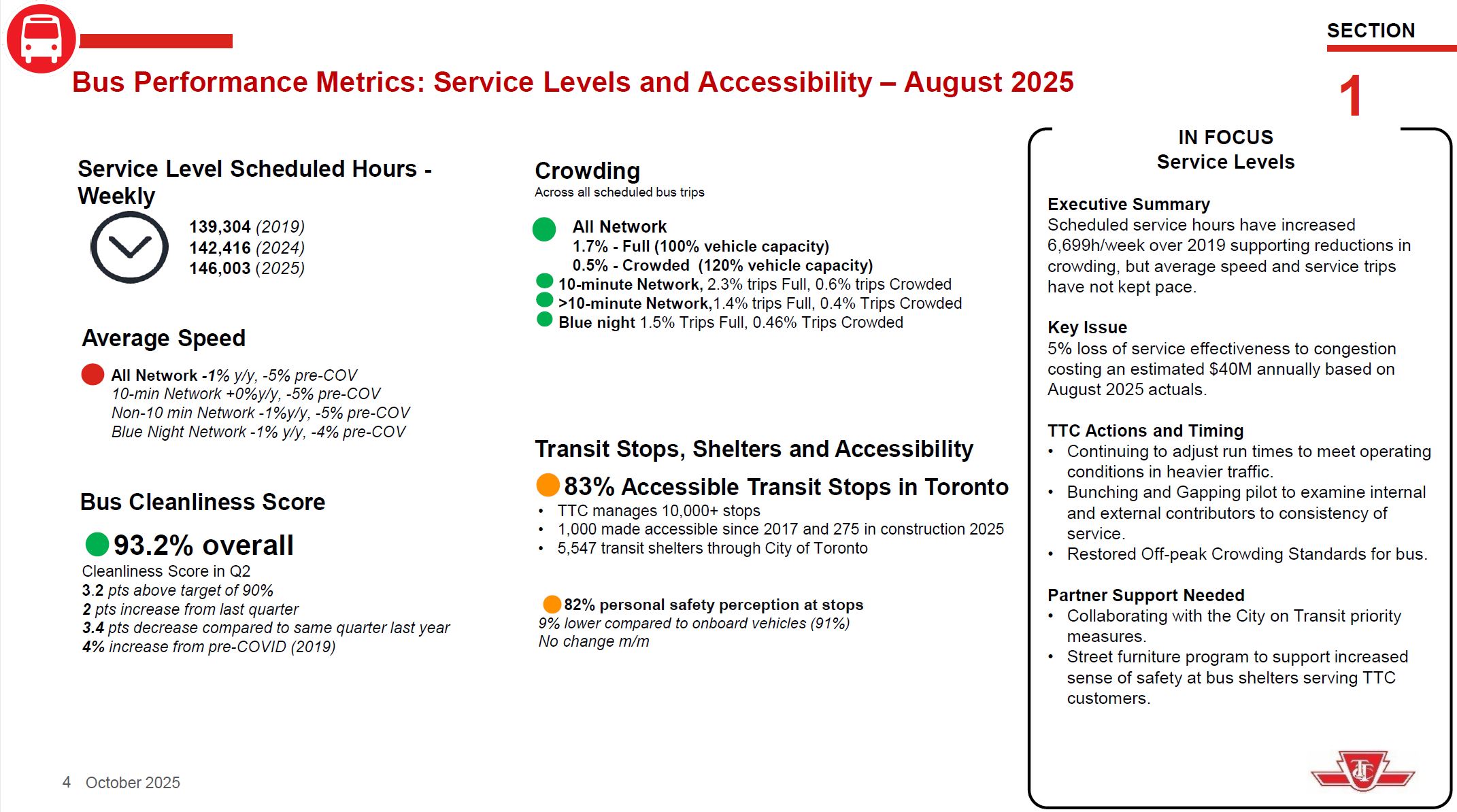
Bus performance metrics have been revised somewhat, and by contrast with the crowding numbers above, these tell a different story about service quality.
99 of 163 TTC bus routes fail to achieve an 80% on time measure, and these represent 68% of all ridership. In simple terms, over two-thirds of riders are affected by buses that are not “on time” by the TTC’s definition which is itself fairly lax. As with the crowding stats, there is no breakdown by time of day to indicate how many of the “on time” trips occur when demand is lower.
Service availability is reported as a percentage of scheduled service, but reveals nothing about fleet utilization. Could the TTC run more service with its existing fleet but for a shortage of staff and budget headroom?
The mean distance between failures (MDBF) for three bus types are shown, and clearly there is a problem with the eBus fleet relative to diesels and hybrids. I explored this in detail in another article. Also missing here is any breakdown between subgroups by manufacturer or bus size (e.g. Nova vs Flyer, standard vs articulated).
See:
Delay data are summarized in major categories, and it is noteworthy that “diversions” account for 41% of all bus delays. This is the sort of number we expect to see from streetcars, not buses, and more granular information about routes and locations would be useful.
A problem with delay metrics is that they count minutes of delays, but do not show how many events they represent in most cases. Equipment delays number fewer than 20/day and yet they are responsible for 25% of the delay minutes.
Those who are familiar with the detailed delay logs available through the City of Toronto’s Open Data site will know that by comparison with the subway, there are scantily few codes for delays on surface routes and many different types of event are bundled under a single generic code. (I will turn to this issue in a separate article.)
Short turn counts for buses and streetcars have always been suspect because the Leary era featured political pressure to get the counts down and keep them there. Comparison of official short turn counts with actual vehicle tracking data shows that these are under-reported. Moreover, as with all other stats, these should be broken down by route, or at least have the “high rollers” flagged for attention.
One issue with measuring “on time” is that it assumes service headways will more or less look after themselves. In fact we know that service is quite erratic with bunching and gaps common. The TTC touts the use of “Run As Directed” (RAD) buses, but there is no metric anywhere showing their contribution, nor the effect of their reduction or withdrawal when now-surplus operators shift to Lines 5 and 6.
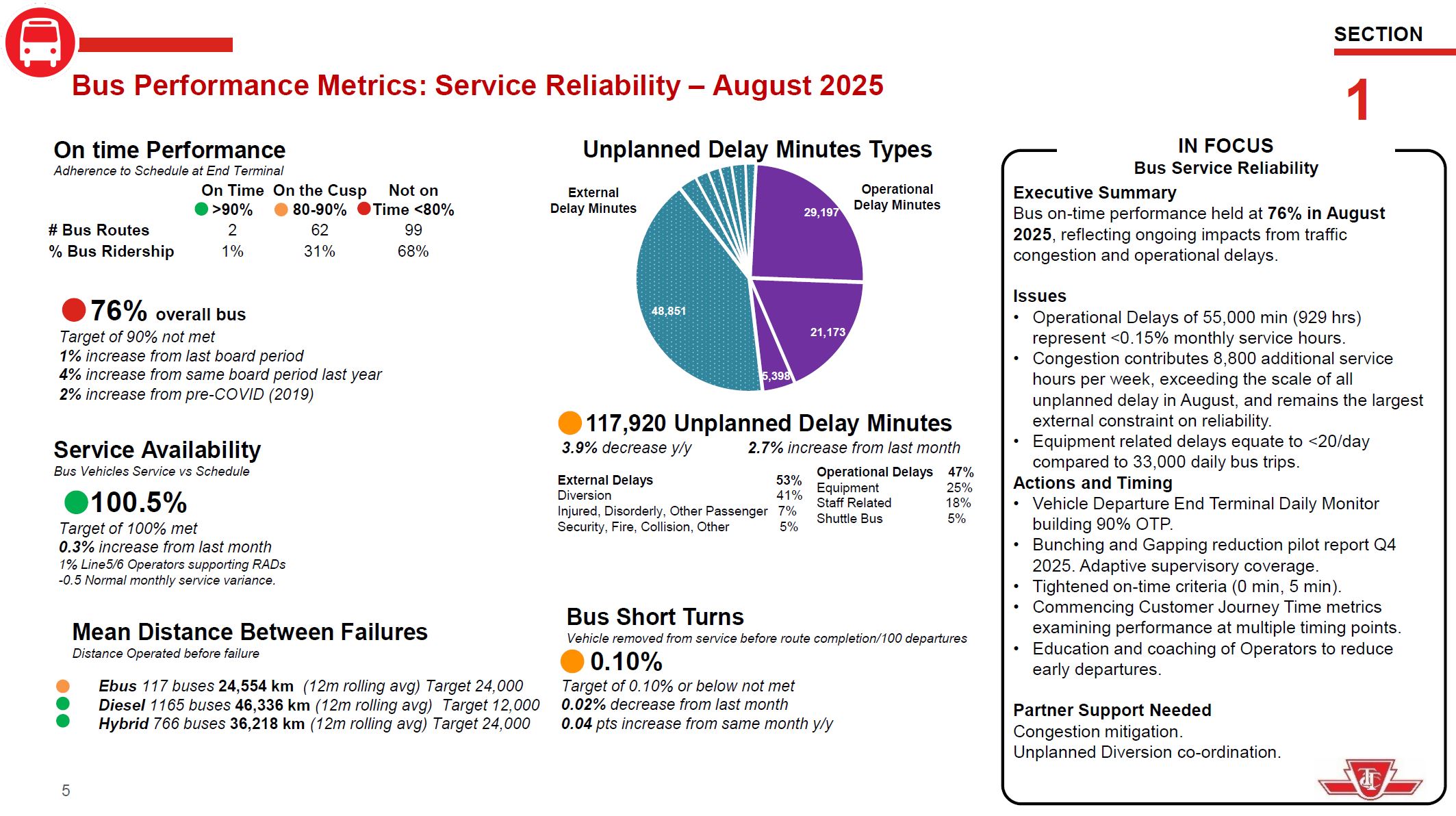
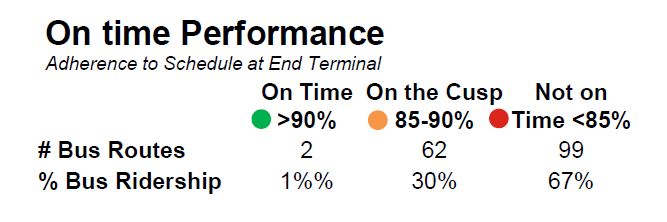
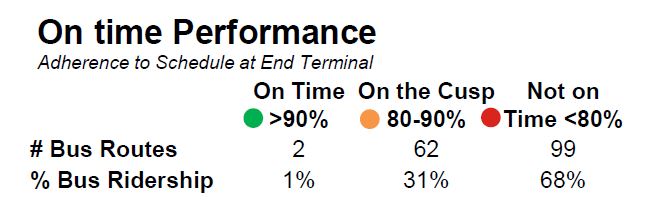
Between the original version of the CEO’s Report and the version used at the Board Meeting, there was a change in the OTP chart in the performance ranges. The “Not on Time” category was reduced to under 80% rather than under 85%, and “On the Cusp” widened from 85-90% to 80-90%. This had little effect on the actual breakdown. Oddly enough, CEO Lali in his presentation referred to the 85% cutoff indicating he was working from the original version.
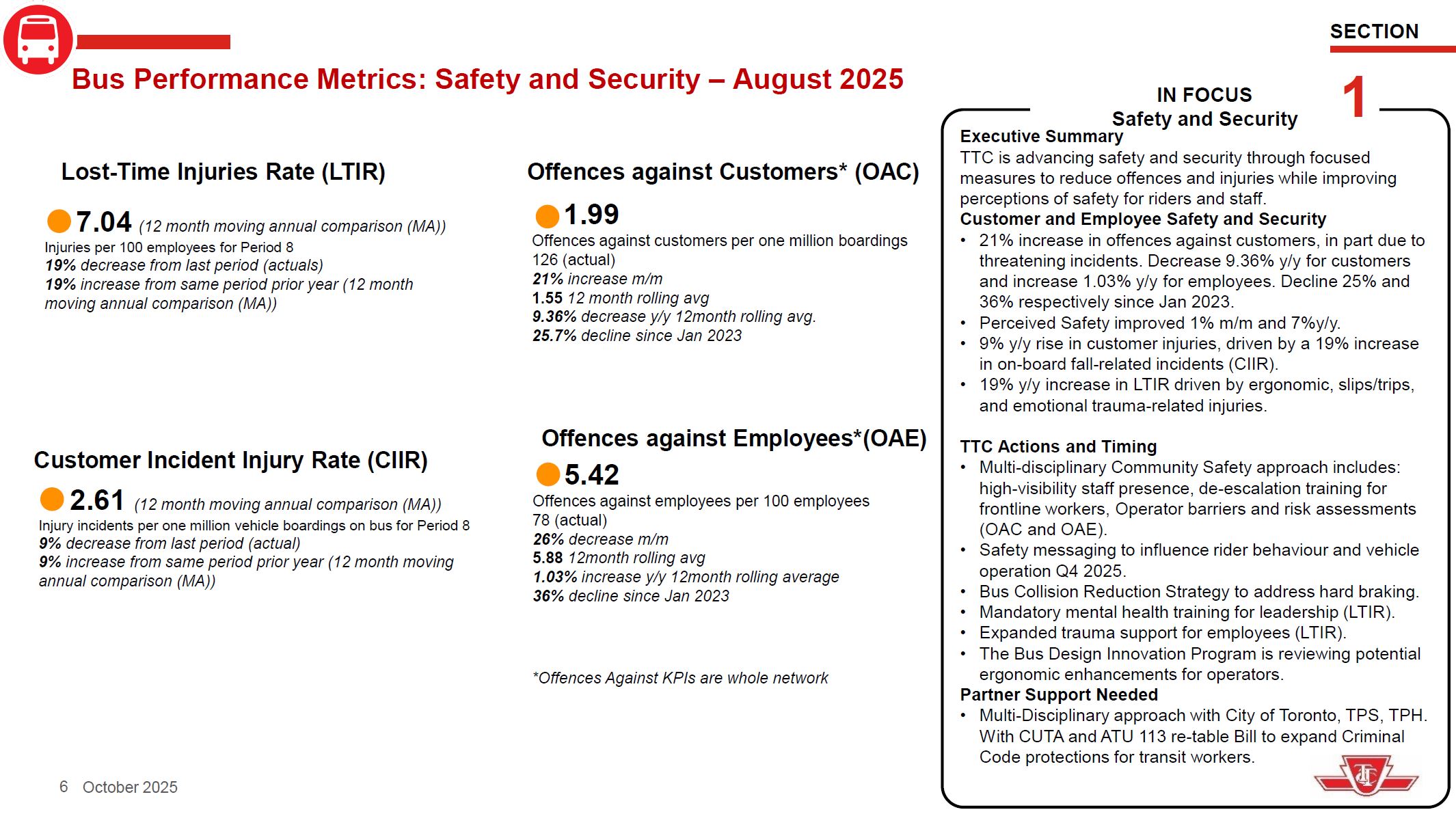
Safety and Security stats present a mixed result with some going down and others going up depending on whether one look at month-to-month values, annual rolling averages or longer periods.
Customer injuries are up on an annual basis driven by a 19% jump in on-board falls due, according to the CEO’s presentation, on rough operation.
Bus boardings are down 5% from 2024, a troubling trend. This is much higher than the 1% decline for the system overall reported on the next chart in this series. Various points of note here:
- Off-peak ridership accounts for 49% of all bus trips, although it occurs over far more hours. Service improvements, including transit priority measures, that concentrate only on the peak will not benefit half of the total ridership.
- The decline in ridership is more severe on the frequent services (10 minute network) suggesting a possible relation to service quality on busy routes.
- Weekend ridership is a substantial contributor to overall demand with Saturdays at 76% of weekdays, and Sundays at 61%.

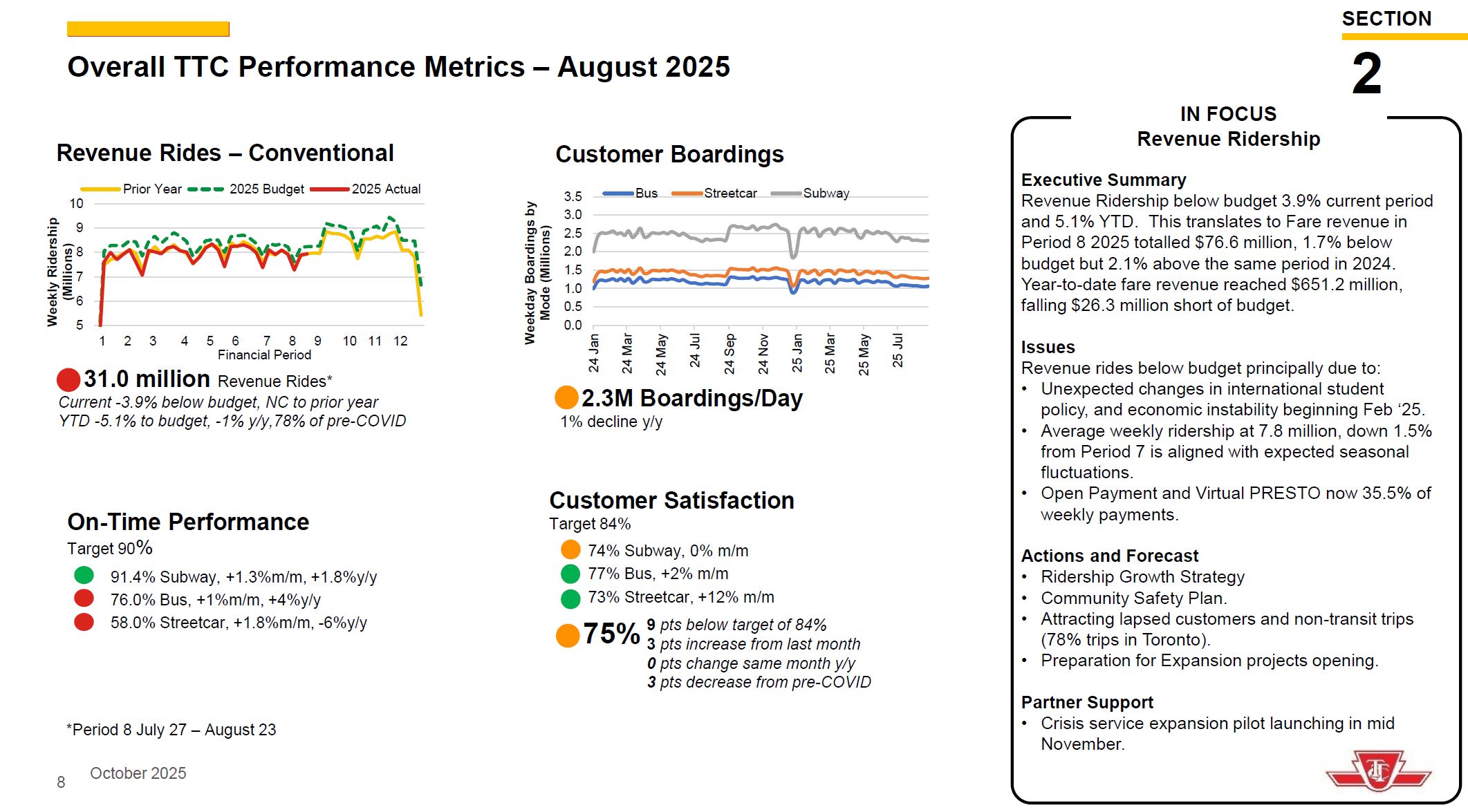
The overall ridership metrics tell a different story from the bus data above. Although total ridership is 3.9% below budget, it is unchanged from 2024. This implies that subway and streetcar demand offset the loss of bus riders. Fare revenue (not charted, but mentioned in comments) is down about 4% year-to-date compared to the budget figure, roughly the same percentage as the ridership shortfall.
Route Productivity
Discussion of metrics for route productivity. Lali implied that TTC is working on a metric for the profitability and/or utilization of a route, and this has implications for future service standards reviews. For example, a route may have a service level through policy (e.g. the 10 minute network or the maximum permitted headway) that could result in underused vehicles.
Some routes never achieve full loads, but that is not what the Service Standards ask of them, only that they serve a threshold level of boardings/hour. In some cases it is not practical to try for full buses because a route with less service to pack in more riders per bus would be less attractive.
As for profitability or cost/rider, some members of the Board who advocate a “businesslike” approach to transit do not think through the implications of such a proposal.
First off, it is impossible to devise a way to allocate fare revenue between routes because the revenue per boarding (one rider on one vehicle) varies from rider to rider and trip to trip. The two-hour transfer allows multiple boardings for one fare, and passes grant unlimited travel for a fixed monthly price. Yes, there is an average revenue per boarding, but this cannot be blindly allocated to every rider’s journey.
Some trips include many short segments, and these would allocate the same revenue as trips that had longer segments. Indeed, a multi-hop trip might allocate more revenue than a typical fare brings in. Conversely, long routes with long trips cost more to operate on a per trip basis and might possibly never recoup their cost from a system wide boarding value.
Many years ago, the TTC tried to produce profit-and-loss values for each route, and the effect was to make all of the short routes (where the cost per boarding is necessarily low) quite profitable on paper although this was a totally fictional way of looking at route economics.
This sort of public musing about ways to deal with budget problems is quite troubling. It belies a view of transit finances that does not align with a pro-transit policy. It is the network of services, not individual routes, that makes transit attractive. Taking this further, if service cuts are in Toronto’s future, the TTC should stop using every minor service improvement as a photo op.
A Ridership Growth Strategy requires that service be more attractive, not less. If anything, there are problems on many routes with inadequate service and crowding at some periods. TTC points to the extra cost imposed by slower operations and traffic congestion, but does not address the time consumed by padded schedules that lead to long terminal layovers. That arose during the Leary era as a way to drive down short turn counts, although these are generally under-reported anyhow.
How Do We Know We’re Winning?
Commissioner Mihevc asked the CEO what he considers an indicator of “winning”, in effect success for the transit system. CEO Lali replied that this has two aspects: one is safety for riders and the other is provision of transit service within the resources given to the TTC by the City. By contrast, Mihevc looked at the level of ridership as a measure of success.
This belies two different views of what the TTC should be doing: attracting riders or meeting City budget targets. This will lead into future discussions of the Ridership Growth Strategy. How much of this can be achieved by internal “efficiency” such as running better service with existing resources, and how much will require added funding either to run more, or to charge less?
It is ironic that in his former Councillor days, Mihevc was both a TTC Commissioner and a member of the Budget Committee. His decisions often fell to accepting the budget constraints rather than advocating for more resources. This is the conundrum facing management and politicians.
UITP Peer Review
This item was considered in camera, and public debate was deferred to the November Board Meeting on a motion by Chair Myers. “Attachment 2” in the motion is the detailed UITP review which contains some information that management wishes to keep confidential. There was a discussion about the extent of the redactions at the recent Audit & Risk Management Committee meeting, and the scope has not yet been agreed to by the Board. Only a summary presentation deck is publicly available.
That the TTC Board authorize the release Attachment 2, with redactions applied for commercially sensitive information, simultaneously with the TTC Management’s Response for public review after consideration of the TTC Management Response by the TTC Board at the November 3, 2025 TTC Board Meeting.
The motion passed with only Commissioner Saxe opposed.
This motion’s wording is interesting because the previously stated reason for keeping the report private was security of the TTC system, not commercially sensitive information. Reading between the lines of past comments, this could relate to the discussion of future Line 2 signalling technology procurement.
Streetcar Switching
During the public session, a deputant used the UITP’s comment about slow streetcar operation as a jumping off point for comments about, among other things, single vs double point track switches. In fact what the UITP presentation said was:
Operational speed for the streetcar is 30 percent lower compared to the global average.
- Streetcar Priority is one of the solutions to increase operational speed.
- Advanced traffic management systems should be considered.
- Automation of switches (motorized) will eliminate stop-look-go and increase operational speed.
The statement about switch automation is misleading in that all of the regularly used turns in the network already are electrified. Other locations that are commonly used for diversions should be added, and much greater integration of the switching with transit signal priority should occur. However, the UIPT did not flag single point switches as a key issue.
The problem lies in unreliable switch controllers installed decades ago to replace the use of contactors on the overhead system. This was triggered by the introduction of longer streetcars (ALRVs) where the pole was further back from the front of the car than on the fleets of CLRVs, PCCs and older vehicles for which the contactor-based system was designed. Reliability problems with the controllers including failure to switch as directed, or changing a switch under a car, lasted for decades.
New controllers are now being installed, but the program is incomplete, and there is no way for an operator to tell which version an individual switch might have. Stop and go-slow orders apply to all junctions even those with manual switches. Problems are not limited to the switches, but to general maintenance of special work.
Pursuit of the single/double blade issue may provide some benefit, but it should not obscure the more general issue of infrastructure maintenance which, as we have seen, also affects the subway and the now-closed SRT. Moreover, true transit priority is required if the City is to achieve its allegedly pro-transit goals. This should not be lost in the debate over switch technology.
For the record, single point switches are still used on other North American streetcar systems including Philadelphia, Boston, San Francisco, and New Orleans. These are all “classic” streetcar systems where single point switches were the norm since the introduction of street railways in the 19th century. They are not “bespoke” technology.
The difference in Toronto today is that the low-floor Flexity cars have smaller wheels and this makes the condition of track and especially switches more important than for the earlier vehicles. This was flagged as a future track maintenance issue when the cars were ordered, but that message was lost over time.
See also:
Wayfinding Strategy
The TTC Board approved a Wayfinding Strategy:
1. Approved the TTC Wayfinding Strategy, including:
a. Whole system approach extending wayfinding standards beyond signs and maps to all customer navigation points throughout the customer journey.
b. Continued use and expanded development of TTC Signage and Wayfinding Standards.
c. Integrated standards with Metrolinx in interchange stations.
d. Increase of traditional wayfinding and immediate commencement of digital tools.
2. Supported Year One Implementation Plan including integration of the Wayfinding Strategy into TTC’s capital and operational budget frameworks for future years.
3. Directed staff to Develop a 10-year roadmap, including,a. Formal estimates for inclusion in Capital Investment Plan.
b. Expanded role for partnerships.
c. Explore the opportunity to build a Centre of Excellence/consulting services for other transit systems following the significant deployment of the strategy modelling integrated wayfinding in a growing multicultural environment.
4. Received the estimate for French wayfinding in Attachment 4 for information.5. Authorized that the information in Confidential Attachment 1 remain confidential until the completion of negotiations.
(The reference to Attachment 4 is odd because the report linked under that name says nothing about French wayfinding. The reference to Confidential Attachment 1 likely relates to negotiations with TMU over their participation in the rebranding of Dundas Station which will be one of the trials for a station revamp program.)
Although there is a lot of material here, much of it expresses general concepts and ambitions, not the specifics of what TTC will actually consider and implement. A related problem will be budgetary headroom for this project, both operating and capital, amid other competing priorities. With a 10-year project timeline, we will not see the system substantially transformed for many years. However, “transformation” is not just about signs, but about the quality, quantity and availability of information riders might use.
The presentation deck makes a key point early on:
Wayfinding in transit systems is about more than signage – it is the strategic orchestration of information, space and sensory cues, that help people understand where they are, where they are going and how to get there confidently and independently.
This is quite a change from a report earlier in 2025 which consisted primarily of an inventory of signs on the system, and not one illustration.
Many deputants spoke to this report and their comments can broadly be divided in three groups:
- Signage is inconsistent both in content and placement. Not all pathways through a station receive equal attention and depending on where someone is, the information they can easily find will vary. This includes riders using secondary entrances and elevators which bring them to parts of a station that do not have the full repertoire of information.
- Signage for surface stops is much less informative than in the subway, if it is present at all.
- Electronic sources (web, transit apps) vary in the amount and quality of information they present.
For the full collection of comments, watch the meeting video.
A great deal of the discussion dwelt on physical presentation of information, but much less so on quality and timeliness.
A major problem for riders is to determine how they should travel in case of disrupted or rerouted service, but this information is provided on a hit-or-miss basis particularly at surface stops. The TTC once had information cards at stops with schedule and route information, but keeping these up to date was a major chore. Their function has been replaced with online access, which is fine for people who have the technology and know how to navigate to the information they need.
A further problem is timeliness and accuracy. Some changes are posted at the last minute or are subject to revisions that are not reflected in posted information either in hard copy or online. This is not just a matter of having a navigable website that integrates many information sources, but of having staff with access to correct information and an understanding of how multiple route changes might interact. The structure and behaviour of the TTC’s site suggests that different groups are responsible for different segments even though they all contain information about service, sometimes contradicting each other.
Once an actual rollout strategy appears, we will get a sense of how the TTC intends to approach the many problems of “wayfinding” on its system. The question of information accuracy and consistency is independent of delivery in the sense that existing mechanisms, though imperfect, will be improved simply by having better content. A major challenge will be to avoid turning the exercise into a construction project that will keep crews busy for years replacing and adding signs and other wayfinding tools while the underlying content remains inferior.
A related problem that the strategy does not address is wayfinding when something changes. For example, if there is a major construction project such as the repair or replacement of an elevator or escalator, navigation paths through stations will change. Ideal routes might no longer work and posted directions could lead riders to a blind alley, especially if there are accessibility considerations.
Like so much of TTC public information, the challenge is not just to provide for a system in perfect circumstances, but to address how it tells people about changes, temporary or otherwise. Without the organizational will and dedication to do this, all the wayfinding technology in the world will not solve TTC’s problems.
Renaming the Carhouse at Leslie Barns
On a motion by Chair Myers with Commissioner Matlow seconding, the carhouse at Leslie Barns, which is currently unnamed, will be called the David Miller Carhouse “to commemorate Mayor Miller’s contributions to the TTC”.
The motion passed with all but Commissioner Jagdeo in favour. He churlishly objected to a building being named after a politician, especially a living one.


This has nothing to do with the topic. But when is the October 12th service changes getting released?
Steve: Bits have dribbled out but the memo has not been released. I suspect someone wants a press conference to announce it and that’s holding it back. Stupid beyond belief as this usually delays some internal processes too.
Some of the Line 5 bus changes will happen but not on major routes like 32/34 and 54.
More when I get the details.
LikeLike
The city and ttc have made it abundantly clear they have no regard to the taxpayers.
LikeLike
The biggest impediment to faster general streetcar operations isn’t a lack of priority, it’s TTC management and the “safe” operating practices they’ve installed.
Just keep them all in the yard if they want everything to be 100% “safe”. It makes for better safety stats when it’s all zeroes across the board. That’s what they’re probably all thinking anyway with 35% of the fleet never being used.
I was on a streetcar last month with an operator who would not activate the doors for boarding if the streetcar was not at the stop line. If there was even a single car ahead at the stop line the doors remained closed. The end result was the streetcar having to stop and sit through two cycles at every single signalized intersection. This is the stuff of nightmares.
I can only imagine this is an official policy with how strictly the op adhered to this procedure. If it is, thankfully it’s mostly ignored.
My standing offer to be dictator for a day to crack skulls at the TTC is still open.
Steve: Yes, stopping only at the stop line is one of those practices by which the TTC hobbles streetcar ops. We get a lot of junior operators on streetcars and they have this stupidity drilled into them. I am astounded that UITP has not called out TTC on this and related issues. That said, the culture of “safety” as a catch all justification for operational and managerial shortcomings is very hard to fight as nobody wants to be accused of causing an accident by skimping on safety. The TTC can skimp on maintenance for years but that’s just being efficient and careful with precious taxpayer dollars.
LikeLiked by 2 people
With regards to the streetcar intersection issues. It seems somewhat obvious that if there has been recent rebuilds of an intersection that there should be no go slow orders or other issues with it. TTC should identify these intersections and sign them as “normal operations” intersections…and update their maintenance and monitoring to ensure they remain in good condition. If there are derailing issues, then remove the signage.
With regards to the stop line issue, I was recently in Helsinki and noticed that they have platforms that are significantly longer than the vehicles (sometimes up to three or even four times longer)…this allows for multiple vehicles to pickup at once, with a little bit of shuffling required. There may be a few locations where this sort of design could work well in Toronto…and it would be interesting to see if they could be identified…some places like Broadview that see multiple lines could benefit from having dedicated areas for each line, or in places like Queen east at Broadview just a bigger station area…other places near Bathurst/lakeshore could just benefit from extended platforms and willingness to open just the front doors while the car in front loads.
Steve: There are already separate platforms for King and Dundas cars at Broadview and Dundas West Stations. Plans to extend Broadview platforms were scotched thanks to political pressure to preserve the parking lot east of the station.
LikeLiked by 1 person
I believe it. The driver on my Bay bus is a Leadfoot Larry and I have to anticipate his starts and stops otherwise I’m on the floor.
Steve: As someone who is not as nimble on my feet as in younger days, I rarely get up from a seat until a bus is completely at a stop lest I be thrown around by rough braking.
LikeLike
With respect to the wayfinding standards, the note to “Integrated standards with Metrolinx in interchange stations” feels like it doesn’t address the root cause of inconsistency with wayfinding signage throughout the system.
If signage changes from the TTC standard in subway stations, and then to Metrolinx at interchange stations it seems like it would just add another layer of signage for riders to interpret. Now, there obviously isn’t enough information available yet to make a clear statement on where the signage designs are going, but if plans are to integrate with Metrolinx at interchange stations only, why not just go the full way and integrate the entire signage standard with the existing standard rather than make a new standard from scratch?
Steve: Yes that line sounded rather odd to me too. However, I’m waiting to see some specific proposals before attempting to critique what is, at this point, “vapourware”. Lots of well-meaning thoughts, but few specifics.
LikeLike
Have you’ve received the service change memo for next week yet?
Steve: No.
LikeLike
Recently why the TTC doesn’t reveal the service changes a month earlier like it used to 5-10 years ago and the only reveal changes during the last minute?
Steve: Sometimes they are holding onto them because somebody wants a splashy press conference. Already known changes include many bus routes modified in anticipation of Line 5 opening, plus better subway service on Line 2. There are also diversions related to two construction projects that are supposed to begin (Queen/Broadview and College/McCaul).
This is frustrating not just to me and my readers, but to the travelling public who don’t know what is about to happen. TTC talks about “wayfinding” and improving “communications”, but drops the ball far too often.
LikeLiked by 1 person
Never mind. The TTC just revealed their next weeks changes on their website.
Steve: Where? There are only a few listed and many routes will be changing.
LikeLike
Here is the October service changes by TTC.
Steve: What is quite ridiculous is that it is not linked from the home page, only from the hard to find “Updates” page. Google shows it but someone would have to search via that route to find it.
Needless to say there will be a lot more info in the detailed memo whenever the TTC releases it.
Update: Mayor Chow is making an announcement Thursday morning. That is probably the reason for the delay.
LikeLike
I got punched on the ttc in 2023. Never found the person and violent attacks have become the regular now. Why not add security measures. Why is it so unsafe people are getting mauled in public with several operators who do nothing but stare you down and insult you.
Steve: The City and TTC are adding security measures. Whether they are enough will be borne out by stats about attacks.
LikeLike
A thought about bus ridership being down while streetcar and subway ridership isn’t… How likely is this due to employment macro factors? During the pandemic, we had the case that bus ridership held up better than streetcar and subway because bus riders were more likely to be going to their in-person workplaces. Now The Economy (TM) is weakening, so possibly the jobs numbers are falling off. White-collar jobs have increasingly pushed for in-person attendance, which might be balancing out the ridership losses from white-collar job losses so far, but that’s not going to be the case for jobs that were already fully in-person.
Steve: There is also the issue of reduced post-secondary attendance due to the reduction in foreign students. Many factors are at work and I would be careful of jumping to a definitive “answer”.
LikeLike
Has there been a similar report for buses as for streetcars? I imagine that would give TTC some guidance. I think Vancouver is buying Solaris buses, is the TTC limited to local (Canadian) procurement?
I also think increasing the number of doors would help, any insights about that?
Steve: The request for the peer review to UITP was specifically for rail systems, not buses, and so there is no comparable report for them. This is an area that definitely needs review because some of the challenges of moving to an eBus fleet are starting to become obvious and could hamper future operations and budgets.
Yes, Vancouver is getting buses from Solaris as dual mode trolley/battery vehicles taking advantage of Vancouver’s existing overhead power grid. I suspect even with Canadian content rules, which are rather lax, they could do some final assembly in Canada. Also there is no competing Canadian supplier.
More doors? Yes and no. TTC is wrestling with whether more doors (as on the streetcars) is a revenue loss problem more than a benefit from being able to distribute loads through a large vehicle.
LikeLike
Streetcar times must be impossible to estimate during work hours due to the “deployment” of the infernal ramp option. It is barely helpful to the people who have to use it. And more importantly anything that a rider cannot use themselves is not actually legal accessibility. What a total waste.
Thanks for your tireless analysis of this stuff. It is so frustrating as a rider.
LikeLike