
TTC Freezes Non-Union Hiring

On Friday, September 26, the TTC issued an internal notice that there would be a freeze on all non-union hiring. This is in reaction to the need to find $141-million in savings to get the anticipated 2026 budget deficit down from $232-million to the Mayor’s target of $91-million.

All non-union requirement is subject to the CEO’s approval.

While, in theory, this does not directly affect service or maintenance levels, there is simply no way that the TTC can find $141-million without at least constraining the union side as well. In turn, this has implications for service growth in 2026 especially considering the ongoing loss of productive service hours to traffic congestion and changes in bus dispatching for the shorter range of eBuses. There is also the question of adequate staffing in various maintenance departments.

One current initiative to improve service is headway monitoring and management, and it is not yet clear whether this would be staffed with “management” or “union” positions.

More generally, the question must be asked whether “management” has been growing at a faster rate than other line positions (be they union or non-union) over past years. The TTC used to publish detailed staffing counts as part of the Operating Budget “Blue Books” up to 2019, but these no longer exist, at least not publicly.

A hiring freeze is only a first step in any review because it addresses vacancies that might or might not be in critical roles. Moreover, it does not address the larger question of whether management should be reorganized or downsized.

One hidden issue in staffing is the matter of consultants and outsourcing. Although the use of outside staff is not as severe an issue at TTC as at Metrolinx, this can be the source of much resentment by “in house” staff who are asked to do more with less while the taps continue to flow for outsiders. Indeed, I understand that a former TTC manager is acting as an advisor on contract to the senior team. This shows how careful an organization must be with double standards.

Recently, the TTC has consulted with interested parties including their Planning Advisory Committee, which I attend, on various service proposals and other matters going into the 2026 budget cycle. It is hard to see how such consultation can bear any fruit facing a constrained subsidy target from our “pro-transit” Mayor.

I asked the TTC to respond on this issue on Friday, September 26, and again today, September 29. As of 5:00pm, the only reply is a copy of the corporate notice that I already had from another source. Its text follows the “more” break below.

Continue reading
Bus Reliability: TTC Reveals Uncapped Stats

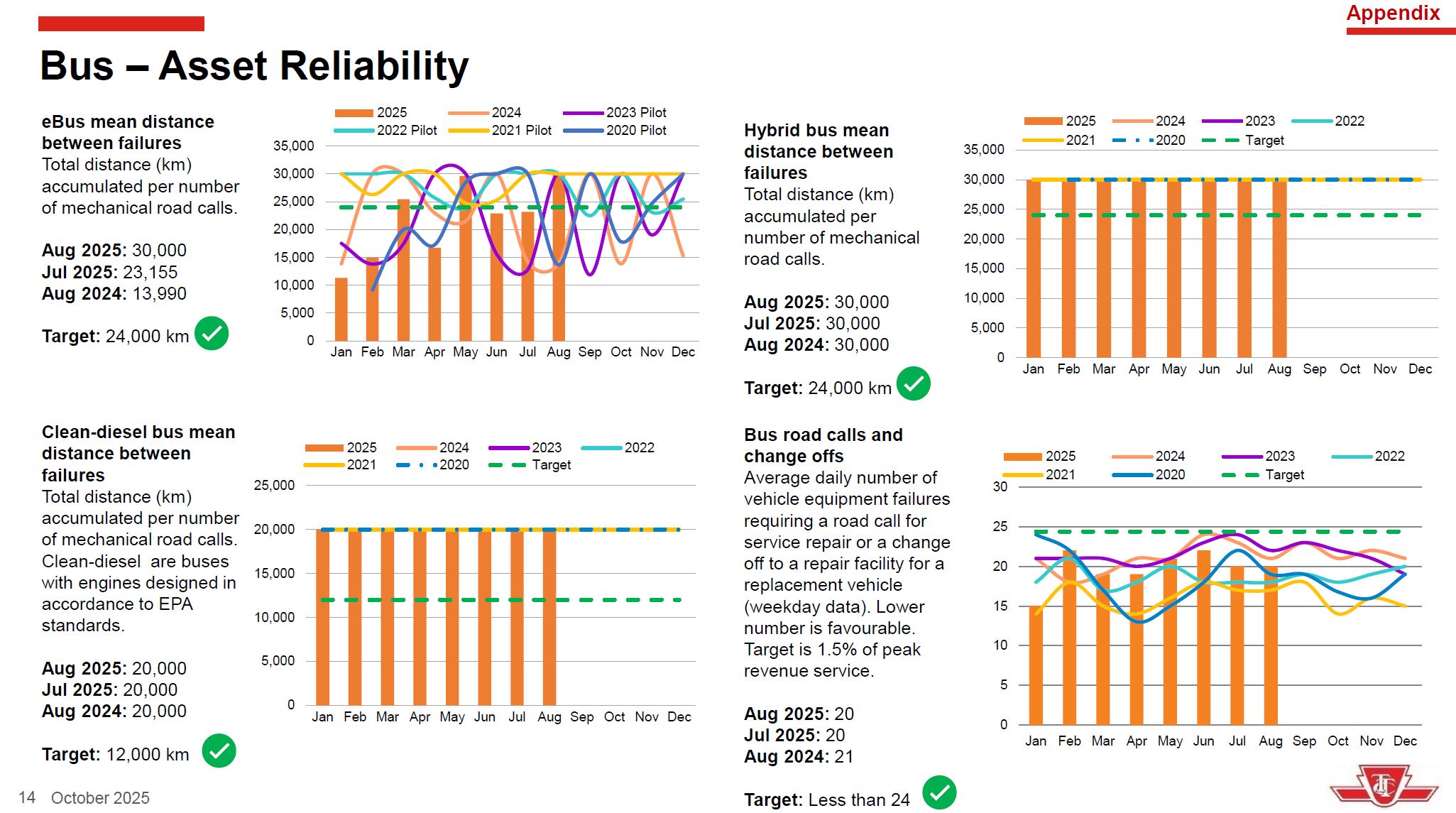
For many years, the TTC reported bus reliability as a mean distance before failure (MDBF) as shown in the charts below.

A fundamental problem with these charts is that the values for Hybrid and Clean Diesel buses are capped at 30,000km and 20,000km respectively, although the actual values could be higher. This makes the values shown for eBuses which lie in the 15,000-30,000km range look similar by comparison.

In the October 2025 CEO’s Report, on the agenda for the TTC Board Meeting of October 6, 2025, the values are not capped. Indeed, the CEO comments on the particularly good results for diesel buses.

Industry-Leading Asset Performance

When it comes to vehicle reliability, our fleet continues to outperform expectations. Across all vehicle types, our buses are achieving Mean Distance Between Failures (MDBF) well above North-American standards. Clean Diesel, in particular, is showing exceptional results, demonstrating industry-leading reliability across our entire bus portfolio. [CEO’s Report at p. 2]

The numbers cited by the CEO for September 2024 to August 2025 are:

Mean Distance Between Failures

Ebus 117 buses 24,554km (12m rolling avg) Target 24,000
Diesel 1165 buses 46,336 km(12m rolling avg) Target 12,000
Hybrid 766 buses 36,218km (12m rolling avg) Target 24,000

[CEO’s Report at p. 5]

The MDBF values affect key aspects of service provision including the number of vehicles required for spares and the probability of a failure affecting service.

Not included in the stats is the mean time to repair which can have as severe an effect as MDBF. If the failures for one type of equipment are more complex putting a bus out of service for a longer period, this can compound the MDBF rate because each failure represents a longer outage. The TTC is somewhat insulated from this effect because it maintains a larger spare ratio than the industry average (see below).

I will review the new format of reported stats (only bus and subway are available so far, with streetcar to come in November) as part of my general write-up of the Board agenda.

The TTC appears to have been under-reporting the reliability of diesel and hybrid buses for many years, and this suggests that they wanted to make their eBus program appear as successful as possible. The historical stats should be restated with the caps removed so that the public can see just what the comparison over past years actually looked like.

Recently, operational issues regarding the deployment and charging for an eBus fleet have come to light, and it is clear that conversion to battery buses is not going to be as straightforward as thought when this program began.

Different fleet counts are cited in the August 31 Scheduled Service Summary and the CEO’s Report.

CEO’s Report
September 2025
Scheduled Service Summary
August 31, 2025
Diesel1,165 (56.9%)1,165 (55.3%)
Hybrid766 (37.4%)766 (36.3%)
eBus117 (5.7%)177 (8.4%)
Total2,0482,108
Peak Scheduled1,5881,588
Spare Ratio29%33%

Only 1,588 of these buses are scheduled in peak service [effective August 31, 2025] giving the TTC roughly a 29% spare ratio (three buses spare for every 10 scheduled), still above industry standards if the pilot eBus fleet is excluded. If they are included, the spare count is even higher, but that could be misleading depending on how many of the pilot buses actually remain in service.

How much of this is due to budget limits on service growth, and how much is due to keeping a high number of spares to offset poor reliability?

233 eBuses remain to be delivered on current orders, and the TTC proposes a further 200 hybrid buses to continue replacement of older vehicles while eBus technology matures. The portion of the fleet now being retired is not the diesels, but the earlier hybrids acquired in 2006-2008. [Source: TTC Scheduled Service Summary effective August 31, 2025 at p. 58]

A through review of the eBus program is needed to understand its effect on future operating and capital budgets without the rose-coloured lenses applied to “green” projects. Emission reductions are a key goal for Toronto, but they should not come at the expense of higher cost and reduced reliability for the transit fleet.