
On September 18, 2025, Toronto & East York Community Council will consider a report recommending a revised proposal for speeding up bus service on Bathurst Street.
- Report and Attachment 1 from the Director, Planning, Design and Management, Transportation Services on Improving the Speed and Reliability of the 7 Bathurst
- Attachment 2 – 7 Bathurst Travel Time Data
Back in July, the original proposal would have seen red transit-only curb lanes in both directions from just north of Bathurst Station to Eglinton Avenue. This proposal encountered substantial opposition, and the revised version is intended to improve transit and traffic operations when and where it is most needed in that segment of route 7 Bathurst Bus. There is no change proposed for the transit priority scheme for streetcars from Bathurst Station south to Lake Shore Boulevard.
The primary time and location of congestion affecting the south end of 7 Bathurst is in the afternoon, Mondays through Saturdays. To address this, the following changes are proposed:
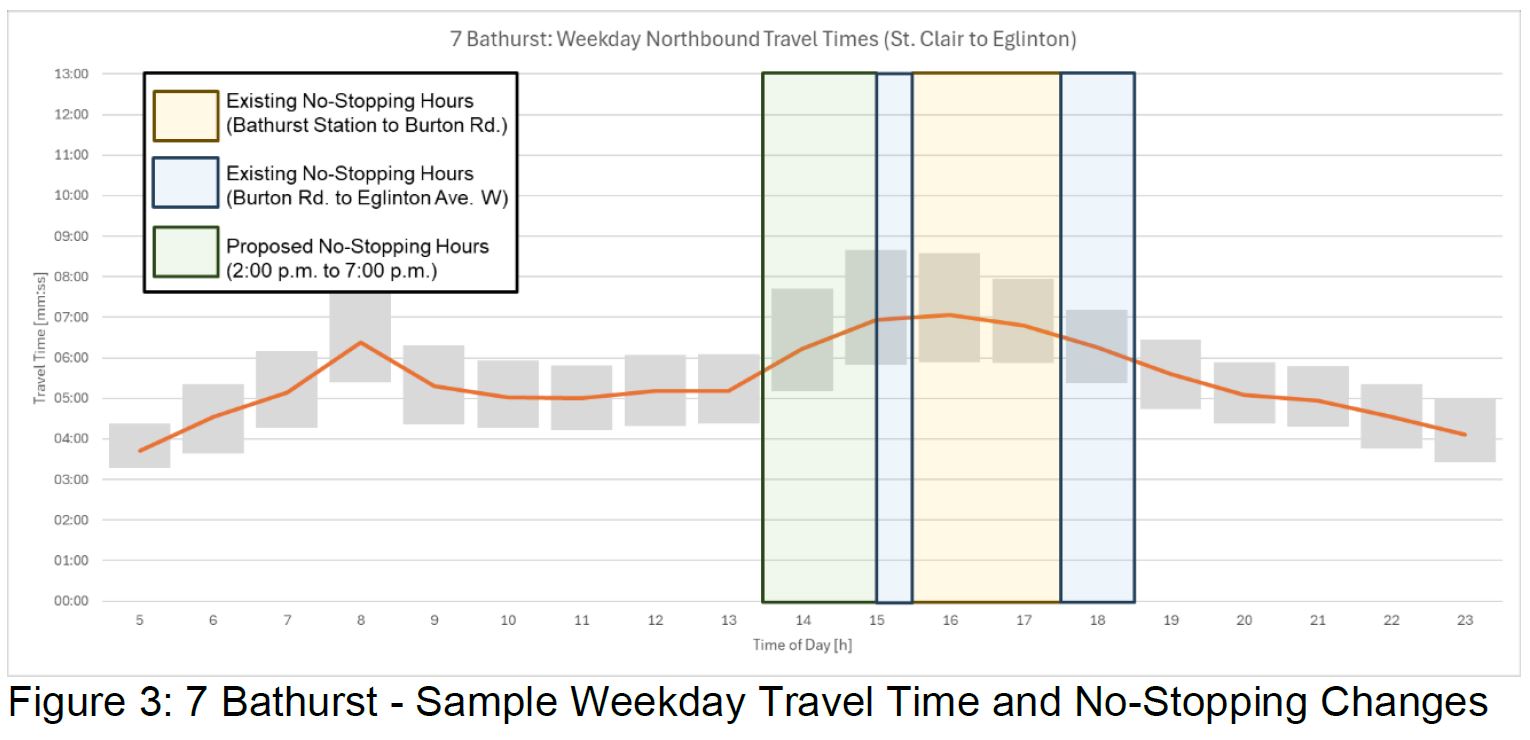
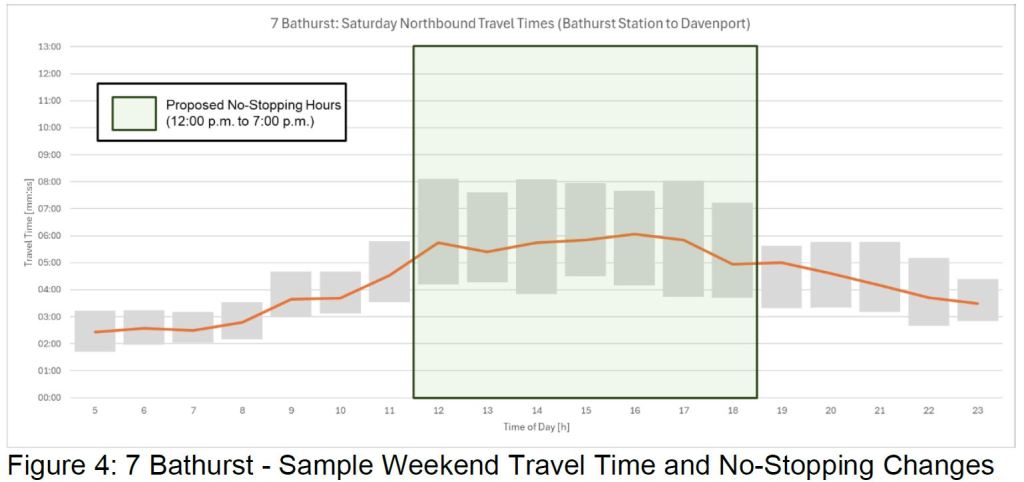
- No stopping will be permitted on Bathurst Street northbound from the north exit of Bathurst Station to Eglinton Avenue from 2-7pm on weekdays, and 12-7pm on weekends.
- North-to-west left turns at Bathurst & Davenport will be banned from 7am-7pm Monday to Saturday, except holidays.
- South-to-east left turns at Bathurst & Dupont will be banned from 7am-7pm Monday to Saturday, except holidays.
- The existing 7am-9am ban on north-to-west left turns at Bathurst & Dupont will be removed.
The chart below shows the weekday and weekend travel time profiles for Bathurst Street with the existing and planned hours of “no stopping” overlaid.
Travel Time Details
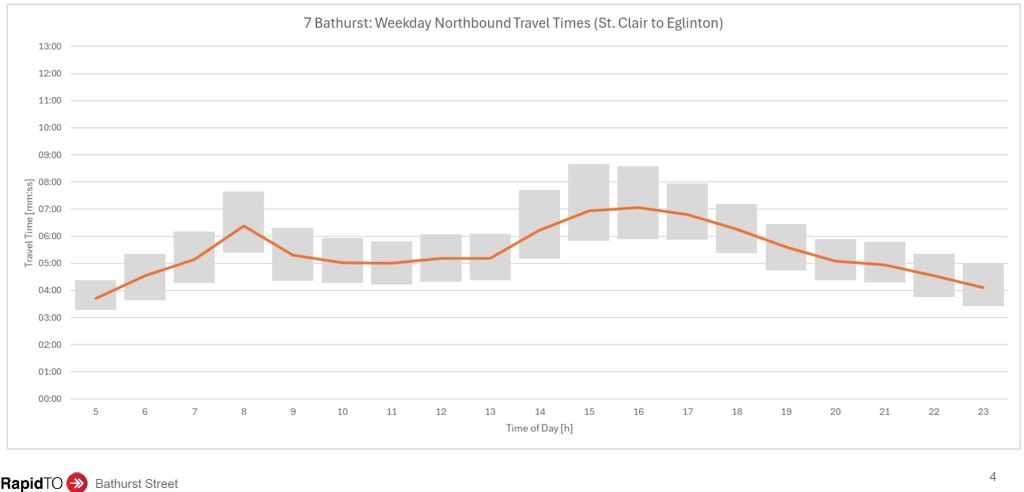
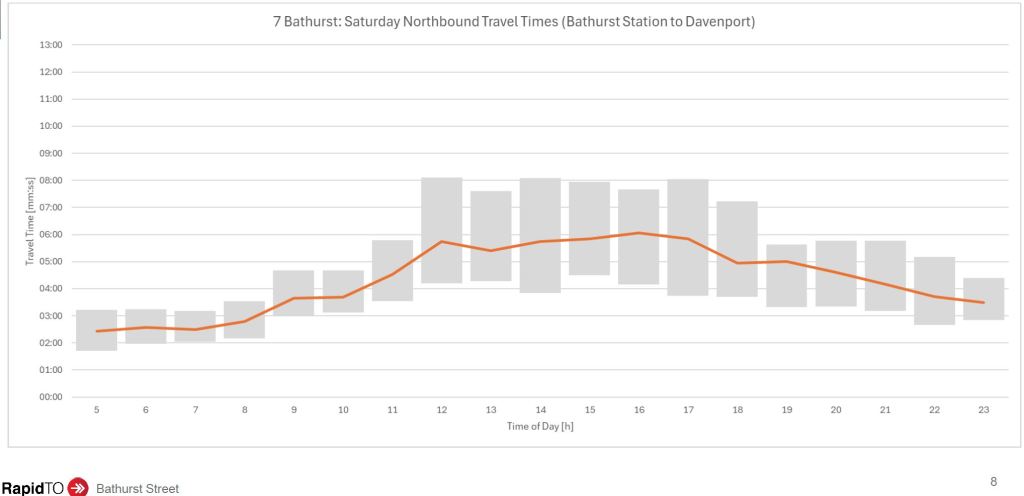
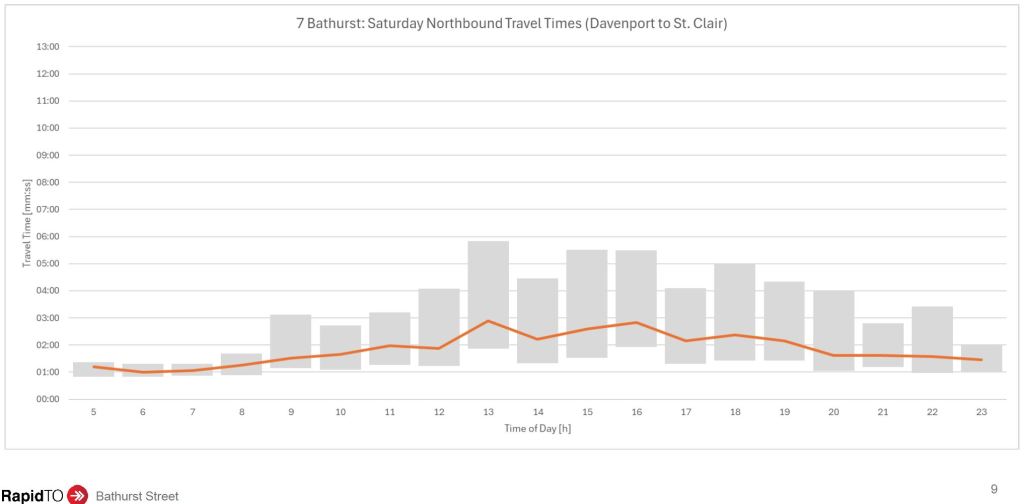
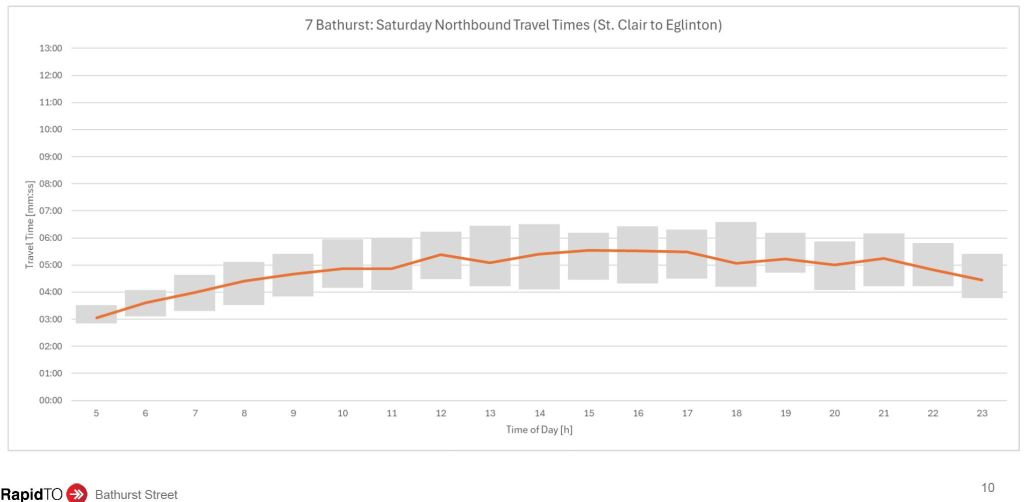
Appendix 2 of the report includes charts showing how travel times vary by time, location and direction.
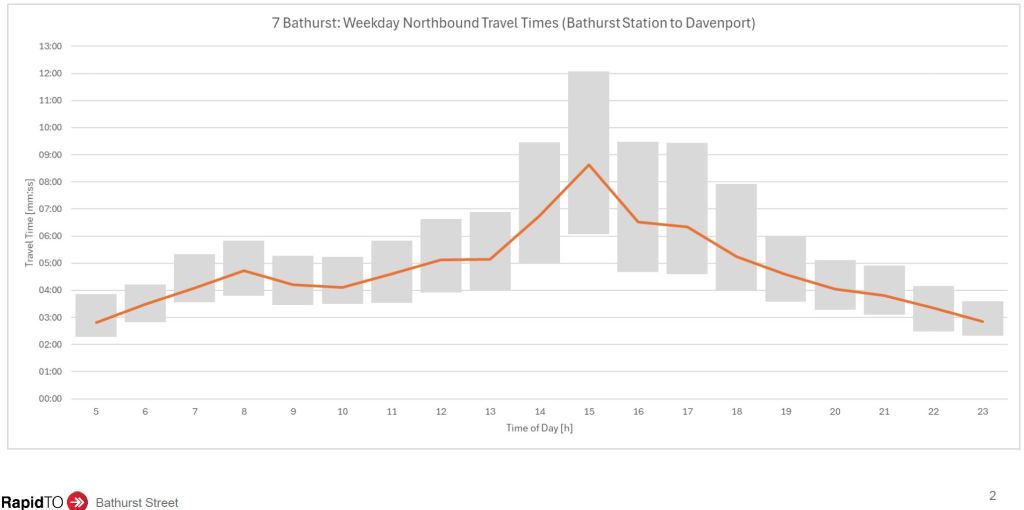
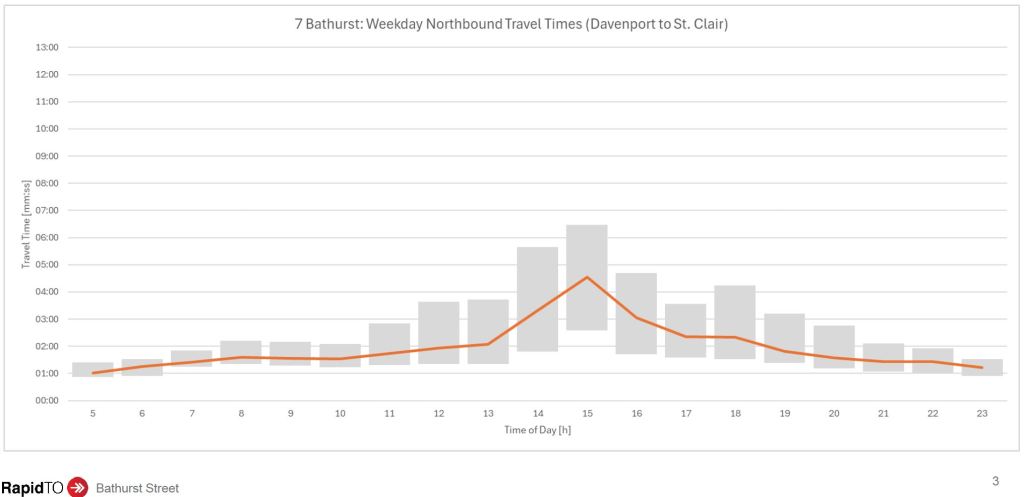
Travel times and the range of values are shown for three segments between Bathurst Station and Eglinton below.
Weekdays
Saturdays
Sundays
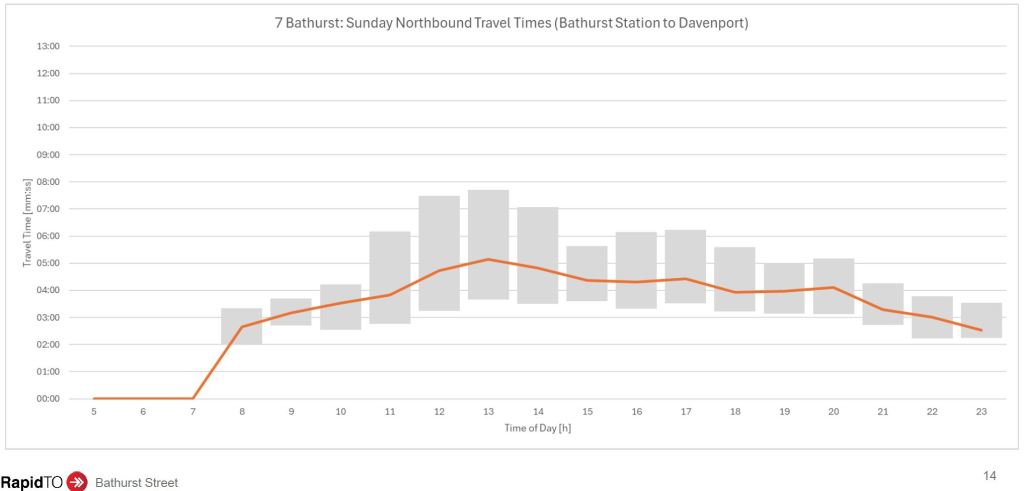
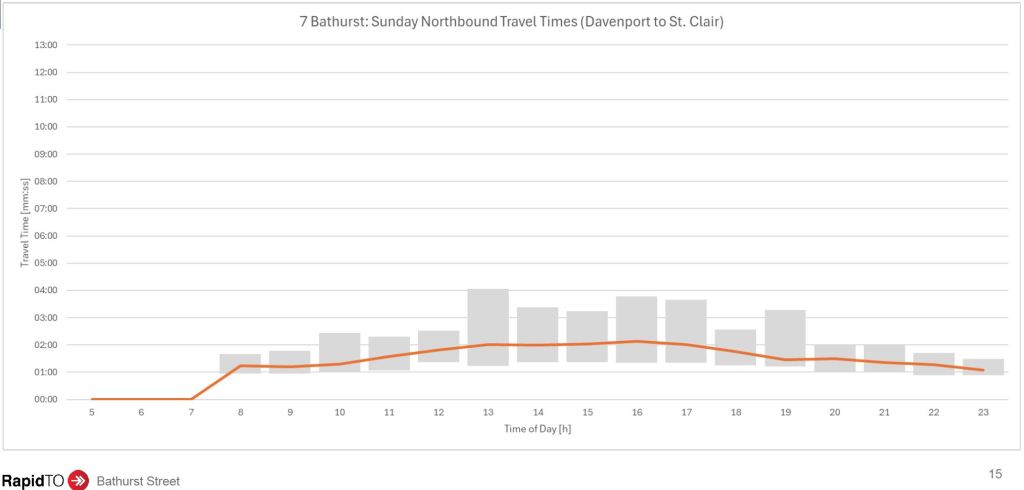
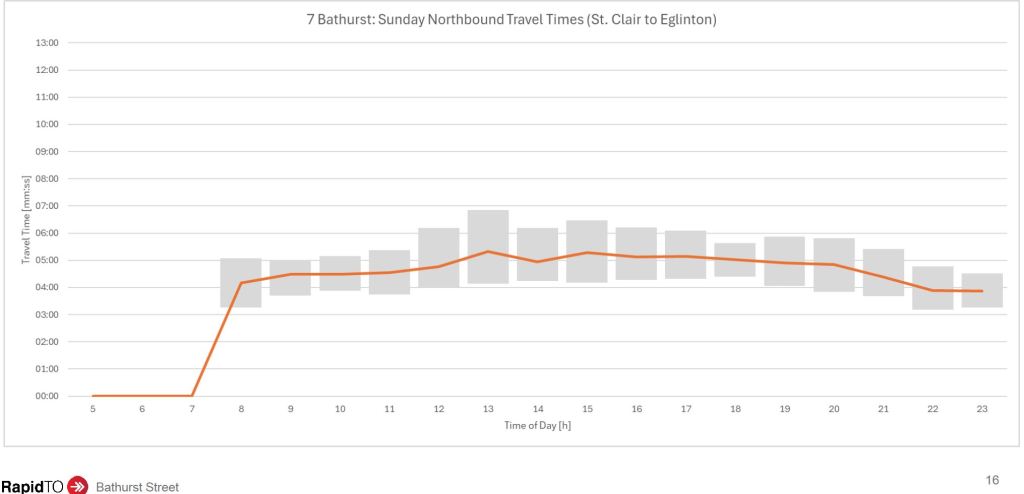
An important issue post-implementation will be not just the reduction in average travel times, but the degree to which the variation in times (the grey bars around the averages above) tighten up to provide more reliable trips over this route segment.
Demand Profiles
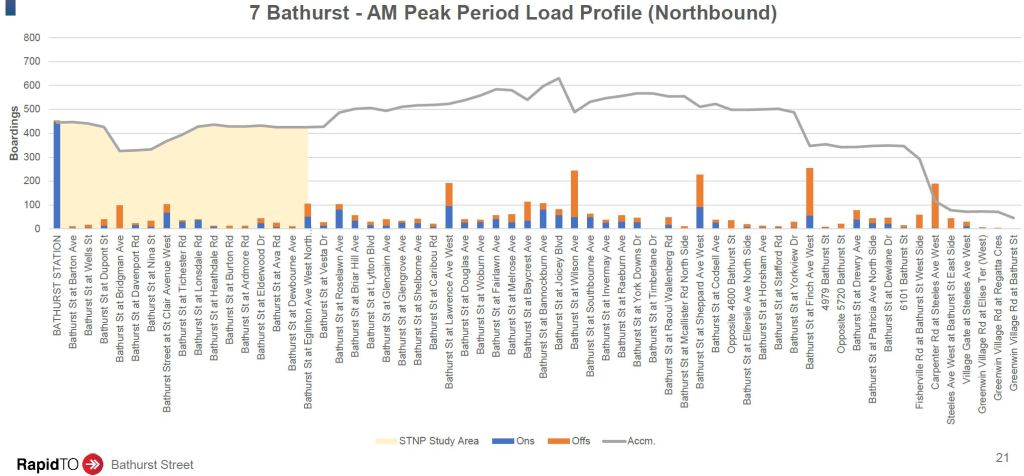
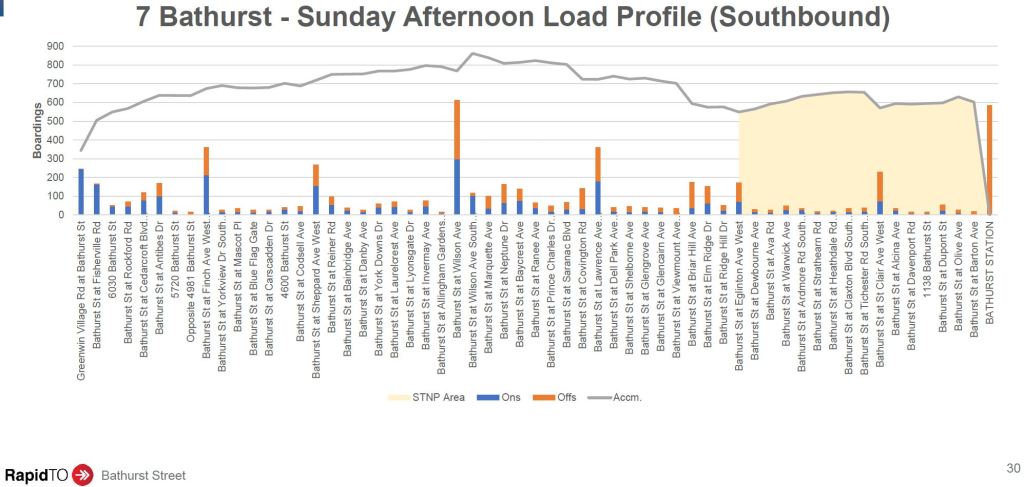
Appendix 2 also includes profiles of ridership along the route. These are interesting as an example of how a major route behaves, but also raise questions about how the benefit of red lanes was presented in the first place.
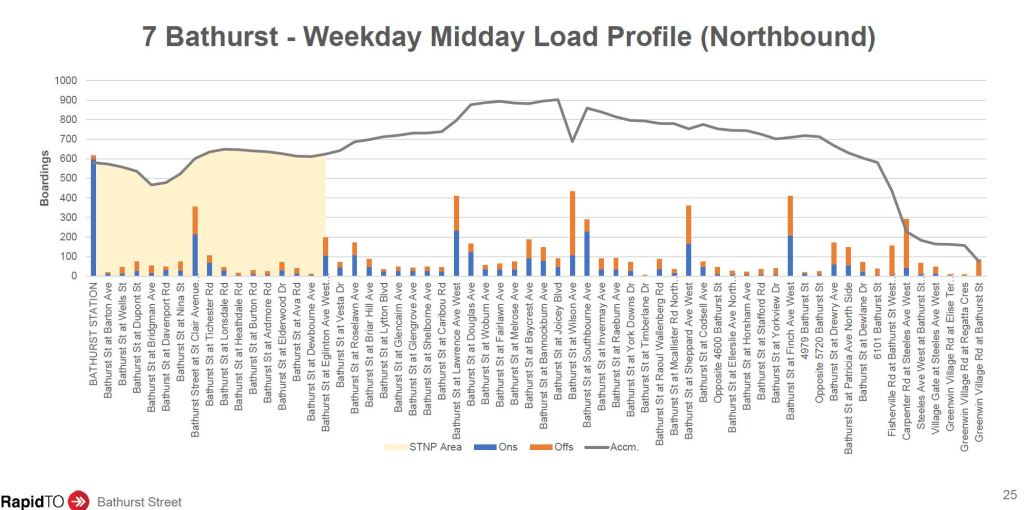
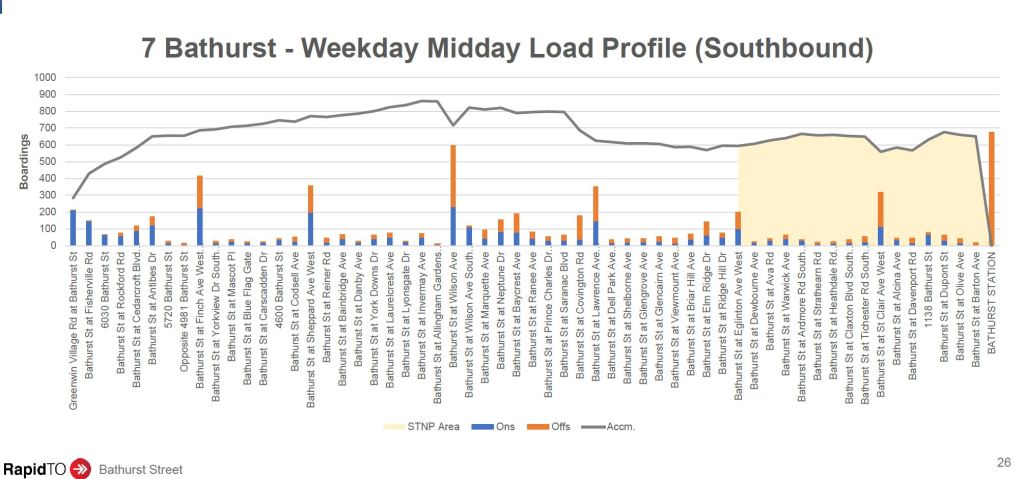
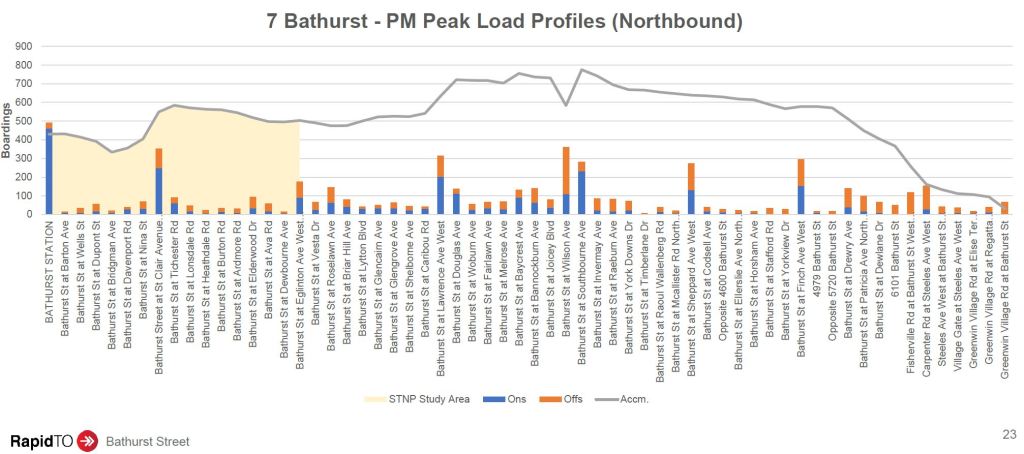
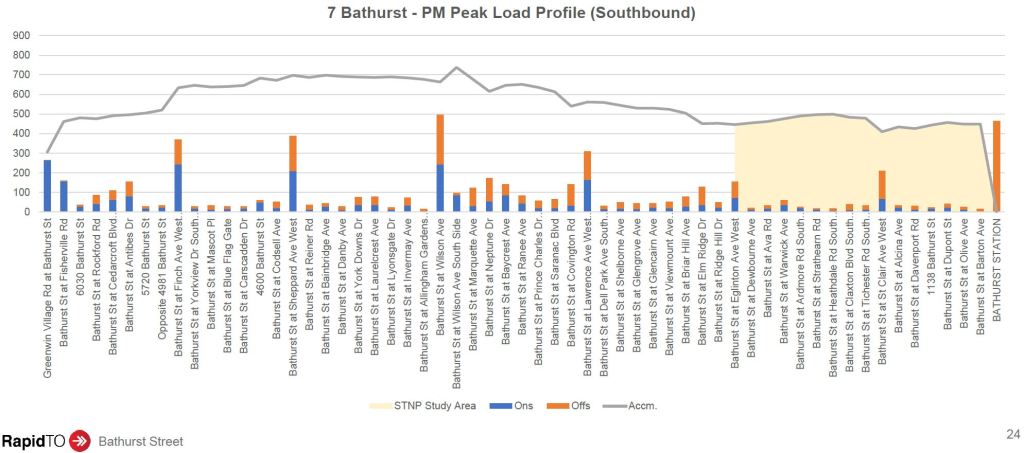
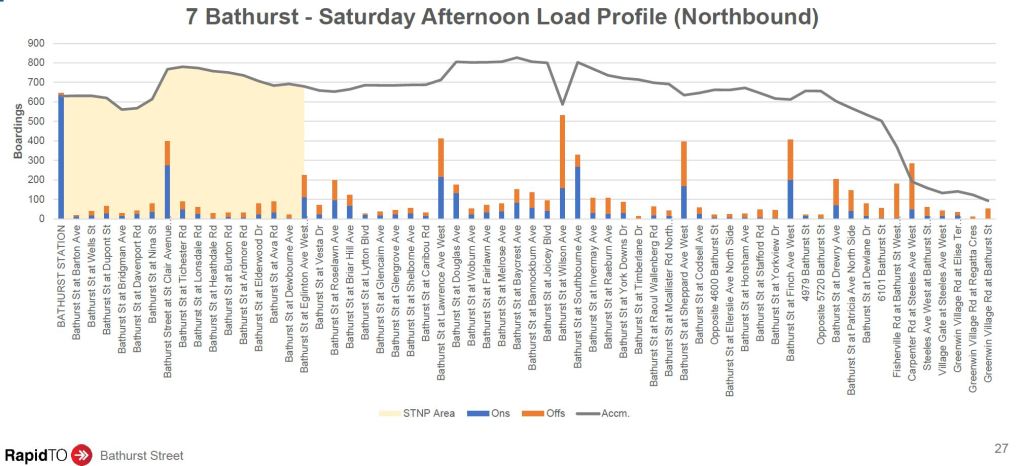
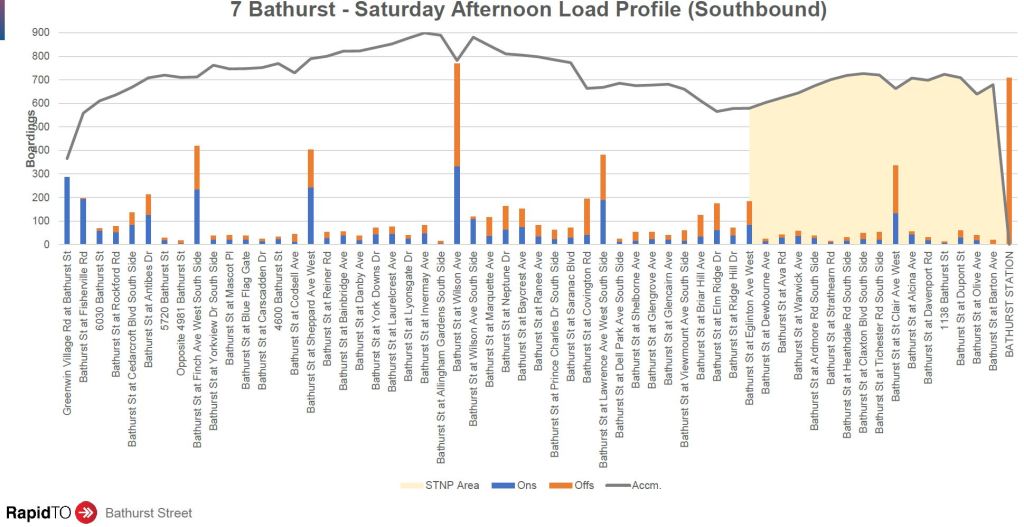
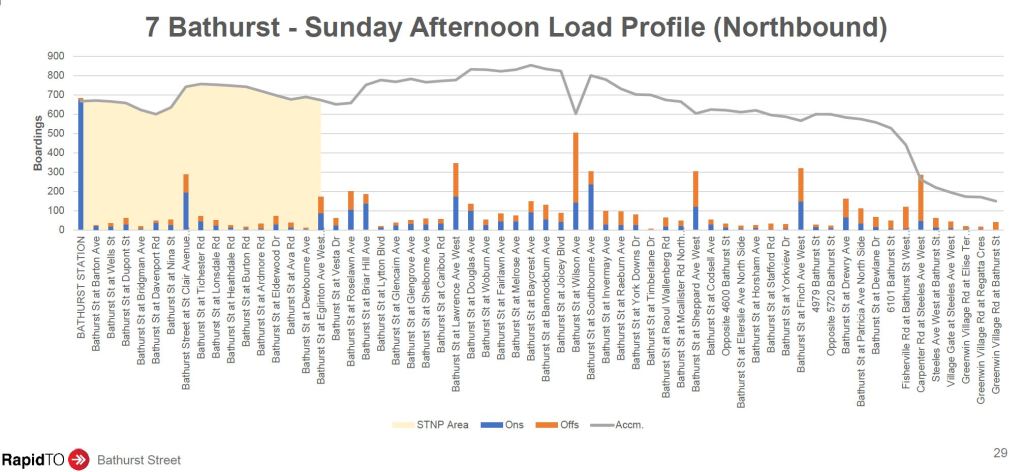
Each charts shows the ons and offs at each stop along the route. The grey lines across the chart show the accumulated load which varies as riders board and alight along the way.
7 Bathurst is a route with many transfer points, and the loads do not accumulate from the one terminal to another. For example, southbound in the AM peak, there are many who alight at Finch, Sheppard, Wilson and Lawrence. The accumulated load is actually higher north of Lawrence than it is at Bathurst Station.
The service on 7 Bathurst is 6 articulated buses/hour all day, every day. Based on the Service Standards, this corresponds to a design load of 462/hour peak (6 x 77) and 276/hour off peak (6 x 46). The number of hours covered by each interval is not shown, and therefore we cannot translate the values to riders/hour nor compare them to the Standards.
AM Peak
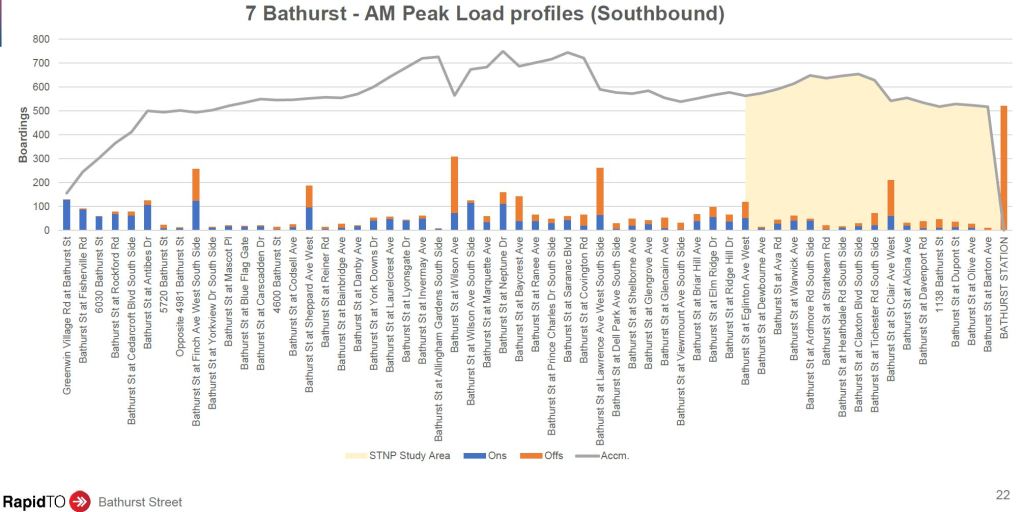
Weekday Midday
PM Peak
Saturday Afternoon
Sunday Afternoon
Overstating the Benefits
When touting the benefits of red lanes, it is common for the TTC to cite the total ridership on a route and factor this up based on assumptions of elasticity of demand relative to travel time.
Our transit assignment model uses two key inputs:
- Transit network data – service levels, speed, and reliability from our CAD/AVL system (VISION).
- Trip origins and destinations – from the Transportation Tomorrow Survey.
The model estimates door-to-door travel times and maps the routes taken. For RapidTO projects, the City uses traffic microsimulation to calculate travel time savings, which are then fed into our model. We apply service elasticity to estimate ridership increases:
- 1.5% increase for every 1% travel time reduction during peak periods
- 2% during midday
- 3% during evenings
The model also shows rider diversion—improved corridors attract riders from others. For example, RapidTO makes Dufferin and Bathurst more appealing, drawing riders from Line 1.
[Source: Email from TTC Media Relations August 21, 2025]
However, it is clear that many riders only travel for a portion of the route and will not be directly affected by any change between Eglinton and Bloor. They might enjoy an indirect effect if service reliability improves and wait times are shorter, but they cannot be counted in any model for increased ridership.
According to the TTC:
Improvements in transit travel time and reliability are expected to increase daily bus ridership by 23%, with 4,920 new riders. Of those new riders, 3,860 are riders attracted from other transit routes, and 1,060 are new transit riders. [Source: Transit Priority Measures on Dufferin Street and Bathurst Street, Table 2. p. 23]
The 4,920 “new riders” are in fact mostly diverted, not net new.
Claims of higher ridership and revenue mislead on three counts:
- A 23% increase in ridership, considering that many riders do not use the section south of Eglinton, is not credible given the expected changes in travel time and the elasticities the TTC uses.
- There are few “nearby” services that might contribute riders in the segment south of Eglinton. It is difficult to believe that subway riders would switch to the Bathurst bus.
- Riders who migrate between routes do not represent new revenue, and could drive up the need for service offsetting revenue from truly new riders.
 Steve Munro
Subject to approval or veto by Mayor Doug Ford.
LikeLike
Maybe they should think about splitting the route to improve reliability. In high demand periods, they could run overlapping shorter branches and add an express route. TTC could do more before blaming others.
Steve: There is no logical or simple place to split the route. A major problem, as I have discussed in another article, is that buses do not leave either terminal on an even spacing. On a ten minute headway, it is easy to get gaps of 15 minutes, and these actually satisfy the “Service Standards” which allow a 50% deviation from the scheduled value.
LikeLike
Jack. Why isn’t there a Bathurst express route?
Steve: Because at a ten minute headway, splitting the service into locals and expresses would make for very wide gaps in each service.
LikeLike
Why is all the city council focus on the bus route north of Bloor but the street car right of way is a given? The impact of the dedicated streetcar lane on Bathurst will have a far bigger impact on the residents of the core than a few lost parking spots north of Bathurst.
Steve: The case for a bus lane was made very badly given the level of service today, and the actual conditions on the route. Also, the residents north of Bloor were noisier.
LikeLike
It didn’t help that they failed to actually inform the residents south of Bloor and failed to engage by not holding open houses in the neighborhood.
I’d love to see the demand profiles for the street cars on Bathurst, similar to the ones posted for the bus route. Post the link if possible. Thanks.
Steve: The TTC has not published charts for 511 Bathurst, nor for 29 Dufferin. For a few years I have been trying to get access to the automatic passenger counting data so that I could produce these charts as part of my service analysis, but the TTC has not been cooperative.
LikeLike
Why there is not Express 907 bus on Bathurst ???
Steve: As I said in a previous reply, the level of service on 7 Bathurst is too low to support both an express and local service. The TTC will not implement an express without an offsetting cut to local service. There is a huge difference between Bathurst and Dufferin. Bathurst has one articulated bus every 10 minutes all day. Dufferin has an artic every 4 minutes during most periods with half of those running express.
LikeLike
There are a lot of left turns at Bathurst and Davenport. I wonder where that traffic will go? (Dupont these days is a horribly congested street with many impediments due to (condo) construction.
LikeLiked by 1 person
Bathurst Street between Queen Street West and Front Street is wide enough to put in a streetcar right-of-way. There used to be talk, just talk, about widening the Sir Isaac Brock Bridge (AKA Bathurst bridge), but nothing came out of it, mostly because of the cost. Is there still “talk” about that bridge?
Steve: No to the bridge. Bathurst will have red lanes as shown on the plan for the streetcar section.
LikeLike
It won’t get better if the construction is done and people move in and they all drive because the TTC still runs the bus every 24 minutes in AM peak!
Steve: Yes. The Annette/Dupont bus is an example of how demand on a route can be killed off by service cuts over the years.
LikeLike