The TTC’s Strategic Planning Committee met on September 4 at 10:00am in the Board Room at 1900 Yonge Street, TTC headquarters. The agenda included a presentation on the 2025 projected results and the outlook for 2026. This includes comments on the Capital Budget and Plan which I covered in a previous article.
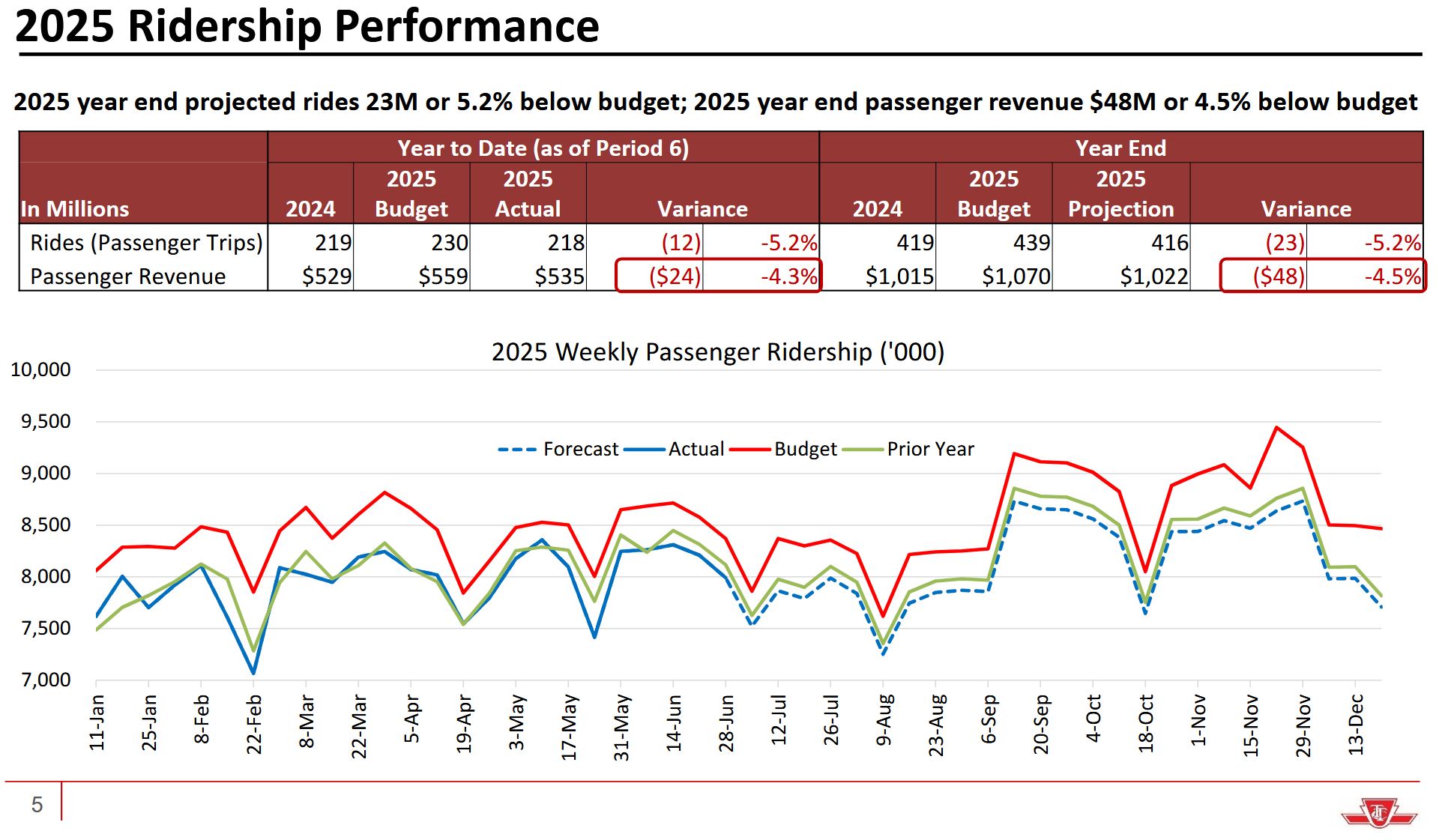
As of June 30, the TTC was running $17.7-million behind relative to budget, and this number is expected to rise to a $36.5-million shortfall for the full year.
This is due primarily to ridership coming in lower than projected partly offset by lower than budgeted expenses.
One item not mentioned in the report is that the TTC’s Operating Budget for 2025 includes a withdrawal of $51.4-million from reserves. There are several reserves for different purposes (one covers self-insured loses from accidents), and it is not clear how much headroom there is for further withdrawals once year-end results are finalized.
The City often finds “left over” money at year end from various sources, and some of this goes into reserves and/or to making the TTC budget whole. Whether this will be available in 2025 is not yet clear.
In any event, if future budgets assume substantial reserve contributions, they could exhaust the “rainy day funds”.
At its meeting of September 4, 2025, the TTC’s Strategic Planning Committee considered a report on the unfunded “state of good repair” (SOGR) projects in their capital budget and a recommendation that these be prioritized for any new funding that might become available.
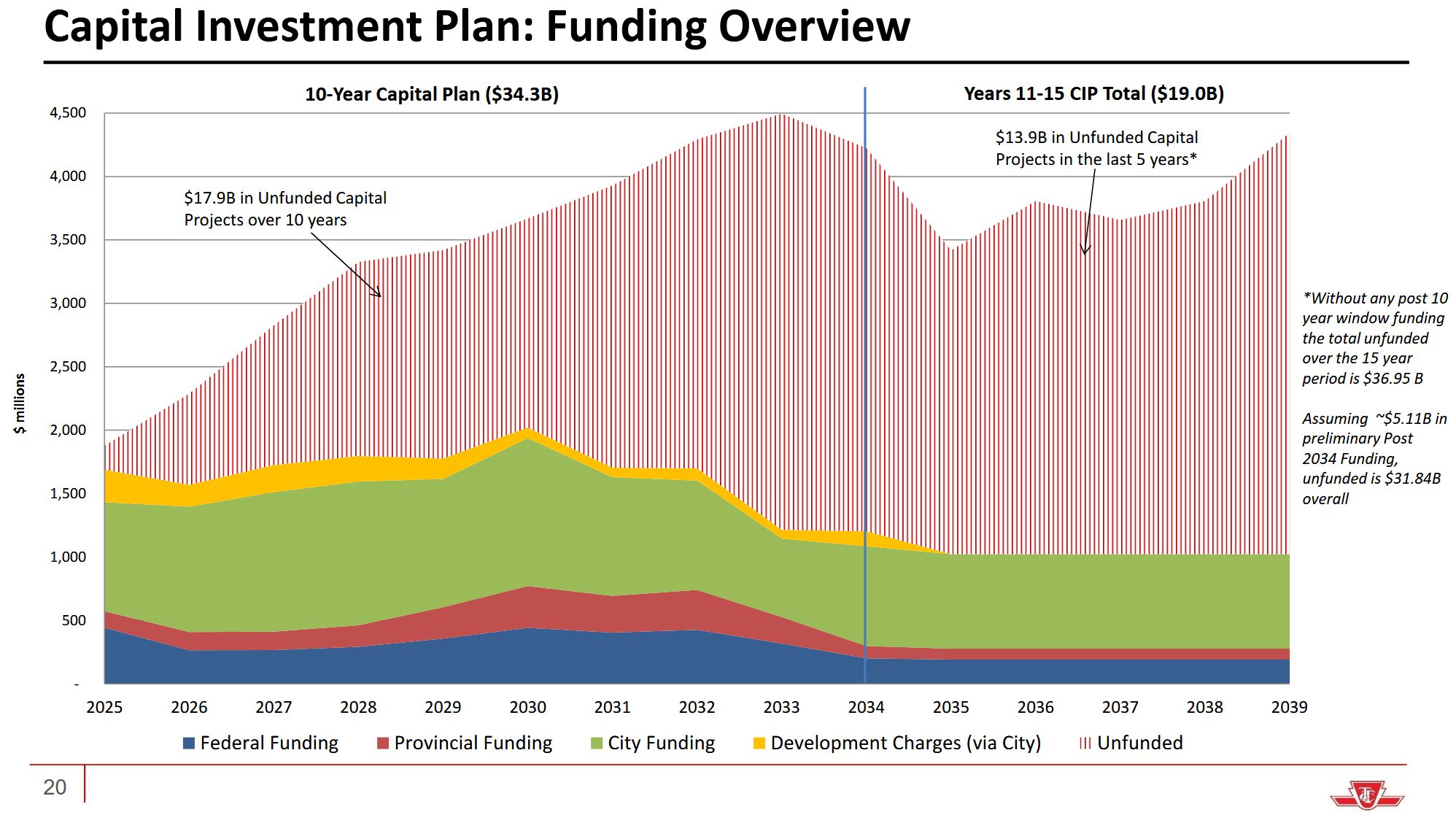
Updated September 8 at 3:15 pm: A chart has been added showing the magnitude of proposed spending and the shortfall in funding over the years 2025-2039.
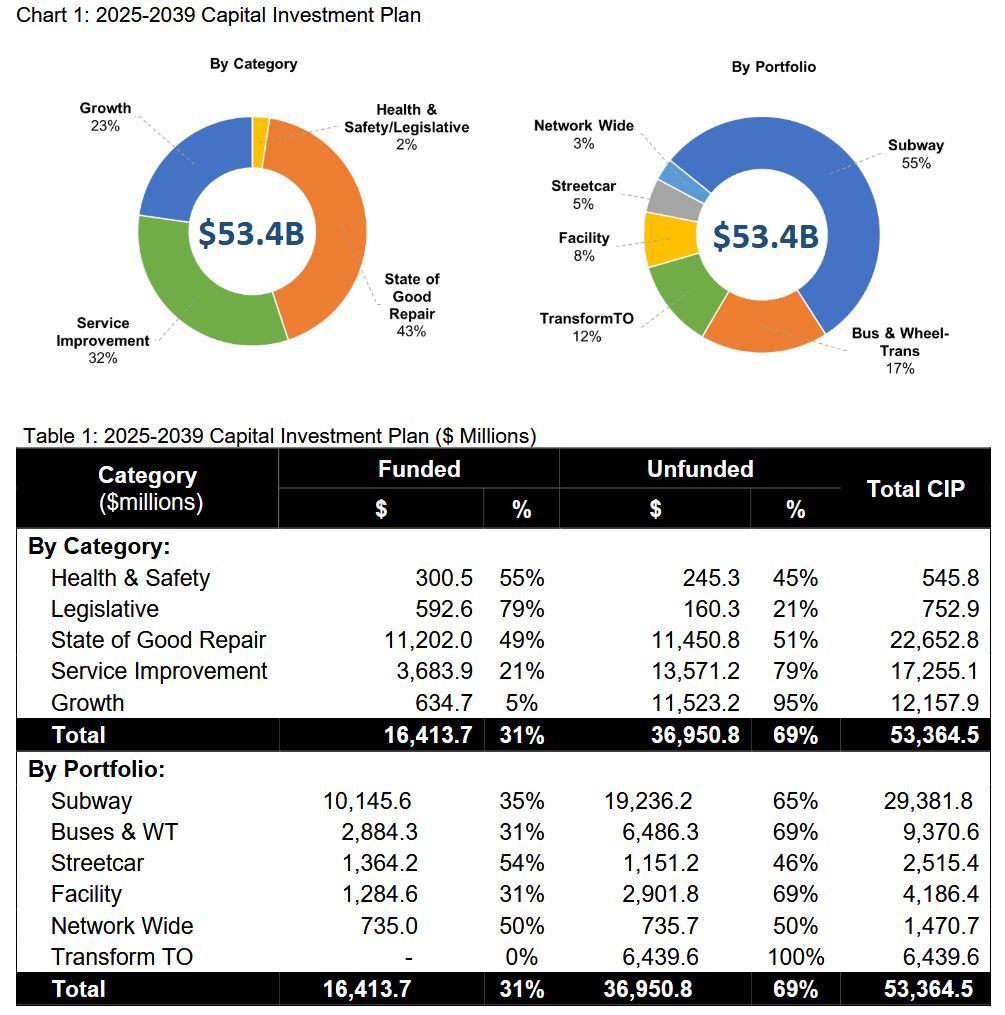
The charts and tables below summarize the 15-Year Capital Investment Plan showing the distribution of funding and spending by area. The categories are ordered by priority with mandated work, a comparatively small component, coming first, followed by State of Good Repair which accounts for roughly 40% of planned spending. Note that the Provincial projects such as the Scarborough Subway and major City projects like the Eglinton-Malvern LRT are not included here.
SOGR does not preclude spending on other work, but some major proposals could compete with basic maintenance. For example, Platform Doors and the TransformTO program together account for about 20% of the total plan ($10.5-billion). Bus “SOGR” includes not just the purchase of new buses, but also the cost of technology change for charging infrastructure. Although these should be funded from separate revenue/subsidy streams, they could elbow aside basic funding. There is not much point in such projects if the basic transit system is allowed to crumble.
Some of the language in the report is rather cataclysmic foreseeing the shutdown of parts of the system, notably the streetcar network, if SOGR work is not funded. The report is inconsistent in the language used to describe the situation:
Given the current approved funding levels, the TTC will not be able to renew tangent track assets at a rate necessary to maintain and support existing service demands in a safe and reliable fashion to meet its SOGR needs. Results of an insufficient renewal rate could include restricted speed zones/slow orders, weekend/multi-day service diversions/closures, and/or emergency service interruptions. [p. 6]
But more dire language appears later:
Even when attempting to utilize more operating resources within preventive or corrective maintenance programs, the TTC may find it necessary to plan and prioritize condemning some rail corridors in favour of renewing others, and some may be fully placed out of service, with key intersections being the most at risk. [p. 18]
Such language has appeared before going back into the previous decade. We have seen what deferred maintenance did to the Scarborough RT and to the subway network which is beset with slow zones where track is not safe to operate at full speed. Delays in funding and approval for replacement of Line 2 trains pushed out their projected lifespan, a situation relieved only by concurrent delays in the Scarborough Subway expansion. By contrast on the streetcar network, some of the worst locations have been repaired in recent years, notably the intersection at King & Church, and more replacements at key locations are planned for the near future.
One cannot help thinking there is an anti-streetcar bias at the TTC where any excuse is used to hobble the system including widespread slow orders and abdication of any sense of providing reliable service.
In past years, the TTC published a much more detailed version of the Capital Budget (aka the “Blue Books”) including maps showing the current condition of assets. These put the scope and immediacy of needs in an understandable form. The closest thing today is the map of Reduced Speed Zones, but this does not indicate the scale and timing of needed work in the near future.
The more cynical among us might wonder if the lack of detail was part of a larger effort in the Tory/Leary era to downplay the gradual decline of transit infrastructure thanks to underspending and deferred maintenance.
It is ironic that the TTC is prepared to consider shutting down part of the streetcar system when there are much more extensive areas on the subway in need of major reconstruction. With a fleet of about 260 cars of which peak service consumes barely 60%, the goal should be to increase use of vehicles they already own, not to sabre-rattle about dismantling the system.
The transit system is more than tracks, and especially on the subway many unseen or little regarded systems keep service operating and stations and tunnels safe for riders. These are all part of the SOGR program, but this emphasizes how subways are expensive infrastructure not just to build but to own as they age.
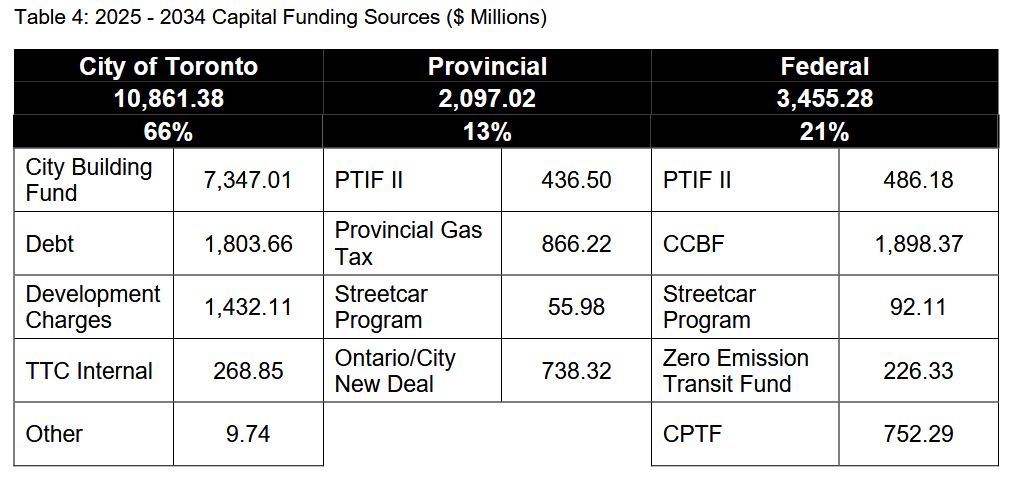
Funding comes from several sources.
The City Building Fund is financed via property tax surcharges begun under Mayors Ford and Tory.
PTIF is an old program that winds down as withdrawals are made from committed funds.
City debt is financed through general city revenues.
CCBF is the Federal program replacing the gas tax allocation.
The projection for Development Charges could be high given the state of the construction industry and the deferral/elimination of DCs on some targeted housing programs. DC funding is only available to projects that expand service, not for day-to-day SOGR.
Amounts for the Streetcar Program are for the last stage of the 60-car order now in delivery and expansion of storage and servicing facilities for some of these cars at Hillcrest. It does not address the SOGR backlog.
TTC Internal funding comes from depreciation of assets that were bought by the TTC and not funded by other governments. In effect, this is a charge on the operating budget.
The New Deal was struck by the Province and City to upload expressway reconstruction and maintenance thereby freeing up capital that would otherwise be spent by the City.
The Zero Emission Transit Fund has help pay for electrification of the bus fleet, but it is unclear whether this will continue or be rolled into the CPTF.
The CPTF is the new Federal program for transit funding across Canada.
Some of these sources will run dry when the associated commitments are fulfilled.
An ongoing political problem in Toronto is the assumption that other governments will continue with project-based funding outside of these programs. This leads to allocated funding being earmarked by the City for the project getting the most attention (e.g. the lobbying for new subway train funding) with the assumption that more money will be available for other works. In the current climate, that is a risky assumption.
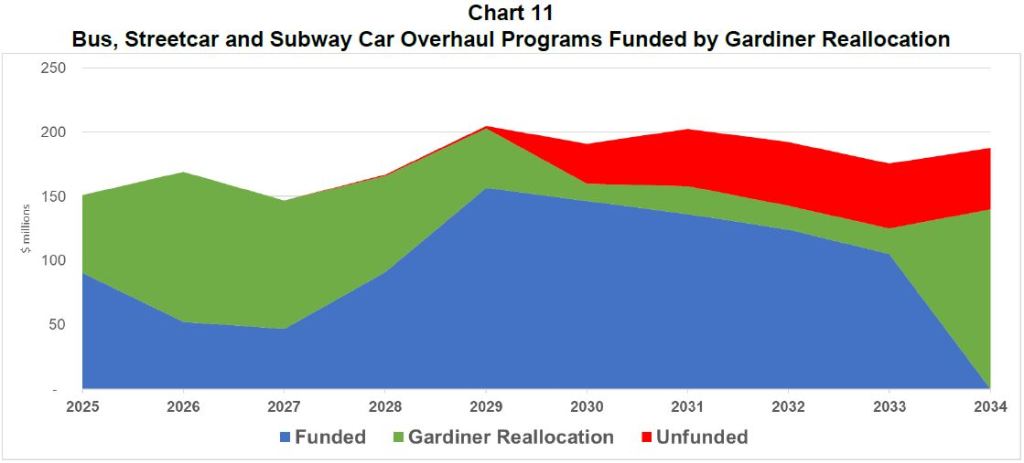
An important change in 2025 was the “New Deal” struck between the City of Toronto and Province of Ontario which had the effect of releasing capital dollars in the City’s plans for expressway renewal for use on the transit system. This money has been allocated as shown in the charts below which are from the 2025 Capital Budget.
Note that these charts show only vehicle overhaul programs, not the larger capital plan and shortfall.
A further problem in the medium term is that the bulge in road spending would only last for the rest of the 2020s, and there is no comparable saving in the early 2030s that can be shifted to transit. The New Deal is a short term fix, not a long term solution. This leaves many projects in the “out years” of the budget with no obvious funding.
Updated September 8: Chart added
This problem is illustrated by a chart showing the proposed spending level and projected revenues, together with the wide gap in future years. Note that as things stand today, the City is the major funder of TTC Capital, but the growing mountain of unmet needs will hit in the very near future unless new money is found or spending is curtailed. That option brings its own problems if the budget lines affected are SOGR projects as we have seen in past budget cycles.
The report includes tables by major segment of the system listing the unfunded capital works. For comparison, I have included the full Capital Budget presentation slides from January 2025 to put these numbers into context. The breakdown in the September report is different from the full budget in January making comparisons tricky in places.


 Steve Munro