TTC Freezes Non-Union Hiring

On Friday, September 26, the TTC issued an internal notice that there would be a freeze on all non-union hiring. This is in reaction to the need to find $141-million in savings to get the anticipated 2026 budget deficit down from $232-million to the Mayor’s target of $91-million.

All non-union requirement is subject to the CEO’s approval.

While, in theory, this does not directly affect service or maintenance levels, there is simply no way that the TTC can find $141-million without at least constraining the union side as well. In turn, this has implications for service growth in 2026 especially considering the ongoing loss of productive service hours to traffic congestion and changes in bus dispatching for the shorter range of eBuses. There is also the question of adequate staffing in various maintenance departments.

One current initiative to improve service is headway monitoring and management, and it is not yet clear whether this would be staffed with “management” or “union” positions.

More generally, the question must be asked whether “management” has been growing at a faster rate than other line positions (be they union or non-union) over past years. The TTC used to publish detailed staffing counts as part of the Operating Budget “Blue Books” up to 2019, but these no longer exist, at least not publicly.

A hiring freeze is only a first step in any review because it addresses vacancies that might or might not be in critical roles. Moreover, it does not address the larger question of whether management should be reorganized or downsized.

One hidden issue in staffing is the matter of consultants and outsourcing. Although the use of outside staff is not as severe an issue at TTC as at Metrolinx, this can be the source of much resentment by “in house” staff who are asked to do more with less while the taps continue to flow for outsiders. Indeed, I understand that a former TTC manager is acting as an advisor on contract to the senior team. This shows how careful an organization must be with double standards.

Recently, the TTC has consulted with interested parties including their Planning Advisory Committee, which I attend, on various service proposals and other matters going into the 2026 budget cycle. It is hard to see how such consultation can bear any fruit facing a constrained subsidy target from our “pro-transit” Mayor.

I asked the TTC to respond on this issue on Friday, September 26, and again today, September 29. As of 5:00pm, the only reply is a copy of the corporate notice that I already had from another source. Its text follows the “more” break below.

Continue reading
Bus Reliability: TTC Reveals Uncapped Stats

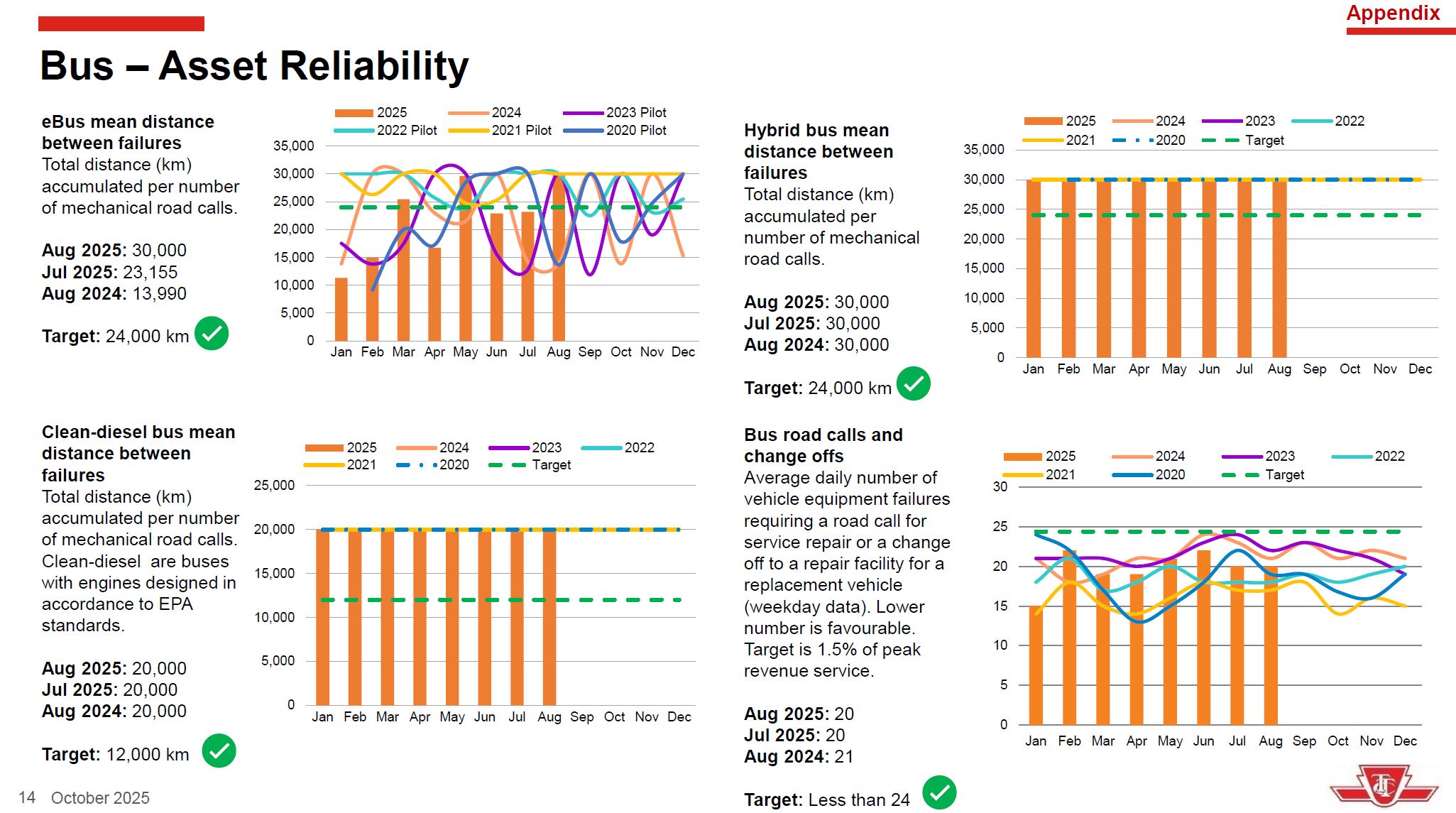
For many years, the TTC reported bus reliability as a mean distance before failure (MDBF) as shown in the charts below.

A fundamental problem with these charts is that the values for Hybrid and Clean Diesel buses are capped at 30,000km and 20,000km respectively, although the actual values could be higher. This makes the values shown for eBuses which lie in the 15,000-30,000km range look similar by comparison.

In the October 2025 CEO’s Report, on the agenda for the TTC Board Meeting of October 6, 2025, the values are not capped. Indeed, the CEO comments on the particularly good results for diesel buses.

Industry-Leading Asset Performance

When it comes to vehicle reliability, our fleet continues to outperform expectations. Across all vehicle types, our buses are achieving Mean Distance Between Failures (MDBF) well above North-American standards. Clean Diesel, in particular, is showing exceptional results, demonstrating industry-leading reliability across our entire bus portfolio. [CEO’s Report at p. 2]

The numbers cited by the CEO for September 2024 to August 2025 are:

Mean Distance Between Failures

Ebus 117 buses 24,554km (12m rolling avg) Target 24,000
Diesel 1165 buses 46,336 km(12m rolling avg) Target 12,000
Hybrid 766 buses 36,218km (12m rolling avg) Target 24,000

[CEO’s Report at p. 5]

The MDBF values affect key aspects of service provision including the number of vehicles required for spares and the probability of a failure affecting service.

Not included in the stats is the mean time to repair which can have as severe an effect as MDBF. If the failures for one type of equipment are more complex putting a bus out of service for a longer period, this can compound the MDBF rate because each failure represents a longer outage. The TTC is somewhat insulated from this effect because it maintains a larger spare ratio than the industry average (see below).

I will review the new format of reported stats (only bus and subway are available so far, with streetcar to come in November) as part of my general write-up of the Board agenda.

The TTC appears to have been under-reporting the reliability of diesel and hybrid buses for many years, and this suggests that they wanted to make their eBus program appear as successful as possible. The historical stats should be restated with the caps removed so that the public can see just what the comparison over past years actually looked like.

Recently, operational issues regarding the deployment and charging for an eBus fleet have come to light, and it is clear that conversion to battery buses is not going to be as straightforward as thought when this program began.

Different fleet counts are cited in the August 31 Scheduled Service Summary and the CEO’s Report.

CEO’s Report
September 2025
Scheduled Service Summary
August 31, 2025
Diesel1,165 (56.9%)1,165 (55.3%)
Hybrid766 (37.4%)766 (36.3%)
eBus117 (5.7%)177 (8.4%)
Total2,0482,108
Peak Scheduled1,5881,588
Spare Ratio29%33%

Only 1,588 of these buses are scheduled in peak service [effective August 31, 2025] giving the TTC roughly a 29% spare ratio (three buses spare for every 10 scheduled), still above industry standards if the pilot eBus fleet is excluded. If they are included, the spare count is even higher, but that could be misleading depending on how many of the pilot buses actually remain in service.

How much of this is due to budget limits on service growth, and how much is due to keeping a high number of spares to offset poor reliability?

233 eBuses remain to be delivered on current orders, and the TTC proposes a further 200 hybrid buses to continue replacement of older vehicles while eBus technology matures. The portion of the fleet now being retired is not the diesels, but the earlier hybrids acquired in 2006-2008. [Source: TTC Scheduled Service Summary effective August 31, 2025 at p. 58]

A through review of the eBus program is needed to understand its effect on future operating and capital budgets without the rose-coloured lenses applied to “green” projects. Emission reductions are a key goal for Toronto, but they should not come at the expense of higher cost and reduced reliability for the transit fleet.

The UITP Peer Review: What is the TTC Trying to Hide? (Updated)

At its September 22 meeting, the TTC’s Audit & Risk Management Committee passed a revised motion regarding this report. There are two effects:

  • A requirement that management report back to the Committee by the end of 2025 on various issues.
  • The report will be considered by the TTC Board at its next meeting (October 6, 2025) including a decision on which parts of the detailed UITP report will be made public.
Original RecommendationsRevised
Receive the International Association of Public Transport (UITP) Peer Review report and direct staff to evaluate the feasibility, cost, timing, and alignment of its recommendations with TTC’s mission and vision.Receive the International Association of Public Transport (UITP) Peer Review report and thank the participants for their assistance.
Direct staff to incorporate the recommendations deemed to be a strong strategic fit into the TTC Asset Management Maturity Roadmap.Direct management to report back to ARMC by the end of 2025 evaluating the importance, feasibility, cost, timing and alignment of the UITP recommendations with TTC’s mission, vision, and current plans, including the TTC Asset Management Maturity Roadmap. This report should prioritize the recommendations, and propose target dates and resource requirements for implementation of all high priority items that management recommends.
Authorize that the information in Attachment 2 remain confidential as it contains information related to the security of the property of the TTC.Forward this report and confidential attachment to the TTC Board.
Release Attachment 2 for public review after consideration by the TTC Board, except chapter 8, subject to approval of the Board, which shall remain confidential as it discusses sensitive details of the TTC’s signalling and control system.
Continue reading

Toronto’s Ambling Streetcars

One year ago, the TTC’s Audit & Risk Management Committee endorsed management’s proposal of a peer review of subway and streetcar assets and maintenance programs by the International Association of Public Transport (UITP).

Much of the review concerned asset management, inventory of system components, condition tracking and planning for maintenance and replacement. There is also a concern that subway and streetcar maintenance could be better integrated due to common technologies. I will leave a full review of this until after the A&RM Committee considers the UITP report at its September 22, 2025 meeting.

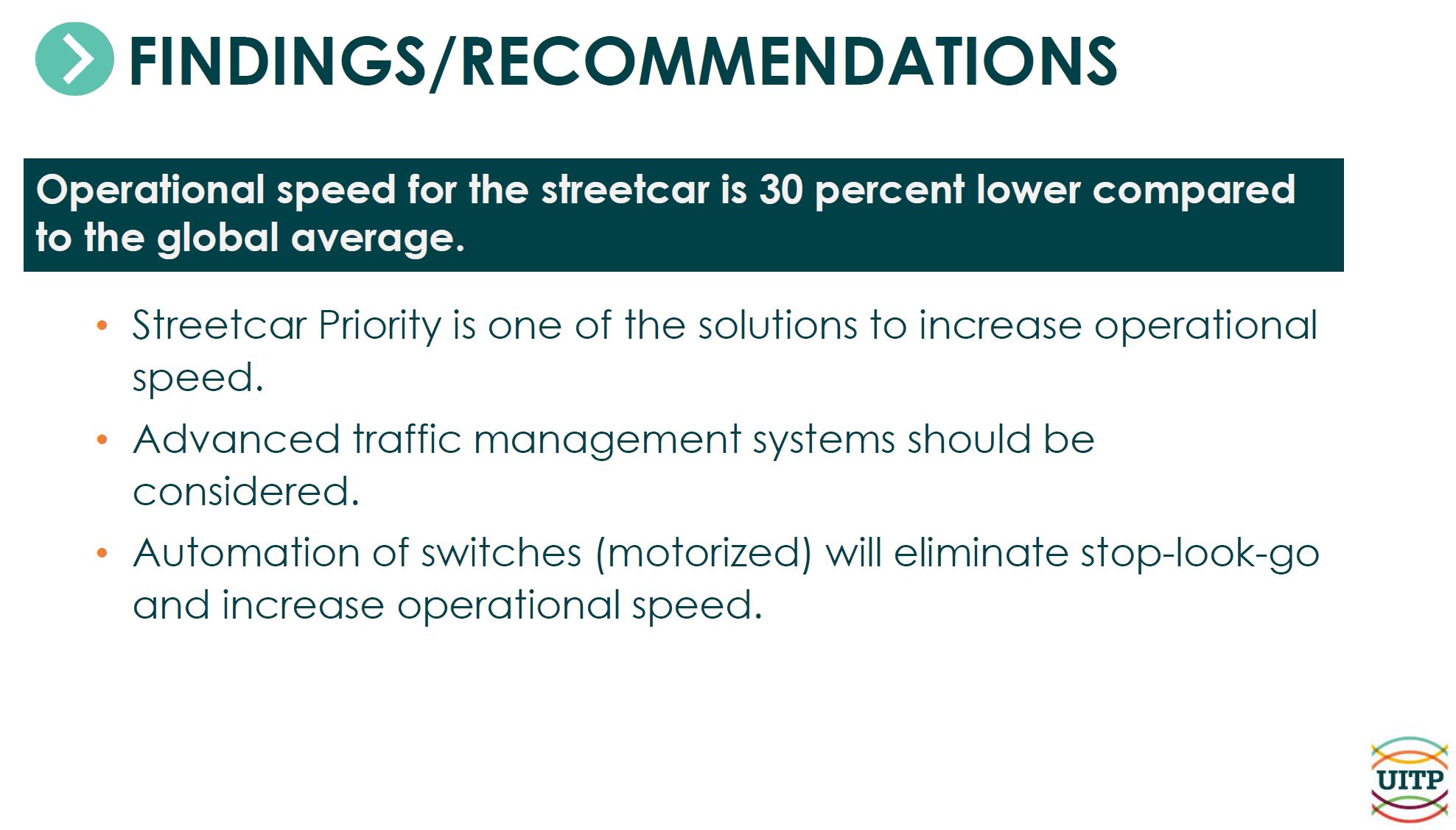
One slide in the UITP’s presentation deck speaks to streetcar operations and notes the glacial pace of Toronto streetcars compared to other systems.

The gradual slowdown of streetcar speeds evolved over a long period, and some of the history is not well known by current TTC Board members nor, I suspect, by many in TTC management. Many readers will remember the sprightly operation of the previous generations of CLRV streetcars and of the PCCs before them. The slowing of streetcar operations is not just a question of traffic congestion, but of other factors including TTC policy decisions. Any move to speed up operations needs to address as many of these issues as possible.

These include:

  • Electric switch operation
  • Track condition at intersections and associated slow orders
  • Overhead condition notably at underpasses
  • Flexity door operations
  • Nearside vs farside stops
  • Transit priority at signals especially for turning movements
  • Reserved transit lanes

The full version of the UITP report is not available and it will be discussed in private session at the committee meeting.

Continue reading

Pantographs for TTC Legacy Streetcars?

The TTC has a Request for Bid open on merx for the retrofit of pantographs on up to six legacy streetcars.

The base bid is for one car, with an option for five additional.

If this work goes forward, Toronto might still see its legacy fleet returned to occasionally active duty, but there is no further information in the request.

The legacy fleet is temporarily stored at the Halton County Radial Railway Museum.

Service Analysis of 154 Curran Hall: July-August 2025

Route 154 Curran Hall was created in September 2024 in part by carving off the Orton Park branch of 54 Lawrence East. It operates from Kennedy Station to University of Toronto Scarborough Campus (UTSC) and uses the Midland/Kennedy red lanes between Eglinton and Lawrence. From there, the 154 runs east to Scarborough Golf Club Road and then dodges north to Ellesmere via Brimorton and Orton Park. The route continues east to Military Trail and then south into UTSC.

Service is not frequent with headways from 22-25 minutes. The schedule summary below is dated November 2024, but the headway pattern is the same as the original September 2024 version.

For services less frequent than every 10 minutes, TTC Service Standards dictate that buses should be no more than 1 minute early or 5 minutes late 60% of the time. This is a rather generous target, but as charts later in this article show, the 154 misses the maximum target by a very wide margin in many cases. However, that 60% is almost a “get out of jail free” card for service reporting and allows wider headways with no upper bound for 40% of the service.

A problem common to shorter routes with infrequent service is that headways can be quite erratic. This compounds the already wide gaps between buses with unpredictable arrivals. These arise from three sources:

  • Buses have adequate time for generous layovers at Kennedy Station, but do not leave reliably on time.
  • Later in the day, some buses run in pairs even on the very wide scheduled headway.
  • Occasionally, a bus will be missing, and there is no effort to dispatch the remaining vehicles on an even spacing leading to double headways of 45 minutes or more.

All of these point to an abdication of line management and a laissez-faire attitude to service quality.

There were no eAlerts issued for 154 Curran Hall during July and August and this suggests that nobody was “minding the store”.

In the detailed portion of this article, I will review headways at the terminals, travel times and the service operation on a few sample days. In future articles, I will turn to other short routes with similar problems.

A route like 154 Curran Hall might not seem important in the grand scheme of things by comparison with the Finch East or Dufferin corridors, but poor service is something riders can see. It is especially galling when a route is announced as “new and improved” but fails to deliver.

Continue reading

Is TTC’s Subway Work Car Fleet Inadequate?

In the Major Projects Update on the TTC Board’s September 2025 agenda, there is a troubling reference under three subway maintenance projects in progress.

Rogers 5G Implementation

“The schedule may be impacted because of workcar and resource availability, which prioritizes state-of-good-repair activities. The TTC will co-ordinate with internal departments to prioritize Rogers work (where possible) so that workcars are available and assigned.” [p. 19]

Line 2 Capacity Expansion Program

“The unavailability of the TTC Operations workforce and workcars is a concern and is impacting the successful delivery of Line 2 Traction Power portfolio projects.” [p. 22]

Line 1 Capacity Expansion Program

“Negative reinforcing cables VMC to Sheppard West: Construction has slowed down due to the unavailability of the TTC Operations workforce and workcars … [p. 25]

“The unavailability of the TTC Operations workforce and workcars is a concern and is impacting the successful delivery of Line 1 Traction Power portfolio projects.” [p. 26]

Reading this, I could not help thinking back to the proposal for renewal and expansion of the TTC’s fleet in the latter years of Andy Byford’s term as CEO. Until 2019, the TTC published its Capital Plan in detail in two large binders commonly referred to as “the blue books”. This practice stopped in 2020, and it was not replaced by an electronic equivalent.

From the 2018 budget, I compiled a list of planned work car purchases. Also, I requested from the TTC a list of new vehicles since 2017. The table below merges this information.

Note 1: At the beginning of the work car plan, TTC owned two tie tampers, RT-21 and RT-41. Descriptions in the detailed plan speak of acquiring two additional units similar to RT-41. However, all that appears to have happened is that one unit, RT-21, was replaced. These units are essential to dealing with track problems that lead to slow orders.

Capital Project DescriptionPlanned YearPurchasesYear
Abestos Abatement Cars RT-34-352017
Geometric/Non-Destructive Testing
Track Inspection Workcar
2017-19Track Inspection Vehicle RT90-912019
Replace RT-7 locomotive 2020-21
Replace RT-16/17 tunnel washer2021-22
Electric combo flat cars (2)2019-20Combo Unit Flatcars
RT-30-31 & RT-32-33
2021
2024
Paper Vacuum Car2015-18Vacuum Car Debris/Paper RT-892017
Vacuum Excavator (2)2018Vacuum Excavator
RT-6 & RT-46
2019
2020
Multi-purpose Tamper
Production Tamper (Note 1)
2018-20
2019
Production Tie Tamper RT-212019
Crane Flatcar (2)2017Flatcar w/ Crane
RT-87 & RT-88
2017
2018
Rail Milling CarProvided by contracted services.
See 2018 and 2024 reports.
Ongoing
Replace dual cab flat cars
RT-5, RT-29, RT-28 & RT-55
2020-23
Dual cab flat car2020-22

Readers will recall the major interruption to subway service in 2024 thanks to an hydraulic oil spill from a work car. This incident triggered a review of maintenance practices revealing problems with the quality and frequency of inspection, and of the general state of the fleet. One issue is the age and condition of some cars which are not always fit for service.

From the table above, it is clear that many planned work car purchases in the 2018 plan have gone forward, but some have not. I asked the TTC about pending acquisitions, but received a generic answer.

The TTC Subway Workcar fleet undergoes a continuous program of growth, replacement, and overhauls, with another 10 vehicles targeted for overhaul/upgrade, or replacement between 2026 and 2032. The usual caveats around timing being dependent on the ability to procure would apply once they are put to tender. [TTC Media Relations email Septmber 8, 2025]

As the subway system grows and ages, the maintenance workload will go up, and with it the need for both specialized staff and work cars. The Major Projects report shows that the TTC is falling behind on both counts.

This is an aspect of “State of Good Repair” that is generally hidden from public view, but is key to maintaining reliability of the infrastructure and the revenue service it supports.

Transit Toronto’s YouTube Channel Is Moving

James Bow has announced that the YouTube channel associated with the Transit Toronto website is moving to a new home. He asks that all subscribers migrate to it so that the new channel’s numbers will climb to a level ensuring YouTube revenue which is key to supporting the site.

The new channel is called Transit Toronto Main Channel with the handle @Transit-Toronto-Main. Content from the old channel will gradually migrate to the new home.

Transit Toronto contains a wealth of historic images and articles as well as current news. It’s well worth visiting and subscribing to the channel.

Bathurst Street Proposal Update: September 2025

On September 18, 2025, Toronto & East York Community Council will consider a report recommending a revised proposal for speeding up bus service on Bathurst Street.

Back in July, the original proposal would have seen red transit-only curb lanes in both directions from just north of Bathurst Station to Eglinton Avenue. This proposal encountered substantial opposition, and the revised version is intended to improve transit and traffic operations when and where it is most needed in that segment of route 7 Bathurst Bus. There is no change proposed for the transit priority scheme for streetcars from Bathurst Station south to Lake Shore Boulevard.

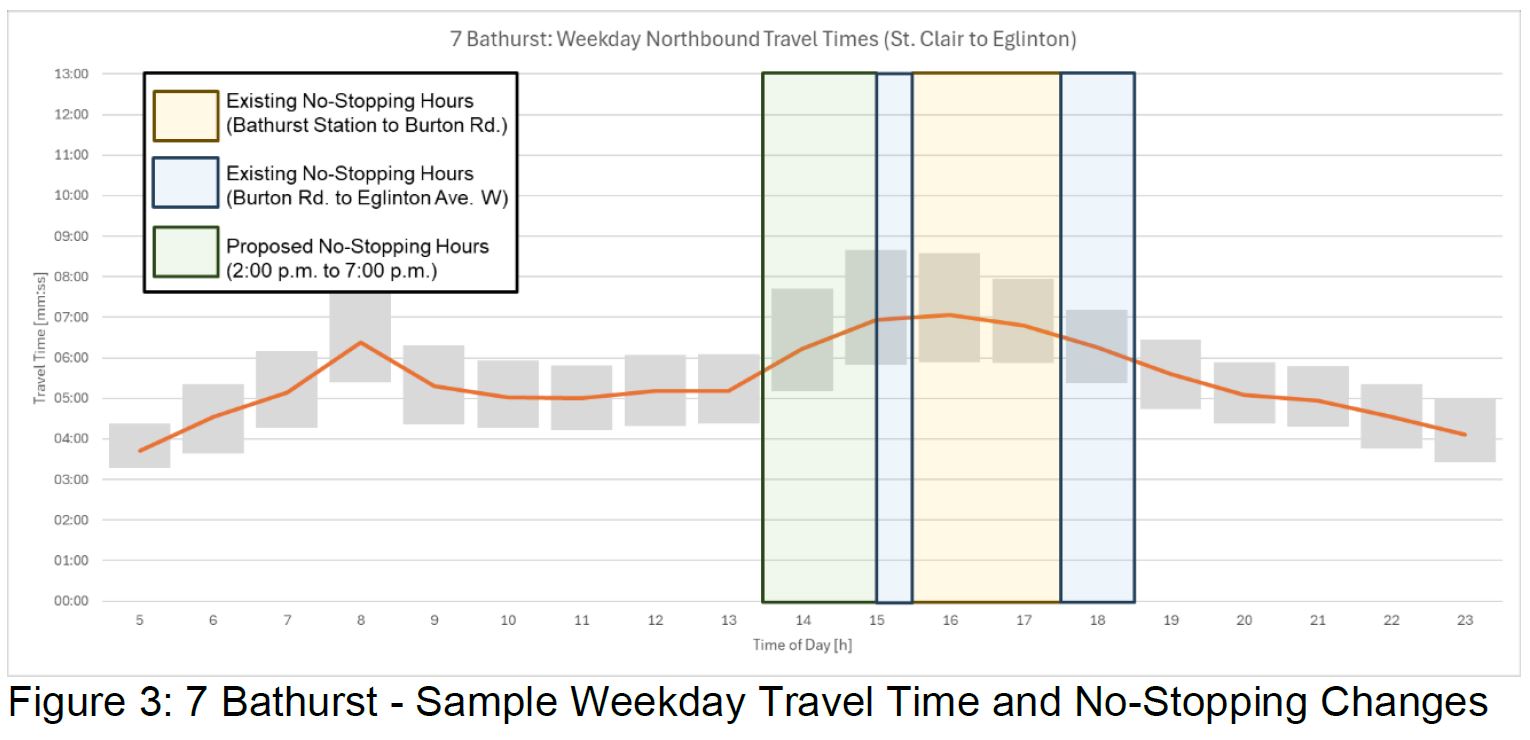
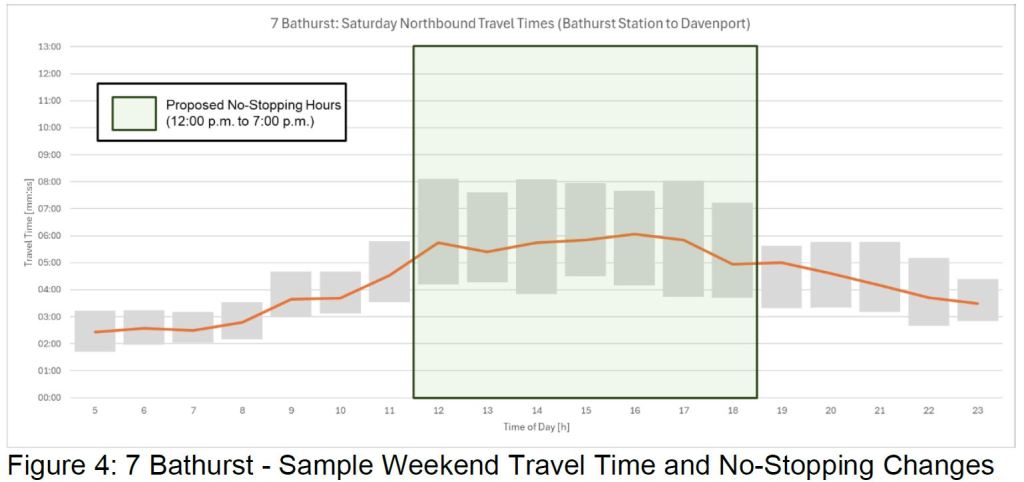
The primary time and location of congestion affecting the south end of 7 Bathurst is in the afternoon, Mondays through Saturdays. To address this, the following changes are proposed:

  • No stopping will be permitted on Bathurst Street northbound from the north exit of Bathurst Station to Eglinton Avenue from 2-7pm on weekdays, and 12-7pm on weekends.
  • North-to-west left turns at Bathurst & Davenport will be banned from 7am-7pm Monday to Saturday, except holidays.
  • South-to-east left turns at Bathurst & Dupont will be banned from 7am-7pm Monday to Saturday, except holidays.
  • The existing 7am-9am ban on north-to-west left turns at Bathurst & Dupont will be removed.

The chart below shows the weekday and weekend travel time profiles for Bathurst Street with the existing and planned hours of “no stopping” overlaid.

Continue reading

TTC Greenwood Shops Open House

One of the TTC’s premier shops will hold an open house as a fundraiser for the United Way.

Saturday, September 20, 2025
9 a.m. to 3 p.m.
TTC Greenwood Complex – 400 Greenwood Avenue
Admission is $5, kids two and under are free.

This event is accessible. Bus and Wheel-Trans shuttles between Coxwell Station and the event will be available.