
The TTC’s Strategic Planning Committee will meet on September 4 at 10:00am in the Board Room at 1900 Yonge Street, TTC headquarters. Among the items on the agenda is a report titled 2026-2028 Ridership Growth Strategy: 2026 Budget Considerations.
This report proposes implementation of six initiatives through the 2026 Budget which is now in preparation:
- Fare capping (limiting the accumulated charge for trips within a month) as a replacement for monthly passes.
- Year 1 of the TTC’s Wayfinding Strategy
- Support growth from changing work-from-home practices
- Improve service reliability
- Implement outstanding proposals from the 2024 and 2025 Annual Plans
- Bring service to the standards for crowding, express network routes, and the 10-minute network
There are many other possible tactics for building ridership. These are not included in the report, but the intent is to report back to the Board following budget approval in early 2026 with an updated RGS.
Updated September 1 at 10:40pm: The list of additional RGS options has been added to the end of this article.
A related issue is the question of a fare increase, the revenue it might generate and the likely reaction to such a proposal. A variety of increases from 5 to 35 cents on various fare classes are presented for discussion, but there is no recommendation.
Full disclosure: I participated in a meeting of the TTC’s Planning Advisory Group to discuss the proposed RGS along with other interested parties. There is a summary of our comments in the report [pp 6-7].
Updated September 4 at 9:00 pm: The Presentation Deck for this item is now available. I will add commentary to the article in coming days.
Ridership Growth Strategy and 2026 Budget Proposals
At its July meeting, the Strategic Planning Committee received a presentation on ridership growth including a draft set of “guiding principles”. The draft has been revised in the September report based on the Committee’s input. The table below compares the original and revised versions.
There is a noticeable reduction in a financial and “efficiency” driven outlook and an increase in rider-focused issues including the need to transparently report on the success of initiatives. There is nothing inherently wrong with “efficiency” and “fiscal responsibility”, but too often these manifest as cuts, or as half-hearted tweaks that do little or nothing for most riders. The first decision should be to find changes that will be beneficial and then figure out how to implement them. Starting with “we have X dollars and would prefer to spend even less” is no recipe for a successful strategy.
| Common to both versions: |
| • Focus on key customer groups (including women, people with low income, and shift workers) • Address barriers to mode shift and reduce points of friction in the customer journey • Improve reliability and reduce service interruptions • Bundle complementary improvements for greater impact • Leverage partnerships to extend reach and resources • Partner with City on advocacy efforts |
| New: |
| • Centre riders and their experiences to inform and drive decisions • Support the needs of frequent, occasional, and non-riders • Use and report on indicators, standards, and metrics that support reducing barriers to new ridership |
| Modified: |
| • Align with TTC’s approved plans (e.g., Corporate Plan, 5YSP, 5YFP) • Draft: Align with current standards and approved TTC Plans (e.g., Corporate Plan, 5YSP, etc.) • Ensure that the TTC remains affordable, accessible, and equitable for customers • Draft: Ensure that the TTC remains affordable and equitable for customers • Maximize use of existing fleet and resources • Draft: Maximize use and efficiency of existing fleet and resources |
| Dropped: |
| • Prioritize initiatives that have greater return on investment than others • Sustain ridership gains from fare and service initiatives through customer experience improvements |
Many ideas were considered as part of a new Ridership Growth Strategy, but they will not all be implemented at once. Six were chosen for potential inclusion in the 2026 budget proposals.
Fare Capping to Replace Monthly Passes
The premise of a fare cap is that the amount spent on transit fares within a specific interval would be limited. The interval could be a month, week, day or even a shorter time. (The two-hour transfer is a simple example where a new fare is not charged until after the period since the “first tap” has expired.) The TTC proposes to replace monthly passes with a fare cap based on a multiple of the single fare.
The adult monthly pass today costs $156 if purchased one month at a time, or $143 if bought on a 12-month subscription. With the base adult fare (paid via Presto) at $3.30, these represent multiples of 47.3 and 43.3 fares respectively.
The report proposes three possible capping levels with their associated cost and anticipated ridership growth. There is no provision for the cost of additional service, if any, to handle ridership growth.
| Fare Cap Level | Annual Cost ($m) | Ridership Gain (m) |
|---|---|---|
| 47 | $10 | 3.6 |
| 44 | $19 | 7.2 |
| 40 | $35 | 16.8 |
The advantage of a cap over a prepaid pass is that there is no need to decide up front whether a pass will be worthwhile each month, nor to make a single payment for a month’s travel. This benefits riders with unpredictable travel patterns, not to mention those whose budgets cannot absorb a single payment for transit where the value might not be realized in actual travel.
Another benefit lies in the “one fare” program which currently does not benefit pass holders. Cross-border trips would could toward the TTC fare count, and TTC rides would be free once the cap was reached.
The report is silent on fare capping for the various discount fare categories: seniors, students, and the fair pass program. The multiples today are not the same as for the adult passes, but caps could be set to different values and adjusted independently depending on fare policies from time to time.
Riders would tap onto transit just as they do today, but Presto would keep track of usage and would stop billing for trips once the cap was reached. The one caveat is that the same Presto, debit or credit card would have to be used for all travel within a month.
Presto’s capping is calendar-based, and so a “month” is a calendar month, not, say, 30 days from a first tap. Other periods such as a week or day could be defined, depending on the number of permutations Presto supports (or could be adapted to support).
As the report points out, fare capping is a common approach both in the GTA and internationally. This is not a new idea, nor should it encounter the “not invented here” syndrome so common in Toronto. The underlying technology to implement it exists in Presto already, and GO Transit has used capped fares as an equivalent to monthly pass pricing for many years. TTC staff talked about capping as an option while Andy Byford was still CEO, but the idea languished thanks to Presto constraints at the time, and political unwillingness to pursue fare policy changes.
Year One of the Wayfinding Strategy
This rather vague item proposes the spending of $5-million on a grab-bag of items, but with no estimate of a ridership benefit.
Corrected September 4 at 9:00 pm: The presentation deck for this report cited a figure of only $2.385-million. TTC Media Relations has confirmed that the lower amount is the correct one. The higher value was a placeholder in a draft version of the report and it was not changed in the final version.
Back in February 2025, the Board considered an interim report on wayfinding, and there was supposed to be a final report in May 2025. It has yet to appear. This has not prevented management from proposing that “full implementation of the strategy” be undertaken at TMU/Dundas, St. George and Finch West Stations.
Moreover, “platform mats” (the platform graphics indicating where riders should stand to align with train doors) would be installed at TMU, St George, Finch West, Union, St Andrew, Bathurst, Dufferin, Kipling, Bloor-Yonge. It is not clear how useful these will be at stations on Line 2 where trains are manually operated and alignment with platform markers is more difficult than on Line 1.
Exit numbering will be added at Union, St Andrew, Bathurst, Dufferin, Kipling and Bloor-Yonge. The intent is to allow directional signage and other information to be based on “go to exit X” rather than named exits which could be meaningless to someone unfamiliar with the station.
The TTC “will also seek to increase its digital customer experience (CX) capabilities in-house”. If this translates to a revamp of their hard-to-navigate website, this cannot come too soon. Earlier this year, in an attempt to simplify access, I began to build, in effect, a “wayfinding guide” to the TTC site, but gave up because of the complexity of navigation paths and locations of information (leave alone currency and accuracy).
What is not clear here is the relative level of spending and effort for each component of the overall strategy, nor of the cost and timelines for expansion beyond a pilot level.
Among the proposed “RGS” topics for inclusion in the 2026 budget, this seems the weakest.
Support Increased Ridership With the Shift Away From Work-From-Home
This change would address the level of subway service needed to accommodate extra in-office work and higher levels of commuting. The estimated cost is $10.9-million, but it would be offset by a projected $60.4-million in new revenue from 24.9-million new trips in 2026. There is no discussion of improvements to the surface network.
For reference, here are the September 2025 service levels on the subway compared with January 2020 before the pandemic-era cutbacks. This gives a sense of how far service levels today are below pre-pandemic values, as well as the headroom for peak period improvements using 2020 as a base.
The TTC has acknowledged that Line 1 service is running below scheduled capacity due to problems with restricted speed zones. That is capacity that can be recouped simply by fixing the infrastructure, but equally this demonstrates the importance of maintenance to achieving future service and ridership goals.
| Period | Line 1 Headway 2020 / 2025 | Line 1 Trains/Hr 2020 2025 | Line 2 Headway 2020 / 2025 | Line 2 Trains/Hr 2020 / 2025 |
|---|---|---|---|---|
| AM Peak | 2’21” / 2’52” | 25.5 / 20.9 | 2’21” / 2’38” | 25.5 / 22.8 |
| Midday | 3’49” / 4’34” | 15.7 / 13.1 | 3’20” / 4’04” | 18 / 14.8 |
| PM Peak | 2’36” / 2’59” | 23.1 / 20.1 | 2’31” / 3’23” | 23.8 / 17.7 |
| Early Eve | 3’30” / 4’11” | 17.1 / 14.3 | 3’42” / 4’52” | 16.2 / 12.3 |
| Late Eve | 5’00” / 6’00” | 12 / 10 | 4’52” / 5’23” | 12.3 / 11.1 |
Improve Service Reliability
The report proposes spending $1.62-million on increased route supervision and additional transit priority signalling. There is no breakdown between the two.
The description of the need for better supervision makes interesting reading:
Organizational changes to route management in 2019 have placed greater demands on Surface Operations Supervisors to manage a high volume of calls related to mechanical issues, bus and streetcar collisions, and security incidents. Operational data indicates that the current average supervisor-to-bus ratio of 1:76 is insufficient to manage and respond to the increased volume of calls and incidents in a timely manner. An increase in resources would reduce the number of vehicles and routes monitored by an individual Supervisor, reduce the response time to manage delays and address incidents, and improve service reliability. These resources would also be used to support next steps on the Bunching and Gapping pilot.
Not to put too fine a point on things, it is clear that the line management protocol implemented by the former CEO was a failure. This problem was masked by the pandemic when, for a time, simply keeping the wheels turning and service operating were top priorities.
However, just putting in more supervision is not, by itself, an answer to problems with irregular headways and the crowding and frustration this brings. The TTC needs to rethink what “good service” including its standards actually mean and how they can be achieved. There is a separate process to review the standards underway now. The challenge is to build standards and reporting mechanisms that riders can believe, rather than goals that are comparatively easy to hit but provide unreliable service for riders. The corporate culture must change from an assumption that all problems are external, notably the perennial bugbear traffic congestion.
As for Transit Signal Priority, there are two current issues.
First, the attitude in Toronto Transportation Services appears to be that if signals make traffic flow smoothly, then transit will benefit. This is the “rising tide lifts all boats” theory of transit priority. Moreover, proposals often refer to keeping vehicles on time with TSP rather than giving transit absolute priority to move as quickly as it can. On routes when “on time” is a meaningless concept and reliable service should be the metric, restricting TSP to only vehicles that are “late” adds a layer of needless complexity. Indeed, if a route is on an unscheduled diversion, it has no schedule.
Second, many common locations for streetcar diversions should be permanently equipped with TSP to assist turns. They should always be active, not enabled as and when someone asks for this, so that diversions get the best priority they can receive all of the time.
Implement Outstanding 2024 and 2025 Network Change Proposals
Several route changes have been proposed, but not implemented. There is little point in going through consultations with riders about new or modified routes only to have the proposals sit on the shelf for want of budget headroom to operate them.
The report estimates the cost will be $15.5-million yielding $2.3-million in new revenue and 0.9-million new rides. There is no list or map of the affected routes in the report.
Bring Service Up To Standards
Although the TTC has claimed on past occasions that crowding is only a minor problem, they acknowledge that they are not meeting their own standards. Moreover, the Express Bus Network and 10 Minute Network service levels deserve improvement. Specific changes include:
- Crowding: Adding service to 64 time periods on 39 routes where crowding levels exceed standards.
- Express Network: Adding service to 27 time periods on 10 routes to meet Express Network standards.
- 10-Minute Network: Implementing maximum 10-minute headways during 46 time periods on 11 routes.
There is no list of the routes or time periods affected by this proposal. The estimated cost is $21.0-million with offsetting revenue of only $1.6-million and 1.9-million new rides. (Yes, the ratio between revenue and rides appears to be low, and I plan to ask the TTC about this.)
The primary beneficiaries of these changes will be existing riders who will see better service and less crowding, but a future benefit should be a decline in complaints about these issues and further increase in demand. That, of course, could lead to more service and associated costs, but after all carrying more people on transit with attractive service is what the TTC should be all about.
Return on Investment
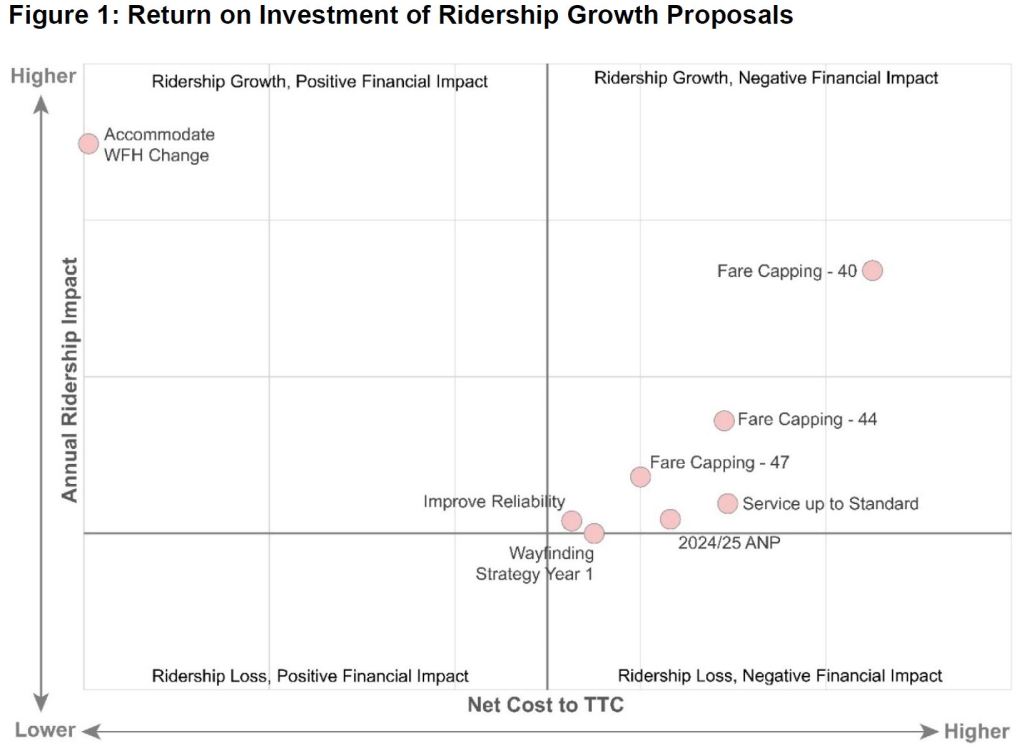
Although a calculation of ROI was dropped from the “guiding principles”, a chart showing this does appear in the report. An important point here is the cause-and-effect relationship. For example, the added revenue from the work-from-home change arises mainly because more people commute, not because the TTC increases service. Indeed, the only service proposal explicitly linked to WFH is an unspecified improvement in subway service, not in buses or streetcars. Other proposals have small estimated ridership effects although they would improve service for many riders.
The “return on investment” is not simply a financial calculation, and this misrepresents transit’s purpose of enabling travel by a large number riders for many purposes without the need for a private car. That has a value, but it is not captured by this simplistic analysis. It is ironic that the TTC trumpets the multiplier effect of spending on capital works, but when it comes to riders and service, the user and social benefits are ignored.
Fare Options
The discussion of fare options as part of a Ridership Growth Strategy is unusual, but not surprising given the political environment. The TTC received large special subsidies during the pandemic years, and in most years there was no fare increase. In 2020, the adult fare (paid by token or Presto) rose from $3.10 to $3.20. In 2023 it went to $3.30 where it sits today.
A long standing management recommendation that was never actually embraced by the TTC Board or Council was that fares rise in small increments each year. In practice, the idea of keeping costs down (the TTC revenue equivalent of the “no new taxes” mantra) led to repeated fare freezes. This was a deliberate political decision that required some combination of added subsidy and limitation on service growth to finance.
If fares had risen ten cents annually from 2020 onward, the rate for a Presto adult fare would be $3.70, not $3.30. Assuming no ridership loss because for small increases, service is more important to riders than fares, this would mean that fare revenue in 2025 would be about 15-16% higher than the expected amount. This would bring roughly $165-million higher on the current ridership level, and considerably more without the pandemic ridership losses. (A 15 cent annual rise would have taken fares to $4.05 and $280-millon more revenue, assuming no losses through elasticity.)
Frozen fares are a political decision as was the choice to keep as much service running as possible through the pandemic. A return to a 67% farebox cost recovery in 2025 would require over $1.8-billion in fare revenue (on a total budget of $2.8-billion) compared to the anticipated $1.07-billion. Without substantial new ridership, fares would have to rise over 60% . In turn that would require much more attractive service lest riders wonder why they are asked to pay so much for the same or worse product.
This is simply not practical. If the City’s goal is for ridership to grow quickly, an attempt to get this amount from the farebox would be fatal to their hopes. This is the new reality of TTC finances, and the City must plan accordingly. A related problem is that Toronto still receives special Provincial subsidies under the “new deal”, and these are not guaranteed for the long term.
Conversely, the question must be asked whether fares should be frozen forever and how much riders should contribute both to rising costs and to service improvements beyond basic inflation. The answer depends on what Toronto sees as the future of its transit system, and how much the City as a whole is prepared to pay to make mobility widely available and affordable.
Alternate revenue sources are a major debate Toronto must have, and the dollars involved must be in the hundreds of millions. None of the schemes for things like advertising, pop-up retail and other band-aid “solutions” come close, and those who advance such schemes really do not have transit’s interest at heart. Past options included a levy on private vehicles or a tax on parking lots. The current report suggests a ride sharing levy citing revenue of $55-million (Canadian) in Chicago, a similar-sized city. The debate over any of these will be difficult and particularly fraught in an election year, even without the inevitable interference from Queen’s Park.
The report includes a table showing the potential revenue from various options including the elasticity effect of riding lost because of higher fares. This is small for low increases, but quickly ramps up at higher levels. Even the highest option does not yield $100-million. By comparison, each 1% increase in TTC costs costs about $28-million.
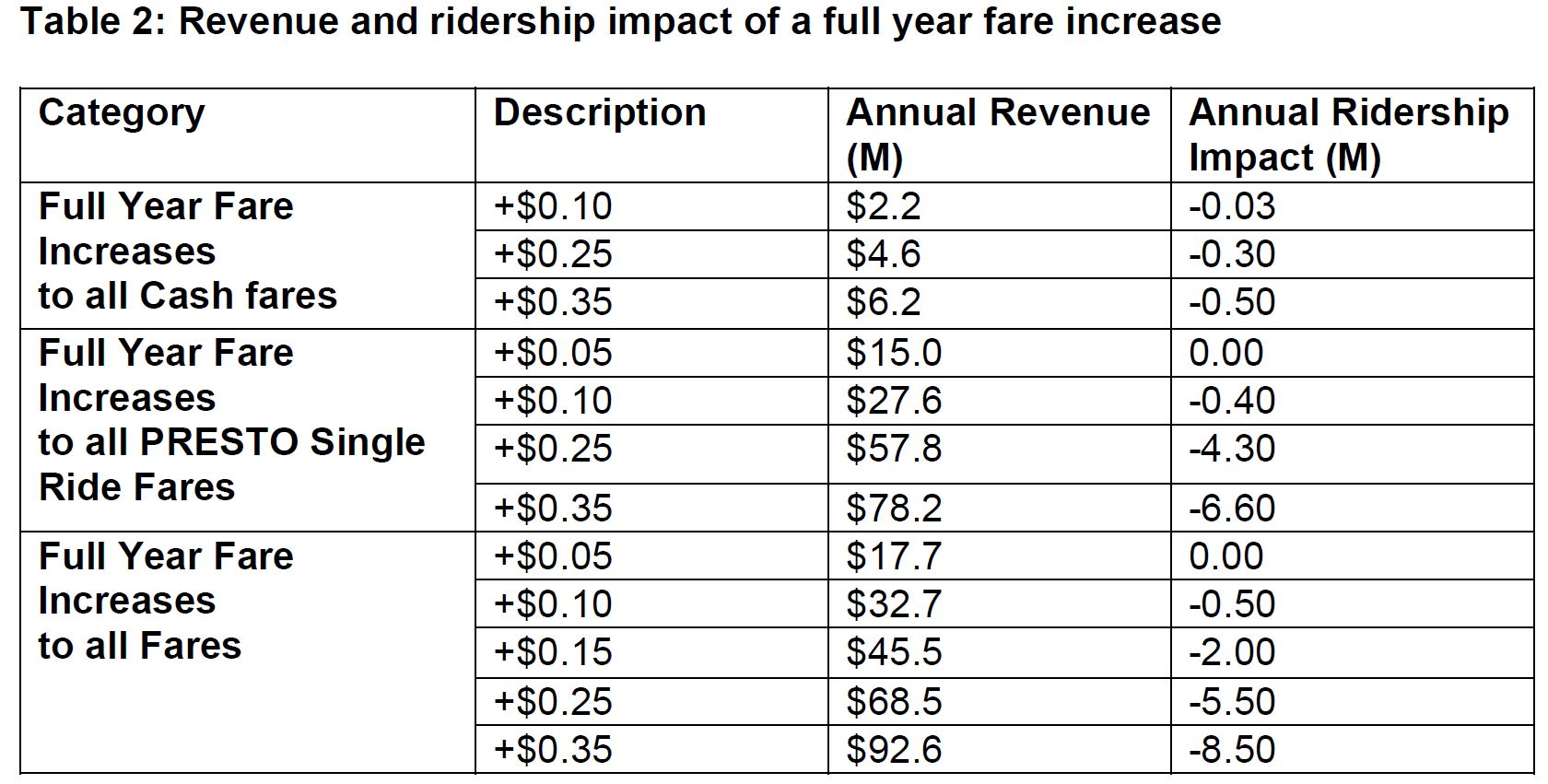
Further options suggested in the report would eliminate concession rates for cash fares. Discounted fares would only be available to Presto users. A standard cash fare of $3.35 would bring in $1.7-million more revenue, not including whatever effect this might have on fare evasion. Cash fares represent a very small portion of TTC revenue, and so any adjustments to them are small change in the overall budget context.
Additional RGS Options
There are several other options that might be considered beyond the six chosen in the recommended group for 2026. They are likely to be part of future year plans.
- Expand and enhance express bus network
- Expand and enhance frequent network
- Expand early morning Sunday service
- Expand and enhance overnight service
- Refine and adopt transportation equity measures
- Continue to implement RapidTO
- Continue to implement targeted transit priority measures (regulatory, TSP, queue jump lanes)
- Expand service integration
- Enhance integration with cycling, pedestrian pathways and micromobility
- Improve comfort and convenience of stop areas, stations and vehicles
- Continue implementation of the Wayfinding Strategy
- Explore implementation of a Mystery Rider Program
- Explore implementation of a New Customer Orientation Program
- Review/conduct research on fare policy initiatives once new PRESTO features are available
 Steve Munro
How grand it would be if a component of the ridership growth strategy focused on increasing streetcar ridership in the core.
There’s an opportunity to make the streetcar system more attractive by letting the cars ‘fly’ again. Revise operating practices to minimize slow zones at junctions, fix the damn switches and ensure they are energized. Focus on capacity and reliability.
Ensure the system is safe, clean and attractive – the basics of any good transit system.
I’m a frequent Blue Night streetcar rider and many vehicles have become rolling homeless shelters. A unsanitary car is a disincentive to ridership.
LikeLiked by 1 person
I guess they didn’t even include the don valley express as something they can add or bring back for back to office changes?
Steve: The Premium Express buses were implemented as political sops to various former members of the TTC Board. They were a big waste of resources even with the extra fare. We are well rid of them.
LikeLike
Seniors would be the using the TTC more than students, since they would not be “locked” in classrooms during a school day. What about “free fares” for seniors, like they do in Europe. Seniors, like me, were able to ride the trams and buses in Polish cities without paying, if you were over 70 years old, but with proof of age. (I had my driver’s licence and OHIP cards with me, that had my birthday on them.) Seen a fare inspector in that Polish city asking a “student” to come with them off the tram, for failure to show their proof-of-payment.
LikeLiked by 1 person
You make a compelling point of being silent on Monthly passes of discounted fares. I have used so much of Post-Secondary past a student committing all over the TTC services almost 3 times daily. A trip to leave my house, somewhere in between, the going home. Some days just out and back, some going back and forth a lot. Either for work, classes, meet up with people, possible chance to leave Toronto to York Region using the buses that cross the boundary with the monthly pass. I was calculating with the frequency of my outgoing nature, depending on how it will be implemented I may actually spend more money with Fare Capping than Monthly Pass to an extent.
Steve: With fare capping, assuming the cap is at or below the current pass price, it’s impossible you will pay more.
Do I wasn’t sure how helpful of a money maker or loser, having a physical TTC merchandise store. Seeing formerly Montreal had one, and Vancouver has one. Seeing with many Gateways and retail spaces open in various subway stations, perhaps one could be acquired to be used as storefront. Seeing some folks don’t know it exist and would like one, being more accessible than online and I think GO Transit does pop-up evens at Union.
Steve: TTC has tried this before, and it’s a tiny market. They farmed it out to a third party who produced rather generic material, and the TTC does not have a brand established at the same level as some other major cities. It may give tourists something to buy, but it’s not a huge moneymaker. Also worth noting is that the total rent from the Gateway stores is not an immense amount either. The total rent revenue in the 2025 budget is $16.1-million, most of which comes from Gateway.
LikeLike
It’s about time they did fare capping on Presto and did away with the Metropass. I thought the only good think about the move to Presto was that we would get fare capping (having heard about it in London). The Metropass has never been a good deal for a simple commuter. Two trips daily and a couple on the weekend and you won’t have broken even. The TTC was intent on ripping off it’s best customers. Anyone on a recurring subscription is a major asset to a business, but TTC just HATED Metropass users. Even the proposed multiple of 40 is not very impressive, though if you’re a five-day-a-week commuter, you’ll break even and maybe get some “free rides” out of it, at least.
LikeLike
They need to allow for transit right of way in the core. Streetcars sit during rush hours, stuck in car traffic. This throws off the whole schedule, making it unreliable. Add on to that the POO fare “protector” making everyone feel like a criminal and consuming a huge part of the TTC budget. You will not get people out of cars and on to transit if it is not reliable, costs too much, takes too long and you are harassed every other stop by a fake cop.
LikeLiked by 1 person
Steve said
Though I agree 100%, that these routes should have been removed, the TTC in its usual bungling way has stopped operating these routes but there are still many TTC Stops for them all over downtown (and elsewhere, I assume). This inattention (to be kind) to minor things leads people to assume they are equally inattentive to other more major problems (like the SRT or like finding that Bathurst did not have enough power for the volume of CNE streetcars last week).
If the TTC cannot do (or is not organised to do) minor things that cost little and involve minor skills (e.g. adjusting Stop signage when routes change or route numbers change) then we will have far less confidence they are concerned about more major things that cost ‘real money’ and require expertise to solve. (A current and recent example of their sloppiness is that the 121 was on diversion for several weeks earlier in the summer there are still paper 121 Stop signs on Front street, though the diversion was over a month ago and I have now made two suggestions to their customer service line to have them removed.)
Steve: My favourites are signs in subway stations where there are in theory “managers” for each site and “group managers” for collections of stations. Taking down out of date diversion posters should be a basic function, but they languish months after they are out of date. What else should these “managers” be doing that never quite happens?
LikeLike
Good to see exit numbering on the list of things to do, though a little disappointing that it’s limited to a few stations. This could and should be rolled out system-wide much faster.
An effort that would cost nothing, and could be linked to the exit numbering, would be a minor change in advertising standards. Every day in the subway I see ads for a business, an event, or an attraction, with no indication as to where it is with respect to the TTC. Simply requiring putting the nearest subway station on such ads would be a massive improvement in wayfinding. The ability to add the exit number would give additional granularity. It’s such a no-brainer. “Come to my business at station X, exit Y” is so much better than “come to my business; use Google maps to find it.”
LikeLiked by 2 people
Not sure if this still happens.. but I recall going to school in the 80’s in Toronto, the TTC would visit every high school and some middle schools for a day and promote student use of ttc. Make up picture ID cards for students to allow purchase of student tickets, have info on routes to the school. By promoting to the next generation, almost EVERY kid used TTC.
LikeLiked by 1 person
The TTC must move away from the flat fare system and implement a variable fare system based on travel distance. A trip between Yonge and Bloor and Union should be cheaper than one from Port Union road and Kingston Rd and Union.
Steve: This debate has come and gone, and a flat fare is definitely where we are going to stay. Indeed, the cross-border co-fare extends the idea even beyond the 416. A common complaint in the suburbs is that it takes so long to get anywhere, and with inferior service to what people downtown get. You would charge them even more?
LikeLike
Why do you people make things complicated? If you want more people using transit, you only need to do five things:
1: Drop the price of a ride to $1.00.
2: Bring the price of a (Metro/presto pass) down to $65.00.
3: Reduce the price of a pass for seniors to $40.00.
4: Issue monthly passes (ONLY…no cash fare) to school kids for $30.00. The kids can buy them at the green Presto kiosks. You are losing hundreds of thousands of dollars every month with them getting free rides.
5: Figure out a way to stop people getting free rides on street cars and buses (you are probably losing $30,000 a week from that!)
What school kids are not spending on transit, they are giving to McDonald’s EVERY day. Isn’t their money better off in YOUR pocket?
LikeLike
TTC has a perception issue.
Advertising campaigns are needed to show it’s clean, safe, and reliable. It also needs to do more to improve cleanliness, safety and reliability too but that will be a perpetual improvement need.
Steve: On problem the TTC has in general is the idea that advertising is all that’s needed to win back riders. People have to see real improvement, not just read claims they can debunk on their first trip.
Another commenter above noted that the Montreal Metro having a special logo that immediately acts as wayfinding anchor is something Toronto could benefit from. This doesn’t replace the TTC logo which is still the agency logo (like the STM), the agency just adopts a secondary logo for the subway network only that’s are easier to recognize and and reproduce digitally and on print than the agency logo.
Encouraging businesses that get most foot traffic from transit usage to start incorporating the logo and nearest station name in their advertising would make the subway relevant to everyone on a daily basis, with many more impressions and opportunities to silently remind users to take transit.
The Metrolinx circle-T unfortunately doesn’t cut it as it’s not unique enough. It needs to be something unique and memorable. The TTC crest might work if it was simplified and text removed.
LikeLike
If you want to grow ridership, then you need to reduce crowding. The TTC has been running very frequent empty streetcars late nights for the last 6+ years while streetcars during the day are overcrowded. Why not move some of those night time streetcar drivers to work during the day? The night streetcars are mainly used by the homeless to sleep and defecate and some streetcars don’t even have the homeless but are running the entire route empty with just the driver on board, what a waste.
Steve: You need to get your facts straight. The TTC did not start running extra streetcar night service until early 2024 to compensate for crowding problems at carhouses. These routes are not empty, although the cars are not exactly packed. The same can be said for many suburban night bus routes which you don’t seem to mind at all. You can compare ridership numbers for night streetcar and bus routes here.
As for sanitation, can we talk about the infamous Yonge night bus?
The extra service covers about 3 hours/day between the end of normal hours when the subway closes, and daytime service startup before it opens. There are about 42 night cars in total, and so the saving would be at most 14 cars moving back to a 30 minute headway from every 20 minutes. That would translate to at most 5 full daytime crews.
I hope that your studies at York are pursued with more accuracy and better research than this comment.
LikeLike
What if the TTC eliminates cash fares altogether? I have already put a suggestion to the TTC to see whether if it is feasible to eventually eliminate all direct cash fares systemwide including all TTC subway stations, all TTC streetcars, all TTC buses and all TTC wheel-trans vehicles 24/7, and only accept TTC fares via a physical or digital PRESTO card, paper TTC PRESTO ticket, or a physical or digital contactless credit or debit card. If adopted this would mean that cash would only be accepted at purchase points like at PRESTO vending machines in TTC subway stations and most Toronto Shoppers Drug Mart stores where customers can buy a new physical PRESTO card, load it up or buy single-use paper TTC PRESTO tickets and recieve change if necessary. These changes that I recommend forwarding to the TTC to eliminate all direct cash fares (where no change can be given) systemwide would put an end to TTC employees counting how much money was deposited into a farebox and providing paper transfers to cash-paying customers on TTC buses. Similarly TTC station agents would no longer count how much money was put into the station farebox and riders paying cash would buy a single-ride TTC PRESTO ticket from the PRESTO vending machine instead. The cash payment machines on TTC streetcars would also disappear. Eliminating direct cash fares everywhere across the TTC would make things safer for TTC drivers/station agents and passengers, make service move faster, more reliable and more on-time. The TTC should switch to a “buy before you board” system for cash payments similar to GO Transit. What do you think Steve Munro?
Steve: There is a proposal for 2026 to eliminate cash fares in subway stations because people can buy Presto tickets. This would be accompanied by a change to a standard cash fare for all riders. Discounted fares would only be available via Presto cards.
Although cash fares are a small part of total TTC revenue, this is an issue for those who have little money and/or have difficulty refilling a Presto card. Metrolinx in its infinite wisdom farmed this out to Shopper’s, and their stores are not on evey street corner, especially in the poorer parts of town. Given how few fares are paid by cash today, and the pending elimination of them in the subway, I don’t see this as a big contribution to faster service.
Note that GO Transit serves a very different rider profile than the TTC, and fare purchase protocols for them are not directly transferable to TTC riders.
LikeLike
That RoI graph is a graph crime! No units on your axis, straight to jail.
Steve: Not my graph. Copied from the TTC report. Direct your ire to them.
LikeLike
@Steve: Yes, I checked the ridership numbers for the night streetcar routes and they are below the threshold for requiring streetcars. I think that the night demand can be better met by running buses on streetcar routes.
Steve: It’s not a question of vehicle capacity. Your original complaint was that the night routes were overserved. If all you do is replace a streetcar with a bus, you still have to pay a driver, and you have added hours because of the overlap of the bus coming into service while the streetcar runs back to the carhouse. The only distinction is that you “save” some streetcar operator hours for day service, but as I already pointed out, the amount is trivial.
LikeLike
It baffles me as to what a wayfinding strategy is doing in a ridership growth study. Every 10-15 years or so, someone decides to revamp the wayfinding standard and it ends up getting implemented in some places, leading to a mishmash of standards. It seems like it’s someone’s pet project and they’re trying to find somewhere they can hide it for funding, just like things getting lumped in with the “state of good repair” budget. Even the ROI graph admits that will have zero impact on ridership.
It all comes down to service levels and/or fare costs, depending on your sensitivity to both. 10 years ago I would ride the Carlton streetcar. Since then, the scheduled daytime headways have doubled, the reliability has gone down, the travel time has gone up (the Flexitys take an extra 18 minutes round trip even on Sunday morning when traffic isn’t an excuse), and I only ride it when I have to or when I know the streetcar is immediately there. Run vehicles more often, improve their reliability, and let the streetcars run at a reasonable speed, and you’ll make them worth riding again.
LikeLike
I find it somewhat satirical that this is being discussed while we are experiencing a surge in people returning to a 4- and 5-day workweek, who will gladly pay for better service and less overcrowding, with or without the pass. The ridership numbers will go up even without this. However, the TTC is in its own La La Land, where I have seen comments by the TTC spokesperson that they have enough capacity (really, has the TTC spokesperson seen the Line 1 trains from Bloor-Yonge to Union in the mornings or in the other direction in the evenings?)
The TTC lives in a fairy tale land where all the extra work days will only be on Mondays and Fridays, and will be absorbed by the overcapacity there. However, they are not accounting for those who were coming 1-2 days a week and now need to reach their workplaces 4-5 days a week, which will take a toll on the Tuesday-Thursday capacity.
Steve: The Ridership Growth Strategy proposes improving subway service, but it remains to be seen if Council will pay for it.
LikeLike