
Several routes in the TTC network are scheduled to operate partly or completely with 18m articulated buses in place of the standard 12m varieties seen on most of the system. A problem commonly found on some of these routes is that although the schedule assumes an 18m bus, what actually shows up is a 12m bus with less capacity.
On some routes, the proportion of shorter buses grows later in the day suggesting that for some reason the longer buses were replaced. The number of buses per hour is fairly consistent from day-to-day, and generally matches the scheduled level of service. This means that few extras (or “run as directed” buses) served these routes even though the capacity was reduced by substitution of smaller buses.
This post looks at how often this problem arises on several routes through the month of July 2025.
Methodology
For each route, a location and direction are chosen to be representative of the service, somewhere all of the trips on a route should operate (as opposed to those missing from short turns).
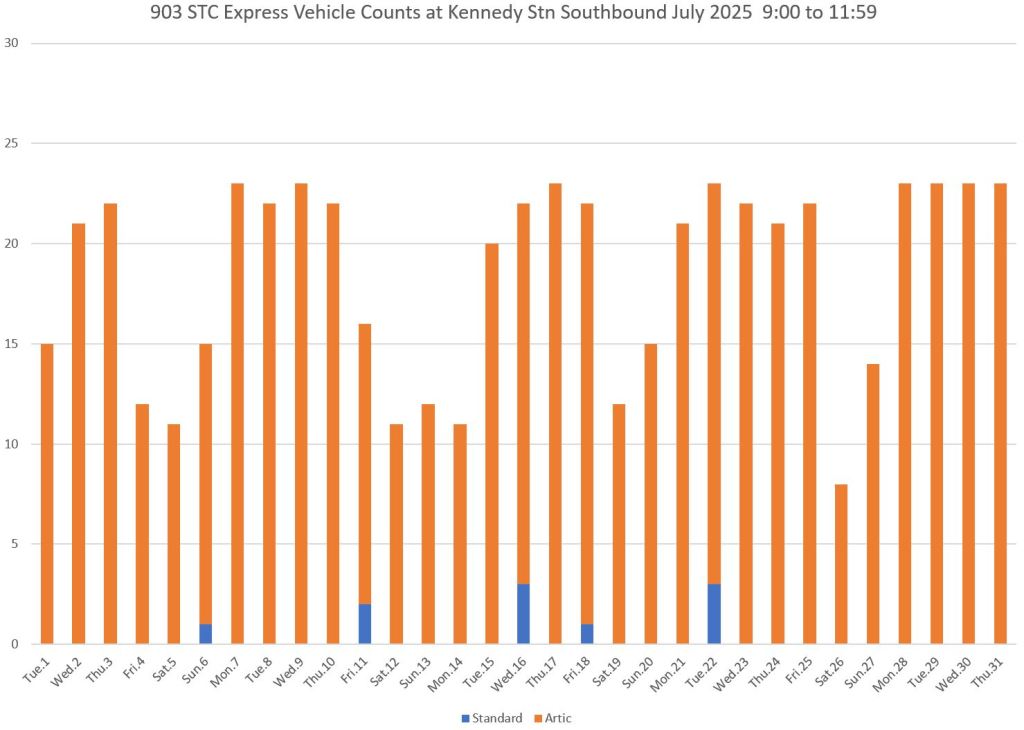
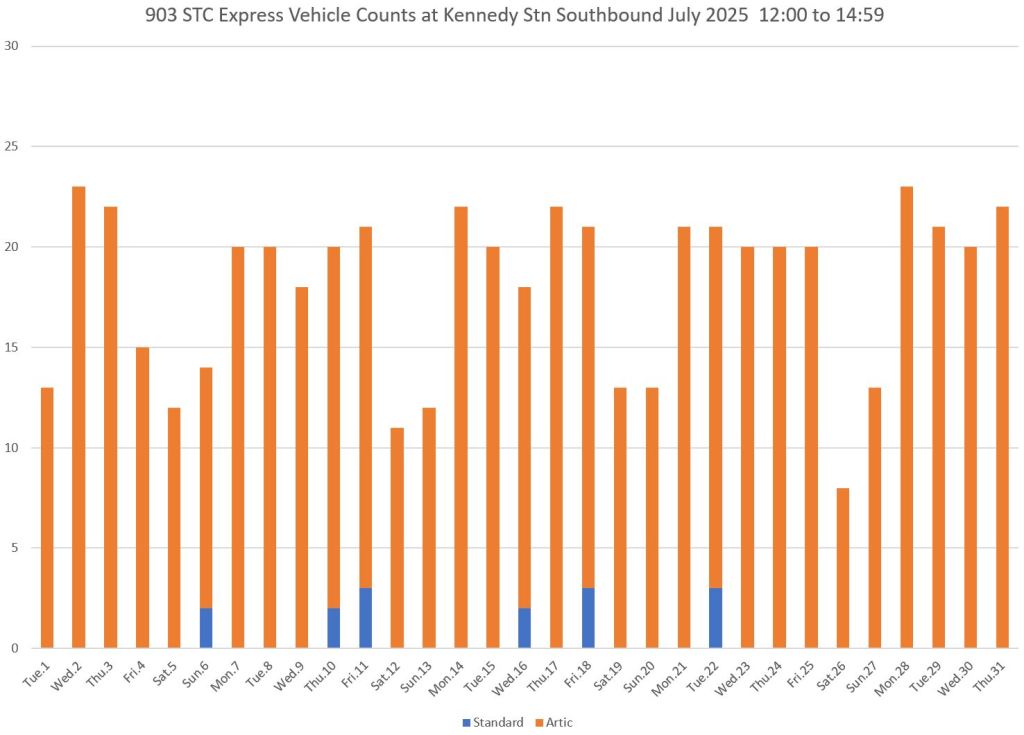
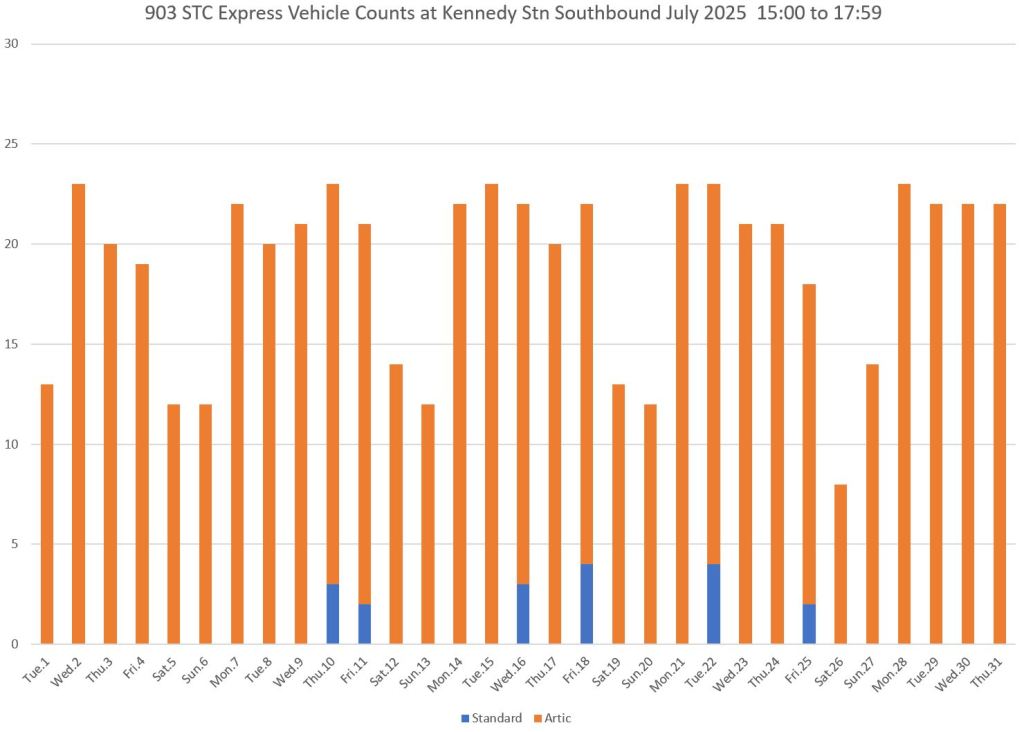
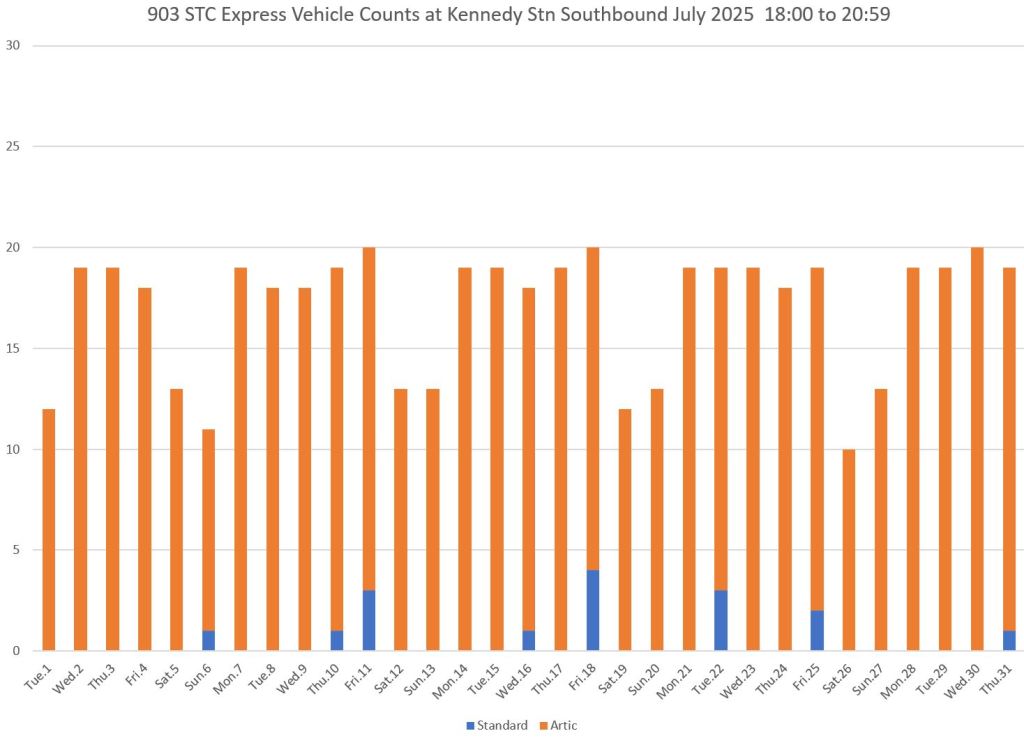
For each day, the actual vehicles from tracking data are counted, and these counts are grouped by three-hour intervals starting at 6am. This broadly gives the AM peak, morning, early afternoon, PM peak, early and late evening time periods. The actual boundaries between these intervals varies from route to route and location to location, but the values for any of these should be consistent from day to day. Weekends, of course, have their own profiles, but all Saturdays should be the same, as should all Sundays. There was no schedule change in the month of July.
On a few occasions the 12m buses might be extras, “run as directed” buses, but most of them are replacements for the larger buses that should be there. This is easy to confirm because the number of buses/hour would be higher than scheduled if there were extras on the route, but the variations are small and generally due to headway irregularities pushing some trips into a different measurement period.
Notes:
- There was no tracking data for all routes in the mornings of July 14 and 18. Counts shown here are what was reported, but this does not represent actual service levels.
- Sunday service begins at different times from route to route, and so the counts shown in the 6am charts might represent less than three hours of service.
- These charts do not show the reliability of service, or the lack of it, only the count of vehicles within each three-hour period
7 Bathurst
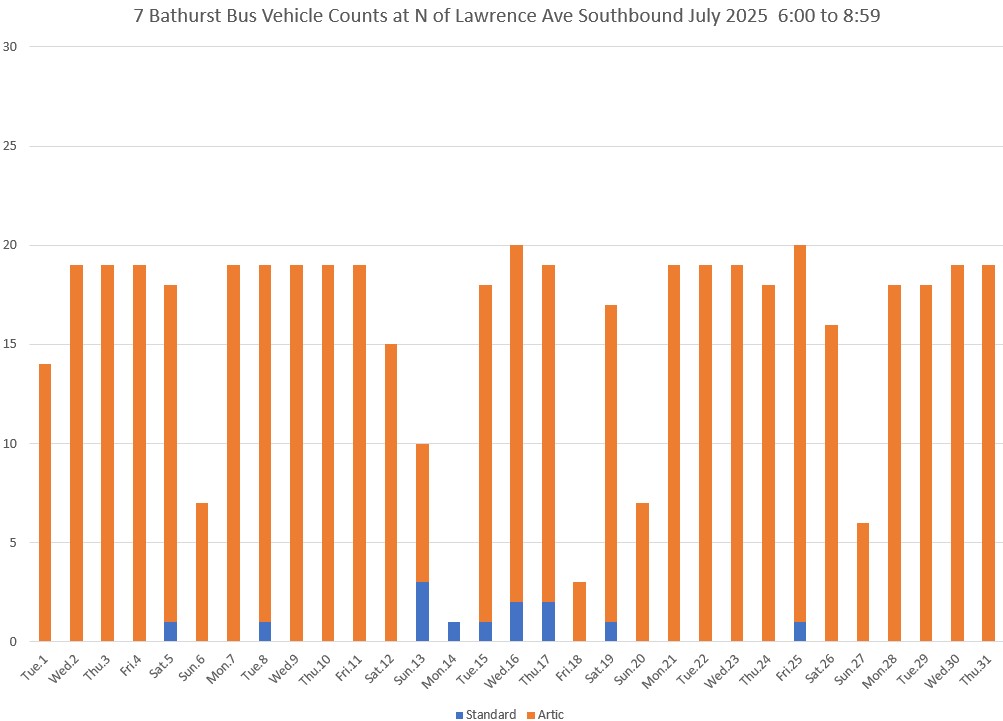
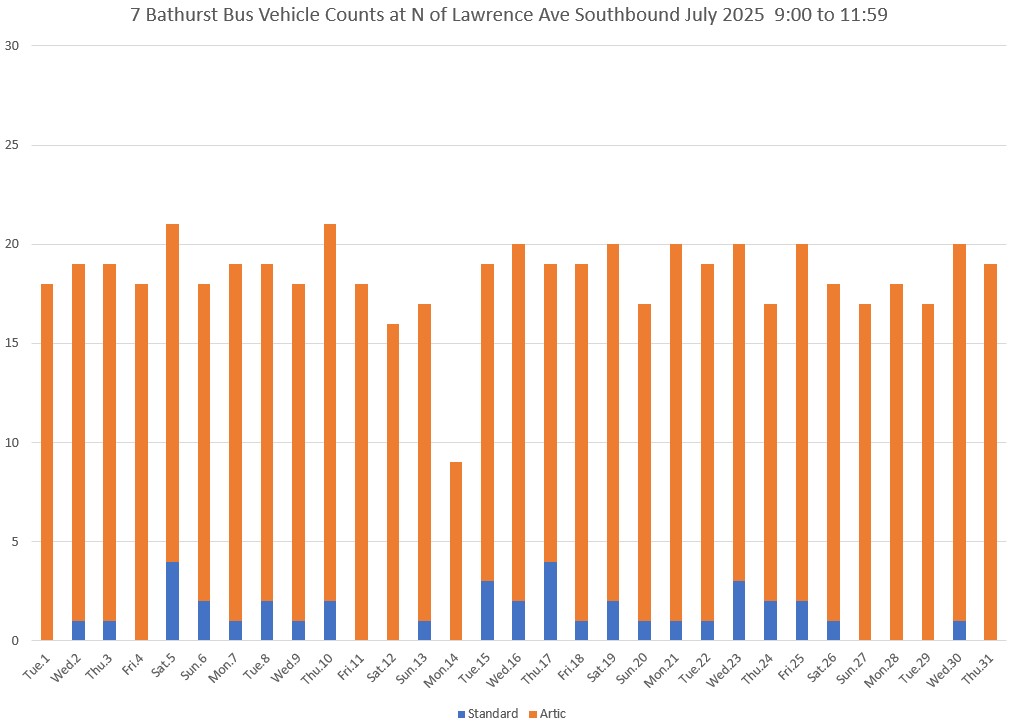
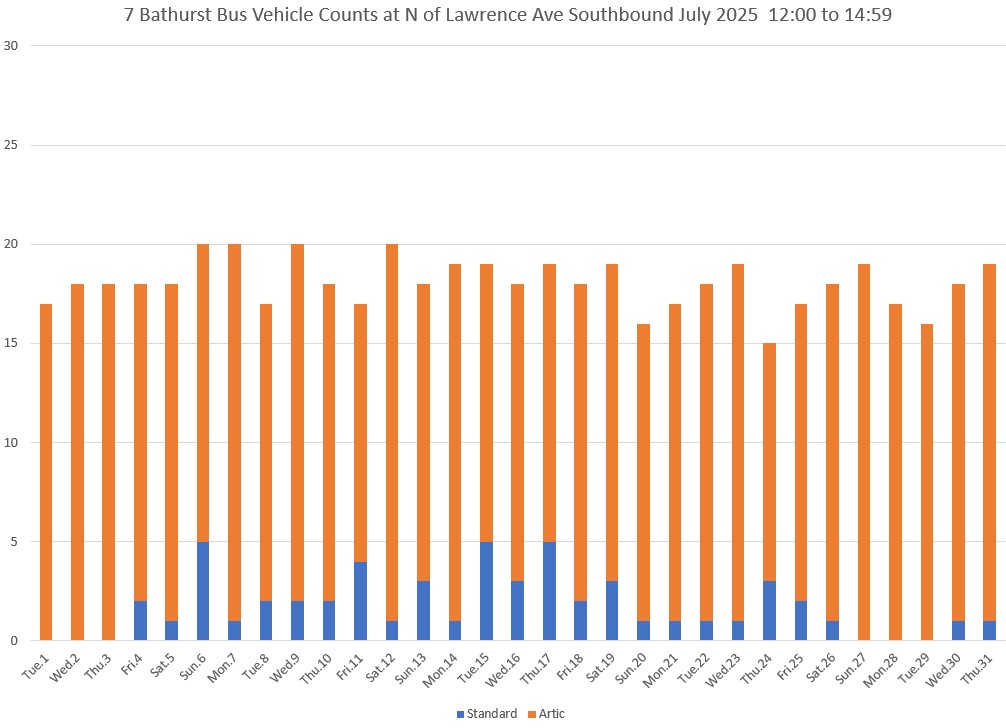
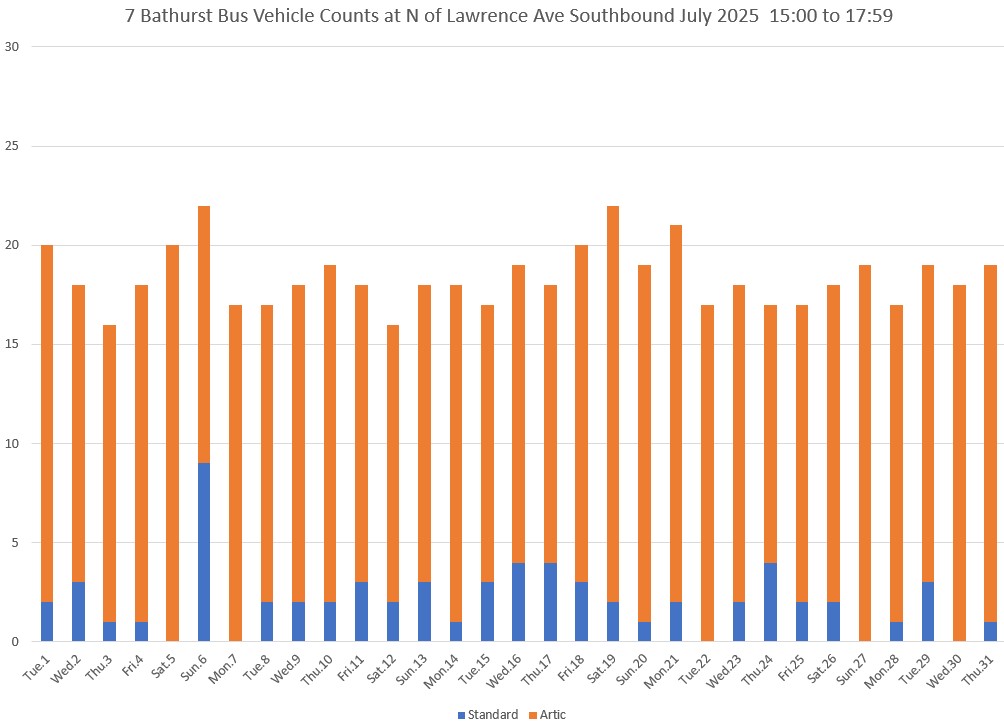
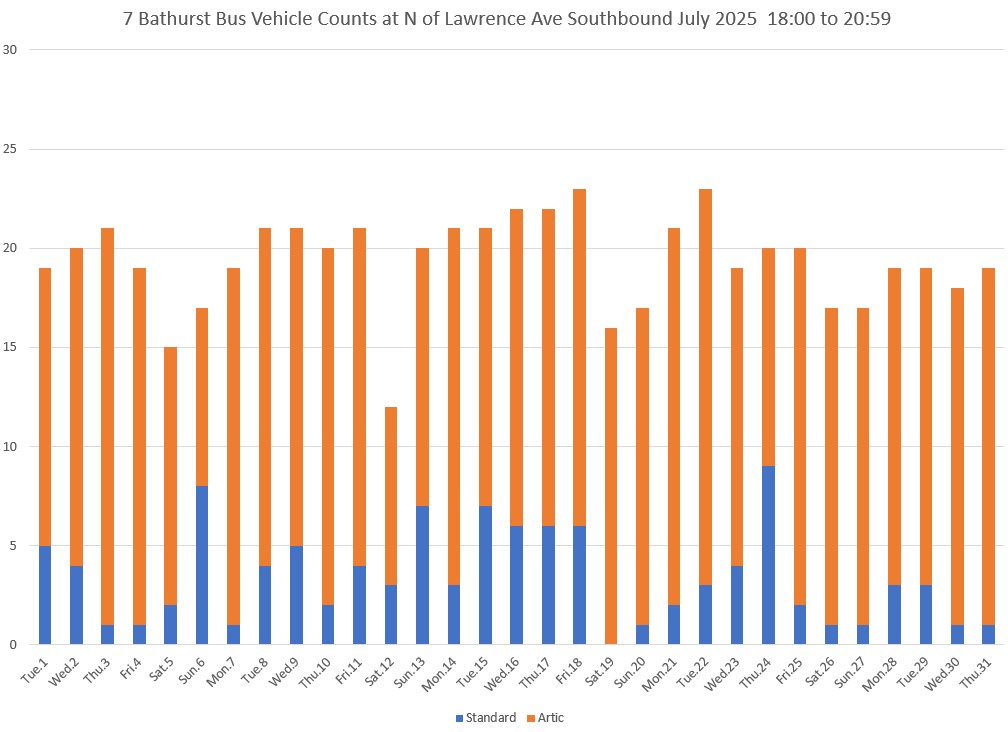
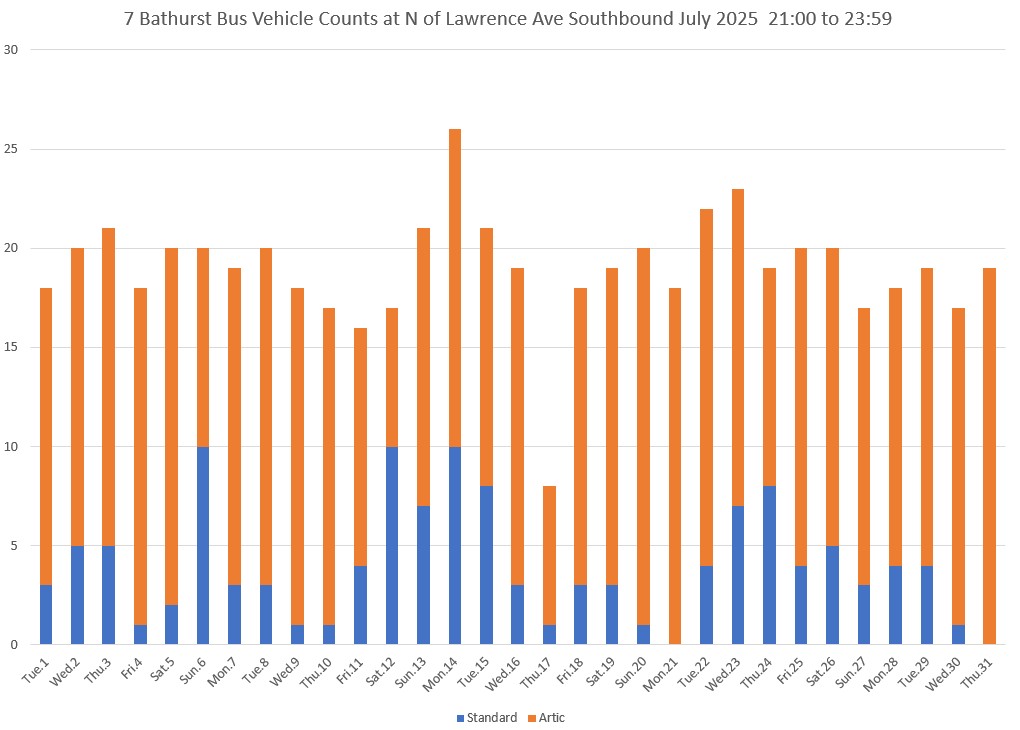
These charts show the daily vehicle counts southbound at Lawrence and Bathurst. The schedule for this route is simple – every 10 minutes all day – and so there should be 18 buses in each three hour period every day.

That pattern is generally visible with a few exceptions. What is interesting here is that as the day wears on, more trips are provided by standard buses (blue) than at the start of service. For some reason the artics were gradually replaced over time, and this reduced the route’s capacity.
29 Dufferin
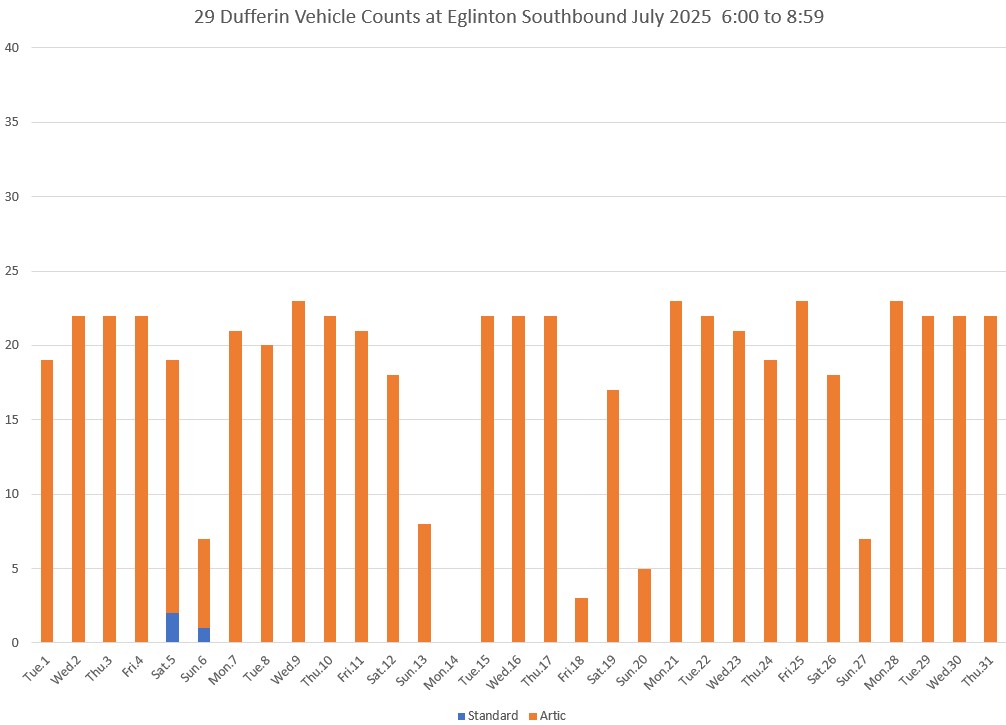
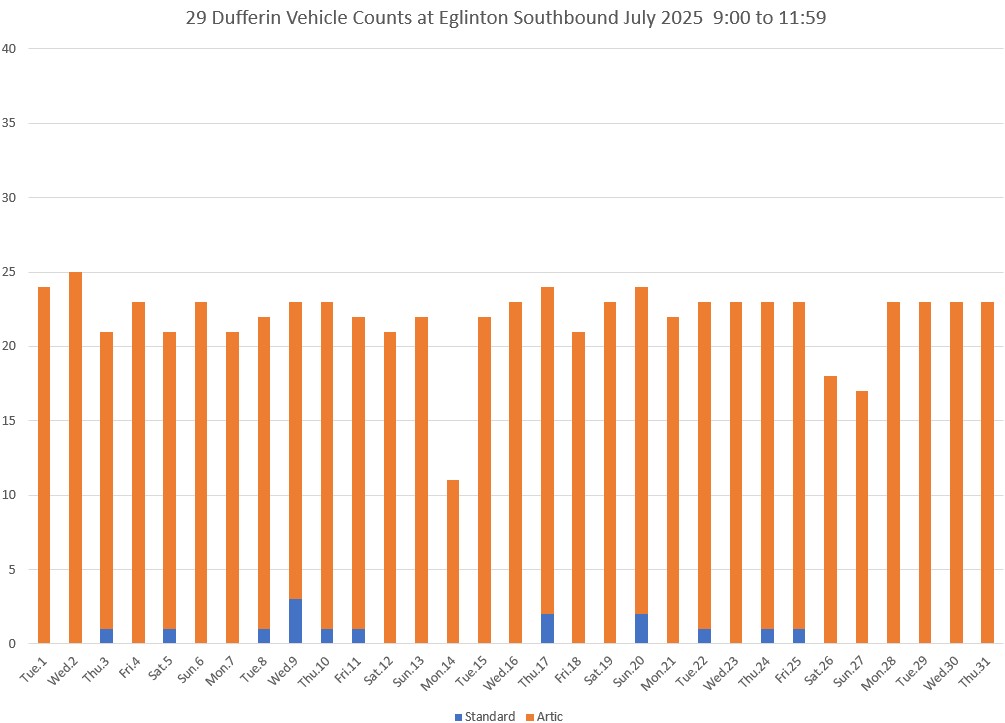
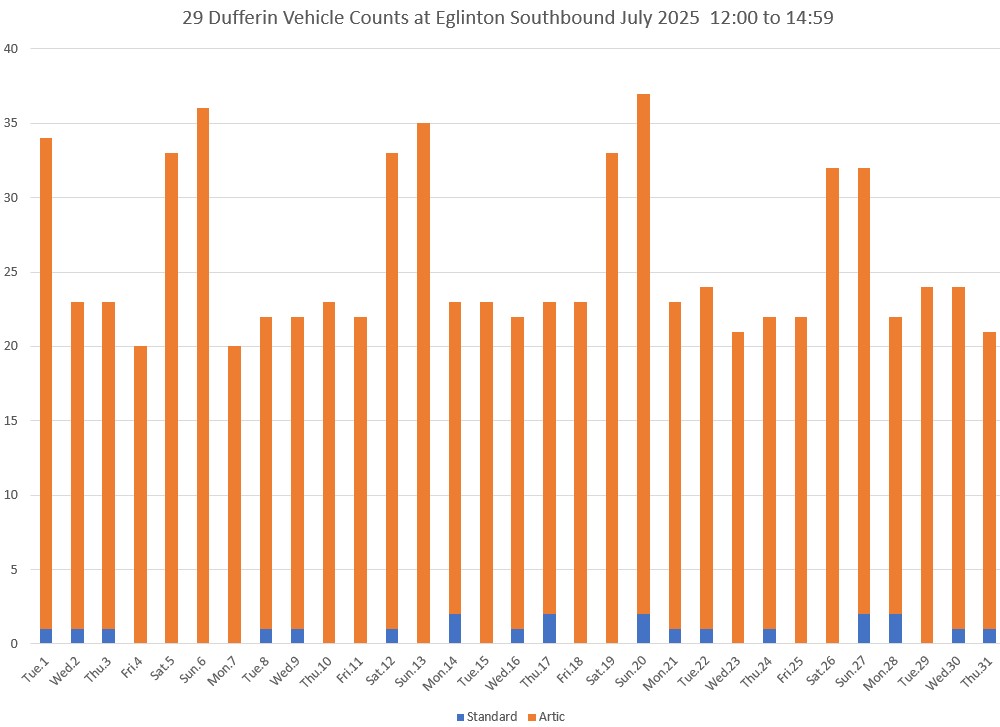
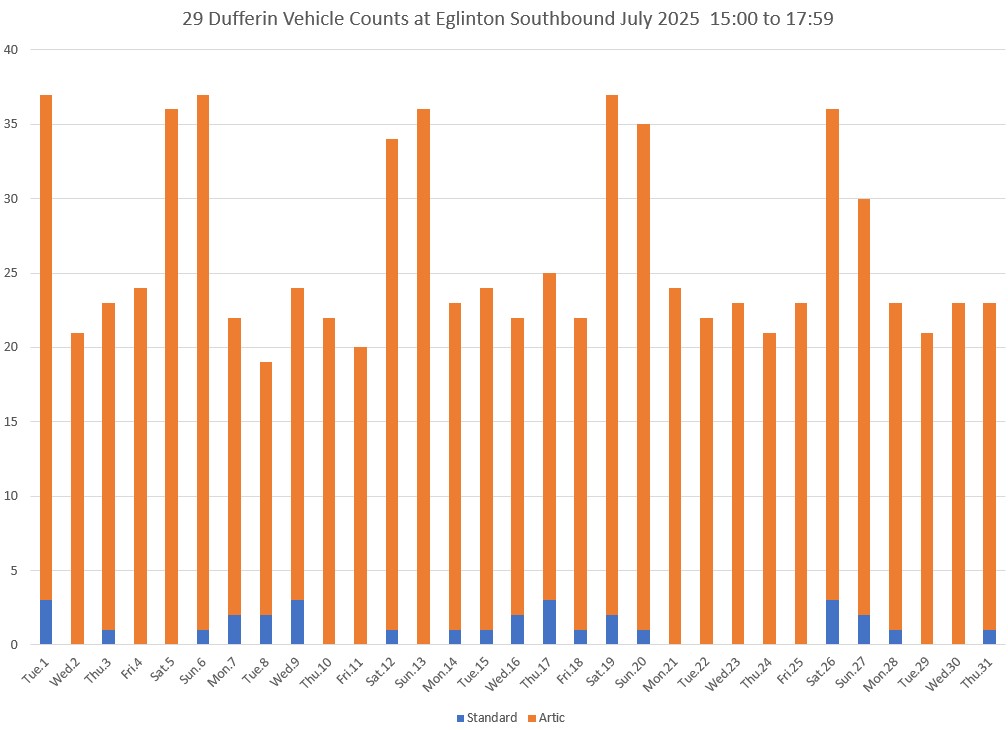
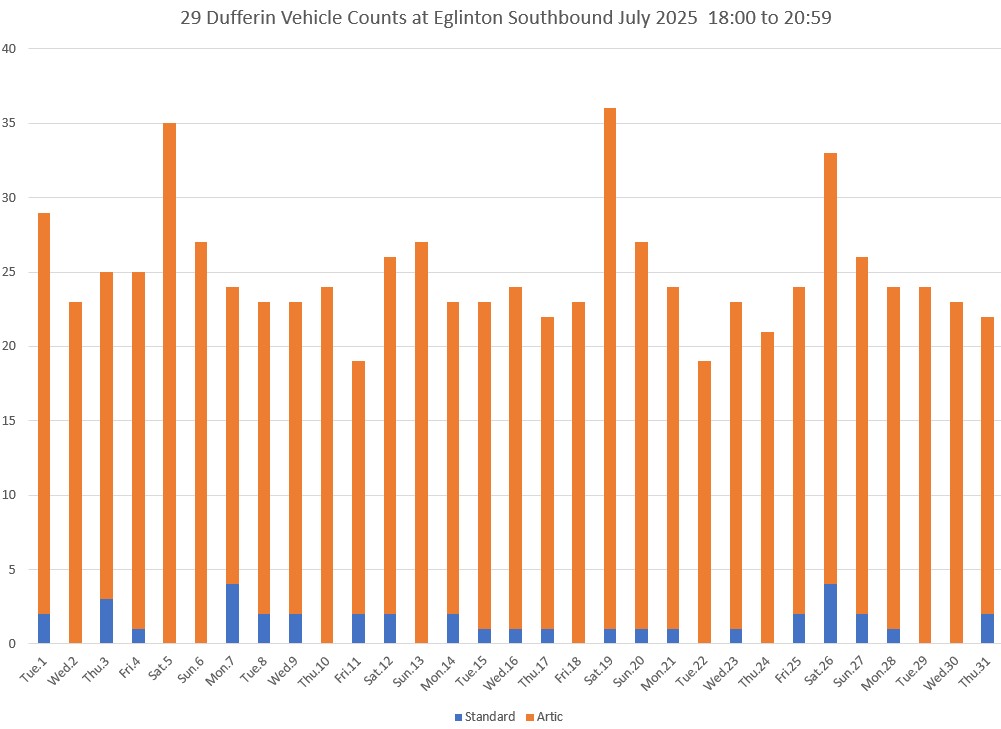
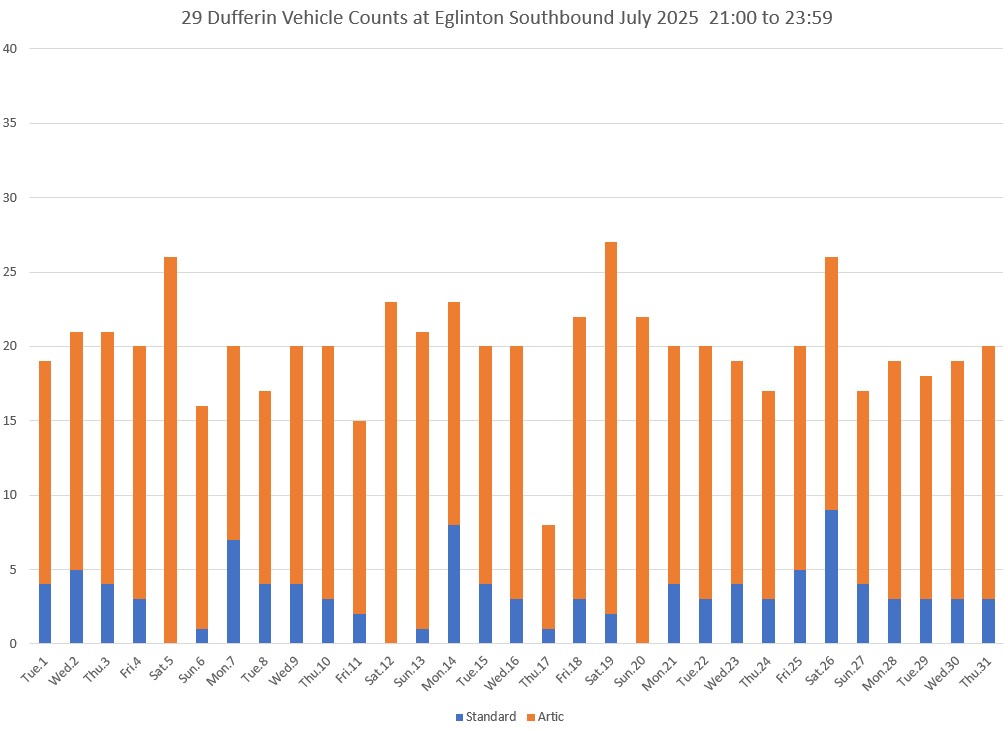
These charts show the counts southbound at Eglinton. During many periods, the local service on Dufferin operates every 8 minutes. Over a three-hour period, one would expect to see 22-23 buses. On weekends, some periods have 5 minute service or 36 buses in a three-hour period.

As on other routes, the proportion of 12m buses (blue) operating on Dufferin grows later in the day, but not as dramatically as in some other cases.
929 Dufferin Express
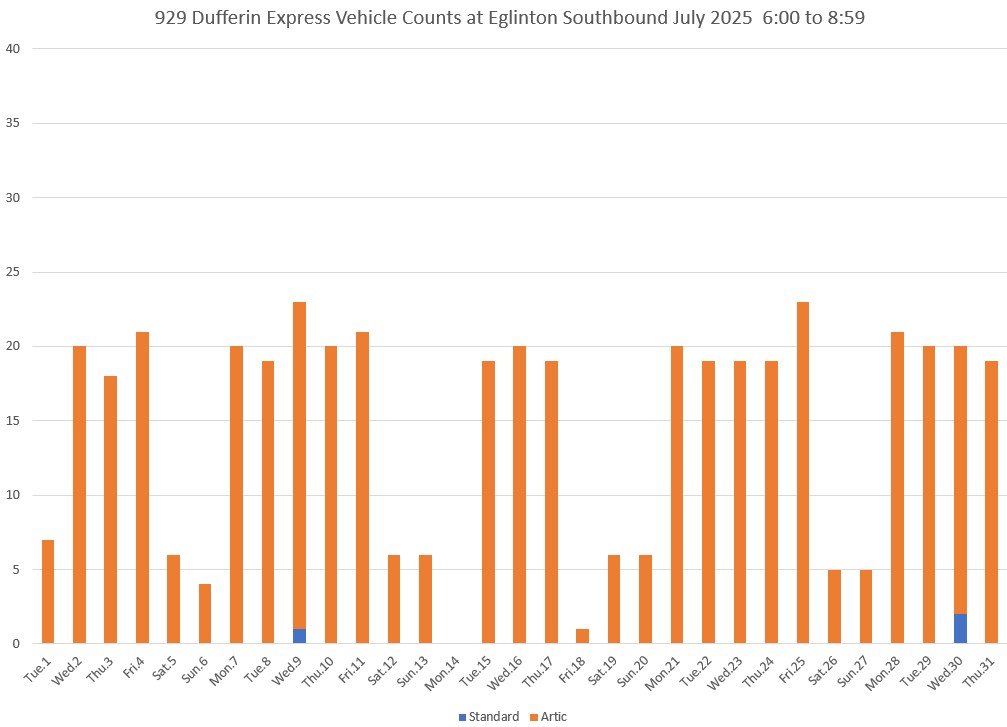
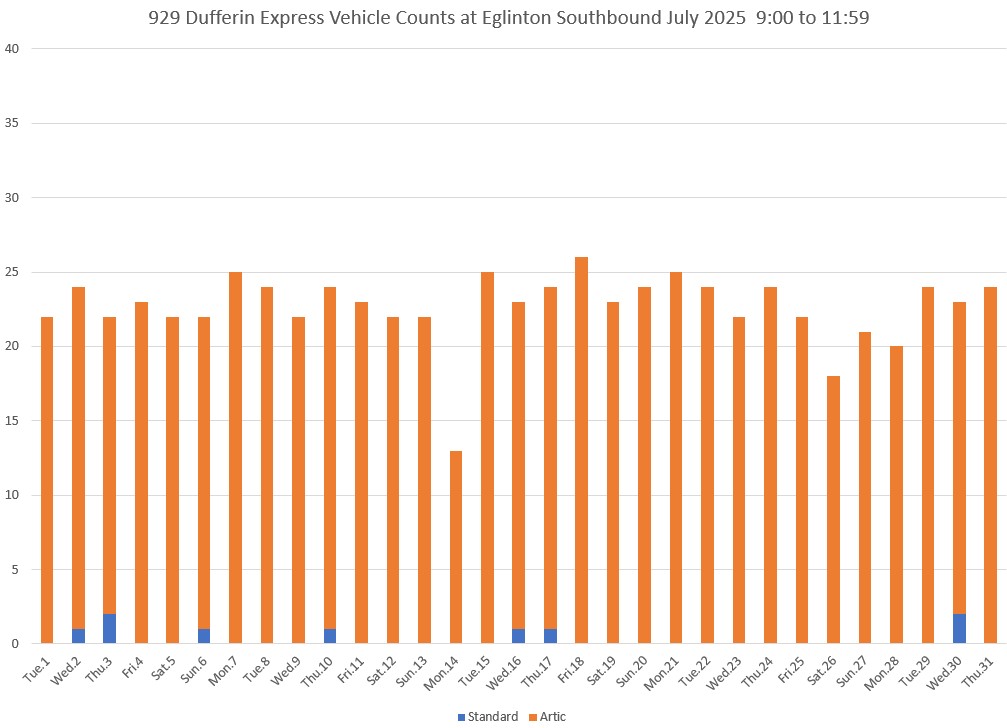
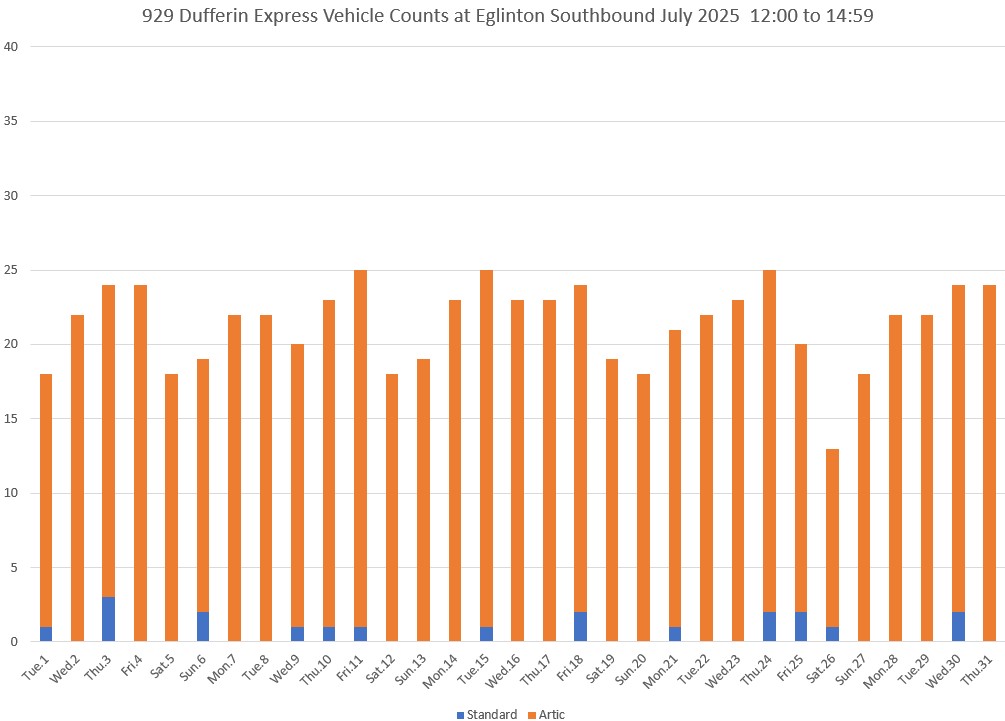
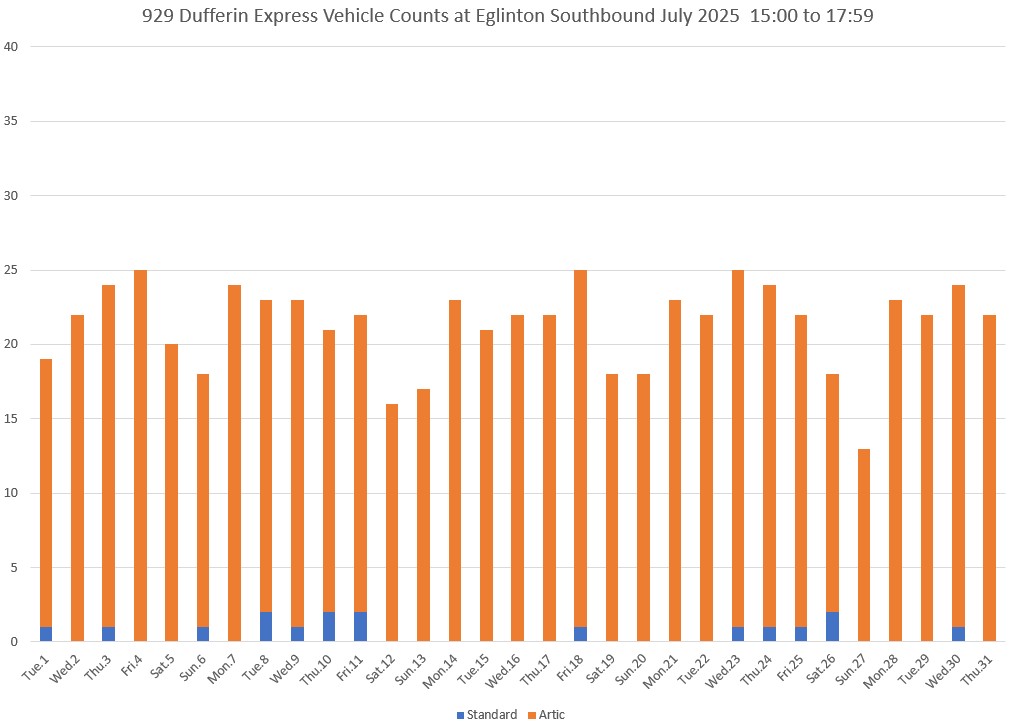
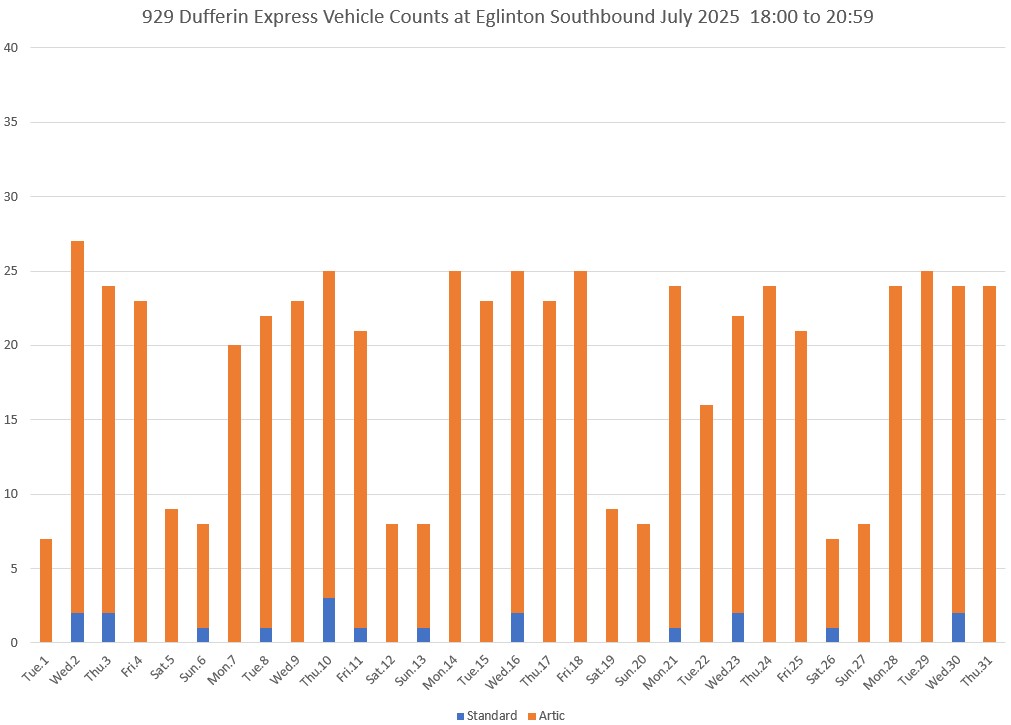
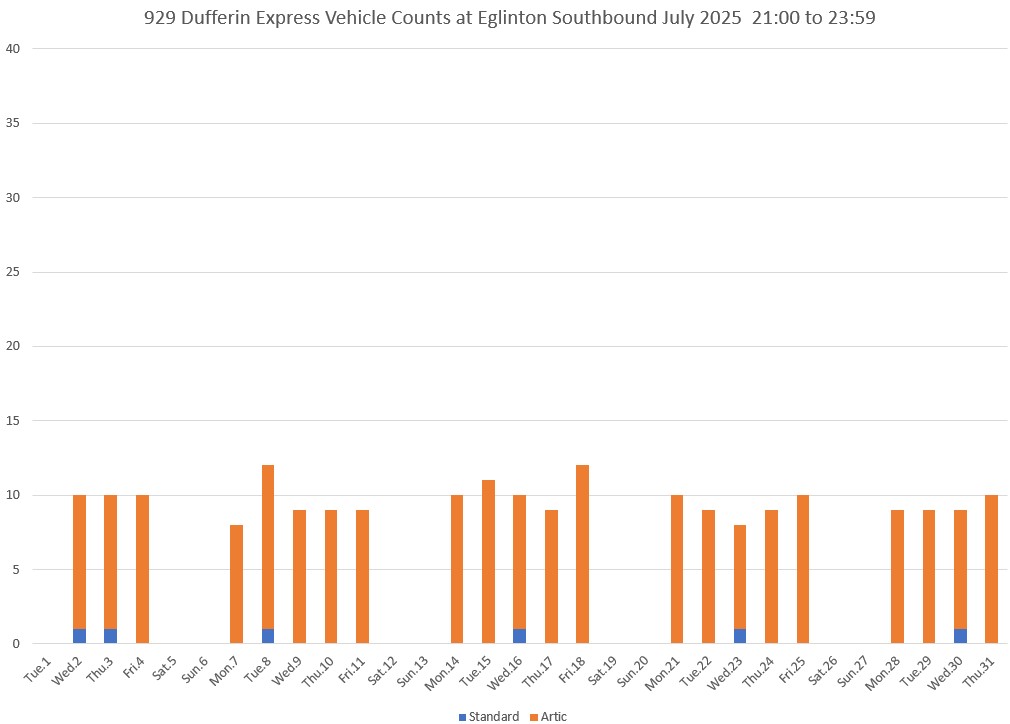
The express service on Dufferin runs every 8 minutes except on weekend afternoons when it drops to every 10. This translates to 22-23 buses in a three hour period most of the time, with 18 buses weekend afternoons. The express service does not run in the late evening and so there are fewer buses in the 9pm chart below.

Few trips operate with 12m buses on the express service.
36 Finch West
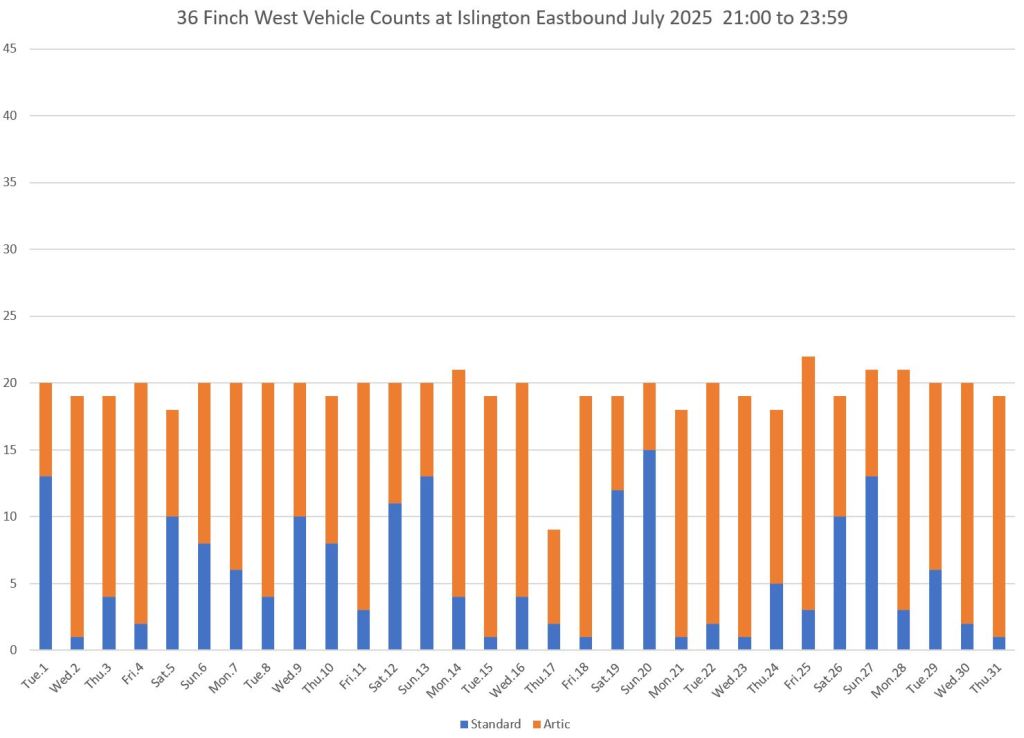
The Finch West bus has two branches that split off to serve an industrial district around Highway 400, but most of the service runs through to Humberwood Loop. On weekdays, the Humberwood 36B is scheduled to run with 18m buses, but on weekends with 12m buses.
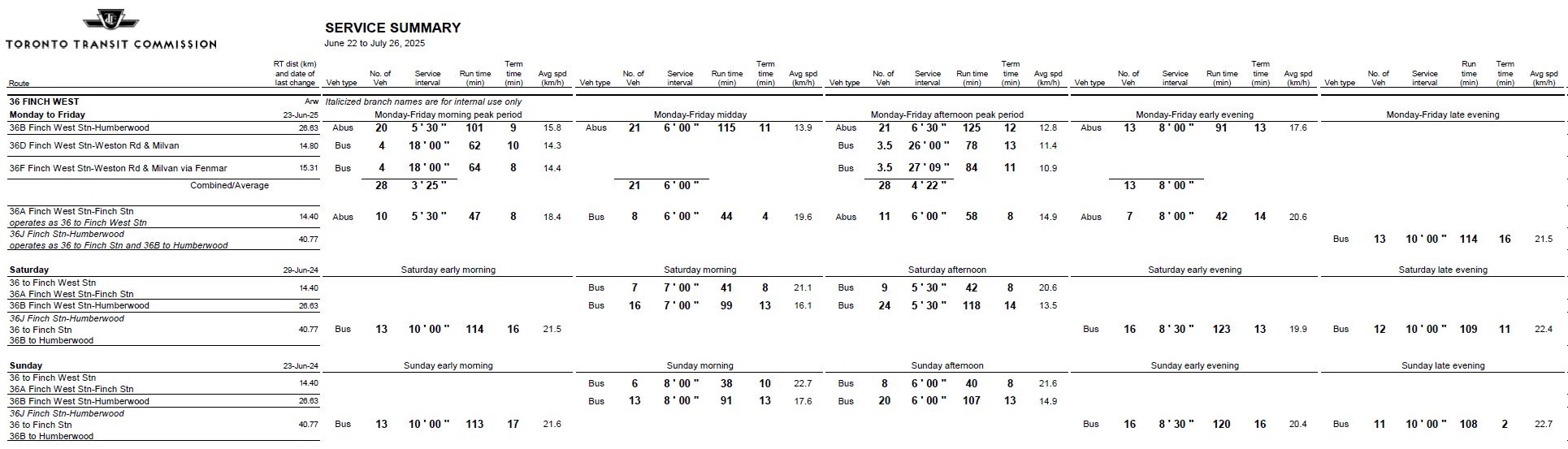
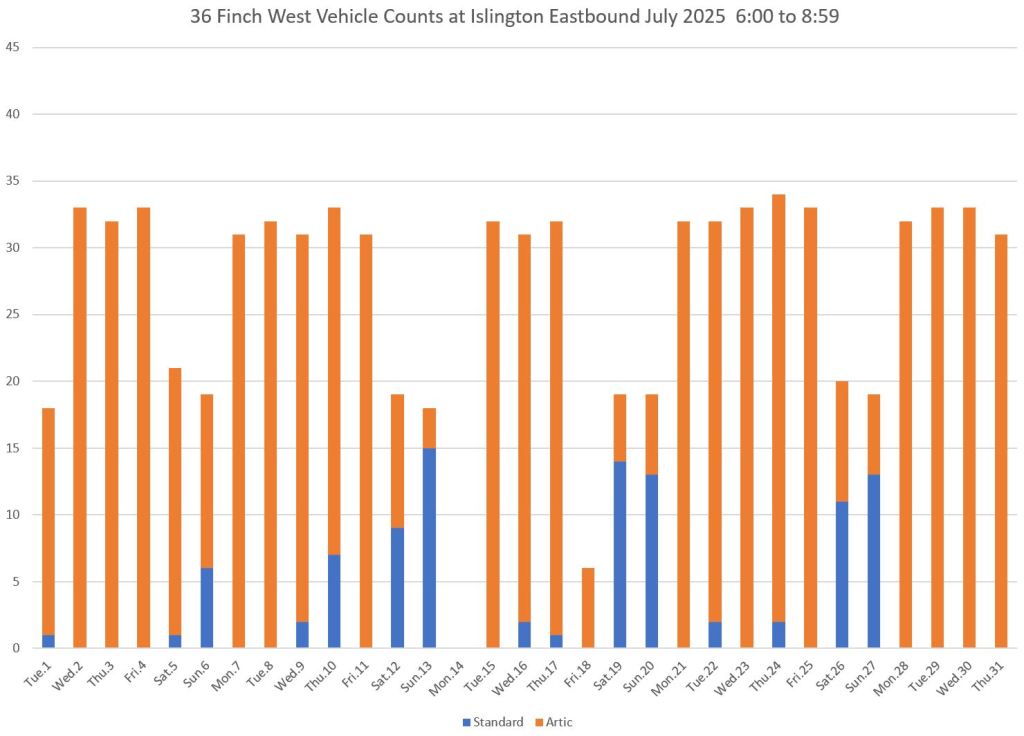
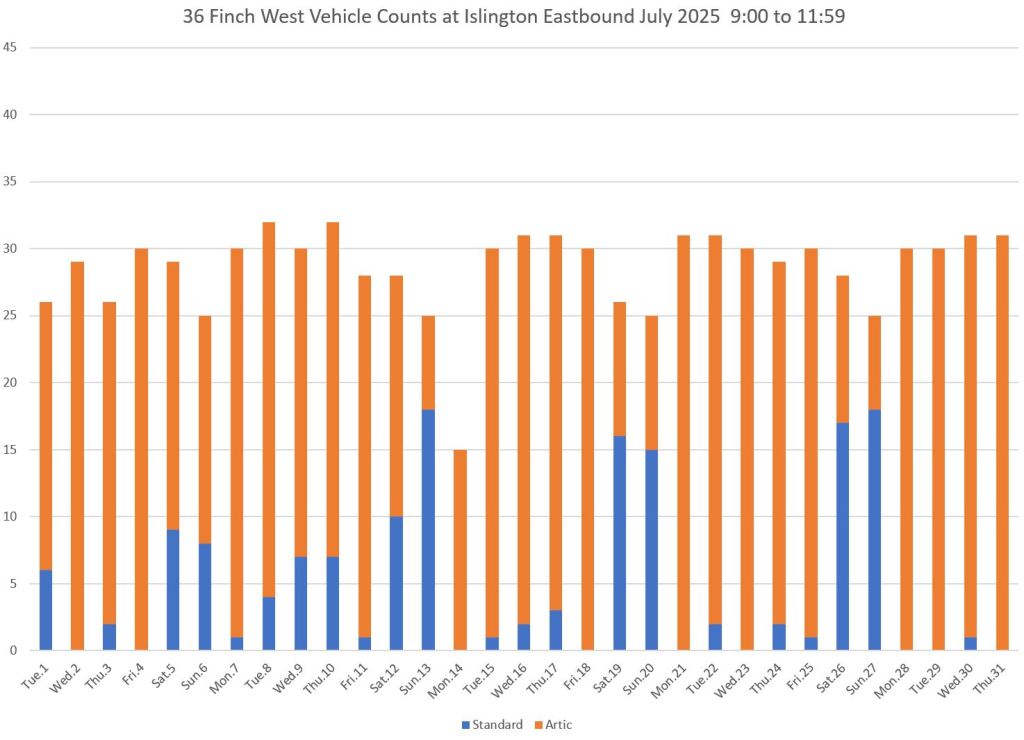
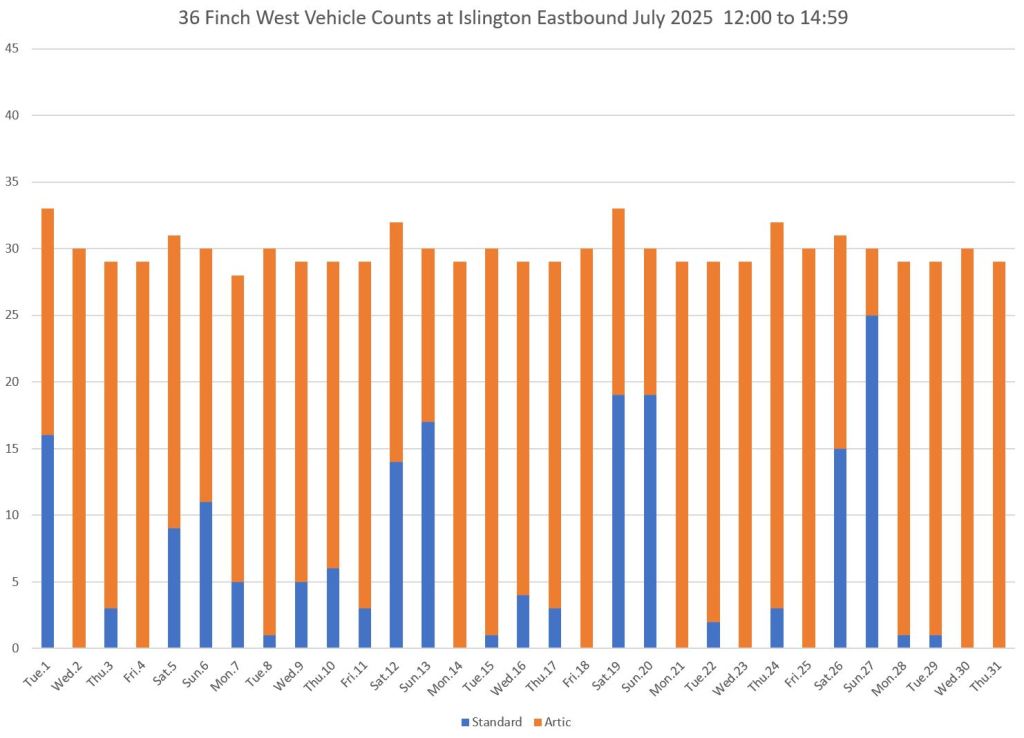
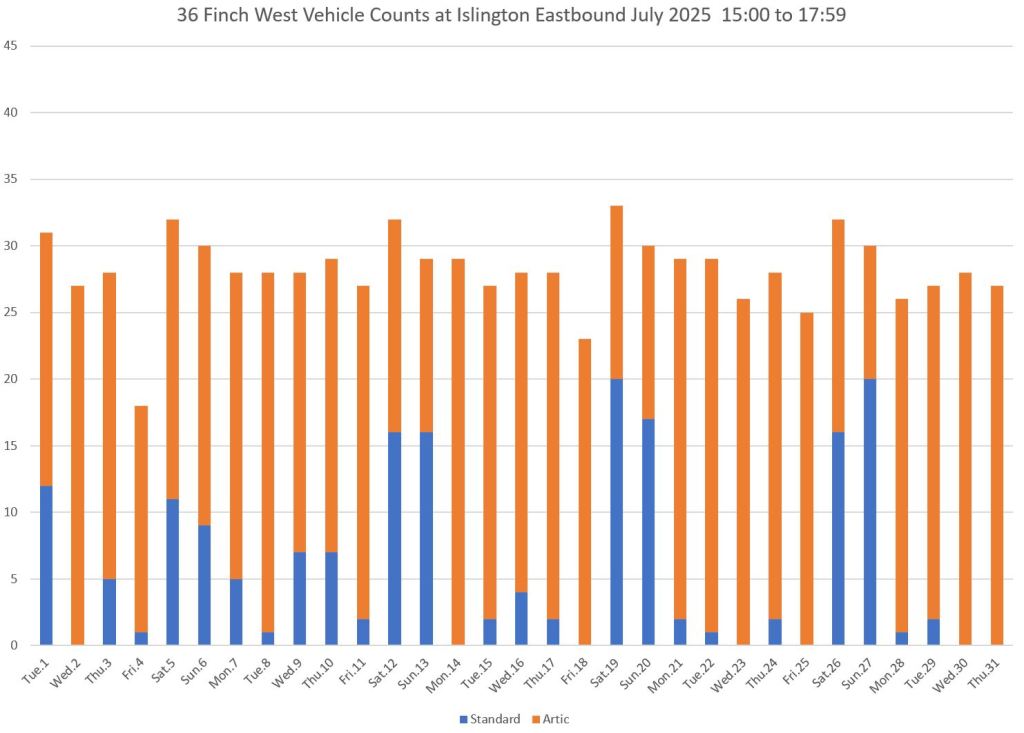
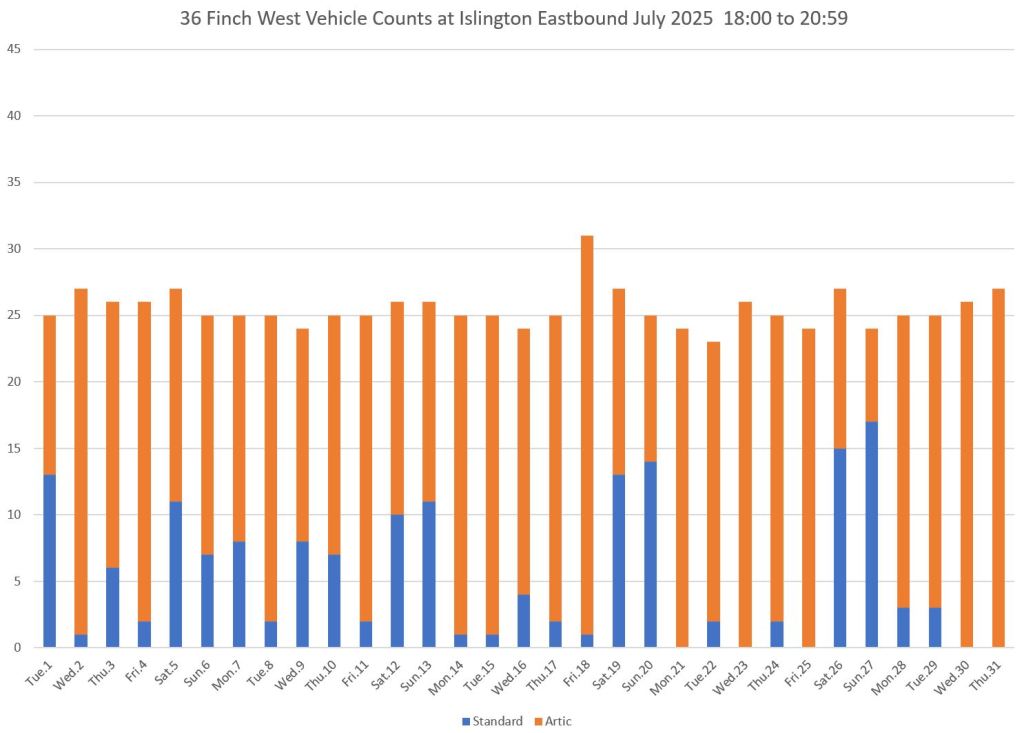
The counts below are taken eastbound at Islington where only the Humberwood service operates and before the Milvan branches merge into the route. The expected number of buses varies over the day because of different levels of scheduled service. Many Humberwood trips operate with 12m buses, and the proportion of these grows later in the day.
Weekends are unusual in that the schedule specifies 12m buses, and yet a mixture of these with 18m artics shows up in the tracking data.
939 Finch Express
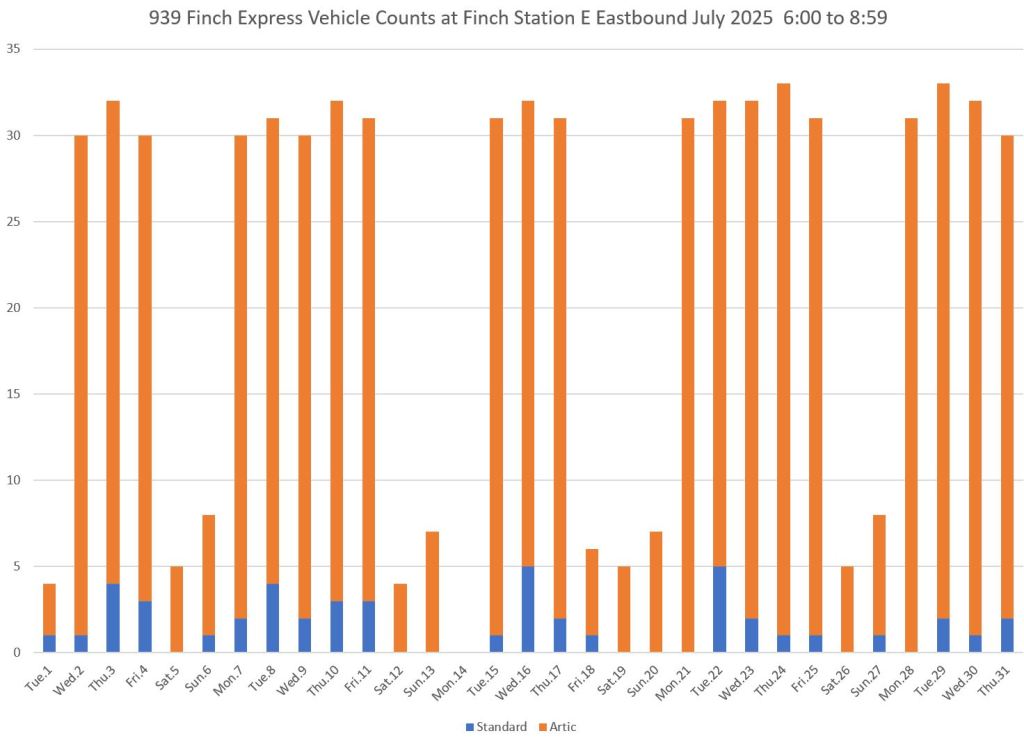
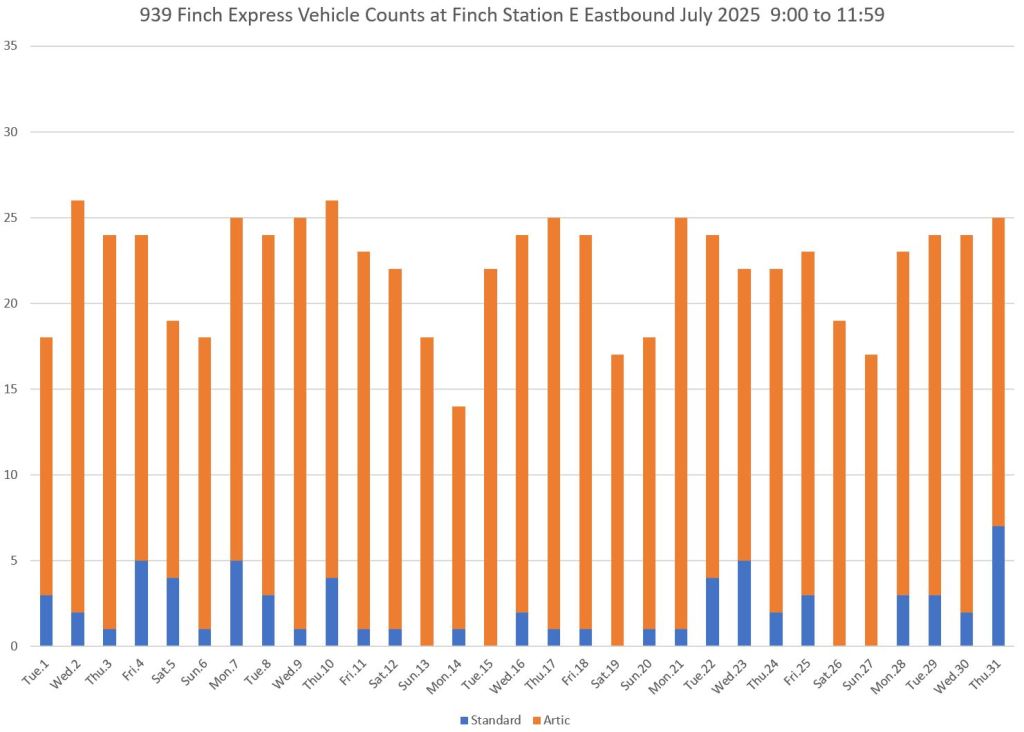
The Finch Express operates with some service terminating at Finch Station, and some extended west to Finch West Station. During peak periods, one branch operates to Morningside Heights, but otherwise the eastern terminus is Kennedy Station via Scarborough Centre.
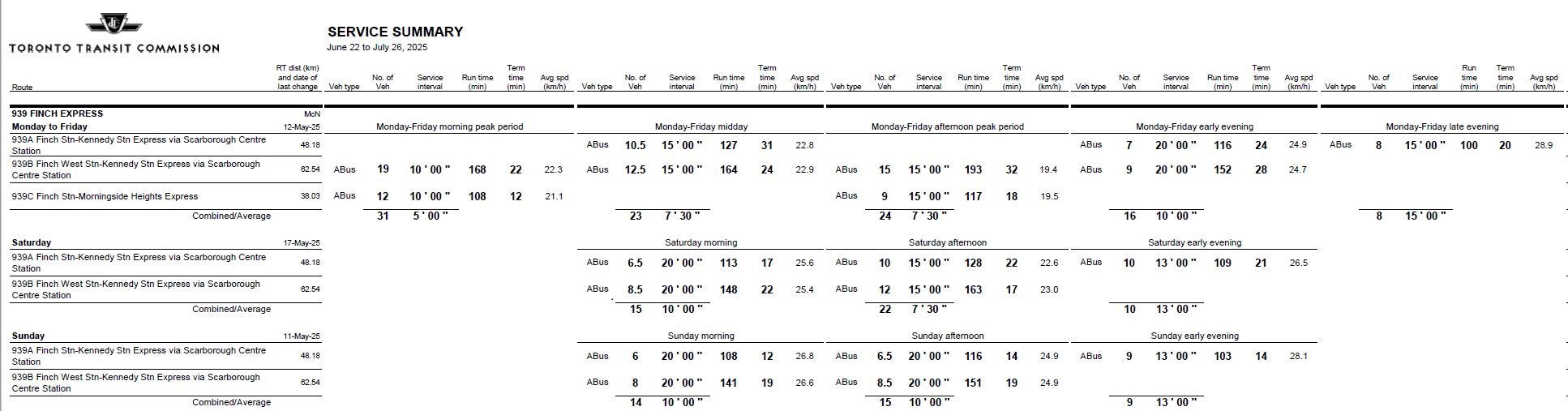
The charts here show the combined service eastbound east of Finch Station. The counts are highest in the AM peak when a 5′ headway operates (12 buses/hour). This drops back to 7’30” weekday midday and PM peak (8 buses/hour), and to 10′ (6 buses/hour) and 15′ (4 buses/hour) in the early and late evening periods.
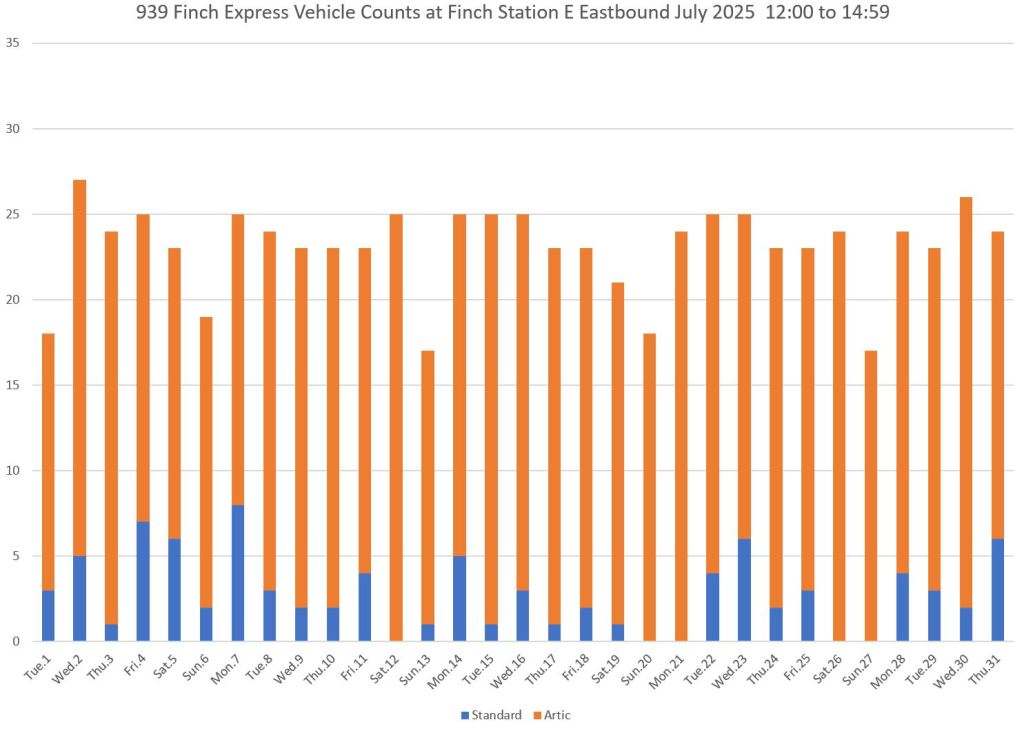
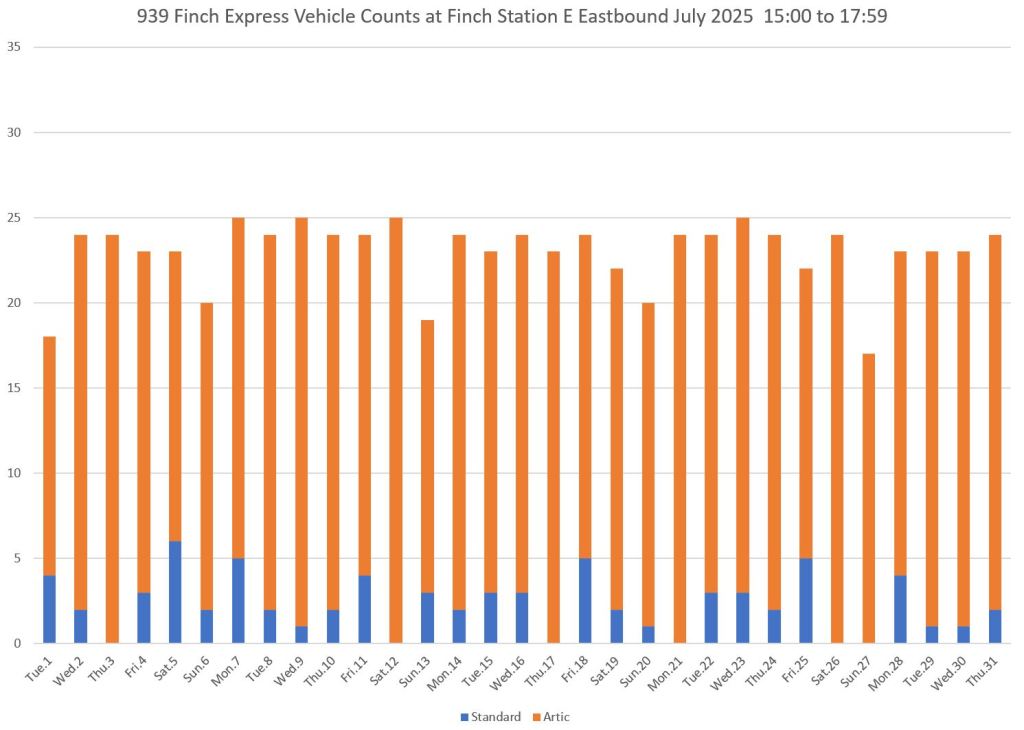
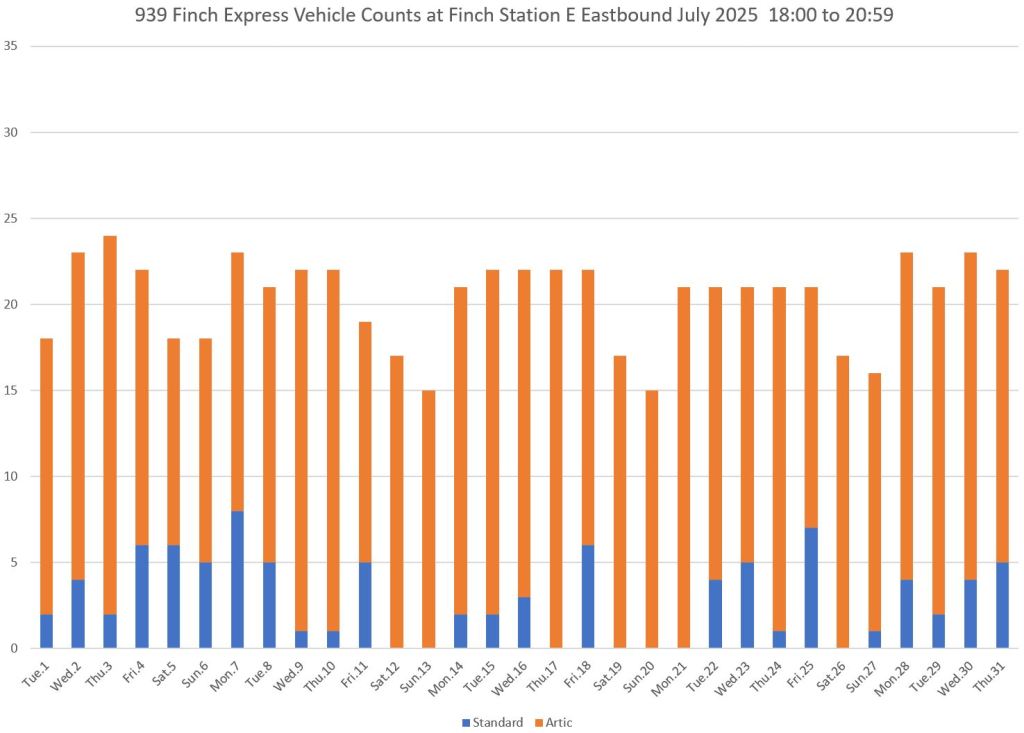
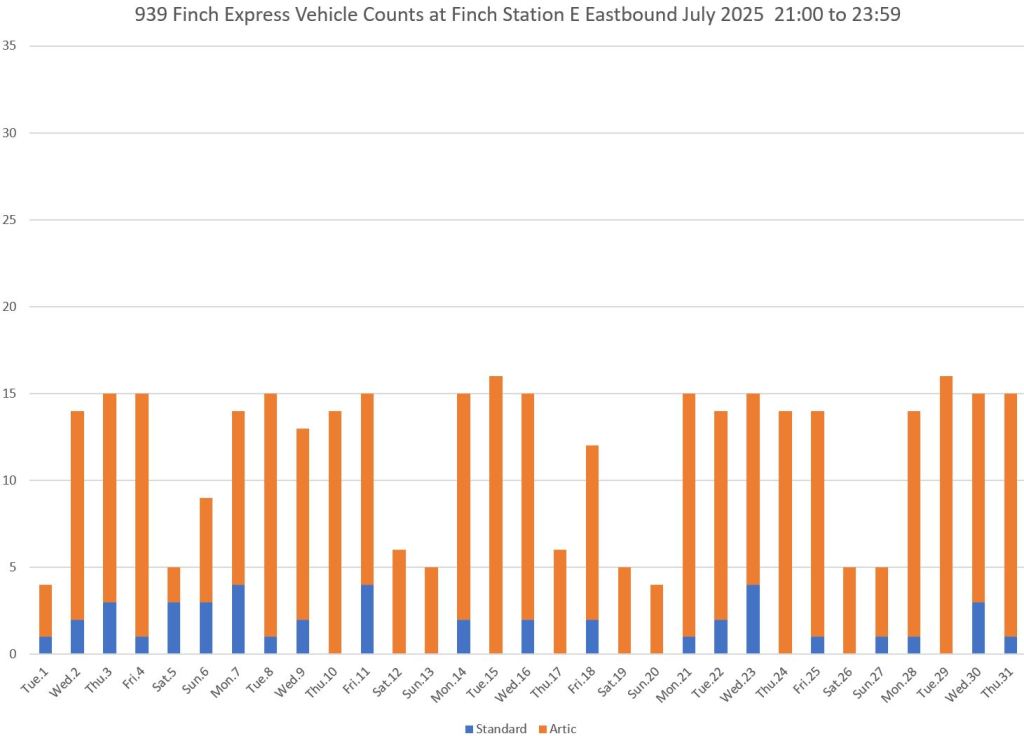
941 Keele Express
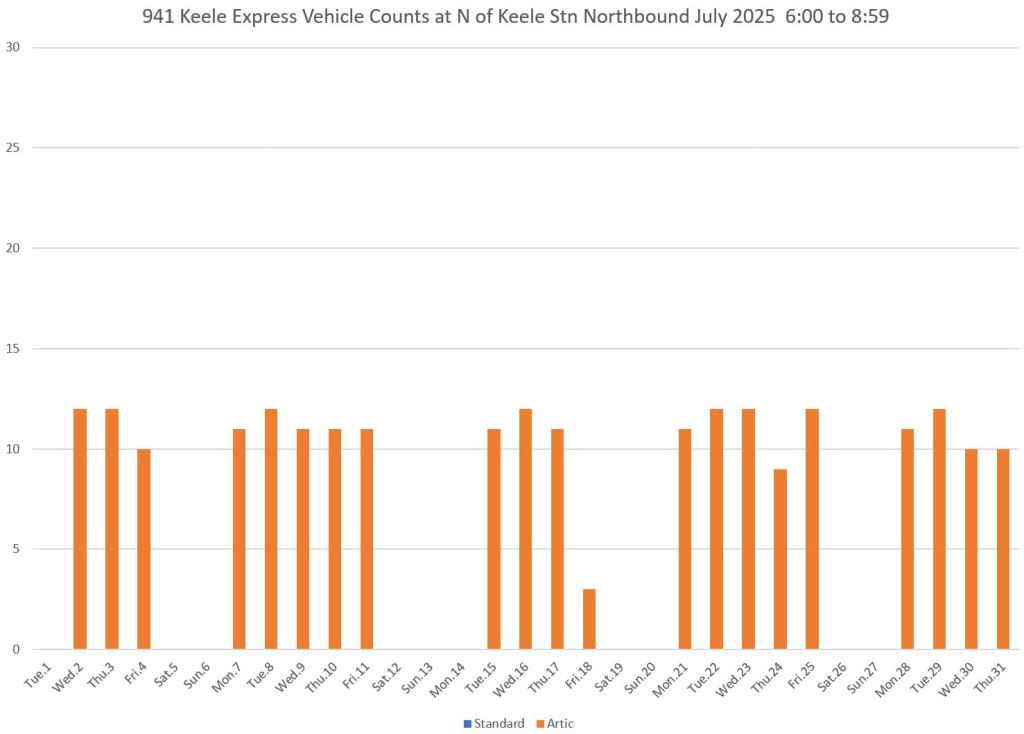
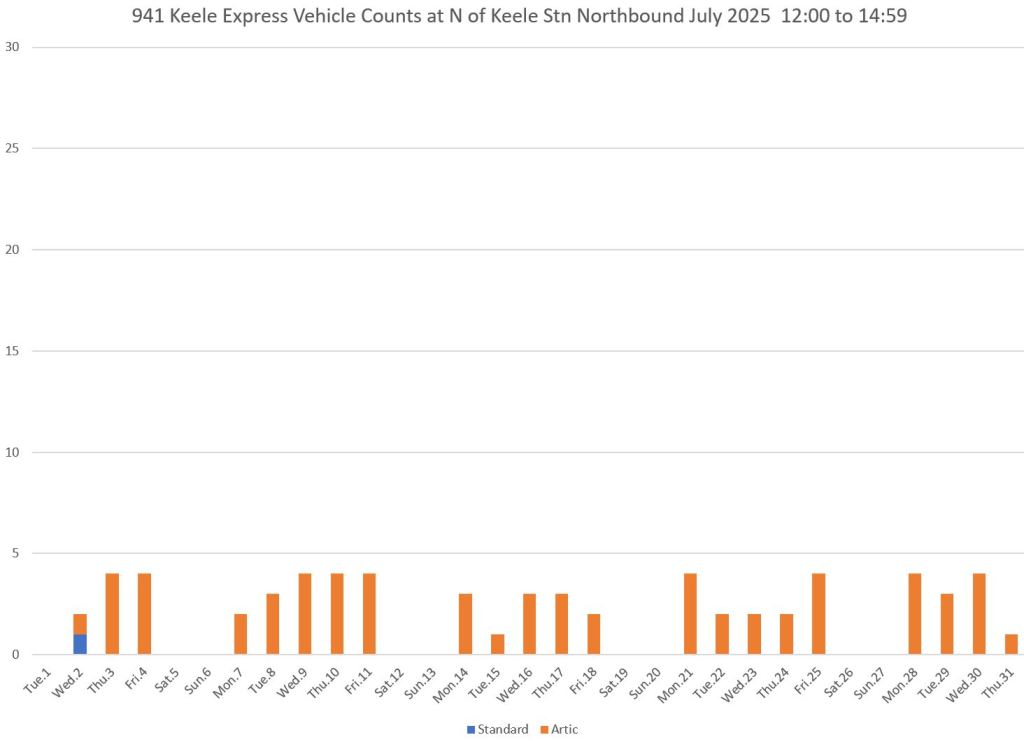
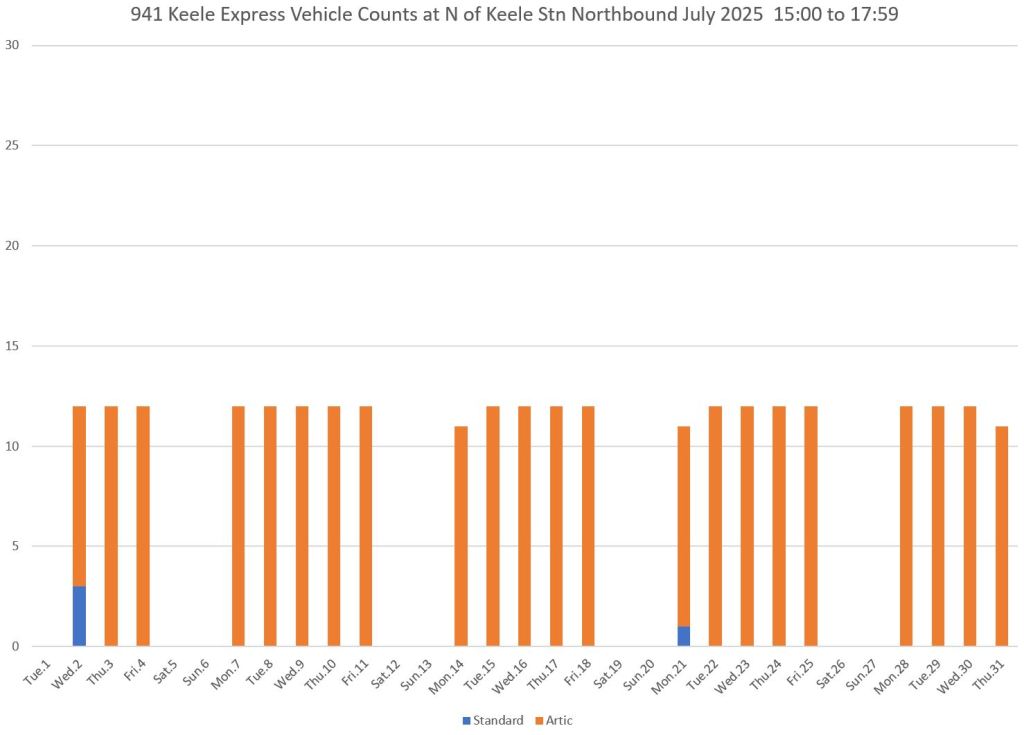
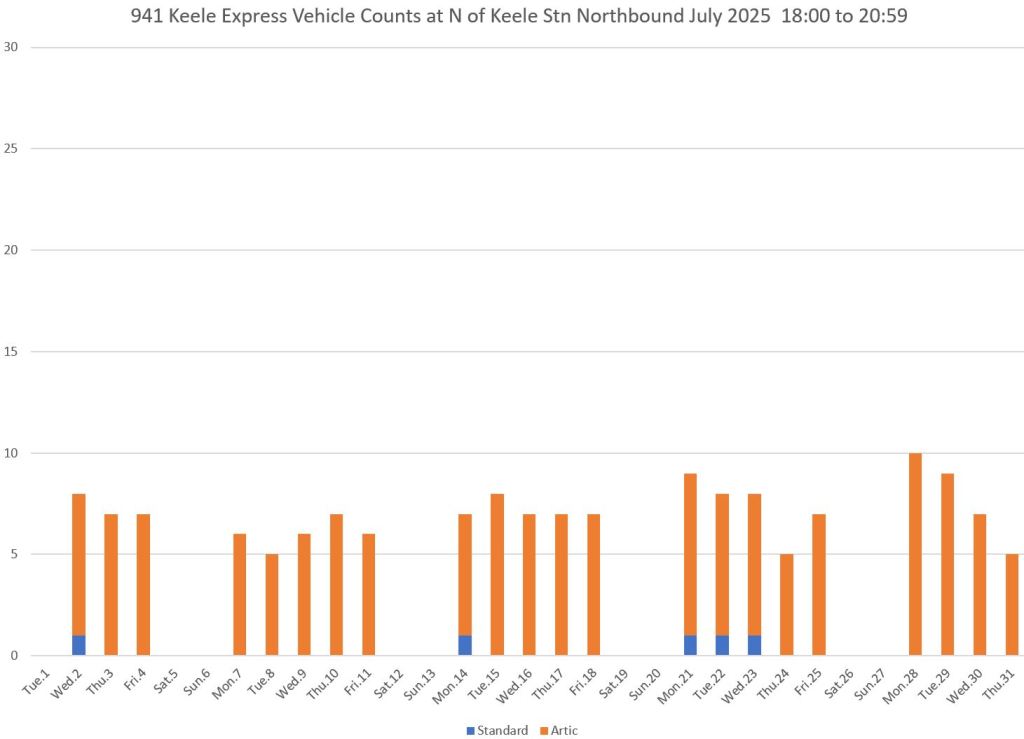
The Keele express service operates only in peak periods on a 15′ headway (12 buses in a three hour period). The afternoon peak service begins before 3pm and extends into the early evening.

12m buses are rare.
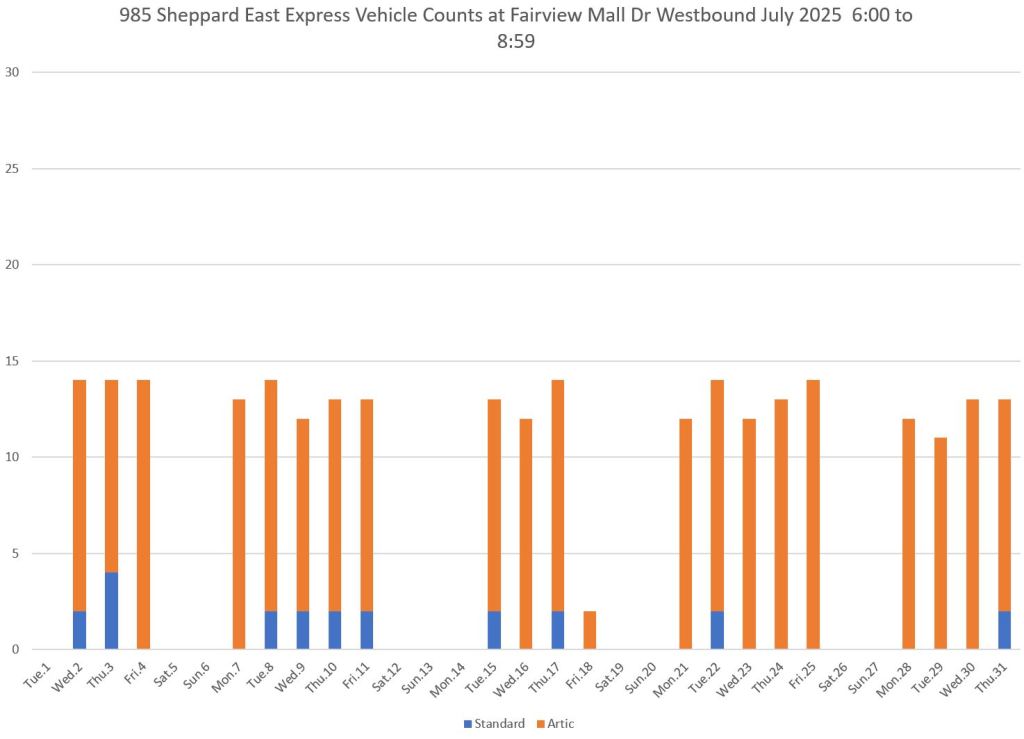
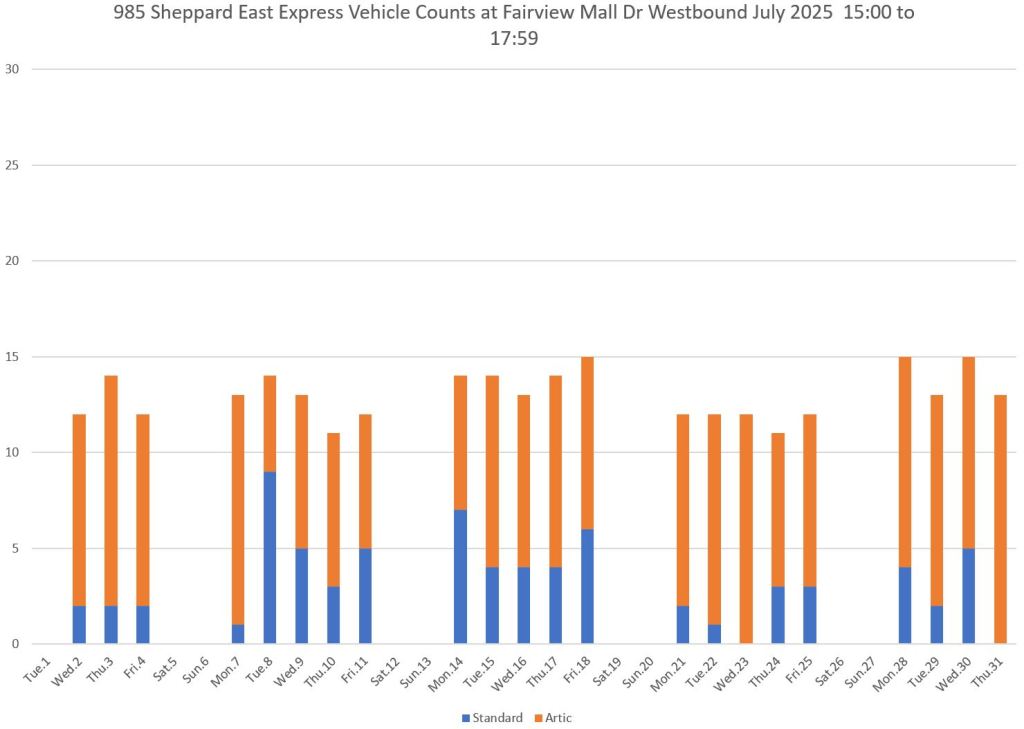
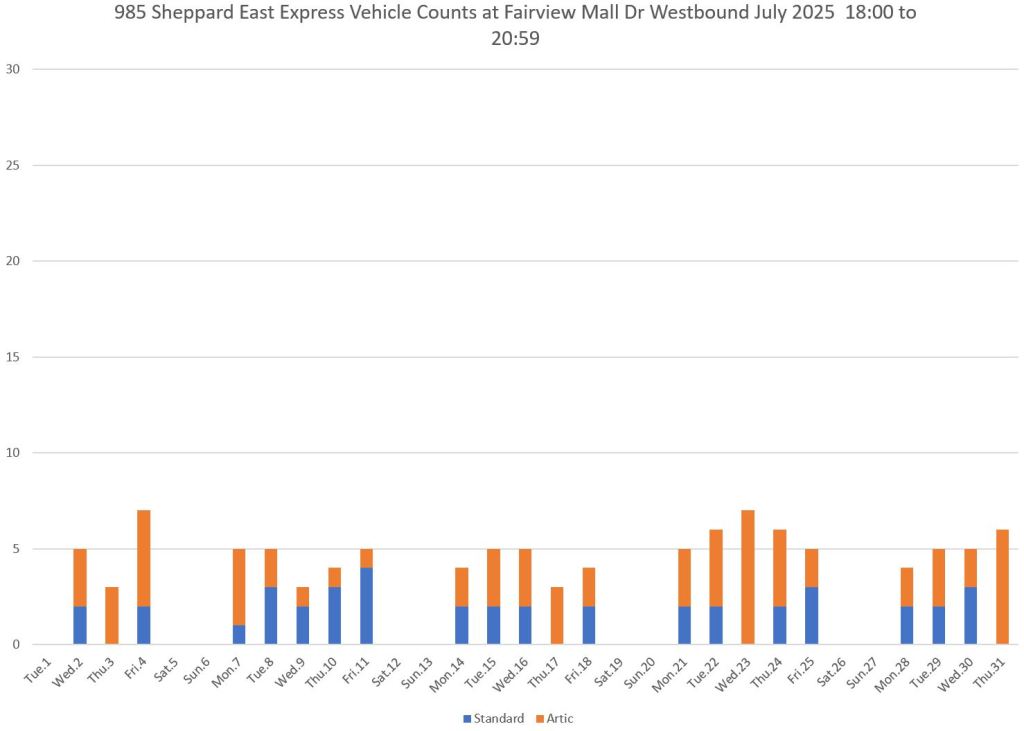
985 Sheppard East Express
The Sheppard East express operates only in peak periods on a 12′ headway (5 buses/hour).

Many trips operate with 12m buses in the afternoon peak.
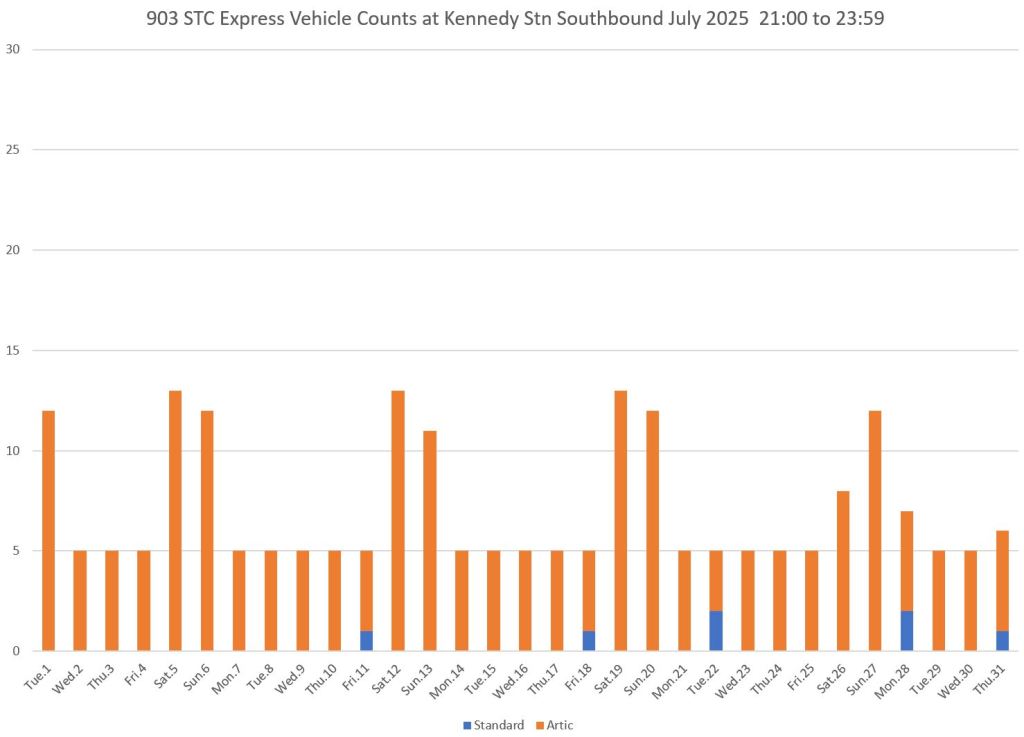
903 STC-Kennedy Express
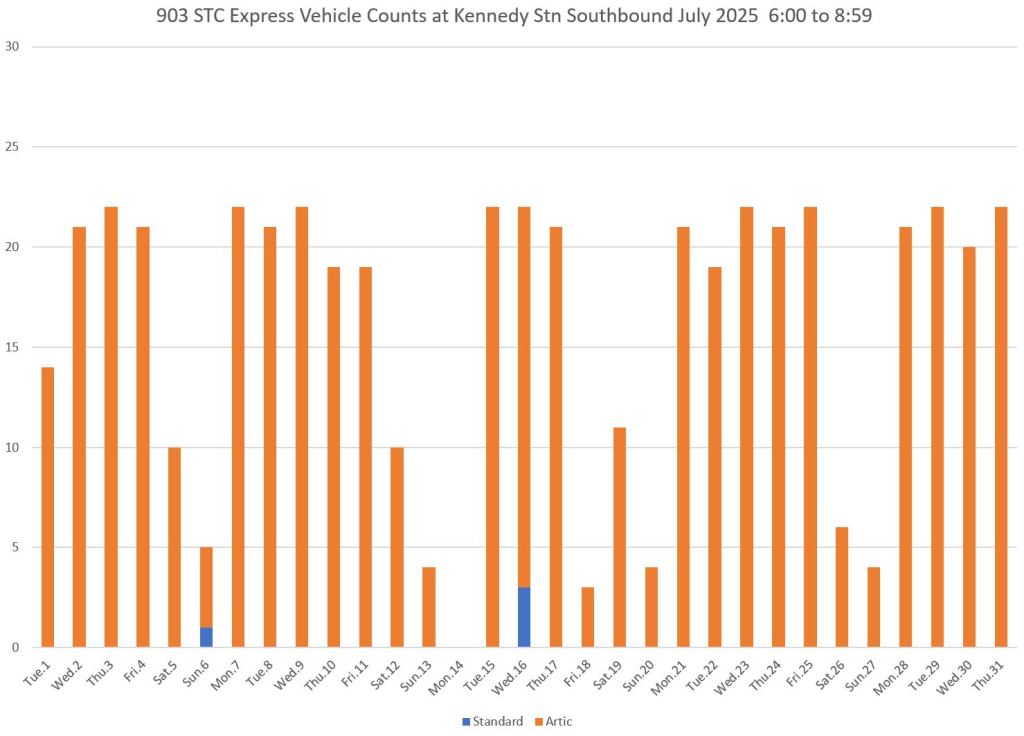
The 903 express is nominally a replacement for Line 3 SRT between Kennedy Station and Scarborough Centre. It also includes a service to Centennial College that was formerly provided by the Progress bus.

12m buses are rare on this route.
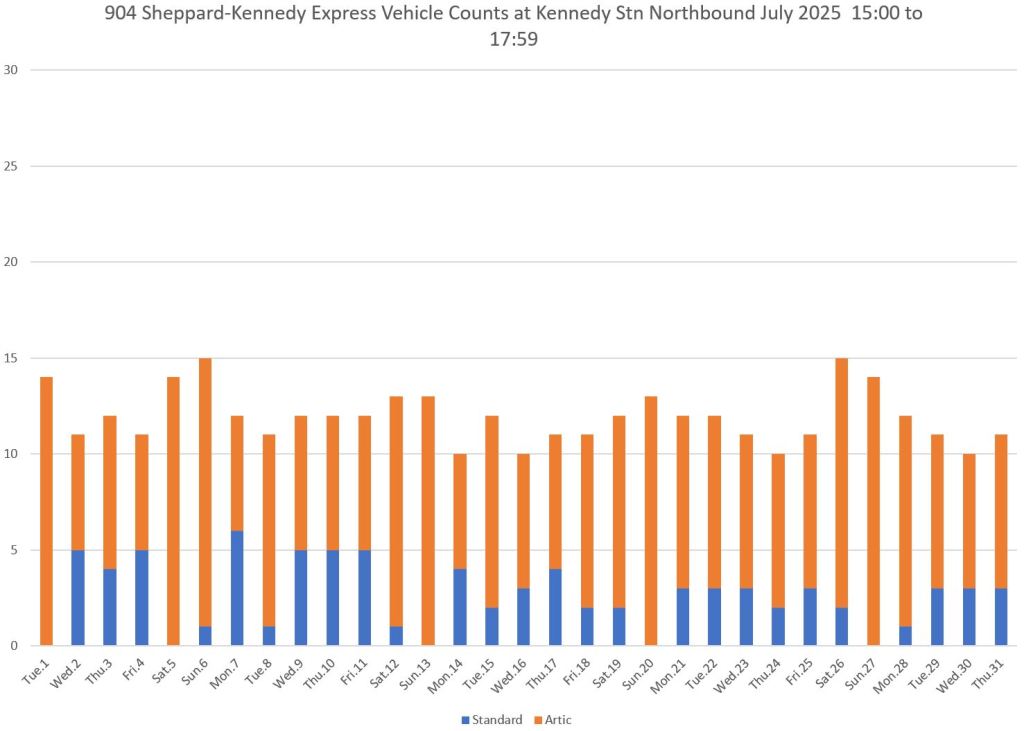
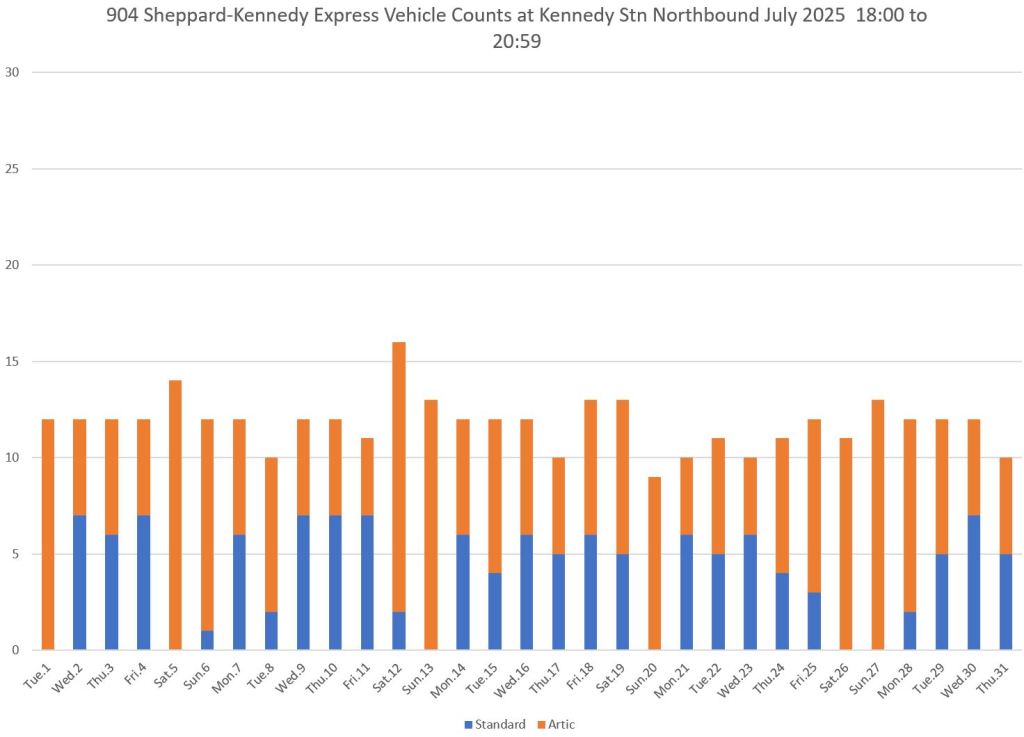
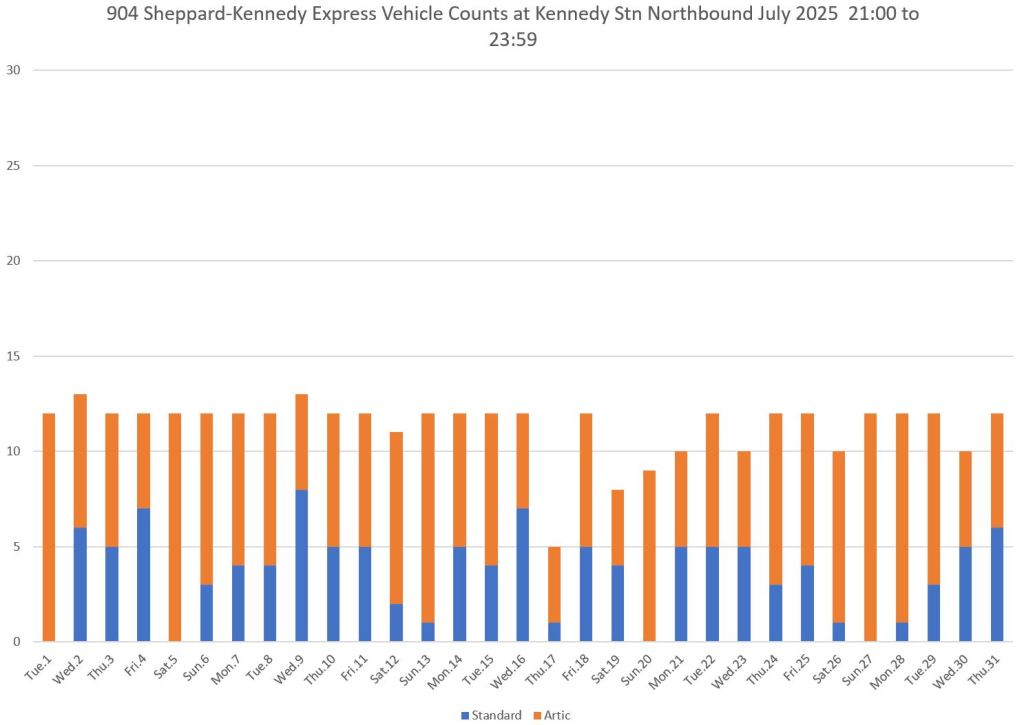
904 Sheppard-Kennedy Express
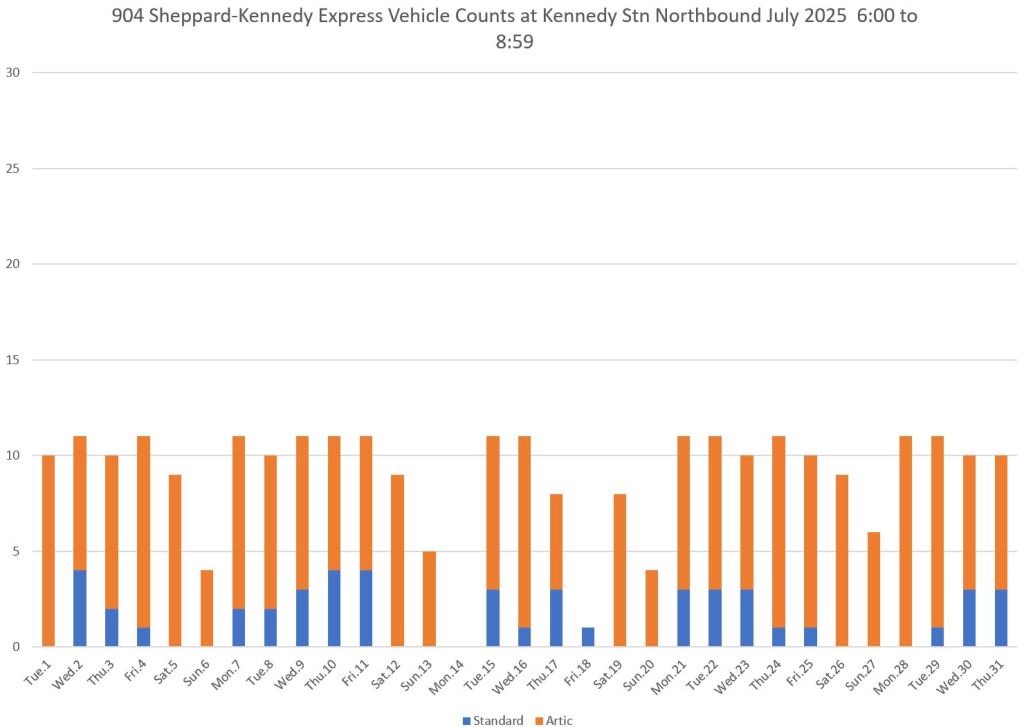
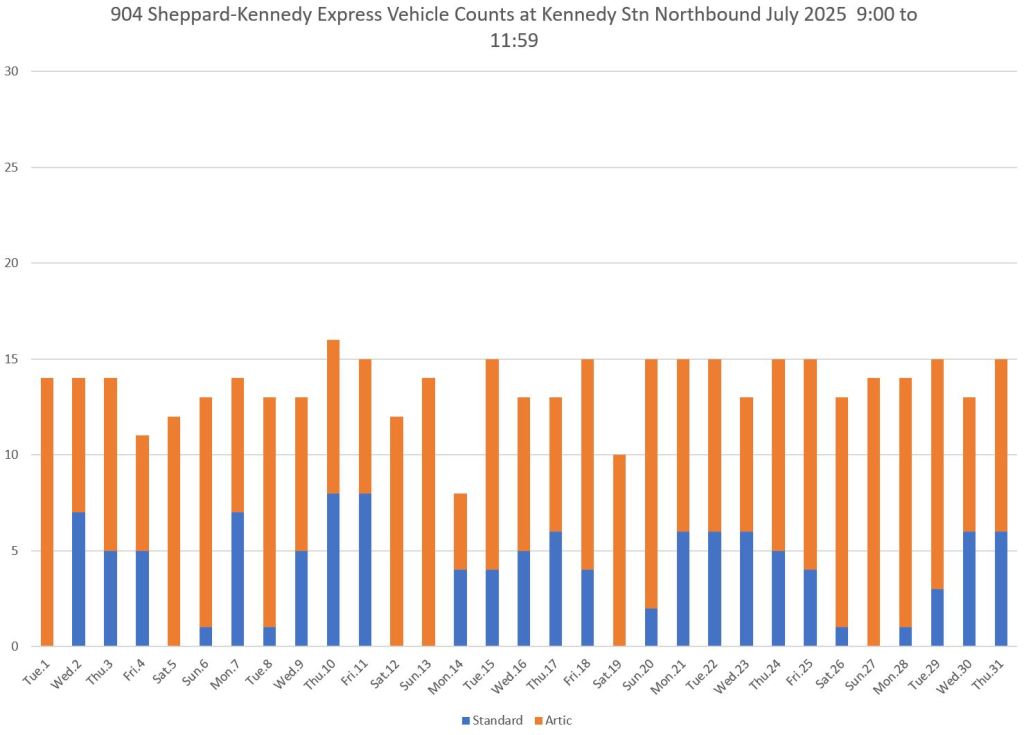
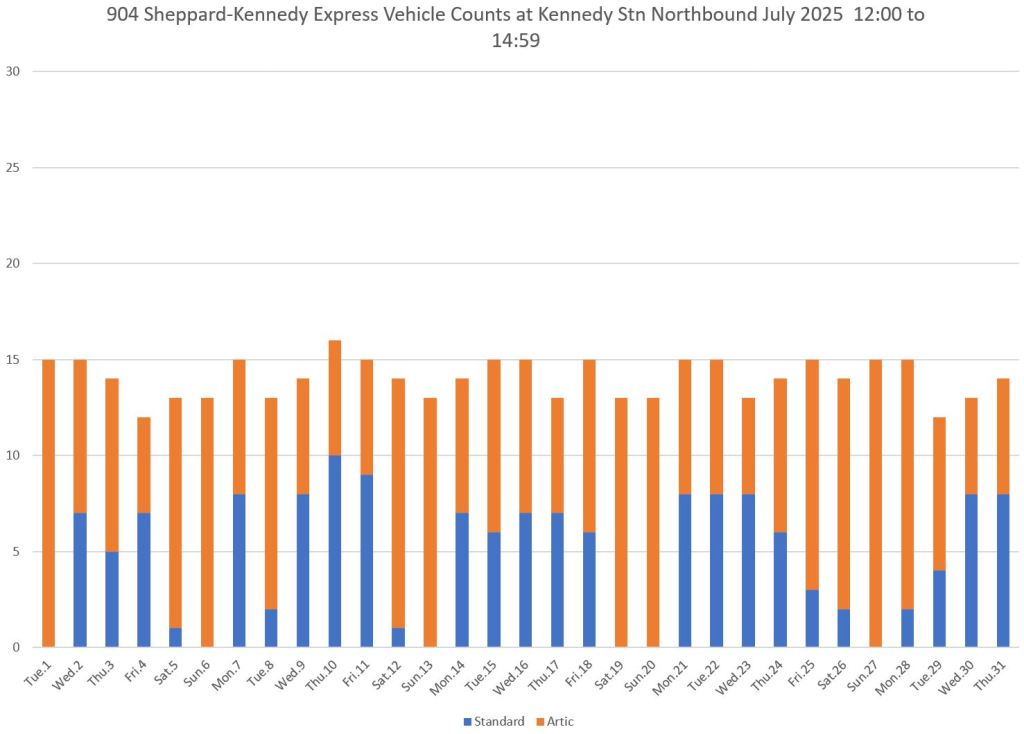
The 904 express bus is notionally an extension of Line 4 Sheppard. It originally ran only from Don Mills Station to STC, but with the SRT shutdown, it was extended south to Kennedy Station.

Although it is scheduled with 18m buses, many trips, a majority in some periods, operate with 12m buses.
 Steve Munro
Most likely due to old arctics with insufficient air conditioning……
LikeLike
Steve, do you have data on the 902? which is another Malvern artic route.
Steve: I have not been tracking the 902, but will add it to my list for August.
LikeLike
Yeah the 36 Finch West bus for some reason lately has a mix of 12 and 18m busses every Saturday and Sunday. Perhaps they use some 18m busses because ridership is high but but not high enough to make it a full 18m route?
LikeLike
Maybe if the TTC didn’t waste hundreds of millions of dollars on fare enforcement, they could’ve had enough money for artics with working AC … super avoidable issue but these idiots wanna lose money on over-policing (ONLY A MINIMAL PERCENT OF FARE MONEY ACTUALLY GOES TO THE TTC THEY GET ALMOST ALL THEIR FUNDS FROM THE GOVERNMENT FARE EVASION DOES NOT MATTER).
Steve: Actually, for 2024, the TTC fare revenue was just under $1 billion with total expenses of $2.5 billion, so 40% of TTC revenue comes from fares, not “a minimal percent”. Most of the rest comes from provincial and city subsidies, with Toronto carrying the lion’s share. I agree that the issue of fare evasion is given undue prominence, and that even if the TTC recovered all of the alleged losses, this would come nowhere near dealing with the funding gap. That said, the importance of fare revenue should not be dismissed. One reason it is low compared to historic levels is that fares have been largely frozen during the pandemic, but operating costs rose. The former recovery level of about 67% has dropped thanks to these two effects. Politicians on both the right (Tory) and left (Chow) have use low fares as “good news” while driving up the losses to be covered from other sources, and threatening the long-term funding stability of the system.
LikeLike
Any thoughts about the cause? Could it be buses being pulled out of service for refueling?
Also where are all the 12m buses coming from for this? Is it all spares, or are they switched from other routes which then see a few random artics in the afternoon?
Steve: Refueling is an unlikely cause as most artics manage to stay in service for longer periods. As for 12m buses, the TTC has lots of spares. Artics on other routes simply reflect the TTC’s somewhat uneven attitude to vehicle assignments which has been a problem for years (it was a common issue with the CLRV/ALRV fleets).
LikeLike
Thank you Steve for keeping track of this. This aligns with my observations. 904/985 always seems to be half and half or mostly standard buses. Often they’ll dispatch a standard for the whole day. If the TTC has issues with the Nova Artics, creating a shortage, they should consider reverting a route or two back to standards to fix the availability issue. I think 905 on weekends and 129B could go back. 941? Maybe this will help?
Also do you know why they removed almost all of the New Flyer artics from McNicoll? I don’t understand why they left only 7 in Scarborough when the promise was to put them on 903 – which they did for about a year.
Do you know what the issues with the Nova Artics are? Do they plan on keeping them for 18 years instead of 12? From a passenger point of view, the suspension on those is terrible and they shake and rattle terribly. Especially on Sheppard and on Kennedy Road.
Steve: No I don’t know what’s up with the Nova Artics, but I have been agitating in various quarters for the TTC to come clean about the reliability of their various classes of buses. Too many stats are consolidated, and some are presented in a way that distorts what is going on. Clearly they are incompetent at reporting, or they have something to hide.
LikeLike
Hey Steve, hate to post on an older post but this seems like the most relevant here.
Are you aware of any plans the TTC has for the artic fleet post Line 5/6 opening? Naturally this will release the 20-24 buses from the 36, but will they all just go to the 927 (had it but lost it), or will they be more dispersed? Thanks for any insight!
Steve: I do not have any info about the TTC’s plans for fleet redeployment post Lines 5/6 opening.
LikeLike