
Since February 2024, I have tracked the TTC’s posted list of Reduced Speed Zones (RSZs) on subway lines 1 (YUS) and 2 (BD). A pattern has emerged that some RSZs are very long-lasting, others are brief, and some come-and-go.
Former Interim CEO Greg Percy claimed that we should expect about a dozen of these at any time, but the current total as of July 13, 2025, sits at 27.
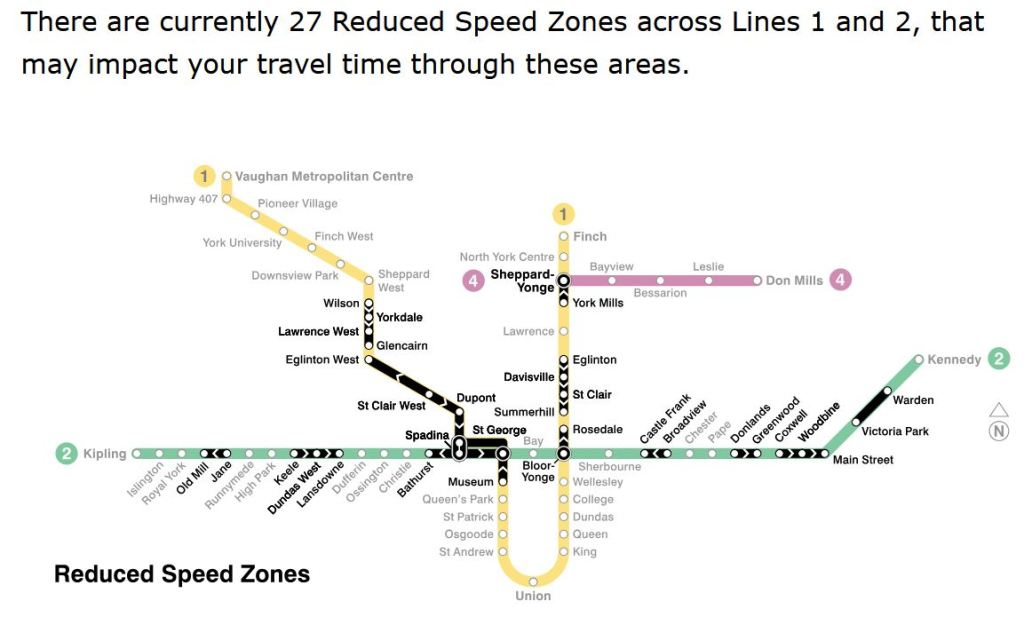
If these zones came and went in short order as problems were discovered, one might tolerate a period of travel delay. My own recent experiences with glacial trips from Vaughan to St. George makes me thankful that I don’t take this route every day, but regular riders there have my sympathy.
Current reporting makes actual tracking of track defects difficult, and there is no sense of the underlying problems or limitations on performing repairs. Transparency demands that more information is provided for the status of RSZs, specifically:
- Location
- Date first reported
- Defect issue(s)
- Planned repairs
- Projected date to completion
- Actual date slow order is lifted
Whether this will speed repairs depends on available resources (capital, work equipment, crews) and conflict with other works along the subway lines, but at a minimum riders deserve to know when they can expect relief from slow orders. The TTC Board and Council deserve to know how deep-seated the outstanding problems might be, where they originated, and what will be required to fix them.
Some of the long-standing issues lie with track built with wooden ties on stone ballast, the conventional way railways are constructed. Some of these areas have been converted to concrete ties, but that does not fix underlying problems with poor track foundations. These issues will not be easy to fix.
These problems have been around for a long time. Up until 2019, the TTC published detailed capital project descriptions in the “Blue Books” (named for the binders that held them), but this practice ended in the pandemic era, at least as public documents.
Here is a description of the subway track rehabilitation project from the 2019 Blue Books. Similar text appears in the 2016, 2017 and 2018 versions. (I do not have these files further back.) Needless to say, some of the work contemplated here never began. I include this detail to show the awareness of problems with track conditions goes back many years, and to provide interested readers with the technical details.
I have tried without success to get equivalent information for current budgets. A lot of this material is dead boring reading, but nuggets like the extract below were scattered through them. There were ideas of posting them online back in 2020, but this never came to pass.
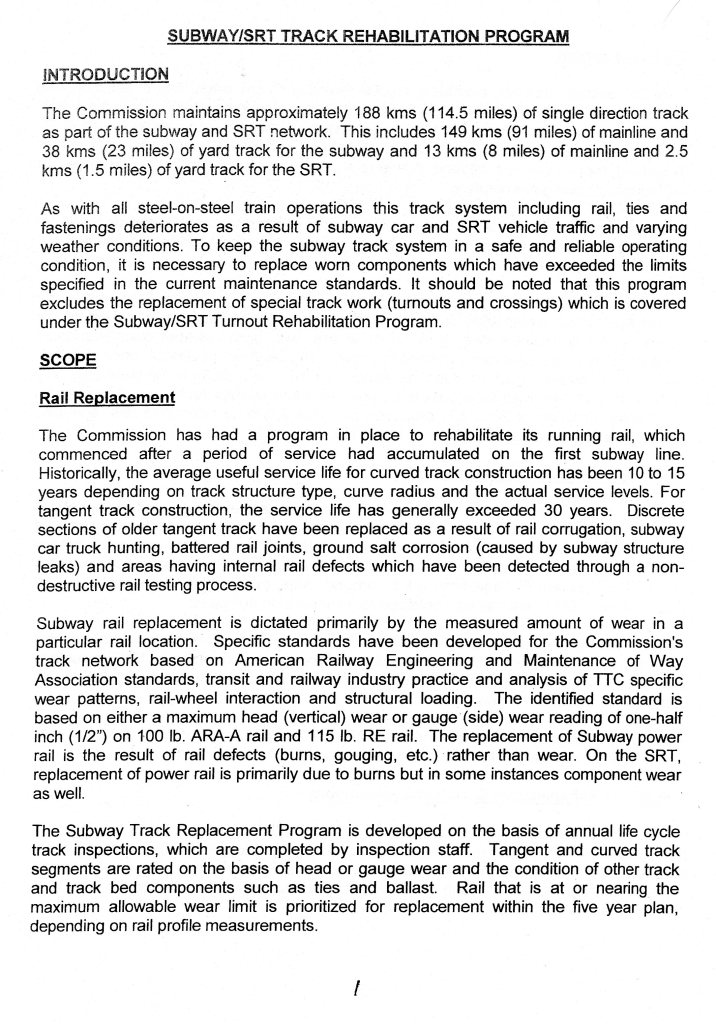
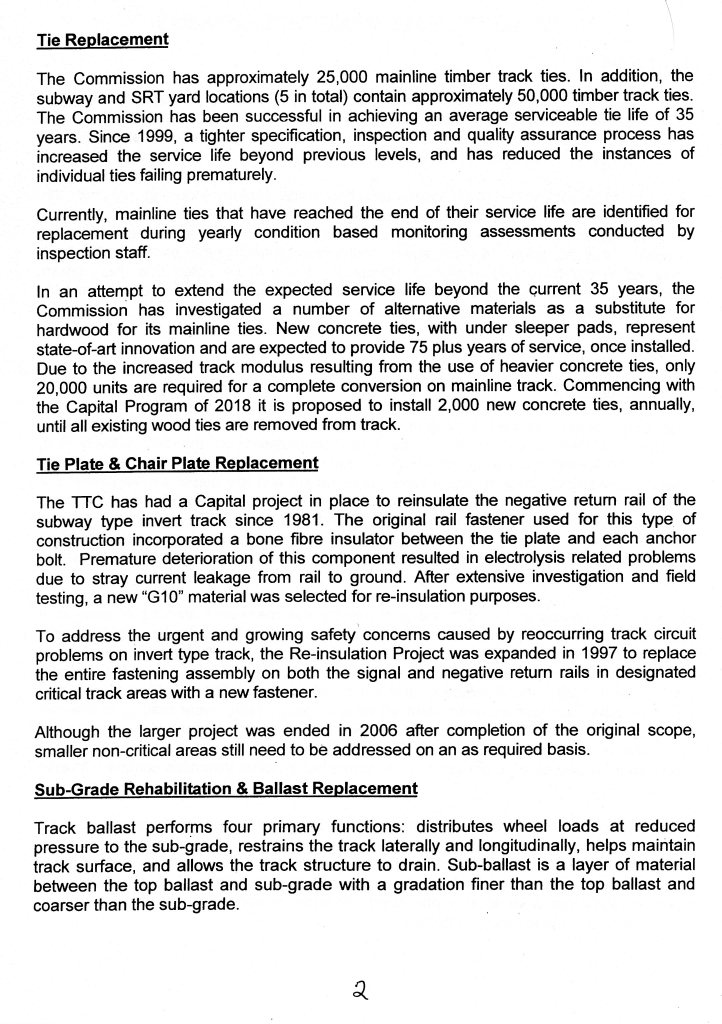
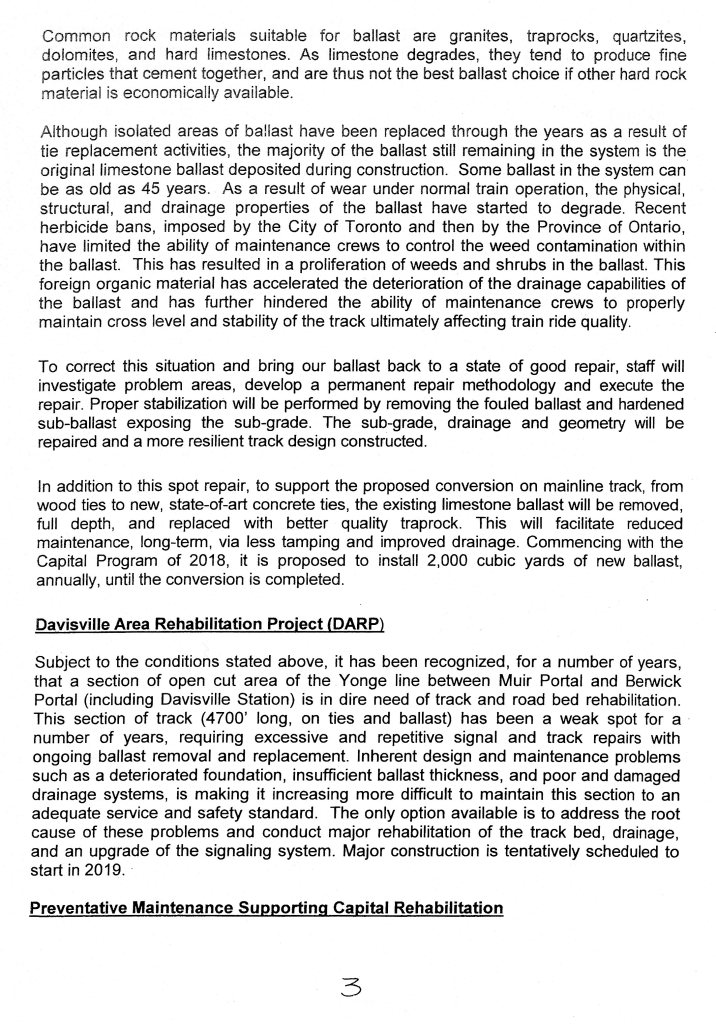
Long-running RSZs, as listed by the TTC, are shown in the table below. The dates refer to the point where I was checking the site for updates, not necessarily the day on which entries appeared and disappeared. Where the “Last Reported” column is blank, the slow order is still in effect. Not all slow orders are included here, especially short-lived ones in the past.
| Line 1 : Location | First Reported | Last Reported | Duration (Wks) |
|---|---|---|---|
| York Mills to Lawrence SB | May 5/25 | June 19/25 | 6.5 |
| Eglinton to Davisville SB | May 29/25 | June 12/25 | 2 |
| June 27/25 | Open (2) | ||
| Davisville to St. Clair BW | July 26/24 | Open (50) | |
| St. Clair to Summerhill SB | July 29/24 | Feb 21/25 | 29.5 |
| July 13/25 | New | ||
| Bloor to Rosedale NB | Feb 16/24 | June 4/25 | 15 |
| June 27/25 | Open (2) | ||
| Museum to St. George NB | June 27/25 | Open (2) | |
| St. George to Spadina BW | June 4/25 | Open (5) | |
| St. Clair West to Spadina SB | June 27/25 | Open (2) | |
| St. Clair West to Eglinton West NB | June 27/25 | Open (2) | |
| Lawrence West to Glencairn SB | July 11/24 | Oct 25/24 | 15 |
| June 4/25 | Open (5) | ||
| Glencairn to Lawrence West NB | May 7/25 | Open (6) | |
| Yorkdale to Lawrence West SB | June 14/24 | Open (56) | |
| Yorkdale to Wilson NB | July 18/24 | April 10/25 | 38 |
| June 9/25 | June 9/25 | < 1 | |
| Wilson to Yorkdale SB | July 3/24 | Oct 25/24 | 14 |
| April 17/25 | May 1/25 | 2 | |
| June 4/25 | June 11/25 | 1 | |
| June 27/25 | Open (2) | ||
| Wilson to Sheppard West NB | May 8/24 | June 17/25 | 58 |
| Sheppard West to Wilson SB | Aug 15/24 | June 11/25 | 44 |
| Line 2 : Location | First Reported | Last Reported | Duration (wks) |
|---|---|---|---|
| Keele to Dundas West EB | April 10/25 | Open (12) | |
| Dundas West to Lansdowne EB | June 27/25 | Open (2) | |
| Spadina to St. George EB | July 13/25 | New | |
| Spadina to Bathurst WB | July 13/25 | New | |
| Broadview to Castle Frank WB | June 17/25 | Open (4) | |
| Donlands to Greenwood EB | June 27/25 | Open (2) | |
| Coxwell to Woodbine EB | May 8/24 | Open (61) | |
| Woodbine to Main Street EB | June 27/25 | Open (2) | |
| Warden to Victoria Park WB | June 17/25 | Open (4) | |
| Victoria Park to Warden EB | June 11/25 | June 12/25 | < 1 |
| July 7/25 | Open (1) |
Three additional columns required are a description of the defects, the planned dates to repair them, and the constraints, if any, on performing this work. Open and recently closed slow order information should appear as part of the monthly CEO’s Metrics Report.
Management should be held to account for the status of slow orders and their progress toward addressing them.


With the TTC claiming weekend subway closures accelerate completion of repairs, how many of these closures are simply mitigating rather than resolving the issues? The southbound Wilson to Yorkdale appears four times. While I generally avoid this stretch, it must be frustrating for regular travellers. How much transparency do you think we can get about the success and permanence of repairs arising out of these closures?
Steve: I’m not sure what we might get, but certainly know what we should get: a detailed explanation of the status and planned action for every slow zone. If management won’t provide it, then we should get new management. If the Board won’t demand it, then we need politicians who will hold management’s feet to the fire.
LikeLike
How did this all suddenly pop up? Because that’s very concerning. I would be crazy but shouldn’t they shut down the university side so they can overhaul it?
Steve: Recently the TTC ran an inspection car over the system and discovered a new batch of problems. This was expected. The question will be how long these will last. Shutting down the University/Spadina line is possible but would be quite an upheaval. Also, it’s almost too late to implement such a shutdown as it is only practical during the more lightly-loaded Summer period.
LikeLike
61(!!) weeks for the crossover at Woodbine is amazing. Is there some custom made piece of special work with a long lead time the TTC is waiting on to fix this?
Steve: I honestly don’t know what’s going on here. One purpose of my article is to “shake the tree” and get TTC to explain the situation at Woodbine and other long-running slow zones.
LikeLike
Thanks for posting the technical stuff, even if it’s getting on towards ten years old. It’s not just the TTC or rail in general that wants to keep the tech material secret for no valid reason. Look at the big 2022 Rogers outage where only the most baby-talk level of details were published for “security” and – even more laughable – “competitive” reasons”, even though there are at least many thousands of people perfectly capable of understanding them.
Some rambling TTC thoughts: The proposal (presumably not even started) to replace hardwood ties with concrete is intriguing because – if I’m reading the railway-speak right – the concrete ties can be spaced farther apart, so the cost of materials is relatively less than one might expect.
And just curiosity: When did Pandrol clips appear on the subway? Wikipedia says they were invented only in 1957, and certainly there were none until fairly recently, but to an old guy like me that may have been 20 years ago or something. Now they seem ubiquitous. Were the older fasteners replaced with clips as a standalone project, or only as rail was replaced? Or at some other time?
The new ties stacked up north of Bloor (for months now) appear to be wood, but both ends have what looks like a lumber joiner plate (that in wood building construction would go into side, not end grain). Ask me how I’ve had time to observe this stuff up close…
In passing, there are great videos on Youtube of mainline rail, ties, and ballast being replaced during running hours in France. Amazing production line work, largely automated and *fast*! In the 1920s!
Steve: Yes, Pandrol clips have been used in the subway for quite some time although I think their first appearance was on new builds like the Spadina line. As for the supposed replacement of wood with concrete ties, I too have noticed that many replacements continue to use wooden ties. I suspect this is because of spot replacements rather than complete rebuilds swapping out all of the old ties.
LikeLike
Next weekend they’re closing a very big portion of the University Spadina side. Hopefully in that closure they fix the slow zones.
LikeLike
The TTC’s map shows a slow zone eastbound from Woodbine to Main. I wonder if that’s an error. I don’t remember encountering one there previously, and there was definitely not one there this morning.
LikeLike
The NB RSZ between Wilson and Sheppard appears to have been lifted. Trains were running at normal speed.
Train are running slower NB between Sheppard West and Finch West, though.
LikeLike
They finally fixed the slow zone from Coxwell to Woodbine after more then a year.
LikeLike