
On May 11, 2025, the diversion arrangements downtown became more complex as the 504 King, 503 Kingston Road and 508 Lake Shore (peak only) streetcar services shifted onto the same Richmond/Adelaide diversion route as 501 Queen. This arrangement will be in place until early September for water main and track repairs at King and Church, as well as for streetcar overhead upgrades on King Street.
As initially implemented, the three routes operated eastbound from King and Spadina, north to Queen, east to York, south to Adelaide, east to Church and north back to Queen. The westbound diversion was similar using Richmond from Church to York.
Immediately after this change, it was obvious that streetcars were snarled in traffic, particularly eastbound on Adelaide. Generally across the diversion, there was a problem with the number of streetcar turns exceeding the intersection capacity in peak periods. There is also construction interference at a few locations along the way.
I wrote about capacity issues and other related matters:
- May 5: King-Church Construction and Traffic Effects
- May 12: King/Church Diversion Observations May 12, 2025
- May 16: 504 King Diversion Revised
On May 16, the TTC changed the 504 King diversion so that it used Shaw Street between Queen and King to reduce the number of turns at Spadina. Only the 503 Kingston Road cars, and a few peak period 508 Lake Shore cars remained, as well as the 511 Bathurst cars looping via Spadina, Adelaide and Charlotte. (The 511 diversion will end on June 22 when streetcar service returns to Exhibition Loop.)
However, this change only addressed the west end of the diversion at Spadina, but further east the full volume of routes 501, 503, 504 and 508 continued to use the diversion between York and Church contributing a high number of streetcars/hour where the service turned. The frequency of service on 501, 503 and 504 is roughly the same through the day. It is the volume of road traffic that changes, not the number of streetcars.
| Period | 501 Queen | 503 Kingston Rd | 504 King | 508 Lake Shore | Combined |
|---|---|---|---|---|---|
| AM Peak | 10′ (6) | 8′ (7.5) | 8′ (7.5) | 20′ (3) | 2’30″(24) |
| Midday | 9’30” (6.3) | 10′ (6) | 10′ (6) | 3’17” (18.3) | |
| PM Peak | 9′ (6.7) | 8′ (7.5) | 8′ (7.5) | 20′ (3) | 2’26” (24.7) |
| Early Evening | 10′ (6) | 10′ (6) | 10′ (6) | 3’20″(18) | |
| Late Evening | 10′ (6) | 10′ (6) | 10′ (6) | 3’20” (18) |
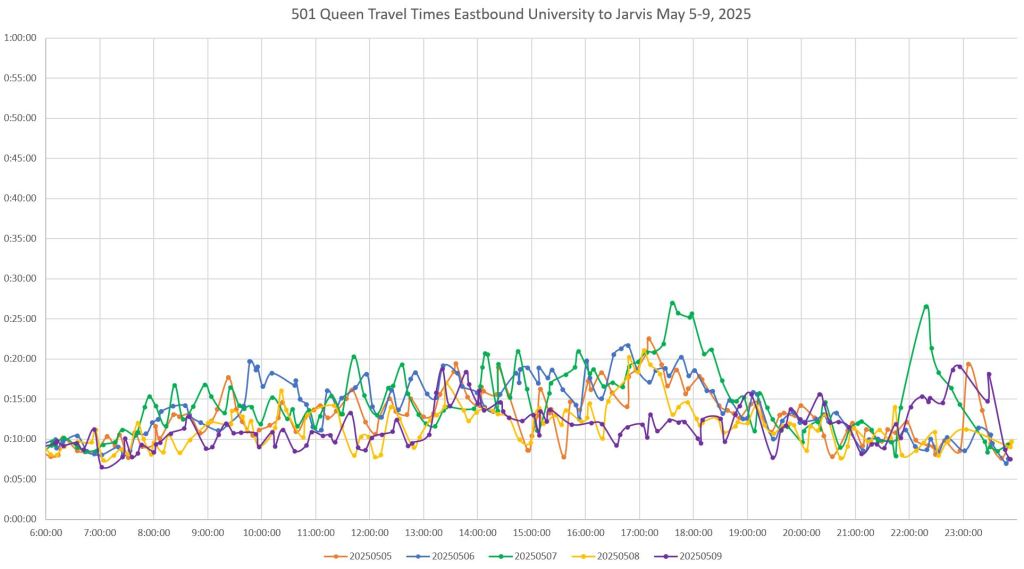
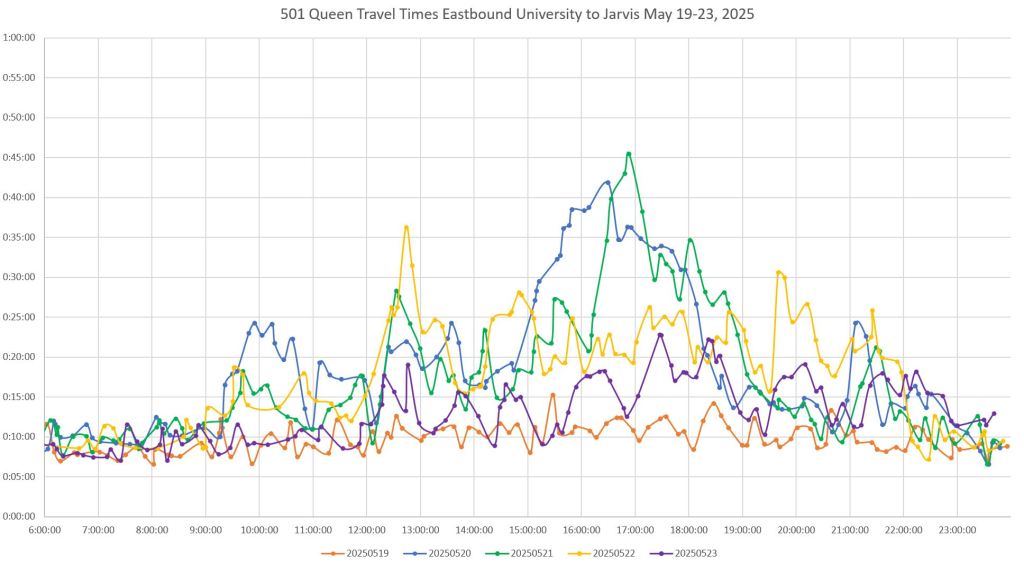
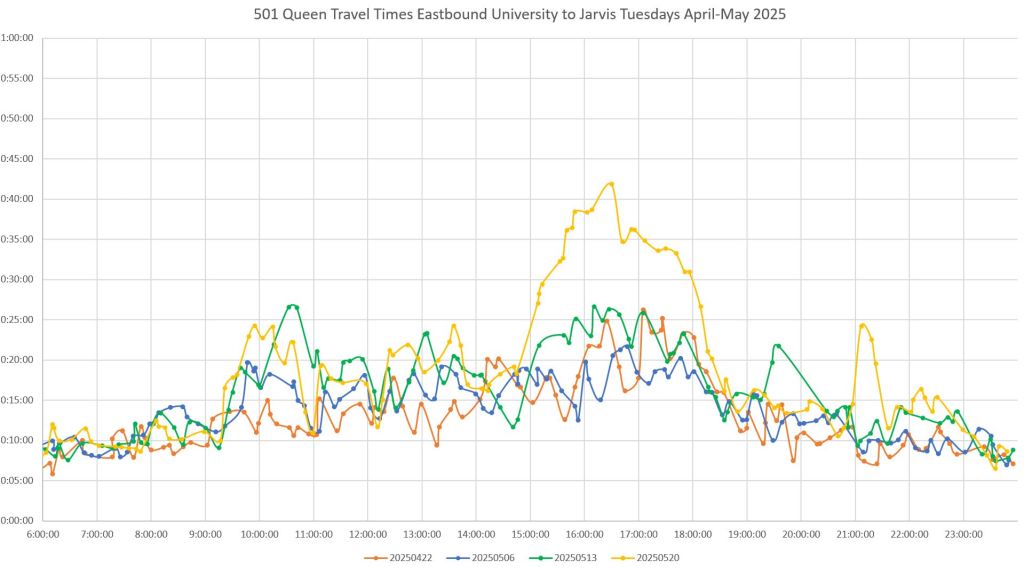
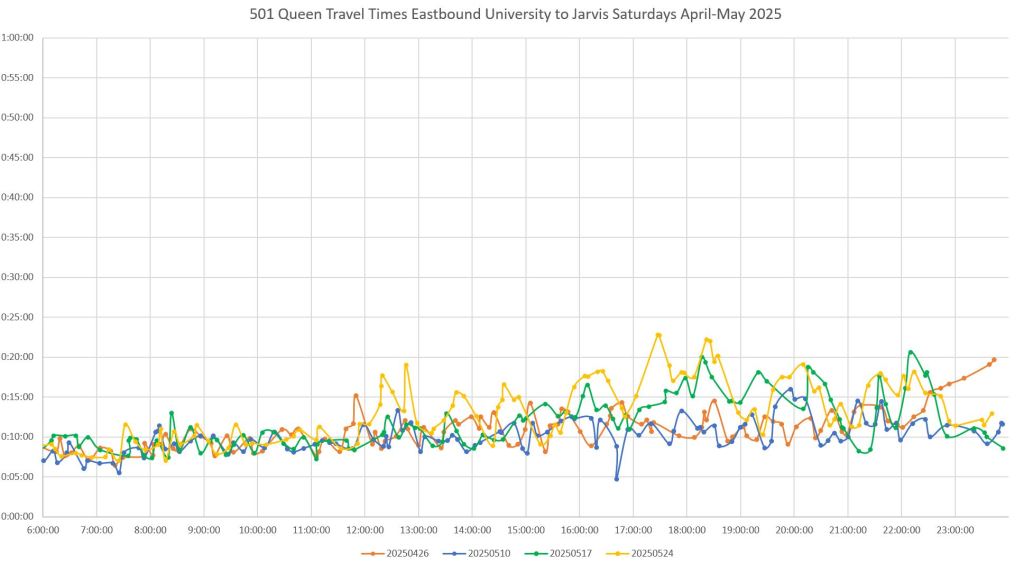
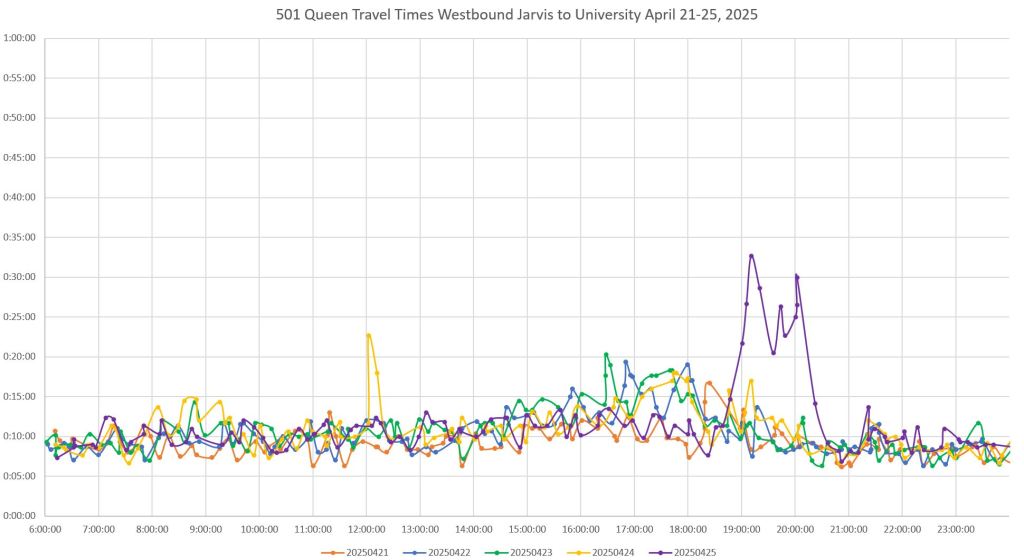
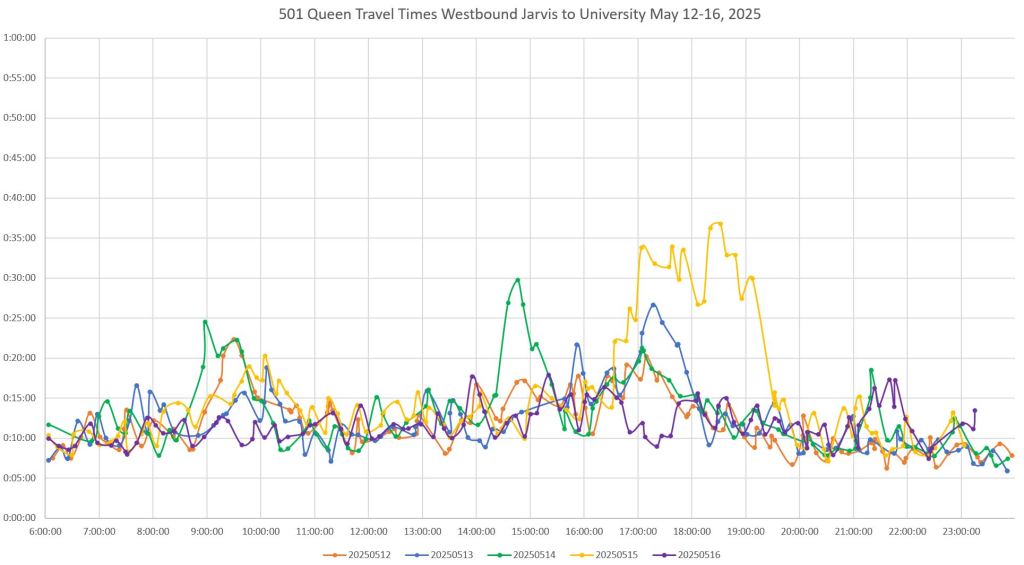
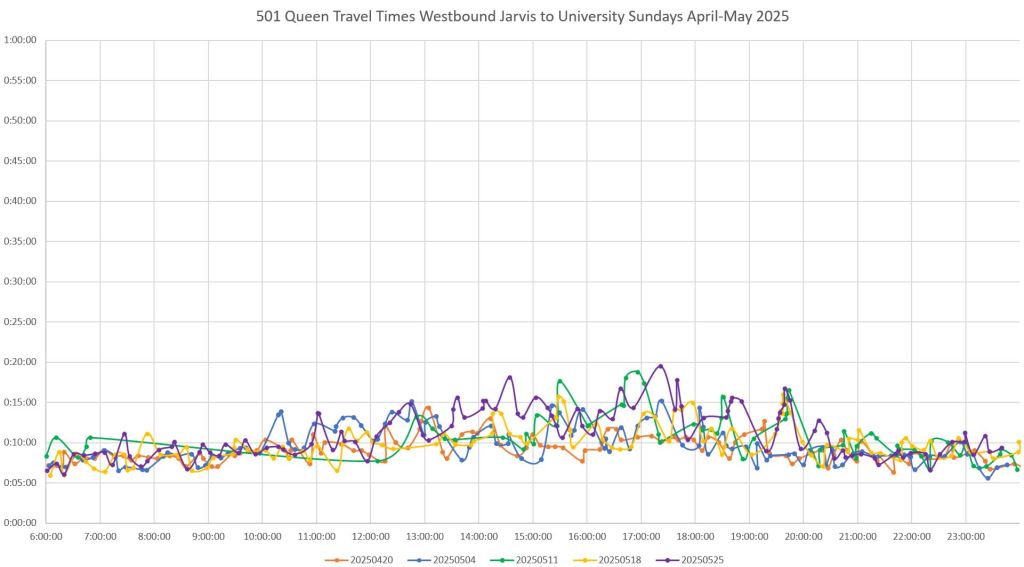
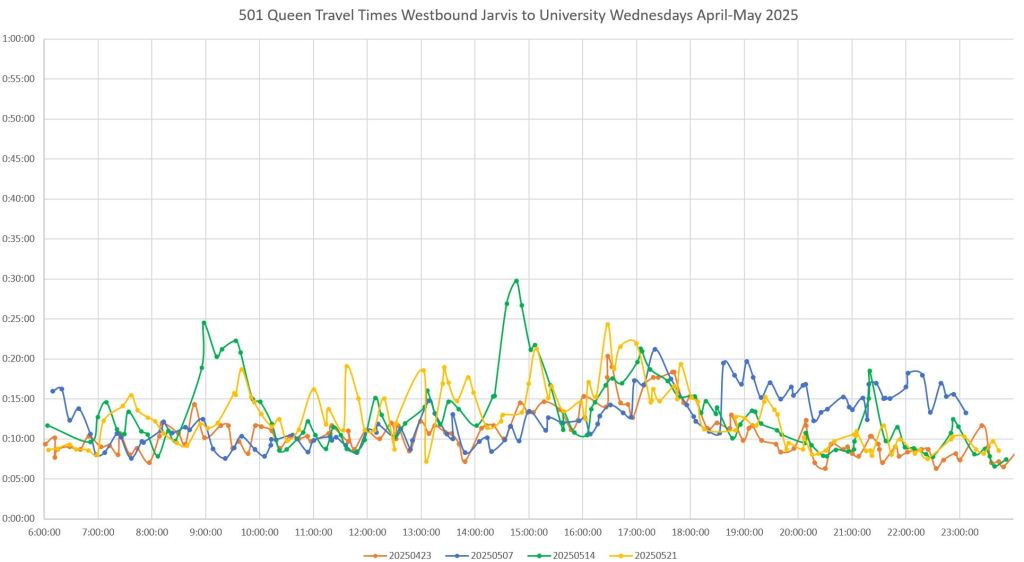
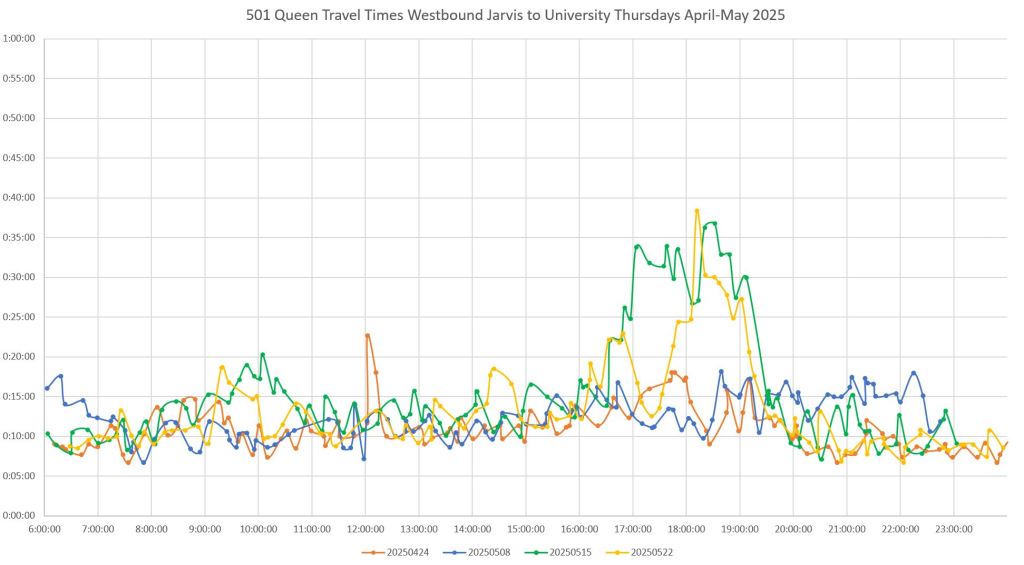
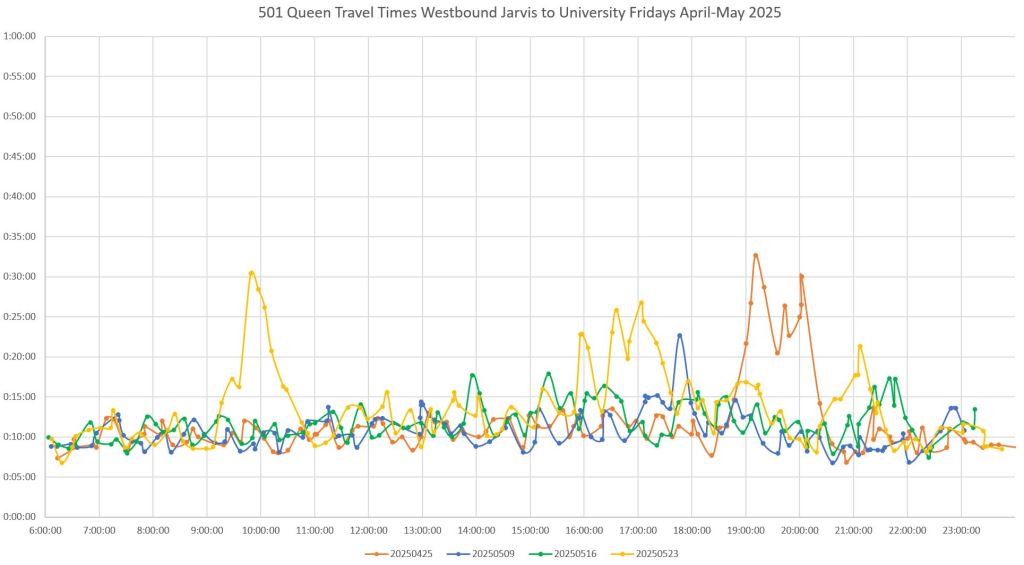
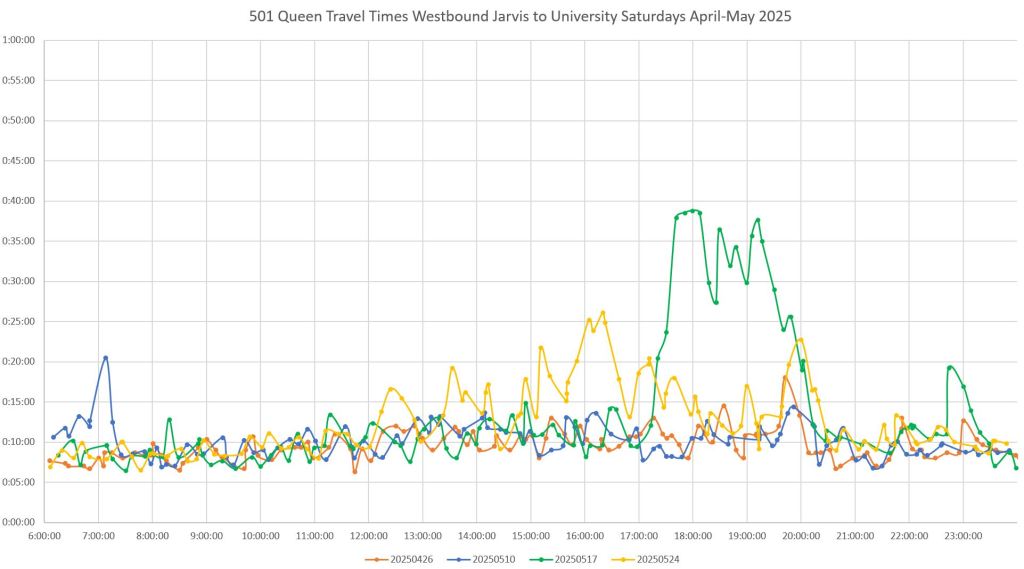
Charts in the following section show travel times between University and Jarvis both ways, and how these rose when the volume of 503-504-508 service was added along the diversion.
Reading the Charts
The data in these charts are adapted from the TransSee website where analytical charts for streetcar routes are provided free of charge by the site’s proprietor and designer, Darwin O’Connor. I have used these because my regular monthly feed of tracking data from TTC will not come in for May until early in June.
The first set of charts shows the travel times grouped by weeks with two weeks before and two weeks after the King/Church diversion began. Note that the week of April 27 was not used because the 501 Queen car diverted via King for part of that period. Monday, May 19 was the Victoria Day holiday.
The second set of charts shows the travel times grouped by day of the week and includes charts for Saturdays and Sundays. The unusually high travel times are from the weeks after other routes were added to the diversion.
For both eastbound and westbound trips, the high points vary considerably by day of the week and by time of day. The PM peak is common, but even that is not consistent. This suggests that the cause of delays varies as opposed to being a chronic, predictable congestion pattern. In turn, this means that clearing delays will be an ongoing task, and it will require more than a few traffic wardens for a few hours in a few intersections.
[Click on the charts to open them full size as a gallery.]
Eastbound from University to Jarvis via Adelaide
By Week


By Day of the Week




Westbound from Jarvis to University
For westbound trips, the high points vary considerably by day of the week, and in part by time of day. This suggests that the cause varies as opposed to being a chronic congestion pattern that is predictable.
By Week


By Day of the Week


Fix This, Now!
At its recent meeting, Toronto Council instructed staff to find a way to improve operations on the diversion. The motion below was passed without amendment.
Mayor Olivia Chow, seconded by Councillor Chris Moise, recommends that:
1. City Council direct the General Manager, Transportation Services, to review the King Street and Church Street transit detour operation and work with Toronto Transit Commission to identify and implement any further transit priority enhancements in consultation with the local Councillor and relevant stakeholders, including, but not limited to, traffic agents, paid duty officers, signal timing changes, parking changes, and other on street changes, that would enhance streetcar operations for the duration of the works.
A related motion increased the spending authorization for the reconstruction of streetcar tracks on Adelaide and associated utility works that were bundled with the project. Work will now be done at night to avoid adding to congestion during the day. After more data accumulate, we will see what contribution this makes to reducing congestion.
A third amendment to the purchase order is now required to help reduce construction impacts in the downtown corridor. Due to ongoing construction at the King and Church intersection, the Toronto Transit Commission is diverting service—primarily along Adelaide Street. To minimise resulting traffic impacts on the Toronto Transit Commission diversion and other traffic on this important corridor, the project team needs to shift construction activities to nighttime hours. This request pertains to the additional costs associated with the transition to night work, which will be funded by Transportation Services.
The total value of this third Purchase Order Amendment being requested is $200,000.00 net of Harmonized Sales Tax recoverable […]
Beyond removing any obstructions from Adelaide Street and ensuring no new ones appear, it is difficult to think how the situation can be improved merely by “tweaking” the street. From the travel time charts, it is clear that when traffic is light, streetcars can navigate the diversion without excessive delay. However, as more road capacity is used by cars in the late afternoon and early evening, the road cannot handle the combined demand.
Problems with left turns bedeviled King Street not that long ago when all service diverted north at Church. The combination of limited capacity for all of the transit turns, plus the absence of enforcement, led to huge queues west across King Street. This was eventually fixed by the addition of police and traffic wardens who marshaled traffic at key points and prevented bottlenecks.
The situation will become more challenging when Church & King completely closes for track replacement in late June. Traffic now on King will have to shift elsewhere, but there will be some benefit because the peak traffic on Church will vanish.
Toronto has a bad habit of putting its faith in technology such as AI-assisted traffic signals to squeeze more capacity out of the downtown street grid. We have yet to see any demonstrated benefit, and it is not clear what, if any, real changes in signal controls are in place. Transit priority signals were not installed at all locations where there are large volumes of turning streetcars. Transit does not, and never has, received priority at major cross-streets because the primary goal is to maximize auto movement.
At times, there is more traffic than will fit. If the situation is bad enough, some of that demand will evaporate, but current congestion on the diversion route suggests that we are far from seeing auto demand vanish. What Toronto can or will do in the three months before streetcars return to King Street is hard to say, but I do not expect much.
I will update these charts from time to time as data accumulates to track the success, or not, of any efforts to trim the high peaks off of travel times on the Richmond/Adelaide diversion.
 Steve Munro
In addition to the intersections, they need wardens to actively enforce zero stopping the right lane on Adelaide. There’s large numbers of delivery vehicles clogging up the road, and also the endless stream of rideshare vehicles that starts around 3:00 p.m.. Many of them are seemingly waiting outside the stretch between Bay and Yonge seemingly waiting for a convenient nearby pickup to be assigned. The monitors need to actively go and force them to leave.
LikeLike
Diversions are always going to be required; sometimes for short-term things like a police investigation, sometimes for longer-term things like the Ontario line or TTC repairs. The ‘special track’ at King & York is due for replacement in 2026 and the tangent track on King between Church and Berkeley is due for new track between Q2 2028 – Q3 2029. The work at King & Church is just the first stage of a series!
If they are planning work at King & York next year, I hope someone at TTC is looking at the curves at that intersection and to adding a southbound track on York from Adelaide to King – if that short stretch of track were added then diversions (for both King & Queen) could be far shorter and use both Adelaide and Richmond much more effectively.
LikeLike
Is there any additional work happening on King while this cluster is underway? This would be prime time to do a deep look at the rails between Shaw and the Don River and fix everything that isn’t absolutely perfect so we can be rewarded with a few years of continuous service.
Steve: The track east of Shaw to Spadina is still active. Repair work is planned between Bathurst and Shaw in 2026-27. Overhead upgrades on King East and on Cherry will be done while the line is closed this summer. Track replacement from Church to Berkeley is planned for 2028-29. Info from TOInview.
LikeLike
The delays are truly horrendous going east, and there is no point at peak times to even take a streetcar before reaching Yonge St, or even Church St. Walking is literally as fast as a streetcar until they ride back on Queen St.
Some obvious solutions that the self-serving TTC will never implement:
Steve: Of these options, the first and third are up to the City, not the TTC. I think that there was too much of “it won’t be too bad and we can tweak thinks afterward” going in rather than implementing an aggressive “transit first” policy. Service and riders get the black eye.
LikeLike
If I may go a little off topic here: I noticed a few weeks ago a new somewhat level platform installed at King and University. Another trial or permanent design? I was disappointed to see it didn’t extend past a single car length.
Steve: Yes, there are new platforms going in along King (I used the one at University westbound yesterday). The supposed reason for the single car length is to avoid having the “second” position blocked while loading passengers. However, this can be a frustrating delay for riders in the second car.
LikeLike
Run 504D to Broadview station and eliminate 504 streetcars east of Yonge or possibly McCaul. That will cut down on turning movements needed on Church.
Were the overhead up, I might even suggest diverting 501 off Queen via Victoria, Dundas, and McCaul but it’s not.
Another thing I noticed is Parliament north of Queen being closed to streetcars right now. There are very few options for diversions with so many channels shut down.
LikeLike
Is this not one of those moments that – even though cash is tight – the TTC / City look to start adding more trackage? There must be streets that can be used to avoid these kinds of messes. Victoria north of Queen being out of service for what seems like ever sort of shows that one street can make a difference.
Steve: There are definitely issues of missing curves, such as east to north at King and York, but the big problem right now is the closure of two major streets, King and Queen, at the same time. Track work that should have been done years ago, including both Victoria Street and the King/Church intersection, adds to the TTC’s problems. It’s a shame that Victoria was not kept open at Queen during the Ontario Line work as it would likely have been a less congested route for streetcars on their diversion.
LikeLike
Even if never used for regular service, replacing track on Bay from Dundas to King would seem to be a useful addition. Perhaps even reinstalling the Old City Hall loop. Both may have even been helpful here.
In general areas east of Yonge could use additional diversion trackage as the network was developed later and thus not nearly as extensive as it is on the west side, particularly east of the Don.
LikeLike
Is there any talk about putting the 504 diversion back to Spadina once Bathurst service is restored?
Steve: I have not heard anything, but I suspect that the 504 will stay where it is. The real problem is that the 504 bus should be going further west to connect with the streetcar service at Shaw if that’s the route the TTC plans to continue using.
LikeLike