
Recent newspaper articles and editorials extol the virtues of the RapidTO projects on Bathurst and Dufferin Street, and portray those who object in a less than flattering light.
- The Globe and Mail editorial: Speed up the bus by ending the free ride of street parkers
- The Star (Andy Takagi): The battle for a bus lane: Why rapid transit on this Toronto main street is sparking backlash
- The Star (Shawn Micallef): How this transit plan could finally make ‘Sufferin’ Dufferin’ a thing of the past
The urgency of transit priority action for the 2026 FIFA games combines with portrayal of transit priority as an absolute good before which all objections must fall. The word “NIMBY” is thrown about to denigrate residents and businesses in the affected areas, but this is no substitute for hard data proving, or not, that the RapidTO proposal really is “the better way”.
For decades, I have advocated for better transit service in Toronto. Transit priority measures are one, but not the only, factor that can improve transit for riders. Quality and quantity of service are also key, and yet the TTC has a tendency to place most blame for their shortcomings on external factors. To be sure traffic congestion is an issue, and Toronto is already at a point where in some locations and times there simply is not enough capacity to go around. This is not a case of some omniscient transit god or AI bot “parting the waters”, but of a recognition that this can only happen by restricting or eliminating competing demands for road space and time.
Another major factor is financial. Even pre-covid, the TTC faced limits on its operating funds and only grudgingly added service on routes. Recent announcements of “improvements” often hid the fact that the added vehicle hours left scheduled frequencies unchanged, but only offset the effects of congestion.
Service reliability and vehicle loading are key factors from a rider’s perspective, but the TTC uses metrics that bury day-to-day conditions in averages and give a generous interpretation to the concept of reliable vehicle spacing. It is no secret that TTC service management leaves a lot to be desired, and some transit “priority” schemes are are really more about keeping transit out of motorists’ way than they are to speed rider journeys.
The problem is compounded by motorists who regard attempts to corral them as an affront to their virility, but whose actions only recently have been reined in through the use of Traffic Wardens.
The City Transportation Department’s outlook is that if they make cars move faster, transit benefits too – a rising tide lifts all boats. This model collapses when there simply isn’t enough room or time for all vehicles. Some must be able to go first, and some will simply have to go away.
The King/Church construction diversions illustrate another aspect here: the concentration of transit service and traffic in locations that cannot sustain it, especially when transit, running in bunches, overwhelms intersection capacities with many closely-spaced arrivals and turns. TTC has redirected part of the diverting service (504 King) away from Spadina to Shaw so that left turns are spread out, and King/Spadina will further improve on its own when the 511 Bathurst cars return to their usual southern terminus at Exhibition Loop in late June. The east end of the diversion, at Church, does not have the same options for spreading out routes and turning issues.
In the FIFA context, we do not yet know what sort of service the TTC plans to operate, and how it will manage both the vehicle and passenger volumes at major transfer points including not just Dufferin and Bathurst but at other locations such as Union Station and major intersections enroute.
Analytical Background Material
My analysis of bus operations on Bathurst and Dufferin Streets is a work in progress. Data for 7 Bathurst has been published in three installments:
- Service Analysis of 7 Bathurst Part I: Headways in April 2025
- Service Analysis of 7 Bathurst Part II: Travel Times in April 2025
- Service Analysis of 7 Bathurst Part III: Headways & Travel Times 2024-2025
Three corresponding articles are in preparation for the 29/929 Dufferin corridor. Links will be added here when they go live.
Dufferin and Bathurst Are Not the Same
An important difference between Dufferin and Bathurst Streets is that the service levels are quite different.
- During most periods, there is a combined service of 8′ on each of the Dufferin local and express branches (15 buses/hour). The PM peak and weekend afternoons have even more with a combined service over 20 buses/hour.
- The Bathurst bus runs every 10′ (6 buses/hour), improving slightly on weekends at times, but at best to 8′ (7.5 buses/hour).
- The Bathurst streetcar also runs every 10′ at most times, with a few periods as often as 8′.
There are many more transit vehicles on Dufferin than on either part of Bathurst proposed for RapidTO treatment.
Times and Locations of Transit Delays
Delays to transit service do not occur at the same place, direction or time on these corridors. Some places show little change in travel time during most service hours when traffic moves fairly freely, while others have very wide swings when peak traffic conditions overwhelm capacity. Some of these areas lie outside of the proposed RapidTO zones north of Eglinton, and the problems they bring to each route will not vanish.
There are predictable delays from mid-afternoon to early evening, and to a lesser extent in the AM peak, and these are generally in the peak direction. Northbound and southbound patterns are quite different for some locations.
Unreliable Transit Service
Across both routes, there are pervasive problems with unevenly spaced vehicles, although the cause varies.
- On Bathurst, the weekend schedules do not provide sufficient time for end-to-end trips and terminal recovery time. Short turns are common and headways are irregular.
- On Dufferin, service northbound consists of two branches, one from Dufferin Loop and one from the Princes’ Gate. These are scheduled to blend, but in practice there is no management of the combined service and pairs of buses are common.
- Both routes suffer from uneven terminal departures even when the schedules provide adequate recovery time. This is, in part, due to “Service Standards” which allow a bus to leave up to five minutes late creating a gap of 13-15 minutes depending on the scheduled headway. These gaps widen as buses travel along their route.
Details of service irregularity can be found in the articles reviewing headways on the two routes.
Estimated Benefits and Savings
The TTC projects very substantial benefits from the RapidTO plans:
The Dufferin Street priority bus lanes are expected to yield immediate benefits for transit users while addressing safety and equity concerns. For transit riders, the lanes will improve bus travel times by up to 29% (i.e., 10 minutes per trip between Eglinton Avenue West and Dufferin Gate Loop) and improve bus reliability by 17%. The enhanced service efficiency along the roadway is expected to increase daily ridership by 23% with 9,300 new riders along Dufferin Street. [TTC Report, p. 6]
[…]
The proposed Bathurst Street priority transit lanes are expected to yield immediate benefits for transit users while addressing safety and equity concerns. For transit riders, the lanes will improve bus travel times by up to 34% (i.e. 7 minutes per trip between Eglinton Avenue West and Bathurst Station) and improve bus reliability by 18%. Streetcar travel times will improve by 13% (i.e. 3 minutes between Bathurst Station and Lake Shore Boulevard West) and streetcar reliability will improve by 19%. The enhanced service efficiency along the roadway is expected to increase daily bus ridership by 23% with 4,920 new riders along the 7 Bathurst and increase daily streetcar ridership by 35% with 6,850 new riders along the 511 Bathurst. [TTC Report, p. 7]
A major problem with these claims is that the travel time savings will only occur under “worst case” situations, commonly in the PM peak, not all day. The percentage increase in all day ridership is simply not credible.
On Dufferin, the 10 minute saving or 29% is shown for the RapidTO section from Eglinton to Dufferin Loop, but this assumes that peak travel times can be reduced to the best of off-peak levels. The saving will apply mainly to the PM peak period.
That 34% improvement on Bathurst is commonly cited, but it only actually applies to northbound trips between Bloor and St. Clair from about 2pm to 6pm. The saving, and hence the change in attractiveness to riders, is much lower otherwise.
TTC estimates that it will save money thanks to the need for fewer buses, and that it will gain substantial ridership.

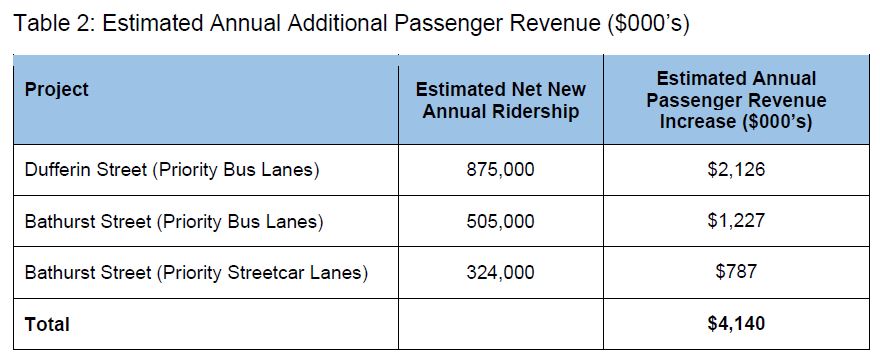
The savings per vehicle hour range from about $59 to $86 with an average of $67. This is not a fully allocated cost, and one must ask why it varies from route to route when the primary variable in marginal costs is the driver’s labour.
The estimated revenue works out to $2.43 per rider, a blended value across all fare types. This assumes a ridership increase of 7-8% over 2023 levels, a very hefty bump compared to what we see on the system as a whole, and considering that the RapidTO benefits will not affect all time periods, locations and riders.
TTC statements about service increases have been inconsistent. The report states:
It is anticipated that any savings will be re-invested into Dufferin Street and Bathurst Street, to further enhance service in support of anticipated ridership increases. Any anticipated additional passenger revenue will be reflected in future Operating budgets accordingly. [p. 4]
During public participation sessions online, the TTC was more circumspect saying that service increases would come after, not in anticipation of, better riding.
The whole idea of RapidTO is to make transit more attractive and gain riders, but it is unclear when or if riders (and those along the corridor) will actually see the possible improvements, or how long those supposed new riders must wait for a bus with room to board.
Effects Along the Corridor
Some commentary about the RapidTO changes focuses on the idea that people do not have an absolute right to park on the public street. That statement is true as far as it goes, but it has an underlying tone that all parking is “bad” and must be expunged. That is easier said than done in some areas.
The southern parts of Bathurst and Dufferin Streets date from the 1880s when driveways were rare and even a rear lane access might not be available. Residents and businesses have been using the curb lane for various reasons for well over a century.
(Dufferin Street did not even have bus service between St. Clair and Queen until 1961, and over the full RapidTO route from Eglinton to the CNE until 1962. Dufferin Station does not have an off-street loop because this was considered a minor stop when the Bloor subway was designed.)
Roads have multiple users with differing requirements, and there is an important distinction between those who live and have businesses on the street as opposed to those who use the road to get from point “A” to “B”. During the design of the King Street transit lanes, there was an important concentration on how the street, primarily commercial and high-rise residential, would work for the locals, while providing better transit service.
General motorists passing through were assumed to divert to other nearby streets, an option that is not available for Bathurst and Dufferin.
During the online consultations, I had a sense that City staff are aware that redesign to address valid concerns will be needed, but it is not clear just how far they will move given the pressure to “do it now”. We will get some sense when an amended proposal comes to Executive Committee in the Summer.
An Incremental Approach
Yes, I can hear the groans already. Never do in one bold step what can be done with years’ worth of small tweaks nobody will notice. Too much transit planning works like that.
The basic issue here is that the RapidTO plan contains three quite separate components that are not interdependent:
- Removal of closely spaced stops
- Changes to traffic regulations (turn restrictions, signals)
- Transit red lanes
Only a few stops are affected by the plan, and their removal will contribute little to the overall saving. I say this based on study of the effect on some streetcar lines when “extra” stop removals produced little or no change because (a) vehicles did not always stop there and (b) the primary delays occur at traffic signals downstream from the removed stops.
Changes to traffic regulations and signal configurations can be implemented today without major road reconfigurations. For example, the changes proposed from Bloor to Dundas on Dufferin are shown below:

Removing turns by general traffic eliminates the inevitable waits as left turns await a gap in the opposing flow, and right turns await a gap in pedestrian crossings.
Red paint is not required to implement these changes.
Similarly, if there are any areas where parking is causing congestion, this can be addressed with time-specific constraints rather than an all-day ban.
The RapidTO proposals started out as a response to the FIFA games which will last for a short period in mid-2026. Dufferin Street was already under study as a corridor, but for its full length. That proposal ran into severe headwinds from residents and Councillors, notably along the northern part of the route which has conveniently vanished from current plans.
Bathurst has never been part of a detailed RapidTO plan, but is one of many streets flagged in the Surface Network Transit Plan. Unless the TTC plans substantial, permanent improvements in service frequency on the bus and streetcar routes, it is not clear how red lanes are justified here beyond the FIFA period which, presumably, will see many parts of downtown with temporarily added traffic restrictions.
The City speaks of the portions south of Bloor (i.e. the subway to Exhibition link) as getting their focus now, and by implication the segment north to Eglinton following along. Further north is not even in the cards. There is a sense of doing as much or little as they can get away with.
Meanwhile, the TTC sits on its hands with the issue of service quality. There is a corporate shrug, a sense “we cannot do anything without those lanes”. That is hogwash, but a convenient and time-worn excuse for inaction.
While we debate the merits of red lanes, the City should proceed with the traffic regulations for turns and signals immediately, and the TTC should address service quality with real line management with demonstrable improvements in dependability. The City should also contemplate the resources (financial, staffing, fleet) that the TTC requires to improve service levels both on the Bathurst/Dufferin corridors and generally across the network.
 Steve Munro
My first thought is why the bus lane had to be 24/7. Residents are used to peak hour parking restrictions but it seems unnecessary (and cruel) to prevent them from parking overnight. How much travel time do the bus lanes save at 11 pm?
Steve: None, but the City says they cannot keep motorists out of the bus lane unless it’s marked, and that means 7×24.
LikeLike
One reason that TTC won’t increase transit times in a meaningful way is that the Union is so powerful and slow vehicles need more drivers for advertised frequency. The slower the vehicles go the more drivers needed. That is why I won’t buy into favouring automobile priority weather a valid reason or not, or whatever external issue TTC claims is the cause. It is an internal TTC issue.
Steve: Actually the padded schedules are the result of the Rick Leary era when his stock response to “on time performance” issues was to make it theoretically impossible to ever be late or to require a short turn. However management practices do not ensure reliable headways. Some schedules are still too tight, and others so padded that there are always many vehicles backed up at terminals.
LikeLike
The F.G. Gardiner Expressway was proposed in 1947 and originally named the Lakeshore Expressway. Construction began in 1956, with the first sections opening in 1962 and the final section completed in 1966.
How many years will it take for any sort of RapidTO on Bathurst to come to fruition? There are comments that getting any sort of bus lane is taking too short of a time, while others (like me) say it takes too long to get to fruition. How long did the “idea” of bus lanes on Eglinton East take before it happened?
LikeLike
It’s the very wrong way people like you are selfish
Steve: I am not sure what you are saying here. My position is clear: some changes both to road operations, TTC line management and scheduling can be made now and do not have to wait for red lanes. As for the lanes themself, the situation varies depending on the route, segment and time of day. A 7×24 implementation is only proposed because the City claims they can’t keep people out of the lanes otherwise. If motorists want to drive there, they will, especially if the remaining lane is crowded and there’s no bus in sight. Other locations with reserved lanes have very frequent service. This is not true for Bathurst Street. My position has nothing to do with selfishness, but with concern that the project might well be set up to fail by asking for too much and misrepresenting the benefits. This has implications for other RapidTO plans.
LikeLike
Great info as usual. I am also curious Steve why the city/ttc are not going to use direct busing for the World Cup soccer? I.e. direct busses from certain points to the stadium? I would also comment that all the changes planned will be moot without enforcement. Witness traffic on the King St corridor, intersection blocking (I would note that I regularly see TTC vehicles committing this) and turning restrictions. Drivers, cyclists, pedestrians, scooters are all guilty.
Steve. Thanks! We have yet to see a service plan. Re direct busing: there is a basic question of how an express-to-the-games bus would get around a local bus on the same route (e.g. Dufferin). On Bathurst, the streetcars could run direct with “local” service in the curb lane. Whatever the setup is, you need both lanes for that type of operation, not just one.
LikeLike
Your response to the below question is wrong. No need to be 24/7. The bus lanes on Pape are during peak periods only.
Steve: My response? It is the City’s position that they need 24/7 lanes, not mine. I don’t agree.
LikeLike
re: Chris’ comment, I think that’s right. They should paint the lanes red, indicating transit priority 7am-9pm or whatever and then post clear signage that indicates an exemption for overnight parking.
This is not a hard thing to communicate and it’s sad staff believe this is ultra complicated.
Steve: Their position is that red lanes means 7×24 and anything else would be confusing especially if rules were different from one red lane to another. I agree with that, but the whole conundrum arises from asking for red lanes in the first place.
LikeLiked by 1 person
Steve –
I have tried a number of times to sign up and leave comments. NEVER WITH SUCCESS. That truly truly sucks. If I didn’t think your efforts were important to us all, I would have uttered rude words and said goodbye.
Steve: I know there are issues with WP signups, but they are beyond my control. A likely problem is that at some past time you went through a signup and established your email attached to some account. Now, WP won’t let you use that email associated with another account name. Looking at my subscriber list, I see an entry for you from June 2024. That’s probably where the problem arises. You are not the only person who has run into this, and I have to chase WordPress to see if they are dealing with the problem.
Here’s the comment I tried to post today:
Excellent in-depth clarification, not that many normal humans could digest it all.
Steve: Most of my readers are at least “normal” if not better. They have the good taste to read this blog, after all 😉
Along the lines of Chris’ comment, the TTC has trouble fitting flexibility, adjustments, and compromise into their mechanical-boy world view (as based on my years serving to them as a consultant since 1974… and my interest living two streets from Bathurst and St Clair West). Does the whole street need to be treated or can some portions be spared? All day, all days, or just peak times? Both directions? “Transactions” like adding off-street parking or otherwise gifting something to drivers and shoppers? And my favourite idea of all: have a Bathurst bus route that goes to Toronto Western Hospital.
Cheers.
Ben__________________________ Ben Barkow, Ph.D.
…making the world user-friendly
LikeLike
Please – puleeze! – tell me that there are at least a few Executive Committee members who are reading your detailed data and sensible ideas … and that all your work is not for nought.
Steve: Yes, there are a few. One problem is that if this plan, as is, is publicly endorsed by the Mayor, then the Exec members have political trouble breaking ranks. There is also the perception that being against the scheme is bot anti transit and anti FIFA, neither of which are true. All the red paint in the world will not fix the TTC’s bad line management.
LikeLike
To Dr Ben: it is not necessary to be WP member to leave comments on Steve’s site. You just need to enter valid email and a name. For example, I am not a member of WP.
Steve: There appears to be a problem that if there was a previous attempt to create an account under the same email address that WP won’t let you reuse it. I have to chase this with WP support.
As far as lanes on Bathurst and Dufferin, I think those that live in houses along those streets have to realize that street parking is not a constitutional right but something available to them on a public street as a favour from the city and can be taken away if the city deems that it can be used more productively. After all, those residents made conscious choice to live there knowing that there is no dedicated parking in those houses – so if street parking is taken away no harm done. Every time I had the displeasure to drive down Bathurst on the way to downtown (an activity I don’t do often) those parked cars on Bathurst are always in the way as there is always plenty of cars on Bathurst in both directions.
Those houses without parking were built a long time ago when traffic and the population of Toronto and GTA were much smaller and traffic patterns more predictable. That is not the case today and street parking on busy thoroughfares is a luxury the city can’t afford.
LikeLiked by 1 person
Ha, ha, ha! OMG, so many complaints, much ado about not much! Dufferin 29 used to be the TTC’s “junkyard route” where they put all their oldest buses before finally scrapping them plus Dufferin below Davenport was beat up and full of potholes all the way to Queen so it was like riding a stagecoach on a corduroy road. Then there were quite a few months when Dufferin buses wandered all over the west end and could suddenly and unpredictably pop up on Dovercourt, Gladstone, Brock, and Lansdowne.
Then of course there was the infamous “Dufferin Jog” which created huge congestion at Dufferin and Queen before Adam Giambrone took on the mighty railways and everyone else and actually rectified that 120+ year-old monstrosity.
I’m actually old enough to remember before there were any buses on Dufferin and I grew up in that area and attended Gladstone Ave PS so I’ve seen a lot come and go on Dufferin. Yeah, residents in those ancient rowhouses will be scrambling to find parking but so what:- put them out of their misery and let the developers buy them out for a good price to replace them with three-bedroom condo towers and underground parking garages:- end of problem. In my day there were still some horse-drawn delivery wagons but the city changes over time and you need to change with it or get out which is what did:- retire to the quiet boonies where deer wander into my yard sometimes:- Toronto and Dufferin 29 etc is somebody else’s problem now, I’ve paid my dues living there for 70+ years!
LikeLike
What this plan fails to take into account are the projects and changes coming to the King and Bathurst area.
Has Metrolinx weighed in on that plan that will affect haulage routes and lanes for the King King/Bathurst station construction?
From the turning restrictions plan I know they have not take into consideration the Portland Street cycle path due this summer which will affect traffic flows in the neighborhood and increase the number of cars on Bathurst substantially. Not to mention that the entire neighborhood south of King will become inaccessible from the North.
Another example of a city department siloed and oblivious to what the other departments plans are.
LikeLike
As a resident of Dufferin Street, I’m strongly opposed to the proposed changes without adequate demographic studies to support these decisions. The city seems to be making changes without sufficient data, such as updated census information and demographic studies.
Here are key points to consider:
1. The population that uses Dufferin Street is primarily composed of workers, including migrant workers coming from abroad to fill essential roles in construction, cleaning services, and other industries. Many of these workers commute during peak season (May-October), and businesses like hospitality and food services experience a significant decline after that.
2. Dufferin and Bathurst Streets are crucial routes for people living outside Toronto who commute to work in the city. Reducing lanes by 50% will likely cause congestion and deter people from stopping in the city, negatively impacting local businesses and residents like myself.
3. The changes will also cause delays in food and supply distribution, as these roads are the main access points to reach malls and stores in downtown Toronto from Western Ontario. This will not only inconvenience residents but also potentially drive up costs for essential goods.
LikeLiked by 1 person
People who are fighting things like transit lanes or shelters or whatever always want studies. More studies. Detailed studies. Studied studies.
The studies will discover that it’s not great to have these things in their back yard, but there are no better places to put them either.
So the request for studies and yet more studies is a delaying tactic.
Yes, it would suck to have XXX placed in your back yard. But the reality is that it’s going to be in someone’s back yard. Too bad it’s yours, but that’s life. (Do people ask for more studies when they get disease diagnoses? Hey, there certainly must be someone more qualified to get this disease! Let’s study it!)
In any case, Bathurst and Dufferin are the key arteries to Exhibition Place. What’s a study going to show, if we bulldoze everything on both sides of Euclid Ave we can put in a dandy reserved right of way?
Finally, I expect that many of these immigrants and migrant workers would use the TTC, so any improvement in transit on these routes would benefit them.
Steve: I have replied to several comments and will try not to repeat myself. First off, the issue for me is that the TTC oversells the beneficial effects of the red lanes particularly for the Bathurst bus. The second question is whether the lion’s share of the benefits can be achieved with changes less extensive than 7×24 red lanes. Most of the improvement most of the time for most of the riders.
I should add that the remarks by some City staff during the online consultations were ill-informed and dismissive, an approach that sends the message “we don’t care what you think” and substitutes the mantra “red lanes are Good Things!” for worthwhile, respectful engagement.
LikeLike
Just to add further context, the Portland Street cycle track will divide Portland Street to a series of single lane one way streets block off Portland at Wellington. This removes the only North/South corridor between Bathurst and Spadina and forces all local traffic to use Bathurst.
LikeLiked by 1 person
I whole-heartedly agree with your overall premise Steve, that the TTC and the City seem to be overselling the benefits of their preferred solution while simultaneously throwing their hands up at the difficulty of trying any other ideas to improve service. Specifically, it’s ludicrous that they can’t (1) implement better bus spacing on the long north-south routes and (2) implement and get the TPS to enforce rules to improve transit flow.
That doesn’t mean that (on Dufferin at least) this plan is not worth a shot. As someone who lives the the west end, I remain in favour even with the considerations you’ve raised.
LikeLike
Maybe an advantage of red lines would be making it safe to bike or e-bike on Bathurst and Dufferin?
Steve: I would not count on it. These are narrow streets, and with buses in the curb lane there is no way for them to pass bikes other than swerving into the auto’s lane which kind of defeats the purpose. South from Bloor, the transit lane will be on the streetcar tracks, and cyclists would share the curb lane with general traffic.
LikeLike
Bus lanes can be timed like they’re in UK even when they’re coloured. They don’t have to be 24*7. Use of bus lane cameras for enforcement can help with rule breakers.
Steve: Alas for the City, it’s all or nothing.
LikeLike
To drben09fc7d899b, are you a chatbot Sir? Your name seems computer generated. Your comment is also sensible which suggests that it is coming from a chatbot or an intelligent human (rare species). You stated, “And my favourite idea of all: have a Bathurst bus route that goes to Toronto Western Hospital.” I fully agree. We need to combine the 511 and 7 into a single route just like the 307 night route. I don’t care whether it is a streetcar or a bus that provides the service because I just want fast and reliable service and I want to eliminate the unnecessary transfer at Bathurst station.
Steve: WordPress has started to generate names like that when people create a subscriber name but not a WordPress account. They get their own name with a ten-character hex string appended. It’s not a bot.
The 511 and 7 are separate partly for historic reasons, but also because the demand patterns north and south of Bathurst Station are different, and most people arriving at the station are transferring to the subway, not making a through trip. This is no different from many other routes that break where they cross a subway line.
LikeLike
To those including Steve who are saying that the bus lanes don’t have to be 24/7, why do streetcar lanes need to be 24/7 especially on a street like King? There should be no double standards.
Steve: What planet are you living on? The King Street lanes are not exclusive to streetcars.
LikeLike
It bears repeating, at least for Bathurst 7, that the issues with traffic are clearly driven by the lights northbound at Dupont, Davenport and St Clair and with the hill above Davenport, and only inconsequentially impacted by parking or other obstacles. Rather than another hypothetical study, simply go ahead with the changes to signals and run analysis on driving times.
I don’t have a personal dog in the fight (I drive and take transit, but mostly bike on the route), but the lack of mitigation for loss of parking and loading, and the incoherent responses from the project team are worrying. I asked them whether they would consider adding additional Green P parking on side streets as provision for businesses. The response was that questions of mitigation would only be decided by contacting the councillor after the project period ends. They specifically responded to my question by suggesting speed humps were the solution.
I don’t understand why a project like this does not include mitigation in the scope. What is the purpose of even having consultation or a project team, surely the city could just paint the lines and hope for the best (as they seem to be doing) without the need for any justification.
LikeLike
City -> Virus. A bizarre autocorrect on my phone which I am unable to edit.
Steve: Thanks. Fixed.
LikeLike
I like Chhotu’s idea. I want to start a petition to combine routes 511 and 7 into a single route. I will approach TTCriders with this idea.
LikeLike
I am not suggesting that the studies done up to date, and the current plans from them, are above reproach. That’s Steve’s criticism, and not a stalling tactic. Other commenters who say “we need more studies!!” (presumably hoping for the result that Things Are Put Somewhere Else Not Inconvenient For Me) aren’t helpful.
I do wonder at this point if there is enough time to determine and implement whatever it is that might work best. Ideally, there should be reasonable trial periods of the solution(s) with careful observation and then tweaking things to take care of any emergent issues. One “Steve Munro’s Blog” appears to have developed the methodology and technology to do comprehensive service analysis….perhaps this could be adopted?
LikeLike
Lyon Huntington said
The northern site is accessed via King, I believe the southern site is accessed via Stewart. To the extent that Bathurst is used, they seem to be driving out of the site and away, not stopping in front of the site on Bathurst.
In other places where such changes have been made many car trips simply disappeared. For example, the King Street Pilot resulted in a 7% decrease in cars crossing Bay Street between Front and Queen.
Really? The proposal allows cars to drive along Portland from King to Wellington, so that’s one part of the neighbourhood. The portion between Wellington and Front can be accessed via Spadina and Wellington or Niagara Street.
I don’t think you read the proposals.
LikeLike
Elka Aranzalez Reales says:
Citation needed, to say the very least.
Why would someone take either of these routes when commuting? They are slow, with tons of traffic lights. Anyone choosing to drive from outside of the city would be using as little of these roads as possible after turning off of the Gardiner, Adelaide/Richmond, the 401, or the Allen.
Again, no one is driving the length of these roads. There are far more efficient routes into the city. For example, if you ask Google how to get from Colerain to Bathurst & Dupont, it only has you joining Bathurst at the end of Vaughan Road and travelling the final 900m on Bathurst.
LikeLike
I don’t suppose anyone at the city has thought of using signage plus *yellow* or *blue* paint instead of red to indicate the lane is time-restricted.
The only solution to congestion is fewer vehicles, and the only way to achieve that is to provide better options than driving (transit, walking, cycling, micromobility). The city of CARonto will do literally *anything* but admit that.
LikeLiked by 1 person
re: Stuart’s comment, literally! How about purple? Could do anything at all to make something new here. lol It’s so strange why the city can’t come up with some kind of compromise here. google “UK bus lane signage” and you’ll find signs for time-gated bus lanes even on painted roads (I know because I’ve seen them irl!)
LikeLike
I guess someone realised that there was no open house/public consultation for the community on Bathurst south of Bloor.
Here is a link to RSVP for the RapidTO Bathurst St Community Meeting with a focused discussion on the southern stretch from Queen St West to Lakeshore Blvd.
Steve: Thanks for adding this.
LikeLike
Straphanger said
Wrong. They stage on Bathurst Street. They get to King via Stewart and Portland (hence the delay on the cycle track install).
I am very doubtful that the hoards that descend on King West via cars Thursday to Saturday will disappear.
The residents on Niagara Street will have the turn southbound removed, so where’s that access? Residents on King West @ Bathurst will be forced to travel to Adelaide and double back down Portland … adding excess cars. And the area south of Wellington will have little choice but to use Bathurst to travel north into the core, again adding to congestion on a reduced Bathurst Street.
I think it would behoove you to look closer at the proposals to see how negatively the two programs will affect traffic flow in the neighborhood and exacerbate the grid lock.
LikeLike
Maybe Dufferin St. should have had a subway by now – there is a shopping mall at one end, Yorkdale, and another one at Bloor, and I’m pretty sure it’d be very easy to have one set up at the near-lakefront, right? But that might mean putting subways in the more-correct places, and in a straight line!
LikeLike
A subway along Dufferin? That’s an interesting idea. Sounds crazy at first, given how low density the development is along the street, but the always packed buses, there seems to be demand. The street is too narrow for safe installation of an LRT. Start at Yorkdale and run straight down to the Ex? You could build it using cut and cover. And to stop complaints, call the line the “Automobile Running Overground Unimpeded Speed Enhancement Line”. All the car drivers would have to love that.
Seriously, this is one of ideas of where to put a subway like that seems much better than others. What are your expert thoughts on that, Steve
Steve: There is a spelling mistake in your hidden acronym. 😉
Fifteen articulated buses per hour is about 1,125 passengers per hour. About one subway train’s worth. Vast expense and years of upheaval for little benefit. Defintely a project for Metrolinx.
LikeLike
Not a mistake. Branding! 🙂
So I can’t do basic arithmetic, do not grasp the differences between different transit technologies, and would be willing to throw away a huge pile of money to put a pretty line on a map. Should I be applying for a job at Metrolinx, as a TTC Commissioner, an MPP, or a city councilor? So many ways to mess up Toronto’s transit.
You are probably right, though. Metrolinx is profoundly incompetent.
LikeLike
While a subway line on Dufferin is an interesting idea, I am more inclined to suggest extending the streetcar line up to St. Clair – easy looping at several places.
Btw, there already is a red bus lane on Dufferin. It is southbound for a couple of blocks from just above Lawrence.
Last week, after a scheduled hospital visit, I attempted to drive back to Caledon, where there is no public transit at all, from downtown Toronto. Unfortunately, I did not get going until 2:30 pm, which was waaaaay too late to avoid traffic jams. The radio reported westbound Gardiner and northbound DVP were completely clogged. I knew Mt. Pleasant would be a bad choice, especially as school was letting out. I could have gone west on Harbord, but it is dug up for construction in its entirety. I decided that going up Bathurst to Vaughan Road might be a good bet, but no, it took nearly 1/2 hour. Surprisingly, it was good on Eglinton, Trethewey, but Weston Road was terrible from St. Phillips to Wilson/Albion Roads.
So, how is transit, whether bus or streetcar, to navigate Bathurst?
The obvious problem is: too many vehicles, all with a driver and no passengers. The would-be obvious solution is much better transit.
It is much too easy to acquire a huge SUV and avoid the bus.
I saw a photo of Yonge Street in the 1920’s. The street was “clogged” with streetcars! A handful of cars and trucks. Perhaps we should take that as an example of what we ought to see on Bathurst and Dufferin.
LikeLike
Steve Munro: Streetcar routes should have 24/7 rights of way even when the streetcar route is not in operation at night such as the 509.
Steve Munro: Buses should not have 24/7 rights of way even when the bus route operates 24/7 as it deprives cars of the right to be parked on roads.
Steve Munro: I advocate for better transit.
Steve: And you are full of crap. FYI there is streetcar night service on Harbourfront between Spadina and Union operated by the 510.
And in case you haven’t noticed, most reserved streetcar lane streets either have parking or don’t need it for the adjacent land use.
I have never advocated for the “right” for cars to be parked on roads, certainly not 24/7. If anything there is far too much parking in areas where the space would be better used by transit.
What I have said is that the Bathurst proposal, in particular, is dubious because of the infrequent service operated on that route. A big problem with telling people we are making transit better is that it actually has to become better.
On both Bathurst and Dufferin, the major problem is that the TTC does not operate regularly spaced vehicles even when traffic congestion is not an issue, and there are traffic delays in areas where red lanes are not proposed. The supposed large riding increase and time savings will not materialize unless the larger issues are addressed.
But that would mean actually acknowledging that the TTC is imperfect and address issues that plague many routes, not just a few that get special treatment nominally due to FIFA.
LikeLike
There are many portions of roads reserved exclusively for streetcars 24/7 but no 24/7 streetcar service. Some examples: Queens Quay West (west of Spadina Ave), Fleet St, Cherry St. This is such a waste of our precious road space. These streetcar rights of way should be made timed only similar to what Steve is proposing for Bathurst St even though that Bathurst has 24/7 bus service. There is no need to have 24/7 streetcar rights of way when there is no 24/7 streetcar service on these roads.
Steve: You didn’t read my follow-up article, did you. The areas in question do not have abutting land use that requires the streetcar lanes to be freed up by parking in off hours.
LikeLike
Why not make Bathurst streetcar 24/7? There is a huge surplus of streetcars, these are clean in the sense that they are electric. Although I am not a fan of streetcars as they provide terrible service, we should make good use of what streetcars we have already purchased.
Steve: As you well know, the 307 Bathurst night bus covers the whole route. Given the low demand, it really does not matter which vehicle is used at that time.
LikeLike
One interesting contributor to congestion at the intersections are the large concrete platforms. In the past, at King and Bathurst for example, the was effectively 2.5 lanes at the intersection. If you suddenly found yourself behind a car turning left you were able to navigate around it. The same if a car was turning right. I know that the safe loading and unloading of passengers is important (just don’t look too closely at Bathurst and Fort York Blvd) but I think the congestion they create is under emphasized. Cars are corralled stuck behind a turning vehicle and trapped by the concrete, of course blocking the streetcars. They are literally street installations that take up more road space and contribute to traffic jams more than parked cars.
Just my two cents.
Steve: That problem was addressed on Spadina by making the platforms far side. On Bathurst, there are passenger islands both ways at Niagara and King, northbound at Queen. Left turns will be banned at all times at Queen and King both ways, and at Niagara southbound. Northbound lefts at Niagara are already banned because it is a one-way street eastbound.
LikeLike
Stevie said : “That problem was addressed on Spadina by making the platforms far side. On Bathurst, there are passenger islands both ways at Niagara and King, northbound at Queen. Left turns will be banned at all times at Queen and King both ways, and at Niagara southbound. Northbound lefts at Niagara are already banned because it is a one-way street eastbound.”
Just a general observation that the design of and installation of the platforms are what exacerbated the traffic. Had they moved the platforms back from the corners it would have left room for cars to continue flowing.
From the community zoom meeting apparently alot of the turn restrictions between Queen and Front are being removed or revised. “We got it wrong” was a repeated phrase from the team.
Steve: Thanks for the update. I was not able to attend the Bathurst South online meeting and so didn’t hear the reactions. I have a suspicion that when the full report next surfaces, there is going to be a lot of “we got it wrong”.
That said, moving the platforms back from intersections would make for longer walks for transfers, and would also mean that people walking out to the islands would not do so at the intersection, an inherently unsafe configuration because motorists are not expecting them there.
LikeLike
Steve – Thank you very much for starting and maintaining this blog. The comments and your responses are well thought-out and extremely relevant to what many of us are experiencing. I hope the associated planners and politicians are following the link.
I too, have been writing, talking and meeting with others blindsided by RapidTO’s overwhelming and unexpected Bathurst Street plan for expanded and restrictive TTC routes through a mixed residential-commercial area located between densely populated neighbourhoods from the Lakeshore to Eglinton.
We appreciate any efforts, any time, to improve TTC service on the 511 and 7 routes. However the so-called plan for FIFA should not be at the cost of ignoring the residents, businesses, service providers and students who are the regular transit users of these routes for myriad reasons.
Like many others, we were blindsided by RapidTO’s overwhelming and unexpected Bathurst Street plan for expanded and restrictive TTC routes through a mixed residential-commercial area located between densely populated neighbourhoods from the Lakeshore to Eglinton.
In the interest of time, and in seeking some serious community consultation and compromise, I decided to express my opinions on RapidTO Bathurst in question form. In addition to copying you with this note, I am sending it to our MPP Jessica Bell, RapidTO, Change.Org, Premier Ford, Mayor Chow, and our City Councillor, Dianne Saxe. I encourage your readers to do the same. Time is short; we need answers to these and other questions before the plan goes any further:
Steve: I will comment on if not answer some of your questions.
Re consultation: First off this is a City project and the timelines are driven by FIFA. There was already a Dufferin RapidTO project in progress complete with consultation, but it was stalled. The “new” shorter Dufferin project was spawned by FIFA planning, as was the Bathurst proposal. Although Bathurst was on the top 20 list of possible RapidTO routes, it was not among the five being given more detailed study until now. In the FIFA context, the TTC’s real concern is to move people between Lines 2 and 5 (Eglinton) to the CNE for the games, and that’s why the current proposals stop at Eglinton. I agree that temporary special arrangements for FIFA will require a lot of traffic planning, and not just on those corridors, but it’s a leap from there to permanent, 7×24 lanes especially on Bathurst with its infrequent bus service.
Re TTC “PR” aka Commuunications Dept: They might get dragged in to assist with consultation, but it’s the planners who really carry the load because, in theory, they know the technical side of the project. The online sessions for Dufferin and Bathurst featured more City staff than TTC, and some of the City staff need some serious re-education in dealing with the public.
Re route changes: I’m not sure why you would bring the 90 Vaughan down to Bathurst Station. As for streetcars between St. Clair and Bloor, the track layout is not well configured for that with the 120 degree left turn westbound at Vaughan, and the limited platform access for streetcars turning in from the north. Also, if anything, this would add to the complexity of the St. Clair to Bloor stretch with a mix of streetcars lading in the centre lane and buses at the curb.
The Barton Street stop is one of several that TTC proposes for elimination in the interest of “safety” which is a catch-all excuse for similar changes elsewhere. The underlying reasons include moving stops to places with signals or at least crosswalks (to eliminate jaywalking), and in theory to speed service (at the expense of longer access walks to service). In some cases, there has been a detailed review of stop changes as party of RapidTO planning, and adjustments were made to the TTC’s original proposals based on community feedback. However, recently the TTC removed several stops on bus routes from service with almost no notice on the basis that they were too close together and also at “unsafe” locations. TTC is inconsistent in pursuing community feedback on these things, or just bulling ahead.
Many of your points about neighbourhood effects at the very least need to be considered and the basic ability of the street to function with only one general traffic lane in each direction is a dubious scheme.
As for a Fordian fait accompli, the FIFA planning has taken on an urgency that is rarely seen in City projects, and frankly feels more like some of Metrolinx’ ham-fisted work. As a representative project for transit priority in general, the urgency risks poisoning the well for future improvements. It would be easy to take a political swipe and gripe about a “John Tory legacy” with games we cannot afford, but responsibility for planning lies squarely with the current City staff. TTC is going along for the ride because they see any transit improvement as “good”.
LikeLike