
Recent newspaper articles and editorials extol the virtues of the RapidTO projects on Bathurst and Dufferin Street, and portray those who object in a less than flattering light.
- The Globe and Mail editorial: Speed up the bus by ending the free ride of street parkers
- The Star (Andy Takagi): The battle for a bus lane: Why rapid transit on this Toronto main street is sparking backlash
- The Star (Shawn Micallef): How this transit plan could finally make ‘Sufferin’ Dufferin’ a thing of the past
The urgency of transit priority action for the 2026 FIFA games combines with portrayal of transit priority as an absolute good before which all objections must fall. The word “NIMBY” is thrown about to denigrate residents and businesses in the affected areas, but this is no substitute for hard data proving, or not, that the RapidTO proposal really is “the better way”.
For decades, I have advocated for better transit service in Toronto. Transit priority measures are one, but not the only, factor that can improve transit for riders. Quality and quantity of service are also key, and yet the TTC has a tendency to place most blame for their shortcomings on external factors. To be sure traffic congestion is an issue, and Toronto is already at a point where in some locations and times there simply is not enough capacity to go around. This is not a case of some omniscient transit god or AI bot “parting the waters”, but of a recognition that this can only happen by restricting or eliminating competing demands for road space and time.
Another major factor is financial. Even pre-covid, the TTC faced limits on its operating funds and only grudgingly added service on routes. Recent announcements of “improvements” often hid the fact that the added vehicle hours left scheduled frequencies unchanged, but only offset the effects of congestion.
Service reliability and vehicle loading are key factors from a rider’s perspective, but the TTC uses metrics that bury day-to-day conditions in averages and give a generous interpretation to the concept of reliable vehicle spacing. It is no secret that TTC service management leaves a lot to be desired, and some transit “priority” schemes are are really more about keeping transit out of motorists’ way than they are to speed rider journeys.
The problem is compounded by motorists who regard attempts to corral them as an affront to their virility, but whose actions only recently have been reined in through the use of Traffic Wardens.
The City Transportation Department’s outlook is that if they make cars move faster, transit benefits too – a rising tide lifts all boats. This model collapses when there simply isn’t enough room or time for all vehicles. Some must be able to go first, and some will simply have to go away.
The King/Church construction diversions illustrate another aspect here: the concentration of transit service and traffic in locations that cannot sustain it, especially when transit, running in bunches, overwhelms intersection capacities with many closely-spaced arrivals and turns. TTC has redirected part of the diverting service (504 King) away from Spadina to Shaw so that left turns are spread out, and King/Spadina will further improve on its own when the 511 Bathurst cars return to their usual southern terminus at Exhibition Loop in late June. The east end of the diversion, at Church, does not have the same options for spreading out routes and turning issues.
In the FIFA context, we do not yet know what sort of service the TTC plans to operate, and how it will manage both the vehicle and passenger volumes at major transfer points including not just Dufferin and Bathurst but at other locations such as Union Station and major intersections enroute.
Analytical Background Material
My analysis of bus operations on Bathurst and Dufferin Streets is a work in progress. Data for 7 Bathurst has been published in three installments:
- Service Analysis of 7 Bathurst Part I: Headways in April 2025
- Service Analysis of 7 Bathurst Part II: Travel Times in April 2025
- Service Analysis of 7 Bathurst Part III: Headways & Travel Times 2024-2025
Three corresponding articles are in preparation for the 29/929 Dufferin corridor. Links will be added here when they go live.
Dufferin and Bathurst Are Not the Same
An important difference between Dufferin and Bathurst Streets is that the service levels are quite different.
- During most periods, there is a combined service of 8′ on each of the Dufferin local and express branches (15 buses/hour). The PM peak and weekend afternoons have even more with a combined service over 20 buses/hour.
- The Bathurst bus runs every 10′ (6 buses/hour), improving slightly on weekends at times, but at best to 8′ (7.5 buses/hour).
- The Bathurst streetcar also runs every 10′ at most times, with a few periods as often as 8′.
There are many more transit vehicles on Dufferin than on either part of Bathurst proposed for RapidTO treatment.
Times and Locations of Transit Delays
Delays to transit service do not occur at the same place, direction or time on these corridors. Some places show little change in travel time during most service hours when traffic moves fairly freely, while others have very wide swings when peak traffic conditions overwhelm capacity. Some of these areas lie outside of the proposed RapidTO zones north of Eglinton, and the problems they bring to each route will not vanish.
There are predictable delays from mid-afternoon to early evening, and to a lesser extent in the AM peak, and these are generally in the peak direction. Northbound and southbound patterns are quite different for some locations.
Unreliable Transit Service
Across both routes, there are pervasive problems with unevenly spaced vehicles, although the cause varies.
- On Bathurst, the weekend schedules do not provide sufficient time for end-to-end trips and terminal recovery time. Short turns are common and headways are irregular.
- On Dufferin, service northbound consists of two branches, one from Dufferin Loop and one from the Princes’ Gate. These are scheduled to blend, but in practice there is no management of the combined service and pairs of buses are common.
- Both routes suffer from uneven terminal departures even when the schedules provide adequate recovery time. This is, in part, due to “Service Standards” which allow a bus to leave up to five minutes late creating a gap of 13-15 minutes depending on the scheduled headway. These gaps widen as buses travel along their route.
Details of service irregularity can be found in the articles reviewing headways on the two routes.
Estimated Benefits and Savings
The TTC projects very substantial benefits from the RapidTO plans:
The Dufferin Street priority bus lanes are expected to yield immediate benefits for transit users while addressing safety and equity concerns. For transit riders, the lanes will improve bus travel times by up to 29% (i.e., 10 minutes per trip between Eglinton Avenue West and Dufferin Gate Loop) and improve bus reliability by 17%. The enhanced service efficiency along the roadway is expected to increase daily ridership by 23% with 9,300 new riders along Dufferin Street. [TTC Report, p. 6]
[…]
The proposed Bathurst Street priority transit lanes are expected to yield immediate benefits for transit users while addressing safety and equity concerns. For transit riders, the lanes will improve bus travel times by up to 34% (i.e. 7 minutes per trip between Eglinton Avenue West and Bathurst Station) and improve bus reliability by 18%. Streetcar travel times will improve by 13% (i.e. 3 minutes between Bathurst Station and Lake Shore Boulevard West) and streetcar reliability will improve by 19%. The enhanced service efficiency along the roadway is expected to increase daily bus ridership by 23% with 4,920 new riders along the 7 Bathurst and increase daily streetcar ridership by 35% with 6,850 new riders along the 511 Bathurst. [TTC Report, p. 7]
A major problem with these claims is that the travel time savings will only occur under “worst case” situations, commonly in the PM peak, not all day. The percentage increase in all day ridership is simply not credible.
On Dufferin, the 10 minute saving or 29% is shown for the RapidTO section from Eglinton to Dufferin Loop, but this assumes that peak travel times can be reduced to the best of off-peak levels. The saving will apply mainly to the PM peak period.
That 34% improvement on Bathurst is commonly cited, but it only actually applies to northbound trips between Bloor and St. Clair from about 2pm to 6pm. The saving, and hence the change in attractiveness to riders, is much lower otherwise.
TTC estimates that it will save money thanks to the need for fewer buses, and that it will gain substantial ridership.

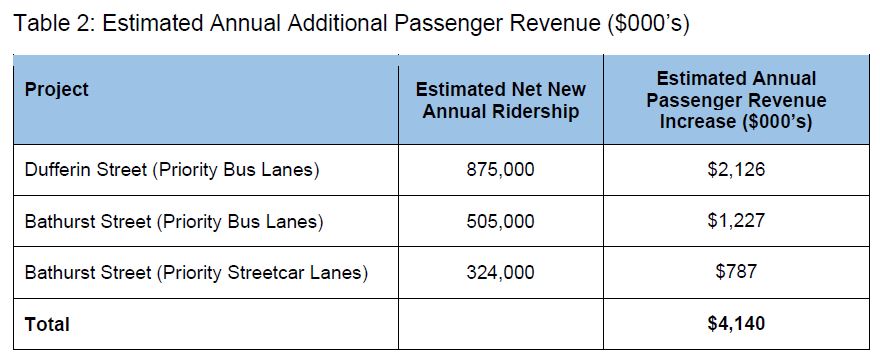
The savings per vehicle hour range from about $59 to $86 with an average of $67. This is not a fully allocated cost, and one must ask why it varies from route to route when the primary variable in marginal costs is the driver’s labour.
The estimated revenue works out to $2.43 per rider, a blended value across all fare types. This assumes a ridership increase of 7-8% over 2023 levels, a very hefty bump compared to what we see on the system as a whole, and considering that the RapidTO benefits will not affect all time periods, locations and riders.
TTC statements about service increases have been inconsistent. The report states:
It is anticipated that any savings will be re-invested into Dufferin Street and Bathurst Street, to further enhance service in support of anticipated ridership increases. Any anticipated additional passenger revenue will be reflected in future Operating budgets accordingly. [p. 4]
During public participation sessions online, the TTC was more circumspect saying that service increases would come after, not in anticipation of, better riding.
The whole idea of RapidTO is to make transit more attractive and gain riders, but it is unclear when or if riders (and those along the corridor) will actually see the possible improvements, or how long those supposed new riders must wait for a bus with room to board.
Effects Along the Corridor
Some commentary about the RapidTO changes focuses on the idea that people do not have an absolute right to park on the public street. That statement is true as far as it goes, but it has an underlying tone that all parking is “bad” and must be expunged. That is easier said than done in some areas.
The southern parts of Bathurst and Dufferin Streets date from the 1880s when driveways were rare and even a rear lane access might not be available. Residents and businesses have been using the curb lane for various reasons for well over a century.
(Dufferin Street did not even have bus service between St. Clair and Queen until 1961, and over the full RapidTO route from Eglinton to the CNE until 1962. Dufferin Station does not have an off-street loop because this was considered a minor stop when the Bloor subway was designed.)
Roads have multiple users with differing requirements, and there is an important distinction between those who live and have businesses on the street as opposed to those who use the road to get from point “A” to “B”. During the design of the King Street transit lanes, there was an important concentration on how the street, primarily commercial and high-rise residential, would work for the locals, while providing better transit service.
General motorists passing through were assumed to divert to other nearby streets, an option that is not available for Bathurst and Dufferin.
During the online consultations, I had a sense that City staff are aware that redesign to address valid concerns will be needed, but it is not clear just how far they will move given the pressure to “do it now”. We will get some sense when an amended proposal comes to Executive Committee in the Summer.
An Incremental Approach
Yes, I can hear the groans already. Never do in one bold step what can be done with years’ worth of small tweaks nobody will notice. Too much transit planning works like that.
The basic issue here is that the RapidTO plan contains three quite separate components that are not interdependent:
- Removal of closely spaced stops
- Changes to traffic regulations (turn restrictions, signals)
- Transit red lanes
Only a few stops are affected by the plan, and their removal will contribute little to the overall saving. I say this based on study of the effect on some streetcar lines when “extra” stop removals produced little or no change because (a) vehicles did not always stop there and (b) the primary delays occur at traffic signals downstream from the removed stops.
Changes to traffic regulations and signal configurations can be implemented today without major road reconfigurations. For example, the changes proposed from Bloor to Dundas on Dufferin are shown below:

Removing turns by general traffic eliminates the inevitable waits as left turns await a gap in the opposing flow, and right turns await a gap in pedestrian crossings.
Red paint is not required to implement these changes.
Similarly, if there are any areas where parking is causing congestion, this can be addressed with time-specific constraints rather than an all-day ban.
The RapidTO proposals started out as a response to the FIFA games which will last for a short period in mid-2026. Dufferin Street was already under study as a corridor, but for its full length. That proposal ran into severe headwinds from residents and Councillors, notably along the northern part of the route which has conveniently vanished from current plans.
Bathurst has never been part of a detailed RapidTO plan, but is one of many streets flagged in the Surface Network Transit Plan. Unless the TTC plans substantial, permanent improvements in service frequency on the bus and streetcar routes, it is not clear how red lanes are justified here beyond the FIFA period which, presumably, will see many parts of downtown with temporarily added traffic restrictions.
The City speaks of the portions south of Bloor (i.e. the subway to Exhibition link) as getting their focus now, and by implication the segment north to Eglinton following along. Further north is not even in the cards. There is a sense of doing as much or little as they can get away with.
Meanwhile, the TTC sits on its hands with the issue of service quality. There is a corporate shrug, a sense “we cannot do anything without those lanes”. That is hogwash, but a convenient and time-worn excuse for inaction.
While we debate the merits of red lanes, the City should proceed with the traffic regulations for turns and signals immediately, and the TTC should address service quality with real line management with demonstrable improvements in dependability. The City should also contemplate the resources (financial, staffing, fleet) that the TTC requires to improve service levels both on the Bathurst/Dufferin corridors and generally across the network.
 Steve Munro
I wholly agree with this and noted as much in an email to relevant parties after one of the consultations. The city and TTC staff fetishized speaking in jargon-laden convoluted “statements” that, if they were a legitimate attempt at answering the question, demonstrated an incredible lack of knowledge of the project that is proposed and the nuances of the areas being discussed.
LikeLike
Susan said
My eyes must be deceiving me, I walked along a good chunk of Bathurst last night and this morning and there was no transit priority to be seen. The items discussed in the recent public consultations are still subject to revision, followed by committee and council approval (or denial).
LikeLike
These are some fair points, and are you say there are indeed solutions that could be implemented that wouldn’t require such a large project. But I find it odd that your conclusion seems to be “it is not clear how red lanes are justified here beyond the FIFA period”, instead of “let’s do both.”
Smaller-scale solutions should be implemented by the TTC on all lines, I agree. They’re less likely to face opposition. But let’s not pretend that people who believe they are the victims of a ‘war on cars’ won’t make a fuss as long as the changes being proposed are small enough. They will show up and complain whether the project is big or small.
So, better to (in addition to small-scale improvements) attempt large-scale change. Even if gets scaled back, it’s still more than you would have had prior. You don’t negotiate with someone by low-balling yourself.
Steve: I had contemplated an update article based on the revised City proposal, but am not sure that is productive. My position, which might not have been clear to everyone, is quite basic.
There is a severe problem with service reliability in both the Bathurst and Dufferin bus corridors that originates beyond the area where red lanes were originally proposed south of Eglinton. If the TTC does not address this problem, the erratic service will remain. There is also a basic problem in the TTC’s presentation of supposed benefits because they cite savings which will mainly accrue in the PM peak as if they will benefit all riders, all day. Moreover, some of the time saving would have been due to stop elimination which could occur with or without red lanes.
The Bathurst corridor was not in the “top ten” list of RapidTO projects, and only snuck in by virtue of the FIFA plans. Service levels on Bathurst are not frequent, certainly not by comparison with Dufferin or with other corridors where red lanes have been implemented. There has to be a discussion about how road space is allocated, but part of this balancing act must consider the relative volumes of transit and auto traffic. Other proposed RapidTO corridors under study – Jane, Finch East, Steeles West, Lawrence East – have considerably more buses/hour than on Bathurst. Arguing for 7×24 exclusivity and displacement of existing uses of the lane is a lot easier when there is frequent bus service. By analogy, I note that a strong argument for the Bloor-Danforth bike lanes is that there is a very strong demand from cyclists. The lanes do not sit empty waiting for an occasional bicycle to amble by. That’s the sort of space trade-off we have to debate, not simply argue that transit is an absolute good because there is a line on the map when it is not matched by high quality service.
For added clarity, there is a stronger argument for Dufferin. Service there is scheduled at 5 or 8 minute intervals at most periods for the local service, plus 8-10 minutes for the express. The Bathurst bus runs every 10 minutes at all hours.
Service will be more frequent during FIFA, but that does not necessarily justify permanent reassignment of lanes any more than other traffic restrictions for the games would remain in place forever.
Much of the debate focused on aggrieved store owners near Bathurst and Dupont, but that is not the only type of affected user. The demand pattern for space is very different for commercial site service (deliveries), shopping (short term parking), residents (long-term parking) and pick-up/drop-off (taxis). The original proposal undermined its credibility by failing to address these variations, and in effect the project painted a target on its back for the “war on the car” folks.
LikeLike
So it’s been approved.
What’s the plan after 8 million dollars gets spent, congestion is worsened, and travel times don’t improve?
This city needs innovation not bureaucratic tunnel vision.
Steve: It’s not 8 million dollars, but the effect on service quality will not be as great as hoped. I will write up the Council debate in a separate article.
LikeLike
How traffic services can blindly approve this baffling. By living and observing the traffic at Bathurst and Front I can predict that both TTC travel times between Lakeshore and King will not improve, and congestion will be impossible.
To illustrate the issues North Bound: Bathurst at Front – Currently the right lane becomes a turning lane by default with only 3-5 vehicles able to turn on a green light. Removing the TTC lane to thru traffic is recipe for disaster.
Bathurst at Wellington – The left turn lane consistently has at least 5 cars wanting to turn, backing up traffic to Niagara. Even with an advanced green the street cars will be blocked, and the line up for cars waiting to enter the turning lane will hold up North bound traffic.
Bathurst at King right lane is consistently blocked with cars waiting to turn right, and once the bike lane changes on Portland Street happen, Niagara and Stewart Street will no longer be an option off Bathurst and into the core.
All this FIFA madness made little sense for 6 games.. until you discover that someone thought it was a bright idea to put the “Fan Experience” at Fort York. So now they’ve doubled the crowds expected into a remote and under serviced corner of the city, rather than splitting the crowds to different areas.
Just stupidity on so many levels.
LikeLike