
Updated May 5, 2025 at 12:50pm:
The TTC now has a web page with details of the changes for the first phase of the construction and diversions. This includes a map showing the diversions to west of Bathurst rather than just downtown. I have added this in the body of the article.
May 5, 2025 at 1:40pm:
Information about the 304 King and 303 Kingston Road night services has been added.
May 5, 2025 at 1:55pm:
The TTC has confirmed that overhead upgrades on King Street East and on Sumach/River will be completed before the King/Church track work end, and streetcar service will resume in September.
May 5, 2025 at 4:30pm:
I asked the City if it thought the intersections used by diverting streetcars and buses could handle the volume of traffic. They replied, but didn’t add much. See the end of the article for the exchange.
Major changes are coming to downtown streetcar routes on May 11 with the next schedule change. This will accommodate a combination of water main replacement, track reconstruction and streetcar overhead upgrades mainly at King and Church. Work is expected to require diversions until the October schedule change on Thanksgiving weekend. Streetcar service is expected to return with the September schedule change on Labour Day weekend.
The effects of work an King and Church have been known for some time through the Annual Service Plan and through a City report on the project. (The original report and recommendations were amended at the recent Council meeting to lessen the effect of various proposed lane closures.) Service levels have been published via the electronic version of schedules used by trip planning apps. The information about vehicles/hour at various locations is taken from those schedules.
(As an aside, the TTC website has still not been updated to include the 2025 Service Plan even though it was approved by the Board in January.)
With the concentration of transit service through various intersections, and the added complexity that most vehicles will make turns at these locations, there simply will not be enough capacity even under ideal conditions. It is no secret that “ideal” is a word rarely appropriate for transit operations downtown thanks to the lack of robust traffic management and real transit priority.
In past years, the diversion of services from King Street around the TIFF street fair created problems for transit travel times and reliability, but this lasted for a brief period. The planned diversions for King/Church will last through the summer.
Many of the water mains in the “old” city have been in service for over a century. Other parts of King Street have seen renewal, occasionally on an emergency basis following a break and sink hole.
The special trackwork at the King/Church intersection has been in bad shape for some time, and was overdue for replacement. Previous reconstructions were in 1983 and 2003. Other competing construction projects got in the way, and the track conditions have worsened year by year. There are many patches, and a well-deserved slow order unlike the standing practice even at freshly rebuilt junctions.
This intersection is also old enough that it predates the era of panel track construction where pre-welded sections are trucked in and assembled on site. This replaced the older style of tracks assembled piece-by-piece and often not welded robustly if at all. TTC has not yet been through its entire inventory of “old” track given the 20-30 year cycle depending on the level of service, wear, and disintegration at intersections.
Other work planned for this period of suspended streetcar service is the reconstruction of overhead on King and on the Distillery branch for pantograph-only operation.
Closing King & Church for an extended period concurrently with the Ontario Line construction at Queen & Yonge will add to the traffic snarls downtown. The City talks about using Traffic Agents to manage key intersections, but whether they provide enough people at enough places at enough times remains to be seen.
Routes Diverting off of King Street
Three routes are affected: 504 King, 503 Kingston Road and 508 Lake Shore.
The 504 King service will be broken into three sections:
- A 504 streetcar service between Broadview to Dundas West Stations operating via the same route as 501 Queen between the Don Bridge and Spadina.
- A 504C bus shuttle from Wolseley Loop south on Bathurst and east on King terminating at Broadview & Gerrard.
- A 504D bus shuttle from Wolseley Loop south on Bathurst, east on King and south on Sumach to Front & Cherry. Buses will loop via [to be announced] and will not serve Distillery Loop.
The 503 Kingston Road service will be changed so that its western terminus shifts from York Street to Dufferin Loop. Cars will follow the same route as the 504 King via Queen from the Don Bridge to Spadina, then shift south onto King to follow the pre-diversion 504B route to Dufferin.
508 Lake Shore cars will follow the same route as 504 King.
Night Service Changes
- The 304 King night car will operate every 20 minutes over the same route as the daytime 504 service diverting via Queen and Spadina.
- A 304D night bus will run every half-hour over the same route as the 504D bus from Wolseley Loop to Broadview & Gerrard.
- The 303 Kingston Road night car will operate every 20 minutes over the same diversion route as the 304 King night car, and will operate as it does now to Sunnyside.
The maps below are from the City Report about this project originally published in February. An updated map for the first phase has been added later in the article.
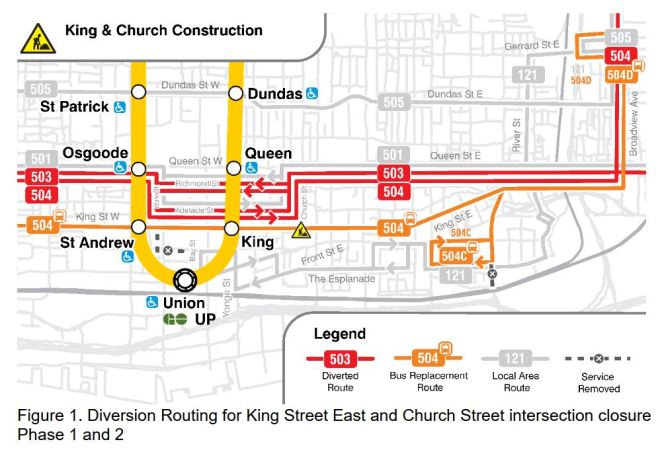
For part of the construction period, King/Church will be impassible even to the replacement bus service and it will divert south to Wellington and Front.
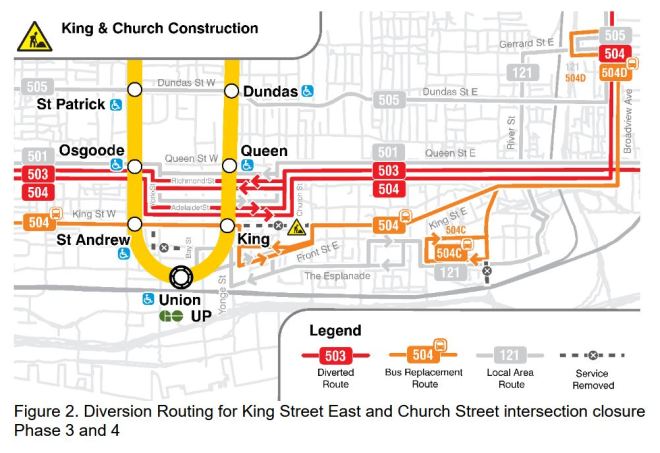
These maps do not tell the whole story because another set of construction diversions will overlap the King/Church changes until the next schedule change in late June.
Although water main work at Bathurst/Fleet/Lakeshore is now complete, track work continues there and on Bathurst Street further north. 511 Bathurst streetcars will continue to divert east via King to Spadina looping via Adelaide and Charlotte. The 511B shuttle bus will be shortened from Wolseley Loop at Queen to an on-street loop via King, Portland and Richmond to Bathurst Street.
509 shuttle buses continue operating between Exhibition Loop and Queens Quay Loop at Spadina. 510 streetcars continue operating to Union Station.
The combined effect of the diversions will be greater than during the total meltdown of King service in 2024 when all cars diverted north via Church to Queen because volumes of other routes (510 Spadina, 511 Bathurst and 501 Queen) will be added to the King services, and more intersections will be affected over a wider area.
Updated May 5, 2025 at 12:50pm:
The TTC’s project webpage has a consolidated map of the diversions for the first phase of the work.

Vehicle Congestion on King/Church Diversions
Several routes will overlap in the diversion area, especially at Spadina and at Bathurst, and their routes will involve many turns that, even with some transit priority assistance, will tax intersection capacity.
In addition, the 511 Bathurst service will loop via King, Spadina, Adelaide and Charlotte, and the 511B Bathurst shuttle will loop via King, Portland and Richmond. This will add to the turning demand at Spadina and at Bathurst, at least until the construction on Bathurst at Fleet and associated diversions end in late June.
The intersections affected by substantially increased transit turning volumes are:
- King & Bathurst
- King & Spadina
- Spadina & Adelaide
- Spadina & Queen
- Queen & York
- York & Richmond
- York & Adelaide
- Church & Richmond
- Church & Adelaide
- Queen & Church
The number of vehicles scheduled per hour will be much higher than the intersections now handle. The City plans to provide Traffic Agents at key intersections, but the large volumes of transit vehicles continue outside of peak periods when Agents are usually deployed, and weekend numbers are similar. This is not a problem for a few hours a day, nor for a few locations.
At King and Spadina, there will be from 18-24 left turns per hour eastbound. There is no transit priority signal to assist these turns.
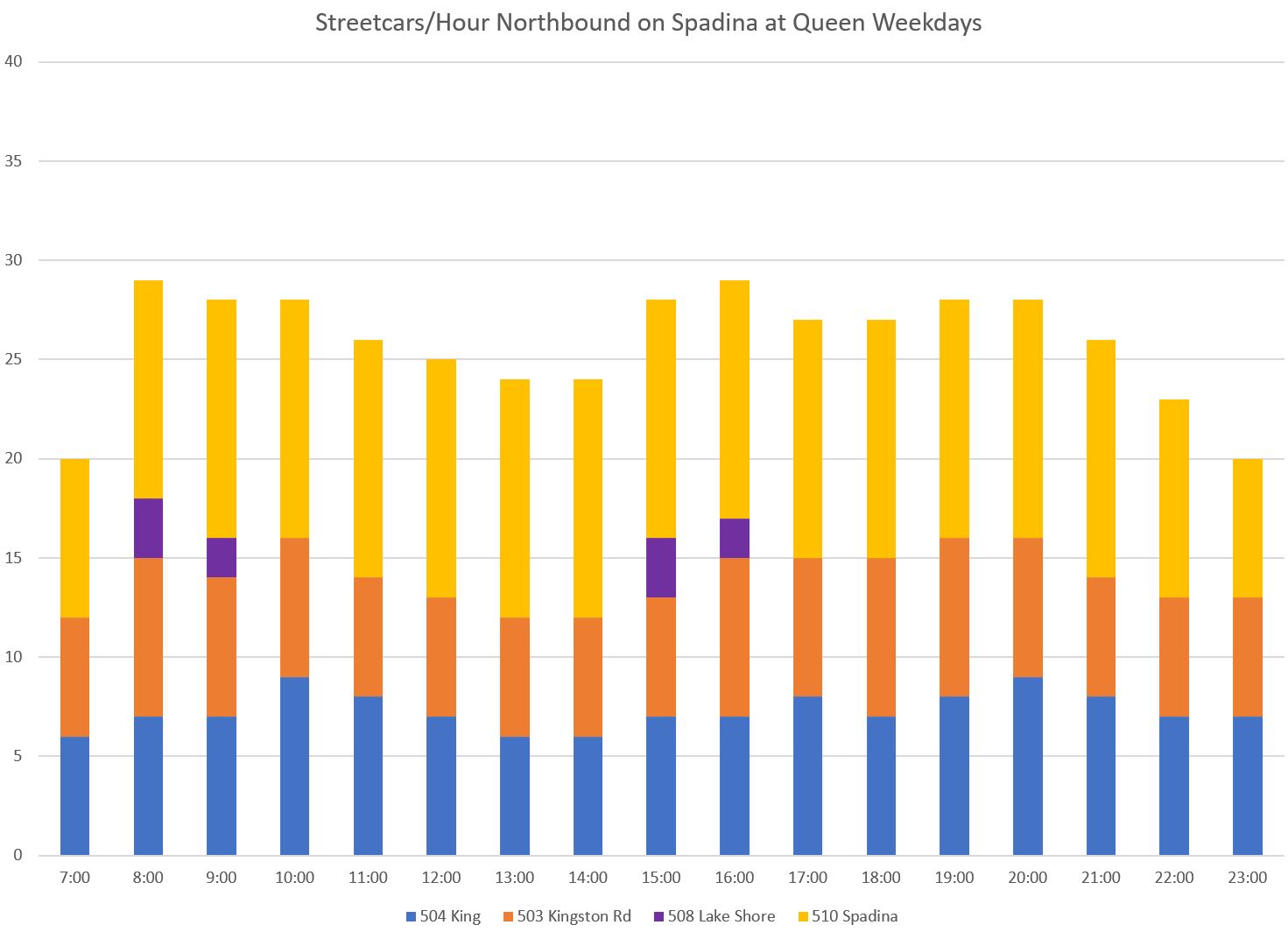
In addition, there will be the through north-south service on 510 Spadina (yellow, top band below). Collectively 25-36 cars/hour will attempt to use the farside stop northbound on Spadina.
For technical reasons related to intersection geometry, a white bar signal cannot be implemented in the standard way used by the City/TTC at turns. However, the volume of transit left turns all day is such that a transit left turn should simply be provided at all times without the complexity of vehicle detection. There is a similar issue at Queen westbound where the detection point for left turning streetcars is beyond the stop line. A further problem at King is that the eastbound electric switch will be disabled and detection of turning streetcars through it will be impossible.
At Adelaide and Spadina, the 511 Bathurst cars (green, second stripe from the top) will turn off Spadina to Adelaide. There is a white bar priority signal to assist the turn, but the intersection is often clogged, and turning cars could block the northbound streetcar traffic.
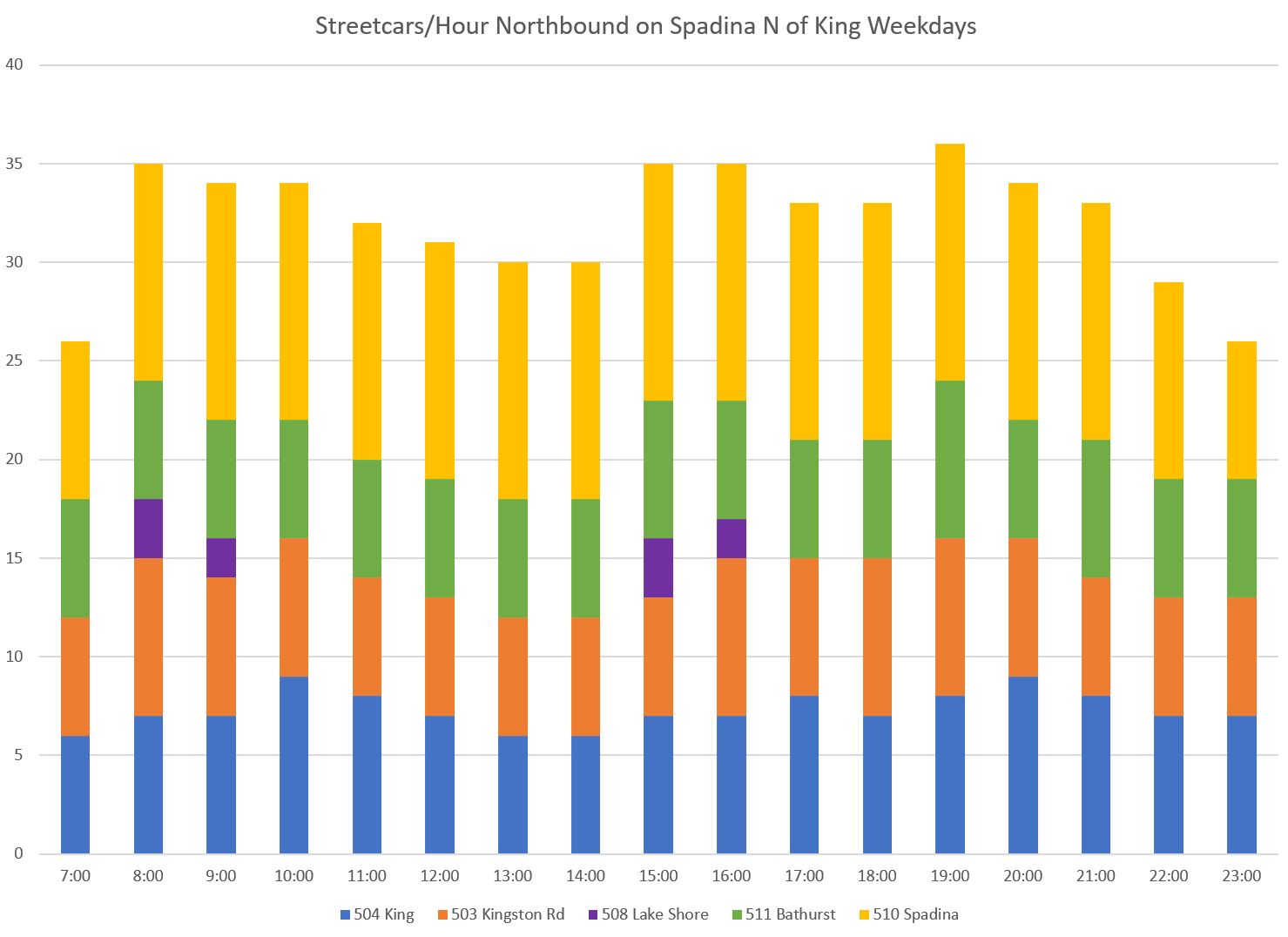
At King and Spadina southbound the situation is similar to northbound except that there are no turning 511 Bathurst cars (they come straight west on King from Charlotte Loop). From 12-18 cars/hour will make the turn south to west onto King and the rest, the 510 Spadina service (yellow, top band below), will run straight through. However, cars will stop at the passenger island adding to the time they occupy the area near the intersection.
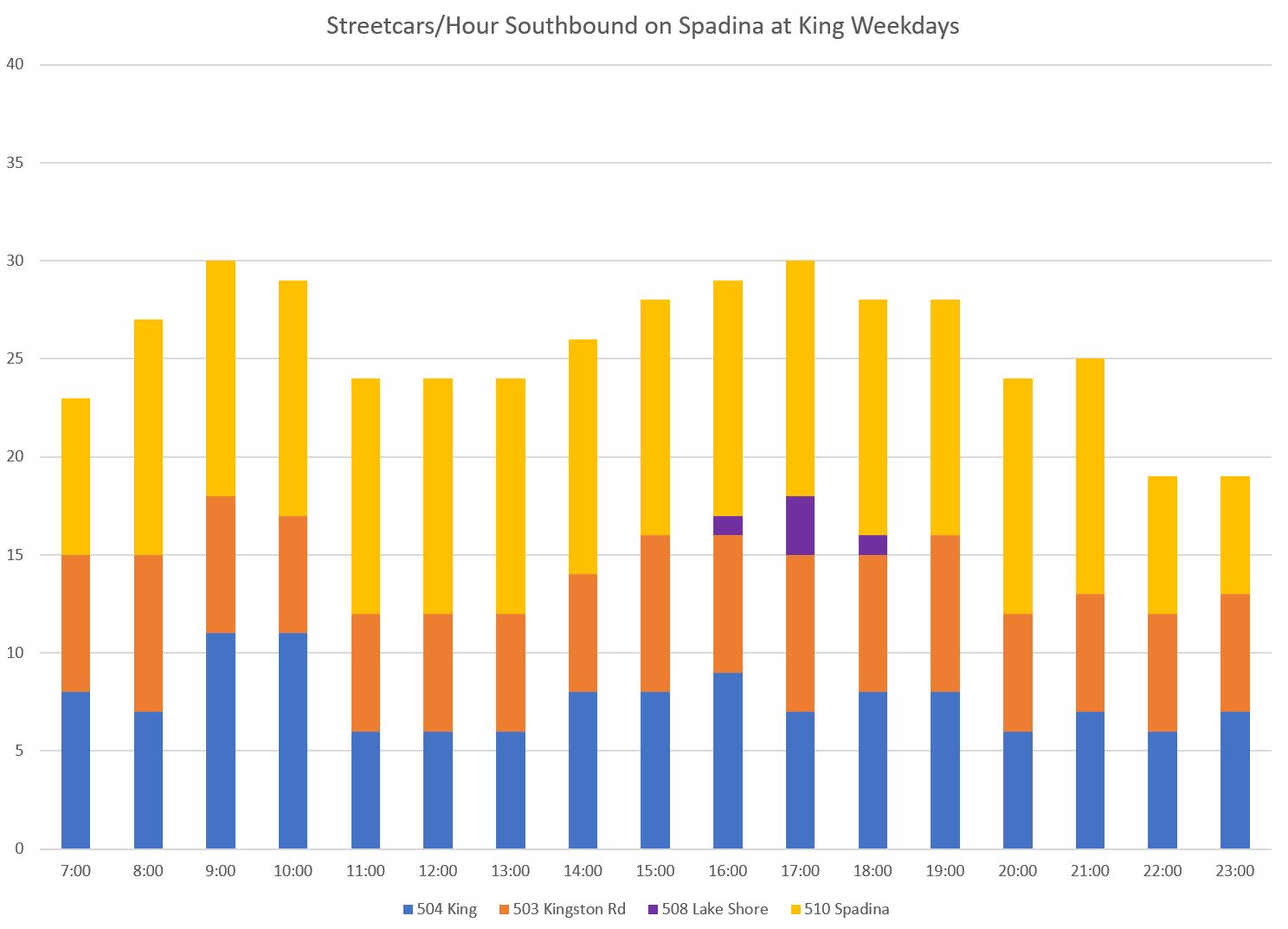
At Queen and Spadina northbound, there will be a combination of 510 Spadina cars (yellow, top band below) and the routes diverting from King Street. There is a transit priority white bar for turns at this location of which there will be 12-18/hour.
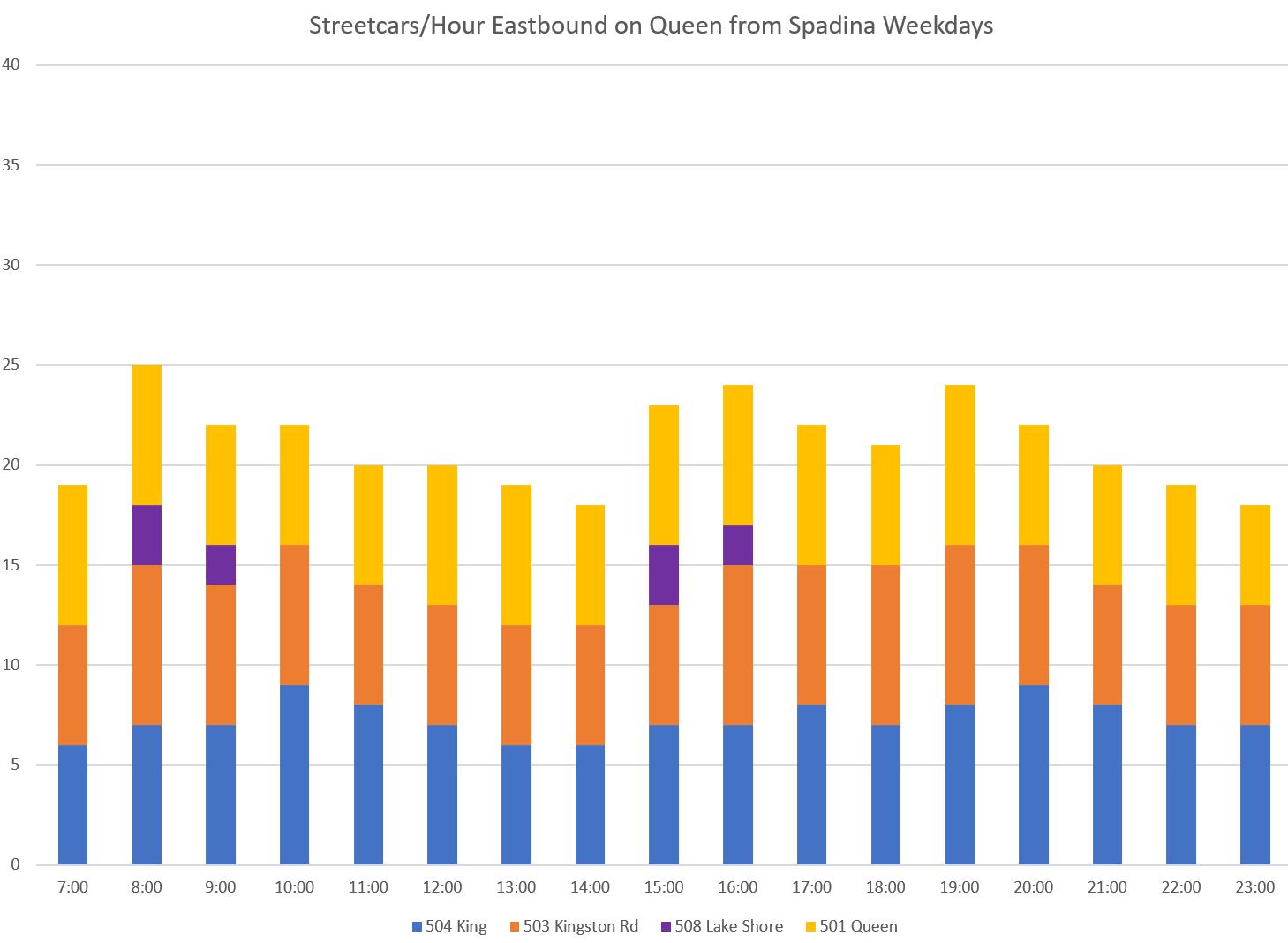
Eastbound from Queen and Spadina, the diverting routes will join 501 Queen for their trip via Queen, York, Adelaide and Church back to Queen Street. The vehicle volumes will be substantially higher than those now operated by only the 501 Queen (yellow, top band) today with 18-25 streetcars/hour making all of the turns enroute.
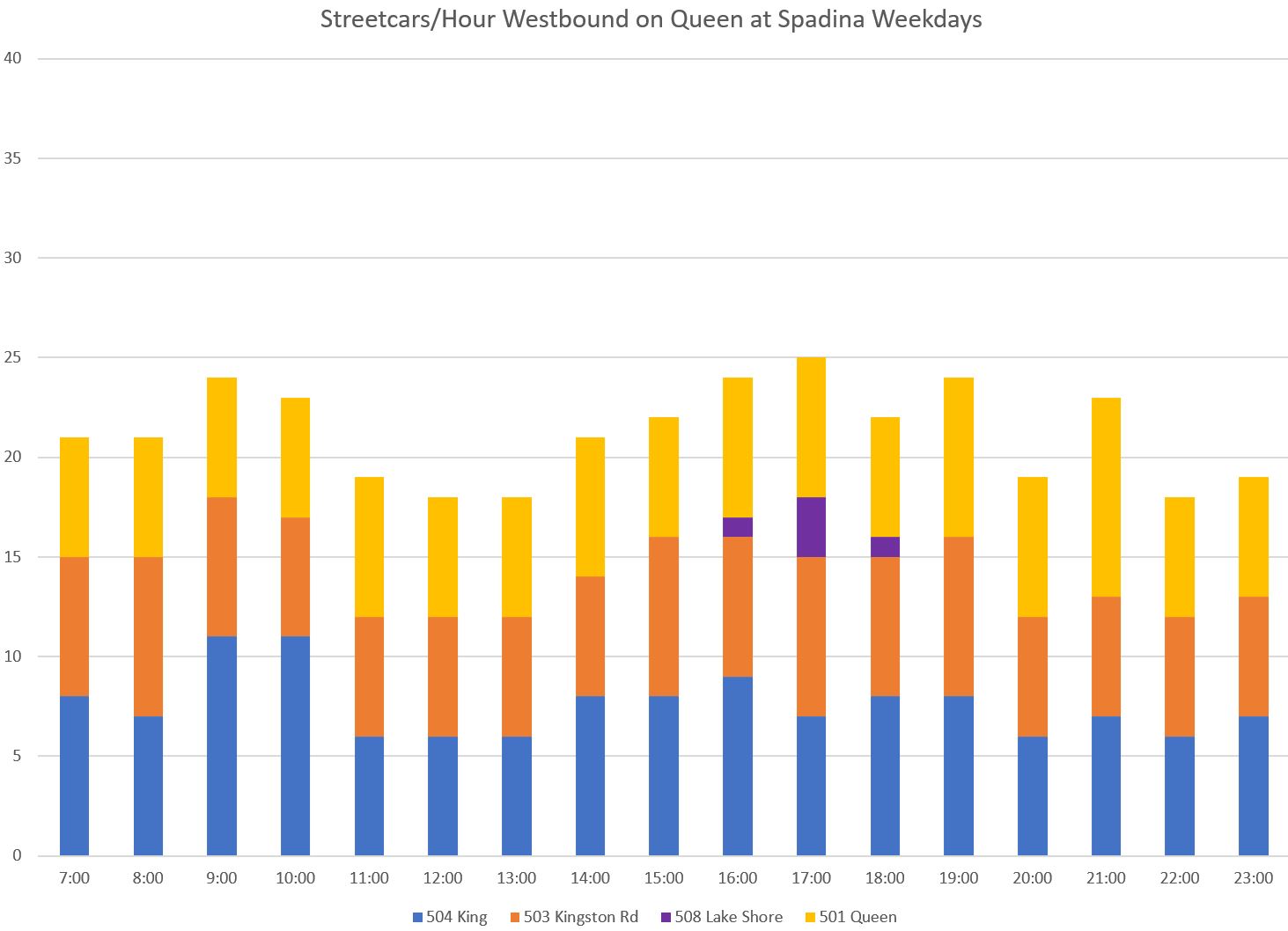
At Queen and Spadina westbound, the volumes will be similar to eastbound. The 501 Queen cars will use the westbound stop on Queen adding a potential delay to diverting cars on other routes waiting to make the left turn. There is no transit priority signal to assist with this turn.
The volume of streetcars shown here also applies to the turns enroute on the diversion at Church, Richmond, York and Queen, and far more streetcars will attempt these turns than today’s service with only the 501 Queen.
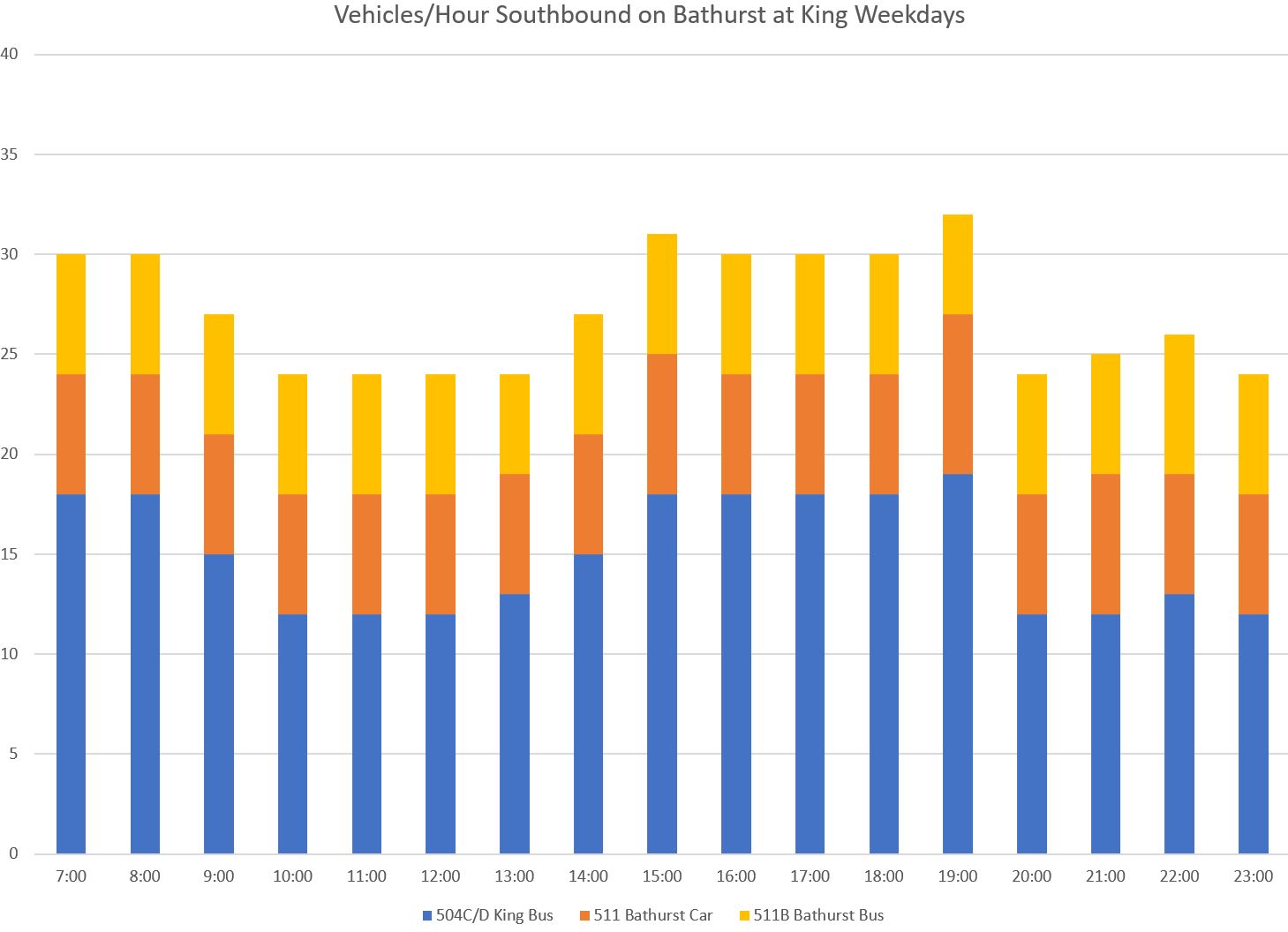
At Bathurst and King, most of the vehicles arriving southbound will turn east. This includes the 511 Bathurst streetcars, and the 504C/D replacement buses which will use Wolseley Loop at Queen Street as their turnaround. The northbound 511B shuttle bus will loop via King, Portland and Richmond.
The chart below shows the number of vehicles. Only the 511B bus will operate straight through north-south. All other vehicles, from 18-27 per hour, will turn south to east. There is no transit priority signal.
Eastbound on King east of Bathurst there will be many overlapping services. Of these, the 511B Bathurst bus (green, top stripe) will turn left at Portland. All others will run through. The 504C/D King buses (light blue, second stripe) will continue east on King from Spadina, but the streetcar services will all turn left there.
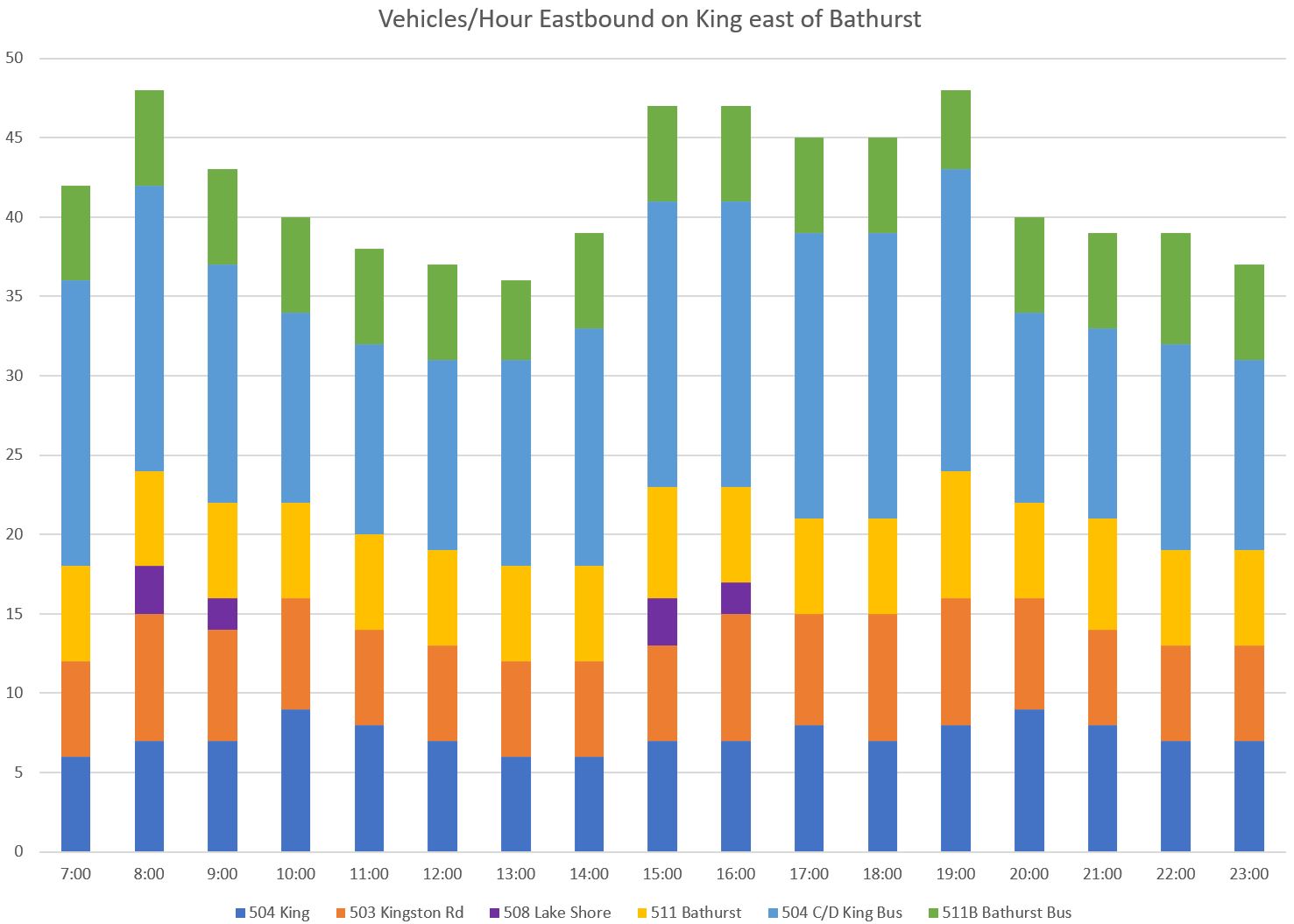
All vehicle counts shown here are taken from the GTFS version of TTC schedules published on May 1, 2025 for implementation on May 11.
The City Responds
Added 4:30 pm May 5, 2025:
When I posted this article, I sent the following note to the City’s Transportation Services Department.
I have just posted an article on my site about the very large volumes planned for streetcar and bus traffic at intersections affected by the King/Church construction diversions.
Does Transportation Services have any comment on whether the combined volumes for turning and stopping by transit vehicles can actually be supported at the affected intersections?
Also, this level of transit traffic will last through much of the day on weekdays and weekends. What measures will be taken to support transit not just in peak periods, and especially when there is added traffic downtown from special events?
Here is the City’s response from their Media Relations Department:
This month, the City of Toronto and the Toronto Transit Commission (TTC) will begin construction to renew aging streetcar tracks and replace the 142-year-old watermain at the intersections of King and Church Streets. This work is required to bring the watermains and track infrastructure to a state of good repair and is part of the Council-approved 2025 Capital Works Program. Work is expected to be complete by the end of August.
In recent years, the City has completed similar streetcar track or road renewal and/or watermain replacement projects on Queen, Adelaide, Richmond and Wellington Streets.
The King/Church project needs to be completed this year to accommodate an anticipated influx of visitors and increased TTC ridership during the FIFA World Cup next year.
To ensure the streetcars on this diverted route operate as reliably as possible during this disruption, a combination of Traffic Agents and/or Paid Duty Officers, on-street parking removals and signal timing changes will be deployed to support streetcar operations. In addition, Parking Enforcement Officers will be deployed at critical locations along the streetcar and bus diversion routes to limit illegal curbside activity blocking active traffic lanes. These measures focus on key pinch points along Richmond and Adelaide Streets from York to Church Streets.
Traffic Agents will provide on-the-ground feedback to the City’s Traffic Operations Centre about how the changes and traffic management measures are working. The City will actively monitor transit mobility and make further adjustments as needed.
More information is included in this staff report.
All of the history is basic stuff we know, and the linked report is one that I had already cited in my article. There is no attempt to address the question about intersection capacity. The focus is on Richmond and Adelaide Streets when the locations of concern are beyond that area.
This is a reply worthy of Metrolinx for its self-congratulatory irrelevance.
 Steve Munro
Though I realise that the TTC and the City cannot do everything at once, it is unfortunate that this diversion will be needed again in 2028-2029 as the tangent track between Church and River is up for renewal then.
TO Inview also noted 2025 work from Yonge to River on electrical overhead, poles etc. I assume (possibly optimistically as it IS the TTC) this will be done while the diversion is in effect.
Steve: When this project was proposed last year, the overhead work was to follow the track work pushing the completion date out to Thanksgiving. It appears that this might still be true, but I have a query in to the TTC to confirm what’s going on.
Update: TTC confirms that the overhead work will be finished before the track work ends.
Municipal511 (which the City seems to be migrating to for road restrictions) also lists tangent track work on King between Yonge and Sumach from May 11 to August 30. Maybe they are going to be repairing the many areas with very deteriorated ‘margins’??
LikeLike
Steve, when the 501 was diverted via Spadina and King in late April, on April 21st I saw 501 operators manually throwing the switch northbound on Spadina to turn onto eastbound Queen, and then 510 operators manually throwing it back to straight ahead. I shudder to think how that will work now if the switch is still not electrified and there’s a streetcar every 2.5 minutes.
Steve: It would not surprise me if some switches needed for this diversion are not working. Last week I saw a Bathurst car stuck NB at Adealide because the switch into Charlotte Loop was frozen.
LikeLike
There is some major underground work happening for the past two weeks on Adelaide between Yonge and Victoria. This forces all traffic to merge into the streetcar lane at that point, which is the single lane left now, as all the work vehicles are parking there. Is that going to be over before this starts? It will be disastrous if not.
Also, I think they really should consider opening up King between Spadina and Victoria to regular traffic during this period to get at least some cars off of Richmond and Adelaide. Yes, I get that it sends a mixed message, but this is an extraordinary situation and allowing some means to move cars out of the way of a triple load of streetcars should be at least thought of.
LikeLike
You mention that “At King and Spadina, there will be from 18-24 left turns per hour eastbound. There is no transit priority signal to assist these turns.”
I don’t see how there would be much of an issue here. Through traffic westbound is prohibited, and a turning streetcar won’t conflict with right-turning vehicles westbound on King. There is already an advanced green for vehicle traffic to allow them to clear the intersection before the pedestrian signal is activated.
With that said, the city should be monitoring this on the first few days, and if I’m wrong they should spring to action.
Steve: You say “Through traffic westbound is prohibited”. Yes, in theory. Don’t count on it. Also there are the pedestrians. They are held for west-to-north turns of which there are none scheduled these days, but not for east-to-north turns.
Another big problem is that every northbound car, including the 510s, will try to serve the farside stop northbound and when a car is sitting there, another one cannot approach from the south or southwest and clear the intersection.
LikeLike
Re: operational switches… Last night (May 5) around 21:30 I was on a westbound King car, with Queen cars operating on a diversion along King to York. At York St., the operator of the King car had to get out and manually throw the switch to proceed westbound. If these switches aren’t repaired, the Church St. diversions will be a real mess.
As far as auto traffic on King is concerned, I travel on King regularly (bike & streetcar) and I’d estimate about 33% (at least) of autos routinely ignore the “no through movement” restrictions, even at intersections like King/Spadina where the “no through movement/no left turns” restrictions is illuminated by a big LED sign. As Mr. Munro says, these movements might be restricted in theory, but in practice the restrictions are routinely ignored.
Steve: The west-to-north switch at King & York has never been electrified. It is an example of a commonly used diversion for which the TTC makes no provision.
LikeLike
Jarek:
I remember a few years ago when there was a pan/pole crossover on Dundas at Parliament. There was a supervisor stationed there to attach the poles without the operator having to leave their post.
I would hope that for a diversion like the one we are discussing on King, with the volume of cars affected, that they would station a supervisor or other qualified person to handle the switch if it is out of service electrically. With that said, based on the “answer” they gave Steve about the turn volumes, it’s safe to say that their plan is a state secret.
Steve: I get the sense that the fact it’s a “Church Street” project has pulled the focus from the wider area affected by the diversions. Also, there does not seem to be an appreciation for the service levels off peak and on weekends.
LikeLike
The pedestrians are held back at the start of the signal phase, so the streetcar should be able to advance eastbound until they would conflict with a westbound Bathurst car, presumably that car would let the east-to-north car complete its turn first if the platform is vacant. If the platform isn’t vacant then the westbound traffic can go through and the east-to-north car can finish its turn at the end of the signal phase when the pedestrians are clear.
Steve: While the pedestrians are held back by the west-to-north right turn arrow, an eastbound car faces a red signal and cannot advance into the intersection. A complete rethink of signal timings and indications is needed, and this would have been easy to work out well in advance. Transportation Services does not appear to be pro-active on this sort of problem. Queen and Spadina westbound faces similar issues.
As a daily user of the intersection I would say that there is pretty high compliance now. Adding the signal changes that were done east of Yonge would make it even better. Red light cameras would be sweet, sweet justice. King and Bathurst has far worse compliance than King and Spadina.
Steve: My point in all of this is that it would not have required major changes to provide for a diversion that is expected to last four months. We went through the same problem in the east end where there was no transit priority for diversions around the Don Bridge construction on Queen, and streetcars (at a far lower level of combined service) queued up on Broadview waiting to turn west onto Dundas. There is a lot of focus on things like eliminating parking and CafeTO lane occupancy, but no talk about how intersections will work.
LikeLike
I guess the 10 metres worth of CafeTO lane occupancy in front of the Broadview Hotel will be staying despite having restrictions in place for the other 2,140 metres along the shared corridor to Church Street. This is only one of the questionable decisions they’ve made.
Steve: The eastbound red lane on Queen to Broadview does not make sense in the context of the King/Church project. It is nowhere near, and the number of cars that will make the east-to-north turn at Broadview is unchanged. Someone has piggybacked this onto the project. I suspect the red lane will be ignored, and there will often be vehicles stopped in the eastbound curb lane.
LikeLike
It appears that the TTC customer-centered service planning is in evidence, yet again. Though I hope I am wrong, there appear to be NO eastbound stop on Adelaide @ Church. This would be good stop for people who normally take the 504 (or 503) and want to get to St Lawrence and the area along Front. I think the only stops are Adelaide & Yonge and then Queen & Church. Pity!
Steve: Yup. That’s our optimized stop spacing. The layout was designed for Queen corridor riders with no thought to diverted King corridor trips.
LikeLike
They’ve not started work on this Sunday. Maybe tomorrow.
Day 1 not looking good.
Steve: Day 1 was a mess because of the marathon and associated diversions lasting until noon with the cleanup taking hours afterward. Some cars were still running via King because the intersection does not close until Monday, And to top that off, the diversion will extend west on Queen for emergency water main work on King between 9am and 4pm Monday. 504s via Shaw to King. 503s to Dufferin Loop via Dufferin.
LikeLike