
The TTC Board met on April 16 with many items on its agenda. These include:
- Election of the Vice-Chair
- CEO’s Report for April 2025
- Financial and Major Projects Update for the Year Ended December 31, 2024
- Transit Network Expansion Update
- Strategic Planning Committee
There are separate articles on this site covering other reports from this meeting:
- TTC Major Projects Update and Funding Shortfalls
- Extreme Precipitation and the TTC
- Audit of Non-Union Workforce Planning and Management
Election of Vice-Chair
The first item was the election of a new Vice-Chair following the departure of Joanne De Laurentiis from the Board. She was replaced by former Councillor and former TTC Vice-Chair Joe Mihevc by Council at its meeting of Marc 26-27, 2025. The Vice-Chair is chosen by the Board from its four “citizen” members (non-Councillors). Ms. De Laurentiis’ departure also required the appointment of a new TTC representative on the TTC-Metrolinx PRESTO Joint Advisory Group.
Freshly re-minted Commissioner Mihevc was appointed both as Vice-Chair and to the PRESTO advisory group. Commissioner Jagdeo was also nominated for the Vice-Chair position, but the vote carried in Mihevc’s favour largely along what might be called “party lines” with Mayor Chow’s faction in the majority.
- Jagdeo: Osborne, Jagdeo, Ainslie, Kim (4)
- Mihevc: Myers, Malik, Saxe, Bravo, Mihevc (5)
- Absent: Matlow (1)
CEO’s Report and Metrics
There is little new in the collection of performance stats with the April report.
The count of buses in the fleet has gone back up to 2044. Back in September 2024, the count was 2,114, then in October dropped to 1983. It is not entirely clear how the TTC counts buses because these numbers do not align with the fleet lists shown in the Scheduled Service Summary.
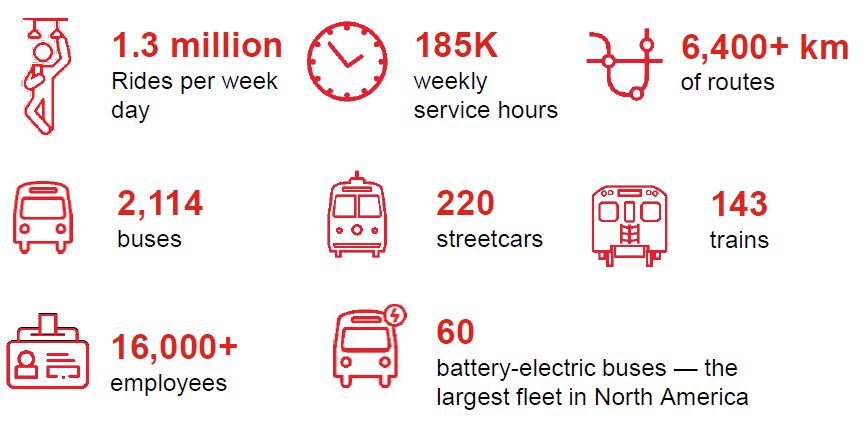
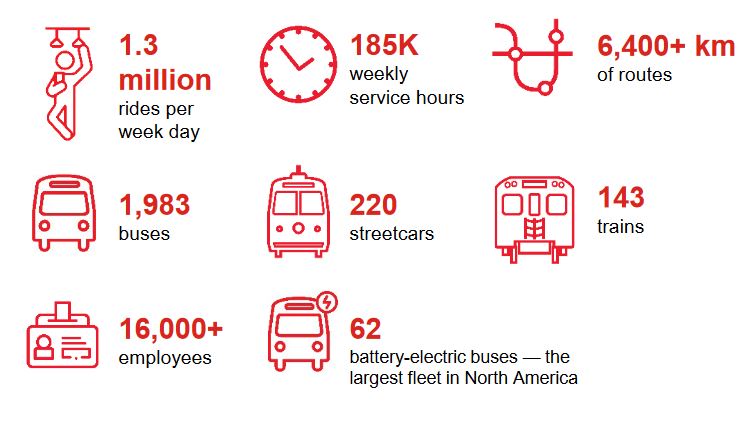
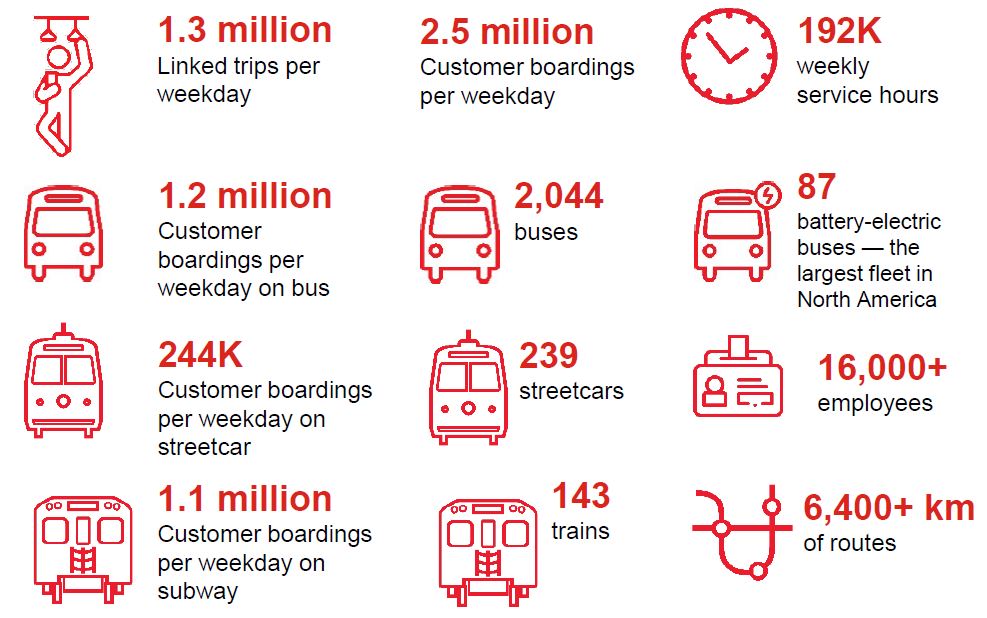
Is this just nerdy bus fan trivia? No. The actual number of buses and how many of them actually work are central to service planning. Obviously operators are needed to drive buses, but if there are many spares, improving service is easier than having no buses. The status of the TTC bus fleet is a key metric, but not one that the TTC reports. Instead, they say “we scheduled X buses and we fielded at least that number”. That does not say anything about how many they could have scheduled based on fleet availability.
Both the subway and streetcar fleets have more vehicles than are needed to make service, but there is never a discussion of staffing up to actually make better use of them.
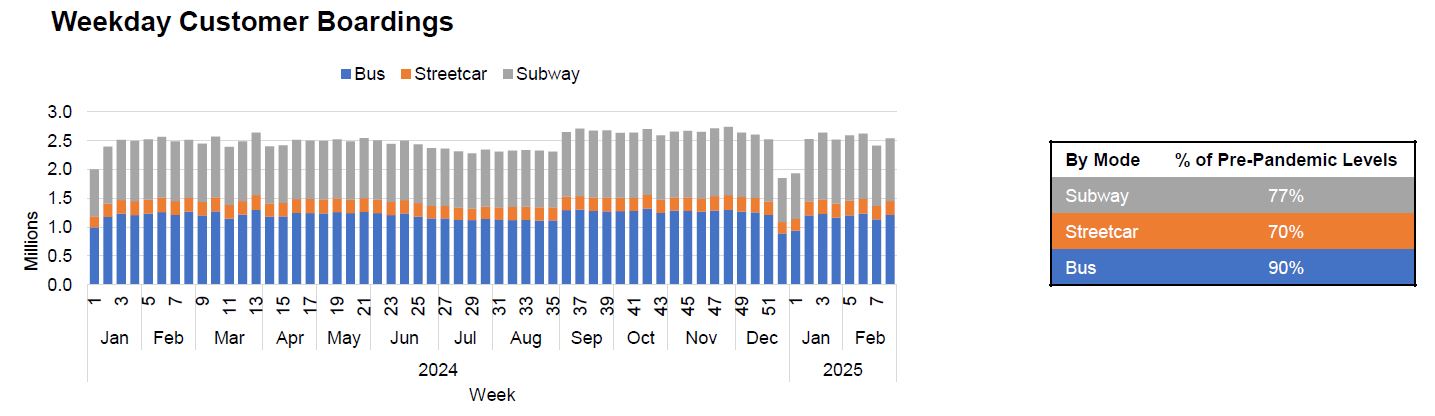
Weekday boardings continue to grow over 2024 levels. On the subway and streetcar networks, growth was 9% and 7% respectively. On the buses it was only 2%, but that network has regained its riding earlier post-covid than the routes serving downtown. Service restoration has concentrated on off-peak periods where recovery has been stronger than during the peaks. Ridership and fare revenue in early 2025 are running slightly behind budget due to severe weather in February.
The TTC has expanded checks for valid fares to the bus network at subway stations. There are no stats thus far to illustrate what additional revenue they are getting from this effort.
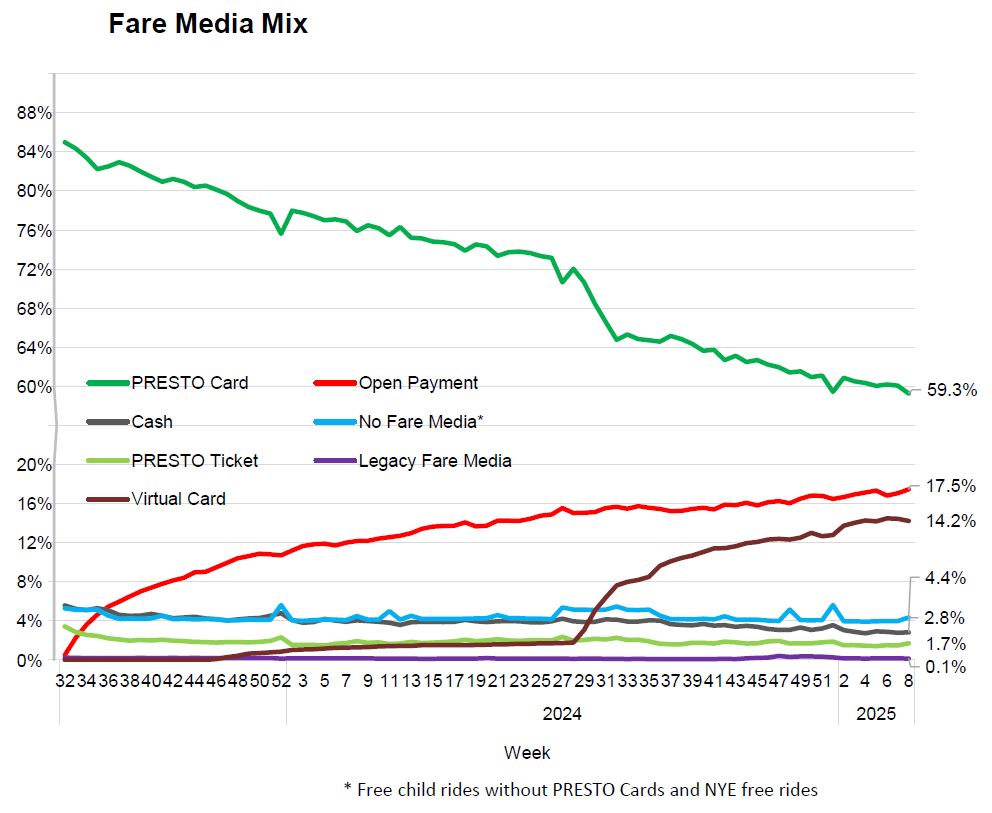
Legacy fare media will not be accepted by the TTC effective June 1, 2025. The usage rate stands at 0.1% with about 36K tokens and 10K tickets collected in the second financial period of 2025, roughly corresponding to the month of February. Cash fares, 4.4% of the current total, will still be accepted.
On time performance during early 2025 was severely affected by the weather. As of the mid-February schedule changed, the TTC has changed the metric from a range of +1/-5 (one minute early to five minutes late departure) to (0/-5). Whether this will have any effect on the actual service provided remains to be seen. The larger issue is vehicle spacing both at terminals and along routes so that buses and streetcars do not arrive in bunches with uneven loads.
(On a scheduled headway of 10 minutes, buses could depart on a pattern of 0-15-20-35-40-55-60 minutes and still be “on time” in spite of gaps 50% larger than the scheduled headway. The situation is actually worse for more frequent service such as every 6 minutes a pattern of 0-11-12-23-24-35-36 would be “on time” and would quickly collapse into pairs. Service would be two buses every 12 minutes instead of one every 6 minutes, but it would “on time” according to the TTC. Such is the bankruptcy of their service metrics.)
Service delivery on the subway system (proportion of scheduled trips actually operated) was poor on Line 1 through a combination of restricted speed zones and weather delays.
Short turns on bus and streetcars continue to be reported as a monthly percentage of trips with no breakdown by route, time of day, or day in the month. Actual counts for individual routes from tracking data show that the TTC misses its target in specific cases, but this is masked by all-month averaging.
The mean distance between failure for buses continues to be reported with capped values for clean diesels (20k km) and hybrids (30k km). We do not know what the actual numbers are for these fleets. For the eBus fleets, the MDBF (mean distance between failure) values are poor at 11,350km in January and 14,935 in February. This is down substantially from a year ago. The TTC does not break out reliability numbers by type/supplier of vehicle, and so we do not know which parts of the fleet cause problems.
Moreover, there is no count of inactive vehicles which, by definition, cannot fail and thereby influence the MDBF values. We do not know how many inactive, inoperable vehicles are in the fleet.
The status of the legacy fleet comes up in comments among enthusiasts. The CEO’s report includes:
TTC’s vintage streetcars moved during Hillcrest construction
As the TTC begins to ramp up construction activity at Hillcrest Complex to allow for the storage and maintenance of new accessible streetcars, staff have temporarily relocated our six legacy streetcars to Halton County Railway Museum for safekeeping.
The TTC’s six legacy streetcars include one Peter Witt, two PCCs, two CLRVs, and one ALRV. With the TTC modernization of the overhead catenary system, the trolley pole on our legacy streetcars is no longer compatible with the new system. The TTC is exploring options to convert the trolley pole to a pantograph, with the aim to retrofit the vintage vehicles before returning home after Hillcrest upgrades are completed.
With the work at Hillcrest planned to run for a few years, it will be a while before we see the historic fleet back in Toronto, let alone on the street for special events.
Financial Report for 2024
The quarterly financial report included preliminary operating results for 2024. Note that these are subject to audit. Comparison with the budget is tricky because it assumed Line 5 would have opened mid-year and provided accordingly.
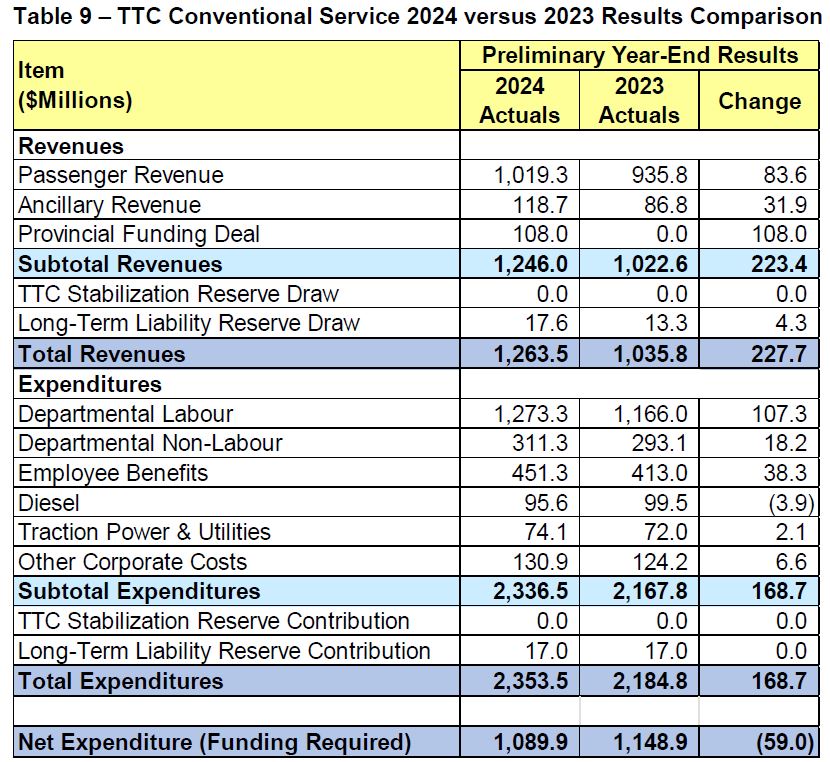
Although ridership fell slightly below the budgeted level, the average fare per ride was higher leading to better than expected results even without Line 5 opening. Provincial funding, which would have included a Line 5 subsidy, was lower than expected. The TTC did not draw on its stabilization reserve because of saving on the expense side of the ledger.
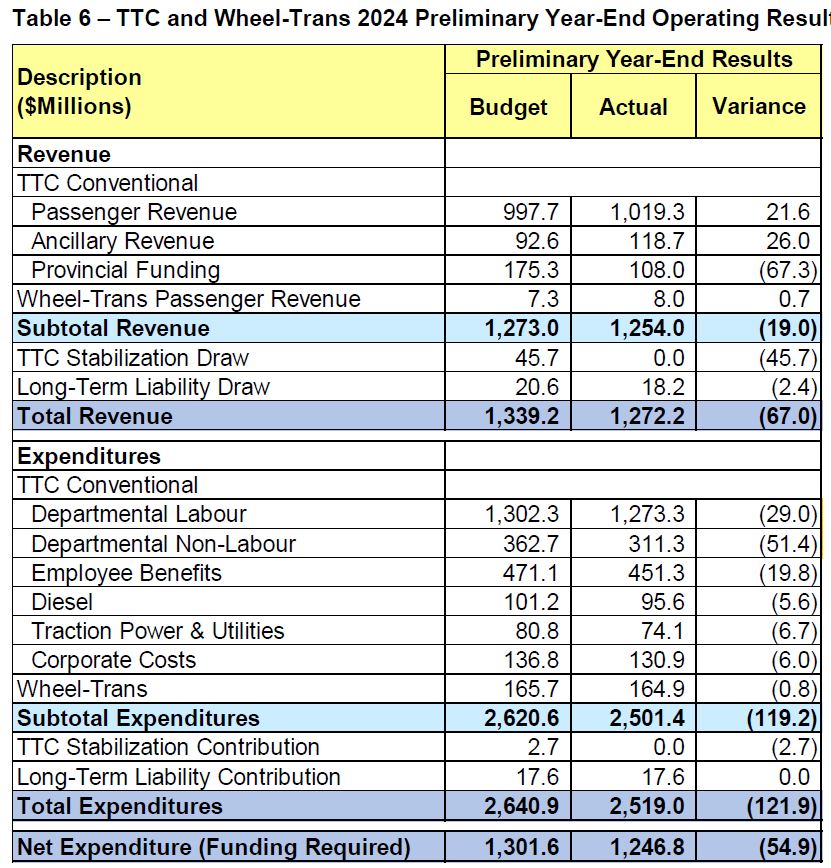
As noted above, the higher average fare more than offset the shortfall in ridership. Savings on expenses were helped by a lower than projected price of fuel.
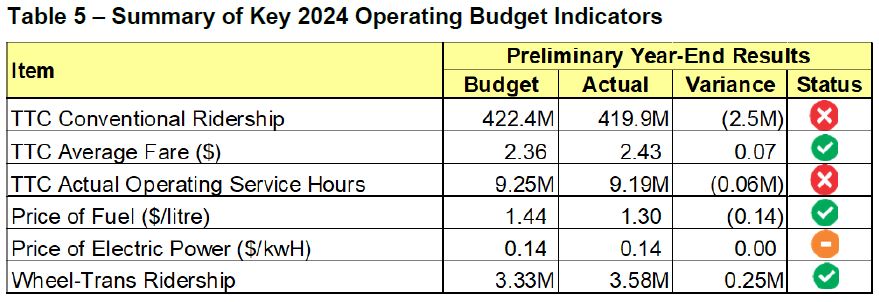
Comparing with 2023 shows a roughly 22% increase in revenue, although half of that was due to a Provincial subsidy payment under the Toronto-Ontario “new deal”. Expenditure rose by just under 8%.
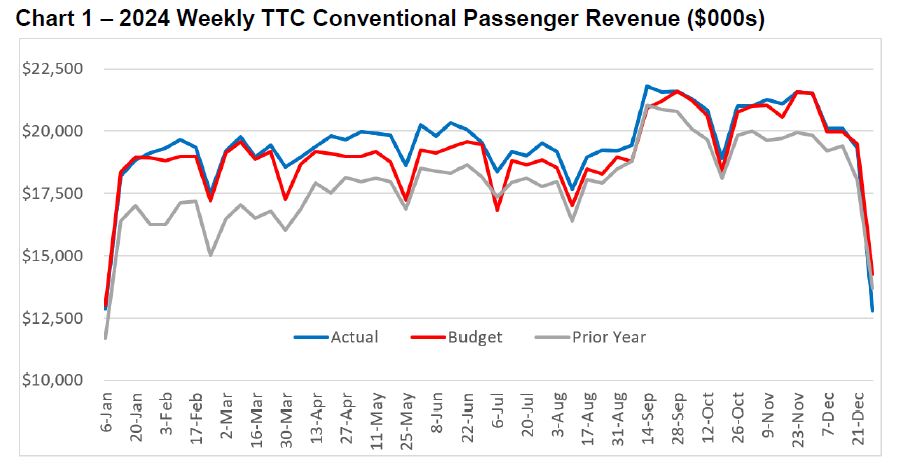
Passenger revenue ran above budget for much of the year, but an anticipated jump in fall 2024 did not materialize to the same extent expected and revenues fell back to budgeted levels. The spread between 2023 and 2024 also narrowed later in the year. As there was no fare change, this directly reflects a slowdown in ridership recovery.
Transit Network Expansion
The Transit Network Expansion report gives an overview of the status of several projects. Readers who want the gory details can read the full document for themselves. The map below does not include provincial projects that are under study, but not yet part of their plans.
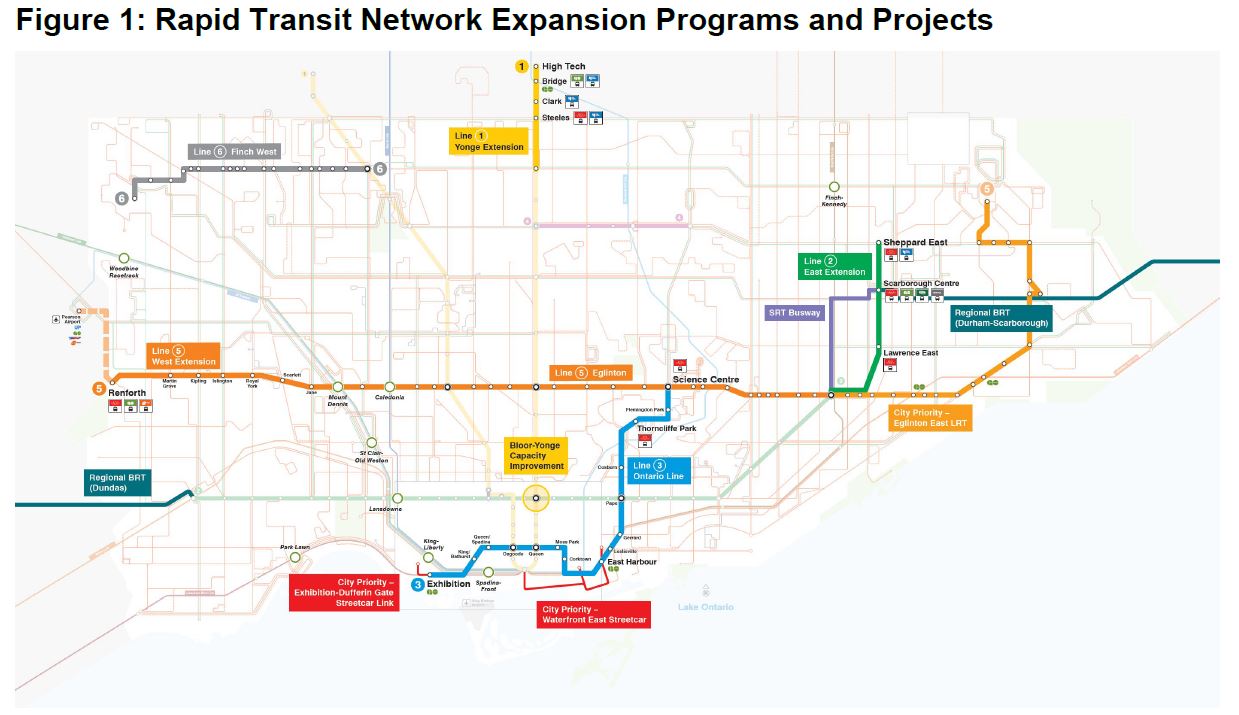
Here are the highlights.
Scarborough Subway Extension
When the Scarborough Subway Extension (SSE) project began, Metrolinx announced that its 7.8km tunnel would be bored at 10-15m/day. In other words, the work would take from 1.4 to 2.1 years. The website for the contractor Strabag still claims that completion will be “by autumn 2024”.
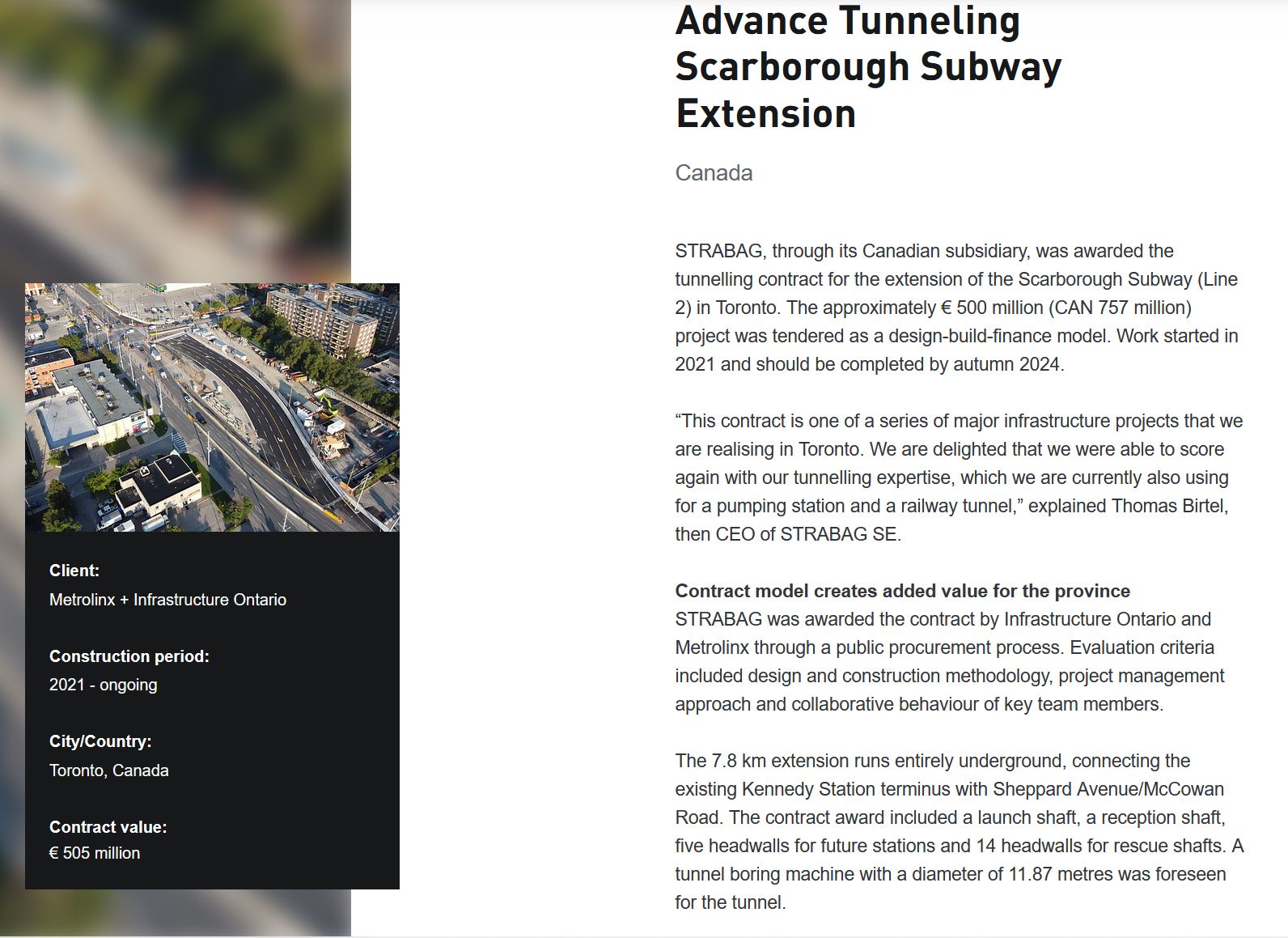
According to the TTC report, things have not gone quite so well:
The tunnel boring machine (TBM) was launched on January 16, 2023 from the launch shaft at Sheppard/McCowan. Approximately 1.1-km of tunnelling was completed at the end of 2024 and 6.9-km remains to be completed as part of the SSE Tunnelling Scope. As per the updated tunnelling schedule, completion is in July 2026. [p. 19]
As for the complete project, it is hard to believe that it can open in 2030 as announced when the tunnel is at least two years late.
Originally Toronto had planned to have the SSE open by 2026, and fleet plans reflected this. Contract award for new trains was expected in 2022. If the schedule in the current RFP holds, this will not occur until 3Q2026 with trains to begin arriving in 2030.
In previous articles, I have written about issues with Line 2 fleet planning and related projects. A project to replace the fleet that should have been well underway years ago was delayed by TTC management, likely with the support of then-Mayor Tory, to reduce capital budget pressures. Now the project, together with a new Automatic Train Control system for Line 2, is back on again.
TTC was saved from dawdling on subway capacity, fleet replacement and Line 2 ATC (Automatic Train Control) both by the covid ridership drop and by SSE project delays. Projected demand is estimated to be within planned fleet and maintenance/storage capacity, but one cannot help thinking this estimate conveniently fits TTC plans. The City is refining demand projections out to 2051. Peak demand on L1 is expected to grow very substantially thanks in part to the Richmond Hill extension, but on Line 2, not so much.
One piece of good news about the SSE is that the TTC and Metrolinx are now working on inclusion of the extension in the TTC’s Line 2 ATC project. For a long time, plans for the SSE were based on a temporary, old-style block signal system that would be a throwaway once the inevitably extended ATC beyond Kennedy Station. This approach would have limited service frequency on the extension and would likely have “baked in” the need for alternate trains to short turn at Kennedy eastbound.
Discussions are ongoing between the TTC and Metrolinx about facilities for subway-to-bus transfer capacity and configuration.
- At the new STC station, the number of bus bays Metrolinx proposes (11) is well below the number the TTC prefers (17) to avoid platform and vehicle congestion with routes sharing loading areas. Metrolinx’ position is that the constraint is related to development plans at the station site.
- At Sheppard-McCowan station, there will be a regional terminal for TTC, York Region and Durham Region services. This was originally to be outside of the fare control area, but Metrolinx has now agreed to putting the loop inside the area. This no doubt relates to the now-integrated regional fares available with Presto.
- At Lawrence East station, there will be a combination of on street and in-station bus transfers. All of these will be outside of the fare control area.
Yonge North Subway Extension
As with the Scarborough extension there is a requirement for more trains both to serve the extension and to provide for expected growth in demand. The growth trains and new maintenance yard are currently unfunded projects.
At the April 2025 meeting, the TTC adopted this recommendation:
Endorse the Line 1 Growth Trains and a new Line 1 Train Maintenance and Storage Facility as priority projects for funding under the Canada Public Transit Fund and direct the Chief Executive Officer, Toronto Transit Commission to work with the City Manager, City of Toronto on a complete submission and prioritization of transit projects for funding through future funding streams of the Canada Public Transit Fund.
This takes another bite out of the limited federal 10-year funding pool and pushes other projects back in the queue.
Station designs are an issue on this extension too:
- At Steeles, Toronto, York Region, Markham and Vaughan all want a a centre median bus platform that would be part of a future Steeles BRT. Metrolinx has advised that it will not provide one. The TTC has asked that the option not be precluded by the station design.
- At Cummer-Drewry, a station desired by some Toronto Councillors, there is no funding for a station. It is not clear whether the extension will be built with provision for a future station much as a “Park Home” station provision was made on the Finch extension. That provision became “North York Centre” station.
Ontario Line
Although this will be an automated Metrolinx operation, TTC will be responsible for “revenue protection, safety and security, customer interfacing, and the network control centre”. Details of these arrangements, not to mention what happens when the inevitable shuttle buses are required to address an emergency or system failure, are still in the works.
Eglinton East LRT
Planning for this line is still underway, but it is hamstrung by construction conflicts with the SSE at Kennedy Station, and a question of where the maintenance facility will be located. Property on Sheppard at Conlins that was originally thought to be a possible MSF is now snared in planning for a possible subway extension of Line 4. A property near UTSC was also mooted, but the University eyes the land for its own uses.
Work on the 30% design is underway through to 2027 and “the initial phase of the work for 2025 is expected to focus on intersection and roadway design”.
Waterfront East LRT
Design work continues on this, but we are unlikely to see much progress soon due both to funding problems and conflicts with other projects notably for the connection at Cherry Street. The extension east and north to Broadview is not even beyond very preliminary sketches even though in theory there will be a major hub at East Harbour Station including a Broadview streetcar connection south from Queen to the waterfront at Commissioners Street.
The project has three segments with the first being the reconstruction of the Bay Street tunnel for added capacity at Union Station.
The TTC is currently not advancing the scope of work for the Segment 1 component, which provides the required capacity and operational improvements to the Union Station Loop, pending further funding commitment and approval, as the procurement strategy for Segment 1 will require full funding commitment for this segment to proceed. [p. 3]
The 60% design for segments 2 and 3 on Queens Quay to Villiers Loop is underway by Waterfront Toronto. For several years, this has been referred to as a BRT facility with the capability of upgrading to LRT. The next report on this project is expected in early 2026.
The in service date for the WWELRT is shown as 2030-31, but this should be taken with a large grain of salt unless all governments suddenly “discover” the importance of this link in the network.
Waterfront West – Exhibition Loop to Dufferin Loop
Design work on the proposed link between Dufferin Street and Exhibition Loop is on hold because of potential conflicts with the Ontario Line.
RapidTO
Transit lanes on Dufferin and Bathurst have been approved by Council as a support for the FIFA games in 2026. Consultation on the plan begins soon. See: RapidTO Dufferin and Bathurst Streets: Public Consultation May 2025.
Sheppard Subway Extensions
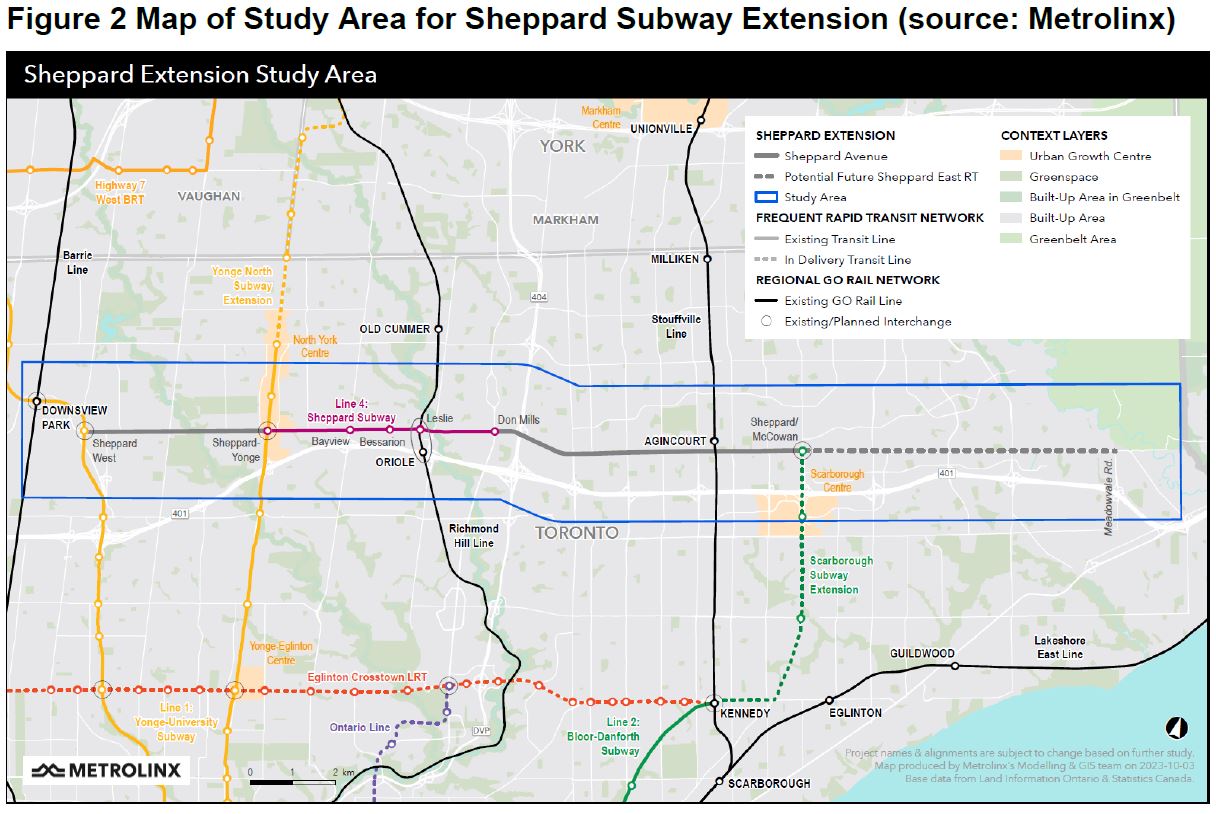
A study of possible extensions of Line 4 Sheppard west to Line 1 and east to McCowan or beyond is now underway by Metrolinx. Depending on the length and service level for an extended line, there will be a need for additional train storage and maintenance capacity, and this could conflict with land requirements for an LRT yard for the Eglinton East LRT and a possible Sheppard East LRT.
Strategic Planning Committee
The Board approved a report establishing a Strategic Planning Committee (SPC) comprised of Commissioners Bravo (chair), Jagdeo, Mihevc, Myers and Saxe. The Committee will have an advisory role:
The SPC will provide advice and input into the development of the TTC’s long-term plans related to
customer retention and growth, and long-term demand growth, with an aim to prepare the TTC for
the future.
The wording in the Terms of Reference has the feeling of careful word-smithing to avoid stepping on toes or giving the impression that the Committee will have too much power in its own right. Specifically, they will:
- Provide guidance and direction in the development of an updated Ridership Growth Strategy.
- Provide guidance on service, fare and customer experience initiatives.
- Provide advice and insights on emerging priorities, scenarios and critical issues for the TTC’s annual budget process, including evaluating new opportunities, assessing risks, and ensuring alignment between financial resources and opportunities to grow ridership in the immediate and long-term.
The contribution to an updated Ridership Growth Strategy will include:
- Review of proposed public consultation frameworks;
- Receiving data and analysis on scenarios, options, resource and asset requirements, and costs;
- Input on key performance indicators on customer satisfaction, service productivity, and ridership growth.
Thanks to the delay in establishing the SPC, the opportunity for input to the 2026 budget process has been shortened, and we could well not see proposals for changes such as new service and reporting standards until next year. In turn, they would not inform budget planning until the 2027 cycle that would begin roughly in mid-2026.
An important component of any planning exercise is to understand where the system is today. To that end, the SPC should direct staff to begin assembling information such as ridership, service reliability and crowding at a granular level. There are other rocks worth looking under, and this is only one, albeit large, example of what might be done.
The worst “strategy” would be to say “we can’t do anything now and so let’s wait for next year”. That attitude has guaranteed that nothing happens with policy or strategy because it is always “too late” to get into the current cycle. We cannot have an informed debate about transit’s future without information about and evaluation of options. Moreover, 2026 brings a municipal election with the inevitable distraction for all politicians who may be “too busy” to think about 2027.
Looking beyond “next year” requires that Toronto decide what it expects the transit system to be, the kind of city it will actually support. This is not achieved just by replacing diesels with eBuses one-for-one, with a few priority red lanes, and a few subway lines that will not serve the majority of travel demand across the city. Those may offer plenty of photo ops, but they do not make a change riders can see and feel to change their attitude about transit, let alone attract substantial shift from car travel to TTC.
As I write this on April 28, no meeting of the Strategic Planning Committee has been announced, and it does not have a presence on the City’s meeting management website.
 Steve Munro
I’ve always been shocked with the lack of sub committees, advisory committees and expert committees at the ttc. According to the website there is only one – the accessibility advisory committee…now two…but council has dozens, with mandatory numbers of meetings etc.
Off the top of my head they should have publicly meeting committees for:
1) safety and security
2) major projects
3) audit
4) budget
5) modernization and innovation
6) accessibility
7) service planning, levels and delivery
8) wayfinding and communication
Many of these should be staffed by only one or two councillors and the rest by experts or citizens. Advice should flow through the ttc board, which should be councillors only. This would give a much higher capacity for detailed analysis and public input.
LikeLike
SSE? Was this not the showpiece for magnificence and efficiency in design and engineering with its large single bore tunnel?
LikeLike
Hi, Steve. Does SSE stand for “Scarborough Subway Extension”? If would be helpful (to me, perhaps to other readers) if the meaning was spelled out the first time the acronym was used.
Thanks.
Margaret
Steve: Yes, it does. And, yes, I should spell acronyms out on first use as not everyone knows or remembers all of them.
LikeLike
Once again, Steve has made a thorough budget analysis where the TTC management and Board have failed to do so.
A crucial exercise, after all the forecasting, planning, & budgeting, is the variance analysis. Without sufficient granularity, a sufficient explanation for differences is difficult or impossible. Without that, a remedy for many problems is unlikely.
With that in mind, is management making fools of the Board?
Considering that the Board meets monthly or so, variances should be reported & explained for the previous monthly period, not quarterly or year-to-date. This means that TTC management must come to Board meetings prepared to explain current variances in detail, instead of claiming that the data is not at hand , and then letting the matter get forgotten.
A different concern I am reading here is that Metrolinx is constantly interfering with TTC planning, building, and operations.
Steve: As you know from my many route behaviour analyses and other commentaries, there is a pervasive problem with TTC management consolidating data over a wide range of times and locations into a single number. This simplistic approach hides what riders see on a day-to-day basis. I know that there is a desire to improve TTC metrics and reporting, but it will be an uphill battle. This is the sort of thing that should show up in the monthly Metrics report (formerly part of the CEO’s report) with lots of detail.
LikeLike
Can you do an article on the (mis)utilization of 600 series rad buses?
Also, what are they planning on doing with the McCowan srt yard?
Steve: Some time ago, I attempted to figure out what the 600 series RAD buses were doing, but from the tracking data it was quite difficult as they did not report any assigned route/run number. Looking at vehicles that had those characteristics, I found they spent a lot of time sitting in subway stations doing nothing. The bright light in all of this is that the TTC has been reducing the number of 600s and, I believe, hopes to get rid of them eventually. Right now they are just soaking up spare operators pending opening of lines 5 and 6 and the associated bus route changes. They were Rick Leary’s catch-all answer to service problems, but management could never prove that they did anything particularly useful. And, of course, the Board never asked.
As for the McCowan property, its fate is not yet decided.
LikeLike
RAD vehicles show up as ADDED trips in the BusTime GTFS real-time feeds. Here are the top ten routes that had them in April from TransSee tracking.
501 | 1838
100 | 908
512 | 782
509 | 698
7 | 544
43 | 406
29 | 404
32 | 400
53 | 368
47 | 367
Steve: Yes, they show up in the archival data too. What does not show up are the vehicles/time spent waiting for something do to. Buses are being effectively scheduled as extras, but are still called RADs (Run as Directed) which is something of a misnomer compared to their original deployment.
LikeLike