
The TTC Board met on April 16 with many items on its agenda including a report on Extreme Precipitation Planning.
Anyone living in Toronto will remember the heavy rains of July 2024 and the snows of February 2025. July 15-16 brought 115mm of rain within 24 hours, higher than the 100-year design for storms. From February 8-17, Toronto saw over 60cm of snow accumulation with no melts between storms. This was the highest snow pack in 25 years.
Both of these events revealed shortfalls in both TTC’s and City’s response to extreme weather. They also undermined the credibility of management claims of the transit system’s physical state, and the City’s false claims about snow clearing. The split jurisdiction between TTC and City forces did not help the situation either.
Among the issues raised in the report are:
- The (in)adequacy of drainage on City streets to prevent ponding and flooding of underground structures.
- The (in)adequacy of TTC drains for streetcar tracks, subway tunnels and stations.
- The condition of drainage and pumping systems from inadequate maintenance and deferred replacement of aged equipment.
- The integrity of TTC buildings, tunnels and other infrastructure to prevent or limit water penetration.
- The actual condition of roads that were supposedly plowed versus reported conditions.
- The absence of snow clearing at transit stops.
- The creation of windrows both along curbs and between streetcar and adjacent lanes where the curb lane is not used by autos.
- The failure to remove accumulated snow on transit routes causing repeated cases of parked cars blocking streetcars, and in some cases, buses.
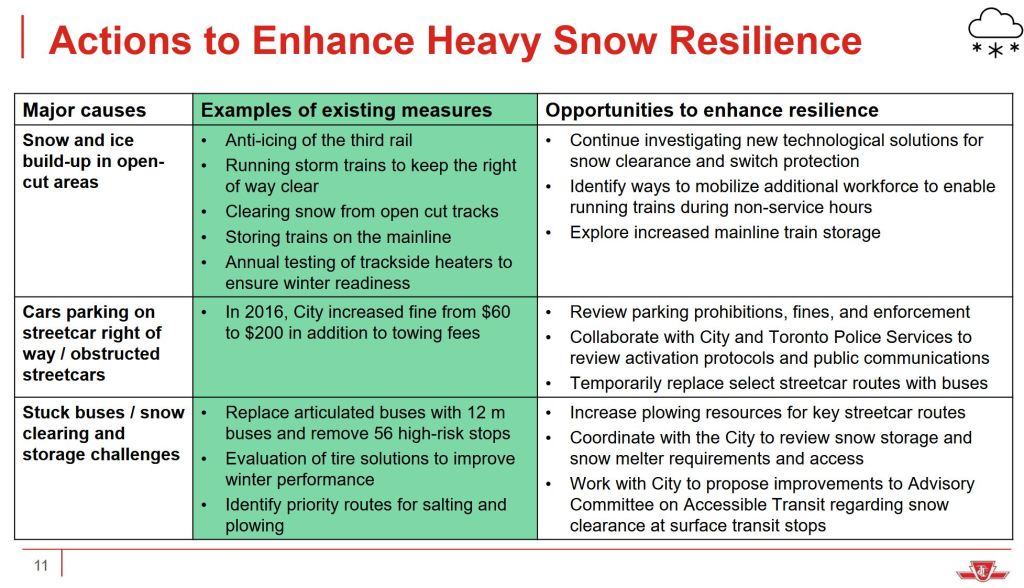
- The TTC’s ability to keep subway open cut areas operational when there is a large accumulation of snow on the tracks and power rails.
- The adequacy and timeliness of public information provided to riders about transit operations during emergency conditions.
Many of these are interrelated. For example, if snow were actually cleared to the curb on four-lane roads with streetcars or buses, then autos would park normally rather than obstructing the only other lane available for transit vehicles. If maintenance of drainage and pumping systems (both day-to-day and life-cycle) kept them in working order, then less water would accumulate and potentially block service or render stations unsafe. If passengers could board and alight from transit vehicles with their usual ease, buses and streetcars would not be delayed attempting to serve snowed-in stops.
Among the TTC’s observations is the challenge of operating streetcars and articulated buses in bad weather, particularly snow. How much of this an inherent shortcoming of the vehicles, and how much is the effect of inadequate infrastructure maintenance and snow clearing?
Both from the delay logs and from personal experience, transit vehicles continued to be blocked by parked cars, and stops were blocked by snow, well after the snowfall ended. Some of the snowbanks did not dissipate until they melted. One particularly ironic location was at the southbound stop on Bay at Albert Street, the City Hall stop.
These are not just issues for the once-in-a-blue-moon weather events, but for the general condition and robustness of transit and related city infrastructure.
The report actually contemplates the purchase of spare buses, and possibly a new garage to hold them, to deal with periods when streetcars and articulated buses have operating difficulties. This would present a substantial premium in fleet size, garaging and staffing for these vehicles. One cannot help asking if the same money invested in better service generally would be more productive, combined with more aggressive storm responses when needed.The TTC is silent on the subway (for which bus replacements are completely inadequate even in good weather), and on the extra staff who would have to be available on the off chance of a bad storm.
This ludicrous approach avoids responsibility for making the streets and the transit system as robust as possible in their own right. Elsewhere I have written about the TTC’s bad habit of maintaining a spare ratio for their fleets well above industry targets, and “just buying more buses” would make the problem even worse. It is the kind of response I would expect from a system whose CEO considers crowded buses a mark of success, and months-long slow orders on deteriorated subway track as perfectly normal.
The TTC routinely trots out its list of unfunded capital projects. Critical maintenance such as replacement of pumps for subway tunnels is on that list. This is not a “nice to have”, but essential for safety. However, the problem is not just in capital funding, but under-resourcing of routine maintenance, an operating budget issue. We know the effects this brought to subway and SRT track. What other aspects of the system are waiting to fail?
The capital budget lines related to extreme weather effects total $1.4 billion of which only $360 million is funded in 2025-2034, mainly in the early years. (See TTC Major Projects Update and Funding Shortfalls for details.)
Extreme Precipitation Effects
The effects of extreme weather include the short-term problems of intense precipitation, and the longer-term issues of storm damage and system restoration to approximately normal operation. There will be lost revenue from lower ridership, but this would be likely simply because riders will not venture out in a storm. The greater problem is the extended effect when the transit system is operating, but challenging to use. During a period when riders would expect a return to normal service, the TTC was unable to provide this.
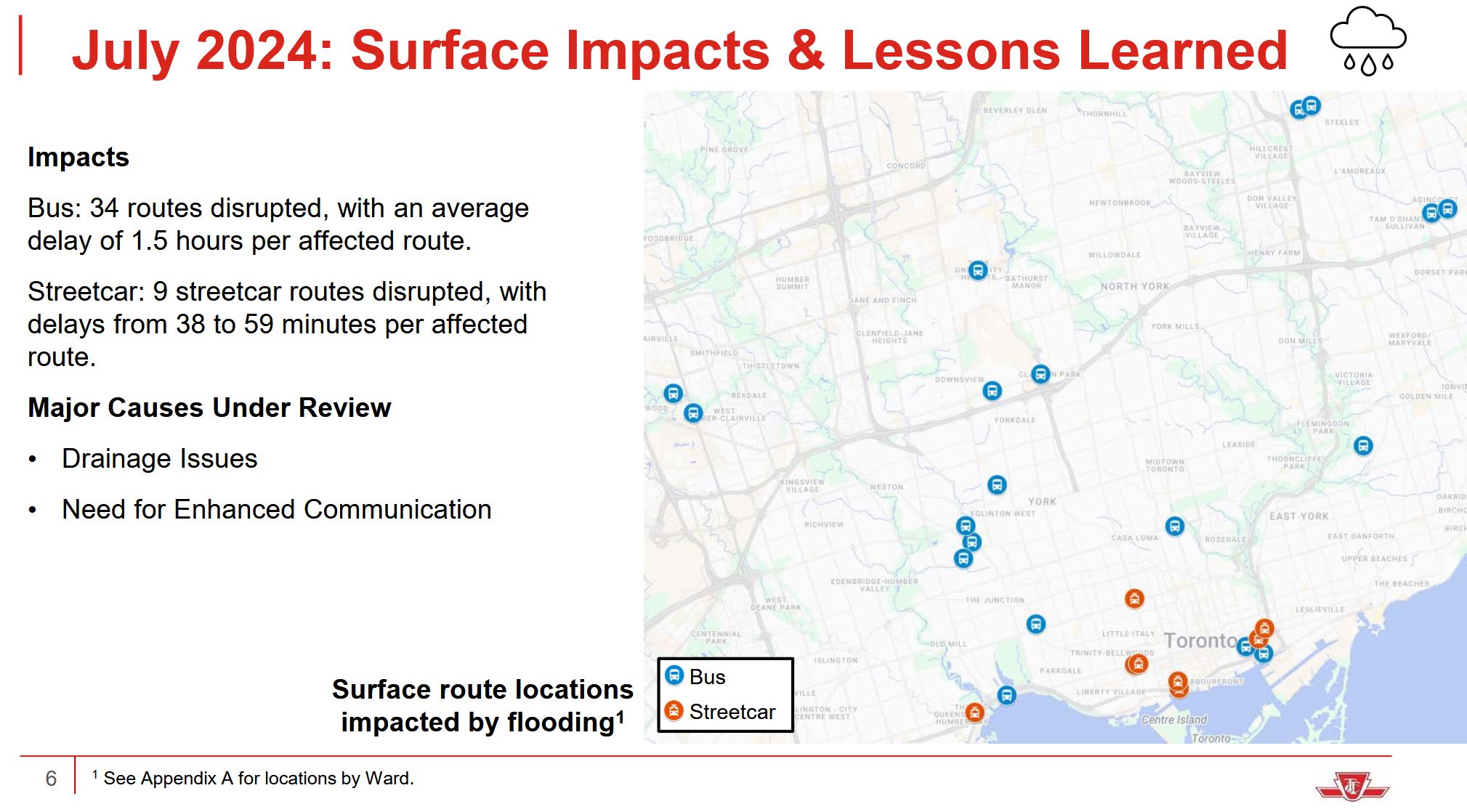
Flooding
In the subway, the report states:
Common causes of flooding observed across several stations were drain blockages, insufficient drainage capacity, water infiltration through at-grade vent shafts, concrete imperfections (e.g., cracks and expansion joints), and water infiltration from adjacent properties. Isolated and location-specific issues observed included:
- Lawrence Station: a failed backwater flow valve and water infiltration from the station entrance.
- Union Station: insufficient drainage in the electrical room and overflow from adjacent properties and catch basins. [p. 4]
Some of these items are a matter of design, some are the result of inadequate inspection and maintenance. Note that this affects both the Operating and Capital budgets.
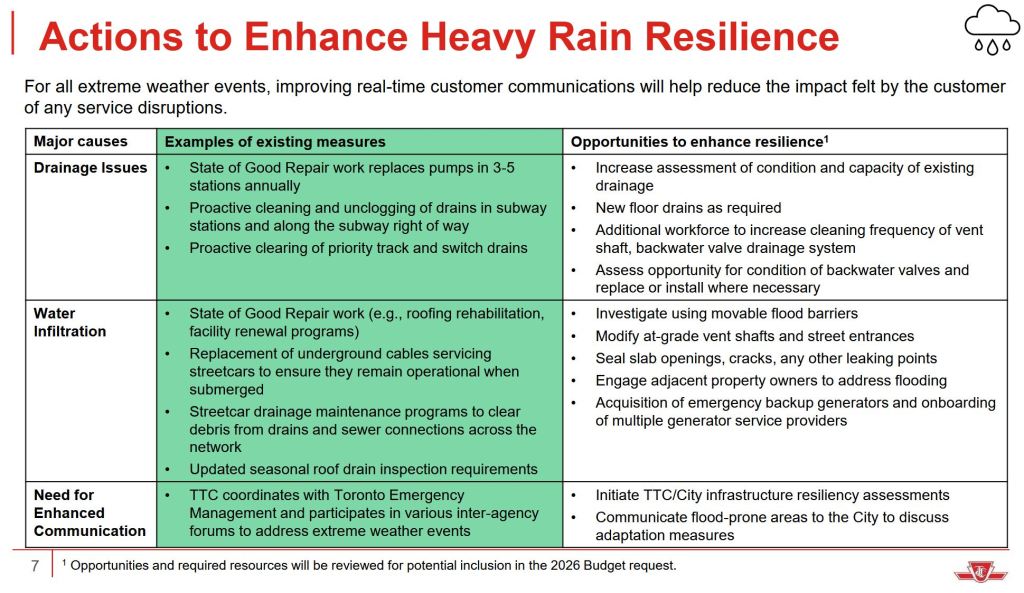
[…] neither the Subway Station Drainage Program nor the Subway Infrastructure Drainage Program, are currently able to conduct drain cleaning at a sufficient frequency to proactively unclog drains prior to anticipated heavy rainfall events. Many of TTC’s assets are past the end of life and not proactively maintained. Investing in SOGR is essential to reducing their vulnerability to extreme weather events.
[…] inspections and replacements associated with the Storm and Sanitary Pump Replacement Program require power shutdowns and consequently can only occur during non-revenue hours. ROW time restrictions and partial funding have resulted in 60% of pumps operating over 20 years past the expected end of life.
[…] there are interdependencies involving the City’s ROW and associated stormwater infrastructure over which the TTC has limited control. For example, the City’s drainage system often reaches capacity, preventing water from TTC’s sump pumps from flowing into it. [p. 13]
In the presentation accompanying the report:
[…] the Subway Pump Replacement Program is partially funded. 41 (14% of all) pumping stations are in poor or very poor condition. An asset or system in “poor condition” exhibits serious defects while continuing to be safe to operate/maintain, with questionable remaining service life. An asset or system in “very poor” condition has one or more serious defects that affects operation, has failed, or is no longer operational, and is near the end of service life or obsolete. [p. 3]
On the streetcar system, flood effects included leakage into vehicles and blockages by stranded autos. There are several areas in the city that are known to flood. This is a matter of local topology coupled with the difficulty of removing water from low-lying points. However, the report also flags the need for emergency generators and monthly inspections of battery-powered equipment to ensure it is actually charged.
The bus network was similarly affected by flooding and by loss of power at some garages. Backup generators were used and the report notes that permanent emergency backups are planned as part of the eBus project.
Snow
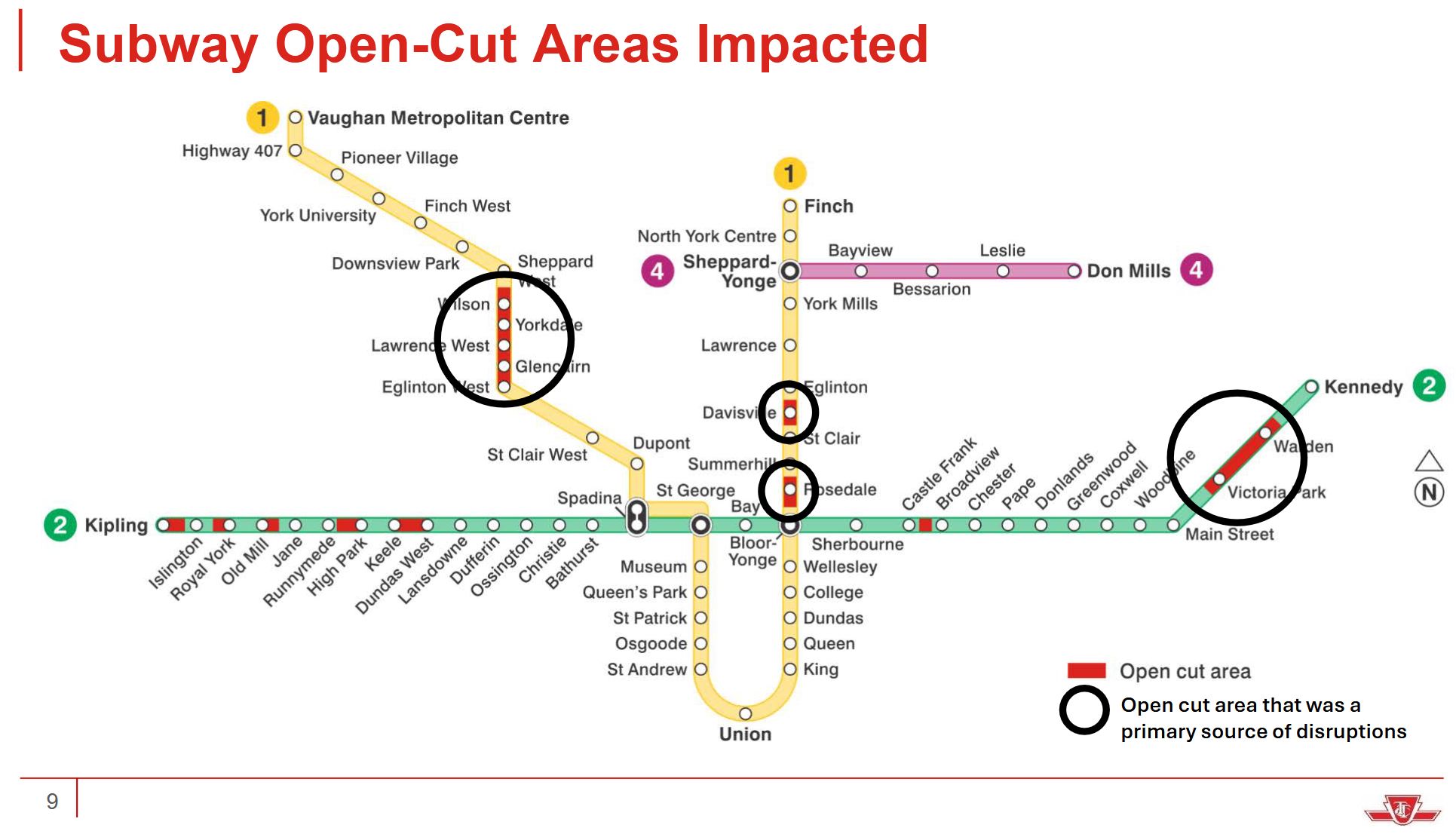
The subway was severely affected by snow accumulation in open areas along the routes and in yards:
Subway service was halted on Line 1 from Lawrence to Bloor for 18 hours, primarily due to loss of traction power from excessive snow accumulation. Delays continued on Line 1 for an additional eight hours after the snow had stopped falling due to blowing snow from the adjacent open field at Wilson Yard. Service on Line 2 was halted between Woodbine to Kennedy for 18 hours.
The most common causes of delays and turn backs were slippery rail conditions and snow and ice buildup on infrastructure components. The back-to-back snowfall events caused snow accumulation that outpaced removal efforts along the open cut sections of Lines 1 and 2. Limitations to TTC’s snow clearing abilities were primarily due to operators reaching their maximum working hours under ESA, limiting the number of storm trains in operation. Another cause of delays was limited space on the mainline for train storage, resulting in delays during the re-start of service. [p. 6]
As snow accumulates around the rails, there is a special problem with the power rail where ice can form due to melt/freeze of snow when the power draw of a passing train warms the rail. A similar problem, but to a much greater degree, bedeviled the SRT. Snow and ice buildup can also interfere with the operation of switches and, on line 2, with train stops where trip arms must raise and lower depending on signal indications. (Line 1 no longer uses this type of signal equipment.) Parts of the open cut areas have room for snow to be pushed aside, but some are hemmed in.
Streetcars
Streetcars suffer from problems with snow and ice build-up in some ways like the subway, but power comes from an overhead wire and the challenge is simply to keep it clear of ice. The ability to do this depends on the temperature. Snow and ice buildups can also affect track switches, and flooding can foul the electric track switch circuits.
However, the TTC identifies the two primary causes of streetcar delays in the past winter as autos fouling the tracks, and the lack of storage space for snow. [p. 7] Snow storage also affected the ability to clear streetcar yards. The Obico Yard property (future western subway yard site) was used for snow storage, but it will not be available when this is redeveloped for future TTC uses.
The TTC observes that higher fines are already in place for blocking streetcar tracks, but it is not clear that these fines will have meaningful effect if cars are not ticketed and towed. Toronto has a bad habit of expecting a bylaw to magically take effect with minimal enforcement.
Toronto’s Municipal Code provides that TTC Route Supervisors and members of the Transit Enforcement Unit can enforce municipal by-laws including ordering towing of offending vehicles. However, they must be “certified by the Chief as competent” for these functions. TTC management has not requested such certification, but there is a clear desire by the Board that they do so.
Buses
Buses did not escape problems from the snow.
Most delays (40%) were attributed to buses stuck in snow. An additional 30% of delays were due to bus collisions, while 20% were a result of bus diversions caused by blocked roadways. The remaining 10% of reported incidents included route cancellations, suspensions or turn backs due to heavy snowfall, collisions with stationary objects, and a singular case where a bus was unable to climb uphill.
The biggest challenge for reliably operating the bus network was interdependence with snow clearing and removal along roadways. Additionally, the significant amount of shuttle buses required to replace subway service, along with the need to substitute articulated buses with standard (12m) buses, and deploy buses for those stuck in snow, limited the availability of both buses and operators.
Accessibility
This report is a rare occasion where the TTC accepts that accessibility is affected by conditions in which the transit system operates. Problems that should last only for the immediate duration of an emergency stretched into days or weeks because of inaction.
Extreme weather events have a disproportionate impact on vulnerable communities that rely heavily on transit, especially surface (bus and streetcar) transit modes. Residents in these communities often have less flexibility for remote work or alternative arrangements for access to essentials such as grocery stores, schools, medical appointments, and daycare during extreme precipitation events and depend on transit services. Additionally, there is a financial strain on TTC riders in vulnerable communities who have already purchased monthly passes and may suffer additional financial burden by seeking alternative transportation options.
Furthermore, individuals with reduced mobility and people with disabilities can be severely affected during precipitation events, particularly when snow and ice are not cleared from sidewalks or when pooling water obstructs pathways, making navigation hazardous or impossible. [p. 2]
We know all of this, but one wonders why nothing was actually done to address the problems. Access to stops can be blocked in various ways:
- Snow from road lanes is plowed in a windrow along the curb making access to/from the sidewalk impossible. In many locations, these windrows were dug out not by City or TTC, but by locals including merchants. The gap might be barely enough for the width of a bus front door forcing single door loading and slowing service.
- Snow from the centre lane (streetcars) is plowed against a bike lane or “bump out” in the sidewalk into what would otherwise be a curb lane.This snow barrier would prevent access to streetcars or buses stopped in the centre lane. Examples were seen on Richmond (with a bike lane between the streetcars and the sidewalk), on Wellington, King and Roncesvalles (all with extended sidewalks at transit stops). On Richmond, this was compounded by a windrow between the curb (bike) lane and sidewalk making a double obstacle to transit access.
The City is supposed to have jurisdiction for clearing transit routes, but making clear and safe access for riders does not appear to be a priority.
Current snow clearance procedures for surface transit stops and pedestrian crossovers involve salting and plowing operations triggered by 2 cm or more of snowfall. The maximum time allowed to complete one round of these operations is 12 hours. [p. 8]
The delay in clearing stops, if this was done at all, measured in days, not hours.
Finally, note that barriers created by snow are not just an issue for those with day-to-day mobility challenges, but for everyone attempting to use the transit system. Clearing these barriers as quickly as possible should not be portrayed as a special effort for a small group of riders, but an essential part of transit service and safety.
Communications
The TTC’s ability to communicate service changes to riders is hampered even under good conditions by limitations of some channels (website, active displays at stops, hard copy notices). During emergencies with fast-changing conditions and a flood of information, keeping notices online is challenging, and at times is replaced by a general notice to “expect delays”. This, of course, assumes that riders are able to receive these notices.
Displays in the subway have limited real-estate for notices, and they address only subway service problems. Some stops have next vehicle arrival signs, but these convey only the estimated time a next bus or streetcar might appear. Transit shelters may have large video displays, but there is no provision for these to display notices about service and diversions.
The report, however, speaks mainly about communications between agencies and teams, and the problems of co-ordinating a city-wide response. Citing this as an area for improvements shows that existing channels are not working under the stress of a complex event like a major storm.[map]
Present and Future Actions
The presentation contains two tables summarizing current and future responses to weather emergencies.
 Steve Munro
TTC doesn’t run on time in the best of weather. I see sometimes half a dozen Blue Night Bloor buses going in the same direction at night. TTC should start firing drivers who goof around and contribute to bunching. At night on many routes, there is ZERO construction and almost no traffic and yet the buses don’t run on time, TTC should start firing problematic drivers.
Steve: I plan a review of night service reliability probably in May-June. It is a big problem, I know. The people I would fire are the managers who let this condition persist.
LikeLike
A week after the snow stopped you could still not exit the southbound Dufferin bus at the south entrance to Dufferin Mall. The buses were letting people out in the middle of Muir Avenue. This is a stop at a major mall on a major route!
LikeLiked by 2 people
I think the word ‘inadequacy’ needs to replace ‘adequacy’?
Steve: It could be read either way, but I have changed the wording to (in)adequacy.
LikeLike
Likewise, I was surprised how bad it was downtown. I use the 503 and at stops at Wellington/Bay or Wellington/York, I had to walk along the street after getting off the streetcar because the snow banks were so high.
Steve: Thanks for mentioning these. I will add them to the article.
LikeLike
Raid the various museums (Halton Co Radial, exporail bear Montreal, etc) and get all the antique sweepers and put them back in service. They’ll need pans because they all have poles, but so what? Then the commissions can can at least keep their streetcars in service …
LikeLike
I have noticed many large private property owners of office towers downtown now either shovel or use little tractor plows to push the snow right out onto the road or into the streetcar waiting areas as a default option. There is not even a pretense that they will clear a path and move the snow elsewhere anymore, the direction is now to simply clear their space immediately and dump all the snow onto the road and let the City deal with it.
LikeLike
One thing I wish was possible but for a number of reasons is not, are heated rails.
The issue between VP and Warden in the winter is snow and nowhere to put it.
For technological and cost reasons, this is not practical but you get the theory behind it. Melting the snow like is done on the switches would go a long way to keep things running.
In terms of rain, Warden Station has a bad tendency to flood during every major rainfall.
I recall a couple months ago during a significant rainfall how the mezzanine level of Warden Station was completely flooded. This happens on a regular basis.
I wonder if Swanboats are an option during flooding?
LikeLike
The problem with inadequate snow clearing at transit stops has existed for many years. In fact I would be hard pressed to recall a time when it wasn’t a problem. My local streetcar stop wasn’t cleared until it all melted away a few weeks after the snowfall.
It’s all fine and dandy to acknowledge the problem but if they don’t take concrete steps to address the problem then who cares? We’re still waiting for proper route and headway management but at least we have no short turns!*
LikeLiked by 1 person
The TTC should be given responsibility for the roads on the streetcar network – in their entirety…traffic lights, drainage, poles, pavement, sidewalks, bikelanes, towing and snow clearing…in which case they wouldn’t be able to blame other divisions…and would be entirely responsible for owning the equipment to fully manage snow removal on the routes. Would also do wonders for priority, simplifying poles and street furniture etc.
LikeLiked by 1 person
The comment on heated rails (or switches). In Toronto, we had 1 day in November, 7 days in December, 14 days in January, 14 days in February, 3 days in March, and 3 days in April. On the other days, the heating would be OFF. Also the sun helped melt or evaporate the snow on the tracks, along with the friction of the trains. Something to think about.
Steve: The passing of subway trains causes problems on the power rail because it is heated by the power draw and the melt then freezes. At switches, the issue is packed snow accumulation preventing the points from change position. This can also foul the automatic train stops where they are still used on Line 2. On the SRT, the TTC added heating cables on the power rails where an additional problem was that the dual, vertically mounted rails provided a barrier against which snow could pile. Ice on the reaction rail was a constant problem because of the heat generated by the induced current from the linear induction motors.
LikeLike