
This article was originally published with a title of “February”. It has been changed to “March”.
The TTC’s Audit & Risk Management Committee will meet on March 24 to discuss several items. The agenda includes:
- TTC Internal Audit 2025 Audit Plan and Departmental Evaluation
- City of Toronto Auditor General’s Report on TTC Non-Union Workforce Planning and Management
There is also a confidential update on the Fare Compliance Action Plan, but no hint of what this might entail.
The 2025 Audit Plan includes four areas for review including:
- A review of the TTC’s customer-centric initiatives, performance metrics, and public reporting practices to ensure alignment with customer needs, operational best practices, and global transit standards.
- A review of processes and controls over maintenance and rehabilitation of subway tunnels.
Follow-up reviews include:
- […] implementation of various third-party Hydraulic Leak Investigation Recommendations
The Auditor General’s report covers many aspects of employee management including issues with retention, succession planning, employee satisfaction and complaint handling. There are profound problems with lack of confidence in the internal complaint handling process.
Departing employees gave very negative marks to the management and culture at TTC, and yet for the period from 2016 to 2024 there was no analysis or reporting on data from exit interviews. This is not surprising considering that the CEO during much of this time was not noted for his open, collegial manner, and critical reviews might have been embarrassing.
As a quick overview, there is an Audit at a Glance, but more troubling information is in the full report.
The Auditor General is silent on the number and cost of “resignations” that were accompanied by buy-outs and non-disclosure agreements that occurred throughout Rick Leary’s tenure as CEO. A difficulty in attracting staff would also be affected by a “poisoned work environment” at TTC which became fairly common knowledge.
I was deeply troubled by the Auditor General’s report because it reveals an organization with widespread problems in employee attitudes, and by extension a dysfunctional management-employee relationship. Long-time TTC watchers have been aware of issues, although getting comments on the record has been challenging. The TTC Board should be concerned at how this situation developed on their watch, and how complicit they are in allowing this decline. Any incoming CEO will face challenges to rebuild the esprit de corps within the TTC, on top of the many other problems our transit system faces.
Performance Metrics and Reporting
I have written about the need for new metrics and much more transparent reporting before and will not belabour the issue with a detailed review here. The major points are:
- Design metrics that reflect rider experience, not management targets that hide rather than reveal the quality of day-to-day life on the transit system.
- Avoid averaging that buries variation in all-day, all-route, all-week, all-month summary values.
- Set standards and report service reliability based on vehicle spacing, not “on time performance”.
- Report missing trips and short turns accurately by route and time of day.
- Report on routes, segments and time periods when vehicles exceed crowding standards. Use the official standards, not management’s 2023 relaxed-to-make-budgets-work versions. Track crowding status to resolution by modified service.
- Create a public dashboard for route-level reporting of service quality.
- Report fleet availability based on total vehicles, not on service targets that under-utilize buses, streetcars and trains.
- Segregate fleet metrics by vehicle type, and report actual performance.
- Clarify service additions to report actual improvements in capacity and frequency separately from changes to deal with traffic congestion or to expand terminal recovery times.
Infrastructure and Vehicle Maintenance
Past audits and external investigations have revealed serious problems in maintenance of streetcar overhead, subway and RT track, and subway work cars. There are too many common factors to treat these as isolated issues.
Internal Audit will now turn to tunnel maintenance practices, another major part of the TTC’s infrastructure portfolio. It will be interesting to see whether the quality and thoroughness of routine inspections and maintenance of tunnels has similar problems.
“State of Good Repair” has been a mantra for TTC for decades, but attention to actual conditions has been victim to a culture of just getting by. The focus on big-ticket capital SOGR projects such as new subway cars and buses eclipsed shortfalls in operating budget needs for day-to-day work that keeps the system running and safe.
Audit of the Toronto Transit Commission’s Non-Union Workforce Planning and Management
The Auditor General of Toronto’s report on non-union workforce planning and management covers approximately one quarter of its 16,300 full-time employees. (An audit of the 75% of employees who are unionized sits in the AG’s “to do” list.) This is not an audit of what employees do, but rather of how the overall workforce is managed.
The review addresses these questions:
1) Does the TTC perform effective succession planning for non-union staff?
- (a) When hiring is needed to address vacancies where succession planning was not successful, is it being done in a fair, open, transparent, and competitive manner?
2) Is the TTC proactive in monitoring and addressing challenge in retaining its non-union staff?
- (a) Are there accurate, complete, and timely data and key performance indicators (e.g. turnover rate) in place for measuring, monitoring and decision making for the TTC to ensure it continues to have a sufficient non-union workforce to meet operational requirements?
- (b) What steps are being taken to obtain feedback from employees (including employee engagement levels) and does the TTC have plans and initiatives in place to address any major concerns?
In 2024, the AG’s Office surveyed 4,094 non-union staff and received responses from 1,952, a 48% response rate. Employee attitudes in the AG’s report therefore represent a large proportion of staff, not a few outliers. Some reported findings show a widespread dissatisfaction with the organization. This is echoed in a review of attitudes by staff who left the TTC over the period from 2016-2024.
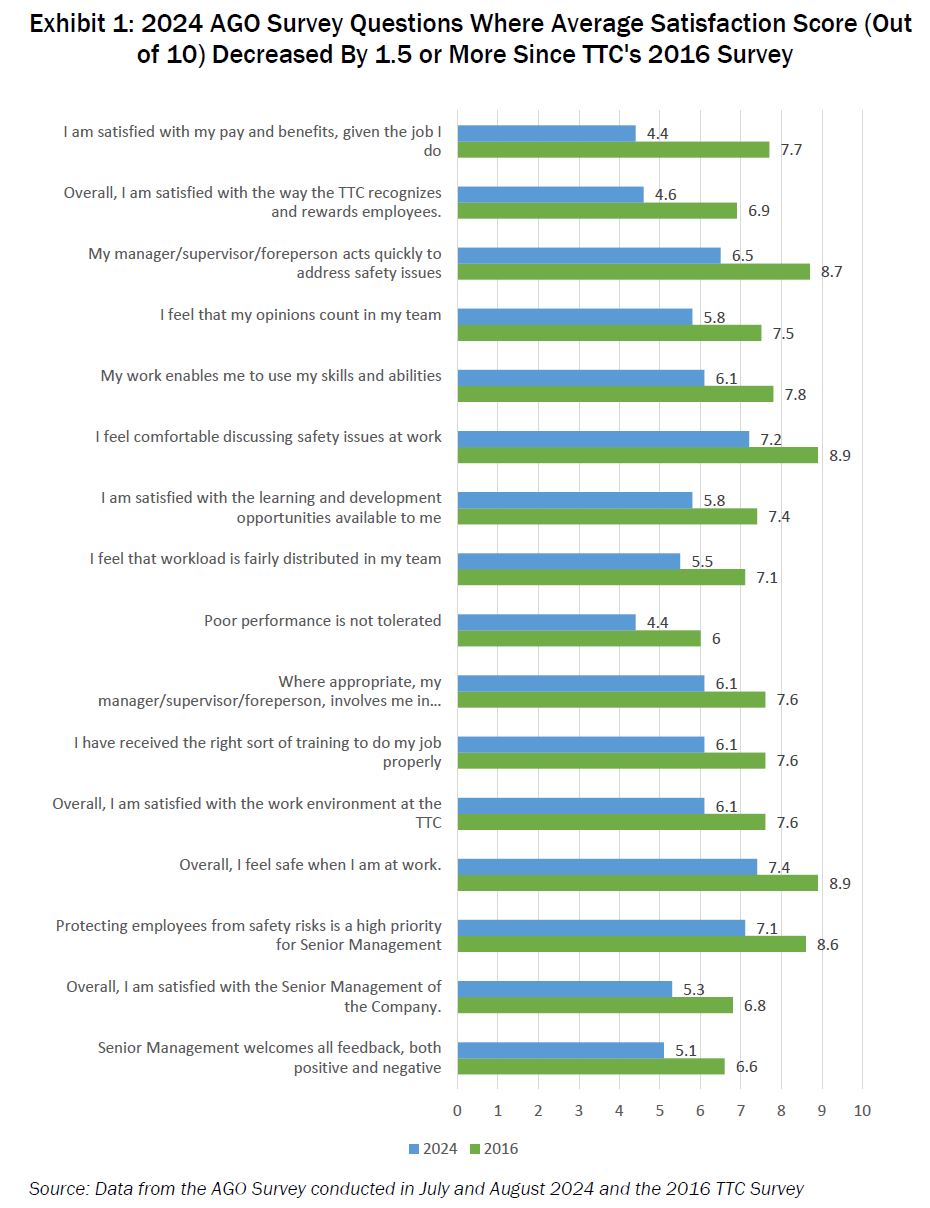
The previous survey was conducted in 2016, and there is an across-the-board decline in satisfaction levels by 2024.
Staff Replacement and Succession Planning
The Auditor General flagged several issues in the TTC’s HR function including a lack of planning for succession and timely replacement of employees. Key Performance Indicators (KPIs) are either missing or insufficiently granular to pinpoint problem areas. (This is not unlike KPIs related to service quality and other issues which take a too-broad view of the organization and mask vital details.)
The AG notes that commonly-used KPIs include:
- Employee engagement score
- Internal promotion rate
- Bench strength (critical role readiness)
- Employee retention rate
- Time-to-fill
- Time-to-hire
A half-hearted attempt at succession planning in one department as a pilot was intended to spread out into the organization, but this really did not get off the ground. The AG Report notes:
Employee Development also developed a variety of tools and support materials designed to help employees prepare for future leadership roles. Although these tools can be beneficial for employees, these are decentralized and mostly voluntary programs, where the employee needs to initiate and advocate for themselves in order to participate. In contrast, a successful succession planning program requires management to identify key positions and develop employees for the specific competencies required for those critical roles.
In the 2024 survey:
… 38 per cent of respondents disagreed with the statement “Senior management are effective in planning the succession needs of the organization.”
Attracting middle-to-senior positions to the TTC is hampered by its pension rules (TTC is not in OMERS like most municipal governments and agencies). The TTC pension allows outward portability to other public sector pensions, but not inward. This makes leaving TTC for another public sector job easy, but is an impediment to those who might join the organization separately from any issue of competitive salary.
When an employee plans to retire, there is no minimum advance notice required. This adds both possible delay and urgency to the replacement process, and potentially eliminates knowledge transfer from the retiree to their replacement.
TTC has had a problem with staff leaving by resignation in recent years, and this echoes the experience elsewhere in the public sector. The analysis does not make any reference to departures under duress with severance payments and non-disclosure agreements.
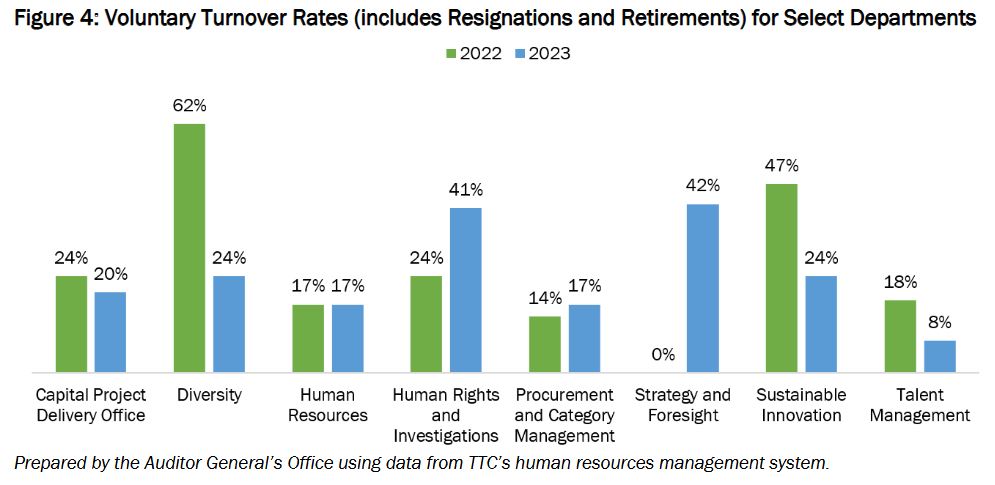
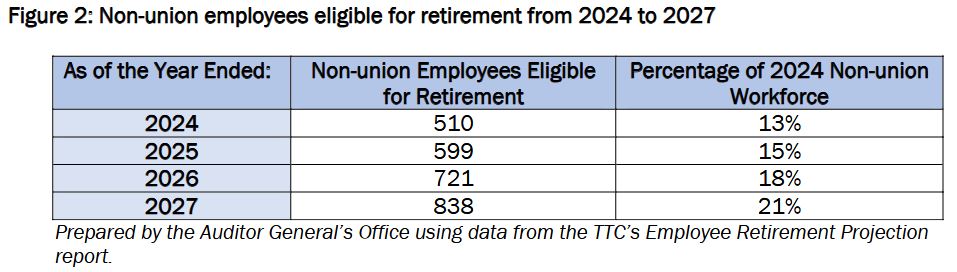
This is compounded by a large portion of the current non-union staff being eligible to retire in the next few years. This represents a huge turnover and potential loss of corporate memory. Succession planning is key.
Re-Employment of Retired Staff
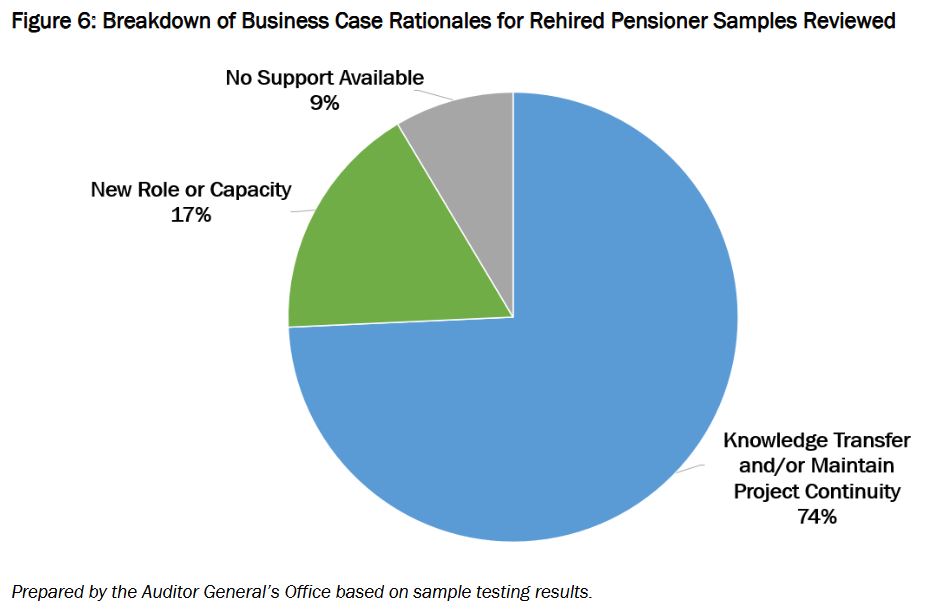
An issue related to the problem of retirements with little notice has been the rehiring of the retired staff supposedly to provide continuity and hand-off. That might be a workable explanation for a short-term contract, but many retirees have stayed on the payroll, sometimes at higher salaries, for extended periods while simultaneously collecting their TTC pensions.
With the scale of potential retirements in coming years, one might well expect this problem to get worse before the TTC catches up to the staffing and training backlog.
The AG flagged many problems with the process for rehiring, the length of term, compensation and review of employee performance. The sense of the report is that this is very much an ad hoc arrangement done for the convenience of the departments and managers involved.
Meanwhile, the policy encourages post-retirement employment as it allows for rehired pensioners to receive both employment and pension income and formalizes the practice of offering pay premiums to rehired pensioners. This results in a financial incentive for employees to retire as soon as they are eligible, which may be earlier than they may have initially planned to stop working, as suggested by the following sample testing observations:
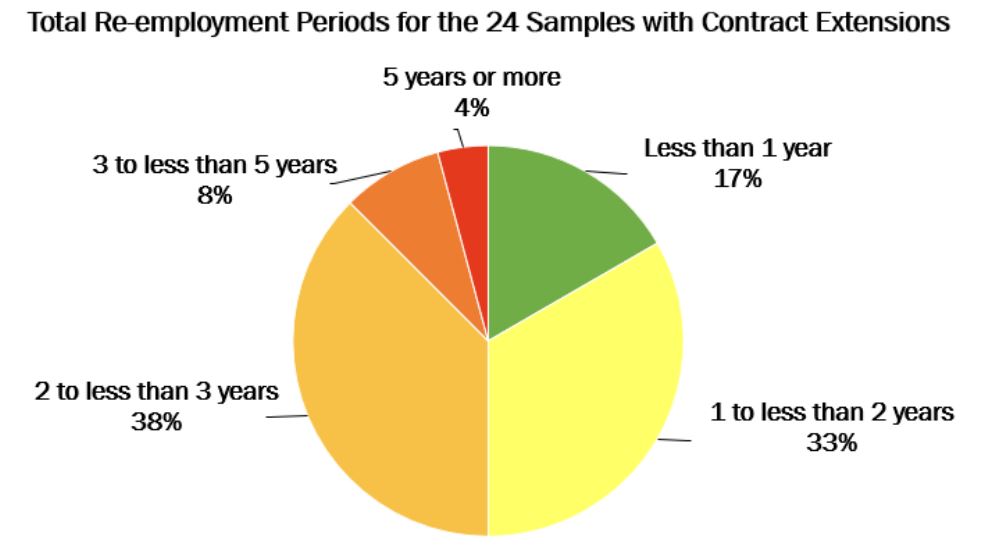
- 58 per cent (18 of 31) of sampled rehired pensioners returned to work within 15 days of their retirement, showing that employees returned to work after only a short period of time after their retirement date.
- 52 per cent (16 of 31) of sampled rehired pensioners returned to work for another 1.5 to 5.5 years after their retirement.
At the time of our audit, some of these employees are still active and their contracts could be extended again. This shows that despite officially retiring, employees continued to work for a long period of time after retiring.
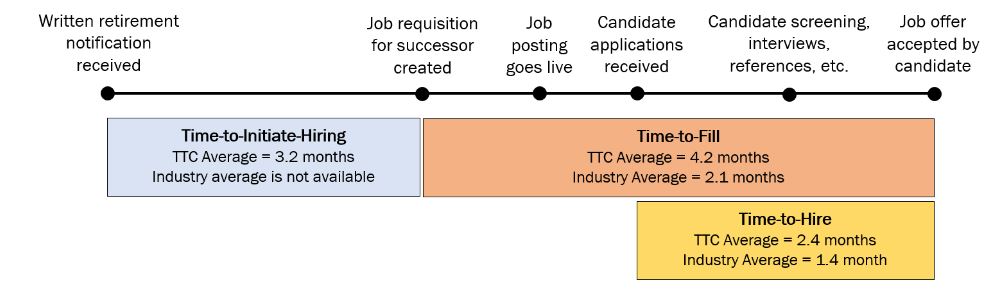
It takes over half a year to replace an employee according to the AG.
Employee Engagement
The Auditor General reports that the TTC does not routinely track employee attitudes to their workplace, and the last such survey occurred in 2016. This was near the end of the Byford era as CEO, and no further tracking was done until the AG’s own review in 2024.
For questions of work relationships with coworkers and immediate superiors, the 2024 results were generally positive, although not overwhelmingly so:
- “My Direct Manager treats me fairly” (80 per cent agreed)
- “I have positive working relationships with my colleagues” (79 per cent agreed)
- “I get help and support from my direct manager when I need it” (78 per cent agreed)
- “I have confidence and trust in my direct manager” (76 per cent agreed)
- “My Direct Manager makes sure I have clear performance expectations” (74 per cent agreed)
However, a comparison of the 2016 and 2024 surveys showed that none of the scores improved, and some declined considerably. The change in staff attitudes to the organization is striking and all headed in the wrong direction. In the chart below, the blue upper bars are 2024 results and the green lower bars are from 2016. The report does not subdivide result by department or organizational unit to explore whether issues are concentrated or general to all staff.
Exit Surveys
No exit surveys were conducted for a 2.5 year period up to January 1, 2023 due to the pandemic. The low organizational importance of this process is illustrated in the report:
We found that there was no evidence of review or analysis being performed on the voluntary exit survey results. TTC management confirmed there is currently no formal written processes or procedures on how exit survey results are to be reported to or reviewed and used by management or the People and Culture Group. The TTC has one dedicated employee who distributes the surveys to departing employees and receives the data, but is still determining how the information will be used and reported going forward.
In the full report, the items listed below are cross-referenced to current employee survey results. [See Exhibit 2, pp 53-55]
- Career-related Professional and Skill Development, Growth and Career Advancement:
- 1 in 2 (53%) respondents stated growth and career advancement played a major or contributory influence on their decision to leave the TTC.
- Almost 1 in 2 (48%) respondents indicated that opportunities for career-related professional and skill development had a major or contributory influence in their decision to leave the organization.
- 2 in 5 (45%) respondents indicated that the degree to which their skills were used in their job had a major or contributory influence on their decision to leave the organization.
- Organizational Culture:
- 1 in 2 (59%) respondents indicated that unhealthy organizational culture had a major and/or contributory influence on their decision of leaving the TTC.
- Almost 1 in 2 (47%) respondents indicated that feeling their ideas and opinions are valued had a major or contributory influence on their decision to leave the organization.
- Company’s Direction/ Future and Executive/ Senior Leadership:
- 1 in 2 (56%) respondents indicated that lack of trust in the executive/senior leadership had a major and/or contributory influence in their decision to leave TTC.
- 2 in 5 (41%) respondents indicated their concerns relating to the company’s future had a major or contributory influence on their decision to leave the organization.
- 1 in 3 (39%) respondents indicated a change in the company’s direction had a major or contributory influence on their decision to leave the organization.
- Work-life balance / Flexible Work Arrangement:
- 2 in 5 (45%) respondents indicated that the lack of flexible work arrangement had major or contributory influence on their decision to leave the organization.
- 2 in 5 (44%) respondents indicated poor work-life balance had a major or contributory influence on their decision to leave the organization.
- Safety, Well-being, and Workplace Harassment and/or Discrimination and/or Violence:
- 1 in 3 (35%) respondents indicated that the psychological safety of the work environment had a major or contributory influence on their decision to leave the organization.
- 1 in 4 (29%) respondents indicated that discrimination towards them during their employment had a major or contributory influence on their decision to leave the organization.
- 1 in 7 (14%) respondents indicated that the physical safety of the work environment had a major or contributory influence on their decision to leave the organization.
Employees seek greener fields either internally or externally, and job satisfaction can have much to do with where they will look.
The 2024 AGO Survey … indicated that 11 per cent of respondents are actively looking for another job outside of the TTC, while 21 per cent of respondents are looking for another job both inside and outside of the TTC.
Complaints Handling
The TTC has three separate groups responsible for handling employee complaints in addition to reports to a manager and via the the Integrity unit and the Whistleblower policy. A problem flagged by the AG is that these groups use different software to track complaints, and there is no mechanism to monitor a complaint if it moves from one investigative group to another.
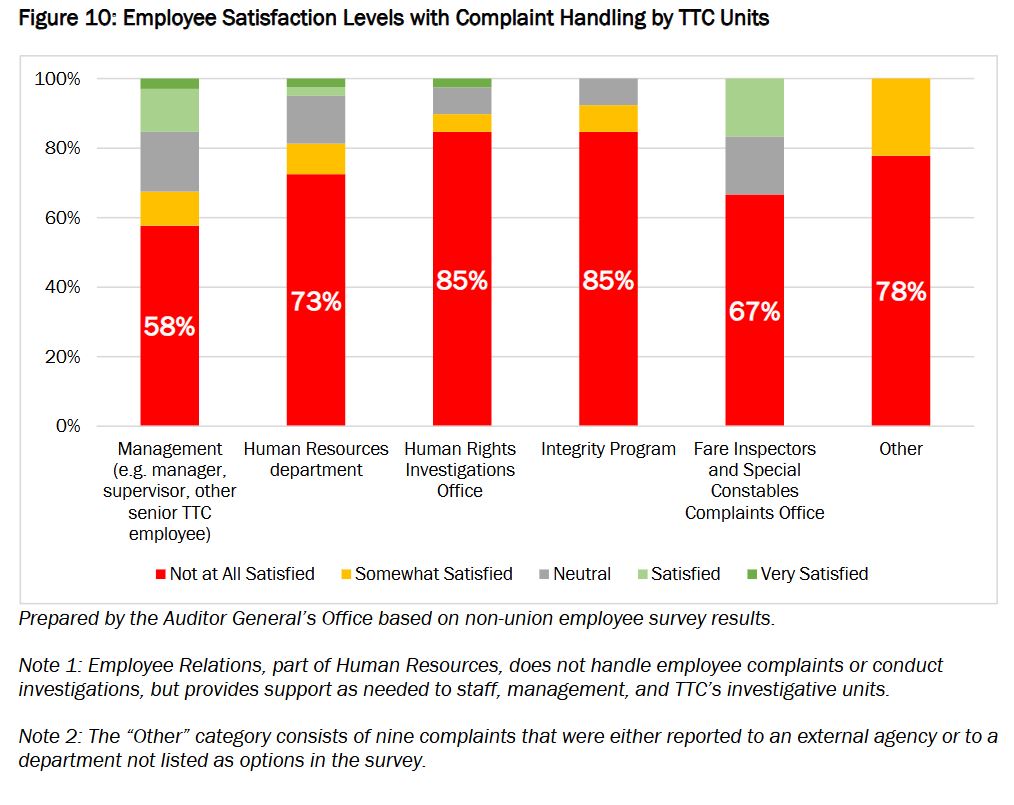
Overall satisfaction with the complaints process is poor with the best result, if one can call “58% not at all satisfied” a “best” case, is for reporting to an employee’s management chain.
The AG survey revealed that employees do not know which route to take with their complaints, and this adds to problems. This system is clearly not organized in the employees’ interest, and the survey results throw management claims of a caring organization into serious doubt.
Several responses from the 2024 AGO Survey indicated that employees are unaware of who to reach out to and when to file a complaint. When complaints are filed with the incorrect unit, the complaint must be transferred to the correct unit, increasing the risk that inter-unit transferred complaints are not addressed in a timely manner or at all.
[…]
The 2024 AGO Survey results show that 60 per cent of survey respondents who brought their matter to someone’s attention said they were not at all satisfied with how the matter was handled, regardless of who or what investigative unit the complaint was reported to. Some responses indicated that their complaint was reported to multiple people and/or investigative units.
Approximately one in five survey respondents (22 per cent or 429 respondents) indicated they experienced workplace harassment, violence and/or discrimination. Seventy per cent, or 300 of these respondents, stated they brought the matter to someone’s attention (e.g., management, Human Resources department, or an investigative unit), of which 60 per cent were not at all satisfied with how their complaint was handled.
 Steve Munro
Is there a link to future TTC board meetings? It’s no longer on TTC website. Thanks.
Steve: The meetings are now on the City’s TMMIS website. If you go here, you will get the current meeting. You can use the dropdown to see the list of future meetings.
LikeLiked by 2 people