
This article continues my review of items from the January 27 agenda with two major reports:
- 2025 Annual Service Plan
- Corporate Plan Update
See also previous articles:
2025 Annual Service Plan
Route Changes
The 2025 Plan has comparatively few proposed changes, and I have discussed these in previous articles when the plan was in draft for consultation. These changes are:
- Extension of 49 Bloor West to Renforth Station. It is worth noting that “Implementation of this change will be subject to ongoing operations and capacity discussions with Metrolinx and other regional partners at Renforth Station.” [Technical Analysis, p. 6]
- Splitting the Belfield branch of 45 Kipling off as a separate 145 Belfield route extended to Viscount Station at the airport.
- Elimination of the 13B weekday midday service south of Queen’s Park to Gerrard
- Amalgamation of 22 Coxwell and 70 O’Connor as a single route 22 to eliminate transfers at Coxwell Station
- Restructuring Etobicoke night service by
- Replacement of 337 Islington (which now operarates from Lake Shore to Steeles) by new routes:
- 345 Kipling from Lake Shore (Humber Polytechnic) to Steeles
- 373 Royal York from Bloor to Steeles & Kipling via Weston Road
- Extension of 353 Steeles west from Pioneer Village Station to Martin Grove
- Replacement of 337 Islington (which now operarates from Lake Shore to Steeles) by new routes:
- Restructuring Scarborough night service by
- Rerouting 334 Eglinton East via Guildwood Parkway
- Extending 385 Sheppard East to Rouge Hill GO
- New 386 Scarborough route from Kennedy Station to Meadowvale Loop
- Rerouting 395 York Mills to align with the daytime 95 York Mills route
- Revising Community Bus routes to better serve their neighbourhoods
- 400 Lawrence Manor: Extension via Wyndale Drive, Culford Road and Lawrence Avenue West to enable connections to a local park, public library and a sports complex
- 402 Parkdale: Route extension via College Street, Dufferin Street and Roncesvalles Avenue to enable connections to retirement homes, community centres and a community health centre.
- 404 East York: Route restructuring by reallocating resources from the existing 404 route to create a revised 404 East York route and a 408 Victoria Park South route. The revised 404 East York route will extend to Main Street, Main Street Station and Danforth Avenue, improving connectivity.
- 408 Victoria Park South (new): To operate via Victoria Park Road, Crescent Town Road, Dawes Road, Park Vista Drive and Eglinton Avenue East, providing better access to apartment buildings and new shopping destinations.
- 405 Etobicoke: Route extension via Scarlett Road and Widdicombe Hill to provide connections to apartment buildings and a naturally occurring retirement community.

“Underperforming” Routes
Two routes were reviewed for modification.
13B Avenue Road to Gerrard
As noted above, 13B Avenue Road to Gerrard, a weekday midday service, was to be discontinued. This was overruled by the Board as discussed later in the article.
The TTC cites low ridership of approximately 110 boardings and 105 alightings at the stops unique to the 13B. The Service Standards set a target of 10 boardings/vehicle hour for bus services.
The 13B service provides 12 trips/day, and the round trip travel time from College to Elm and return is about 10 minutes. That means 2 vehicle hours (120 minutes) are dedicated to this service. With 110 boardings, that is 55/vehicle hour, substantially above the cutoff level for “poor performance”, Moreover, the standards do not consider riders who are already on the buses with trips originating north of College. They show up in the “alighting” numbers, but don’t count for purposes of route review. This is nonsensical.
Moreover, there is no plan to actually reduce bus hours because elimination of the 13B does not save enough time on the overall trip. At best, the mid-day headway could be improved from every 25 to 22 minutes, but there would be no operating savings.
87 Cosburn via East York Acres
87 Cosburn was to lose its off-peak loop via East York Acres due to operational issues from parking (the bus loops through the parking lot) and bad weather (there is a hill on the approach, and the parking lot can be snowy and icy) . The scheme was opposed at the consultation stage, and was dropped, but may be reviewed in the future.
An analysis of customer travel time impacts indicates that the current stop at East York Acres saves approximately 2,016 minutes per week for customers who use it, compared to walking to the next nearest stop. However, the diversion costs through-riding customers approximately 6,863 minutes per week, resulting in a net cost of 4,847 weekly customer minutes. From this perspective, removing service to East York Acres would result in a net benefit to customers.
While the customer travel time analysis supports this routing change, feedback from the immediate community and ACAT opposed to the change. In addition, stop relocation constraints prevent the proposed changes from being implemented. Consequently, this proposal is not recommended at this time, but may be revisited in the future. [Technical Analysis, p. 8]
Analysis of this change used a common TTC approach of pitting the benefit of a faster journey for riders who travel past East York Acres against those who use this stop. There will always be more “benefit” for through riders because they are more numerous, and such an analysis of route “efficiency” is a sure way to dispose of this type of local variation. The change would not affect service levels or operating cost, and to call it “underperforming” is misleading. Yes, there are operational problems, but far from 100% of the time, and the TTC routinely bypasses East York Acres in bad weather as they do many other stops.
Night Streetcar Service
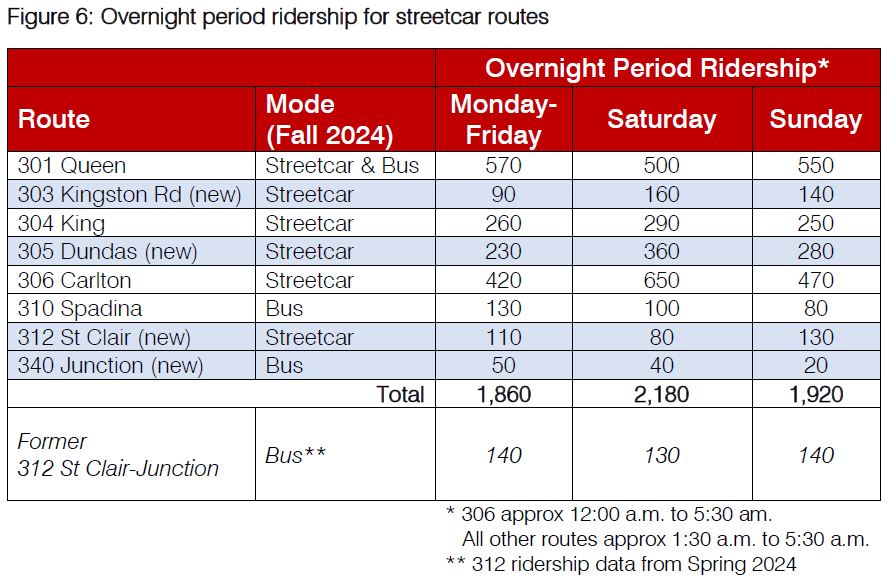
Service on the overnight routes has been improved in recent years as a tactic to deal with carhouse capacity problems. Projects to renovate Russell Carhouse and Yard, and to add capacity at Hillcrest run well behind the delivery of new streetcars. Night cars run more often and new routes were added. The table below shows ridership values.
Values for 301 Queen are intriguing because they are low relative to the route’s length and service frequency (15 minutes).
The 303 Kingston Road car suffers from poor scheduling. Although it duplicates 304 King to provide better service from Roncesvalles to Broadview, eastbound trips from Queen and Roncesvalles on the 303 are scheduled one minute behind the 304 cars coming south from Dundas West Station.
Note that although 306 Carlton has a high count, this includes trips after midnight, rather than after 1:30am.
Another problem with this table is that it does not show the number of trips included in the counts and, hence, the ridership or “productivity” per trip.
Construction Projects
Although there are four major construction projects planned on the streetcar network for this year, the ASP only addresses two of them: the intersection at Queen & Church and related works in the St. Lawrence area, and the intersection at College & McCaul. The plan is silent about planned work on King West including the intersection at Dufferin, and at Bathurst, Fleet & Lake Shore.
For further details, see my article about major infrastructure projects.
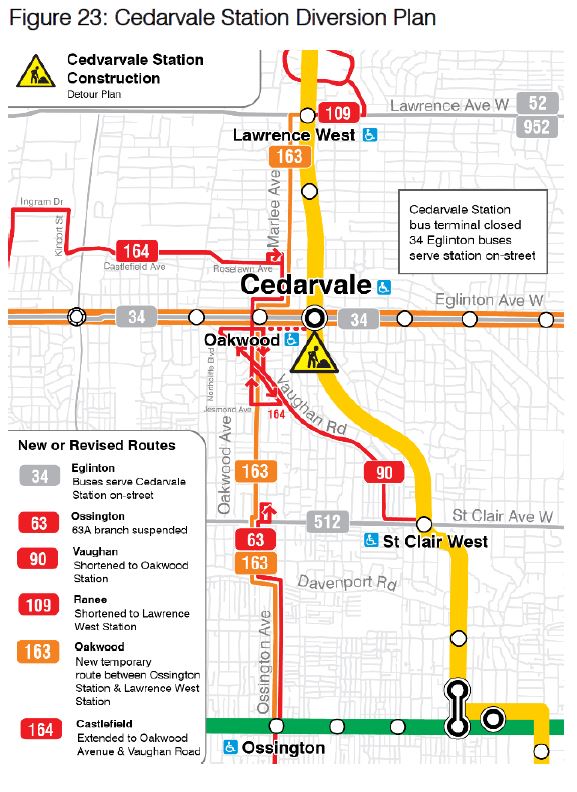
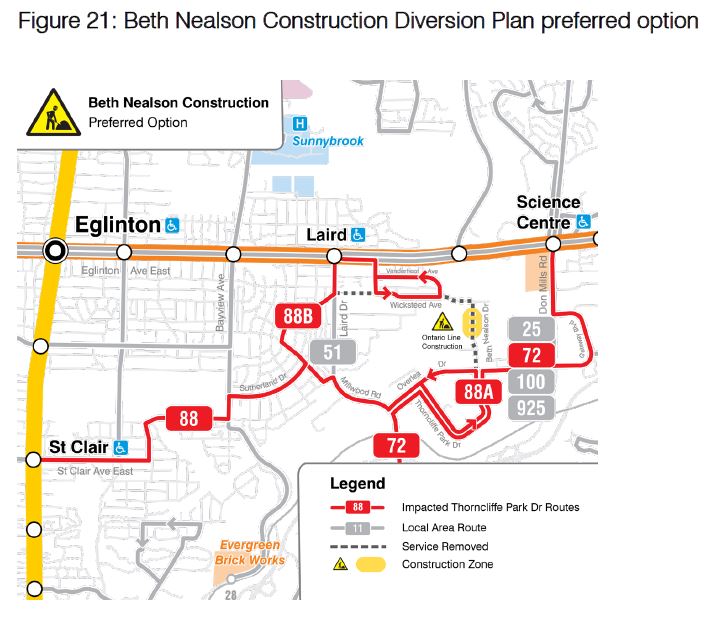
There are two major projects affecting the bus network: reconstruction of the bus loop at Eglinton West Station following the opening of Line 5, and the closure of Beth Nealson Drive for Ontario Line construction.
At Eglinton West (to be renamed Cedarvale Station thanks to Metrolinx’ dislike of “duplicate” station names), routes will be rearranged so that they do not loop there. Route 163 Oakwood, used on a previous occasion, will be used to fill in gaps created by other route changes.
The grade separation of Beth Nealson from the future Ontario Line corridor requires a split in 88 South Leaside which now operates as a loop. A “hybrid” option retains direct service from Thorncliffe Park to Laird & Eglinton with a limited service route 156 Laird. This option depends on budget headroom to operate the service.

Feedback from Operators
Appendix 3 of the plan includes feedback from reviews of the plan conducted at TTC operating divisions. Crowding is a frequent topic raised by those who actually drive the buses and see conditions first hand. How well TTC addresses this problem will be worth watching considering that a gradual return to pre-2023 Service Standards is planned for the next few years.
Streetcar operators noted problems with signalling at various locations where streetcars do not get the priority they should, as well as schedules that do not reflect actual conditions on routes. These conditions are obviously related.
The Service Plan does not list route segments and times where crowding is beyond either current or 2023 standards. Such a list was published many years ago, but became embarrassingly long and vanished. The Board and public deserve to know which areas management considers to be problems, and how quickly these will be addressed.
Technical Analysis of 503 Kingston Road
The plan includes a section reviewing the last round of route changes to determine whether these should become permanent. All but one were confirmed. 503 Kingston Road, which now has all day service between Victoria Park and King/York, was left in an unsure status for future monitoring. The ridership analysis reveals fundamental flaws in TTC standards and methodology.
The route is examined in three ways: ridership on the Kingston Road segment east of Woodbine Loop, ridership between Woodbine Loop and River Street, and ridership on the full route. Because the “new” service on weekdays is only in the evenings, only that period was studied.
The 503 has low boardings per vehicle hour on Kingston Road on weekday evenings. This is not surprising considering that most riding will be outbound from downtown and riders will not be counted as “boarding”. Weekend values are better but not high.
The Service Standards aim for 35 boardings/hour for streetcars, but oddly ask only 10/hour for bus routes even though the relative vehicle capacities are much less than 3.5:1. It should be noted that 6/hour does not even meet the bus standard, but this shows the error of looking at boardings on only a portion of a route where riders will already be on board and will not be counted.
Most routes will have low boardings outbound on their outer ends in the evening. That is the nature of transit demand, and even applies to the subway where demand comes mainly from trips originating downtown, not at the outer stations. A similar analysis might suggest that parts of the subway should be closed earlier, or converted to bus operation.
Ironically, when service on Kingston Road was provided by the 22 Coxwell bus, all riders originating downtown would have transferred onto the bus and counted as new boardings. One rationale for the revised 503 service was elimination of this transfer.
Furthermore, the extended 503 service supplements service on the east end of 501 Queen and 504 King. On Queen from River to Kingston Road, half of the evening service is provided by the 503. On King from Sumach to York, one third of the service is the 503 car.
Service is not well-blended between the 501 and 503 which are scheduled two minutes apart at Coxwell westbound on weekday evenings, and at the same time on Saturday evenings. On paper, this might be two 10-minutes services blended in a 5-minute headway, but that is not how the service is designed. Planned bunching even if service is “on time”!
Stats cited in the report show that the 503 route taken as a whole performs better than individual segments. In the table below (assembled from text and tables in the report), the boardings/hour for the full route are higher than on individual segments. Moreover, on Sundays the claimed number of riders on the Queen Street segment is higher than for the route overall. This is nonsense.
It is difficult to review these claims from available data because, in spite of repeated requests, the TTC does not release fine-grained automatic passenger counter data (about half the streetcar fleet has APCs installed).
| Segment | M-F Eve | Saturday | Sunday | |||
| Boardings | Riders | Boardings | Riders | Boardings | Riders | |
| Kingston Rd | 6/hr | 500 | 10/hr | 2325 | 8/hr | 1904 |
| Queen St | 10/hr | 1793 | 18/hr | 8912 | 17/hr | 7789 |
| Full Route | 26/hr | 2786 | 47/hr | 11608 | 38/hr | 6639 |
The Debate
The Board discussed the proposed 13 Avenue Road cutback at some length, and the issue was as much process as specifics of this case. During the consultation period in 2024, Matlow’s office was told that there would be no service cut. This was flatly not true, and the proposal was known months ago. I wrote it up in reviewing the ASP in August 2024. If the plan had been to keep the same number of buses, but on a slightly improved headway, this gets us to the classic “vehicle hours” problem with how the TTC “counts” service. Trimming the route but keeping three buses in service would not reduce hours, but would eliminate service.
Matlow noted that some years back when service cuts were implemented by the Ford regime, his actual counts of riders on 74 Mt. Pleasant were quite different than those reported by the TTC. He has been burned before.
Matlow’s motion to hold off on the cutback was challenged as local pork barreling in a manner we rarely see at the TTC Board. Although the 13B extension is in Councillor Saxe’s ward, the cut affects Matlow’s constituents who board further north. He spoke at length about shifts of health care workers, but failed to note that this cut only affects weekday middays, somewhat undermining his position.
The motion carried at least partly on principle with support from Board members concerned as much with how the scheme had been presented as on the merits.
Community Buses
The discussion of Community Buses focused on their high cost/rider and whether these routes deserve to remain in operation. This was a good example of the loss of corporate memory of why a service is provided in the first place.
These routes were created to provide a more economical service that individually dispatched Wheel-Trans trips by connecting concentration of seniors with local destinations such as shopping malls, libraries and medical centres. Management claimed that they were a stopgap pending general accessibility of the system. That is false. Self-evidently there is no point in having an accessible conventional system if those with mobility issues cannot reach it at their home or destinations.
A ride-on-demand service, a suggestion from Chair Myers, requires dispatching services and vehicles on standby, whereas a fixed route simply operates by a schedule and there is a point where this is more productive than on demand service.
The Service Standards provide some illumination on the purpose of these routes. Note that this talks only of riders diverted from Wheel-Trans, not others who might not qualify for WT service but who could benefit from a Community Bus.
Community bus services are designed to act as an intermediary between conventional and Wheel-Trans service, as a result they will be measured against a lower performance standard. For community bus to be cost effective the cost per passenger trip must be less than the Wheel-Trans taxi cost per passenger trip. Therefore, a minimum number of Wheel-Trans door-to-door trips must be diverted to each viable community bus route such that each route serves no less than the average number of trips performed by a door-to-door vehicle per service hour. [p. 20]
According to management, for the first half of 2024 the average subsidy per rider was $48 for 4 riders/hour. That’s an expensive bus at almost $200/hour, well above the cost of the operator.
In the 2025 operating budget, Wheel-Trans costs are $182.6m gross, $173.2m net. With 4m projected riders, this gives a subsidy of $43.3 each. However that is for a mix of van and taxi based services, and van service per rider costs are much higher. Community buses are, as intended, a less expensive alternative. This background has been forgotten by those who see only high costs without context.
A special pleading came from Councillor Ainslie for a Community Bus in his ward. This was sent to management for study and possible implementation, but without the vitriol directed at Councillor Matlow for the Avenue Road bus.
The ASP also includes a review of a Community Bus request in the STC neighbourhood, but it was turned down due to low ridership potential. It is quite clear that the TTC needs a clear review of the purpose and standards for Community Bus routes.
Streetcar Issues
Responding to a question, management stated that the introduction of six-minute service on three routes (505 Dundas, 511 Bathurst and 512 St. Clair) will increase streetcar hours by 1,400 or 8% per week. This will add 45 more operators and 18 peak streetcars.
One Commissioner noted that the proposed diversion around King & Church would concentrate service on Queen street — routes 501 Queen, 503 Kingston Road, 504 King (both A and B branches) and 508 Lake Shore (peak period only). Management responded that the plan recommends removal of parking and CafeTO patios in the affected area. They also claimed that service to be adjusted to reflect lower need for service on the combined route.
Transit signal priority is already in place on the Ontario Line diversion southbound on York at Adelaide, and eastbound on Adelaide at Church. There is no priority westbound at Queen and Church, southbound at Church and Richmond or westbound at Richmond and York.
Run As Directed Buses and Supplementary Service
A letter to the Board from Amalgamated Transit Union Local 113 noted that there were many operators without work to do beyond sitting around as spares either at divisions or in “run as directed” (aka “RAD”) buses parked usually at subway stations. Management replied that they are working to reduce the use of RADs and add to scheduled service, but this is a temporary situation with surplus operators awaiting the opening of LRT lines 5 and 6. Since November 2024, some buses operated as unscheduled extras, as opposed to RADs, on routes with known capacity problems. Service might run beyond the budgeted level to make use of the spare staff.
Management were unsure of the current level of RAD usage, but a chart of this is provided in the Board Period service change memo (not publicly posted, but available on request). Here are the charts from February 2024 (left) and January 2025 (right). Note that the heading on the 2025 chart is incorrect as is evident from the page footer. Also, the chart format has been changed to show each division’s RADs individually rather than as a stacked chart whose height shows the total vehicles across the system.


The 2026 Service Plan
Work on the 2026 Service Plan is already underway, and the TTC intends for this process to occur earlier in the year than it did in 2024 with consultation beginning soon. The intent is that the plan be available as input to the 2026 budget in Fall 2025 rather than appearing after the budget is locked down.
Motions
Motion to Amend Item (Additional) moved by Councillor Alejandra Bravo (Carried)
That the TTC Board:
1. Direct TTC staff to collaborate with City of Toronto Transportation Services on the creation of a process to coordinate the planning and implementation of temporary parking adjustments and other transit priority measures that reduce congestion on corridors with TTC routes during capital projects that impact TTC service, in alignment with Action 5.3e of the 2025 Annual Service Plan.
Motion to Amend Item (Additional) moved by Councillor Josh Matlow (Carried)
That the proposed routing changes affecting 13 Avenue Road be suspended.
Motion to Amend Item (Additional) moved by Councillor Jamaal Myers (Carried)
Subject to available funding identified through an in-year budget review, direct TTC staff to implement a nine-month pilot project in 2025, at a cost of $210,000, for a new Community Bus route operating three days per week in Ward 24 Scarborough-Guildwood, serving Masarykpark Homes and surrounding destinations, and that implementation be subject to an assessment for operational feasibility, agreements for access to private property and operator and vehicle availability.
Addressing Service Delays on the TTC – by Commissioner Josh Matlow, seconded by Chair Jamaal Myers
Motion to Adopt Item moved by Councillor Josh Matlow (Carried)
That the TTC Board requests Staff report to the Board in Q2 2025 with the following:
1. Findings from the UITP TTC maintenance review that shall also include a focus on the ATC signaling system to assess system performance and any root cause(s) of signal failures.
2. A review of communication protocols with riders during service interruptions, which includes:
- Auditing all PA systems to ensure that announcements are intelligible;
- Enhancing notices for the hearing impaired;
- Improving timeliness of service disruption and resumption notices in stations and shuttle bus stops directly to affected riders through increased TTC personnel complement or other means;
- Improving the way public notices of disruptions are communicated to riders through media; and
- Exploring the creation of a TTC app or partnering with an existing transit app provider that provides riders with relevant, real-time information.
3. In consultation with ATU 113, the potential for improving the efficiency of shuttle bus operations and more timely commencement of shuttle buses in response to service disruptions, including an assessment of how many buses are available to provide emergency shuttle buses at any given time and utilization rates of “Run As Directed” buses.
4. In consultation with the Division of Transportation Services, the feasibility and efficacy of providing options and redundancy for transit on surface routes, including priority lanes for surface transit.
5. Solutions to the unauthorized access to subway tracks.
TTC Corporate Plan Update
The Corporate Plan Update was received without debate indicating just how important this item was for the Board.
Within the plan, achievements, goals and risks are subdivided into five categories:
- Build a Future Ready Workforce
- Attract New Riders, Retain Customer Loyalty
- Place Transit at the Centre of Toronto’s Future Mobility
- Transform and Modernize for a Changing Environment
- Address the Structural Fiscal Imbalance
I will leave it readers to peruse the full document, but the most important part of each section is the list of risks facing the TTC. My own list, somewhat modified from the version in the Corporate Plan, includes:
- Employee engagement. This is not simply a case of finding out what employees want, but of addressing corporate culture and the legacy of a poisoned environment under past management.
- Internal capacity to manage multiple concurrent projects and changes after a period of relative calm and retrenchment in staffing. This is not just a question of having enough engineers, but people in many roles acting on a co-ordinated basis. Siloing has always been a drag on the TTC’s ability to deliver changes across organizational boundaries.
- A highly competitive market for IT professionals including cybersecurity, as well as other technical and professional fields, combined with the losses from pending retirements.
- The continued existence of legacy systems limiting the ability to analyze data, not to mention questions of support and reliability.
- The condition of infrastructure, the SOGR backlog, and TTC’s capacity to perform needed repairs.
- Limits on the ability to maintain the system due to inadequate staffing. A related issue is the loss of corporate memory and expertise as key staff left or were forced out of the organization.
- Severe shortfalls in both Operating and Capital support for future years.
- Competition between growth-related and state-of-good-repair projects for funding, and related effects on system capacity and reliability.
- Capital and operating costs driven by a move to zero-emission buses, and the question of how long special subsidies for them will continue.
- Hardening the system against the effects of climate change.
- Traffic congestion, service reliability and rider satisfaction.
Metrics
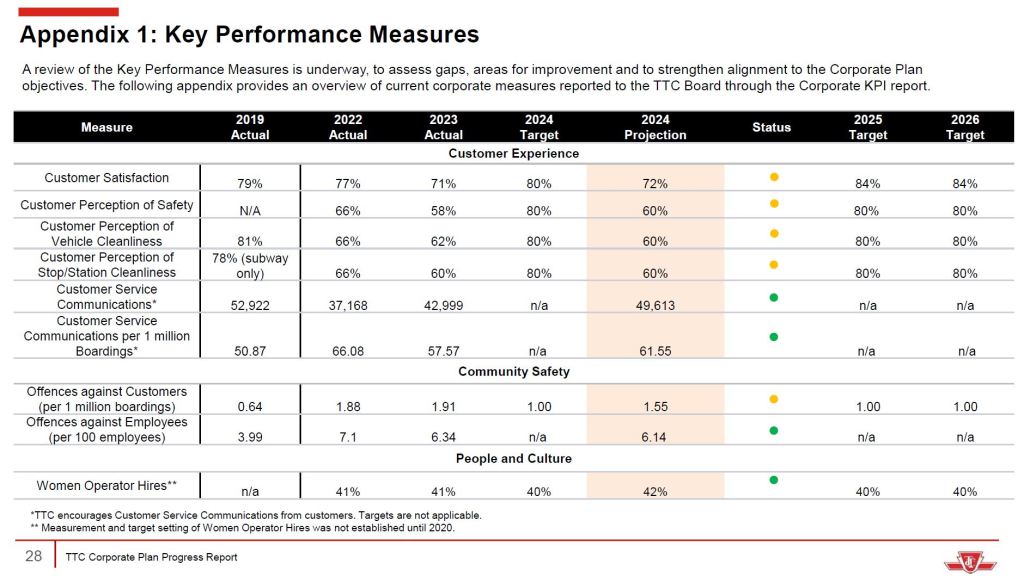
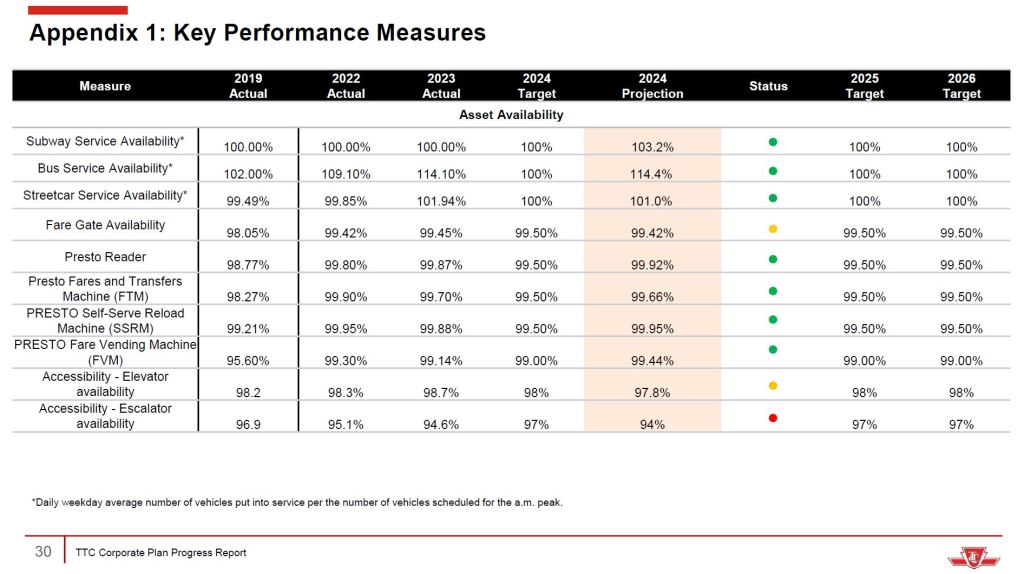
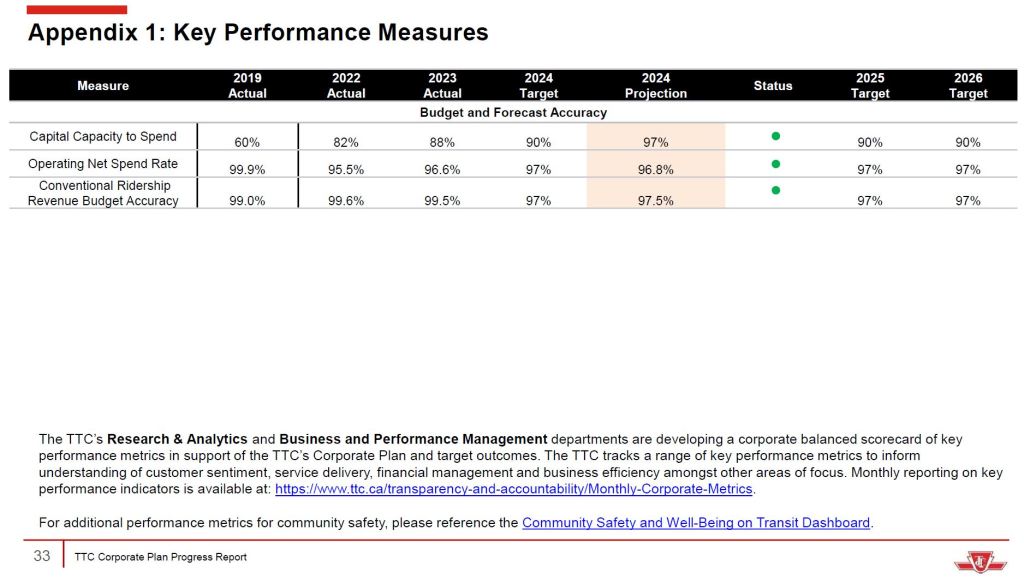
On many past occasions, I have written about shortcomings in the metrics by which the TTC tracks its performance. That said, the Corporate Plan Update includes a time series for the current metrics from 2019 to 2026 providing a convenient way to see evolution in values through the pandemic and hopes for the near future.
Items of note:
- Targets for Customer Satisfaction are at a level (84%) not reached in recent years and well above the 2024 projected value. Perceptions of safety and cleanliness similarly lie well below target levels.
- Conventional system ridership is projected to remain below the 2019 level into 2026 (450.4m vs 525.5m).
- Wheel-Trans ridership is projected to reach the 2019 level in 2026 (4.1m).
- Bus operating speeds are lower and will remain so compared to 2019.
- Mean distance between failures (MDBF) for some bus types (hybrids and clean diesels) continues to be reported on capped basis (a round target value), not the actual value. The target for clean diesels in 2024-26 (12k) is substantially below the projection (20k). Direct comparison of vehicle reliability is impossible from these values.
- There is no metric for fleet utilization. Buses that do not leave the garage do not contribute to failure stats.
- The cost per ride is projected to rise from $5.65 in 2024 to $6.27 in 2026, and the revenue:cost ratio is projected to fall from 49% to 44%.
- The SOGR backlog percentage is forecast to fall from 20.7% to 10.7% from 2024 to 2025. This is mostly due to the funding of Line 2 subway cars, and also does not include some long term unfunded needs that will come into the mix in future years adding to the backlog.



 Steve Munro
One of the suggestions from operators was to extend the 114 bus along Commissioners to the Wheel Trans Garage at Leslie. The 114 currently goes east on Commissioners to Logan, turns south to Lake Shore, east to Carlaw and back north to Commissioners. Based on few trips, I would suggest that the operators’ idea could be further improved by going east on Commissioners to either Carlaw or Logan, then east along Lake Shore to Leslie and then south on Leslie to Commissioners. This would serve the (large) Canada Post sorting office at Leslie and Commissioners and would still allow a layover for the operators at the Wheel Trans Garage (if that was the aim of their proposal).
LikeLiked by 1 person
Attempting to remove the Wheel-Trans service is definitively late-stage capitalism.
Rather than continue a service for seniors with accessibility issues who paid taxes most of their working lives, and the vulnerable disabled population who are in wheelchairs, the Board wants to cut the service for profit.
And then people will read how another C-suite executive got millions more in bonuses this year.
LikeLike
No turn priority at Queen and Church is the most obvious failure here. Also recently I noted the east to north switch at Broadview and Queen for the 504 is out of service which disables the protected turn signal. There was a physical sign installed to indicate it was disabled which makes me ask how long it’s been broken. How could a switch in such an important location be allowed to operate like this?
Steve: I was through that corner a few times recently, and both the switch an signal were working. I actually waited for a turning streetcar as a pedestrian yesterday (Feb 1).
I’m confused by the 503 ridership analysis. Shouldn’t the numbers be compared against the 22 bus service it replaced? The TTC would presumably run a service on Kingston Road in any event (as they did before) even if they discarded the 503 so it’s not as if they’d be saving much money by cutting operator hours. Are we to believe they would append the old 22 service on Kingston Road on to the new proposed 22+70 mega route?
Steve: I think there are several problems with the way TTC presents service analyses with incomplete and conflicting data. They get away with it because the Board is uncritical and does not want to challenge the “experts”.
LikeLiked by 1 person
When I passed through on Friday (Jan 31) the NA sign had been covered up with a sign warning of the switch being off electrically and operators were manually throwing the switch.
LikeLike
While they are looking at delays, lets talk about the infamous “late clearing work zone”. Shutdown from Finch to St. Clair this morning – 1st train south from Sheppard is typically 05:32, was well after 06:15 this morning. No one seemed to know (and/or care) how long it would last, when the first train finally came south, it was an absolute cattle car at Bloor. Does no one wear a watch down there? This happens at least 1 to 3 times a month.
LikeLike
We need to have private sector participation in our transit system. Places such as China, Hong Kong, Taiwan, Japan, South Korea, Singapore, Malaysia, and India with some of the best transit systems in the world all have private sector involvement in various forms. If you want change, then you need to change your ways. If we continue to insist on a 100% public transit system with taxpayers always ready to bail it out, then what you will get is the garbage that the TTC has become.
Steve: This is a myth. What any operator, public or private, delivers depends on what we, through the City or Province, demand of them.
LikeLike
Steve – thanks as always for this. In your opinion, does the 2025 report contain fewer changes (at least, to daytime service) when compared to other years?
Does the TTC maintain a list of previously approved changes (e.g. 150 Eastern) that have yet to be implemented?
And do you find it interesting that operator feedback about the 123 was that it needs to be cleaned up (I know that I’m paraphrasing), but that nothing was proposed?
Steve: They probably have a list internally, and it should be published as part of the Service Plan with current status such as pending budget, awaiting construction work, rescinded, etc. As for the operator feedback, the Service Plan is basically set in its original version in the summer with minimal change thereafter. They might be planning to address some of the comments raised, but there is not much sign of this in the plan. We will see over coming months if anything happens.
LikeLike
But we have had mayors and premiers of all political stripes and not one of them was decent enough to demand the right things? The TTC is a failure regardless of who is in power because the 100% public sector model is fundamentally flawed. The TTC streetcars are by far the slowest in the world and often slower than walking even with the streetcar rights of way, we need to change how the TTC is governed and funded and we need to involve private sector players to figure out the best model as is done in Asian countries which boast the best transit systems in the world.
LikeLike
Um, have you checked on Metrolinx and their private sector partners recently? How is the Crosstown line going? How is the GO upgrade going? Hurontario LRT? Have the private sector players running Presto implemented the features promised 10 years ago? Did _anything_ Metrolinx got “private sector involvement” for go well?
LikeLiked by 1 person
Steve – just a follow-up to my question about the 123 not being revised. What are the criteria for the TTC to split branches into separate routes – is it primarily operator feedback? I’m thinking about the 118/119 split from the 96, and the impending 145 split from the 45. Other than the 123 being a candidate for multiple routes vs multiple branches, several other routes have multiple confusing branches (37, 66, 84, 110, etc.) – could they potentially be split as well? Thanks again Steve!
Steve: I am not sure there are set criteria beyond the ability to schedule each “branch” with its own service design. Of course this can lead to planned bunching if the headways don’t blend on the common section. This matters less where an infrequent branch is split off as a separate route, but not for frequent services.
LikeLike