
This article covers:
- The January 2025 CEO’s Report
- A follow-up on the report re Subway Streetcar Fleet and Infrastructure
- The proposed interim wayfinding strategy
- An update on fare collection technology
- A new procedure for handling complaints about CEO misconduct
I will cover the 2025 Annual Service Plan and the Corporate Plan Update in a separate article.
Location of Reports Changed
Effective with this meeting, the agendas and reports for Board meetings have shifted to the City’s meeting management site which hosts Council and Committee meetings. This will also host documents for Board committees such as Audit & Risk Management. Information for past meetings continues to be available on the TTC’s own site.
In Fall 2024, the CEO’s Report was reorganized with the Key Performance Indicators split off from the main report. There are now separate pages on the TTC site for accessing monthly CEO’s Reports and KPI reports.
CEO’s Report
The two major topics in the CEO’s Report were an update on the Line 2 T1 fleet, and commentary on recent signal problems on Line 1.
T1 Fleet Update
Although new trains for Line 2 will begin to arrive in 2030, assuming that funding is confirmed and a contract can actually be signed, the delivery period overlaps both the end-of-life date for the existing fleet and the planned requirement for additional trains for route extensions and service growth. Management noted that because the TTC has a larger T1 fleet than it needs, some cars are being used as a source of spare parts. (The excess is due primarily to changes in fleet planning related to timing of Automatic Train Control Implementation on Lines 1 and 2, as well as to the delay in building the Scarborough extension.)
TTC is planning for life extension of the T1 fleet to bridge the gap.
The TTC is undergoing a series of studies with the vehicle’s original equipment manufacturers (OEMs) and independent expert consultants to develop a limited life extension program to help transition the T1 fleet to the New Subway Train (NST) fleet. Focus will be on safety-critical mechanical and electrical systems
and structural integrity of the vehicle frame and body. In addition, the obsolete HVAC system will be upgraded to allow for the use of new refrigerants in an effort to lower ozone depletion and global warming risks.
The necessary work will be reflected in the 2026 budget.
Signal Problems on Line 1
Three events in December caused major signal system outages and delays for riders on Line 1.
Two of these, on December 4 and 9, were caused by wheel spin-slide problems that prevented the system from accurately knowing the position of a train. The automatic fail-safe response is to halt operations.
TTC implemented temporary speed restrictions in locations prone to spin-slide events, and is working with the vendor, Alstom, to determine if signal Zone Controller updates are possible to change how they react to them.
On December 11, there was an automatic shutdown caused by a compound error. When work cars are coupled together in trains, the transponder that communicates with the ATC system should only be active on one of them. A work train with multiple transponders passed a signal in Wilson Yard triggering an alert for what should be an impossible condition, two separate “trains” being in the same location. Also, the signal’s location in the ATC database was incorrect. These conditions triggered a shutdown of service on Line 1.
Note that this is not a condition where redundancy could have prevented the shutdown because the same problems would have been “seen” by any redundant servers.
Operating procedures have been changed to deal with both a server shutdown condition, and to ensure that coupled work car trains operate properly.
KPIs
The KPI report brings published statistics only to November 2024, and this does not reflect riding through and after the holiday period.
Although the TTC has begun some plain clothes fare enforcement, there are no stats yet on changes in rider behaviour or effects on revenue. The 2025 budget provides for 75 more fare enforcement staff for expansion of coverage to the bus network, but they will not be active until later in 2025.
Ridership in November was up 1% over October and 6% over 2024 through a combination of higher in-office work and 473,000 added rides for concerts at the Rogers Centre adding 4% to the daily totals.
Fare revenue is running at 103% of budget. Broken down by fare type: 80.7% adult, 6.8% post-secondary,
5.3% senior, 7.0% youth (ages 13-19) and 0.2% other. The mix of fare media used is changing as more riders move away from Presto cards to apps and open payments.
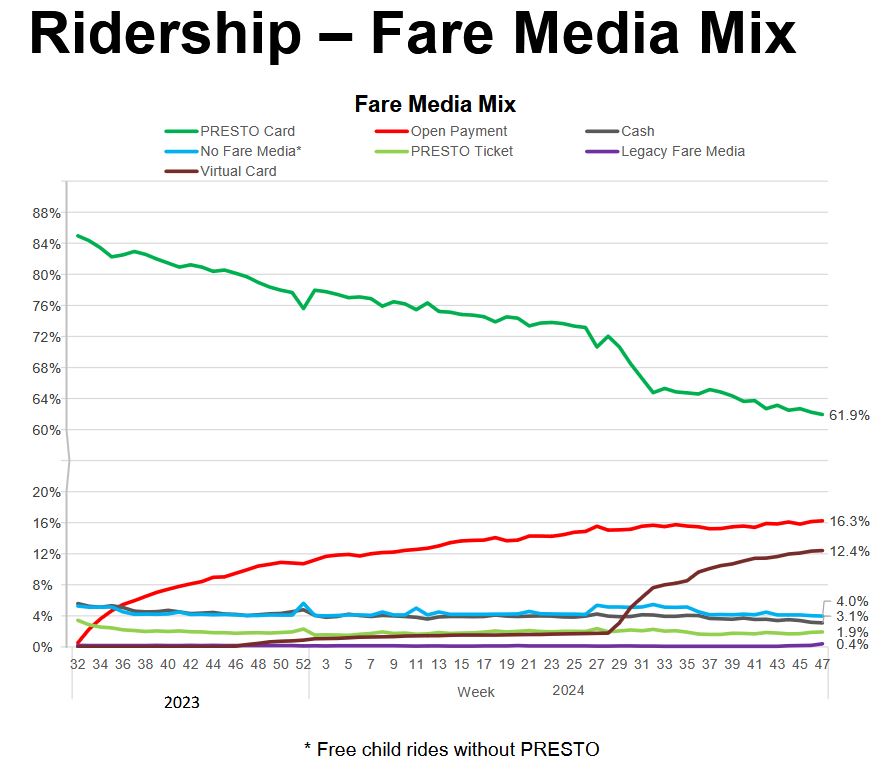
I have written before about problems with service stats including on time performance, short turns, and vehicle reliability which do not accurately reflect conditions. There is nothing to add here. TTC plans to revamp some of these metrics, and I will return to this topic in a future article.
Subway and Streetcar State of Good Repair, Expansion and Modernization
I wrote about this report in a previous article. This is a follow-up based on debate at the Board meeting.
The amount of subway and streetcar work is clear in the capital budget details. In years past, the TTC published the “Blue Books”, large binders with detailed information on every capital budget item, but stopped doing so in 2020. I have requested the equivalent information for the current budget and await a reply from TTC. TTC advises that the details will not be available until after Council approves the budget on February 11.

There is a very large increase in the annual cost of streetcar track work, while the subway stays constant, or allowing for inflation, actually declines. Although parts of the streetcar system are overdue for repair, such as the Church/King intersection, these are exceptions rather than a widespread problem requiring a “catch-up” on the scale implied by the spending.
The report includes a comment about conflicts between needed work on King Street, the Gardiner Expressway project, and FIFA 2026. The work plan for King Street, other than major projects already flagged at Church and from Dufferin westward, covers only a brief period in July implying small scale, spot repairs, not major reconstruction.
The TTC 2025 streetcar diversion plan aims to ensure asset availability for FIFA 2026, with a particular focus on key King Street track intersection replacements at King and Church and King and Dufferin, along with the replacement of the Fleet and Bathurst intersection, resulting in streetcar diversions on the 504 King and 509 Harbourfront routes. As part of the 2025 strategy, various life extension programs are planned along the King Street route on the tangent tracks. Although a life extension program will suffice to ensure a reliable FIFA 2026 service, it is anticipated that these assets will need to be replaced post-2026 and long before the completion of the Gardiner Expressway work. [Report at p. 10]
At the January 27 Board meeting, Fort Monaco, Chief Operations and Infrastructure Officer, mentioned that there was a pending period where the amount of streetcar track repairs will be challenging to manage, but gave no details. He will bring a report on multi-year plans to a future Board meeting. This is definitely a case where better advance knowledge is required by policy-makers.
There are about 80 locations with various types of special work (junctions and loops, depending how one counts them) not including carhouses and yards. At a replacement cycle of 25 years, this implies a rate of 3-4/year. Tangent track lasts 20-25 years depending on how well it was built, and the level of day-to-day service on it. The TTC has worked through almost all of the badly built track from the last century during a period after streetcar retention was official policy but before track construction techniques caught up with the need for longevity.
A related plan that needs airing is the work to upgrade streetcar overhead to full pantograph compatibility. This project has the sense of dragging on, and it compounds the length of route closures when bundled with major track repairs. A large portion of 506 Carlton is scheduled for upgrades in 2026. What else remains, and when will this project complete?
At the Board meeting, a deputant raised the question of changing streetcar switches from single point to double point as a way of allowing speedier operation through intersections. That, in turn, brought on the issue of permanent slow orders on the streetcar system, by analogy to those on the subway.
Single blade switches have been used on North American streetcar systems for over a century, and until comparatively recently they were not considered an impediment nor a safety hazard in Toronto. (They remain in use in Boston, Philadelphia and San Francisco, for example, although these systems have nowhere near the number of complex intersections as Toronto.) A few derailments led the TTC to impose several standing orders for streetcar operation that have noticeably slowed service.
- All facing point switches, manual or automatic, are “stop, check and proceed”. This arises in part from problems with automatic switch controllers which were introduced for the ALRV streetcar fleet decades ago, but whose behaviour was unpredictable. A program to replace them is still in progress, and there is no sense of when this will end or operating procedures will change.
- All special work (switches, crossings) is to be travelled at low speed regardless of the condition of the track.
- Streetcars are not supposed to pass each other on special work for fear of a derailment and collision. In practice this rule is ignored except by the most junior operators.
- Operation through many locations where roads cross rights-of-way, notably on The Queensway, are at low speed lest an errant motorist make a left turn across a streetcar’s path.
- Operation through underpasses is at low speed lest trolley poles dewire damaging the contact wire/bar and/or the car. Note that no trolley pole operation remains on the TTC on regularly-used revenue trackage.
This list goes far beyond the design of track switches and speaks to the combined effect of infrastructure design, deferred maintenance, integrated signalling and switch controls, and a possible over-abundance of caution.
Monaco’s comments implied that he thought slow zones on the streetcar network were rare, and he cited King/Church as a bona fide example. What he did not address was the system-wide slow orders or why they remain in place.
Subway Reduced Speed Zones
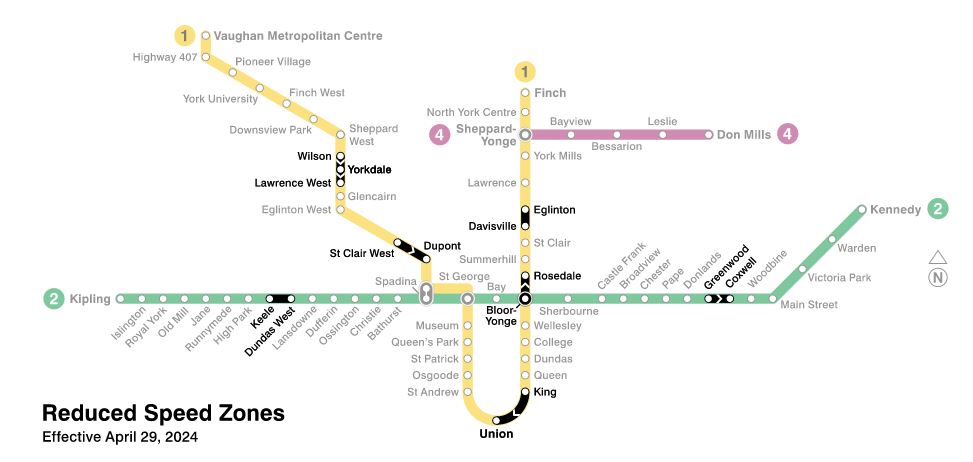
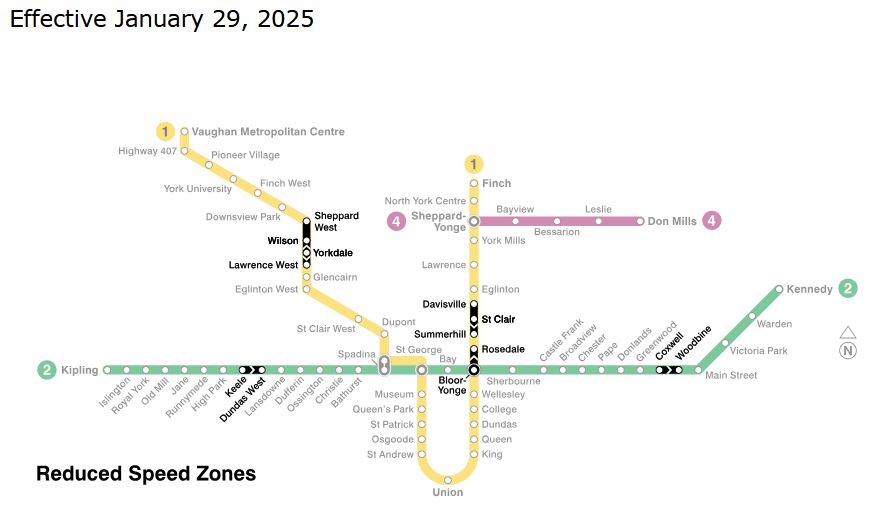
RSZs continue to exist on the subway. Here is the current map together with the April 2024 version for comparison. Some slow zones come and go, but many are long-standing. The maps beg the question of why repairs have not been completed for nine months.
It is the TTC’s position that twelve or so RSZs would be a normal situation although this was not the case in past years. Is this a problem of locations with challenging repairs, or is this a backlog that the TTC cannot address?
The report was amended on a motion by the Chair with a hope of speeding up track projects and minimizing disruptions.
Amend recommendation 1 so that it now reads:
1. Endorse the 2025 Subway Closures and Streetcar Diversions Forecast, and request that the Chief Executive Officer, TTC, in consultation with the General Manager, Transportation Services, City of Toronto, work to continually review the forecast with a view to minimize the disruption experienced by riders including exploring options to dedicate additional resources and personnel to expedite repairs.
Proposed Interim Wayfinding Strategy
The TTC has been working on an updated wayfinding strategy for some time, but the report gives me a feeling that this is more a case of “you should have a strategy” than the development of concrete designs or a philosophy.
The context for a review is there are many changes in what “wayfinding” might mean including not just signage but electronic information, recognition of the needs of those for whom English text will not do, an increase in the diversity of information beyond simply transit routes and stations, and the need for dynamic changes to reflect short and medium term disruptions.
What is striking about the report, and the online survey that preceded it, is the complete absence of illustrations. There are nine pages of text followed by a sixteen page inventory of signage types completely devoid of pictures.
One issue flagged here is the existence of another standard from Metrolinx which is already implemented within their facilities and on new routes under construction.
A vital question is not the physical format of signs, but what they contain. It is pointless to replace a sign with a new typeface if this does not add to the information riders need to see and present a consistent “look and feel” for navigating the system.
Other navigation aids include an online presence, and the problems of the TTC’s website, let alone integration with information on other operators.
A final report is due in May 2025, and we will see whether it addresses issues with more than reams of text.
Meanwhile, the Board passed an amendment to the report recognizing the difficulties of navigating Union Station thanks to mixed responsibility for wayfinding there.
Motion to Amend Item (Additional) moved by Deputy Mayor Ausma Malik (Carried)
The TTC Board requests that TTC staff work with the Head of Property and Asset Management of Union Station and the Manager of Transit and Infrastructure at Corporate Real Estate Management, and with relevant staff at Metrolinx to report back on a wayfinding strategy for Union Station as part of the Final Wayfinding Strategy.
Fare Collection Update
This report is about fare media and systems, not fare enforcement. Most of the report is in a confidential attachment which has not been made public.
The agreement between TTC and Metrolinx for Presto runs to November 28, 2027 wit an automatic five-year renewal unless either party gives a two-year notice to terminate. That gives the TTC until the coming November to make up its mind whether to stay with Presto, or embark on a separate system.
The TTC’s 10-Year Fare Collection Outlook “identified that a real-time, account-based, open
architecture fare collection system would meet the TTC’s technology goals”. [p. 3] What this means for riders is that they would no longer depend on either a stored value Presto card, or a pay-as-you-go charge against a debit/credit card. Instead, there would be a central account where fares owed would be tracked and billed in bulk. This would allow the calculation of fares, including any applicable discounts, to be separated from the equipment on board vehicles and in stations greatly simplifying changes to tariffs including short term promotions.
A study of TTC requirements is underway to inform the decision, but the details are not yet public. An obvious concern is whether Ontario will, as it did before, strong-arm Toronto into taking whatever Presto has on offer, or if the TTC requirements will inform the development of “Presto 2.0”.
Some features of the new Presto system are already known:
The upcoming PRESTO 2.0 system will have numerous benefits for customers, including from an equity and accessibility perspective. For example, PRESTO 2.0 will ensure a seamless experience for customers, including new and expanded payment and account management options, improved concession fare capabilities, enhanced customer support, and instant card loads.
It is important to note that physical PRESTO cards and limited-use PRESTO Tickets will continue to be available after the transition to PRESTO 2.0. These options provide the most protection from banking fees associated with debit and credit transactions, which may particularly impact those who are unbanked or under-banked and have low or volatile income. The availability of PRESTO Tickets will ensure continued access for social and community agencies that distribute fares to numerous groups, such as newcomers, those experiencing homelessness, and clients with low incomes. [p. 3]
With such a glowing description, and the Provincial interest in a unified system, one wonders why the TTC contemplates alternatives, beyond knowing what the competition might offer.
New TTC Policy – TTC CEO Misconduct Complaints
This report sets out a process for filing and investigating complaints about the CEO. There are no specifics about the report’s origins, but clearly it emerged from recent experience with the former CEO and procedural gaps in then-existing policy. The TTC needed a clear reporting and investigative process free of potential conflict of interest or possibility of retribution.
The introductory text gives an overview:
The attached new policy […] is designed to better ensure that responsibilities of employees are clearly set out, while ensuring that the workplace remains safe, inclusive and free from discrimination or harassment. The TTC CEO Misconduct Complaints policy was created to ensure employees and customers have a clear mechanism to file complaints of alleged misconduct against the TTC CEO and to ensure that the complaint process ensures the principles of impartiality, confidentiality, procedural fairness and human rights.
The new policy provides a definition of “misconduct” and sets out a process that allows for complaints, relating to alleged misconduct, to be properly brought forward to the Human Resources Committee.
The policy expressly provides that the Human Resources Committee may engage external legal counsel to assist in providing advice or recommendations and may also retain a third-party investigator to conduct an investigation, if deemed necessary. Depending on the nature of the complaint, the Human Resources Committee may also elect to take other actions as appropriate, including counselling the CEO with respect to the alleged misconduct.
The Definitions section of the report sets out various types of proscribed behaviour.
- discrimination: Unequal treatment resulting in adverse impacts based on protected characteristics under the Code. Discrimination can be direct, systemic, or unintentional.
- harassment: is defined as engaging in vexatious comments or conduct against a person that is known or ought reasonably be known to be unwelcome. It can involve a course of conduct or a single serious incident. Harassment can be connected to one or more protected characteristics (Code-based harassment) or of a personal nature (non-Code) harassment. Harassment may include bullying, humiliation, or offensive electronic communications.
- hate activity: Actions intended to harm or intimidate individuals based on identity or community membership.
- misconduct: Refers to any improper, unethical, or unlawful behaviour that violates TTC policies, codes of conduct, or applicable laws. Misconduct may include:
- Discrimination, harassment, hate activity or behaviour undermining dignity, human rights, or contributing to a poisoned work environment.
- Abuse of power, including exploitation, intimidation, coercion, or acts of reprisal against individuals for raising concerns, filing complaints, or participating in investigations.
- Conflicts of interest with TTC operations or stakeholders.
- Violations of the Code, OHSA, or other relevant laws.
- Any conduct compromising TTC’s integrity, reputation, or effective functioning.
- poisoned work environment: A hostile or intolerable workplace resulting from serious wrongful behaviour, whether a single egregious incident or repeated actions.
- reprisal: Any punishment or threat of punishment for asserting rights under the Code, OHSA, or TTC policy, including filing complaints or acting as a witness in investigations.
We can only hope that this policy will not need to be exercised in the future, and that the Board will be better attuned to the behaviour of their senior management than in years past.
 Steve Munro
Does this imply that some T-1 cars have already been retired?
Steve: Effectively, yes.
LikeLiked by 1 person
Steve, what date is the next schedule change? This is when we’ll likely receive more information about the upcoming Bathurst-Fleet-Lakeshore track and overhead work, which means diverting the “509 Harbourfront” and “511 Bathurst” streetcars, and also running a shuttle bus from the Carr loop (Bathurst & Queen) and the Exhibition loop via Fort York Boulevard.
In addition, we’ll find out when streetcars return to the “510 Spadina” route with completion of track work on the streetcar portal at Spadina subway station.
Steve: The next Board Period starts on February 16. The memo detailing changes has not come out yet and I don’t expect to see it for a week or so.
BTW the loop at Queen and Bathurst is Wolseley Loop.
LikeLike
Steve interjects: This is a compendium of three comments left in reply to the article.
Part I:
Full disclosure, I’ve only glanced at this, and it requires a thorough read later, but this has me incredibly alarmed:
The implication, perhaps the only logical possibility being, is that *wheel revs* are counting for distance/positioning measurement.
Either I can’t see the forest for the trees, or the TTC has been sold an incredibly…????…system…
Whether this is a block system, or something much more sophisticated, how can vehicle positioning be ‘fooled’ by this?
Part II:
From my previous post:
“how can vehicle positioning be ‘fooled’ by this?”
Perhaps I’d assumed too much in thinking Line 1 has been upgraded with fixed sensors?
Steve jumps in: There were balises on Line 1 from day 1. The basic issue is that a balise resets the “I am here” information and the train reports its location through a combination of known fixed balises plus wheel revs. At key points where fine-grained location spotting is needed, there are axle counters. These are found at interlockings. When a train is passing, the signal system knows it should have 4 axles per car, or 24 per train for a six-car train. That’s how it keeps track of where a train is moving through turnouts and crossings. This has also been in place since day 1.
There’s a number of excellent research papers I’ve Googled brusquely that all allude to the “slip and slide” issue. Google: “Slip and Slide Detection and Compensation for Odometery System, Using Adaptive Fuzzy Kalman Filter “.
It is a well known issue…in very dated control systems. What did the signalling/control upgrade of Line 1 get us exactly?
Part III:
Further delving on Line 1 and control/signalling/dispatch:
Press releases and news 18 Dec 2017
???
Steve: Urbalis 400 is used world-wide. It was new for Canada (which has only a handful of automated lines to start with), but not new for the world where it is installed on nearly 200 systems. The project was particularly challenging both because it was a “brownfield” installation on a working railway, and because the TTC had bought a mishmash of technologies to replace old signals, and they were not compatible. Why did they do this? So that management could “sell” ATC without the sticker shock of a full line project.
This was part of the mess Andy Byford inherited when he took over as CEO. I wrote about the signalling contracts back in 2015.
The technology we have is certainly not outmoded. In the case of the work train incident, this was caused by a crew error where transponders on more than one car were active at the same time, compounded by a database error in a signal’s location that triggered an automatic shutdown of the main line. Work trains are a thorny problem for ATC because of variations between cars, and the fact that some can operate in trains some of the time, individually otherwise. Originally, the TTC had delayed implementation of work car ATC transponders, but this limits their operation when they must share the line with regular ATC enabled trains. Again this is a more complicated situation for brownfield installs because work car/train specs would be designed around the signalling system for a new line. Retrofits are harder.
LikeLike
The obvious solution to the wayfinding problem is to adopt the Metrolinx system in its entirety, and then identify gaps, communicate them to Metrolinx and come up with a plan in conjunction with them to close any gaps…
If I was the government of Ontario this would be one of the obvious cost saving steps I would be pushing onto all local transit…why the ttc would have to fund studies on this, or come up with a system is beyond confusing at this point in our history….
LikeLike
Another informative article Steve. What are your thoughts on the TTC adopting the Metrolinx wayfinding standard? Which, in your view, is the more suitable for the TTC to take on?
Steve: I am waiting to see what the TTC’s proposed standard will be. Right now it’s a mish-mash and hard to compare. An important point I made in the article is that there is a difference between standardization for its own sake, as opposed to having consistent content where a would-be rider will see a consistent set of directions. For example, a retrofit of existing signage just because it uses a different font or arrows from Metrolinx would be a complete waste. When I see specific examples of existing and proposed TTC standards, an inventory that shows which “non standard” signs would or would not require upgrades, and an explanation of the effect of the Metrolinx standard, I am not commenting.
From a point of personal preference I have always found Metrolinx signage less attractive than TTC’s, but the real issue is content.
LikeLike
Surely the TTC knows the lifespan of T1 trains and how long it’ll take to get new trains. So why are we now doing a stopgap life extension thing? Is this another of John Tory and Rick Leary’s gifts to Toronto?
Steve: Yes. To reduce the size of the capital deficit, Leary trimmed various items including the subway car replacement, although he later reinstated it when it became clear that the needed life extension could be unworkable. Unfortunately, the procurement did not go ahead as quickly as hoped due to Federal funding hangups and this cost us a few years. Moreover, the unit cost of the trains is now higher than earlier estimates, and so we are only getting 55, just enough to operate Line 2 from Kipling to Kennedy rather than te original 63. Those extra trains would have been used on the Scarborough extension, but are now bundled with the project cost there.
LikeLike
Will Presto 2.0 allow cash payments on buses and streetcars, and issue a transfer that can automatically open subway station fare gates? Or will the current paper transfer be used indefinitely requiring a collector at a station entrance? Or would payments by cash be discontinued on buses and streetcars?
Steve: The TTC is looking at registering fareboxes that can issue machine readable transfers.
LikeLike
I still have questions as to the “wheel spin-slides” fouling detection of position parameters.
The phrase is more correctly termed “Position(al) Uncertainty” or “Location Uncertainty”.
There’s some exceptionally detailed and referenced papers on-line, and some refer to the Urbalis 400 system, which apparently has about 25% of the World market.
One excellent discussion here, albeit for mainlines systems, but the methodology is the same.
Steve: This discussion picks up the basics of the problem fairly thoroughly. As long as there is a reset using closely spaced tags (aka balises) frequently, the uncertainty cannot grow beyond acceptable levels. Moreover, the system can have a standard “safety padding” included when calculating train spacing that will always be larger than the maximum level of uncertainty. This is not mentioned in the article.
The spec for the new Line 2 subway trains provides that the leading truck of the end cars (the one that is measuring train movement) will not be powered. This means that the wheels participate neither in acceleration or braking (via regeneration) and therefore will not slip. Motors on the rest of the train provide the energy required to drive the train. This should largely eliminate spin-slide problems on the positional measurement. Here is the relevant paragraph from the spec:
One other thing I should mention is that you can see how stopping accuracy is ensured on Line 1 by closer spacing of balises coming into stations and approaching the stopping point.
LikeLike
@Stephen Saines
Indeed, it is much more sophisticated, but you seem to be correct that wheel revs are counting for odometry, and thereby enabling train localization.
The fundamental problem with designing automatic train control is that you need to localize (know the position of) the vehicle on a continuous basis without requiring sensors installed in every metre of rail. That becomes costly VERY quickly.
The solution is therefore to regularly add balises to add a ground-truth location (as you’ve pointed out) and then localize the train using some other means in between the balises, with the train communicating with the nearest balise the entire time.
Under normal conditions, wheel odometry is a simple and robust way to localize a train. It is not (or should not, at least) be as simple as counting one wheel’s revolutions but rather many of them. Wheel odometry should be robust under most conditions as the fundamental principle of train motion is that wheels do not slip. Minor slip conditions are handled by complex sensing schemes (Kalman filtering is one, as you have discovered), but spin-slide conditions occur for extended periods and can make it much immensely difficult to localize to the system’s required level of accuracy until the next balise is crossed.
Obviously, wheels may eventually spin-slide – so the problem is not that they have used wheel odometry for localization between balises, but rather that they have not designed a more robust way of handling this case other than halting the entire line’s operation.
As an aside, there are potential alternatives to balises that enable continuous measurement without wheel odometry, using as optical tracking systems (cameras, etc.) but these have their own problems and the world has ultimately settled on balises + wheel odometry.
Steve: See my remarks in response to Stephen Saines’ last comment about having unpowered trucks on the outer ends of the new Line 2 trains.
LikeLike
Steve says: For example, a retrofit of existing signage just because it uses a different font or arrows from Metrolinx would be a complete waste.
I’d have to disagree with this statement, part of standardizing is ensuring you have the same font and arrows, specifically because it makes it easy to navigate…
The current situation is actually even worse, where there are in some major stations multiple wayfinding systems in place at the same time, often to the same locations…a great thing to look for is exit signs…next time at Bloor/yonge…you will find red, green, icons, words, words with modifiers (emergency exit), different fonts, different heights, different placement, arrows, no arrows, lit, unlit…even more so at Union…that’s for something where there is an existing standard…
Frankly I would rip out all the existing stuff and go from scratch with the new system…and then never worry about it again…
Steve: Bloor-Yonge is a mess thanks to the overlapping effect of many separate renos and new signage each introduced, but there are many stations where the signage is coherent and does not need replacement. This should not turn into a massive construction project to replace like for like just to change the font and arrows. Those pages of inventory of every sign in the system make me worry that they will concentrate more on uniformity than actual content, placement, and continuity.
In a brilliant example of a “designer” who is unclear on concept, there are now centre platform stations on University Avenue where the advertising/next train signs are between the platforms and invisible from large chunks of areas where riders await trains.
Remember also that the TTC depended on an advertising company doing one-for-one upgrades of the old system, and some platforms are woefully short of video screens. This is what saving our precious tax dollars gets us.
LikeLike
Is the wheel slip related to why the Yonge line sometimes doesn’t line up with the platform stickers at Bloor? I assume this problem could cause trouble for platform doors, and I’ve wondered a few times in the last year when they didn’t line up correctly what was happening…
Steve: With all of the slow zones and special operating arrangements, it is possible that the train was being operated manually. I had a cab ride once on a train in full ATC mode, and it stopped perfectly beside the markers every time. Also, given that trains slow down well before the stopping location in ATC mode, wheel slip during the final part of the braking cycle is unlikely.
For PSDs, the platform portals are generally wider than the train doors so that there is some leeway in train stopping location.
LikeLike
Regarding wayfinding, I was passing by the yet unused Forest Hill Station of Line 5 and noticed that the signage of the south west entrance integrated into the condo development was completely lacking any consistency with the station signage across the street. A TTC logo was affixed to the window, the only indication it was an entrance to line 5.
Wayfinding standards are important not just for the TTC but also for private developers whom are contracted to pay for the sign but not given clear standards as to its contents.
Steve: Here is the Google Street View link for those who have not seen this in person. At the point this was taken last summer, there wasn’t even a TTC logo. Mind you Metrolinx seems to be avoiding a major TTC presence with the tiny little logo on the red post on the NE corner which is visible if you spin the view around.
LikeLike
Soooo …. the former CEO was not only a crap manager but also a jerk (least-worst word I could think of) as well? Cool!
Yeesh.
LikeLike
Forest Hill Station on Line 5: It seems to me that a red TTC logo on a matching red background high up on the post is like not posting the TTC logo at all! How about outlining the logo in a contrasting colour to make it stand out? Or place it down next to the 5 logo where it is closer to eye level and would stand out against a black background? Perhaps another TTC logo beside the LRT logo above the entrance door. Hello?
LikeLike
Wow! I never expected to see a reference to the Vulcan mind training test here.
LikeLike
Hi there do you think the TTC will eliminate all non-Presto fare media (cash, tokens legacy ttc senior/youth tickets, legacy ttc day passes and paper transfers) so that eventually only customers with presto fare media (physical or digital PRESTO cards, PRESTO tickets or physical or digital credit or debit cards) can pass through ttc subway faregates or board any ttc bus or streetcar?
I have advocated for several years now that the TTC should only be accepting presto fare media and not accept anything else even cash fares where change cannot be provided, I want to bring this request to the TTC so that staff can look into.
Once all non-Presto fare media is removed, the TTC will be one step closer to a true and totally modernized fare system where only card payments will be accepted.
Steve: You have not been paying attention to recent events. TTC was going to stop accepting any legacy fare media, only retaining cash fares, at the end of 2024, but there was one final decision to make this effective June 1, 2025 except for WheelTrans where the extension runs to December 31, 2025. An advertising campaign about this is already in progress. Sales of legacy media ended quite some time ago, and this is simply a case of allowing riders who have stashes of old media to use them up. You might want to read TTC reports on the issue before taking your ideas to TTC as if they had not been addressing the topic. Also, BTW, they already accept credit and debit cards in addition to Presto cards and the phone app. The vehicles for Lines 5 and 6 do not have on-board fare machines, and riders will have to tap on machines at surface platforms or in stations.
Cash fares are supported by fare vending machines. On buses, the TTC is examining the use of registering fareboxes that could issue machine readable transfers. Whether this will be implemented (and considering it requires a comparable change on fare gates) remains to be seen.
LikeLike
Steve, Alstom is the company that manufactures the Toronto Rocket subway trains.
It was also the company that manufactured the trains for the Metro de Caracas. Those trains were made in France, as Alstom was a French company, and shipped to Venezuela.
Steve: And your point is? The TR trains were manufactured in Thunder Bay. Alstom supplies trains to many cities from multiple manufacturing sites.
LikeLike
Isn’t funding pretty much confirmed at this point? While it’s technically possible a new government would reverse it, it’s not likely, and would be highly unpopular.
Steve: Nothing is set in stone. If the government falls before it signs a contract, all bets are off. As for the ten year federal transit fund, I have my doubts that a new government would honour it, especially if they can claim a national financial emergency care of Trump tariffs.
Probably safe to assume none of the extensions will open until well after all 55 trains are delivered, though.
Are the additional trains for the extensions (for a total of 70 or 80 trains) still in the picture? Or have they been cancelled entirely?
Steve: The 55 trains stretch well into 2033 based on the delivery schedule in the RFP. That only replaces the existing Line 2 fleet. Trains for extensions are beyond that. The full 70 trains (55+15) are to be delivered by the end of 2033. This includes cars for the Scarborough and North Yonge extensions that will be purchased by Metrolinx as add-ons to the TTC contract. Any trains beyond that for growth in service are in 2034 and beyond, and these are not funded. There is also no funding for the proposed new yard and maintenance facility needed to handle an expanded fleet.
LikeLike
Metrolinx’s wayfinding isn’t flawless, but it’s a significant improvement over the TTC’s—especially as the two systems will soon operate separately even on the same transit line. The entire process of keeping them distinct feels unnecessary. A unified approach would be far more effective, with the TTC helping to identify any gaps in Metrolinx’s system. As long as the signature “TTC font” remains the artistic standard for station identifiers, I have no complaints.
LikeLike
Wast there a reason given for the move in the online location of TTC Board reports and agendas?
Perhaps I’m just resistant to change, but the old location was (albeit not necessarily done in the most attractive way, and perhaps tucked away obscurely) somewhat straightforward to navigate.
I suppose I should wait for a few meetings to get recorded in the new location to decide whether I like it or not.
Steve: The City’s meeting management system is much better and standardized across all committees and boards that use it. The TTC’s own site has gone through a few redesigns and frankly is far from ideal. The URLs for documents are complex, and not necessarily fixed.
LikeLike
I am sure Metrolinx is eagerly awaiting feedback with those open arms and ears that they are known for.
LikeLike
For Steve and Stephen Saines’:
Spoke to my Mobile Robotics & Perception prof at the University of Toronto about the TTC’s wheel odometry/dead reckoning issue, through which he enlightened me to a few details.
1. Alstom (and therefore the TTC) uses a combination of wheel odometry/dead-reconing and accelerometer data to localize the trains between balises.
2. Alstom is capable of MUCH better methods of train localization but it is too conservative to implement them.
Regarding #2, Thales contracted the University of Toronto to study improved train localization methods, which was studied on line 1 using the T1 rolling stock.
Per their paper (linked below), they found that LIDAR is a substantial and practical improvement over dead-reckoning and accelerometer-based localization up to 70 km/h. If Alstom used LIDAR-based localization alone for its ATC systems, it would achieve a localization to within 10 cm within stations and within 2m in tunnels.
Using this technology would eliminate the wheel-slip possibility, and in my opinion alone, sensor fusion (by combining LIDAR, dead-reckoning, and accelerometer data) would likely reduce the error further.
It is known that train spacing in automatic train control is limited by the localization error of the trains. Alstom, Thales, and Bombardier are conservative enough and make too much money using their current technologies to implement anything other than dead-reckoning, accelerometers, and balises in their signalling technologies. Even the ECTS is just starting to incorporate GNSS.
Steve: Thanks for the info, but the link only works if you have an IEEE subscription, employer or institutional login.
LikeLike
Since the January 29th reduced speed zone map shows “all clear” between Eglinton and Davisville, today (Feb 4th) I parked myself on the Imperial St bridge and watched.
The trains continue to crawl on this section of track, as they have done for several months, particularly southbound trains. I would be surprised if southbound trains exceed 15 km/h here.
It makes me wonder why the board is being fed erroneous information. Human error? Trying to minimize (mislead re) the RSZ situation?
Steve: Yes, I rode this section on Feb 3rd, and noticed that it was slow where the map said it was not.
LikeLike