
This article includes observations and updates from the January 10, 2025 TTC Board meeting. For background information on the Operating and Capital Budgets, please refer to my previous articles:
- TTC 2025 Operating Budget – Preliminary Review
- TTC 2025 Capital Budget and Plan – Preliminary Review
The budget report and presentation deck are available on the TTC’s site:
- Recommended 2025 TTC Operating Budget; 2025-2034 Capital Budget and Plan and 15-Year Capital Investment Plan and Real Estate Investment Plan Update
- Presentation Deck
This was the first Board meeting for Deputy Mayor Ausma Malik and Councillor Alejandra Bravo as Commissioners. They replaced Councillors Chris Moise and Stephen Holyday.
There was relatively little debate on the details of the budget with the overall sense being relief that the TTC will be able to make some improvements in service in 2025. However, three Commissioners proposed amendments to the recommendations that foretell a more actively involved Board in setting policy in the coming year.
Normally the Board agendas are released at least a week before meetings in keeping with practice by the City Clerk for Council and Committee agendas. Although it appears, according to Commissioner Matlow, that the budget report was completed a few weeks ago, it was not released until a few days before the meeting when the Mayor and TTC Chair held a press conference to announce the high points. This may serve their post-holiday scheduling, but not the public’s (or other Board members’) ability to digest and comment on the budget in time for the Board meeting.
Motion by Commissioner Matlow
[The Board] Directs the TTC CEO and Director – Commission Services, to publicly release the TTC’s annual budget at least 10 business days prior to its consideration by the Commission.
For many years, the budget has arrived as a fait accompli at the Board with no room for debate about priorities or changes in underlying assumptions about the Board’s goals even when a new Board inherits the philosophy behind an outgoing Board’s budget. The Board has taken a very hands off approach leaving decisions to management with, as we have seen recently, less than ideal results as the priority for tight budgets compromised system integrity.
The motions below are intended to re-establish an active Board as the TTC and City look to establish a stronger role for transit, and to set priorities before budgets lock in past assumptions.
Motion by Commissioner Bravo
[The Board] Establish a Strategic Planning Committee to assist the TTC Board in managing strategic planning and priorities, including through a Ridership Growth Strategy and other existing strategic documents, and direct the Director, Commission Services to report back to the February 24, 2025 TTC Board meeting on a proposed structure and meeting schedule after canvassing Commissioners’ interest in committee membership.
Amend the 2025 Schedule of Meetings to add a Special Meeting of the Board in September 2025 to consider recommendations from the Strategic Planning Committee, receive an update on the 2026 Budget, and discuss budget priorities informing the development of the 2026 TTC Operating Budget; 2026-2035 Capital Budget and Plan and 15-Year Capital Investment Plan and Real Estate Investment Plan Update.
Direct the Director, Commission Services to include a Special Meeting to consider recommendations from the Strategic Planning Committee, receive an update on the next year’s budget, and discuss budget priorities informing the development of the next year’s budgets in future year’s recommended annual schedule of Board and Committee meetings for the Board’s approval, in accordance with Section 20 of the By-law to Govern Board Proceedings.
Chair Myers proposed overlapping goals based on the TTC’s Ridership Growth Strategy. The original RGS from 2003 operated from the premise that management should tell the Board what might be possible as a menu of costed options, rather than precluding discussion on the basis that “we can’t afford it”. The 2018 update was written in the context of rising demand and crowding, and included changes such as the two-hour transfer and GO Transit fare integration. Unsurprisingly, it flagged key factors for both existing and potential new riders: trip duration, wait time, crowding, affordability and reliability. Fare changes can only go so far, and service quality is inherent in four of these five.
The points about hiring strategy are important because past attempts to implement service improvements were hamstrung by “we have no staff”. Establishing priorities well before the budget is finalized can reduce lead times to expand service. (A related change in the 2025 Operating Budget speaks to the need for an improved recruitment process within the TTC.)
Motion by Chair Myers
TTC Staff conduct public consultations and develop a Ridership Growth Strategy 2.0, building upon the Ridership Growth Strategy 2018-2022 and report back to the Board in July 2025;
TTC staff develop a hiring strategy on the basis of the approved Ridership Growth Strategy 2.0 and report back to the Board by October 2025; and
TTC staff use the approved Ridership Growth Strategy 2.0 and associated hiring strategy to inform the 2026 TTC Budget process.
Targeted Service Improvements
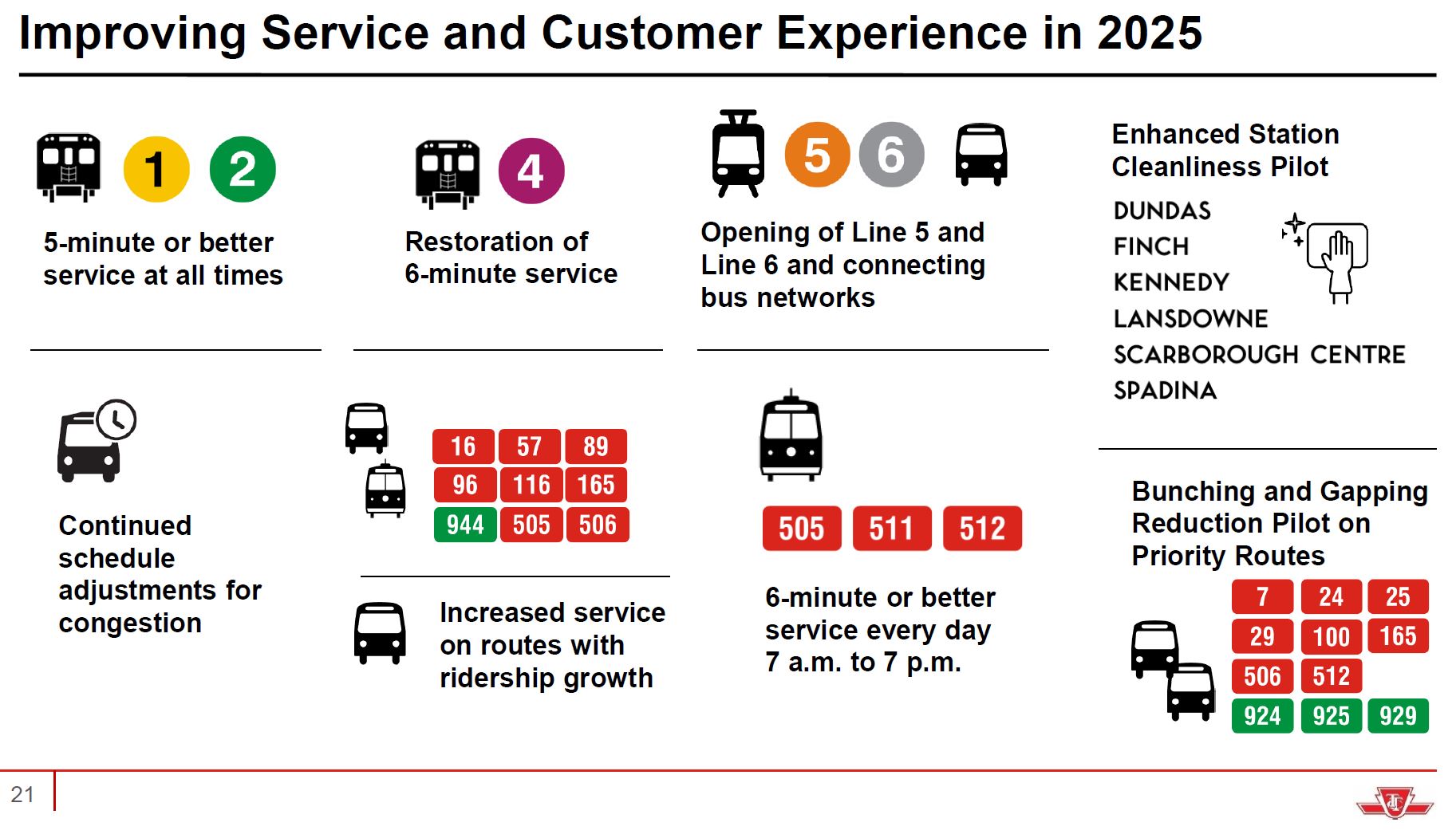
The TTC plans service improvements on the three subway lines, and on selected bus and streetcar routes, as well as efforts to improve reliability reducing bunches and gaps on some routes.
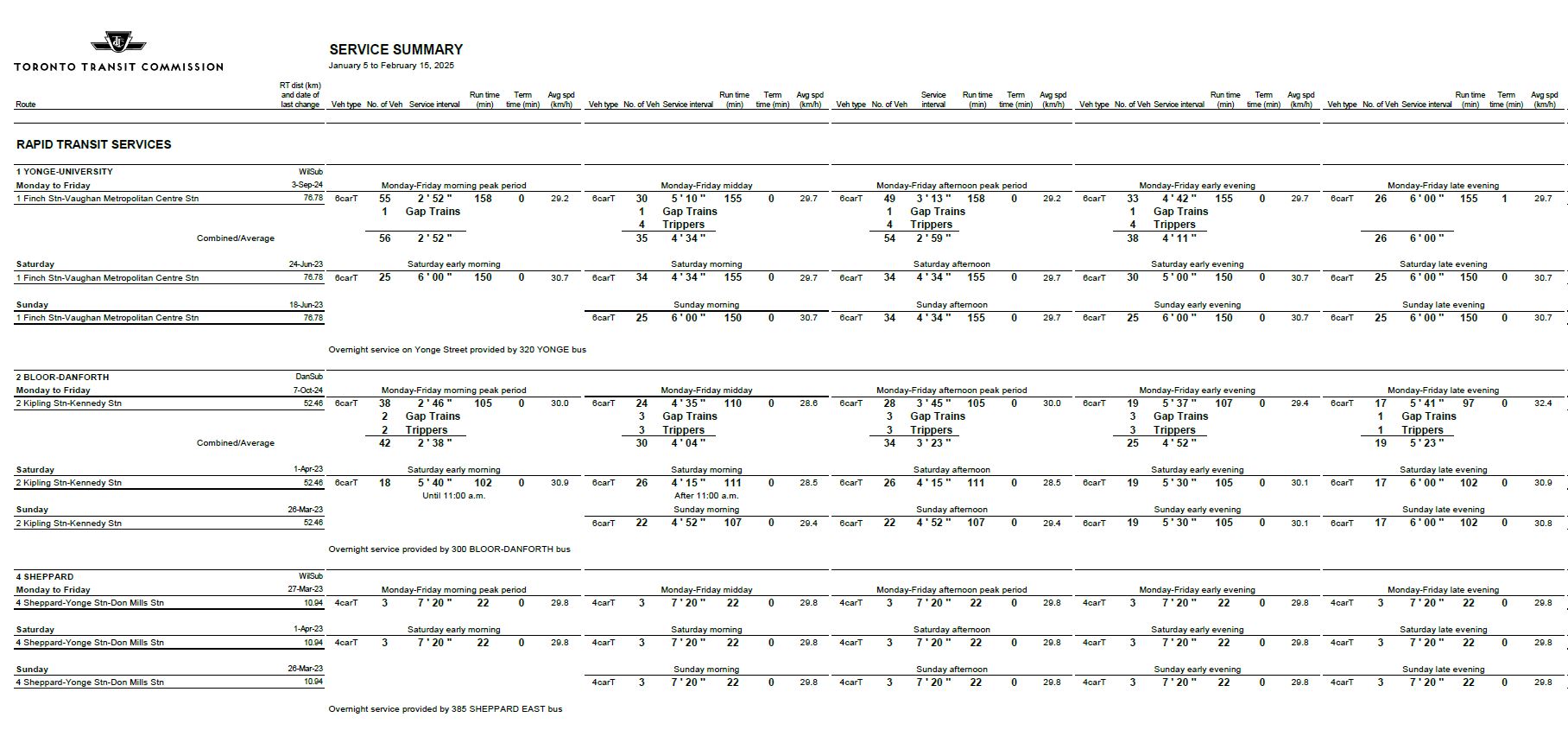
For comparison, here is the summary of subway service in January 2025.
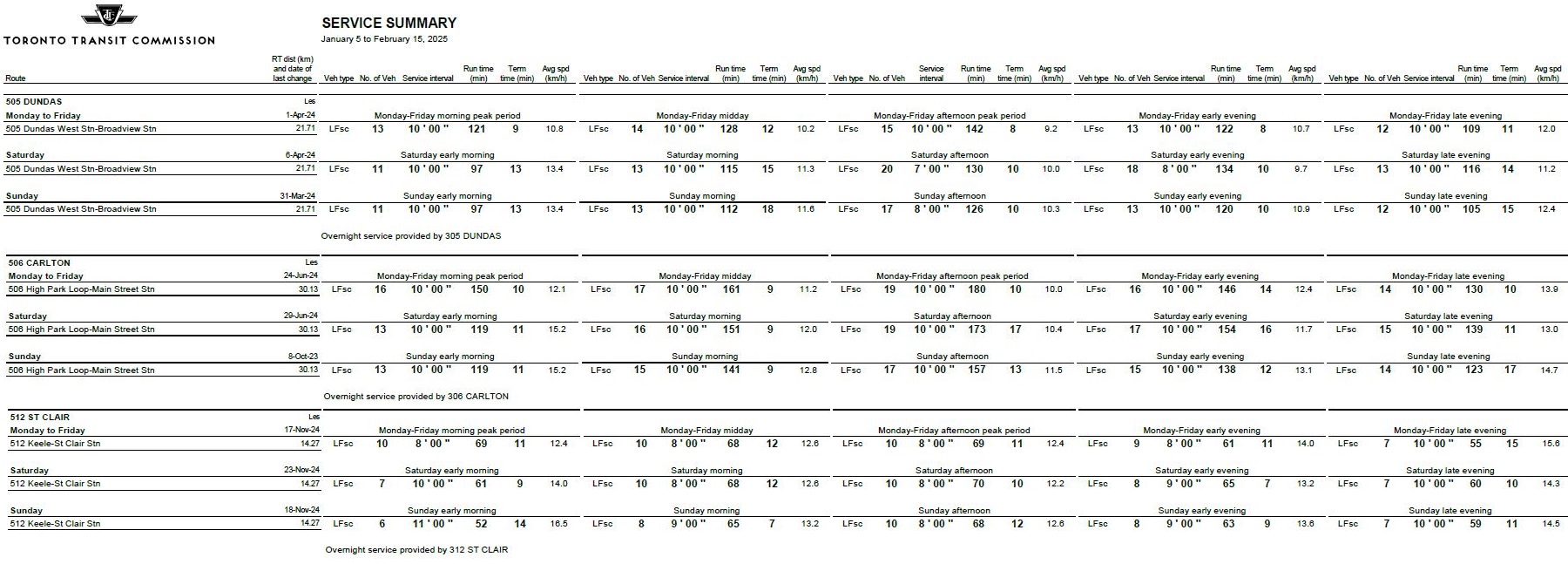
Here are the summaries for routes 505, 506 and 512.
Reducing the Unfunded Backlog
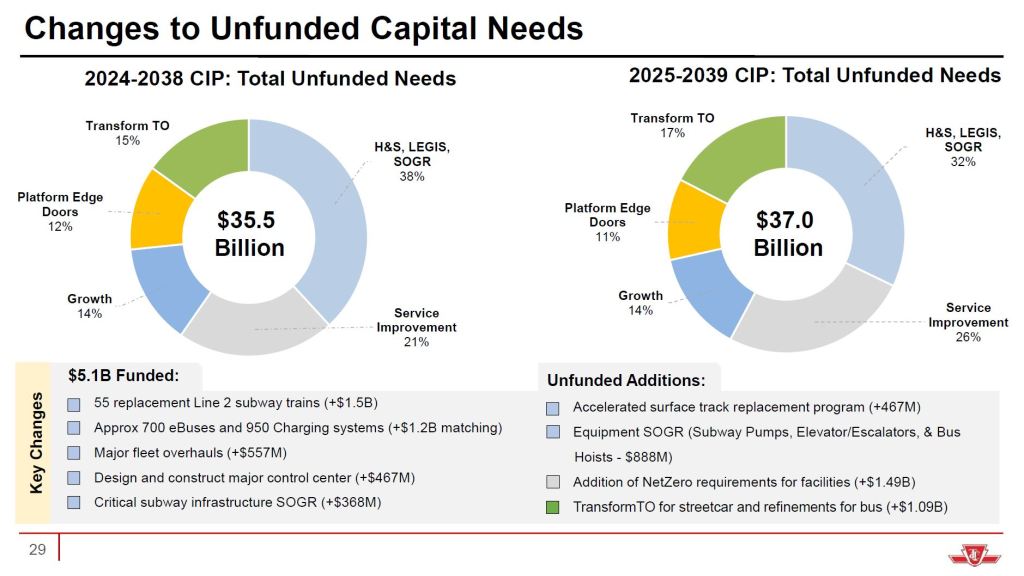
With the announcement of funding for 55 new subway trains, plus other money coming the TTC’s way notably from Provincial assumption of Gardiner/DVP expressway costs, several major lines totalling $5.1 billion are now “funded”. However, this is partly offset by new items including surface and subway infrastructure, and added requirements for the City’s Net Zero plan.
During the meeting, we learned that the federal subway car funding is not yet a signed deal. Whether this will be locked down before an election is called remains to be seen.
The TTC is still deep in the woods on long term funding. The charts on the right below show how available funding has been allocated. Note that monies repurposed for the Gardiner Expressway rebuild run out in the early 2030s when that program would have ended. On an ongoing basis, the upload does not have as significant effect as in the early years.
eBus procurement faces a challenge because there is no guarantee that special incentives to purchase electric buses and charging infrastructure will continue indefinitely. It is far too soon to bank on operating savings to offset extra costs including both capital (buses and infrastructure) and operating (extra dead mileage/hours for vehicle charging).

Fare Capping
Several people made deputations to the Board with a common theme that the TTC should implement fare capping. The premise is that instead of pre-paid monthly passes, there would be a cap on the number of fares charged. Once a rider hit that limit, travel would be free.
This is similar to the system already in place on GO Transit for Adult Presto users who travel free after 40 trips. It does not apply to those like students and seniors who already receive a deep discount.
With capping, a rider does not have to commit to the full cost of a pass at the start of each month, but would automatically receive the benefit if their travel reached a threshhold. The same scheme could also be applied on a weekly or even daily basis, although the two-hour transfer already provides some benefit to riders taking many trips. (The question of extending the two-hour window to three hours was also raised by some deputants.)
Fare policies generally are discussed in the TTC 5-Year Fare Policy and 10-Year Fare Collection Outlook. Activity on this has been quiet in recent years, but it is an obvious topic for engagement by the Strategic Planning Committee.
Fare Evasion
Fare evasion is a constant issue at Board meetings, but the discussion is often clouded by inadequate data and by varying attitudes to fare enforcement. The number $140-million comes up regularly as the revenue lost to evasion, and Board members routinely hope that this can somehow be recovered to aid in funding the system.
The Operating Budget contains a provision for increased enforcement and an anticipated return in added fare revenue.
To support the implementation of a Fare Compliance Strategy, $2.6 million is recommended to fund 69 new positions. This is comprised of 56 fare inspection staff deployed in the bus network with the support of 10 Special Constables and 3 program staff to monitor and manage the program, integrate the Fare Compliance program’s actions and track, analyze and report on the program’s results. The investment in fare compliance is expected to generate $12 million in recovered fare revenue in 2025, with $7.5 million being allocated to offset this program’s cost and contribute to funding new priority action investments while alleviating a $4.5 million base revenue pressure from an emerging seasonality trend.
Unscrambling the figures in that paragraph:
- $12 million in new revenue will be generated
- Of this:
- $2.6 million will go to the cost of staffing new positions
- $4.5 million will offset an anticipated change in ridership levels in fall 2025 vs fall 2024
- $4.9 million will fund other priorities including service improvements
Note that these will be part-year costs and revenues because the fare compliance program will not staff up immediately. It is not clear how the TTC will measure the change in fare revenue from this program as opposed to general growth across the system, or what cuts it will make if the $12-million target is not achieved.
A fundamental issue here is that recouping the “lost” revenue from evasion will never achieve 100% recovery. Staff to ensure compliance cost money. Some evaders will never be caught simply because it is impossible to monitor everyone. How much of the $140 million will reappear in TTC coffers remains to be seen. Linking service improvements to revenue recovery risks the possibility that hoped-for service will not appear.
Reduced Speed Zones: Status and Mythology
The question of eliminating Reduced Speed Zones (aka “RSZs”) came up as it has at past Board meetings. Management repeated a line they have used several times about how they only have 90 minutes nightly to make repairs, and that they have already reached their target of no more than 12 RSZs.
There is no other way to say this: that is flatly not true. TTC routinely takes longer “possessions”, as they are called, of sections of routes for major repairs. Work over the coming two weeks has already been announced by the TTC. Indeed, this practice was advocated by management years ago to the Board as the only way critical repairs could be made on a timely basis.
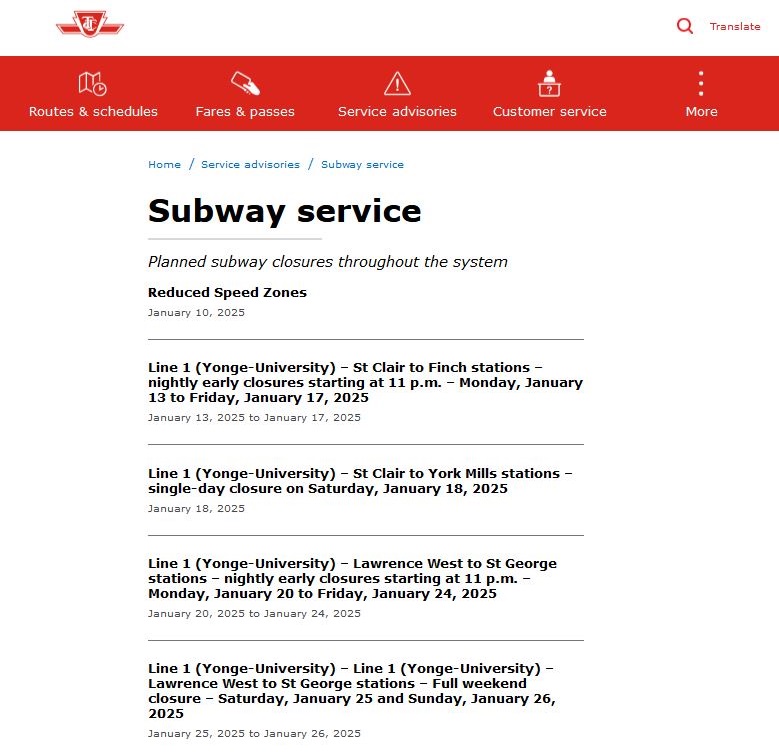
A further piece of creative writing is that trains travel slowly through affected areas to extend the life of the track. No. They do so for safety so that they do not derail. If slow operation were a way to extend track life, we would all be walking faster than the subway trains. What is “extended” is the length of time management try to get away with failure to make timely repairs.
The issue is not just the number of slow zones, but how promptly they are addressed. The TTC still has long-standing RSZs, and this has an ongoing effect on service for Line 1 in particular. It is difficult to expect better, more frequent service with new trains and Automatic Train Control if the TTC cannot keep track in good condition.
A related problem is the availability of specialized work cars needed to perform these repairs. Improved reliability of subway work cars is a line item in the Operating Budget, and riders deserve to know when this will show up in elimination of slow orders across the system.
By contrast, the Boston system (MBTA) has just achieved a zero slow zones status after a Herculean effort to attack hundreds of problems across their system. The Boston system is much older than the TTC’s – the earliest part of what is now called the Green Line opened in 1897, the oldest subway in North America. It has always operated with streetcars. The Boston system is about 50% larger than Toronto’s with a variety of operations in tunnel, at grade, on elevated, and in street-level rights-of-way.
Using Toronto’s metric, proportionately, they would aim for about 18 slow zones at any time. They have achieved zero and intend to stay there with only short periods to address problems on an urgent basis.
| Toronto (TTC) | Boston (MBTA) | ||
| Line 1 | 38.4km | Green | 43.0km |
| Line 2 | 26.2km | Red | 36.2km |
| Line 4 | 5.5km | Blue | 9.7km |
| Orange | 18.0km | ||
| Total | 70.1km | Total | 106.9km |
Expecting a steady state of 12 RSZs is the sort of half-baked goal that allowed the TTC to underperform for years. Toronto deserves honesty from TTC management, not continued excuses and misinformation about what can be achieved.
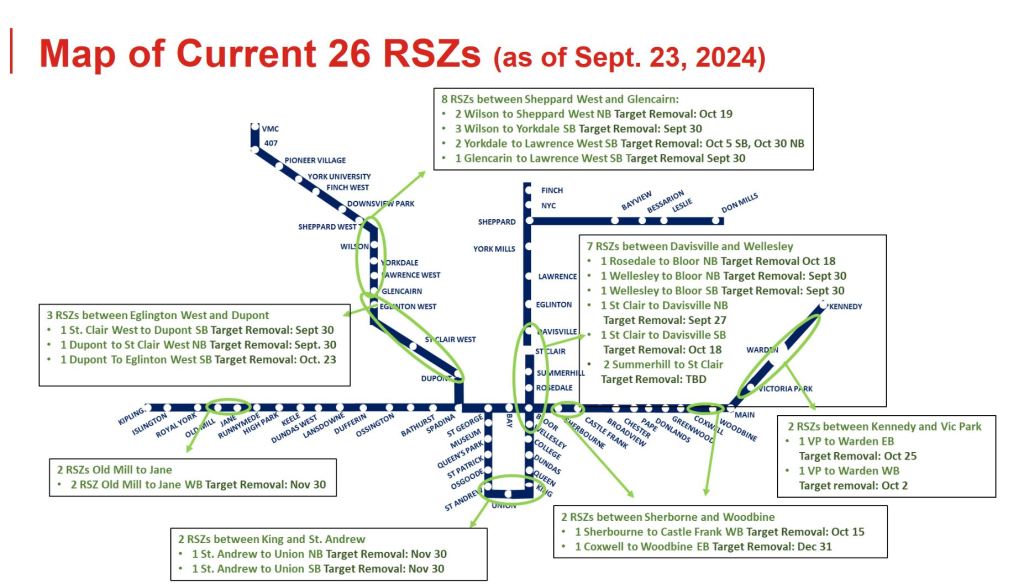
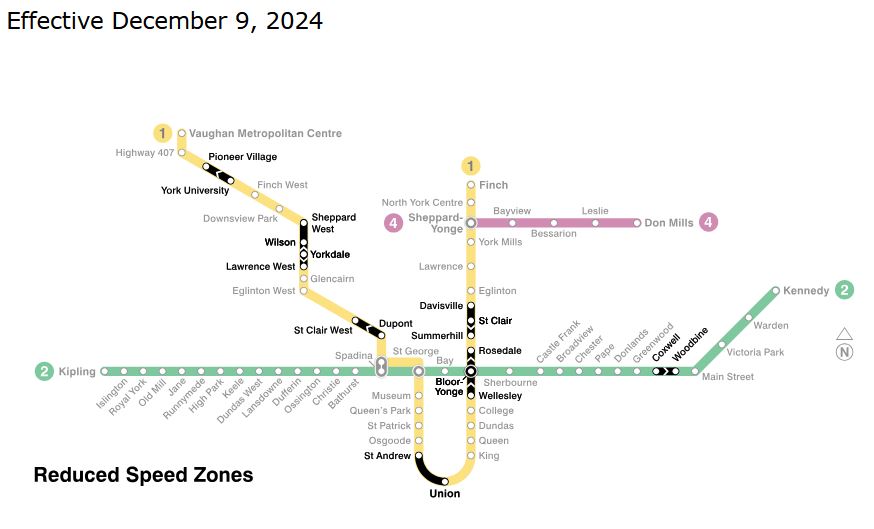
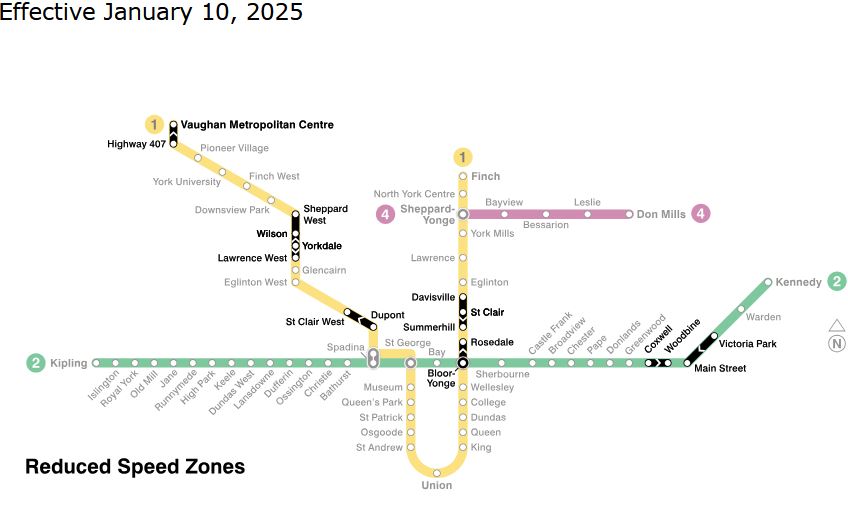
- Mass Transit Magazine: The MBTA is slow zone free. How much faster are trains running?
- MBTA Performance Metrics: Speed Restrictions
Vehicle Hours and Mileage: Measuring the Quantity of Service
The metric routinely cited by the TTC in discussing the return to the pre-pandemic service level is vehicle hours. However, this value does not provide a valid comparison.
The Operating Budget presentation gives a clear illustration of how vehicle hours and actual service diverge over time. The chart below shows bus hours in black, and bus kilometres in grey with the resulting operating speed in red. Since 2013 (the base used here), the speed has been declining and is now only 86.2% of the 2013 value. The slower the buses, the fewer trips they can make per hour, and hence the less service. Moreover, new or extended routes can increase mileage and hours on the system which is a separate change from better or restored service on existing routes.

See the article linked below for a comparison of actual service levels on each route by time of day.
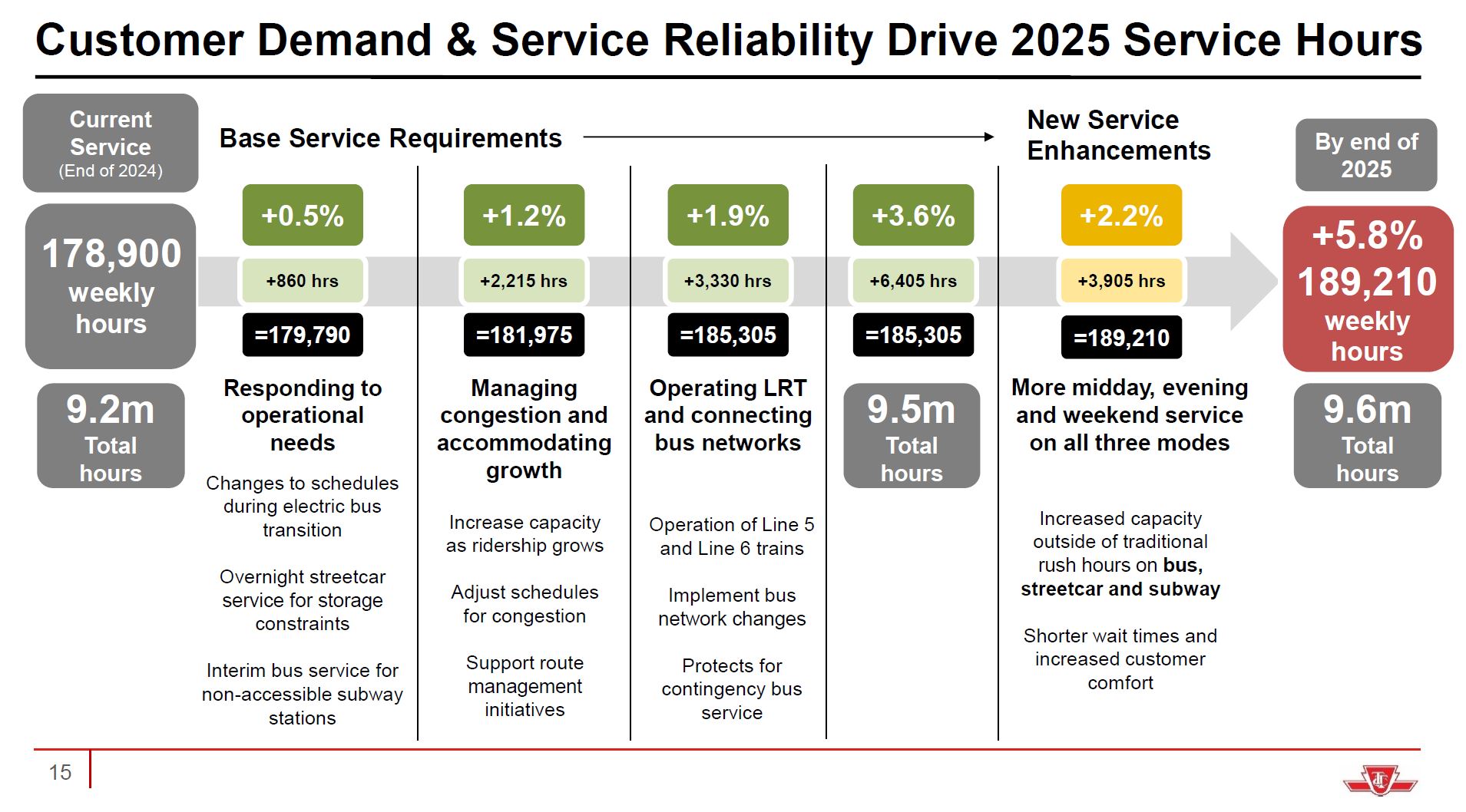
In 2025, the amount of service hours will increase by 5.8%, but only 2.2% of this is for improved service. The rest goes to adjusting to changing operating environments, and the opening of new LRT Lines 5 and 6. Comparing vehicle hours in 2025 to the value in 2019 is misleading because the two networks and the environments in which they operate are different.


Unfortunate news to hear that TTC might not have done the paper work for the Federal funding based on the line of questions from Saxe.
But also, the potential Federal elections could also hurt TTC from getting any new Subway cars. Maybe the tariffs talks could force the feds to buy new trains to prevent a massive loss in jobs in Canada from other jobs being lost?
Also, I actually don’t mind TTC losing any funding from the EV program. They can stick with hybrids. EV have a higher Capital cost just to purchase, shorter operating range compared to hybrids/Diesel, and then the added cost of chargers. And more garage to garage runs, which will negatively affect operations, garage space, and storage.
Steve: I agree that the hype about electric buses is excessive when the real issue in saving emissions is to get people out of cars and onto transit where more service is the big requirement. But, hey, there is a whole consulting/management industry in “innovation” with battery buses.
But they definitely have the right people on the board, Chow did a better job this time around. I believe one of the board members mentioned that they all actually take TTC regularly. Which is something we all been asking for.
Not sure why they need a 10th garage? Considering a few LRT lines will come online. If anything they need another wheel trans garage.
Steve: There is a plan to use the property at 780 Kipling for Wheel-Trans. That is the future 10th garage site, and then there is the study to come of the Obico Yard lands and how that will be divided up between subway and other uses.
With the fare being frozen this year, I think its safe to assume it will also be frozen in 2026 because of city elections. So fares won’t go up till 2027 the earliest.
LikeLike
We need a similar chart illustrating service hours, kilometres, and speed on the streetcar system over the last 20 years or so to show the impact of the TTC’s dumb management practices that waste funding and customer time.
– The stop-and-crawl through special work “safety” policy
– The “safety” restriction limiting no more than one streetcar from entering a junction at any given moment
– Slow orders and slow zones enacted for “safety” to prevent lawbreakers and the oblivious from self-caused harm
– Governors placed on streetcars to prevent the doors from closing too quickly because of “safety”
Steve: I am planning to do something like this.
LikeLiked by 1 person
Steve,
It is very exciting to see the investment in the TTC right now. But my concern is that we will not see any real day to day improvements due to the TTC’s lack lustre service standards such as the measurement of vehicle hours instead of service. How likely do you think that is?
Steve: There is a move afoot among some Board members to change the way the TTC measures the quality of its operations. Possibly something, including updated standards, will come from the Strategic Planning that will be formed soon. I am guardedly hopeful.
LikeLiked by 1 person
Thank you for this.
Seems to me we are witnessing a perfect storm.
Given the cultural take over at city hall and the hiring of Metrolinx exec Percy and dei hiring in general. I fear the worst and it is unfortunate.
Steve: “DEI” policies have been in place at the City for years before the current administration, and they are certainly not responsible for hiring Greg Percy who is, btw, only in an acting role at present.
12 years ago I warned every level of government the defective presto system was a really bad idea that would lead to financial ruin. But the TTC continues to blame the victim with entrapment and heavy undercover fines. A public inquiry would be very interesting indeed. But that will never happen.
Steve: The method of enforcement is separate from the specific technology. Presto was a bad system from the outset, and the TTC wanted to install something else, but were forced to accept the provincial system as a pre-requisite to continued subsidies.
Given my position I sometimes regret I couldn’t do more. I wouldn’t hold my breath for truth from management.
Our civic leaders lack the ability to tell the whole truth.
Cheers
Gus Rizakos
LikeLiked by 1 person
Its wonderful to see an actual plan to improve service, truly it is. But I’m still sitting here thinking I think it’s a positive sign the TTC is looking to enhance the customer experience and improve service. Rather than pretend.
However one thing sticks out to me like a sore thumb. The East Waterfront LRT project, and subsequent Union station expansion. Am I alone in thinking that we should be diverting any and all energy and resources into expediting this project?
It seems wildly irresponsible of us to be dumping money into improvements and enhancements in other parts of the city, which are already serviced by some form of transit. Where as we are building a massive new community, which is already home to thousands of new residents. And countless businesses. Who are filling in an area of the city which either has very rudimentary transit, at best. Or at worst, absolutely no transit at all.
You (As in the city) mean to tell me that no one sees the critical nature of this this pending problem. We’re building a ‘transit oriented’ community WITH NO VIABLE TRANSIT OPTION! Only in a city like Toronto could something so stupid take place….. well maybe Hamilton.
I just don’t understand why this is not raising alarm bells with someone, anyone. Why are we not trying to find some creative way to finance this thing. If our provincial and federal partners feel that they have given us enough money as it is, and we don’t need anymore. Is this glaring hole in our planning just being ignored by Waterfront Toronto, Council and the Media? I guess so. Boy will there be hell to pay when all those buildings go up, with little to no parking, thousands of people and only a bus service to move them. What happens than? Traffic will be lovely down there with those narrow roads which are not designed with buses and a high volume of autos in mind.
Steve: There is supposed to be an update report coming to Council in the next few months. The 60% design work is now underway. There are several problems with this project.
First, it never had the priority among politicians of the big subway projects. It’s a “downtown” project, and so has no champions. John Tory claimed to my face that it was a priority, but you would never believe this from the budgetary and political support he actually provided.
Second, the cost of the project jumped a lot because the TTC underestimated the complexity and cost of changes needed in the Bay Street tunnel and Union Station. For a time, the project was delayed for examination of alternatives such as a moving walkway or a funicular within the tunnel linking south to Queens Quay.
There is a timing issue with how long that link will have to close, and how quickly a through east-west service could be in place on Queens Quay. This is also tangled with timing of the Gardiner reconstruction at the DVP interchange and Ontario Line construction because the Cherry Street link cannot be built immediately to provide an eastern link.
Assuming funding can be found, the line will not open until the early 2030s. Work on re-configuring Queens Quay East will likely be the first step because it is not dependent on other projects, but even with a reserved busway there, the problem of linking transit north to the core area at Union remains.
LikeLiked by 2 people
Call me naive, but I’m stunned by your reportage regarding the reduced speed zones, which IMO can fairly be called an epidemic.
The blasé acceptance by the Board of mediocre track maintenance goals speaks to a broken culture. I recently had dinner with a US based transit consultant and he expressed amazement that Toronto was unable to maintain (all of) *two* subway lines in a state of good repair (2 1/2 if you count Line 4).
I served on a corporate board for several years. Were I on the TTC Board I’d be asking not only about the details of the RSZ remediation plan, but what personnel changes were being made in response to this dire situation. This situation arose not by magic, but by managers making bad decisions.
Steve: There is a culture within the TTC Board of not challenging management, “the experts”, both for fear of sounding stupid, and because that’s not perceived as being the Board’s duty. It is easy to be trapped into a technical argument where the management explanation sounds plausible, and without extensive evidence to the contrary, someone raising objections can easily be made to look like a fool. Gaslighting is another common technique to belittle critics. People wonder why I go into such detail in some articles, and it is precisely because only with overwhelming evidence are criticisms heeded. The Board appears to be shifting to a more activist role in setting policy and expectations, and this is long overdue.
LikeLiked by 1 person
Posting as FYI line 2 was shutdown between Islington and Keele at 6am this morning due to a rail issue. This is not an area flagged as a RSZ. Perhaps it’s related or perhaps not.
Steve: It was a late clearing work zone incident. Rail, in the sense that repairs were not able to be completed in time for start of service, but not an RSZ issue per se.
LikeLike