
This is the second article in my review of the TTC’s 2025 budget package to be discussed by their Board on January 10, 2025. The Operating Budget is covered in the first part.
- Recommended 2025 TTC Operating Budget; 2025-2034 Capital Budget and Plan and 15-Year Capital Investment Plan and Real Estate Investment Plan Update
- TTC 2025 Operating Budget – Preliminary Review
The Capital Budget and Plan exists in various forms:
- A one-year budget for the current year.
- A 10-year plan corresponding to the City’s financial planning horizon. In past years this tended to contain only approved projects for which funding was certain, but now some projects are only funded in early years.
- A 15-year plan takes a longer view and includes many projects that have not reached the approval stage. The intent is to give the City and other funding partners a heads up on the longer term needs for transit funding.
Separately there is a Real Estate Investment Plan. This was created a few years ago in response to project delays caused by the time needed to acquire property before works could go ahead. In some cases, this gives early warning of items that have not even shown up in the 15-year plan. I will address the Real Estate Plan in the third article in this series.
When the 15-year plan was first unveiled, it shocked City financial staff, Council and the TTC Board with its scale then roughly three times the 10-year plan. Over the years projects would pop up from the TTC with little warning because they did not appear on official lists until they were approved. (Only a few enjoyed special status of “below the line” as placeholders in anticipation that someone would pay for them when the time came.) Now everything was on the table, but with no sense of priorities beyond broad areas such as “state of good repair”
The three budgets/plans have grown substantially over the years, as has the City’s expected share of the cost thanks to Provincial and Federal governments backing away from what once was an assumed one third contribution to whatever the TTC proposed. Today, funding from these governments is a mix of ad-hoc allocations to specific projects and some dedicated yearly funding, albeit nowhere near enough to cover what is proposed.
The charts below show the 1-year, 10-year and 15-year versions of the plan broadly subdivided by category and portfolio (groups of projects generally related to one part of the network such as the subway). Note that the 10-year plan is roughly ten times the cost of the 1-year budget, but the 15-year plan is over three time the 10-year plan. This implies a massive jump in spending, and it is hard to believe that scale of change will occur.
The 2025-2039 plan is up by $5.4 billion over the corresponding 2024-2038 plan, or 11.4%. The unfunded amount is almost the same ($37.0 billion in 2025 vs $35.5 in 2024) because of new money freed up by provincial assumption of major highways from the City.
The main additions are listed below (Budget report at p. 42):
- An accelerated rate of SOGR for critical infrastructure such as subway pumps, escalators, elevators, and other aging assets (Subway/SOGR) – $0.9 billion
- An accelerated rate of surface track replacement (Streetcar/SOGR) – $0.5 billion
- Addition of Net Zero requirements for facilities (Facility/SI) – $1.5 billion
- Vehicles and infrastructure required for TransformTO service enhancements for streetcars and refined estimate for bus service (TransformTO/Growth) – $1.1 billion
- Procurement of additional subway cars to support future growth and service maturity (Subway/Growth) – $0.7 billion
There are large projects in the later years of the plan contributing to the high cost beyond year ten. Some of these are described as “aspirational” which is a polite way of saying they are unlikely to materialize. However, the political problem remains that the big number, $53 billion, gets the attention and would-be funders cough on the size. Prioritization is an obvious requirement, but that has political challenges.
Note that these budgets do not include the large provincial projects such as the Eglinton and Finch LRT lines; the Ontario, Scarborough and Yonge North subway lines; nor the GO Transit expansion including the SmartTrack stations Toronto will pay for. Those are in the Metrolinx budget, not TTC.


Funding for the 10-year plan comes mainly from the City. The tables below show the shares in summary, and with more detail of each funding stream.
The City share comes partly from the City Building Fund, a property tax add-on originated by Mayor Tory that will continue to grow in future years on top of the basic property tax. This tax carries debt floated to pay for many transit projects. This is shown as “Debt Recoverable” in the second table below in the amount of $7.4 billion over 10 years, or 45% of the total funding.
Another source is development charges, although the magnitude of that contribution is affected by the real estate market and rate of new construction, and is forecast to decline. DCs will provide $1.4 billion, but most in the early years.
Gas tax subsidies stay the same over the decade, and so in real terms they decline in value.
Many of the federal and provincial funding streams depend on future governments continuing programs already in place.


The City’s ability to carry this expense is possible in part because of the “New Deal” with Ontario which has uploaded the cost of the Gardiner and Don Valley expressway. Note the unfunded (red) portion of this chart. This is an example of work that is included in the 10-year plan, but which is not yet fully funded. In effect, the $16 billion value for the 10-year plan understates its true cost because it does not include the unfunded portion of projects.

Charts below show the breakdown of funded and unfunded work varies by type of project and area within the system. Note that TransformTO is completely unfunded, as is most of the Service Improvement and Growth category. Funding for the streetcar network is in better shape than bus and subway because of project timing. Much of the streetcar system renewal is well on its way to completion, whereas the subway and bus networks face major fleet replacements and expansion, as well as facility cost associated with growth.

The chart below compares the 2024 and 2025 plans showing how the unfunded portion of the plan has evolved. New funding goes almost entirely to state of good repair, health and safety and legislative requirements spread over the 15 years.

In a separate table (see. p 56 of the report), both Platform Edge Doors and TransformTO are listed as “aspirational” projects. Between them they account for $10.5 billion of the $36.7 billion in unfunded projects. City Council will have hard decisions to make in prioritizing these relative to basic maintenance and growth needs.
The TTC links its capital plans to Board and Council objectives as shown in the table below. Notable by its absence below is the substantial service increases foreseen by the City’s environmental plan, TransformTO, although this has a very large effect on fleet and facility needs. The 10-year plan covers mainly the existing system with only selective growth areas, notably in rapid transit.

The 10-Year plan contains only a small amount of design funding for the Waterfront East LRT, and nothing for other LRT projects such as Eglinton East and Waterfront West.
15-Year Plan Update
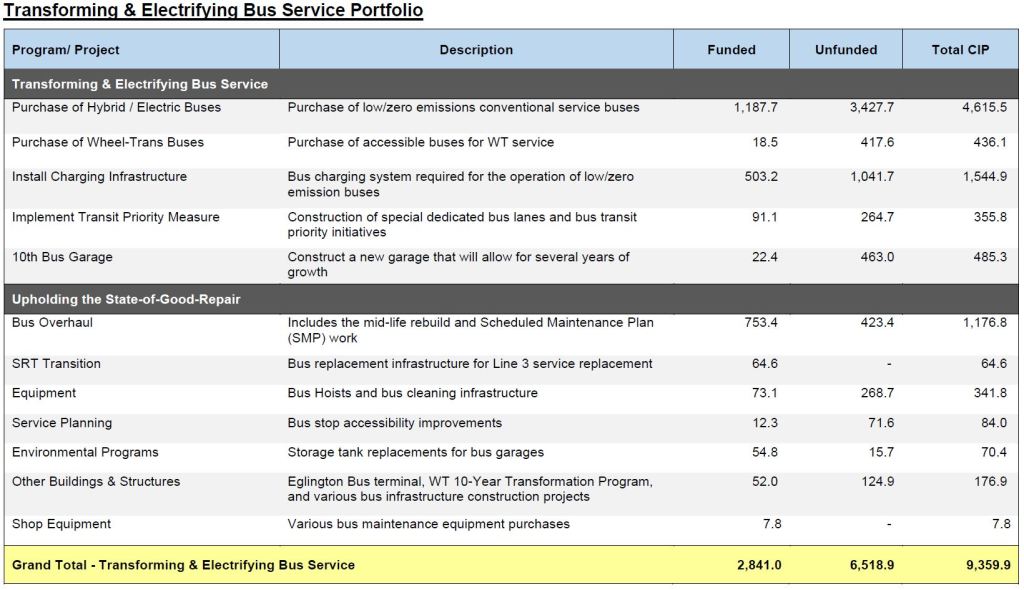
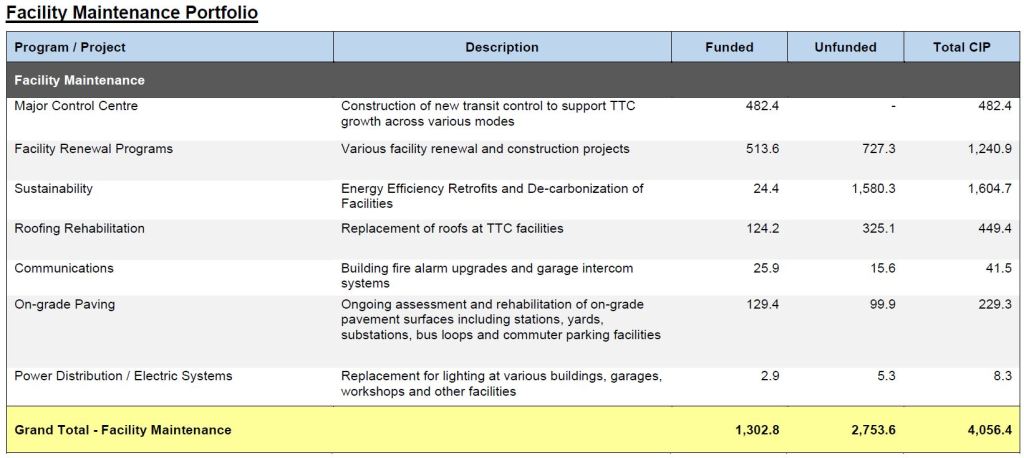
The report contains an updated list of capital projects by portfolio. One thing that is not clear is whether the costs shown here end in 2039 or if some of these projects and associated spending lie in 2040 and beyond. Clarification is required to put the $53 billion pricetag in context.
Some programs are ongoing such as bus purchases at a rate of 140 a year or more. The electrical charging infrastructure will last beyond 15 years, but with current plans for a 12-year lifecycle, purchase of new buses will always be a line in the budget. (140/year is not an adequate rate to refresh a 2,200 bus fleet.)
I hope to obtain more detailed information about items within this plan, and will report on them when and if info is forthcoming from TTC.





 Steve Munro
One of the things I wish the capital budget would do (and something council should require) is that the unfunded items should have both business cases and funding options attached to them. Especially the one-off capital items.
For example we could get moving on platform doors with a 10 cent temporary fare increase…which would raise about 43m$/year…and would allow for 1 or 2 installations per year…as time goes on savings from reduced delays and compensation to victims/employees etc. could also be included…and the city could then advocate for funding from provincial savings to healthcare or other funding to speed the projects up…at the initial rate it’s likely that the 38 line one stations could be done just in time to start on line 2…
TransformTO will need to have a few options that would likely include taking on additional debt to finance new vehicles and figure out operations…a basic starter pack of 1 new e-bus station and associated buses should be priced out at the least…
LikeLike
Probably a stupid question, I’ve heard there speculation. Would the Line 2 subway car funding be compromised if there’s an election. Or had the funding for it been given to TTC already in some TTC/City account?
I’ve heard ppl wonder, if an election took place and CPC gets a majority government , they can reverse the funding given to TTC.
Just curious if the funding has already been given to TTC/City?
Steve: This is a concern in the short and longer term. Short term, will the government get its act together and formalize the subway car funding. Longer term, how much of any of the existing programs will survive a change of government. Remember how Mike Harris capped transit funding at existing commitments and cut off everything else. That’s why the Sheppard subway ends at Don Mills. They ran out of money.
LikeLike
I note that the Capital Budget notes $$ are there for further planning for the streetcar link between Exhibition and Dufferin. I do not see any mention of funding for the TTC part of the QQE LRT (Bay St from QQ to Union) which is, as we know too well, a “high priority” for City! Is this because the funding (or lack of TTC funding) for QQE is in some other ‘basket’ or ????
Steve: The only money for Waterfront West or East is planning and design funding, not for construction.
LikeLike
Why is purchase of new subway vehicles up to $3.9B? I thought that it was about $2.5B for the new T1 trains fleet.
Steve: That includes cars for growth mainly on Line 1. The $2.5B only buys the 55 replacement trains for Line 2.
LikeLike
More money is needed for underserved areas of Scarborough and Rexdale, why Downtown gets all of the additional service?
Steve: When I publish the additional info from the Board meeting you will see that there are planned improvements on 16 McCowan, 57 Midland, 89 Weston, 96 Wilson, 116 Morningside, 165 Weston Rd. North, and 944 Kipling S Express. Bunching/gapping reduction will be trialed on 7 Bathurst, 24/924 Victoria Park, 925 Don Mills Express, 929 Dufferin Express, 100 Flemingdon Park, and 165 Weston Rd. North. None of these is downtown and some are even in Scarborough. (This list was not available when I wrote the original article.)
LikeLike