
The TTC released its 2025 budget package on January 7 including the proposed Operating Budget, the Capital Budget and Plan, and the Real Estate Investment Plan. The TTC Board will discuss this package at its meeting on January 10.
This article is a preliminary review of the Operating Budget. I will turn to other parts of the package in separate articles, and will add follow-up articles after the Board meeting.
Highlights:
- Fares continue to be frozen at 2023 levels.
- The total Operating Budget for 2025 is $2.819 billion of which $1.387 billion will be covered by City subsidies. This is broken down as:
- Conventional system: $2.636 billion with a subsidy of $1.214 billion
- Wheel-Trans: $182.6 million with a subsidy of $173.2 million
- Service hours will be increased by 5.8%. There are some specifics in the budget, but more details are to follow.
- 1.7% increase to account for ridership growth and new services for accessibility pending completion of the Easier Access program.
- 2.2% increase for off-peak service.
- 1.9% increase for opening Lines 5 and 6 together with bus network changes (tentatively planned for July and August, respectively, subject to Metrolinx confirmation of dates).
- Specific service improvements listed in the budget include:
- Implementation of 6 minute service or better from 7am-7pm, 7 days/week on 505 Dundas, 511 Bathurst and 512 St. Clair.
- Return to pre-pandemic wait times on subway lines during off-peak periods.
- Restoration of pre-2023 off-peak crowding standards. Service will be increased starting in April on nine priority routes (not listed).
- Increase in Wheel-Trans service to handle an expected 4 million more rides in 2025.
- Increase in capacity to recruit, train and develop the workforce.
- A pilot program on 10 key routes to reduce bunching and gapping.
- A pilot program to improve cleanliness in six key subway stations (Scarborough Town Centre, Kennedy, Dundas, Finch, Spadina, Lansdowne).
- Improved maintenance and asset management for key items such as subway work cars.
- Beginning an environmental resiliency program.
- Expanding the fare compliance program to increase revenue.
- Cost savings of $37.2 million from budget reviews and efficiencies.
These items are discussed in more detail in the main part of the article. Many parts of the budget are presented here only in summary with tables showing financial breakdowns. Readers interested in further details should consult the TTC’s budget report linked above.
Budget Overview
The total operating budget, including Wheel-Trans, now sits at $2.8 billion. Of this, fares cover only about 40% of the “conventional” system, a big drop from the days when farebox recovery was at 60% or better. This is due to the combined effect of ridership that is still not at pre-pandemic levels, fare freezes, and the rising cost of operation.
In the short term, there is Provincial funding contributing 7% of the total. However, the “New Deal” expires on March 31, 2027 and this creates a future gap that must be filled over and above the annual growth in subsidy needs.
(Note that $93 million in Provincial gas tax revenue flows through the City to the TTC and is included in the “City Funding” shown here. The remainder of the Provincial gas tax and all of the Federal tax flows to the Capital Budget.)
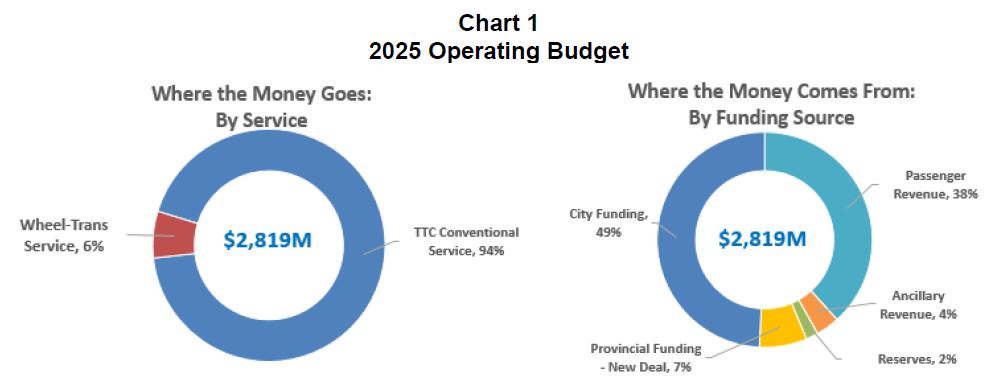
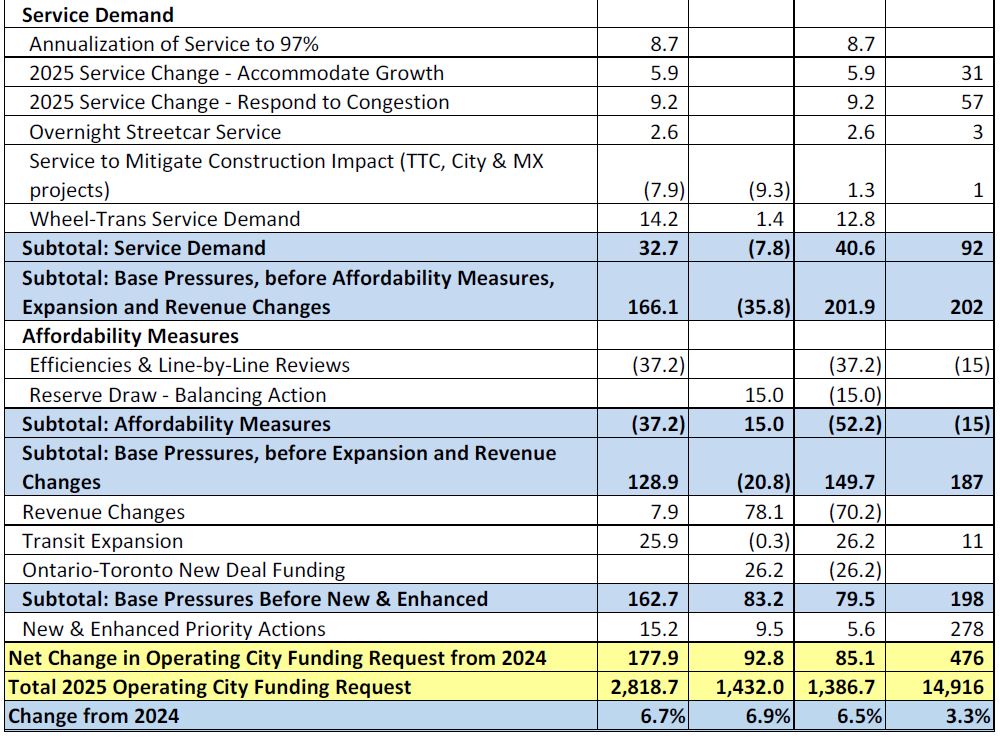
This budget is a 6.5% increase over 2024 ($85.1 million) arising from various changes:
- The lion’s share of the “Base Pressure” comes from cost-of-living increases in wages ($83.2M), and reversal of a 2024 budgeted reserve draw ($25M)
- There is a one-time adjustment in Workplace Safety and Insurance Board / Long Term Disability costs ($21.3M) changing from accrual to current year accounting.
- The full year cost of 2024 service changes plus planned additions in 2025 ($40.6M, of which $14.2M is for Wheel-Trans).
- “Affordability measures” include a reserve draw ($15M). Note that the reserve may or may not actually be needed depending on actual results for 2025. In 2024, the TTC only spent 96% of its approved Operating Budget.
- Additional revenue ($70.2M) offsets some cost increases. This includes an anticipated $12M from improved fare enforcement.
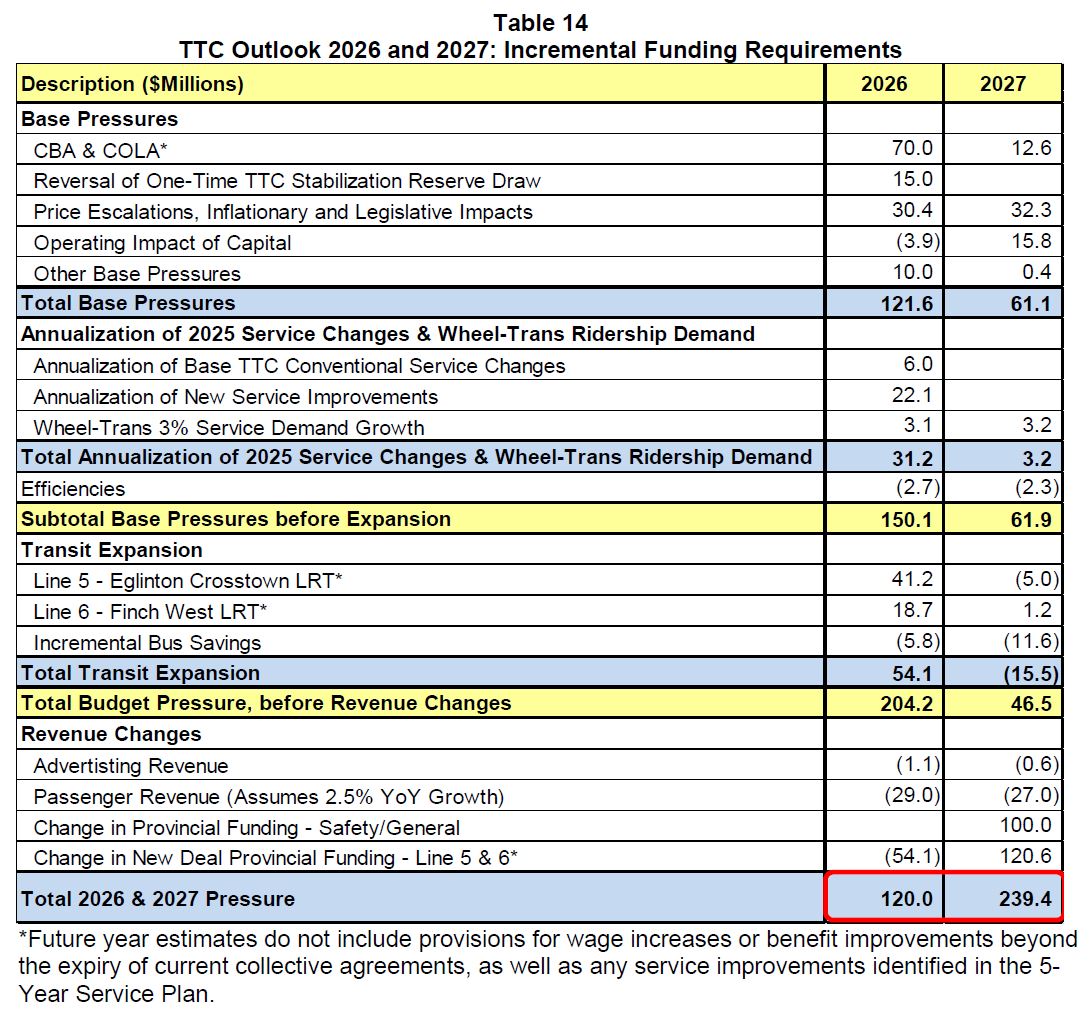
- The operation of Lines 5 and 6 is covered by a Provincial subsidy and there is no net cost in the TTC’s budget.

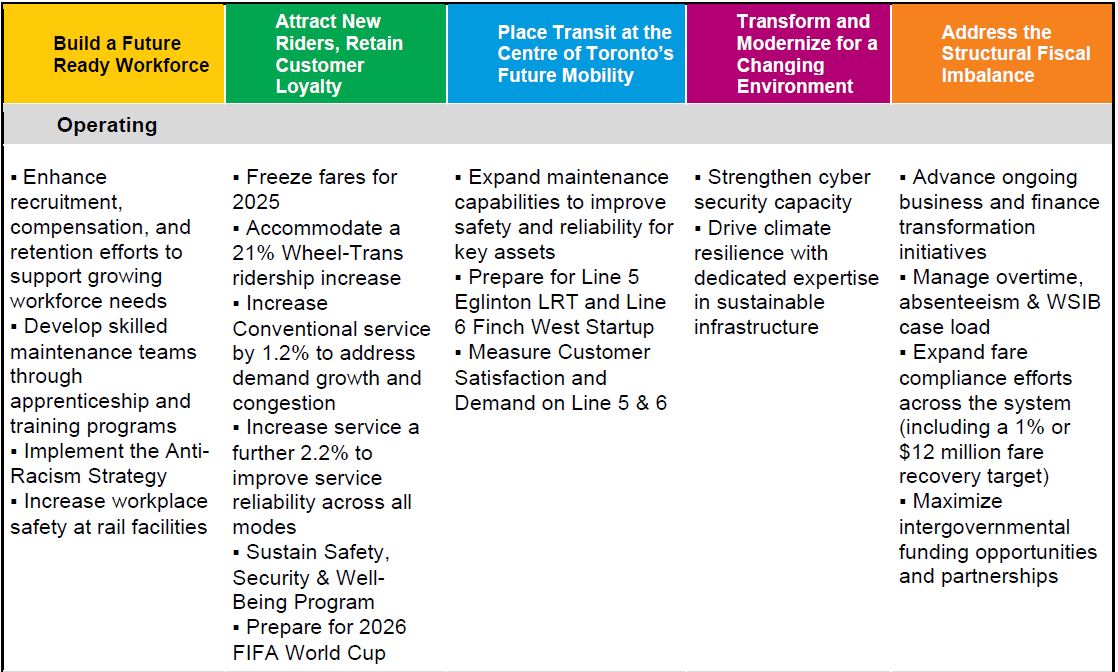
The chart below shows the components of the 2025 Operating Budget as they relate to Board and Council priorities.
Metrics
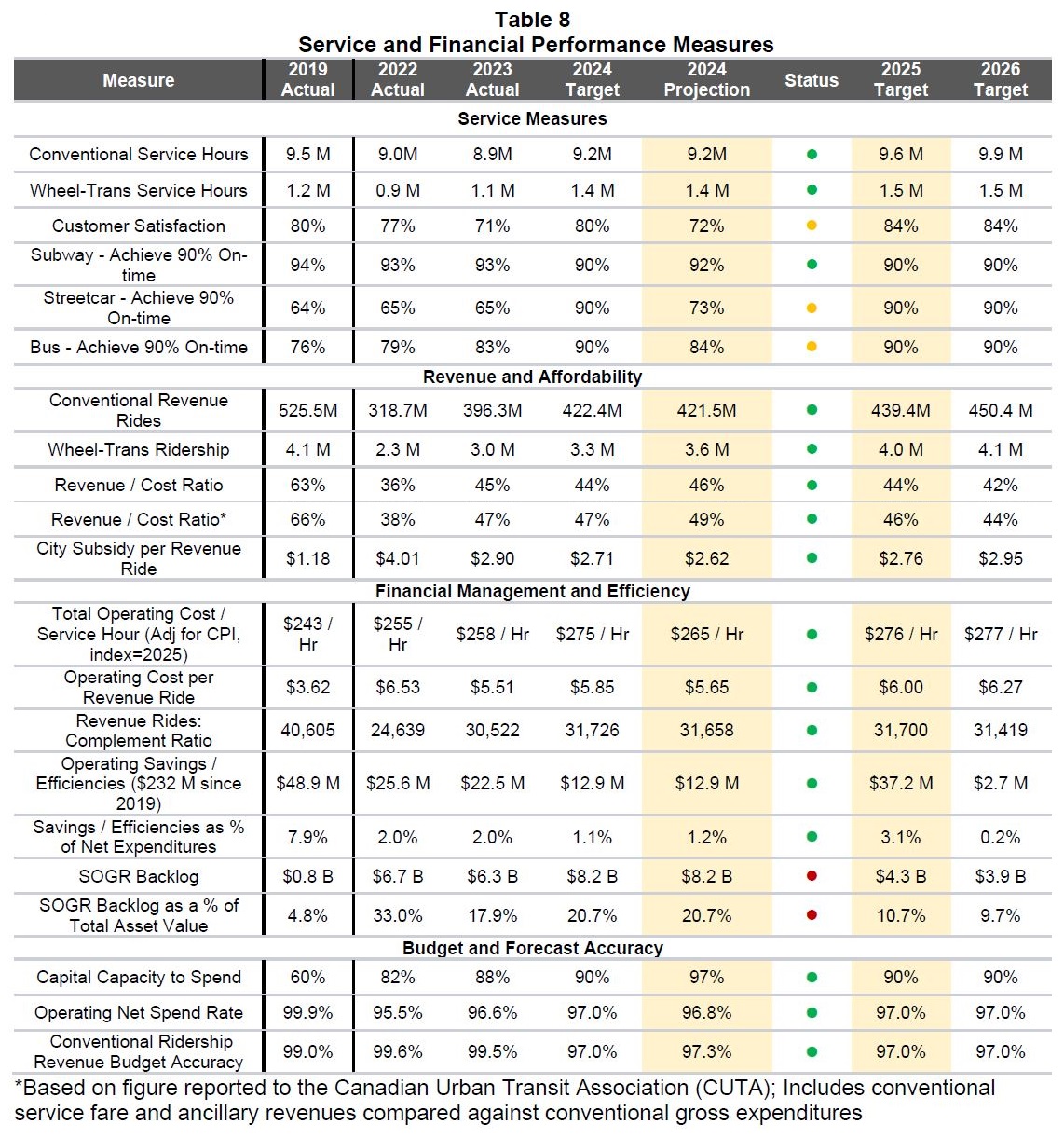
The budget includes a table consolidating several performance metrics and showing their evolution from 2019 (pre-pandemic) to present. At this point there is no discussion of new/revised metrics, notably for service reliability and crowding over the length of routes. Although the On Time Performance target for all modes is 90%, it is a real stretch to think this will actually be achieved for bus or streetcar operations.
The revenue/cost ratio, historically above 60%, dropped with the pandemic onset in 2020 and has not yet grown back to its formal level in part because ridership is still below 2019, and in part because of below-inflation fare increases over the past five years. This is a deliberate policy choice by the City, and the only question is whether a future budget will bring any fare increase or targeted changes in fare structure. The budget contains no discussion of fare policy.
Note that the cost/hour for operations is very substantially higher than an operator’s wage. This number includes many costs that accrue due to vehicle use (mileage), fleet size (servicing and garaging) and infrastructure (stations, tunnels and other fixed subway systems). An ironic effect of one person train operation is that the cost/hour goes up because the non-wage costs are allocated against fewer operator hours. The marginal cost of adding service is considerably lower than the fully allocated cost.
Ridership
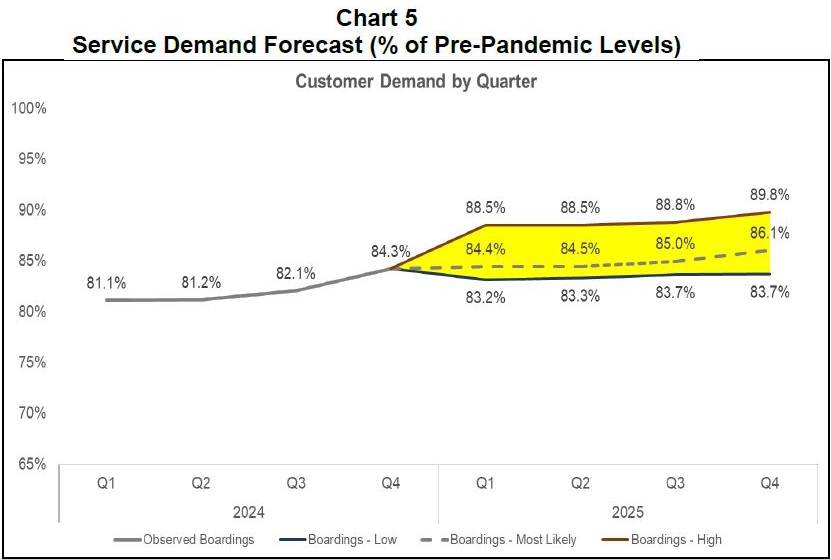
The demand for service is expected to remain below 2019 levels overall in 2025 with the range of prjected boardings shown in the chart below. Note that this would bring the system almost to 90% of the 2019 level. However, demand recovery is uneven across the system with many routes now seeing off-peak demand, notably on weekends, above 2019. This is the reason for concentrating improvements in those periods. Off-peak service has a lower marginal cost because no new vehicles are required, and there is generally less deadhead mileage to/from garages relative to in-service hours.
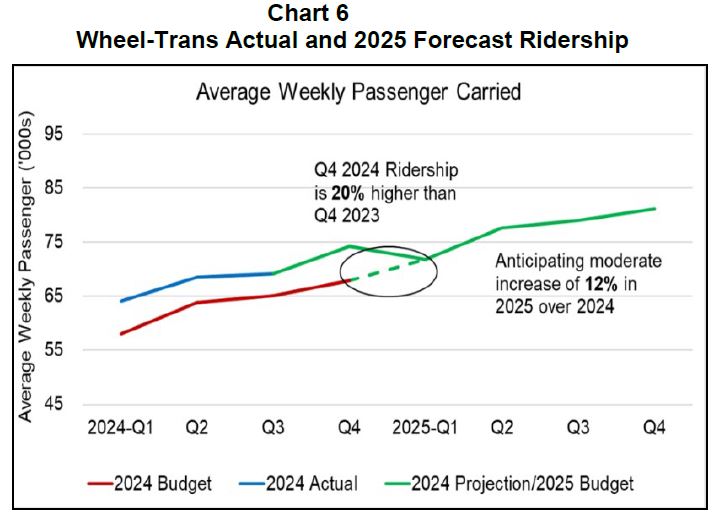
Wheel-Trans demand has been growing at a strong rate, and this is projected to continue in 2025.
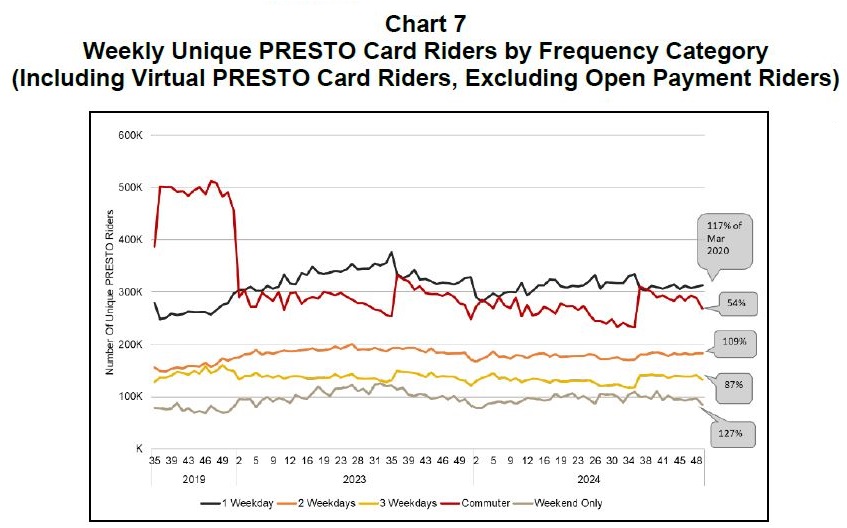
The character of TTC ridership has changed since 2019, and is now thought to have settled into a “new normal” pattern for weekday commute trips. Growth in future years will come from economic activity and population. In effect, this pushes the last phase of “recovery to 2019” into the territory where new riders must be attracted to the system rather than simply assuming they will return as their work arrangements evolve from work-from-home to in-person. A related challenge will be whether the population growth and associated travel demand will lie along the traditional pattern served by the TTC network, or will be stronger for non-core journeys where transit is less competitive.
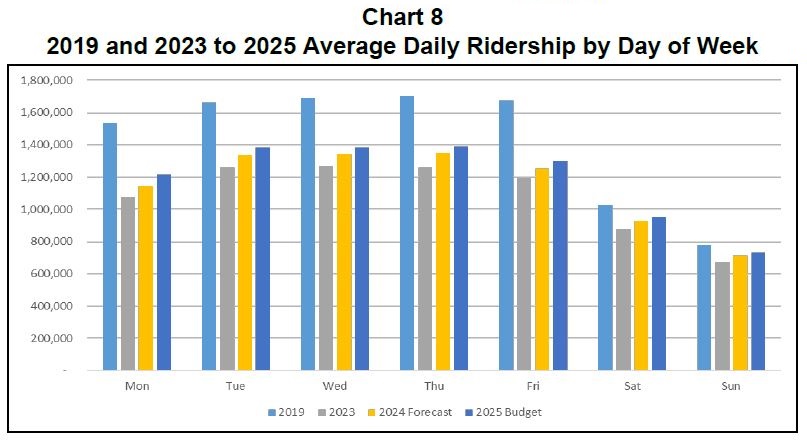
Weekend travel relative to 2019 is stronger and service improvements will be concentrated there. However, this represents a lower proportion of TTC ridership than weekdays, hence less growth in absolute terms.
There is a potential issue in ridership projections for fall 2025 in that an expected bump in demand in November 2024 was not as strong as expected, and 2025 could underperform expectations.
With the opening of Lines 5 and 6, there will be substantial added costs, but comparatively small added revenue. This implies that most riders in the early years will be existing users of the bus service.
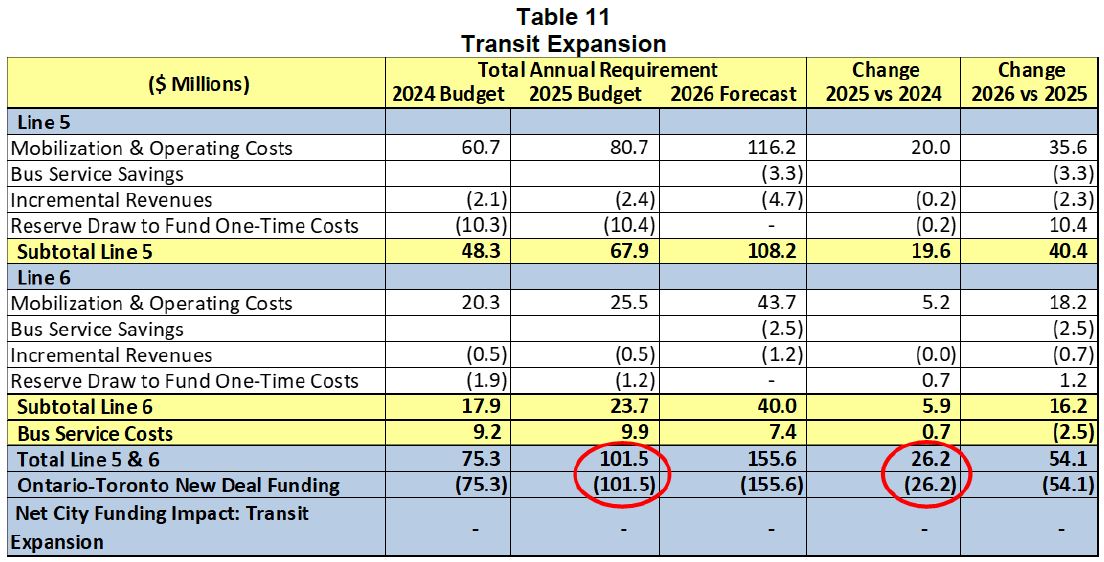
“Affordability Measures”
“Affordability Measures” include a number of factors, but the largest among them is a one-time change in the accounting for WSIB/LTD costs by removing an accrual of future year expenses from the current year accounts. This change reflects that post-retirement medical and dental costs are already handled on a current year basis, and the provision for future WSIB/LTD costs is removed from the budget. This is an accounting change, and does not represent any new initiative or efficiency within the TTC.
The Car Parking Strategy involves a reduction in lease payments to Hydro One for underutilized parking lots on their property that will be downsized.
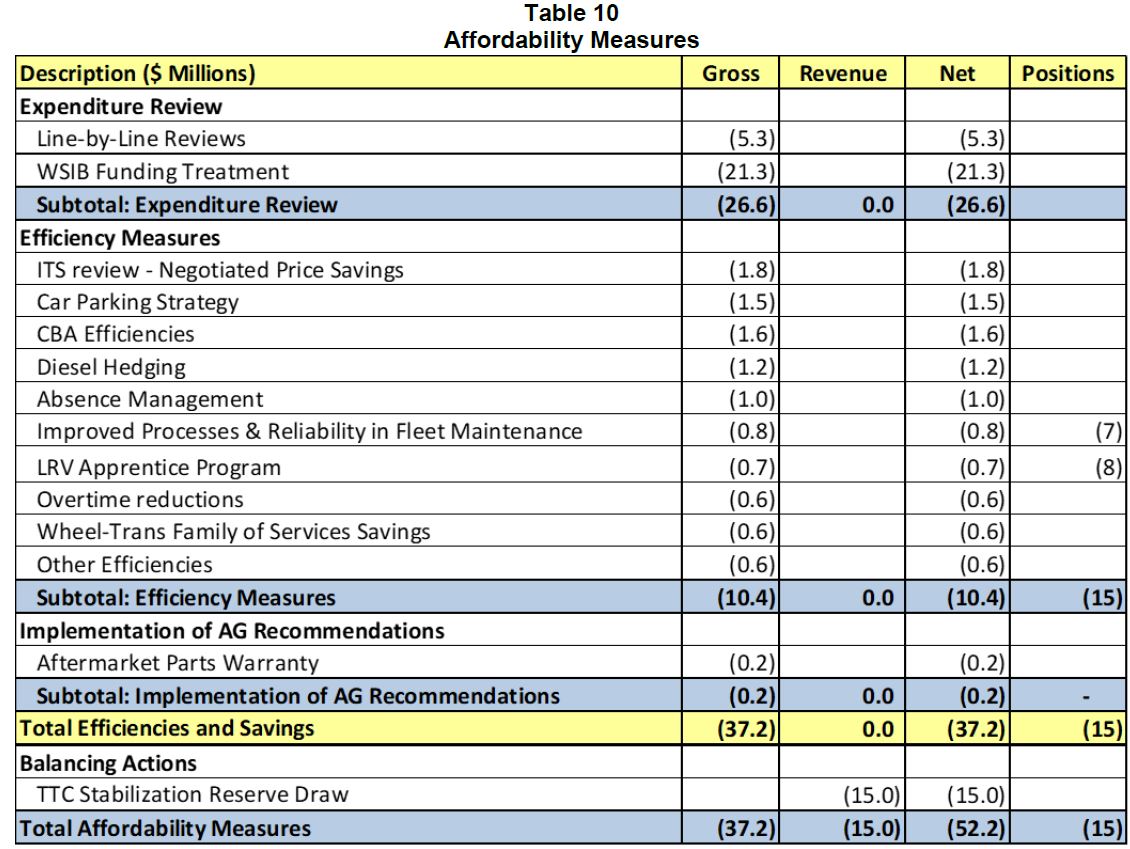
New & Enhanced Functions
The TTC lists several areas for new and enhanced functions and operations, although the dollar value of the changes is small. These changes are largely financed in part through revenue from the fare compliance program, partly offset by its increased cost.
This shows how the claimed losses from fare evasion cannot be completely recaptured because enforcement has a cost. 56 new Fare Inspectors and 10 Special Constables will be deployed on the bus network, plus 3 staff to monitor and manage this program. (Note that values shown here are for implementation part way through 2025. Full year numbers in 2026 will be higher.)
Other key changes include:
- “$1.0 million and 12 positions to enhance workcar and electrical preventative maintenance, in response to increased workcar usage for capital work to meet maintenance standards required to improve service reliability.” This is a direct response to the ongoing problems with the ability to complete planned maintenance work such as track repairs.
- 7 Supervisory staff will be redeployed to reduce bunching and gapping on “10 of the most problematic routes”.
- Service will be improved substantially on three streetcar routes (Dundas, Bathurst and St. Clair) where cars will run every 6 minutes or better, 7am-7pm, every day. Typical headways now are every 10 minutes. Combined with a focus on headway management, this should reduce crowding and loading delays, and speed up service.
- Off-peak subway service will be restored to pre-pandemic levels.
- Off-peak crowding standards will be restored to pre-2023 levels.
- Additional workforce to improve station cleanliness.
- 10 street outreach workers for downtown streetcar routes (Spadina, Queen, Kingston Road, Carlton) initially focused on overnight services. (This will be funded by Toronto Shelter and Support Services.)
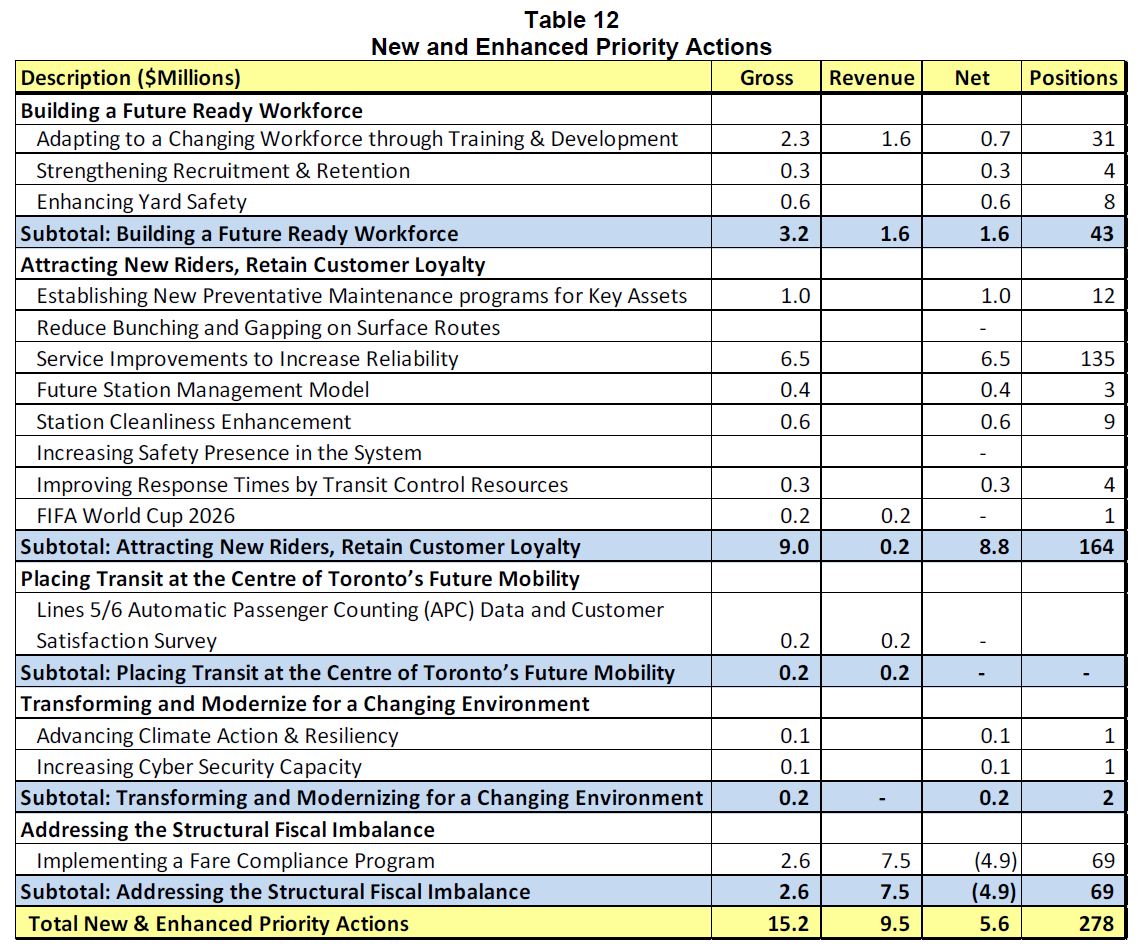
Look-Ahead to 2026-27
Costs in future years will continue to rise faster than revenues and added funding will be needed.
In 2026, the full year cost of changes to be implemented through 2025 will appear.
The numbers for 2027 should be read with care because they do not include provision for future contract negotiations or various service enhancements shown in the Five Year Service Plan. Moreover, funding under the Provincial “New Deal” expires on March 31, 2027.


If the TTC is budgeting for a “future ready workforce” does that mean that they feel they have a present-ready workforce?
I’m also amazed Table 8’s 6 bucks/revenue ride. I probably just haven’t been paying attention. At best, they get about half that per ride in fares?
Steve: The recovery is around 40% as shown a few lines earlier in the same chart. Anyone who has been citing the old 60% plus TTC recovery number hasn’t been paying attention since 2020.
LikeLiked by 1 person
Earlier today I watched a southbound Line 1 train crawl from Eglinton to Davisville at about 20 km/h. It appears to be yet another go slow zone. Observing the train triggered my anger over how far the TTC has deteriorated in recent years.
Steve, do you have a view on whether the “$1.0 million and 12 positions” is even close to what is required to restore Lines 1 and 2 to a state of good repair? I have no special insight, but it sounds low given the scale of the TTC’s problems.
Steve: The report describes this item as:
There is far more do be done to fully restore Lines 1 and 2, but the fact this is mentioned explicitly admits that there has been a shortfall that has affected the system without going into the details.
LikeLiked by 1 person
7 supervisors at 100k/yr for 10 routes to reduce bunching is ludicrous…700k/yr could implement a software solution that could manage all routes…something that except in extreme circumstance should be able to be done in real-time by a computer way better than a human…for instance, monitoring traffic light status, gps location and number of riders, number of riders at stops, estimated and historical traffic, 911 calls…there is no way one person can manage all that at once…
I thought this was what Vision was supposed to do…and am surprised it seems to not be able to? Crazy…
This seems to indicate a lack of technical expertise or willingness to innovate…
Steve: I am deeply wary whenever “innovate” or any variation on that is cited as a solution. A fundamental issue with the TTC’s monitoring system, Vision, is a common one in a lot of IT projects. It does what the people who specified it thought it should do. That’s the point where “innovation” is needed, and it could well just be getting back to proper line management. Simply duplicating existing processes in an organization that had already lost some of the art of service management through centralization is no way to specify new systems. Of course you need a solid philosophy of what “good” service really is in order to build tools and measure to that goal.
But when your metrics don’t tell you half of what is really going on, and the goal is to sugar coat the stats to make management look good, the last thing you need is a new piece of software showing up just how bad things are. I have done a lot of that with what are actually rather straightforward presentations using data the TTC has had for decades, first with CIS and now with Vision. My earliest analyses go back to 2007, and it is frustrating when the TTC claims that the work I have done does not capture all of the service. Of course they couldn’t until recently prove that extras (RADs or whatever you want to call them) even existed because they were not tracked. A great job there of building specs that cannot even handle basic operations.
Some TTC insiders have been very impressed and wondered why they don’t get this sort of detail from their own shop. Others, content with how things are, are dismissive of the need for better analytics.
As an IT professional with decades of experience, it is deeply frustrating to run into this sort of attitude. (And don’t get me started about their website.)
LikeLike
I just don’t understand why they would pilot an employee program that clearly won’t scale…the system has 192 routes…so at the least it’s going to require 150 staff for whatever it is they are doing, and I suspect that will only be during daylight hours…double it if you are serious…clearly we understand that software can help, since you couldn’t do your graphs by standing on the corner for a month keeping track of the buses with a clipboard…the algorithms behind any routing software are fairly well understood, and can easily prioritize different goals and use different data sources…frankly sim city can simulate (and operate) transit better than the ttc can, and that is a massive opportunity…
Steve: I think the biggest problem is getting the TTC to have a workable philosophy of what service should look like beyond the level of ticking off vehicles passing by. As long as their only metric is “on time performance” with a generous window measuring “success”, it does not matter what manual or automated system is in place. It will “manage” to a bad model. Some times, evening out headways will require deliberately running vehicles “late” or even short turning, but with managed re-entry into service so that a pair is not recreated in the opposite direction. Example: a short turn car leaving Woodbine Loop westbound comes out nose-to-tail with a through car from Neville rather than splitting the gap.
LikeLike
It absolutely could not. This is not a realistic budget for a system that would manage vehicles on 200 routes with well over a thousand buses on the road. These days, $700k/yr gets you about 5 moderately skilled developers once you include all costs (taxes, benefits), or maybe 1 person remotely capable of architecting such a system and 3 helpers. That’s just not happening at this budget — entirely apart from the question whether it would work well.
Steve: It is not clear when the supervision might start, and so the $700k could be a part year cost, higher for 2026.
As far as I know data on traffic light status is not available in Toronto. Traffic lights would have to be retrofitted at additional cost.
Steve: I think that the “fix” is the other way around. Rather than TTC supervisors monitoring the signals, the programming of the signals needs to be changed to favour transit. The current attitude at the City is that motorists come first, and transit “benefits” from smoothly flowing traffic. As with other aspects of route management, it is the underlying philosophy that has to change, and the technology can be made to do whatever we say is “good”.
This data is definitely not available. Are you going to install a raspi with a camera looking at every bus stop in the city? There’s 9000 of them. Maybe just the most important ones, like a 1000 cameras or so? Or maybe a people-counting button, that schoolkids would press for fun?
Nevermind transit: despite in practice being a car city, Toronto doesn’t even have synced traffic lights on any major car arteries. Metrolinx is paying Accenture over $100 million _per year_ to run Presto systems. What could possibly make you think that Toronto is capable of building or buying a system that would coordinate the entire TTC fleet for less than $7 million? What is the last major software project that went well for the city or the province? What makes you think this one would be different?
LikeLike
I agree with this…but my experience in software development is that often times the process of developing these things requires management to actually think about it in detail and figure out what they want to do beyond the status quo…
Similarly they likely do not see the need to get into something deeply that they won’t be able to impact with their current toolset…
My comments about knowing traffic light status, or number of folks at bus stops are obviously aspirational (and may not need to scale to every location in the system), although the city does have more of this data than is publicly available…there are efforts in open data to ensure that more of the streetlight data is available…some do have endpoints that can be polled in real-time, and/or controlled…obviously whatever system was chosen would have to be flexible to new and varied data sources over time…
Already with the data that is available (number of folks on vehicles, GPS location, historical data, traffic data, construction data) a computer will be able to better manage and process this than a human, who will have enough trouble just looking at a map and some charts…
I am 100% confident that even 5 developers thinking about this problem seriously could have more of an impact on 10 lines than putting folks on the ground…and potentially generalize the solution to all lines…even more so if there are viable existing solutions that just need to be integrated…
We have one developer already (Steve) who has figured out way better charts than the city can…and I spent only a few weekends a decade ago to come up with heat maps and all sorts of other things that I still haven’t seen the TTC do…
Steve: TTC has produced heat maps of riding demand. I have been trying to get hold of detailed riding info from the automatic passenger counters, but all I have today is the “light-medium-crowded” breakdown. I am not sure why TTC has been dragging their feet on releasing this.
LikeLike
Honestly Steve if you are looking for a fun chart idea…a short turn suggestion chart would be a fun one to do…just take your journey chart and put x’s where the streetcar should short turn to improve service…;-) I think you might already have all the tools in your arsenal…
Steve: The info in the operational charts (so-called Marey charts) or their equivalent needs to be seen in real time to manage things like vehicle spacing and re-entry from short-turns.
LikeLike
TTC if people want a “European” style good transit why don’t they copy their models? Privatise bus ownership to start. Contracting out. Even train ownership or track maintenance in various cities. TTC seems stuck in institute quick sand.
Steve: In many cases, privatization has been tried and been a dismal failure. It is by no means a universal approach.
LikeLike