June 1/25 the Earliest Date for Eglinton/Finch says TTC Chair (Updated)

At the TTC Board meeting on December 3, Chair Jamaal Myers proposed a motion to extend the validity of legacy fares (tickets, tokens, day passes) to June 1, 2025 for the “conventional” system, and to December 31, 2025 for WheelTrans. This was adopted by the Board.

After the meeting, in a press interview, Myers was asked “Why June 1”?

He answered that June 1 was the earliest possible opening date for Line 5 Eglinton Crosstown and Line 6 Finch. Those lines have no fare collection support for the old fare media.

This puts Metrolinx in a bind: either they announce an earlier date, something they have been loathe to do for months, or they acknowledge that we will not ride these trains until late Spring, maybe. If Doug Ford holds an election as expected, there will be no ribbon cutting for him to tout his great works.

Updated Dec. 4/24 at 6:10pm: In today’s Star, Myers qualified his statement:

TTC chair Jamaal Myers told the Star on Wednesday that the TTC is preparing to operate the Eglinton Crosstown and Finch West LRTs using an internal target date of early June next year — though he was careful to note that he does not speak for Metrolinx, the provincial agency in charge of constructing both beleaguered light-rail lines.

Myer added that the June target date was set separate from Metrolinx’s construction timeline, and was solely for the TTC’s internal preparations to take over operations once the LRT is ready.

He said TTC staff are using June 1 as a target date to train the LRT drivers and it includes a 30-day “revenue service demonstration,” which will see trains run along the full track of the LRT. The internal target dates were partly created for financial planning purposes and are not specific to the LRT.

The 2017 Line 2 Renewal Program

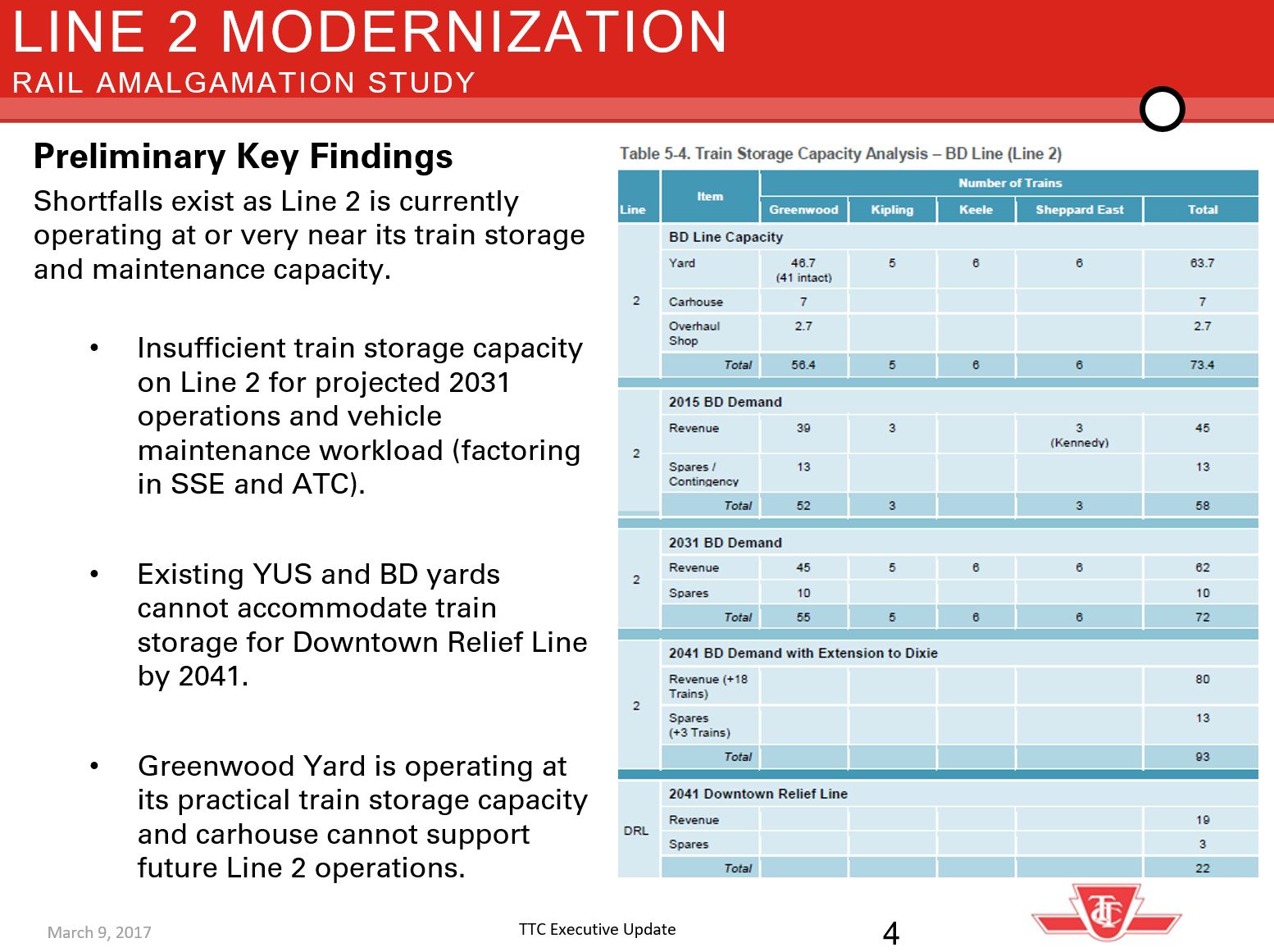
Back in 2017, there was a proposed renewal program for Line 2 that covered many aspects including fleet planning, extensions, future demand growth, signalling and maintenance yard requirements.

Most regular transit followers in Toronto will scratch their heads and ask “what renewal program”. The problem was that it was too rich for political blood at the time and most of it was ditched after CEO Andy Byford was replaced by Rick Leary.

A fundamental premise of the plan was that all of its components would be handled through one master schedule and common overall project management. The TTC had learned from experience on Line 1 that a piecemeal approach was fraught with conflicting timetables and specifications, not to mention the danger that each piece had to be funded separately with little appreciation for the big picture.

A Rail Amalgamation Study was conducted for the TTC by HDR and Gannett Fleming starting in 2015, and it was expected to finish in 2017. The intent was to review the line’s needs based on various future scenarios. For maintenance and storage facilities, it would consider:

  • The use of 2-car sets rather than the 6-car TR train configuration.
  • Possible line extensions
  • Expansion of the work car fleet to support expanding infrastructure
  • Implementation of ATC (Automatic Train Control) signalling

A preliminary report from the study showed that capacity would be a major problem. Note that in the context of this study, the Ontario Line did not yet exist, and the intent was that Greenwood Yard would host the Downtown Relief Line trains. Even without the DRL, Greenwood would not be able to handle expected growth in demand on Line 2.

The remainder of this article shows the details of the resulting plan, notably proposals for a new Line 2 fleet and expansion of the work car fleet that might have been set in motion had this scheme not been sidelined.

The TTC had a consolidated plan for Line 2 (and for the DRL), but this fell victim to budget cuts, the idea that we could “make do” rebuilding old trains and signal systems, and then the Provincial intervention with Metrolinx showing how they “knew better” how to plan and build rapid transit lines. We all know how that worked out.

Continue reading

Searching For a New TTC CEO (Updated)

A late addition to the TTC Board’s agenda for December 3 is a presentation on the characteristics the TTC should look for in a new CEO by the search firm hired to manage the process.

Updated Dec. 4, 2024: A section has been added at the end with additional information from the Board meeting.

Jayson Phelps, Senior Partner, Phelps Group, will make the presentation, but the deck is already available and contains some interesting reading. Over recent weeks, Phelps Group conducted 1160 surveys via a publicly available web site, as well as 1062 by email invitations. Individual interviews were conducted with 31 people including the TTC Board, Leadership Team and “key stakeholders”. [Full disclosure: I was one of those stakeholders.]

The presentation summarizes feedback from those surveys and interviews. It is broken down into four sections: Experience, Leadership Attributes, Capabilities, and Challenges/Opportunities. There is also a section on Key Success Factors At 18 Months.

Anyone who has read position descriptions for senior management will recognize many points of which these are only a few.

  • Knowledge of transit systems,
  • Intergovernmental experience,
  • Good communications skills,
  • Ability to build relationships with employees, governments and the public,
  • Valuing diversity,
  • Planning, budgeting and capital project management,
  • Working within limited funding,
  • Exploiting technology for organizational improvement.

Two particularly stand out:

  • Demonstrated focus on rider experience, accessibility, and affordability.
  • Passionate about improving transit systems as essential public services.

There is a long list of challenges including restoration of maintenance and service reliability, but also related issues such as organizational structure, departmental silos, and conflicting priorities.

Through the presentation, some points imply a very troubled background within the TTC. It has been no secret that the past era was not a happy one, but seeing some of these issues in print as part of a new CEO search gives a sense of the rot.

  • Ethical Leadership and Accountability
    • Upholds ethical standards, communicates honestly, and takes accountability for decisions.
  • Stakeholder Engagement and Public Advocacy
    • Skilled at navigating relationships with unions, government entities, and community organizations, fostering collaboration and trust.
    • Skilled spokesperson, building credibility with the public and enhancing organizational reputation.
  • Workforce and Organizational Culture
    • Low workforce morale, mistrust in leadership, nepotism, favoritism, and resistance to change.
    • Talent drain to competitors, non-competitive compensation, and limited diversity in leadership.
  • Operational and Infrastructure Issues
    • Maintenance backlogs, reliability issues, and slow zones requiring urgent state-of-good-repair projects
  • Key Success Factors at 18 Months
    • Public Trust: Strengthened public confidence through visible leadership, improved service quality, and consistent dependability.
    • Employee Morale: Enhanced employee engagement and reduced turnover through recognition programs, inclusivity, and fostering a collaborative workplace culture.
    • Workplace Culture: Addressed toxic workplace culture by fostering fairness, collaboration, and transparency

Terms like ethical leadership, honesty, accountability, credibility, low morale, mistrust, nepotism, favouritism and toxic workplace culture do not sound like the kind of organization TTC purports to be. Many senior staff have left either through retirement, buyouts, constructive dismissal, or simply through disgust with the TTC’s leadership.

That list of key characteristics and challenges for a new CEO tells a grim tale.

Rebuilding the TTC will be a challenge on many fronts, not the least of which is getting hold of today’s pressing issues, but simultaneously developing a plan for a new TTC and building the organization’s trust that it can be and should be implemented.

For many years, the TTC Board failed in their duty to manage their CEO and actions taken by him, and were happy to sit back as long as he met the City’s and Mayor’s target of keeping costs down. Whatever investigative details were provided to the Board prior to the CEO’s departure, we will probably never know.

For too long, some Board members chose wilful blindness. They have no place at the TTC.

Continue reading

TTC Board Meeting: December 3, 2024

The TTC Board will meet on December 3 with several items of interest on their agenda.

  • CEO’s Report and Key Performance Indicators
  • Notice of Motion: Proposed deferral of legacy fare retirement
  • Financial and Major Projects Update
  • Easier Access Program Update

In a previous article, I reviewed the report on subway work car hydraulic leaks. See:

After this agenda was published, the Federal Government announced its one third support for the purchase of 55 new Line 2 subway trains. See the Major Projects Update below for more details.

Continue reading