
Back in 2017, there was a proposed renewal program for Line 2 that covered many aspects including fleet planning, extensions, future demand growth, signalling and maintenance yard requirements.
Most regular transit followers in Toronto will scratch their heads and ask “what renewal program”. The problem was that it was too rich for political blood at the time and most of it was ditched after CEO Andy Byford was replaced by Rick Leary.
A fundamental premise of the plan was that all of its components would be handled through one master schedule and common overall project management. The TTC had learned from experience on Line 1 that a piecemeal approach was fraught with conflicting timetables and specifications, not to mention the danger that each piece had to be funded separately with little appreciation for the big picture.
A Rail Amalgamation Study was conducted for the TTC by HDR and Gannett Fleming starting in 2015, and it was expected to finish in 2017. The intent was to review the line’s needs based on various future scenarios. For maintenance and storage facilities, it would consider:
- The use of 2-car sets rather than the 6-car TR train configuration.
- Possible line extensions
- Expansion of the work car fleet to support expanding infrastructure
- Implementation of ATC (Automatic Train Control) signalling
A preliminary report from the study showed that capacity would be a major problem. Note that in the context of this study, the Ontario Line did not yet exist, and the intent was that Greenwood Yard would host the Downtown Relief Line trains. Even without the DRL, Greenwood would not be able to handle expected growth in demand on Line 2.
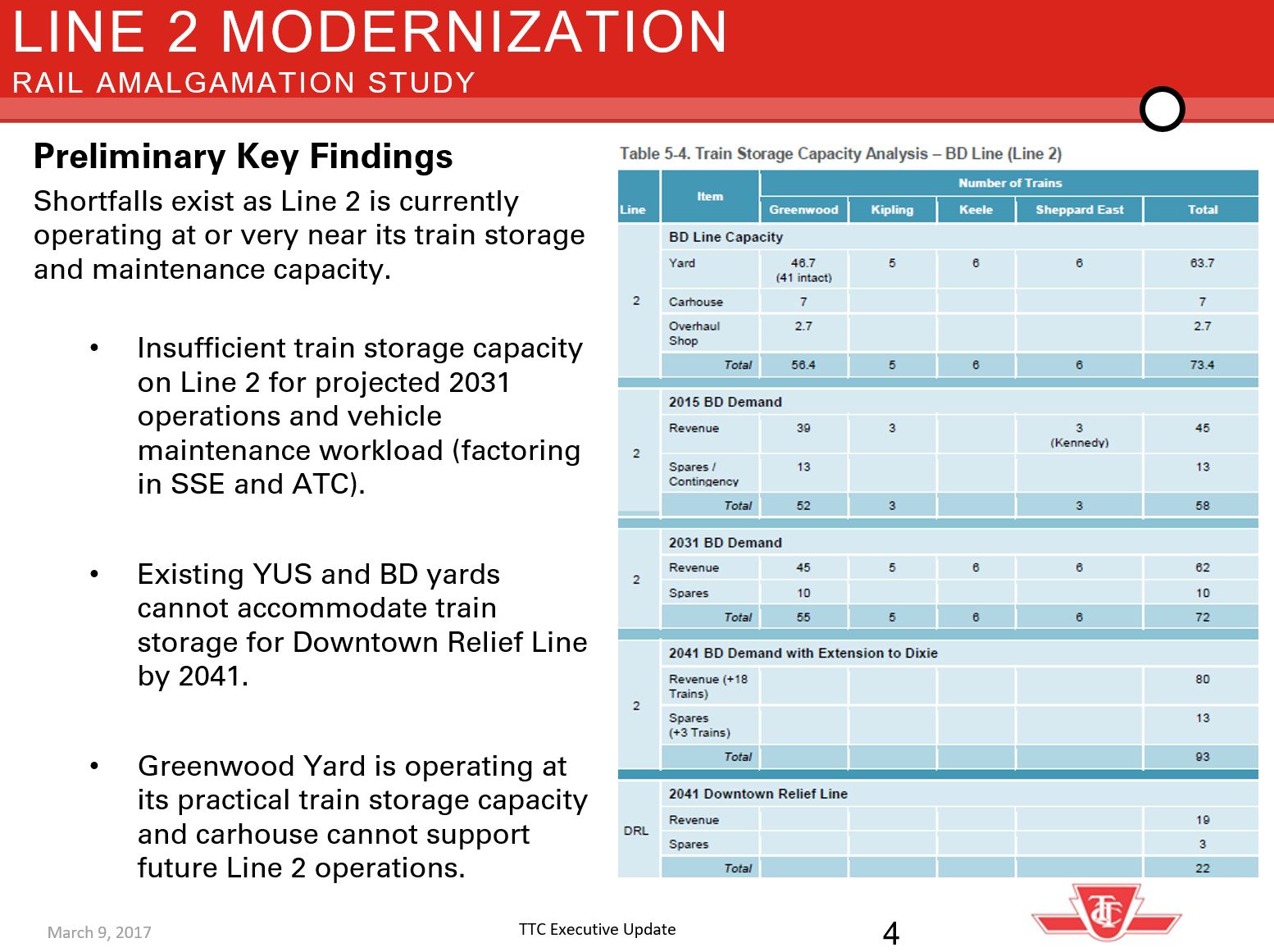
The remainder of this article shows the details of the resulting plan, notably proposals for a new Line 2 fleet and expansion of the work car fleet that might have been set in motion had this scheme not been sidelined.
The TTC had a consolidated plan for Line 2 (and for the DRL), but this fell victim to budget cuts, the idea that we could “make do” rebuilding old trains and signal systems, and then the Provincial intervention with Metrolinx showing how they “knew better” how to plan and build rapid transit lines. We all know how that worked out.
The need for a “portfolio” approach to the projects was obvious to the TTC from problems they had with a piecemeal approach to Line 1 renewal including the Vaughan extension and new signalling.
This would allow identification of dependencies between the components that would co-ordinate schedules, avoid overlaps, optimize budgets, and avoid needless rework due to design conflicts. It would also “create a single point of accountability and reporting structure”, an absolutely vital part of any major undertaking.
The consolidated portfolio had a proposed timeline as shown below. Note the proposed dates for various components, some of which have not yet actually started.
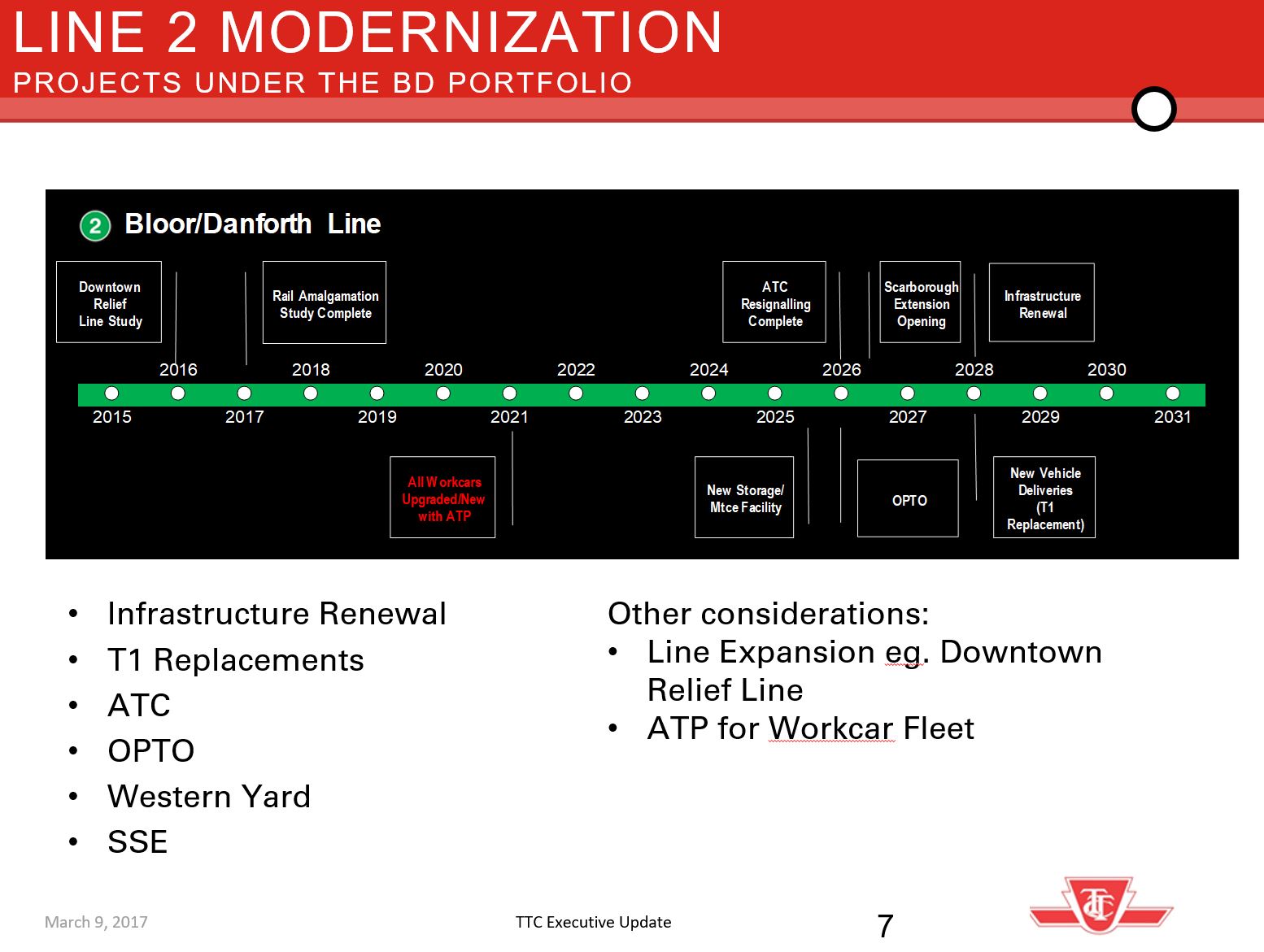
“Infrastructure Renewal” listed above was intended to upgrade the outdoor portions of the line subject to more rapid deterioration.
These constitute new corridor-related Subway Infrastructure projects which are over and above normal “state of good repair” activities. These major projects focus on exposed open-cut areas of the existing subway corridor which are deteriorating significantly due to weathering by the elements, leading to increasing restricted speed zones and asset unavailability.
The areas in question were Kipling-Islington, Keele-Dundas West, the Prince Edward Viaduct, and Victoria Park-Warden. The work would include various aspects of water control, track stabilization and switch modernization.
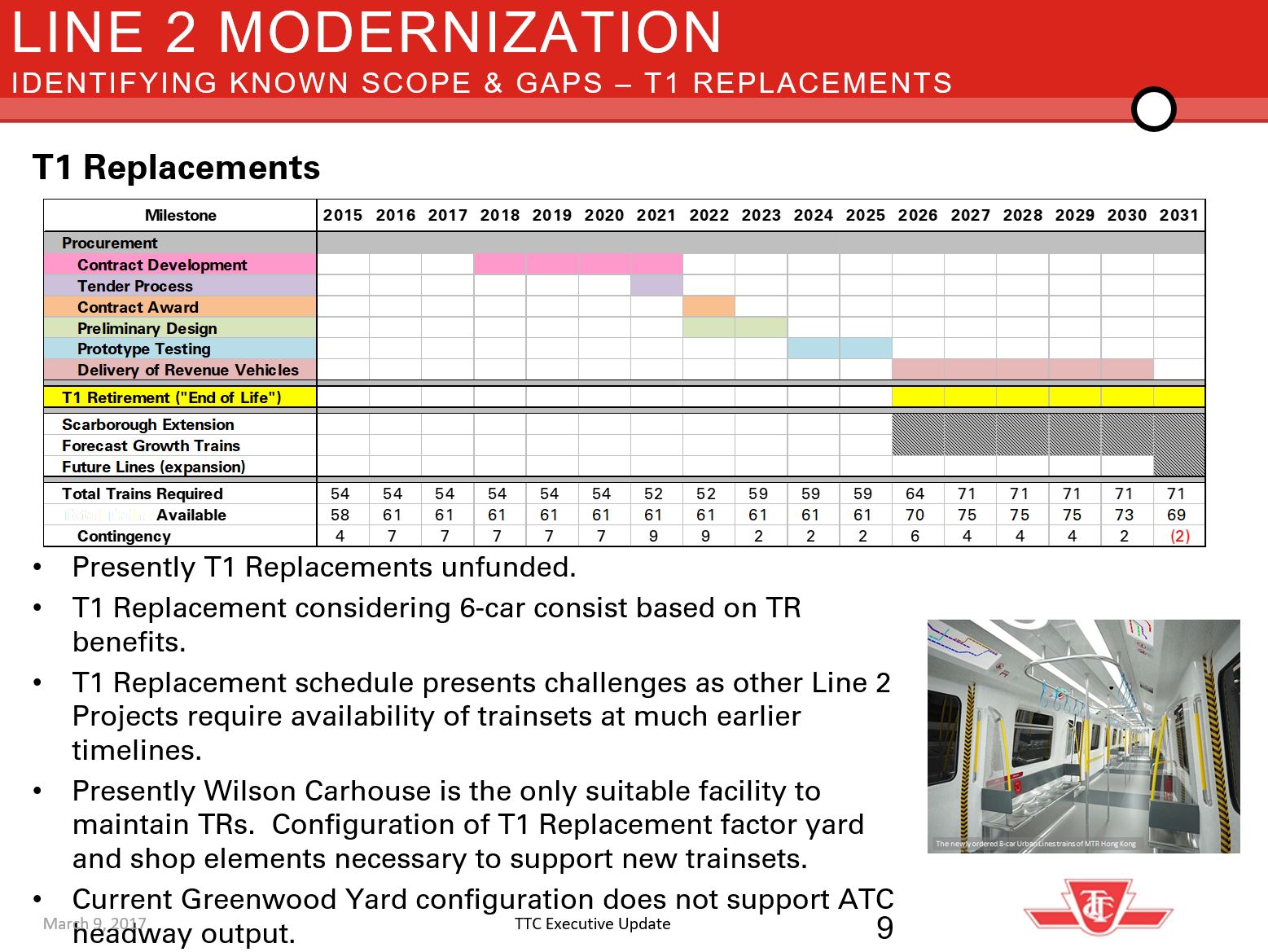
The T1 replacement project schedule and key details are shown below. Note that prototypes would have been delivered and tested in 2024-25 with production trains starting in 2026.
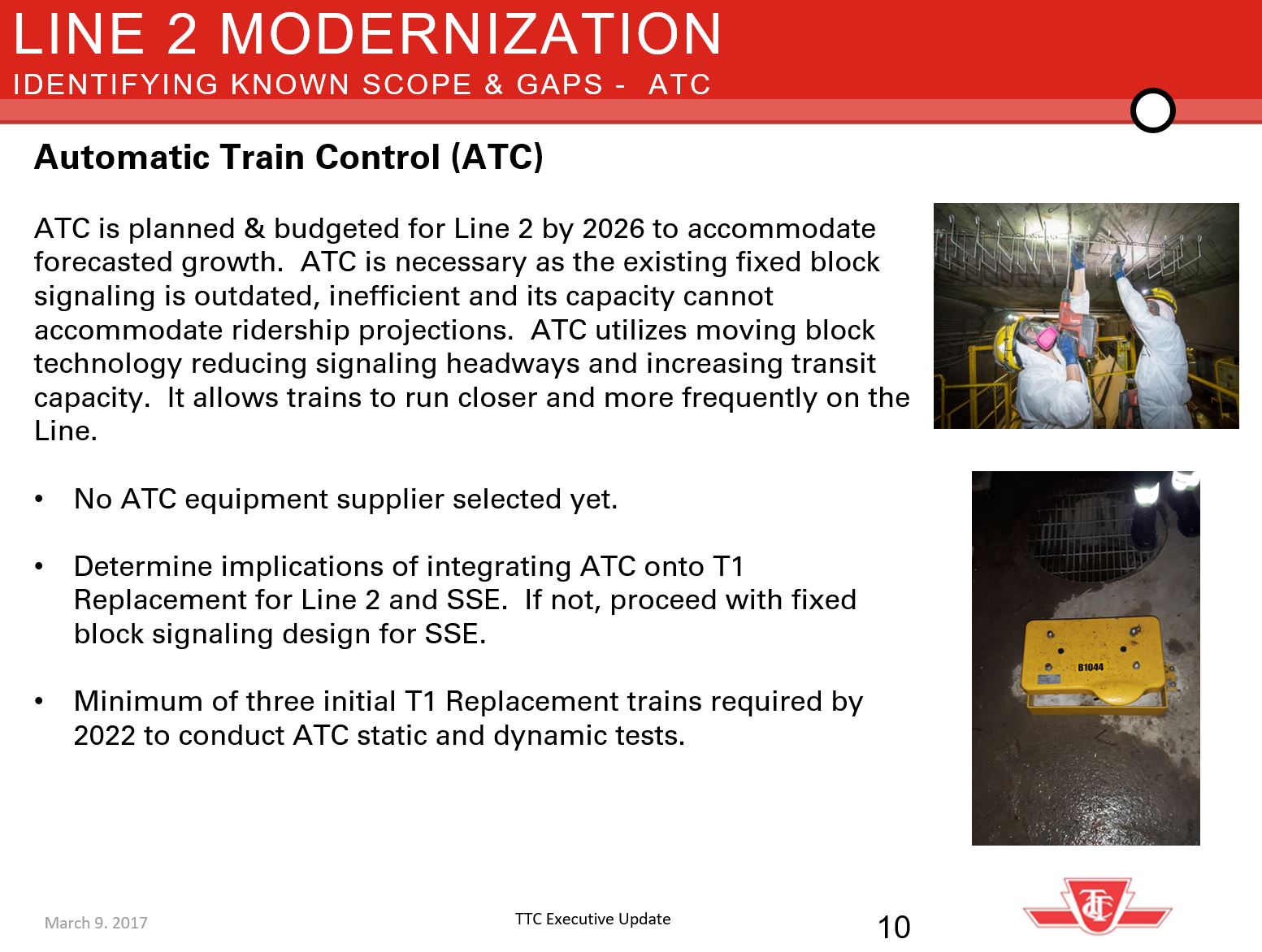
The Line 2 ATC project, like the new trains project, would already have been underway in the 2017 plan. Note that this project would require new trains for testing by 2022. As of fall 2024, the ATC supplier has still not been selected, and the idea that a different system might be used on Line 2 than is already on Line 1 invites compatibility problems.
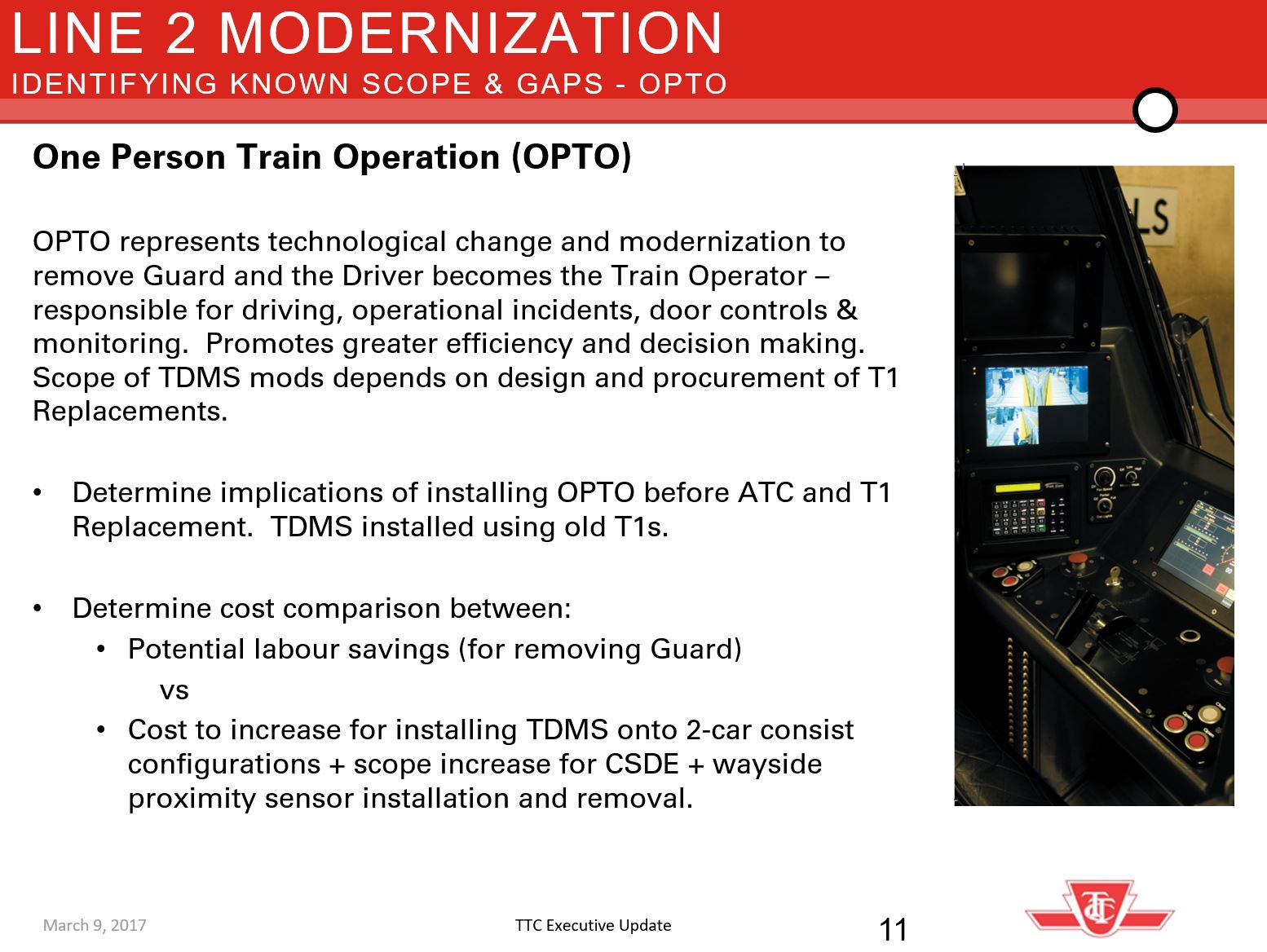
One Person Train Operation (aka “OPTO”) requires extra equipment in the operator cabs as well as wayside equipment to broadcast images of the platform to the cab. Leaving aside the question of whether a 2-person crew is preferable, the slide below details the OPTO issues for Line 2. One key point was that if two-car sets were procured for Line 2 rather than six-car sets, there would be more cabs in which OPTO equipment would be needed.
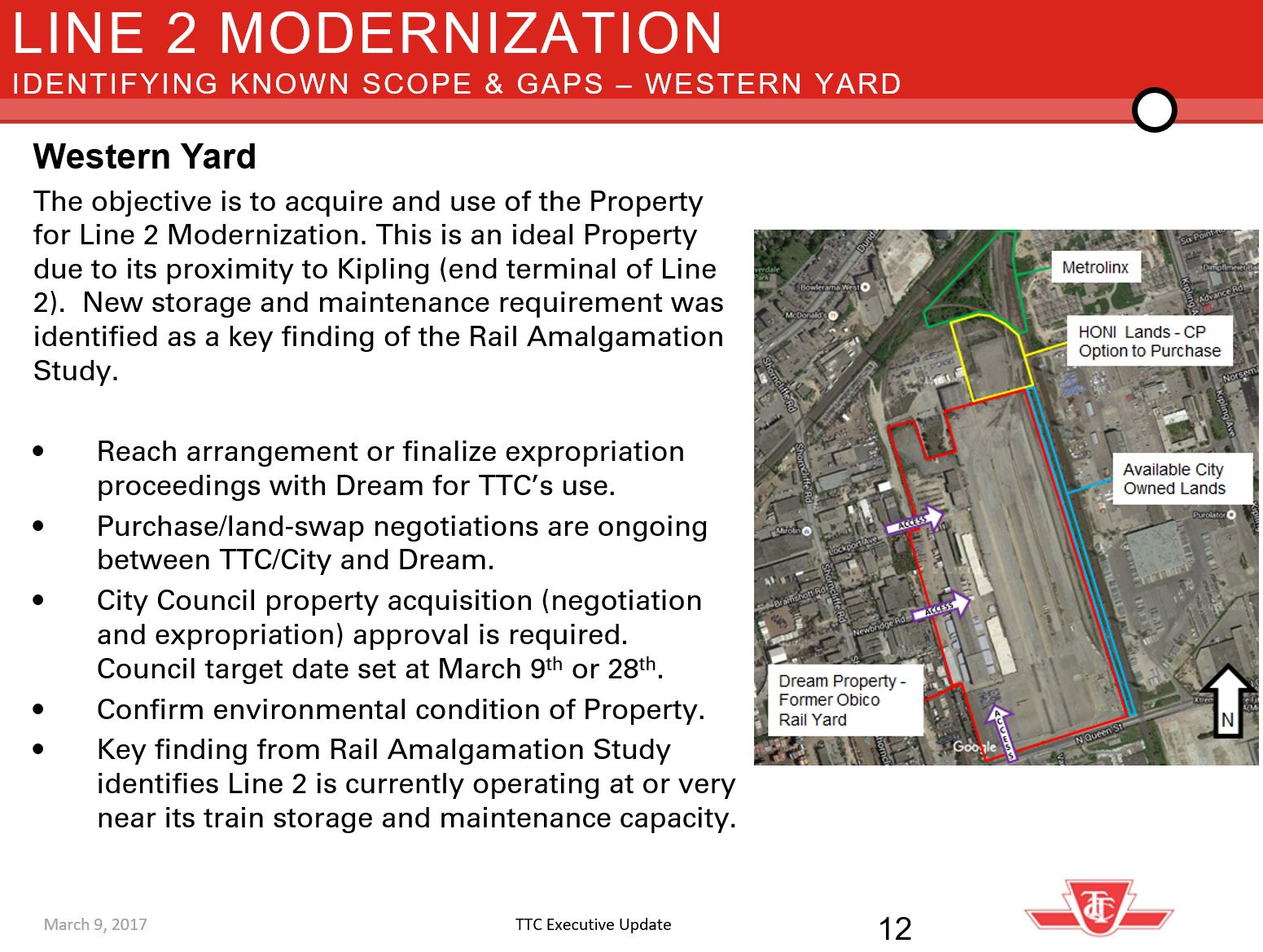
Another key component was a new Western Yard. This part of the plan was based on the need for a new yard configure to handle six-car trainsets. The geometry of Greenwood Yard and buildings is such that six-car sets will not fit. Under the scheme to operate the DRL from Greenwood, this did not matter as the DRL would get its own appropriately configured fleet and Line 2 operations would shift to the new Kipling yard.
With the announcement of the Ontario Line, the need to rededicate Greenwood for the DRL vanished. Specifications for the proposed new Line 2 trains require 2-car sets with the middle pair being operated independently, when necessary, by hostler controls.
The property at Kipling was acquired by the City, but it will not be needed as a subway yard until the Line 2 fleet outgrows Greenwood and other storage tracks that will be added, notably on the Scarborough Extension.
The Scarborough Subway Extension as then planned would have ended just north of Scarborough Centre with storage tracks beyond the terminal station. It was expected to open in 2026 at which point the SRT would be decommissioned. Because the timing of this project overlapped the ATC conversion, there was a possibility that a temporary block signal system would be required. This problem remains on the revised SSE project because of delays in acquiring a new Line 2 fleet.

All of these projects had a complex relationship to each other as shown below. Note that many key dates are already in the past.

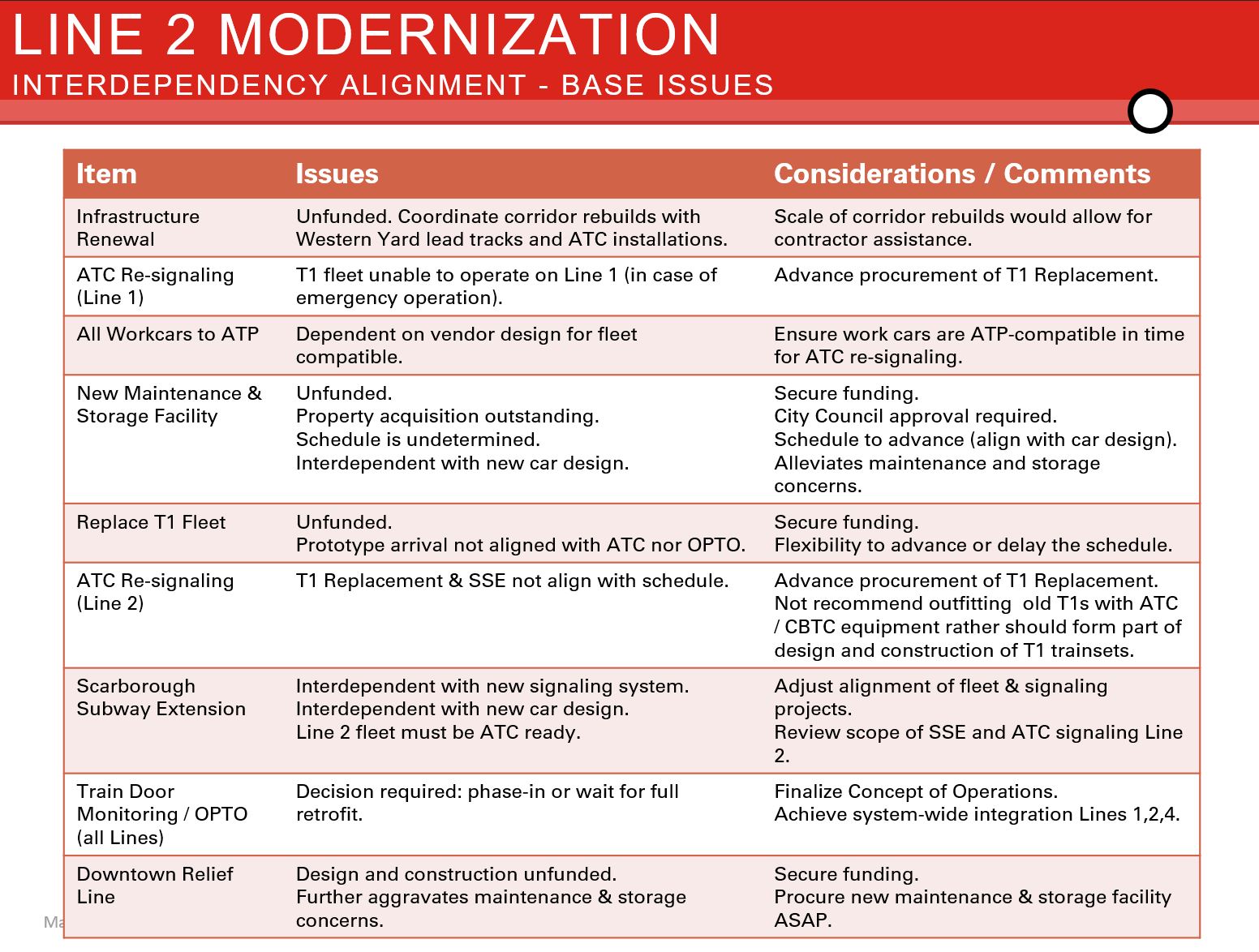
The dependencies between the projects are set out below.
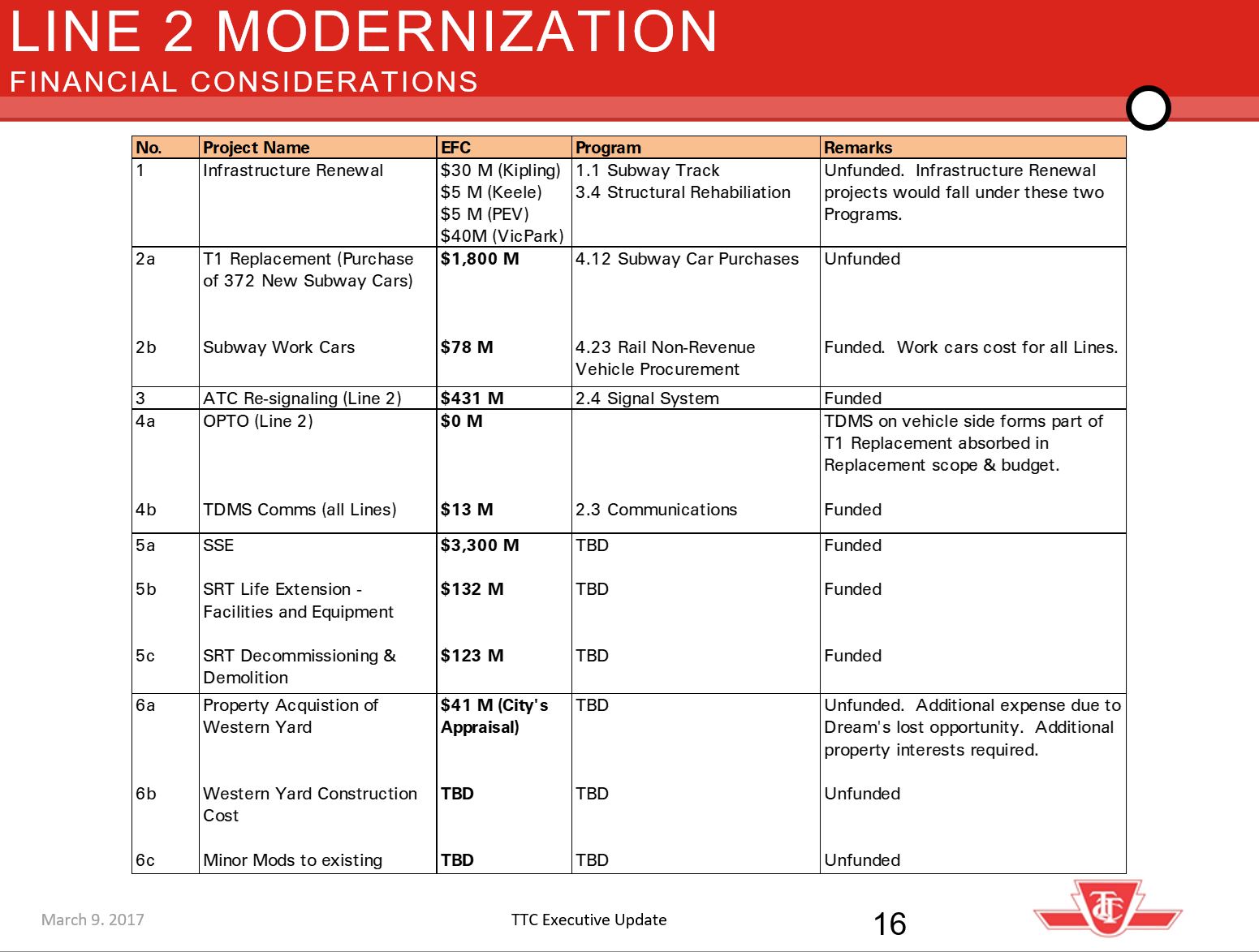
The projected costs were somewhat less than current prices thanks to years of delay and some changes in scope. Note that the T1 replacement would have covered 62 trains at a cost of $1.8-billion by contrast with the recently funded purchase of 55 trains for $2.27-billion.
There is also a $78-million provision for work cars, some of which would have replaced aging equipment that is still in use today.


It’s like watching an entire city slowly ossify by its own choice.
LikeLiked by 1 person
So were going from a potential 80 trains , down to 62 trains , and now 55 trains. Yikes.
I was hoping…..I guess dreaming, that Sheppard would get new trains. From 4car sets to 6car sets. Get rid of those temporary walls.
I wonder what the plans are for Kipling property. I know just east of it, in the former Purolator property , they wanted to build a new bus garage. Knowing TTC , they’ll hold onto it for as long as they can.
LikeLike
Can the tracks at Greenwood yard be reconfigured for 6-car trainsets, if at a cost of reducing the total storage capacity there? Of course, this would require some additional storage at a new Kipling yard, for the long-term and also during construction if, say, half of Greenwood was closed at a time for track changes.
I recall talk about a desire for open gangways in the new trains, similarly to the TRs, to allow better passenger circulation and improved capacity. But I’m not sure if this opinion is present in the TTC board or management.
It seems like making open gangways with separable 2-car trainsets could be mechanically more complex with the sensitive accordion and rotating components dangling off the end of a 2-car set. Or is this possible/common?
Steve: Greenwood cannot be modified because the carhouse/shops building is only four cars long in places and cannot be extended due to physical constraints of the yard. The spec for the new trains is to have cars in pairs, but with an open gangway.
LikeLike
Steve wrote:
Yes, the Greenwood site does appear sadly quite constrained in size. Looking at the track layout from overhead, it looks beautiful, complex, and convoluted like the complexity of a living organism. I’ve always scratched my head a bit about the 3-track portal, and the asymmetry in some of the switch choices. (Perhaps this is typical when you have a lot of design constraints like space available. A lot of quirks!) 🙂
LikeLike
I haven’t been following as much as a used to. Just expected the TRs to move to Line 2 and new trains for Line 1 again.
Understandable why the pairs of cars. Unlike the TRs you don’t have to take an entire train out of service for an issue. Would that mean less spares required?
Steve: “Spares” is an odd concept for the TTC because they have had a surplus of equipment in all modes for some time, especially on the subway. Originally, existing spares were going to be used to extend Line 2 east from Kennedy, but with that project pushed back, the cost of “SSE” trains is now part of that project. It is really not clear what spare ratio they are aiming at or could sustain after years of having more vehicles than they needed.
LikeLike