
The TTC Board will meet on December 3 with several items of interest on their agenda.
- CEO’s Report and Key Performance Indicators
- Notice of Motion: Proposed deferral of legacy fare retirement
- Financial and Major Projects Update
- Easier Access Program Update
In a previous article, I reviewed the report on subway work car hydraulic leaks. See:
After this agenda was published, the Federal Government announced its one third support for the purchase of 55 new Line 2 subway trains. See the Major Projects Update below for more details.
CEO’s Report and Key Performance Indicators
Ridership and Boardings
Demand on the TTC network continues to grow and is about three percent higher at the start of November compared with 2023. Subway and streetcar demand grew by six and five percent respectively, while buses (which have already regained much of their former ridership) are at the same level as last year.
In September, growth on the subway and streetcar networks was 9% and 14% respectively, while it was only 2% on the bus network.
Over the past year, the downtown commute rate rose from 2.5-3 days/week to 3-3.5 days/week. Demand is growing at downtown subway stations, and in some cases is now higher than pre-pandemic levels.
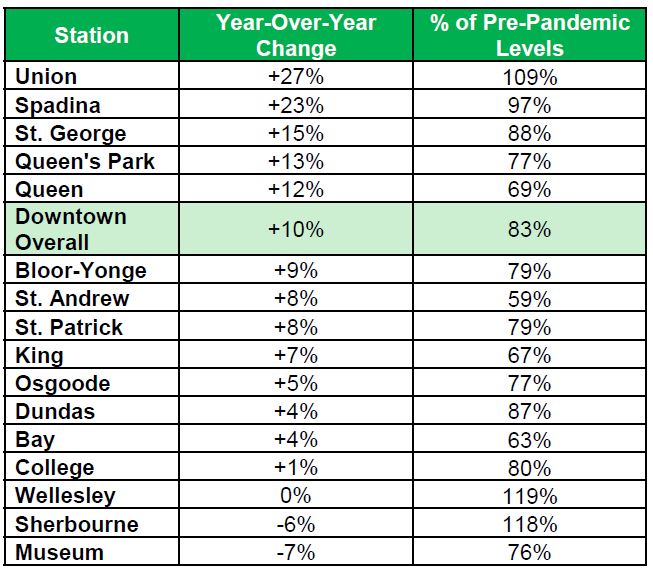
Tuesdays and Thursdays are now the TTC’s busiest days with Thursday demand 8% higher than Monday.
The CEO’s Report states:
Current observations indicate that sufficient service is provided to accommodate the rise in customer demand and the TTC will keep monitoring demand at key points and adjust service levels as necessary.
Riders on some routes might beg to disagree with this claim. Until we see the 2025 budget, we will not know just how much additional service might appear.
New Year’s Eve transit will again be free from 7pm on December 31 to 8am on January 1 courtesy of Corby’s Distillery.
Fare Revenue
Thanks to strong demand, fares brought in about 2.3% more than budgeted in September, and year-to-date fares stand at 103% of budget.
There is no discussion of how much of this gain is due to higher demand, as against higher recoveries thanks to fare enforcement.
The breakdown of fares by source shows the evolution of Presto away from the proprietary card.
- 91.8% of fares are paid through Presto
- 15.5% use Open Payment
- 10.7% use a virtual Presto card (smartphone app)
- 64% use a physical Presto card
- Legacy media account for 0.1%
- Cash accounts for 3.5%
- The remainder comes from bulk purchase tickets.
The quarterly financial update describes the overall fare revenue situation:
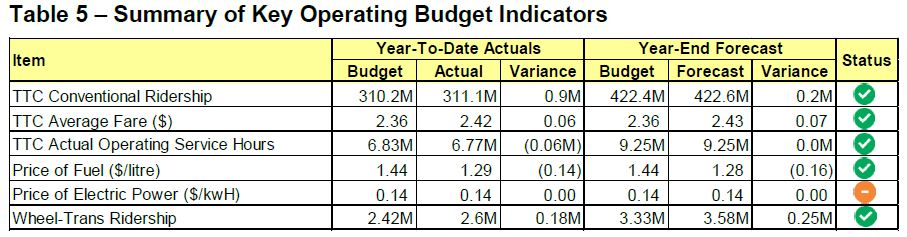
The $27.1 million favourable revenue variance was primarily driven by higher TTC Conventional passenger revenues due to higher than anticipated ridership levels and a higher average fare per rider due to an increase in single fare rides resulting from the growing use of riders using Open Payment methods.
In other words, more people are paying the full adult fare by using bank cards rather than the discounted rate available through passes on Presto.
Subway On-Time Performance and Capacity
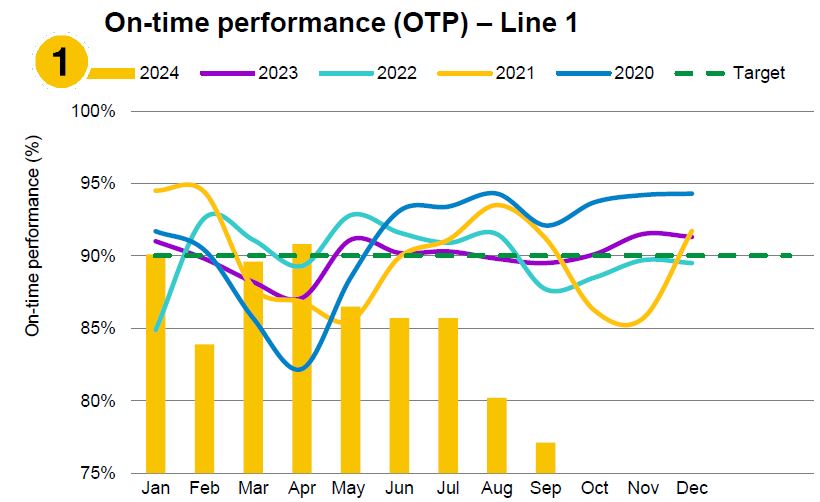
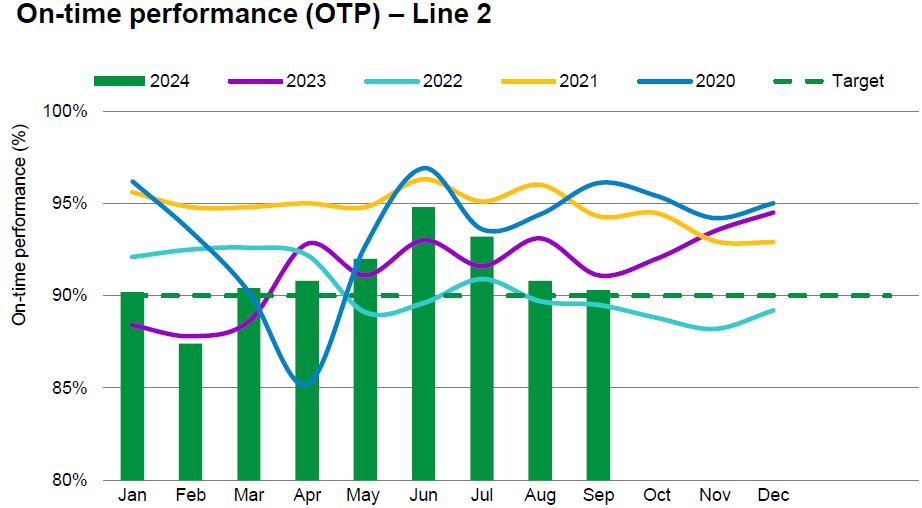
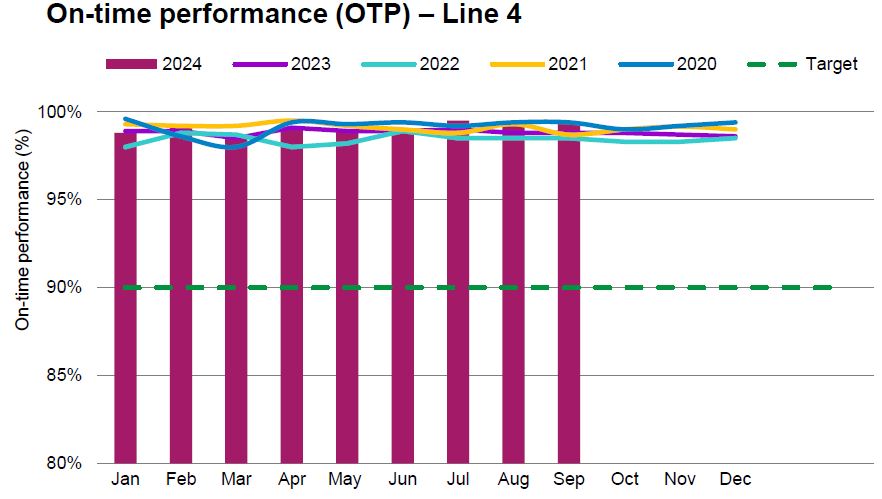
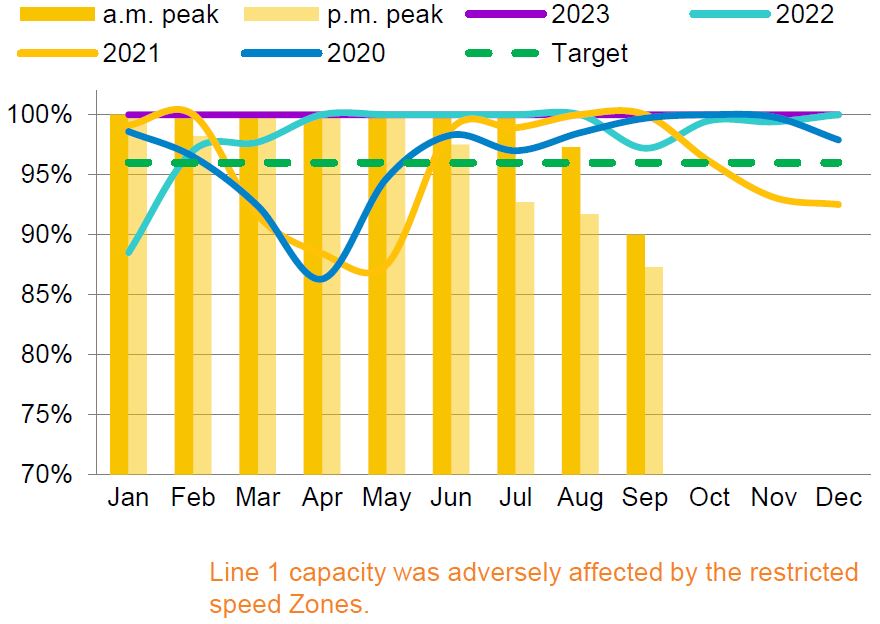
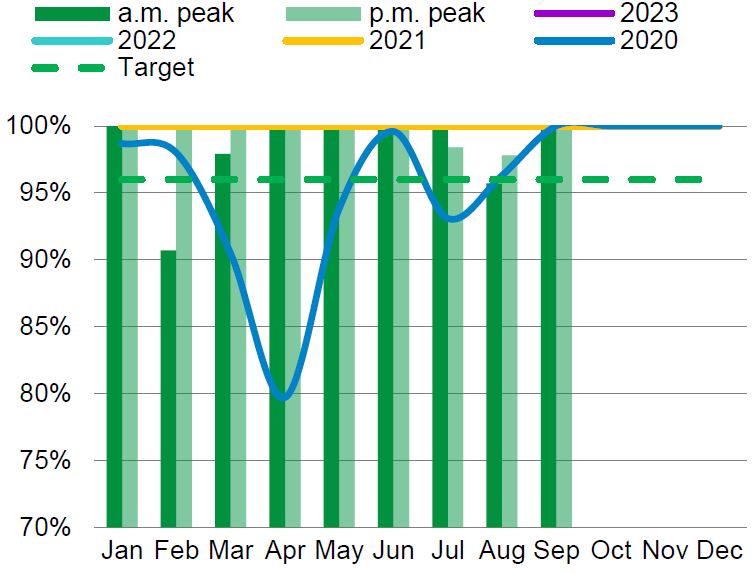
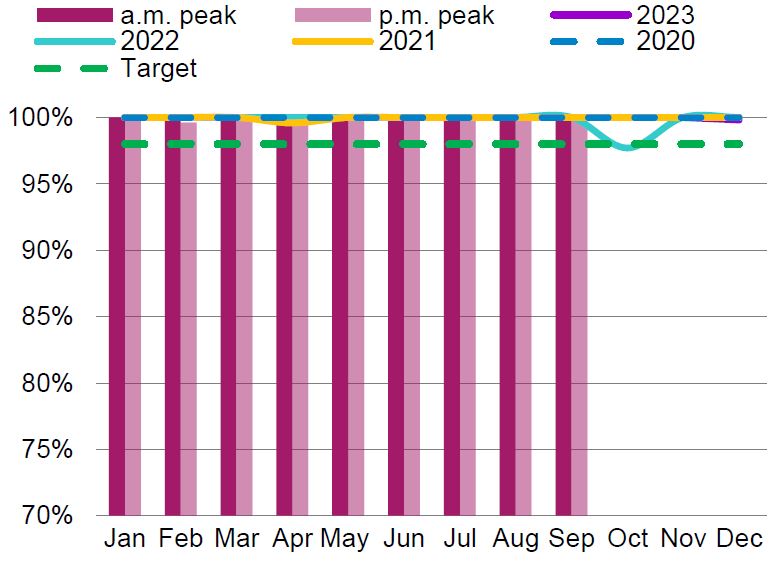
In the charts below, on-time performance and capacity are defined as:
- On-time: To be on time a train must be within 1.5 times of scheduled headway.
- Capacity: Total number of trains that travelled through 12 key sampling points during a.m. and p.m. peaks as a percentage of trains scheduled. Data is based on weekday service. Peak periods: 6 a.m. to 9 a.m. and 3 p.m. to 7 p.m.
Note that because trains can be further apart than scheduled, an “on time” route can actually have fewer trains/hour than advertised.
The many restricted speed zones on Line 1 have hurt OTP numbers, but they are getting worse, not better as the year goes on.
On-time performance
Capacity
Restricted Speed Zones
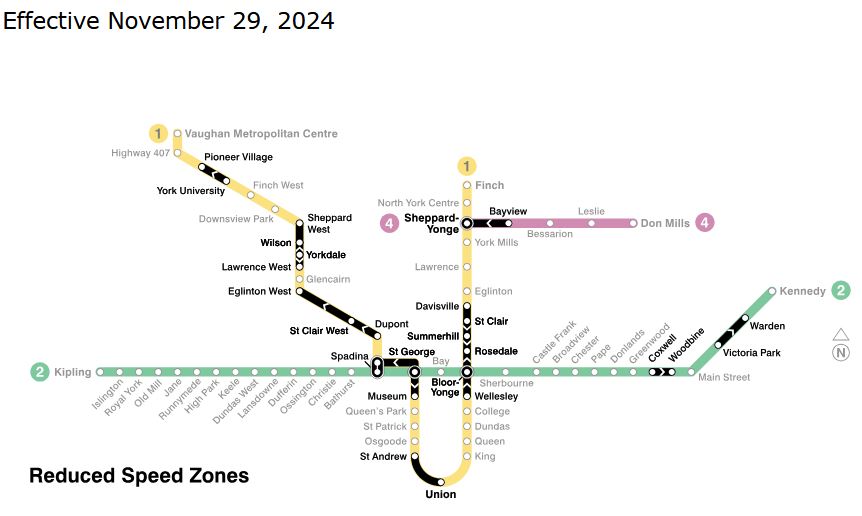
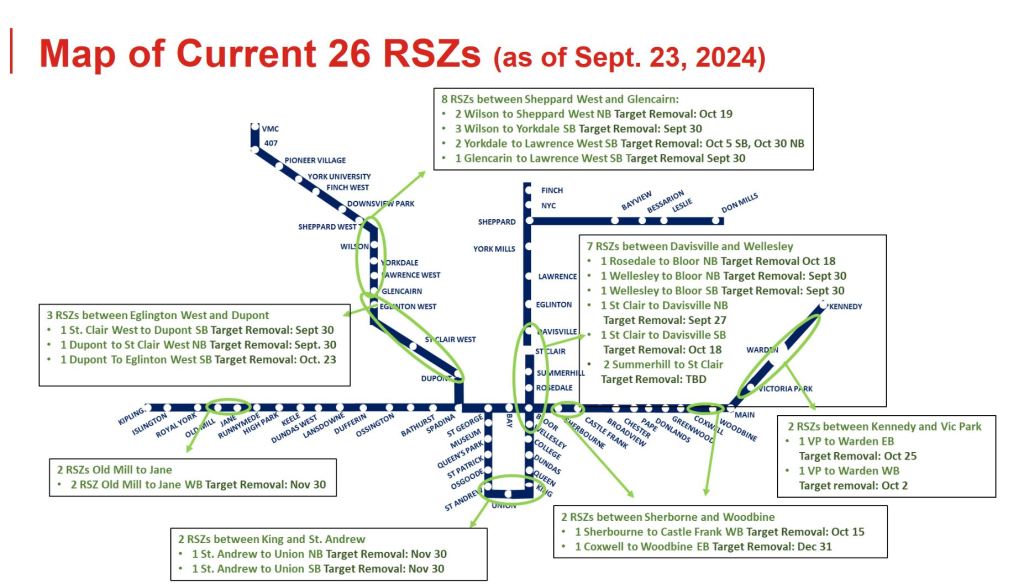
As of November 11, there were 17 Restricted Speed Zones on the subway according to the CEO’s Report, and this had not changed by November 29 as I write this. Here is the November 29 map together with a map presented to the TTC Board in September listing target dates for removal of RSZs. Although some of the zones listed in September are no longer on the map, several with target dates in September and October remain, and new zones have been added.
eBus and Streetcar Deliveries
The TTC has received a total of 16 new eBuses of which two are in service. The CEO’s Report claims that once all of the current order is delivered, the TTC will have a 400-eBus fleet. However, this includes all 60 of the pilot eBuses from BYD, Proterra and Flyer, many of which do not see regular service.
The streetcar fleet stands at 230 vehicles plus one in the process of acceptance. The CEO’s Report says that all new cars will be delivered by the end of 2025, but some of the enabling projects for added and renewed storage at Russell Carhouse and at the Hillcrest complex will not be completed when the last new streetcar arrives. (See Major Projects Update below.)
The financial update notes that:
Key drivers of projected underspending at year-end include the procurement of accessible streetcars, where supply chain issues are causing a delay in the delivery schedule and associated milestone payments, […]
A major question for TTC planning in 2025 and beyond is the number of buses and streetcars their budget actually allows them to run. Both the bus and streetcar fleets exceed service and maintenance spare requirements, an ongoing condition for years. The constraint on service growth lies in the workforce and the service budget. The 2025 budget is expected to appear later in December, and we will see just how committed Toronto and the TTC actually are to service growth.
See also: The Mythology of Service Recovery – November 2024 Update
Bus and Streetcar On-Time Performance
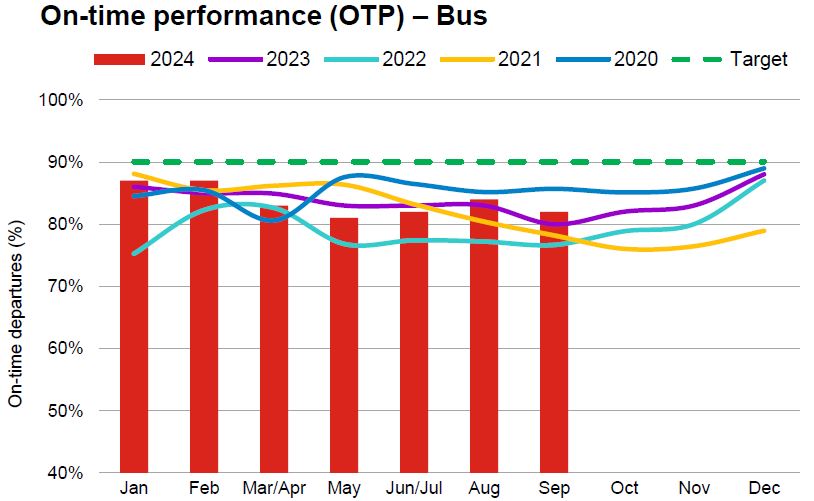
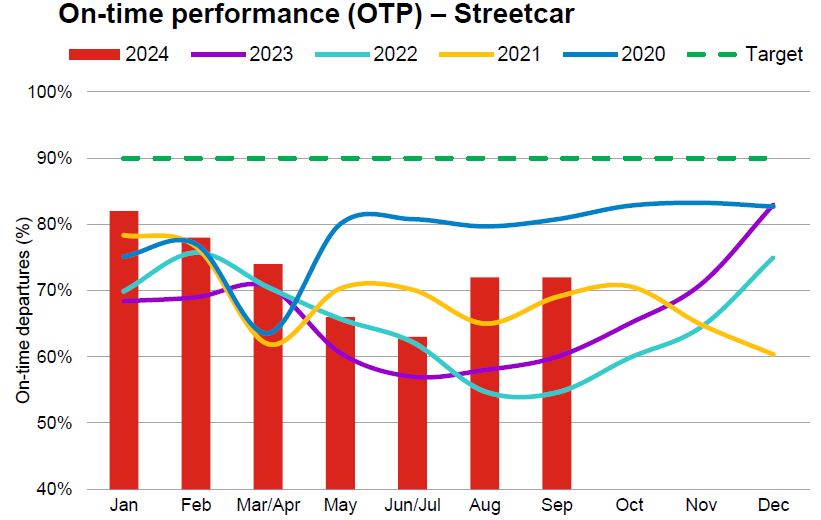
The metric used by the TTC is meaningless for three key reasons:
- Only service at terminals is considered, not along routes where most riders will board.
- Results are consolidated over the entire month with no breakdown by route or time of day.
- The on-time standard has a window of 6 minutes which allows vehicles to leave the terminal “on time” as pairs or much closer together than the advertised headway with no penalty for the resulting gaps.
Streetcar results are poorer because of higher average congestion on these routes, and the large number of construction projects affecting them.
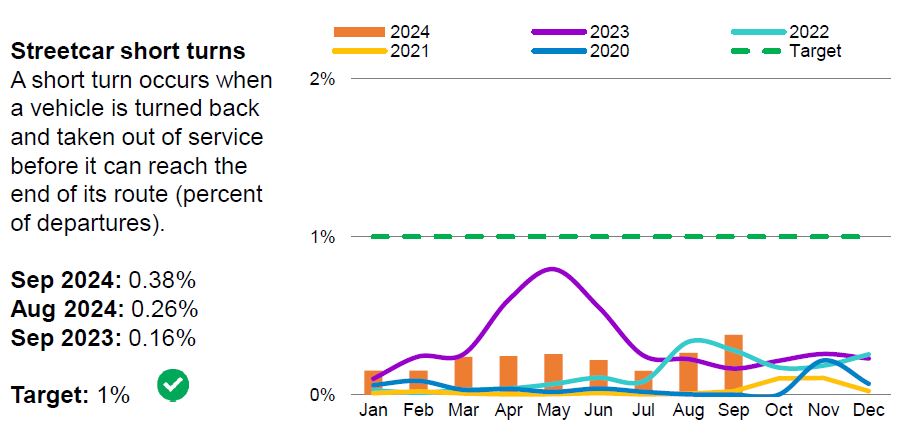
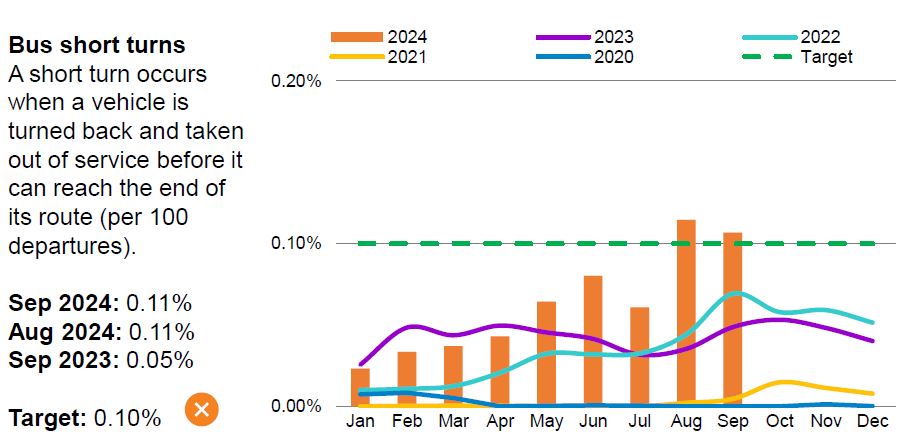
As with the on-time stats, short turn stats are consolidated across all routes and time periods. They are now shown as a percentage of all trips, not as an absolute number.
From my reviews of vehicle tracking data, there is a good chance that many short turns are not counted in the official statistics.
Vehicle Reliability
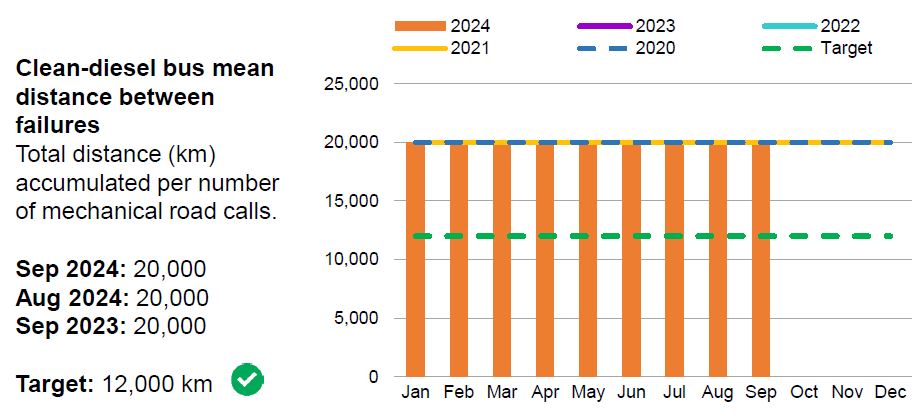
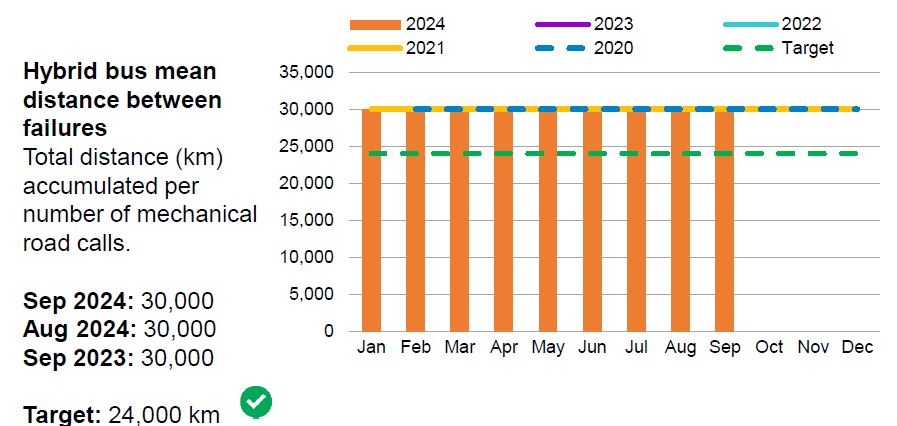
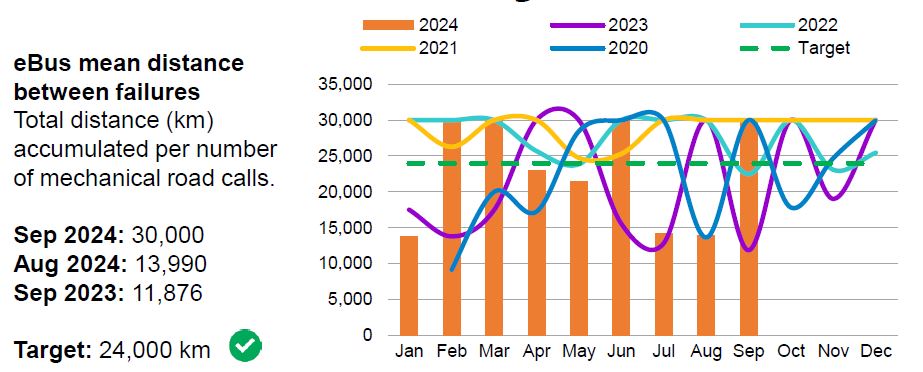
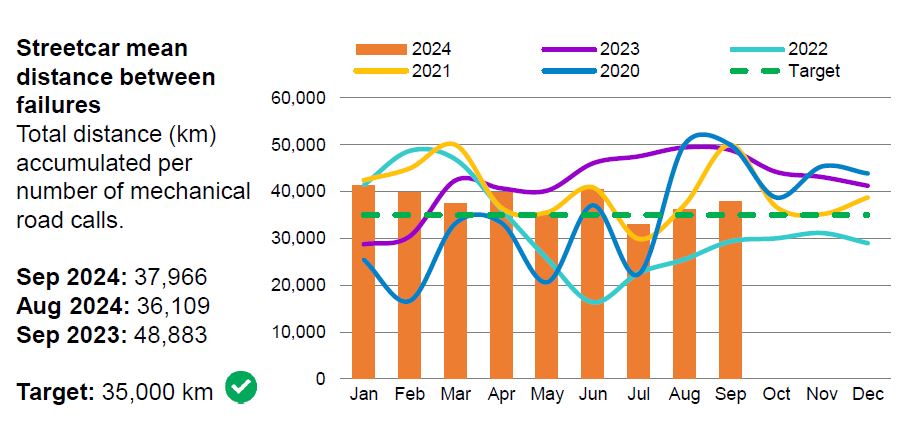
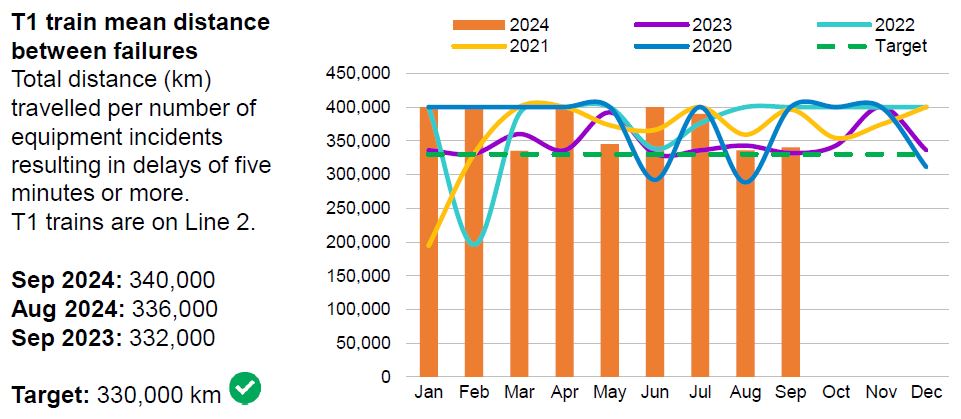
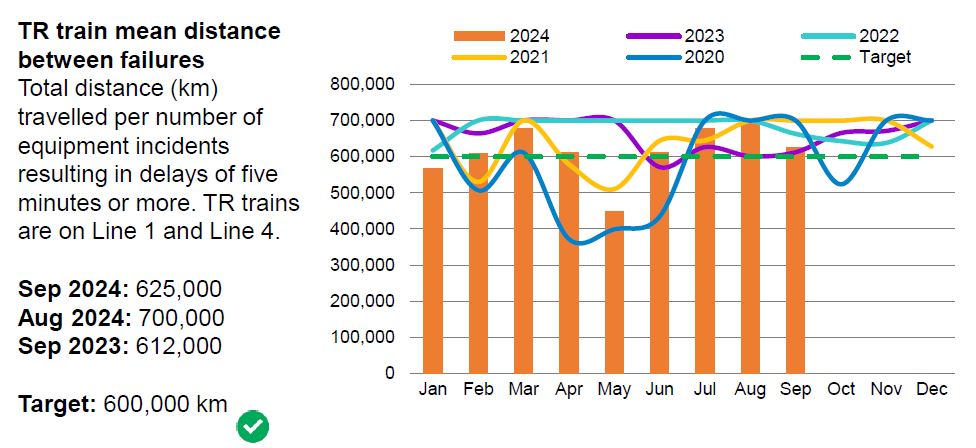
The TTC continues to report reliability with values capped in the charts rather than showing the real month-to-month data. This makes meaningful comparisons impossible. Diesels are capped at 20k and hybrids at 30k kilometres mean distance between failures, and eBus stats are similarly capped at 30k, although they often fail to reach this level. There is no way from these charts to know which are the most reliable vehicles in the fleet.
For the rail modes, only the T1 (Line 2) train stats appear to be capped at 400k km.
Notice of Motion: Proposed deferral of legacy fare retirement
TTC Chair Myers has a Notice of Motion that:
- the TTC defer ending the acceptance of tickets, tokens and day passes,
- staff prepare a communication plan to inform riders of this pending change, and report back to the January 27, 2025 Board meeting.
- That subway crash gates, left open so that riders can deposit fares and walk into stations, be closed as originally planned.
It is not clear how, with the crash gates closed, riders could use legacy media to enter the subway except by transferring in on a surface vehicle. Moreover, riders who have a paper transfer from a bus, or a fare receipt from a streetcar, would not be able to use entrances with a fare barrier.
The situation arises from the focus on fare evasion among Board members, and the idea that they must “do something” to stem losses. Unfortunately, the fare system is in a transitional state that does not make simplistic changes easy. In past debates, it was clear that some of the Board have limited experience with riding the transit system and do not understand the implications of their proposals. A change that better controls fare payment by one group of riders might make system usage very difficult for others.
With all of the hand-wringing about fare evasion, there has been no documentation of increased revenue at a scale comparable to claims made about losses.
Financial and Major Projects Update
The financial update begins with an overview of likely 2024 operating results. Revenue is higher than normal thanks to higher ridership and a higher average fare per ride. At the end of Period 9 (roughly the end of September), revenue is running $27.1 million over budget. Passenger revenue for 2024 is expected to be 9.5% higher than in 2023 due to higher ridership and a higher average fare.
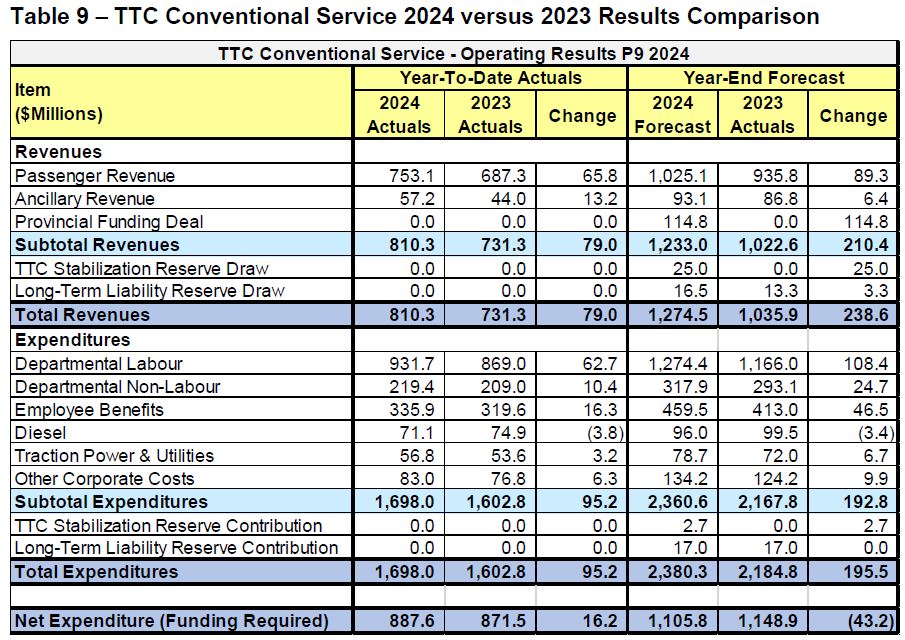
Expenses are down because provision for lines 5 and 6 opening was not fully required. This saving will be used to reduce the draw from reserves planned in the 2024 budget (only $25 million instead of $45.7 million).
The report explains how “service investment” continues to support riders across the city.
[…] the TTC continues to protect service coverage across the city. This recognizes that even on the lowest ridership routes, it is critical that all customers have access to safe, reliable, and accessible service. Service investment will increase to 97% of pre-pandemic levels in 2024 from 95% in 2023 to accommodate ridership demand changes through new and revised routes and to maintain reliability in the face of increasing congestion on mixed-traffic corridors.
As I discussed in a recent article, the TTC’s point of comparison for recovery is service hours, not the amount of service riders actually see.
Major Projects
This section of the report details the status of the large capital projects underway at TTC. This is not a full list of the works in the 15-year Capital Plan because many of those do not yet have funding or approval to proceed, or are individually too small to appear in the Major Projects list. Even the approved projects are not yet fully funded.
An important issue when celebrating the arrival of new money, as with the announced Federal support for new subway trains, is that there is always a list of projects in the queue vying for attention.
Readers interested in specific projects should refer to the report. The information below is an overview.
Subway Portfolio
The nine major projects in the subway portfolio have a combined estimated final cost of $16.7-billion of which $9.9-billion was unfunded when the report was written. With the November 29 Federal announcement, and the Provincial funding that unlocks, this number is reduced by about $1.5-billion.
Some of these projects are long-running collections of work at several sites such as Easier Access station upgrades, fire ventilation, and capacity improvements at key stations. Some have “hard stop” dates dictating when they must occur, while others are likely to float to slots where money is available.
- The Easier Access Program is covered in a separate section later in this article. It is fully funded with a 2027 end date.
- The Second Exits Program brings stations up to current fire code with two separate exits. The project has funding for 87% of its work. Nine stations have been completed, and five are underway:
- College & Dundas West (2026)
- Summerhill: detailed design underway, in service 2027
- Greenwood & Dundas: planning stage, no in service date
- The Fire Ventilation Program upgrades ventilation at locations undergoing reconstruction, as well as replacing end-of-life equipment. This is an example of a cost that is not borne when subways are new, but are needed state-of-good-repair decades later for equipment that is largely invisible. This project is 92% funded.
- New Subway Trains to replace the Line 2 fleet of T-1s and provide for expansion.
- This has several components, although they will all be filled from a common contract award:
- 55 replacement trains. Current estimated cost $2.27 billion funded equally by Toronto, Ontario and Canada. Note that the existing fleet is 61 trains, but only 55 are required for the pre-pandemic level of service (46 trains plus 9 spares).
- 25 growth trains for Line 1.
- 15 expansion trains for and funded by Metrolinx (7 for Scarborough, 8 for North Yonge)
- 17 trains for growth on Lines 1 and 2 through 2041.
- Media reports of statements by Federal and Provincial Ministers indicate that the trains will be built in Thunder Bay, and yet the TTC plans to undertake a Request for Proposals from the industry.
- This has several components, although they will all be filled from a common contract award:
- Line 2 Automatic Train Control (ATC) will modernize signalling on the Bloor-Danforth line and provide for more frequent service than the current signal system allows (reducing the minimum headway from 140 to 120 seconds). This project is 69% funded on a total estimated cost of $881.1-million. It is linked to the new cars project because the existing fleet cannot be economically modified to run on ATC. The projected completion date is 2035/36 likely with a staged implementation as was done on Line 1.
- The Line 2 Capacity Improvement Program includes many components to address the effects of increased service and passenger demand: station capacity, electrical traction power upgrades, guideway changes (e.g. spare tracks), carhouse and shop modifications, and signal system upgrades (Greenwood Yard). This project is only 34% funded out of a projected total of $2.7 billion. There are timing issues because some aspects are linked to the delivery of new trains and increase in service levels. The traction power upgrades are also subject to constraints on workforce and work car availability.
- The Line 1 Capacity Improvement Program has similar components to Line 2, but with extra requirements to allow operation of headways as short as 100 seconds (the pre-pandemic minimum was 120 seconds). This affects station capacity, traction power and ventilation. The planned fleet expansion triggers the need for a new 34-train yard and maintenance facility. This project is only 16% funded out of a projected total of $6.3-billion.
- Bloor-Yonge Capacity Improvements:
- This project will provide a new eastbound Bloor-Danforth platform south of the existing station similar to the northbound-to-Yonge platform that was added at Union Station on Line 1. The entrance and concourse areas will be expanded with added capacity for passenger flow between parts of the station. Platform edge doors (PEDs) will be installed on the Line 1 level, and provision for them will be included on the Line 2 level (installation is dependent on the ATC project).
- The project is 83% funded out of a projected total of $1.5-billion, not including PEDs and various other potential costs.
- Early works (utility relocations) completed in October 2024.
- To allow for the expanded entrance, a chiller plant in the Brookfield Development (Hudson’s Bay building) must be moved. This work is expected to complete in mid-2026.
- The project will be a progressive design-build with a development phase to end in early 2027. Project completion is expected in 2035.
- The Stations Transformation Program is part of the move to eliminate traditional Station Collectors and fare collection. The project’s $51-million cost is fully funded, and the work is expected to finish in 2025.
Bus & Wheel-Trans Portfolio
There are five projects within this group of which the lion’s share covers the electrification of the bus fleet. Most of this work is not yet funded.
- Scarborough RT Conversion to Busway: This $94-million project is fully funded, and 25% of the allocation has gone to provision for temporary terminal and on-road operations, as well as design work for the busway itself. Removal of the former SRT infrastructure from the corridor is in progress. Property acquisition for some locations has the longest lead-time within the project, but the TTC is pursuing workarounds to allow construction to proceed. The 100% design is expected by the end of 2024. Project completion will be in 2027.
- Wheel-Trans 10-Year Transformation: This $50-million project is fully funded and only 29% is unspent. This is primarily an IT project to support the Family of Services approach to serving Wheel-Trans riders. It also includes the construction of 16 Access Hubs. Completion is planned for 2027.
- Purchase of Wheel-Trans Buses: This $446-million program provides for ongoing replacement of WT buses, although the current funding only covers deliveries from 2022-26. Supply chain issues push some planned 2024 deliveries into 2025. Up to ten zero-emission WT buses will be obtained as a pilot in 2025 with the intent of complete fleet conversion over the decade 2026-35.
- Purchase of Hybrid and Electric Buses: This project covers bus purchases out to 2035, but available funding only lasts to the end of 2025. The total plan includes 336 Hybrids (delivered), and 340 Electrics (delivery has just begun) through 2024-25. Beyond that is an unfunded requirement for 1,840 buses over the next decade. The total cost is $5.1-billion of which only 22% is funded.
- eBus Charging Systems: This $1.2-billion project is only 20% funded, but it is an essential counterpart to the planned eBus purchases. It overs the installation of charging systems in all garages, but does not include any provision for en-route charging which is not yet part of the TTC’s eBus operational plans.
Streetcar Portfolio
- Purchase of 60 Streetcars: These cars are intended to support growth in demand on the streetcar system. The $516-million project is fully funded, and almost half of the cars were delivered as of October 31. Supply chain issues hamper the deliveries, but the TTC also is shy of storage space thanks to construction problems at Russell Carhouse and delays in beginning the work to convert part of Harvey Shops as an operating location for Flexitys.
- Hillcrest Facility: This $148-million project is fully funded. It will convert part of Harvey Shops for storage, servicing, testing and maintenance of 25 Flexitys. The storage is expected to be available in Q4 2028.
- Russell Carhouse: The carhouse is being modified and expanded to support maintenance of the Flexity cars that have roof-mounted equipment rather than underfloor with traditional streetcars. The yard is to be completely rebuild with a concrete base and stormwater management, as well as pantograph-compliant overhead power supply. The $168-million project is expected to complete in 2029.
Network-Wide Portfolio
- VISION Computer Aided Dispatch / Automated Vehicle Location: This project began in 2016 and is supposed to complete in 2025. Only 11% of the $112-million funding remains to be spent. Work in progress includes implementation of the Yard Management System for automated allocation/dispatching of vehicles, an Operator Performance module, the Bustime trip prediction system amd upgrades to SMS text messaging.
- SAP ERP Implementation: SAP is a collection of computer applications under a common umbrella that began as a financial management system but has expanded over the years into many other areas. The TTC had a large inventory of elderly systems, some of which still survive due to the complexity of underlying processes, notably time, attendance and workforce scheduling. The City of Toronto has embraced SAP to integrate business processes. The project began in 2014 and is planned to run to 2027 at a total cost of $273-million of which half has been spent to date.
- PRESTO: The Presto fare system implementation began in 2012 and is now projected to end in 2027 at a total cost of $79-million, of which 91% has already been spent. Relations between the TTC and Metrolinx on the scope of implementation have not been easy with Metrolinx failing to deliver contracted elements to the TTC. Although there has been an agreement settling the differences, some functionality will not be delivered on time due to the potential transition by Metrolinx to a new vendor of the underlying Presto IT system. In particular, the TTC’s desire to support cash fares and machine readable transfers will not be supported by Presto until 2025-26.
Easier Access Program Update
The installation of elevators and other accessibility changes at subway stations continues, but will not hit the legislated target of January 1, 2025 for all sites. Schedules for some of them have changed due to local conditions and conflicts, design problems, contractor performance and labour availability, supply chain issues and property acquisition delays.
Warden and High Park are running ahead of schedule, the others are behind, and some remain on time.
The on time projects are at Greenwood (Q2 2025), Rosedale (Q2 2025), Christie (Q3 2025), Spadina (Q3 2026), and King (Q4 2026).
At Islington, only partial accessibility will be provided until completion of planned redevelopment. At Warden, accessibility will be provided as part of the temporary bus terminal during redevelopment.
The schedule for several stations has been revised. For details about the cause of delays, please refer to the report.
| Station | Revised Date | Original Date |
|---|---|---|
| Warden (interim) | Q4 2025 | Q2 2026 |
| High Park | Q1 2025 | Q2 2025 |
| Summerhill | Q4 2025 | Q1 2025 |
| Lawrence | Q2 2026 | Q3 2025 |
| College | Q2 2026 | Q3 2025 |
| Museum | Q2 2026 | Q4 2025 |
| Old Mill | To be determined |
The TTC will adjust surface routes to provide all-day coverage for incomplete projects:
- 97C Yonge will get all-day, every day service.
- 13A Avenue Road will get late evening service.
- 31 Greenwood’s extension to Coxwell Station will be maintained.
- 149 Etobicoke-Bloor is a new route that will provide alternative service for High Park, Islington and Old Mill Stations.
No service plan has been announced for these changes.
 Steve Munro
Thanks Steve for the information. I notice that there is funds to have chargers installed at all bus garages. But I assume that’s is a mistake, because we’ve heard repeatedly of Queensway being left out.
So is it confirmed that Queensway will get EV chargers or is TTC changing their minds in Queensway with every report we see? Appears to be a lot of flip flops with Queensway garage. Another thing about Queensway, east of the property TTC is leading their space to a private company. Can TTC not get that property back to expand Queensway garage?
Steve: If you look at the report at page 66 of the pdf (page 39 within the detailed appendix itself), you will see the phasing of the project to install charge points:
The table on the following page shows that the six garages in Phase 1 are Arrow, Eglinton, Birchmount, Wilson, Malvern and McNicoll. Phase 2a includes Eglinton and Mount Dennis. Yes, it looks like Queensway is bringing up the back of the queue.
Also, Russell. I wasn’t expecting Russell to take this long. It’s been about 10 years since the LRVs have been delivered, yet here we are struggling with both Russell and Hillcrest.
Steve: Russell seems to be partly a case of underestimating the complexity of rebuilding the yard, plus very slow design on the carhouse modifications. Similarly, the work at Hillcrest is only inching along. There does not seem to be much priority assigned to this work.
A random unrelated question. I remember years ago there was and to extend St Clair line west to Jane or possibly Scarlett. Are those plans still around, but unfunded, or simply not a thought if anymore? I do recall hearing TTC either buying land just west of Gunn’s loop for a potential westward extension?
Steve: This scheme was part of the Transit City plan which would have seen the Jane LRT come south to Bloor Street. This would provide a potential connection to the Finch West carhouse for the St. Clair cars. However, the Metrolinx LRT lines are being built to standard gauge, and even assuming the Jane line is built eventually, there is a good chance it would be a branch off the Eglinton Crosstown, not a separate line to Bloor. Interconnection with St. Clair won’t happen, and so the incentive to extend westward vanishes.
LikeLike
Adult single fare is $3.30 regardless of whether you use a Presto card or debit/credit card. Only cash or Presto Ticket costs $3.35.
Steve: I have clarified the text to make a contrast between single fares on credit/debit cards vs passes available on Presto.
LikeLike
With the Hillcrest complex slowly expanding, I can see the small number of extra streetcars needed to be used on the 512 ST. CLAIR extension to Scarlett Road could be based there. No need to use branch off to Mt. Dennis. Just make sure there will be a track foundation for the streetcars to use the new underpass at Scarlett & Dundas.
LikeLike
Phil Verster, the embattled CEO of Metrolinx, is out at the transit agency. Please do NOT consider him for the TTC CEO position. 😱
Steve: According to the government press release, Verster has accepted a new position. The TTC is still in the early days of the search phase. From sources, I have heard that he was interviewing overseas. We are well rid of him.
LikeLike
Couldn’t the extra order for 17 new subway trains in the same common contract be used for the line 4 extension if that ever happens.
Steve: I’m sure it could. The real question is how long the vendor will want to keep the production line available waiting for new lines to be built in Toronto.
LikeLike
A full 0.1% of fare revenue comes via legacy fare media.
But it’s vital that it be maintained .. because … board-members who don’t use the TTC have no idea how fares are collected?
What is the cost of collecting that 0.1% of revenue? Want to bet that it’s way, way more than 0.1% of all fare collection costs?
As for “A change that better controls fare payment by one group of riders might make system usage very difficult for others” … solve that problem but not by creating others – ditch the legacy fare media!
I have posted here and elsewhere many times that transit service providers should not be discounting any fares – charge one fare for any ride (or by distance or however it’s done otherwise). The others entities like school boards, social service agencies, et al, buy modern fare media in bulk for distribution to clientele.
LikeLike
These RSZs around Rosedale are getting really annoying and it’s making North York a less viable place to live. Previously, the condos in North York slotted in right at the edge of the idealized 20/30 minute commute time to downtown. I could just sort of zone out for 20 minutes during the ride and then arrive at my destination. But with the RSZs, it pushes it past that point, and it just makes the commute dreary and annoying. After about 25 minutes, I wake from zoning out and start wondering why things are taking so long and get impatient. It makes me want to move closer into the city again. But there aren’t many condos between North York and midtown. The city was designed with certain subway commute times in mind, and they really need to fix the RSZ problem to normalize things again. Those extra 5-10 minutes really start adding up over the months.
LikeLike
I can’t help thinking the TTC will have to close the open cut section of the Yonge line for an extended period of time to deal with all the RSZs. This is what the MBTA had to do to get a handle on their slow zone crisis (also the work of Rick Leary). I hope whoever the new CEO is, they have the guts to admit this if it’s indeed true.
LikeLike
The RSZ southbound between Summerhill and Rosedale was “allegedly” removed (according to a supervisor I talked to at Bloor this morning. The net result was my train (Run 104) ran down from Summerhill at what seemed excessive speed, and then OVERSHOT Rosedale by 4 1/2 CARS (yes, really). We sat for a few minutes, then the announcement we can’t stop at Rosedale due to “technical issues”. Just a guess someone pooched the ATC controls – I see at 10:25 there are still issues between York Mills and Bloor – nice job boys!!
LikeLike
Thanks Steve. A couple of questions. Is there a bonus for early completion in the accessibility projects? And is there any info on the Islington Station redevelopment? It’s one of the CreateTO housing sites and I believe that the station redevelopment requires completion before the needed housing can be built.
Steve: A bonus? They will be lucky to finish “on time”, and I doubt there is any incentive in the projects to do better. The timing for Islington is, as you say, tied up in the CreateTO project. I will have to check which way the dependencies work.
LikeLike