
The TTC Board met on October 29 with an agenda that did not give the impression of being an all-day affair, but that is not how things turned out.
An extended debate in both public and confidential session arose from a management proposal to ban eBikes from the system from mid-November to mid-April as a safety measure. This arose from a fire onboard a subway train earlier in 2024 and a more general concern about eBike fires as these vehicles become more common.
There were many overlapping threads in the debate, but in the end the Board referred the matter back to staff for additional information, especially in regards to harmonization with existing City and Metrolinx policies, and the problem of enforcement. This will be on the December 3, 2024 meeting agenda.
To me, the most frustrating part of the discussion was the amount of time devoted to that issue compared to the almost non-existent debate on basic matters like service quality and management, as well as reconciliation of TTC plans with Council’s rather lofty aims to increase transit use as an essential environmental policy.
There was little new in the CEO’s monthly report. Ridership continues to build at a modest pace, and the profile of demands by day-of-week and time-of-day requires a rethink of service provision.
Other issues in this article:
- Hydraulic fluid leaks from subway work cars
- Reduced speed zones
- Ending legacy media
- The size of the TTC bus fleet
- Transport buses for warming centres
- Streetcar open door cameras
- The CEO’s mandate
- Gambling advertising
CEO’s Report
Note that the CEO’s Report has been split into two pieces with the detailed metrics in a separate document.
Hydraulic Fluid Leaks
Councillor Matlow asked about the status of the report on hydraulic fluid leaks in light of another such incident recently. Interim CEO Greg Percy replied that the preliminary investigation of that incident showed it was due to operator error.
Rich Wong, Chief Transportation and Vehicles Officer advised that the report would be available “shortly”, and when pressed said that this would be by year-end. In the preliminary draft, preventative maintenance for work car hydraulics has been increased, and night shift support has been added to check vehicles before they leave the yard. Previous failures were due to various factors including bad installation of O-rings, routing of hoses and chafing, and the lack of pro-active replacement of consumable parts.
Matlow asked if there were common factors, how long these problems have existed, why the former CEO took so long to bring this information to the Board, and why the new report is not already at the Board. Percy replied that the report will be released before the next Board meeting.
Bem Case, Executive Director of Sustainability and Innovation, pointed out that there are two reports. One is a root cause analysis which showed a common factor with the quality of workmanship sometimes worsened by incorrect corrective actions, but there was no suggestion of a deliberate act. The second is a Peer Review that was only just received and is now in final review by the TTC.
Ridership and Boardings
Councillor Saxe asked about the use of two different metrics cited for demand on the system: boardings and ridership. Josh Colle, Chief Strategy and Customer Experience Officer, explained that both terms are used referring to different aspects of travel. The transit industry mainly uses boardings which count every time a rider boards a vehicle separately, while ridership is historically linked to paid fare for complete trips. CFO Josie La Vita clarified this saying that boardings related to rider behaviour (i.e. which buses they ride) while rides are linked to revenue tracking.
Councillor Holyday observed that the subway is busier then ever. Ridership is up 10% over 2023, but the stats in the KPI appendix only go to August. Is the profile what was expected, and what does the TTC have to look at for service over longer term.
Josh Colle replied that the TTC is noticing the “shape” of demand is changing, and weekend ridership is going up more than weekdays with more crowded trains on Saturdays and Sunday. Previously, the focus was on peaks. TTC finds that some days are quieter with Tuesday-Thurday being higher than Monday and Friday. All days are trending upwards, and staff have been discussing how many trains will be needed by time of day.
Holyday replied that it feels like the shoulders of peaks have the greatest pressure, but the gap between trains is still long. What does the TTC have to do for service/funding, how does this relate to the budget? This is a customer experience issue.
Reduced Speed Zones
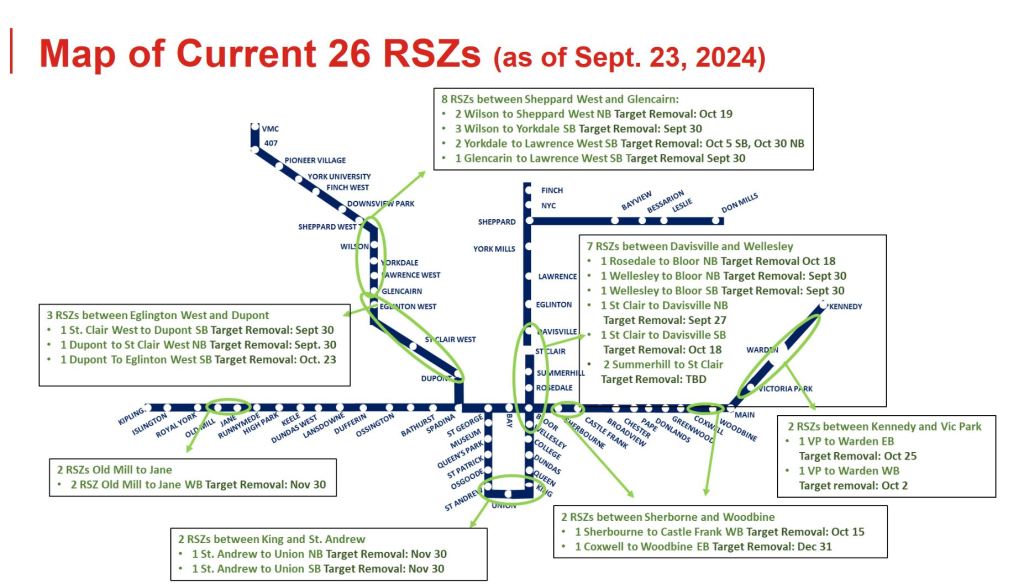
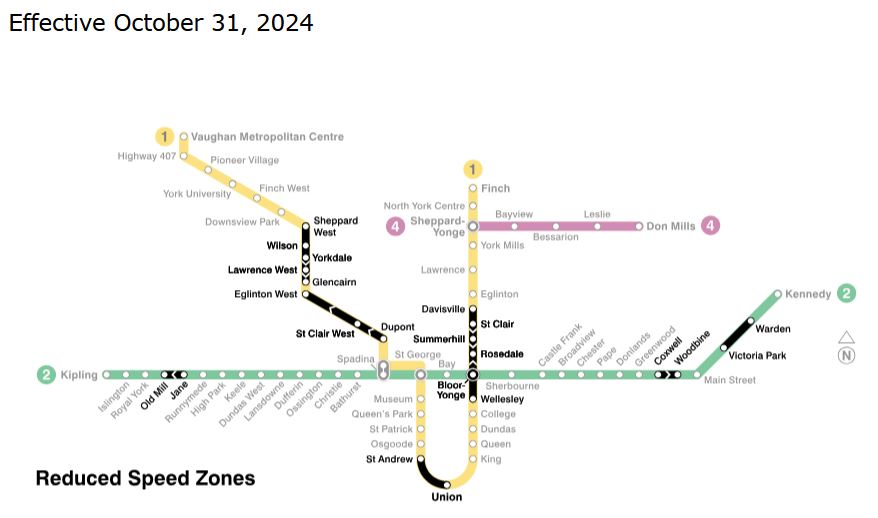
Chair Jamaal Myers asked for an update on the subway slow zones. Fort Monaco, Chief of Operations and Infrastructure, replied that there are now 22 zones. TTC hopes to reduce this below 20 by month end with the aim of getting to about 17 before the Taylor Swift concerts, and under 10 by year-end. Greg Percy noted that they will never get to zero because there will always be areas requiring maintenance, and a range of 7-10 would be common.
Myers asked about the status of the UITP (International Union of Public Transport, the acronym is French) review of TTC practices. Staff replied that this is underway with a documentation review, and that in-person visits will follow.
What was not mentioned in the discussion is the distinction between a short restricted speed zone and a longer zone due to deteriorated infrastructure over an extended distance, a problem that can develop thanks to chronic lack of maintenance.
At the September Board meeting, staff reported on existing zones with hoped-for completion dates. Here are the September 23 and October 31 maps for comparison. Almost all zones with an October 30 or earlier target date on the September map remain on the October map.
Ending “Legacy” Media
The TTC recently announced that “legacy” fare media – tickets, tokens, and day passes – would be eliminated at the end of 2024. This follows Board directions in 2022 and 2024, in part arising from debates about fare evasion.
When this idea first surfaced, a major concern was that agencies buying tokens or tickets to give to their clients would have no alternative. This was addressed with the introduction of Presto tickets.
Updated November 5, 2024:
However, these tickets had their own problems because they eventually expired thanks to a technical limitation within the Presto system, and they had to be traded in. This problem has since been resolved, and the TTC advises that the tickets now have a shelf life of five years. [End of update]
On the subject of tokens, there are about 6.7 million still in circulation with a book value of $23 million, and about $2 million worth of old tickets. TTC receives only about 4,000 token fares per week, and the inventory in public hands clearly will not be spent down quickly. If the TTC provides refunds, this is a cash outlay, but there is already an accrued liability on the books for revenue on unused tokens. In past years there were concerns about counterfeit tokens being turned in for refund, but this was not mentioned in the debate. For bulk sales customers, a refund mechanism is already in place.
Another concern about refunding old media is that they might not have been purchased at the current fare levels, although this only becomes a real accounting cost if the value of returned media exceeds the accrued liability by the end of a refund period. As things stand, the TTC is not accepting old media for refunds and urges riders to use up whatever they have by year end.
Lines 5 and 6 were designed and built with no capability for legacy media because it was assumed that these fares would not exist when the lines opened.
The entire discussion gave the impression of Board members who are out of touch with policies, some of which they have already endorsed. Online information about the change is already posted, and an advertising campaign will start in stations in a few weeks.
TTC will still accept cash fares by bus fareboxes and streetcar vending machines. In the subway, riders can buy Presto tickets at entrances.
How Many Buses Does the TTC Own?
Between the September and October CEO’s Report, 131 buses disappeared from the claimed fleet size.
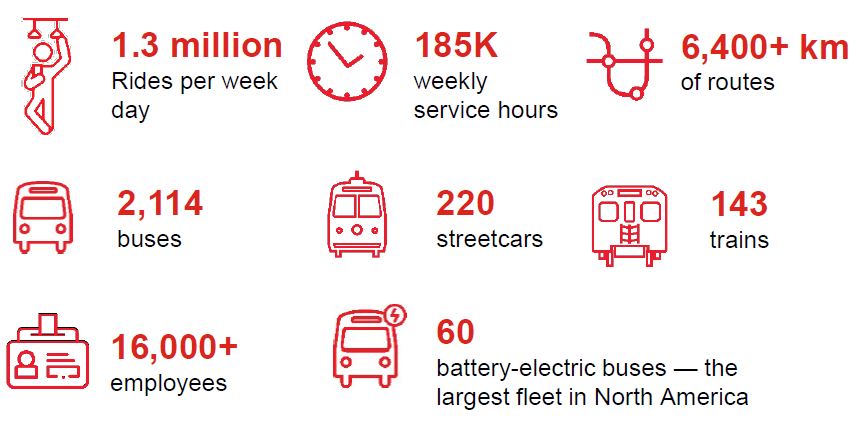

The count of 2,114 buses has appeared in the CEO’s Report for a few years in spite of ongoing purchase and disposal of vehicles. The count of active vehicles in the October 2024 Scheduled Service Summary is 2,070. I asked TTC about the discrepancy, and they replied:
As you probably appreciate, the numbers fluctuate based on new arrivals and decommissioning.
We have a rotation of spares for both planned and unplanned maintenance that allows us to manage the approved fleet plan and meet service delivery requirements. [Email from TTC Media Relations, October 25, 2024]
This is not simply a matter for trainspotters’ nerdish interest in the makeup of the bus fleet, but of the headroom the TTC actually has for maintenance spares above scheduled service and for growth without the need to buy more buses. The oldest buses in the fleet have been replaced by new hybrids whose delivery is now complete, and another batch of old buses will be replaced by the eBuses that have just begun to arrive. This will reduce the average age of the fleet and eliminate the oldest, least reliable vehicles.
For many years, even before the pandemic service cuts, TTC maintained a spare ratio larger than industry standards for a bus fleet. This is not an unusual situation when subsidy policies favour capital replacement over ongoing maintenance and overhauls. However, that generous spare ratio policy runs aground as the cost of buses rises through complexity and technology change. Moreover, any plan to substantially increase transit service also requires more garage space. There is already a concern that future eBus purchases are not funded, and it is important that the Board be aware of the system’s limitations on service growth.
Seasonal Prohibition on Lithium-Ion Battery Powered E-Bikes and E-Scooters
The Board considered a report about the issue of lithium-ion powered devices in which management recommended that the Board:
Approve the prohibition of lithium-ion-powered micromobility devices, including e-bikes and e-scooters, onboard TTC vehicles and inside TTC stations and facilities from November 15 to April 15 each year.
Discussion of the report went on at great length including in private session, and in the end the Board referred the matter back to staff to consider several issues.
The TTC Board on October 29, 2024, referred this report to the TTC’s Racial Equity Office and directed staff to complete an equity impact review for consideration by the TTC Board at the board’s next meeting. Such review should assess potential impacts that a ban of lithium-ion-powered micromobility devices, including e-bikes and e-scooters, may have on equity deserving groups and gig workers with recommendations for impact mitigation developed in consultation with TTC Safety staff and Toronto Fire Services. [Carried by a vote of 5-4]
Major points covered during the debate included:
- The difference between the TTC’s proposed policy, the policy at Metrolinx and the City of Toronto’s distinction between powered and power-assisted devices.
- The existing TTC prohibition on bikes and other large objects on the subway that is almost never enforced.
- The difference between Metrolinx and TTC in station layouts and enforcement regimes.
- The varying degree to which battery manufacturers warn against exposure to cold weather and other factors such as water and salt that could compromise battery integrity.
- The economic impact on gig workers who depend on transit for carriage of their eBikes to work locations.
- The degree of danger and potential effects for passengers, staff and infrastructure of a battery fire on board a subway train.
- The difficulty of providing an inspection, validation and enforcement scheme for batteries, and competing demands on security staff for other incidents on the transit system.
- The differential in the effect of the proposed ban on various groups who may disproportionately depend on these bikes.
I will not recount the entire debate but interested readers can watch it on YouTube.
The debate was notable for bringing competing issues before the Board: the desire to limit risk and liability from eBike fires, and a concern that a ban would have equity implications for eBike users, and the overall City policy to encourage cycling as an alternative to car travel.
An important distinction here is that if eBikes are considered to be inherently dangerous to other riders, then the question has nothing to do with who is using the bike. Conversely, if the bikes are not as dangerous as claimed, then a ban could be viewed as targeted against a group.
This discussion was not helped by conflicting information about the extent to which all batteries, as opposed to those of select manufacturers, constitute a danger. Also, the potential effects focused on harms to riders, not to infrastructure if there were a train fire within a tunnel (e.g. damage to cabling, vehicles and structures).
The TTC Audit and Risk Management Committee spends a lot of time hand-wringing about liability issues, notably those related to fare evasion. The question of eBikes brings them up against a different target group, one that cannot be conveniently dismissed as scofflaws who avoid paying for service.
The Board has a personal liability issue to ensure the safety of its employees, and allowing eBikes might be considered as permitting a dangerous work environment. Some Board members played down the problem because there has been “only one” subway fire with an eBike, and fortunately this happened in a station where passengers and crew could escape. There has, of course, been “only one” Russell Hill crash, one SRT derailment, both of which were traced to poor maintenance and training. This is not a straightforward issue, and the debate will continue at the December Board meeting.
Transport Buses for Warming Centres
Over past years, the use of TTC subway stations as shelters by homeless people has grown as the City’s shelter capacity maxed out. Notable locations were stations that remained open all night, Union and Spadina.
In an attempt to deal with this, the TTC provided buses that were intended to take people to shelters, but with the lack of space, the buses themselves became shelters even though they are inappropriate in many ways. Over the winter season, only 296 people were transported to a City shelter while 5,816 were sheltered on buses.
For 2024, buses will not be used as warming shelters, and will only be provided when temperatures fall below -15°C to move people to available shelter space. That level corresponds to the second tier of City support for the homeless. At -5°C, warming centres open, and at -15°C additional capacity is provided because of the extreme cold.
The plan for 2024/25 is outlined below.
The TTC recommends the following response and outreach approach during the 2024/2025 winter season (November 15, 2024 to April 15, 2025) to continue to support individuals sheltering within the transit system:
TTC Stations staff will continue to encourage individuals in need to move to Spadina and Union stations upon station closing.
- Streets to Homes workers will continue to be available at these stations to connect individuals with social supports. These workers provide the following services:
- Conduct referrals to the shelter system through Central Intake, which may include directing individual(s) to warming centres, as appropriate;
- Conduct referrals to housing workers, for those who are not already working with other housing workers or agencies;
- Conduct wellness checks;
- Provide clothing and supplies;
- Provide harm reduction supplies and harm reduction services; and
- Provide seasonal resources (sleeping bags, socks, hats, hand warmers), snacks and gift cards, and PRESTO cards.
- Special Constables will be notified to assist, if required, and will encourage individuals to access available social supports and resources.
- Redirecting individuals to available warming centres and shelters allows them to access locations that meet the expectations outlined in the Toronto Shelter Standards.
- However, it is expected that individuals will also move to other available locations within the network, i.e. streetcars, until stations reopen.
- The TTC will continue to provide transport from Spadina and Union Stations to available warming centres and shelters when the temperature reaches –15 Celsius, upon notification by the City.
- Bus Operators will receive information and guidance regarding their role in providing this service through face-to-face communication. This is in addition to the de-escalation training they receive as frontline employees. The TTC will also be issuing communications to inform employees of the response and outreach approach this winter season.
- The City’s Community Safety Teams will provide support to the TTC by working with the TSSS Duty Office to find available space during Extreme Cold Weather days. They will also assist with co-ordinating the movement of individuals onto the buses and accompany Bus Operators in the vehicles during transport.
- The TTC will continue to provide shelter buses at the request of emergency services, i.e. building fire.
Interim CEO Greg Percy advised that staff are working on a “phase 3” to deal with conditions if all shelter space fills up.
An amendment proposed by Councillor Holyday to the staff recommendations was approved by the Board:
Direct the Commission to recover costs from the City of Toronto for special buses provided for people waiting or direct transport of people to shelters.
The intent is that the cost of homeless support be borne in the appropriate part of the City’s budget.
Streetcar Open Door Cameras
The idea of automated ticketing for motorists who drive past open streetcar doors goes back to 2017 as part of a package of transit-friendly measures. In 2021 and 2022, the Ontario government enabled the practice, but there has been little progress to implementation. Work has arrived at the design stage for a system during 2025 with the intent of a limited roll-out in 2026. No tickets would be issued until the new system proves its accuracy.
In parallel, the TTC and City are working on designs to make stops safer such as bump-outs from the curb. This will require a rethinking of how road space allocations and provisions for turns occur at streetcar stops, as well as integration with bike lanes where they exist.
Chair Myers proposed an amendment to the report which was endorsed by the Board.
Request the Province of Ontario to significantly increase the penalties (fines and demerit points) associated with section 166(1) of the Highway Traffic Act relating to the improper passing of streetcars while the streetcars are stationary for the purpose of picking up or dropping off passengers due to the seriousness of the offence.
CEO Mandate
The Board approved a confidential report about the mandate for the CEO’s role at TTC. No details were published. Notwithstanding this, ATU Local 113 President Marvin Alfred spoke to the Board about the workers’ perspective on a new CEO. The following text is a paraphrase of his remarks which can be heard in full on the meeting video.
Alfred noted that even before the pandemic, there had been a decline in service and maintenance with management hiding the effects. Restoration of transparency and accountability are required. It was not bad luck but management and the Board’s direction not to spend that contributed to the SRT derailment, not a single loose bolt.
Lack of accountability goes to the top, and big changes were implemented without debate. The TTC needs to be honest about the scale of the problem.
Service may be at pre-pandemic levels, but we don’t know the effects of schedule and standards changes.
Service is not managed enroute, and so is not managed. Alfred asked the Board to work with ATU, not against them. After the Russell Hill crash that was thanks to cuts, the system was rebuilt. The new CEO needs to be a champion for transit service.
In reply to a question from Councillor Holyday, Alfred remarked that service to riders is not in place to deal with customer needs. Headways are wider. Budget service hours are going to standby “route 600” buses, and the public is not getting what they expect. Service is haphazard and cancelled runs are cherry picked. Even when a “600” bus is dispatched it must come from a hub, and the missing buses produce gaps. The ATU wants to discuss how service people expect is not actually deployed.
The TTC has an online survey for public input on a future CEO. This is available until November 5, 2024. I will write on that topic in a separate article.
Gambling Advertising
Councillor Moise proposed the following motion to the Board:
- Request the TTC’s contracted third party provider, Pattison Outdoor Advertising LP, to forward all advertising relating to the use of sports betting and gambling to the TTC for review in accordance with Article 6 of the Advertising on TTC Property Policy.
- Request TTC staff to review any further sports betting and gambling advertisements, in accordance with the Advertising on TTC Property Policy, to determine whether the proposed advertisement complies with the requirements as set out in Article 8.0, in particular Article 8.1.4 of the Policy.
- Direct TTC staff to study the feasibility of a ban on sports betting and gambling advertisements from all TTC assets and report to the Board by Q1 2025.
Councillor Matlow asked if there are any criteria for the types of advertising the TTC will accept, e.g. cigarette ads. As these decisions come up, there should be some process related to specific goals.
Michael Atlas, General Counsel for the TTC, noted that the proposal does not do anything but send the matter for review by staff. However, the Supreme Court has already ruled on this general area and its relationship to free speech. An analysis is required to establish what should be accepted, and the Courts have put a fairly high standard on this.
Councillor Holiday asked what kinds of things the Court has found reasonable to ban. Atlas replied that messages related to hate and terrorism, and more recently to abortion, but the ads must be reviewed in their entirety including links from them. The Court supports debate in the public realm e.g. transit. The TTC has no explicit ban on gambling ads now.
Councillor Matlow asked if this motion is redundant. Atlas replied that the only change from current practice is that all ads would come to the TTC for review and Pattison (the company which handles ad placement on the TTC) could not approve ads on their own.
Commissioner Osborne wondered if the Board is on a slippery slope, and saw no end in sight of target ads to be banned. The TTC would be “telling people what’s good for them”.
Commissioner Jagdeo noted that an alcohol producer pays for the New Year’s eve free rides.
Councillor Holyday opposed the proposal because of the lost revenue, and the substantial redundance relative to current review practice. He does not want this type of motion to continue coming to the Board.
Councillor Matlow stated that a decision to accept ads should not be taken as indicating Board support, but things like gambling are legal. There should be a review process but not on an ad hoc basis at the Board.
Chair Myers supported the motion in part because Councillor Moise is Chair of the Board of Health and has done addiction counselling.
The motion failed with only two in favour.
 Steve Munro
UITP? Unexplained acronym. Also addition counselling –> addiction counselling.
Steve: Fixed. Thanks.
LikeLike
The escooter debate is pretty ridiculous. A one off situation that didn’t result in injury, where there was reportedly tampering with the battery…when the ttc has numerous ongoing safety issues that result in deaths and injuries on almost a monthly basis. Fires at track level, buses and trains hitting folks…if every suicide resulted in a report on how to avoid that issue then almost every meeting of the board would have to face up to platform doors, better track security…now we have folks ODing in station waiting areas…maybe we shouldn’t have unattended entrances anymore? If every bus crash came forward to council then they would have to have cameras, drug testing, dead man switches on buses, speed tracking….and on and on…almost all of which would have more impact on customer safety and workplace safety at the ttc…
That said the city and Metrolinx should come up with a better system to check that scooters are safe, maybe partner with local repair shops to tag vehicles that have had yearly safety checks done…this would increase safety across the city instead of letting the issue fester – specifically with vehicles that are stored in apartments etc…scooters and bikes aren’t going away, and existing models will be with us for a decade or more likely…best to come up with a holistic program that works instead of putting our heads in the sand…
LikeLike
Steve,
I can’t help but think that if this was anytime before the late 90s that E-Scooters would have been banned from the TTC.
The choice is already spelled out for them in By-Law 1.
Section 3.6 of By-Law 1 states:
Additionally, Section 3.11(a) states:
Hell, it even says things in the following which gives TTC staff justification for removing the homeless.
Section 3.19 states:
Sections 3.24 and 3.25 State:
Is it just me or is the TTC Board afraid to make a decision or enforce their own by-law anymore?
Steve: The TTC Board is running up against contradictions in their political views. The By-Law is written from the point of view that people who do any of these things are inherently “bad”, but it gets complicated when they are “cyclists” or disadvantaged people. (I use quotes there given the wide range of what is passed off as a bicycle these days.) There is also the problem that the TTC in olden days only rarely had to enforce the By-Law, and face the public reaction which can be quite polarized. They do not have the staff needed to actually implement the eBike ban across the system.
There is a more general issue with “motor vehicles” and large objects in that severe congestion on board can be caused by an excess of baby carriages and shopping carts, as well as mobility devices. The difference with eBikes is the potential fire hazard.
LikeLike
No mention on the status of fare evasion. Number of people charged. Repeat offenders etc.
Given the cost to the public of $100+ million I would have thought that this should be a topic for discussion at each meeting.
Steve: This came up in the “boardings vs trips” discussion with a suggestion that there should be some visible change in revenue per rider if a significant change had occurred in evasion rates, but the topic was not pursued. This will be an “interesting” debate when management is faced with reporting on a hard number (the dollars coming in) versus a soft number (the claimed evasion rate, lost revenue and effects of improved enforcement). Until now, they have not had to prove that they are doing enough enforcement, or that the money spent on it is gaining revenue to offset the cost. In the eBike discussion, management did note that if resources are to be directed to inspection and enforcement re bikes, this will take away from other things that TTC security staff are expected to do.
LikeLike
I agree, as a frequent user of the Spadina subway, I can say trains slow down just South and North of St Clair West, but other than that, the delay is barely noticeable. This is a short zone with minimal impact. I would love to see a detailed explanation why each RSZ exists and the actual speed limit for each zone.
LikeLike
Two things on this:
First. There has been a significant increase in drivers and also e-bike/scooter users making dangerous passes to the left of stopped streetcars in the opposite direction lane. Only ten years ago I could say I had never seen that happen at all, now I see it at least once per week (as a twice per weekday rider). These cameras need to be set to capture activity on both sides of the streetcar, not only the door-side. The default assumption that drivers would never do something so dangerous has apparently gone out the window.
Second, a large number of times I’ve seen cars jump the open doors are US or Quebec licence plates, and even with Ontario plates I suspect they are from out of town and generally have little to no knowledge of streetcars at all. Even if the Driver’s Handbook has it in there to get a licence, it may have been decades since they read it. There’s an easy fix here for a large sign at Gardiner Expressway off-ramps with the simple instructions “DO NOT PASS STREETCARS WHEN DOORS ARE OPEN”. I know that won’t solve the whole problem, but I bet there’s drivers every day coming into the city who will see that sign that had no idea.
LikeLiked by 2 people
The problem with any sort of photo enforcement of traffic laws (at least in Ontario) is the photo can only identify the vehicle, not the driver. That means the police can only fine the owner of the vehicle, not give any demerit points to the driver. A lot of people (or companies in the case of commercial vehicles) won’t care, and will just pay the fine over and over.
LikeLike
I’m having problems up-voting some of the posts, even with all browser extensions off for this site. (Chrome latest ver, on Linux)
Steve: Don’t worry. I think that you have to have a WordPress userid for that to work.
Whatever, relevant to a number of posts, and certainly an option for the TTC to explore (legally, without a waiver, this applies to the TTC as much as it does to air-travel and other public venues)
TDG Act and its regulations:
In Canada, the transportation of dangerous goods is strictly regulated under the Transportation of Dangerous Goods Act, 1992. The Act and the Transportation of Dangerous Goods Regulations were designed to promote public safety (people, property and the environment) and security during the transportation of dangerous goods.
On October 25, 2023, Transport Canada published the Regulations Amending the Transportation of Dangerous Goods Regulations (Site Registration Requirements) in the Canada Gazette, Part II.
To be legally technical, even laptop computers and iPhones are covered, but allowed a waiver.
A medium depth search (again, I’m still looking for how Metrolinx is dancing around this issue legally) shows nothing that I can find for Transport Canada issuing a waiver to Metrolinx on the ‘dangerous goods’ aspect.
M’linx might have an ‘accord’ with the Feds on this, and therefore very reluctant to divulge it to the public, and the TTC Board might have been informed of this.
Quite peculiar…I’m still searching.
LikeLike
Let’s see a reduced speed zone map for the entire streetcar system. They’d run out of black ink!
Steve: Yes! Slow orders have been standing in for proper maintenance even longer on the streetcar network than on the subway. It’s going to be very hard to get them to reverse a policy that is born of a concern for “safety”, and the long-standing issues with the track switch electronics. I wonder how many people at the TTC even remember when it was not necessary to stop, check and proceed at every switch, and tiptoe across every intersection.
LikeLiked by 1 person
EVERY SWITCH? I need to get out more!
Steve: You can imagine what crossing from Roncesvalles to Sunnyside Loop is like on The Queensway. Then there are the slow orders on the intersections along The Queensway lest some idiot motorist make a left turn in front of a streetcar. This is “transit priority” in Toronto.
LikeLiked by 1 person
I am not sure if TDG would apply to transit agencies and the amounts of lithium cells carried. TDG generally has a lower limit of dangerous items at which point the shipper has to meet TDG regulations. So for example, taking a BBQ propane cylinder for a drive in your car does not invoke TDG, but a truck shipping a large number of cylinders (either by volume or weight, I’m not sure) would have to be placarded and registered.
Transport Canada’s regulations regarding lithium cells calls out transport by aircraft and “vessels” (i.e. boats) specifically. Road transport would still be covered, but you’d probably have to dig through the UN classification scheme to find out how.
Lithium cells that show heat damage are another matter, and will get thrown into a container filled with fire-suppressing pellets and labelled as such, even if it’s just one cell.
While my TDG certification expired years ago, I still have had recent occasion to deal with lithium cells, damaged and undamaged.
LikeLiked by 1 person
Streetcars entering Long Branch loop have to stop and pause to check the (almost never used) spare track switch before proceeding. That just shows how over-general this stop-and-proceed policy is. I guess if you are sitting in a chair in the TTC HQ, assuring that no streetcar will ever proceed over a switch without stopping and checking means a nice tick-mark on your to-do list and a green light on some management dashboard.
LikeLiked by 2 people
By e-scooters do they mean the electric mobility scooters, the wheelchair-like devices? Will staff be examining what kinds of batteries are used?
Steve: Wheelchair like devices would be exempt, but not “bicycles” which are primarily powered by their batteries such as those typically used by delivery couriers. As for staff examinations, that matter has not been settled and was one of many reasons this was sent back to staff for review.
LikeLiked by 1 person
Don’t TTC buses still come bike racks on the front? Surely, the minimum compromise should be that e-bikes should always be allowed on buses on the bike racks since it doesn’t endanger anyone that way. Still, Uber or some designated third party really should setup proper downtown e-bike storage/rental/charging centres for their workers. Uber leases and rents cars to their drivers; I don’t see why they can’t offer similar services for their bikers. Uber should also provide advice on bike safety like the wearing of helmets and the use of lights at night.
Steve: The heavier bikes/batteries used by couriers are too heavy for the bike racks on buses.
LikeLike
2 points —
a) regarding the bike racks – only one position is available, after the union complained that the operators’ vision was blocked, and therefore should not be used. Funny how other transportation systems running IDENTICAL buses, with bike racks are able to use both positions. (Guess they hire higher visual acuity operators.)
b) the issue of why the RSZ’s are still there over a month after allegedly going to be cleared seems to have been sidestepped…. much more smoke blown, and our collective a**es will explode.
LikeLike
Metrostinks has place a green sticker on every bike that has a battery that is CE or UL compliant. They periodically check for them. They also periodically throw any bikes beyond the maximum of 2 off of trains. I was once on a coach with 14 ebikes in the west end of the car. Needless to say that door was unusable. They either have to enforce the rule or put bike coaches on all Kitchener trains. They did this on weekends for a while.
They are now checking fares on the platform at Brampton Station before every inbound train as fare evasion was rampant. I don’t get into Toronto enough to comment on the TTC but all the transit agencies need to have the same policy.
LikeLike
Hi Steve, TTC should do away with all cash fares entirely across all in-service TTC transit vehicles, like GO Transit, and several other transit agencies worldwide like Transport for London in London England, Public Transportation Victoria in Melbourne, Australia and Greater Dayton RTA in Dayton, Ohio, United States have already implemented and only accepting electronic fare card and contactless credit and debit card on transit vehicles. It reduces maintenance costs with cash fareboxes, cuts down on fare disputes, eliminates the need for bus drivers to count how much money was put into the farebox and the need to provide paper transfers. I really hope the TTC eventually goes to a full-fledged cashless fare payment system on all TTC transit vehicles eventually, with cash only accepted at PRESTO vending machines in subway stations and third party retailers like Shoppers Drug Mart where customers can purchase and load PRESTO cards with money or a TTC monthly metropass or purchase paper 1-ride, 2-ride or day pass TTC PRESTO tickets and can give change if needed. Removing cash fares would be one step closer to a true and totally modernized fare collection system. I have already requested TTC staff to look into the feasibility of scrapping all in-vehicle cash fares entirely at the Accessibility forum and at the Ask TTC events in September and October 2024 respectively.
LikeLiked by 1 person
By moving the TTC to a fully digitized fare system would involve:
– Removing legacy fares from circulation: TTC senior/youth/student paper tickets, TTC adult tokens and old-style scratch-off TTC day passes (no longer accepted as valid fare after December 31st 2024).
– Eliminating all cash fares entirely on all TTC buses and streetcars where change cannot be given, including the removal of all fareboxes (cash can still be accepted at PRESTO vending machines in subway stations and 3rd party retailers such as Shoppers Drug Mart where customers can buy and load PRESTO cards and buy paper TTC PRESTO tickets and can provide change)
– And retiring paper transfers.
LikeLike
When compared the latest ridership in this CEO report to 2019 levels, how much percentage is that in pre pandemic levels by bus, subway, or streetcar?
Steve: The TTC is no longer publishing this breakdown in the new version of the CEO’s report. I will ask what the numbers are.
LikeLiked by 1 person
“There will always be 7-10 slow zones”? Really? The TTC board is just gonna let our maintenance keep being in disrepair like that?
Just goes to show the board’s sheer unambition and lack of desire to fix our transit’s most pressing problems. We need a CEO who will do whatever it takes to get the number of RSZs down to zero and actually bother to give the TTC the maintenance help it needs.
Steve: I can only accept the idea of 7-10 slow zones, at most, if they are very short in length and are fixed quickly. TTC management are stretching our patience with the maintenance backlog.
LikeLiked by 2 people
Would you support shutting down parts the subway for a week at a time to fix things faster? That’s what the Boston MBTA has been doing.
Steve: Some of the RSZs are in key areas that would be hard to replace with buses. Also, crossovers are not ideally placed for a short distance shutdown. This mess is the result of a lot of deferred maintenance that cannot be fixed quickly. The idea that we should accept as normal that there would be several RSZs open at any time says a lot about acceptable maintenance practices these days. And the MBTA is no paragon to cite as an example.
LikeLike
Assuming that buses won’t be used as warming centres this winter seems short-sighted. The last time Trump was elected, there was a large influx of refugees from the US, and I doubt Trump will honour previous agreements with Biden on how to handle them. If anything, the city should be installing bus charging stations near existing warming centres and other strategic locations. That way, we can use EV buses as temporary overnight warming centres for surge loads without all the noise, pollution, and wear and tear of leaving diesel buses running all night.
Steve: If Trump refugees arrive in numbers, we will need more than a few buses, and our problems as a spillover of his policies will be much larger than warming centres.
LikeLike