
At its meeting of September 24, 2024, the TTC Board received a presentation from Fort Monaco, Chief Operations and Infrastructure Officer, on subway restricted speed zones (aka “RSZs”).
From the sheer number and duration of these, it has been clear to riders that the TTC fell behind both in the quality of its track maintenance, and in its ability to work through the backlog. It is one thing to say that RSZs are implemented for safety, but when they are so numerous, “safety” had become a matter of necessity beyond routine levels.
The current RSZ map, together with expected dates when these zones will be repaired, is from the appendix of the presentation deck. Monaco noted that with each RSZ adding about two minutes of travel time, the trip from Wilson to Union Station is extended by about 15 minutes.
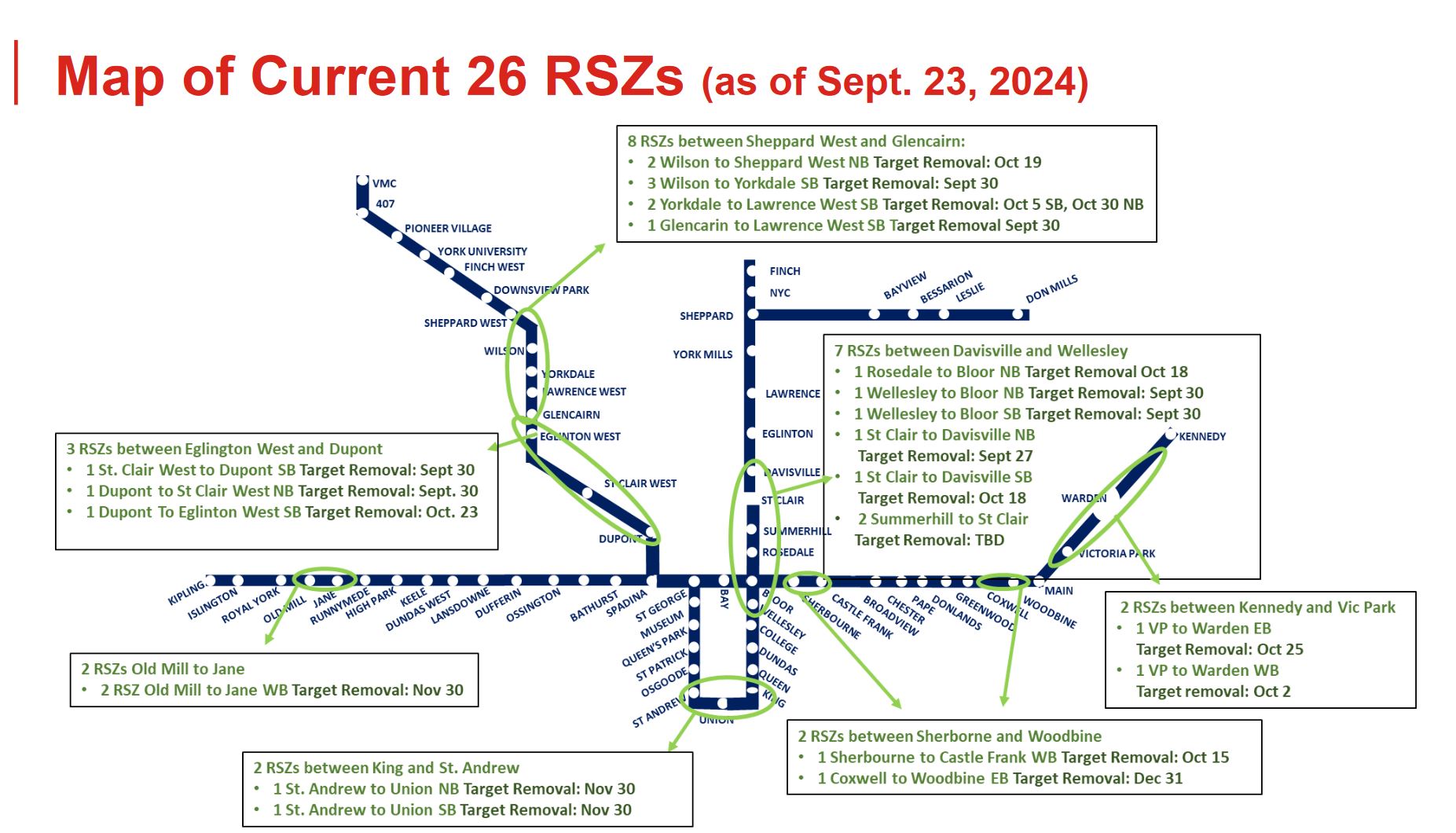
The locations where these occur are overwhelmingly in “open cut” locations where rail is laid on ties and ballast. In tunnels, rail is either mounted directly on the concrete tunnel floor, or on structures which themself are fixed to the tunnel. Such track cannot shift around as much from forces of passing trains. Other track issues include several types of wear that can induce noise and rough train operation, but also fractures from metal fatigue.
Since January 2023 the accumulated count of RSZs is almost 300. Of these, only 30 were planned, typically for track renewal projects where a slow order is required over an extended period while work is in progress.
(In the table below “NDT defects” refer to flaws in the track detected by non-destructive methods such as ultrasonic scans.)

Geographically, the problems were distributed across the system, but with many being in areas of open track. These tables list the number of RSZs, not their duration. [Click on any image to open the gallery.]


The average time to resolve an RSZ was 22.1 days, while the median was 11.6 days. This disparity indicates that although typical times (the median) were under two weeks, there would be many cases well above that length.
An example of the type of problem that can occur on open track is degradation of ballast due to poor drainage.

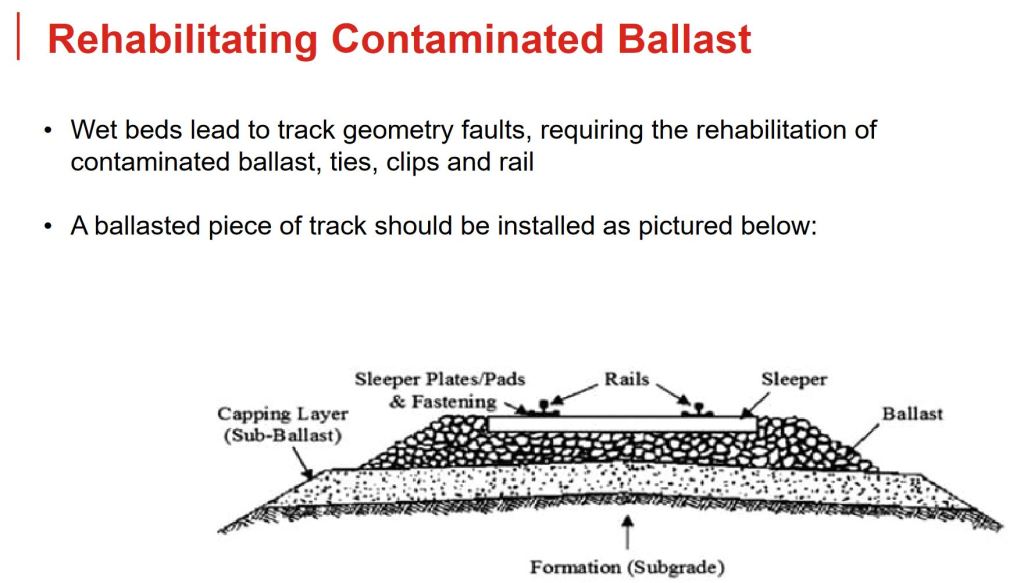
Many types of inspection are used to detect problems with track.

When a defect is discovered, the work involved could be localized (e.g. a broken weld) or it could cover an extended track segment (e.g. out of alignment rails on track with deteriorated ballast). The overnight repair window is only 90 minutes long when the time needed for setup and clearing the work site are taken into account. Longer periods are provided by early closings, or by weekend shutdowns of an affected section. After repairs are complete, the repair must be inspected and given a few days to “settle in” before the RSZ is lifted.
In May 2024, inspections revealed 25 new defects, 18 on Line 1 and 7 on Line 2 of which 10 were in open cut track. Additional defects were found through the year bringing the total to 85 of which 65 have been resolved. The work required six weekend and 53 early evening closures.
The TTC has a short-term and long-term plan to deal with this situation. These lists hint at the problems that led to the backlog in the first place, notably the reliability of the fleet of workcars essential to this work and the skills level of staff.
Short Term:
- Continuing regular maintenance to meet or exceed all North American standards
- Improving workcar fleet reliability
- Increasing TTC staff skills and training
- Exploring options to increase maintenance windows
Long Term:
- Introducing additional track inspection technology
- Acquiring our own ultrasonic and geometry survey equipment
- Enterprise Asset Management investment in data and knowledge
Design is underway for a TTC ultrasonics car so that they are not dependent on rented equipment and can inspect the network more frequently aiming at a “fix before fail” capability. This car will not be available for about two years. The TTC would like to get down to a steady state level of 6-8 RSZs across the system.
 Steve Munro
That sounds like TTC statistical engineering to me. It does not jive with my personal (but admittedly anecdotal) Line 1 experience.
I travel between Davisville and St Clair multiple times a week, and there has been at least one go slow zone there since at least spring 2024.
I’ve been lucky enough to travel to the EU several times the past few years. The dismal state of TTC infrastructure and maintenance, compared to the EU transit and HSR systems I’ve been on, is very depressing.
LikeLike
This is something that does not happen overnight, I don’t know how we even got to this point and who decided to let this fester for years.
I’m quite young and might have some rose-tinted glasses, but growing up, I never seen the subway have this many problems before. The only incident that I remember was the Russell Hill crash.
I do have to ask, has there been a point where the subway tracks were badly maintained?
Thanks for the article as always, Steve. I hope you have a great day. 🙂
LikeLike
Is replacing ballested track with concrete base worth considering long term?
Steve: At one point TTC was thinking of doing this on a problematic section of track from Berwick Portal (south of Eglinton) down to Muir Portal (north of St. Clair), but the work would require extended closures of subway service which make it impractical.
LikeLike
This brings a few, problematic, if not outright disturbing things to light. Why and how did things slide this far downhill without anyone raising the issue. We should never have gotten to this embarrassing state. I’d expect this type of penny pinching, unsafe behaviour from a private operator. But thought the TTC learned from their past. The rot is in the top, also how the hell does the TTC not own its own electronic rail inspection system? It has kilometers upon kilometers of rail which millions depend on daily, but yet they’re renting this type of thing. How much money does that cost vs. just owning one. It’s not like it’s some one or two time use thing. Transit systems run these things non stop every day. Did the TTC ever own one? What could posses them to ever think that renting a critical piece of regularly used equipment was the answer. Just when you think the management at this organization could not possibly screw up any worse…. here we are! Just fire the entire leadership, replace them with ChatGPT we might get better ROI.
LikeLike
Looking at Mr. Monaco’s chart, for the section of Davisville to Wellesley – NOT A SINGLE ONE has been removed. 5 had definitive dates given – Sept 27 to Oct 18, and two TBD (we know that meant a while yet).
To me travelling this section every day, means one (or more) of 3 things –
a) we are getting smoke blown up our a**es,
b) they use a dart board to pick dates,
c) the system is screwed, and can’t get repairs done.
The one from Bloor to Rosedale has been since early in the year, and they actually ran it full speed for 3 (yes 3) days after allegedly fixing it. I was at Rosedale and looked over the platform and found wooden ties split into 2 sections, tiedowns not attached to the rails – took pictures and showed them to Davisvile – RSZ back that night apparently.
Steve: Yes, I have been watching the non-completion of RSZ repairs and was planning to do an update on this after the TTC Board meeting next week in case management actually provides new info. As the investigation into the SRT derailment and subsequent info about the state of subway track has shown, there has been a lot of “smoke blowing” in recent years about track repairs.
LikeLike
December now and not only have the YUS RSZs not been lifted, there is an additional one between Spadina and St. George.
Coming and going to Vaughan for work is getting really tedious.
LikeLike