
The TTC Board will meet on September 24 with several items of interest on the agenda. Among these is:
Also on the agenda is the quarterly financial report. I will review it in more detail in another article, but it includes material relevant to the Line 2 project
The modernization report updates the status of various projects, notably the proposed purchase of replacement trains for the T1 fleet on Line 2. Related projects include installation of Automatic Train Control, upgrades to Greenwood Yard, and various infrastructure changes to support future service increase.
Recent months have seen much hand-wringing over the timing of a subway car purchase and the state of both the aging T1 fleet and the 1960s-era signal system. The newfound urgency at TTC is due, in part, due to deferral of an entire package of Line 2 upgrades in past years.
A comprehensive plan was presented to TTC management’s Executive Committee in March 2017, but it sat on the shelf. [Note: This plan is not available online.] The plan included many components including a new fleet with a delivery window of 2026-2030, and conversion of Line 2 signalling to Automatic Train Control. Trains, signals and other infrastructure continue to age, costs rise, and the first of the replacement trains is not expected until 2030.
With later delivery of new trains, the existing T1s require another five-year overhaul cycle for continued service. This adds an estimated $163 million to overall costs which are already up due to inflation.
Thanks to the delay when the TTC and City were constraining the capital budget, the need for a Line 2 modernization was not “rediscovered” until 2023.
Toronto is now in the difficult position of having a huge appetite for transit capital, but with funding sources inadequate and uncertain beyond the immediate future. Assuming that each level of government will pony up one third of any project is a foolhardy basis for planning, and hard decisions will be needed about which projects can go ahead.
At a time when Toronto claims it wants to shift urban travel from cars to transit, the level of investment we will likely see will at best preserve existing operations and infrastructure.
Replacing the Line 2 Fleet (T1 cars)
The original plan called for replacement of the full 61-train T1 fleet. This is more trains than Line 2 actually required in pre-pandemic peak service plus spares. (Some of the T1s were first earmarked for service on Lines 1 and 4, and then for the Scarborough extension. With the shift to Automatic Train Control, continued use of the T1s on Lines 1 and 4 was no longer possible as they cannot be retrofitted for ATC.)
The base order is now 55 trains which matches 46 peak Line 2 trains (January 2020 schedule) plus 9 spares (20% spare ratio). Trains for the Scarborough and Yonge North extensions have been shifted to those project budgets with provincial funding.
| 2017 Plan | 2024 Plan | |
|---|---|---|
| Tender process | 2021 | 2024 |
| Contract award | 2022 | 2026 |
| Preliminary design | 2022-23 | |
| Prototype testing | 2024-25 | |
| Delivery | 2026-30 | 2030-2035 |
| End of T1 retirement | 2031 | 2035 |
Recently, it was convenient to blame the suspension of an RFP for new trains on the lack of federal funding, but in fact it was the TTC who first backed away from the need for new trains and signals. At a time Toronto should have been lobbying for train funding, the TTC instead embraced a 10-year life extension for the T1s, and continued patching of the elderly signal system. This proved unworkable, but the momentum of the 2017 plan was lost.
Here is an excerpt from the 2019 Capital Budget “Blue Books” describing the deferral of new trains. This change in replacement philosophy was an early example of former CEO Leary’s hobbling of the the TTC’s future.
Future Subway Car Purchases
Subway Car Purchases are for the most part driven by the following:
- Service design life of the existing fleets is a 30-year life cycle;
- Service enhancements in headways;
- Ridership Growth/Capacity Studies; and
- Network expansion for which this type of vehicle procurement is not covered under [this] program but under the specific expansion project line item.
It should be noted that the future fleet procurements must also include the provisions for new maintenance and storage facilities on Line 1 and Line 2.
To meet the currently projected overcrowding and service headway enhancements on Line 1 there is a requirement for 44 additional trains between 2019-2033. This requirement for additional ridership trains remains unfunded. With the approval of the T1 Life Extension in 2018, the replacement of the T1 fleet, which was originally planned to commence in 2026, has been deferred until 2035. [Source: 2019 Capital Budget Blue Books, section 4.12, page 608b. Not available online.]
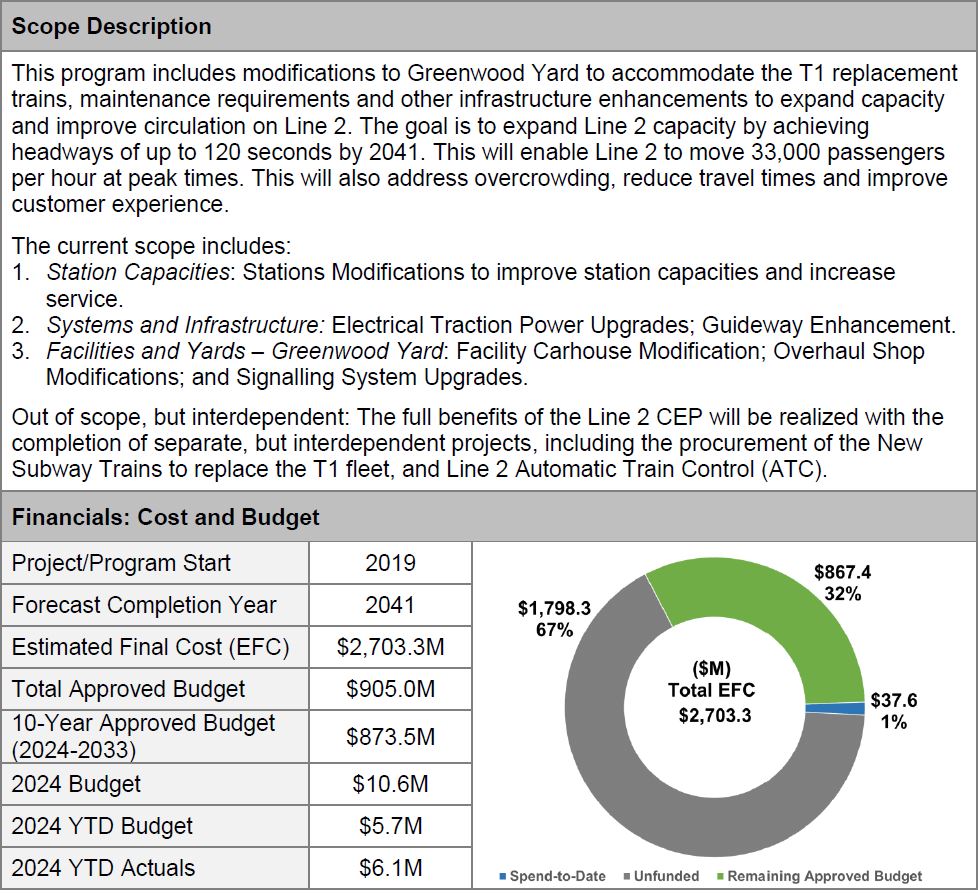
The cost and funding status for key parts of the Line 2 project are in the Line 2 Modernization report. However, other related work is included in the quarterly financial update, and this shows a bigger gap between approved and available funding.
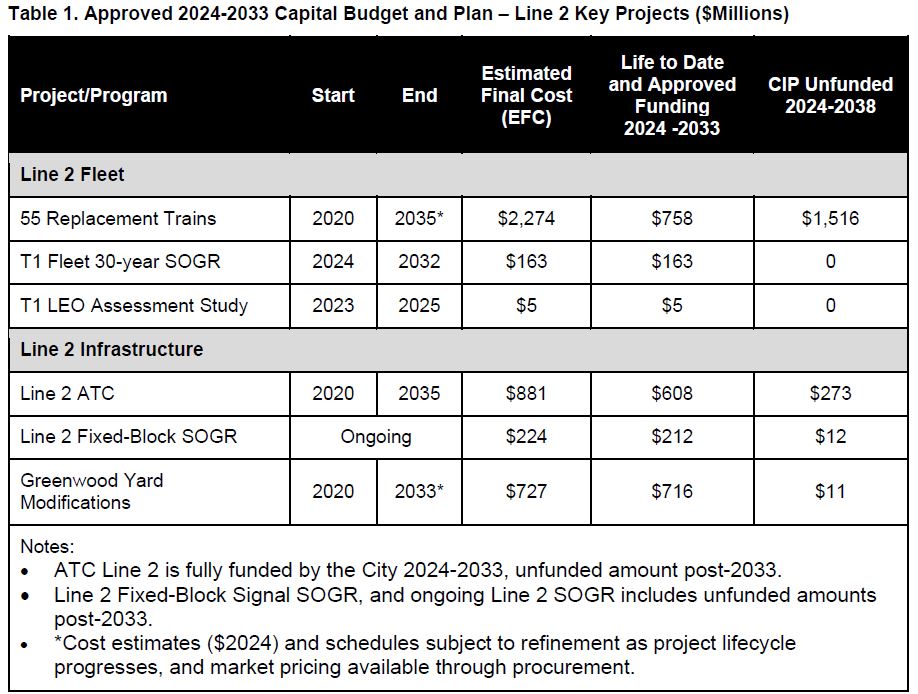
From the Financial Update
The total number of trains projected over the life of this order is well above those needed just as T1 replacements. Provision for two extensions and for demand growth pushes the total fleet up substantially.
| Line 1 | Line 2 | |
|---|---|---|
| Existing trains | 76 | |
| Replacement trains | 55 | |
| Extensions | 8 | 7 |
| Demand growth to 2032 | 25 | |
| Demand growth beyond 2032 | 13 | 4 |
| Total trains | 122 | 66 |
A new western yard was proposed in the 2017 plan because space at Greenwood would be taken by the Relief Line trains. The Ontario Line has its own maintenance facility at Thorncliffe Park thereby relieving that pressure in the short term, but eventually a second yard on Line 2 will be required. The City has already purchased property for this west of Kipling Station, an action taken before the Relief/Ontario line changeover happened.
A new yard will also be required on Line 1 likely somewhere north of the Richmond Hill terminus. This yard is not funded as part of the extension project.
Another important part of the Line 2 modernization is the installation of Automatic Train Control. This is not yet fully funded, and ATC installation on the Scarborough extension depends on a contract for the existing part of the line.
The Federal Funding Plan
The Federal government has announced the Canada Public Transit Fund totalling $30 billion over 10 years. As a national program, this is far below the needs of transit systems country-wide. It contains three components:
- Baseline funding: $500-million/year
- Metro-Region agreements: $2-billion/year (intended for the largest systems)
- Targeted funding: $500-million/year (intended for special projects and rural systems)
For a complete description of the fund, see Table 5 in the Line 2 modernization report.
There are several issues with this plan, not the least of which is the question of the existing government’s lifespan, and the degree to which any new government will continue to support the scheme whether project agreements have been signed or not.
Another important concern is that the City’s appetite for federal dollars greatly exceeds what is available. The $3-billion annually will be parcelled out based on a formula that is 70% ridership and 30% population. It is not clear whether Metrolinx will take a slice of this pie. In the past, the CIty has simply assumed that the feds would come in for one third of any project with the right enticement. However, if the funding is tied to a fixed annual amount divvied up among cities, Toronto will run out of headroom for this source before it runs out of projects.
In the case of the subway trains, provincial funding depends on a federal commitment, and such a linkage could effectively cap availability of provincial dollars.
Competitive Tendering
The TTC states that the tender for new trains will be open and competitive to get the best possible price. However, Premier Ford issued a joint statement with Unifor implying that the work of building new cars is destined for Alstom’s plan in Thunder Bay:
“Thousands of workers in Thunder Bay, where the subway trains are made, and millions of transit riders are depending on the federal government funding its share of the project,” Ford and Unifor President Lana Payne said in their statement. [Source CTV News]
On the signalling project, the TTC also plans to issue an open tender rather than simply using the technology already in place on Line 1. Even if the same vendor provided the Line 2 ATC, there are technical issues making interoperability of the Line 1 and 2 fleets challenging.
The RFP for Line 2 ATC does not include a Crossline Train Operation (CTO) feature for trains to move between Line 1 and Line 2. The requirement for CTO has been reviewed based on existing and future service plans, and operational needs assessment. It has been determined that CTO is not a requirement for day-to-day service for Line 1 and Line 2. There are also technical challenges that arise with CTO on the revenue fleet with one of the main constraints being that the trains on Line 1 are a permanent six car consist with a fixed ATC Train-Borne equipment configuration, whereas the expected new trains for Line 2 will consist of three married pair cars that will be dynamically configured. The dynamic configuration for the Line 2 ATC Train-Borne equipment is not supported by the ATC Line 1 system architecture. It should be noted that to support the CTO feature, additional funding would be required to redesign and upgrade the existing Line 1 ATC system to accommodate CTO. [Line 2 Modernization Report at pp 16-17]
The use of married pairs for Line 2 rather than six-car sets as on Line 1 was dictated by the use of Greenwood Yard which was designed around the Bloor-Danforth trains with married pairs. The original scheme for a western yard assumed that it would be built for six-car sets.
This incompatibility would also extend to trains procured for Line 1 as opposed to Line 2, and that problem is not addressed in the report. One way or another, it appears that the TTC will be forced to retrofit the Line 1 ATC for a hybrid fleet.
“Competitive tendering” in theory keeps bidders honest, but introduces technical complexity if new and old vehicles and systems are incompatible.
One cannot help remembering the snafus in the original Line 1 resignalling project where multiple, incompatible technologies were procured and, eventually, discarded.
Meanwhile on Line 1
Although the focus has been on Line 2 and its trains, there is a large, unfunded program to improve the capacity of Line 1. New trains are only part of the requirement which also includes:
- Capacity expansion at major stations to accommodate more frequent service and resulting passenger flows.
- Traction power upgrades to support more trains on the line, and to renew existing facilities.
- Fire ventillation upgrades to handle larger passenger volumes.
- A new maintenance and storage facility with capacity for 34 trains.

This is an example of the size of project that will compete for available funding at all levels of government.
 Steve Munro
Thanks Steve. Very informative!
LikeLike
A reconfigured seating design set of 6 cars with full length bench seating against windows on the Bloor Line would help crowding from morning till night. This set would be unique and a challenge to the Woodbine shops. They have the technology and expertise to fulfill this plan for the love of HS cars.
Steve: We went through the issue of bench seating years ago on another proposed purchase of cars. There is an accessibility issue because some people cannot sit in sideways-facing seats, and having only a few per car does not guarantee access. Jamming the last possible rider onto every train has tradeoffs.
LikeLike
Steve said:
When I was in London this year and Budapest last year virtually none of their subways had front facing seats.
The Elizabeth line and a couple of Bakerloo trains had them in London but that was it. All the other major lines (Piccadilly, Central, Northern, Metropolitan, Circle and District) did not.
My understanding with the Elizabeth Line was this was more of a design feature due to distance than accessibility. The line is more regional than local (as well as serving Heathrow) requiring different seating.
If other major systems don’t have this issue why do we?
I get the accessibility concerns but a line needs to be drawn somewhere both for cost and practicality reasons.
Steve: The cost difference is minimal. Accessibility should not be negotiable.
If you look at the interior design of the Ontario Line trains you will see that they have a mix of transverse and bench seating. Of course this is a preliminary Metrolinx design, so who knows what the final layout will be.
LikeLike
TTC continue to treat the procurement of new trains and the procurement of new ATC as two independent projects whereas they are highly integrated. With a transition from wayside signalling to ATC, the signalling system moves from being predominantly wayside-based to being predominately train-based, with complex train-borne signalling equipment that has to be physically and functionally integrated with other train subsystems. If TTC were to operate the new trains on both Line 2 and Line 1, even in non-service hours, then the integration challenges become even more complex. “Integation challenges” have significant budget and schedule implications.
LikeLike
A lot of Japanese trains have all longitudinal seating, too. Even on longish runs. Like the train I usually took coming home from school when I was studying there. It started at Minami-Kurihashi on the Tobu Nikko Line, ran through the Tobu Skytree and Tokyo Metro Hanzomon lines, to Chuo-Rinkan on the Tokyu Den-en-toshi Line, which is nearly 100 km. Of course, hardly anybody actually rides from end to end… Like I only took it about 19 km, from Shibuya to Eda, in Yokohama.
LikeLike
I think I’m confused. The TTC is going to get a different ATC for Line 2, and Line 1’s system can’t handle semi-permanently married pairs, but part of the train order will involve using semi-permanently married pairs on Line 1 so they have to overhaul that system anyway?
This smells like a boondoggle.
Steve: As I said in the article, this sound like the same sort of cocked up planning we saw in the original Line 1 resignalling contracts that Andy Byford had to rip up/consolidate to get a workable system. In this case I think that somebody is trying to avoid sole sourcing the contract to the incumbent, and also pushing off the cost of retrofitting Line 1 to a separate project. It sounds like a very big “ooops”, but we won’t see the effect until later this decade when they “discover” the need for a Line 1 retrofit.
LikeLike
Steve: Reader warning: Satire alert!
So true! In Canada we have legal abortion and medical assistance in dying. Why do we even have any cripples left? They’re so inefficient. And entitled, like when they roll up to you, sitting in one of those blue fold-down seats and want you to get up.
Sadly, we are now pandering to the disabled, first with the 4 seat configuration on the streetcars with two pairs of people facing each other. Now the Ontario Line mockup shows the same style of seating. Given that it is impossible for 4 people who possess 8 legs to actually fit in such a configuration, they are obviously catering to the disabled at the expense of the enabled.
Given that Japan is a culture that makes little effort to accommodate disabled persons, it’s not surprising that some trains do not have seats that do not face forward, though the ones where I lived did.
If y’all want to talk about how we should do things like they do in other countries, how about Singapore? It’s extensive MRT system is all longitudinal bench seating, true, but the stations are all accessible (at least one entrance per station) and every station has an accessible toilet (which are actually clean enough to use, unlike the TTC’s few cesspools). The public bus network is all accessible as well. Instead of advocating taking away from someone who has it harder than you, why not agitate for improving things for everyone?
Disappointing that only 3 months before the Accessibility for Ontarians with Disabilities Act goes into full effect, half of the comments on this piece (3/6) are about why it’s not necessary to accommodate all members of the public.
Steve: Considering ongoing problems with the operation and adequacy of WheelTrans, and the continued efforts to push disabled riders into “Family of Services” arrangements, that “catering” is hard to discover.
LikeLike
Why must be keep on modernizing?
Using horse drawn streetcars was just fine, just change the horse team every 4 hours but keep the conductors working 12 hours, and ignore the manure piling on the streets. Using cast iron pot belly stoves was just fine to heat them in winter. Don’t need air conditioning in the subway since they run in tunnels away from the sun’s heat. Save money by keeping things they were.
Shall I go on? 😉
LikeLike
After being screwed over by York region on the Vaughan extension, the TTC shouldn’t be tricked again by York region on the Richmond Hill extension. The TTC should operate trains up to Steeles only. York region should run its own trains and operate its own train yard for anything north of Steeles.
LikeLiked by 1 person
They just wasted tax-payer money, TTC is the worst transport system in the world, a city in China spends 7 years constructed 339km subway. What Canada needs to do is to face the facts. Since it has no money, it should try to relax restrictions and allow companies in China and Japan to participate in construction or renovation. This save money and speed up the project.
LikeLike
There should be a fair, open competition for the new subway trains contract. Given that Metrolinx awarded Hitachi Rail a design, build & maintain contract for the Ontario Line and it is also supplying the train sets for the Hurontario LRT in Mississauga, it will be quite surprising if the TTC essentially sole sources this order. I’m not sure how Metrolinx made decision on choosing Hitachi Rail for Ontario Line given lack of transparency.
LikeLike