
In a previous article, I reviewed travel times for the bus and streetcar operations on 510 Spadina Avenue at the north and south ends of the route where severe traffic congestion made bus operation extremely difficult. The north end problem resolved itself first with a diversion, then at least partly with completion of construction on Bloor Street, but the south end required a reserved bus lane to bypass the traffic queue for the Gardiner Expressway on ramp.
With all the attention on these areas, a separate factor is often overlooked in comparing the services: when and where there is little or no congestion, the buses are faster than the streetcars in spite of the “transit priority” treatment with dedicated lanes. The problem lies in a combination of different stopping patterns, traffic signals that do not favour streetcars, and operational practices requiring streetcars to creep through intersections.
This is the daily experience of regular riders on Spadina, and it is a “dirty little secret” that factors conspire to undermine the quality and speed of streetcar service. This is both a City and TTC problem because responsibility for road design and streetcar operations rest with the two organizations.
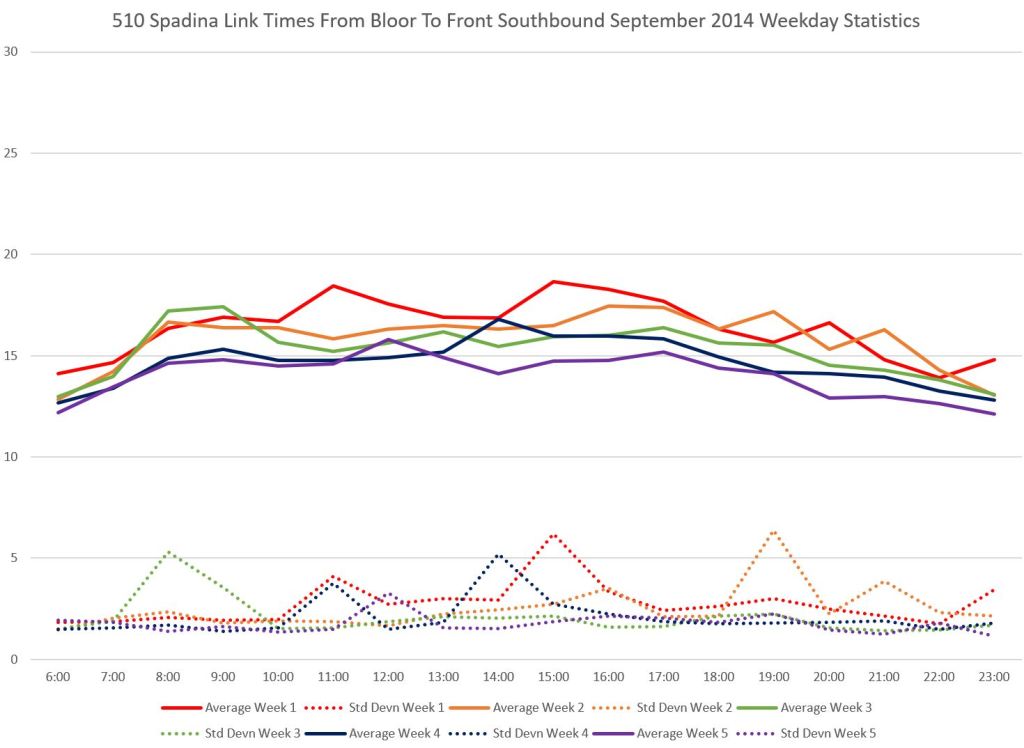
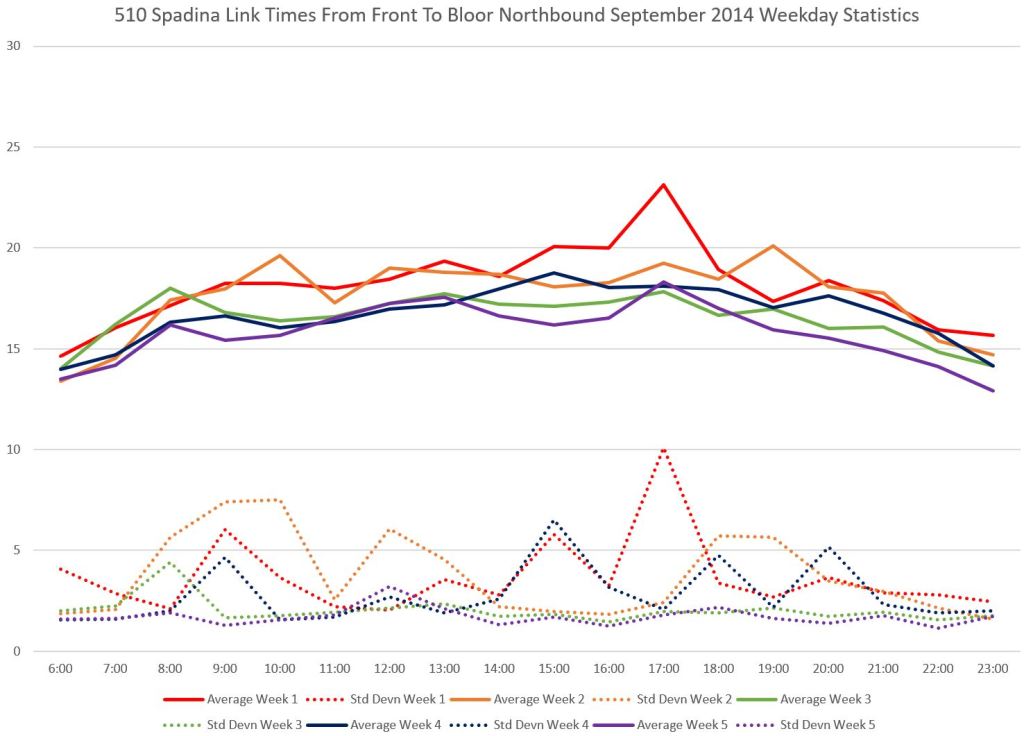
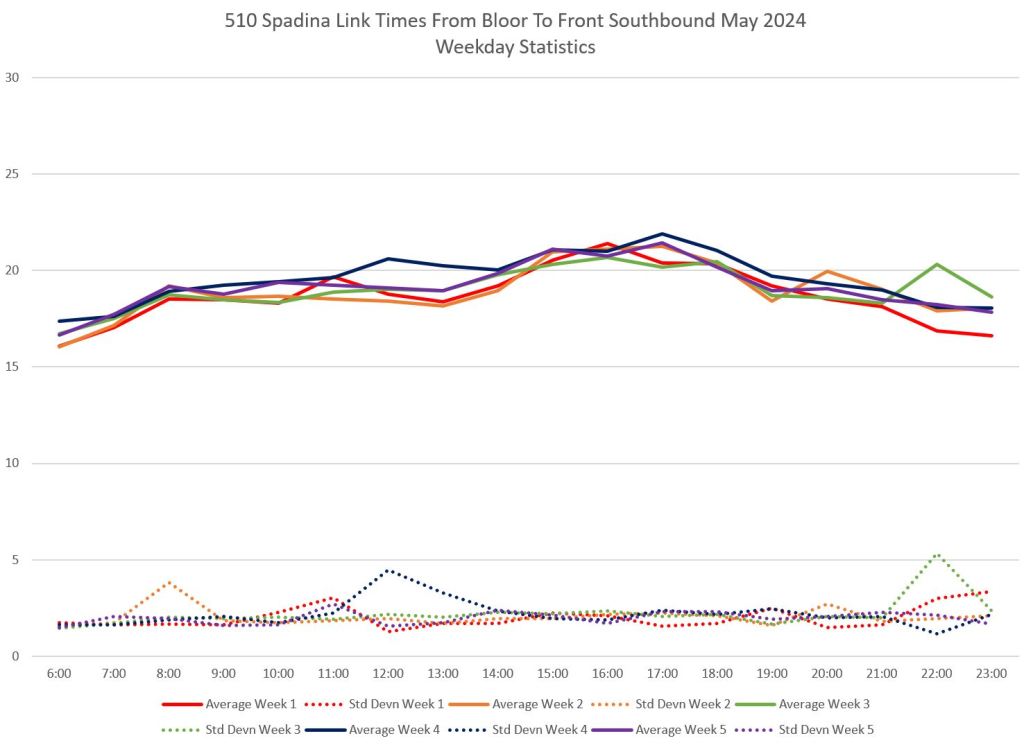
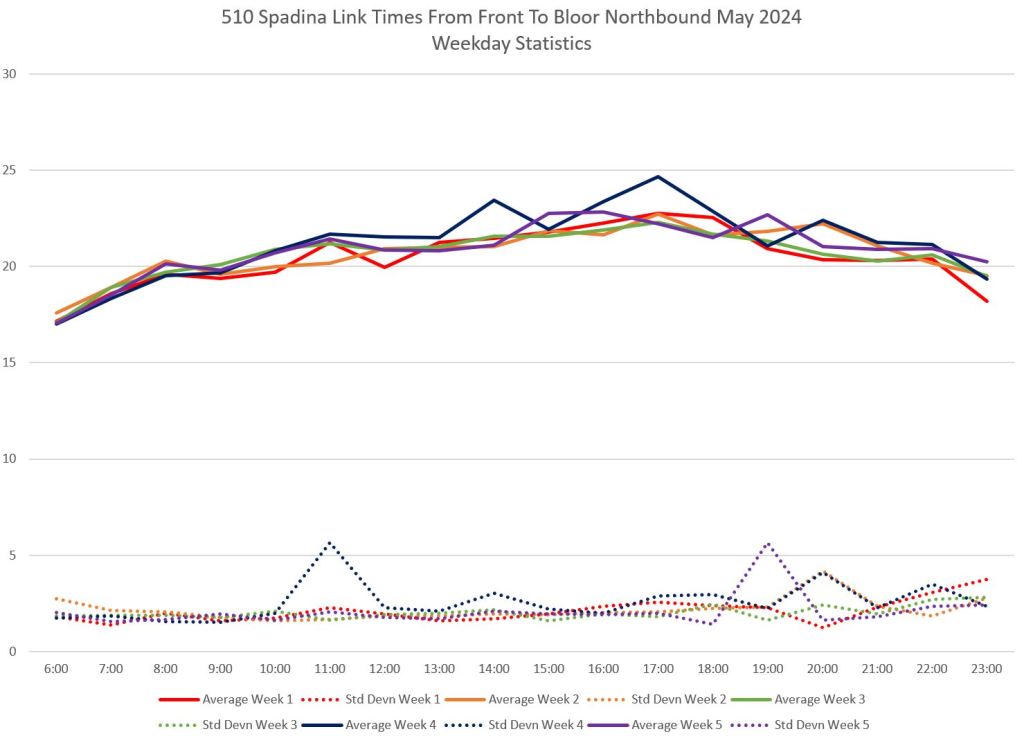
Updated August 11 at 2:20 pm: Charts have been added at the end comparing streetcar travel times over the central portion of the Spadina route in September 2014 and May 2024. The differences reflect both loading times, acceleration and operating practices of the former CLRVs compared to the current Flexitys,
Introduction
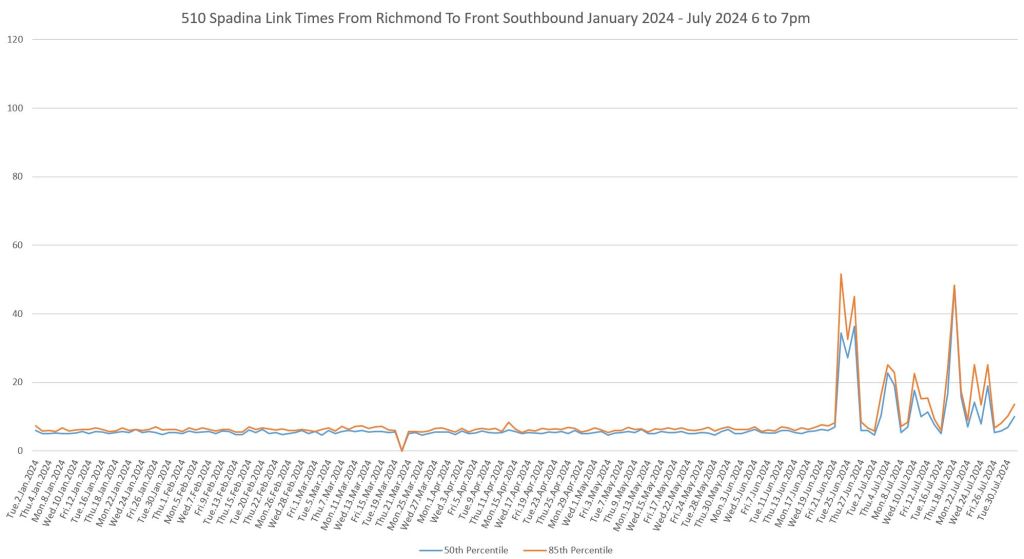
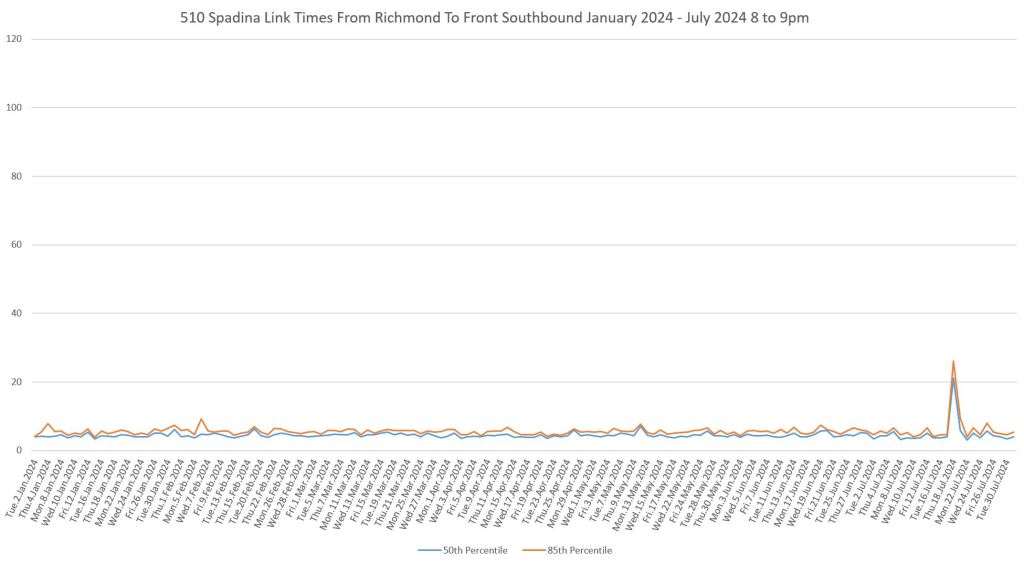
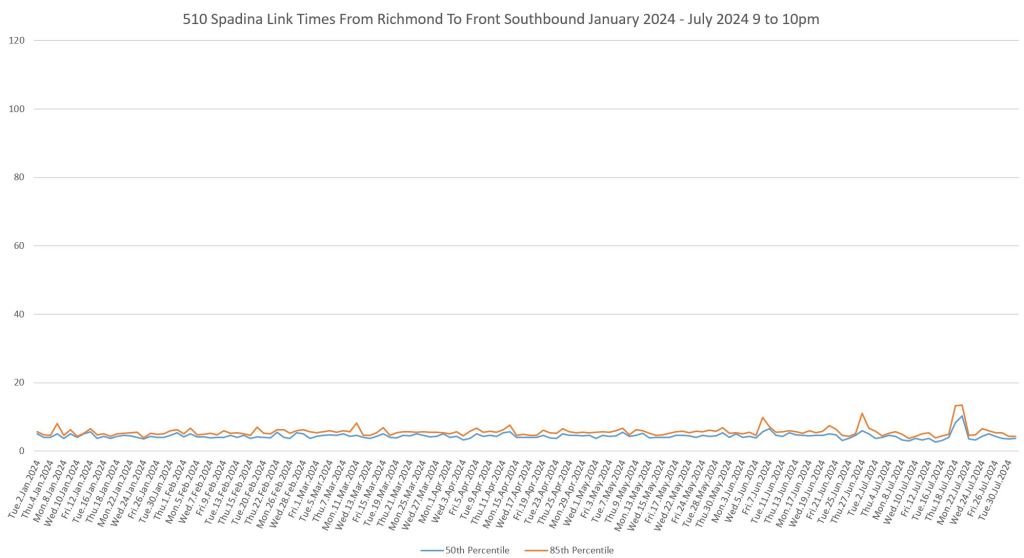
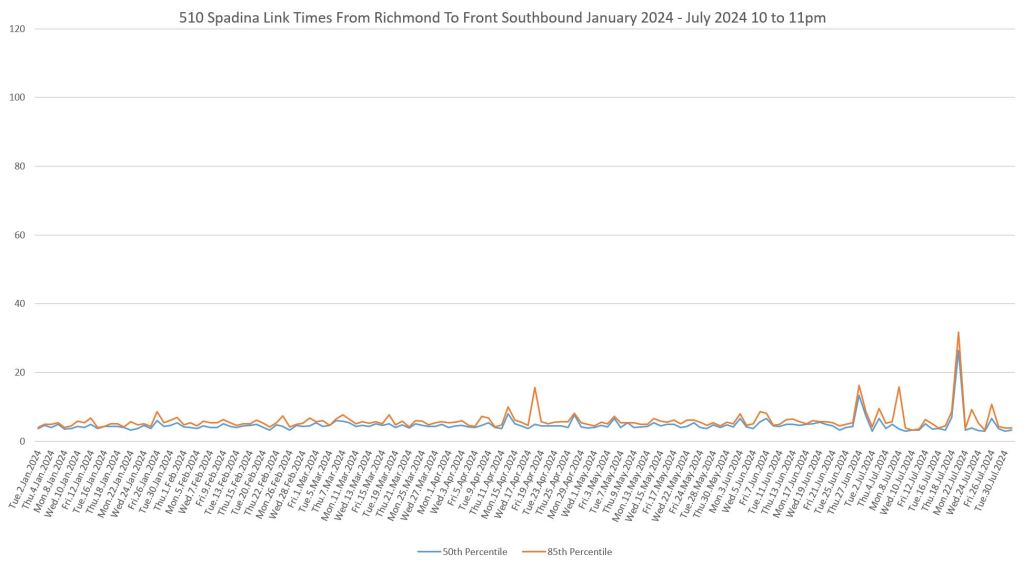
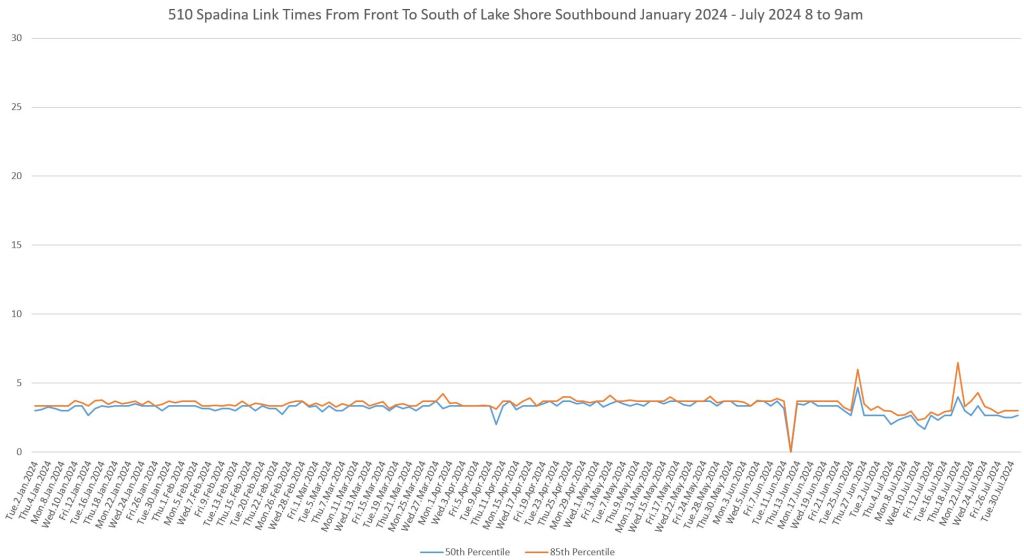
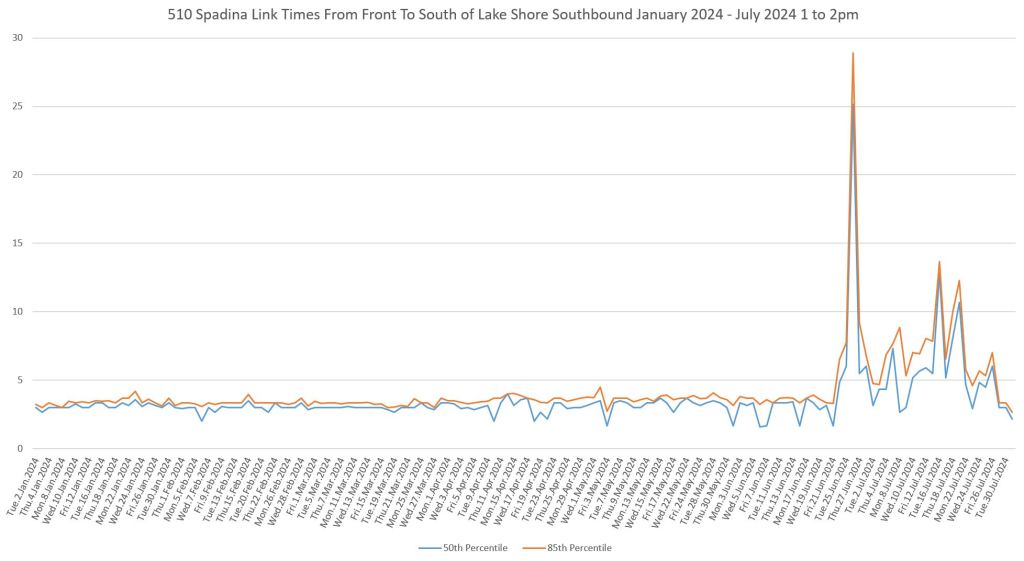
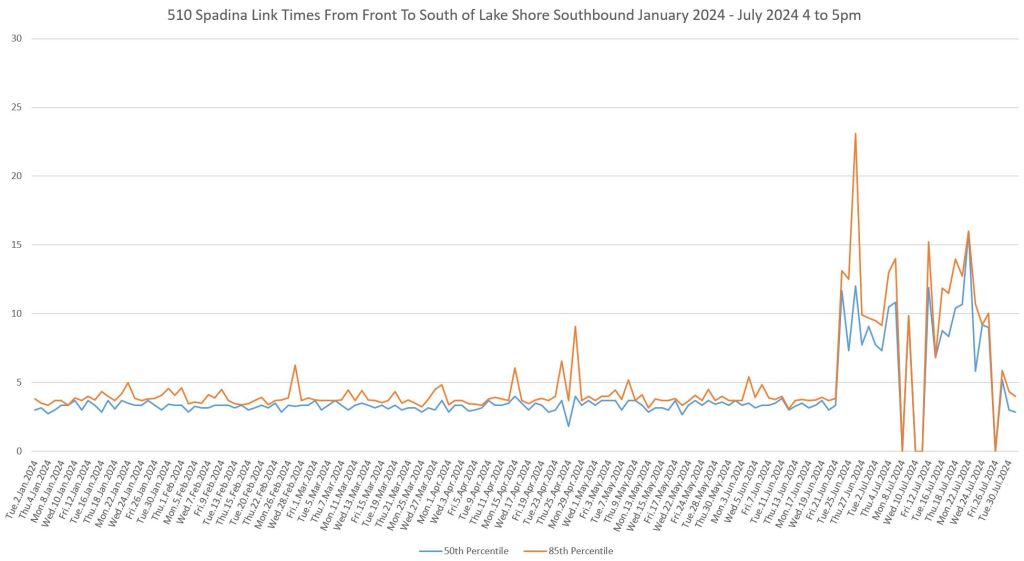
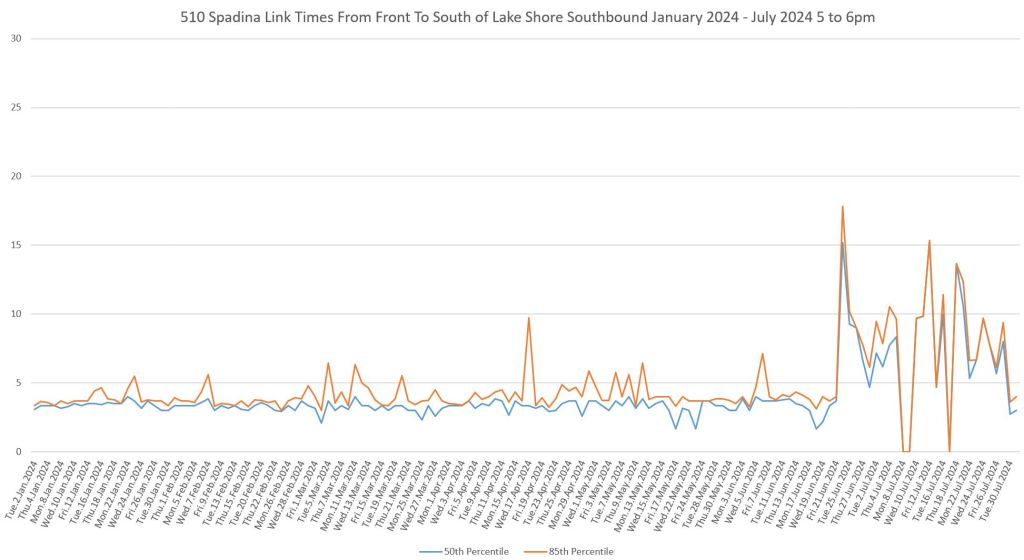
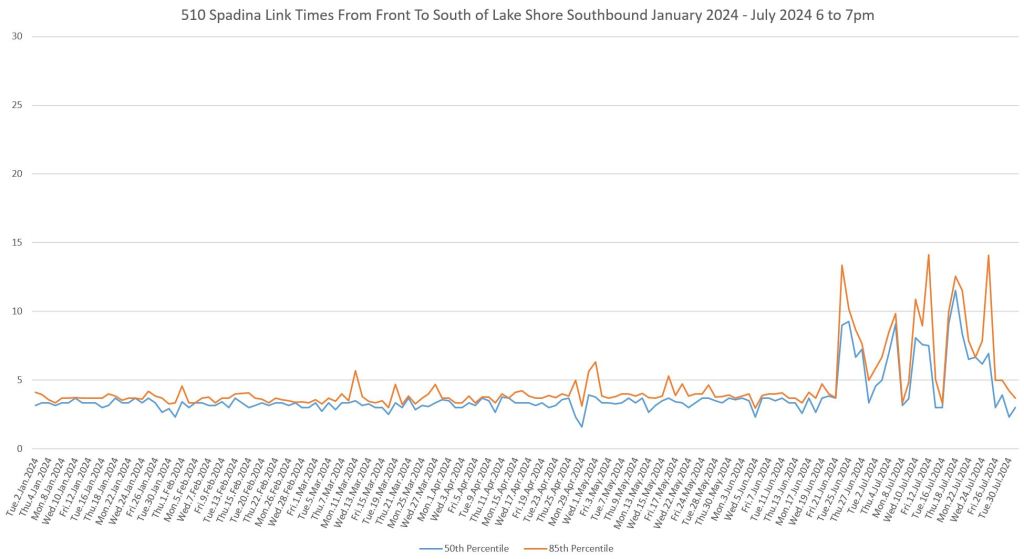
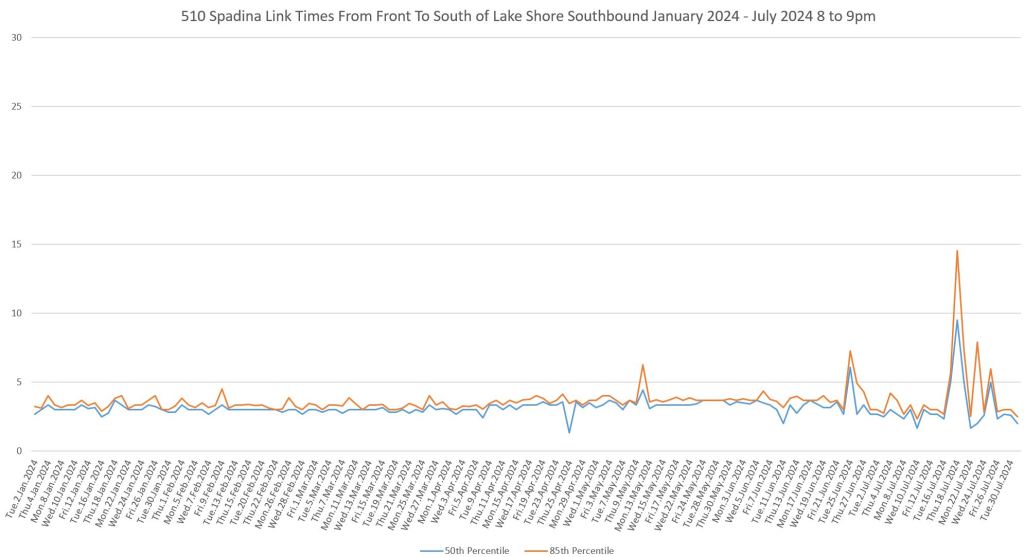
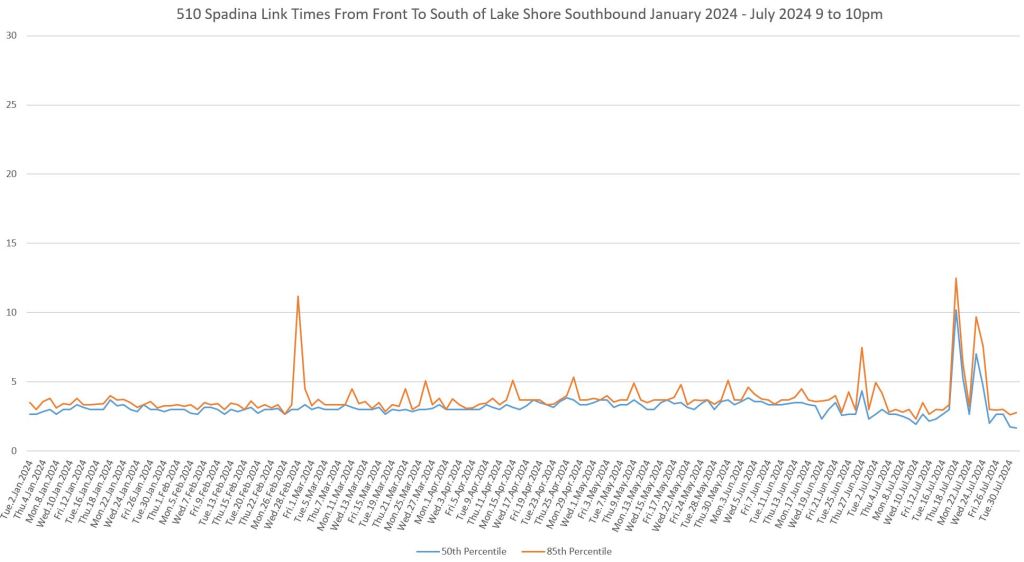
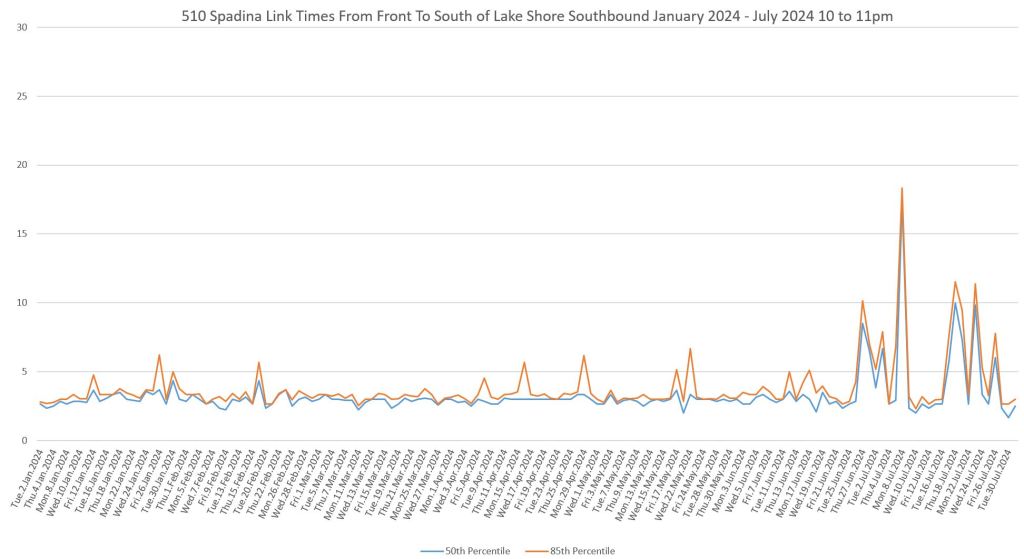
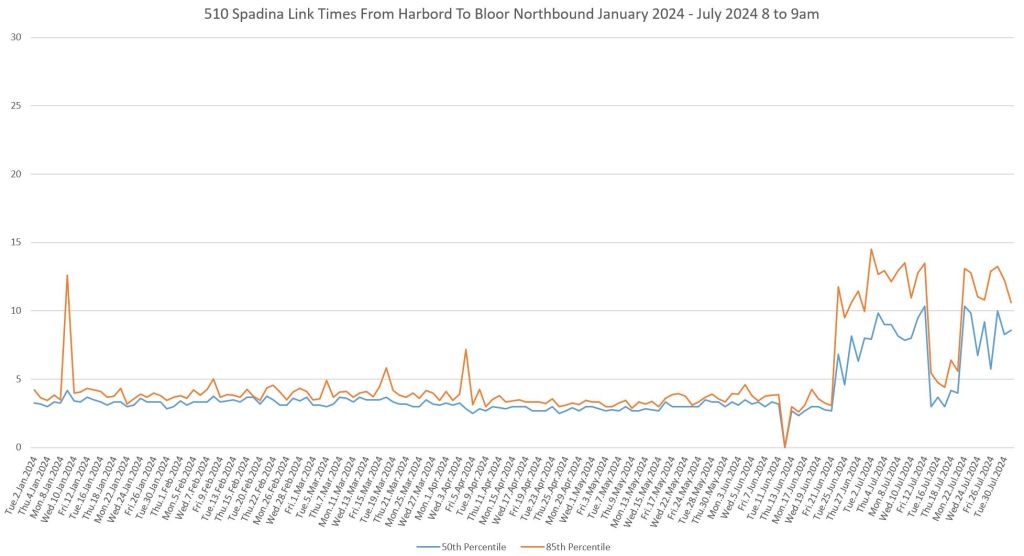
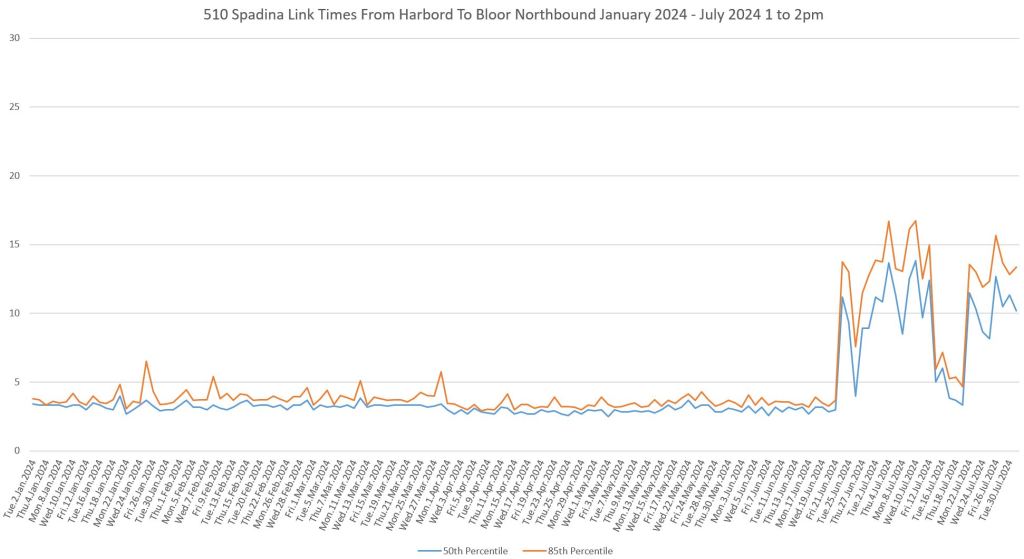
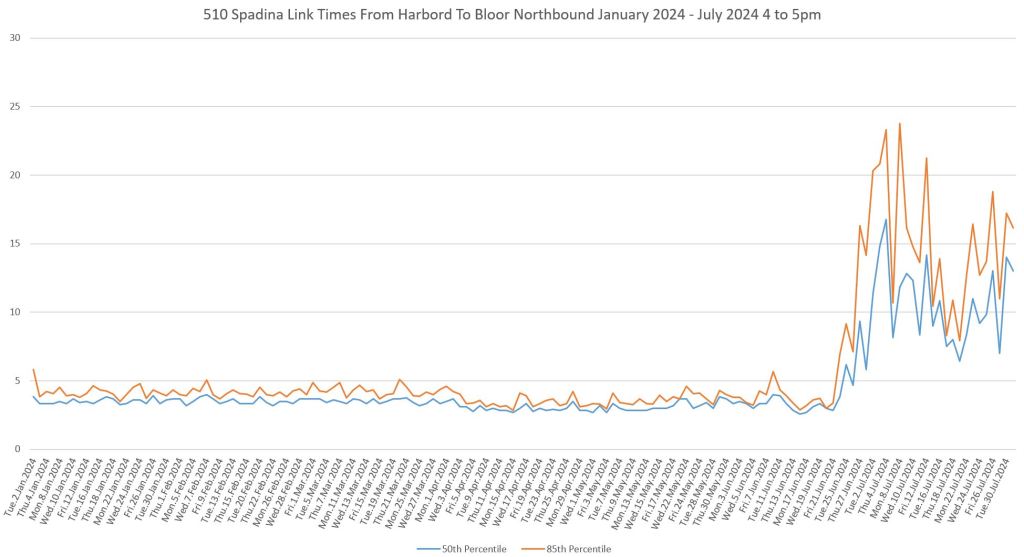
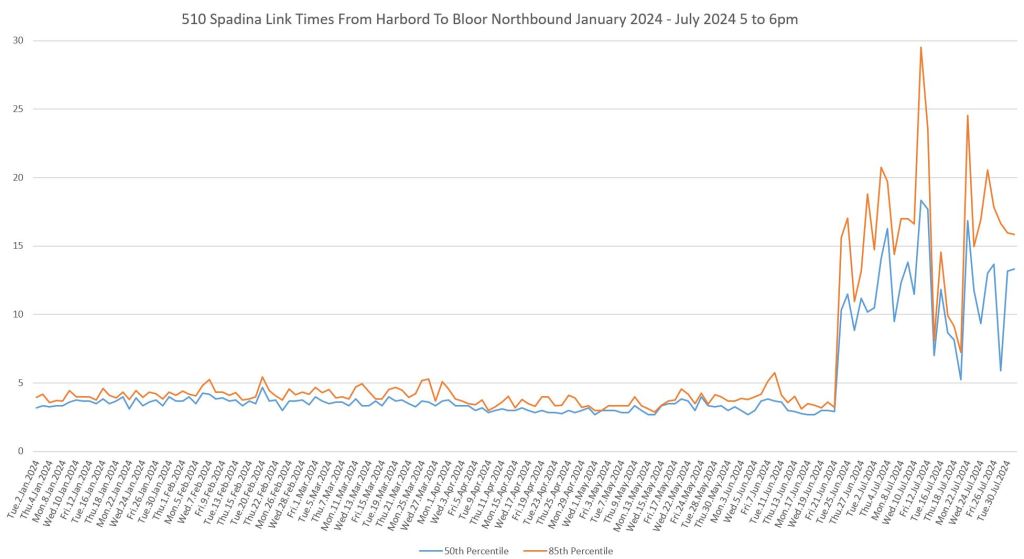
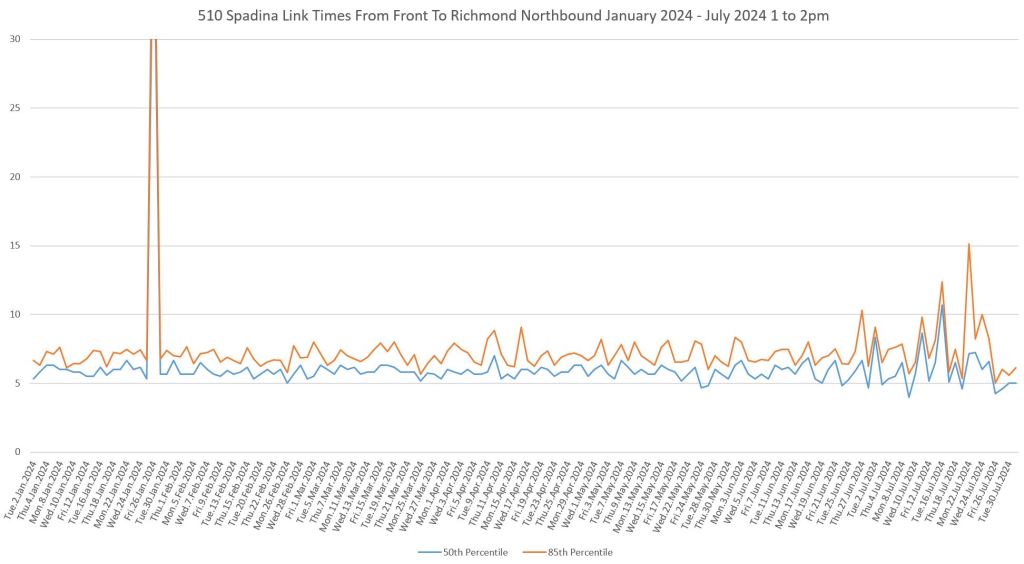
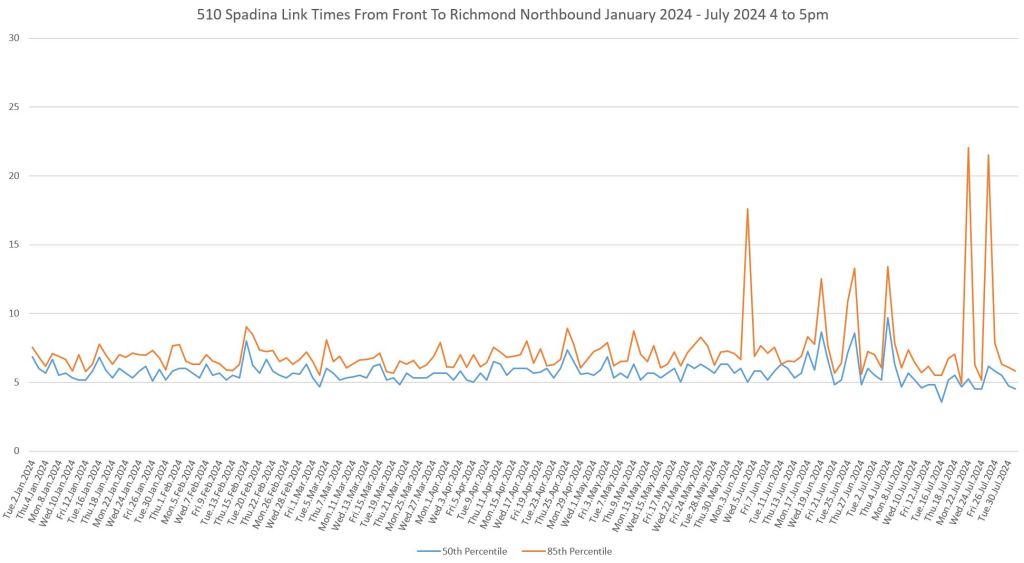
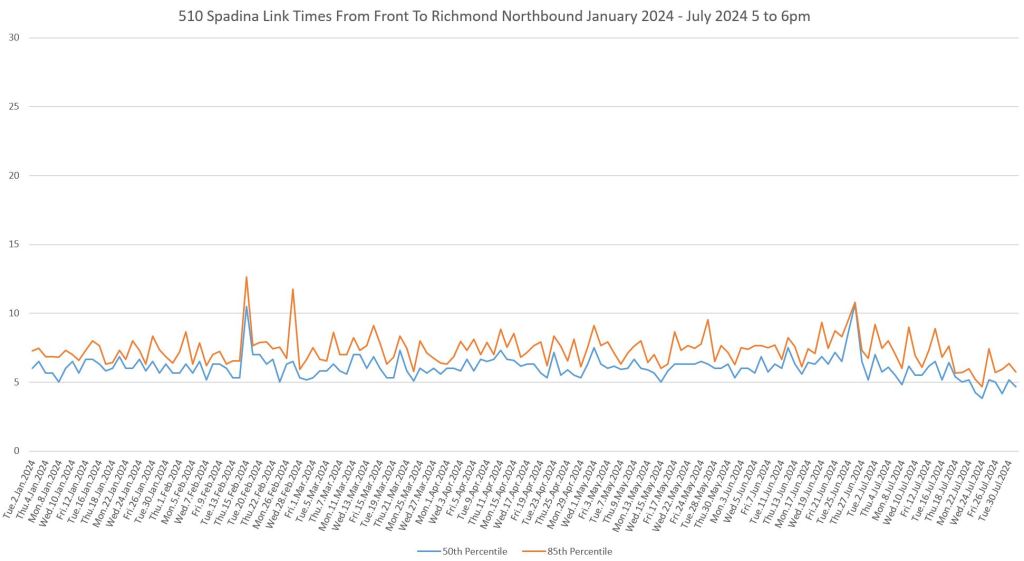
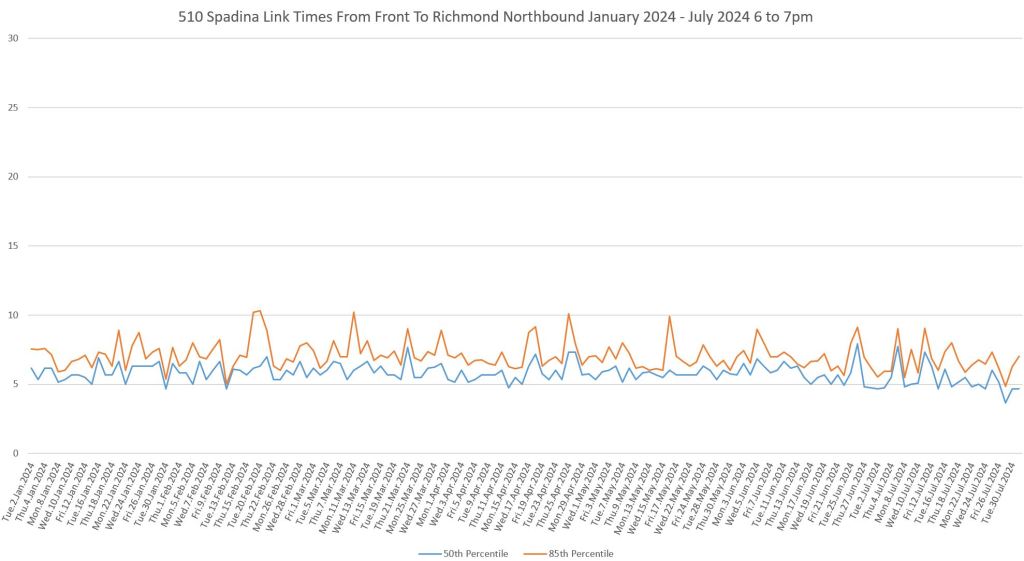
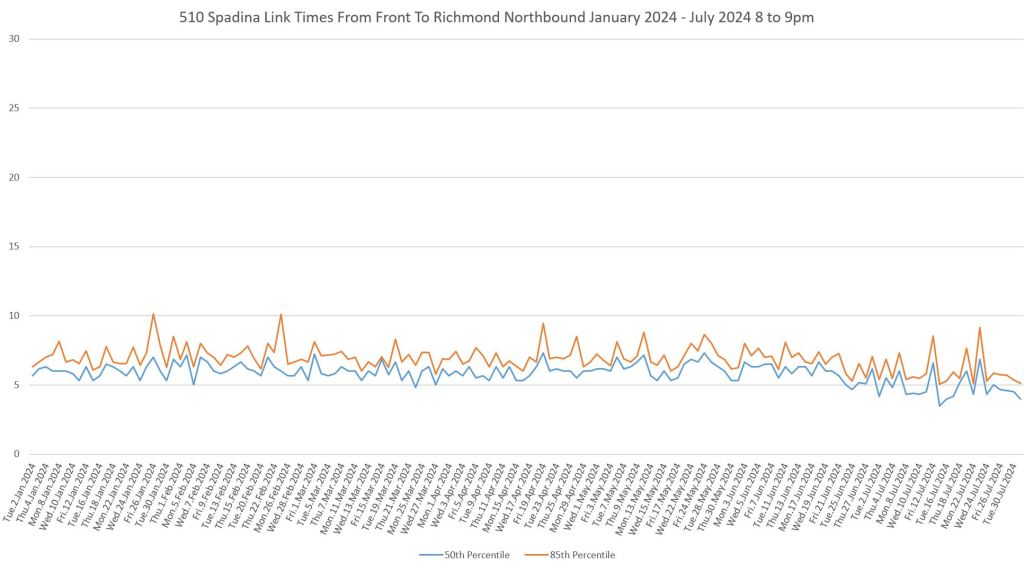
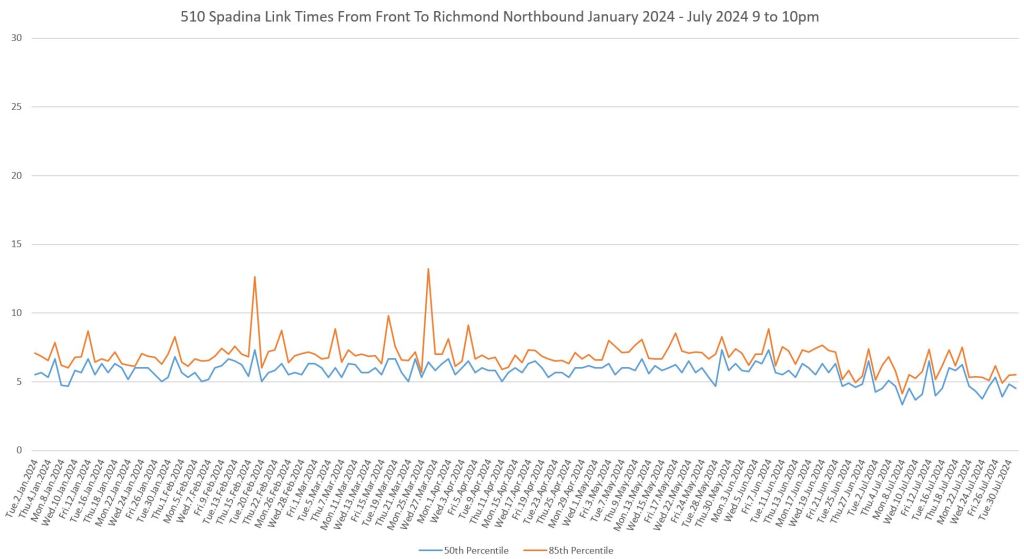
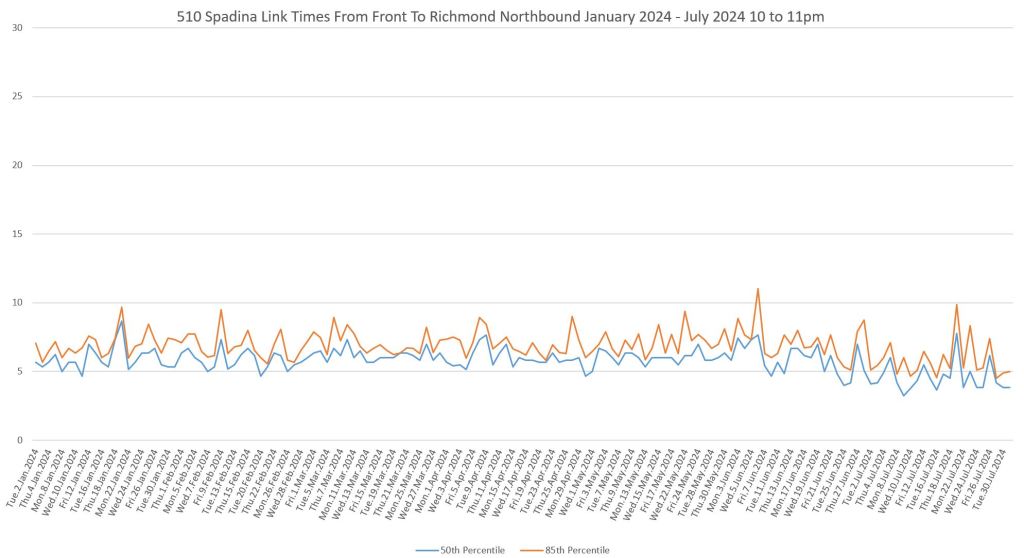
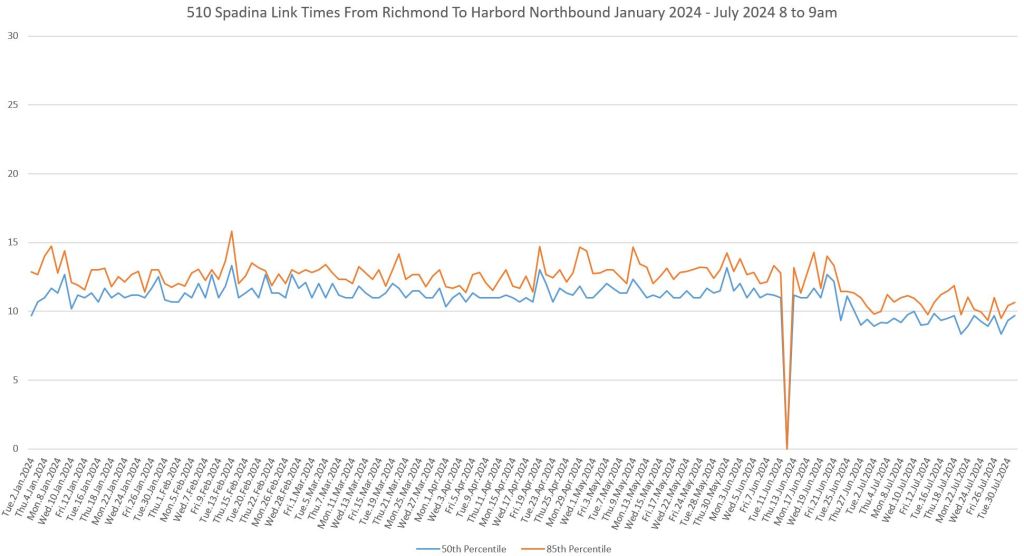
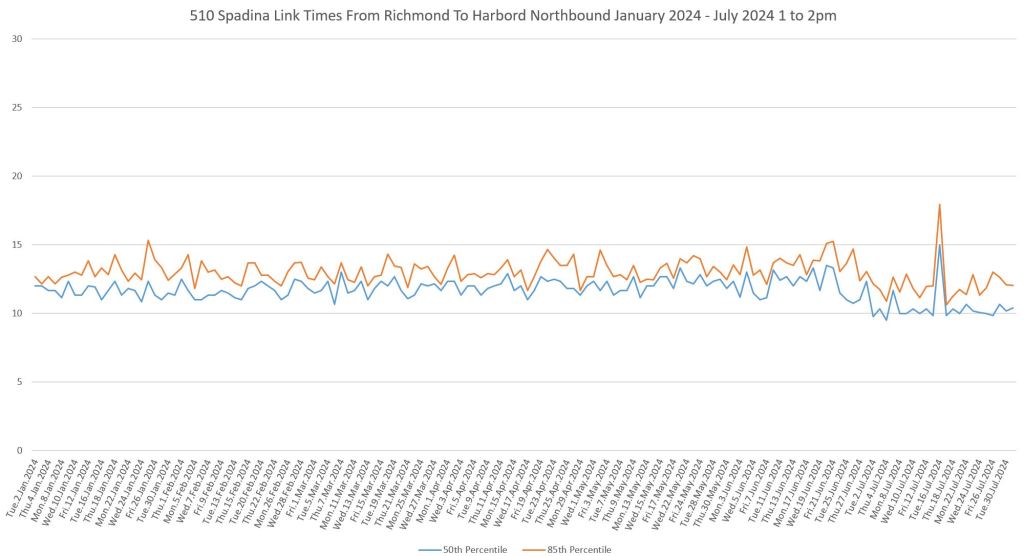
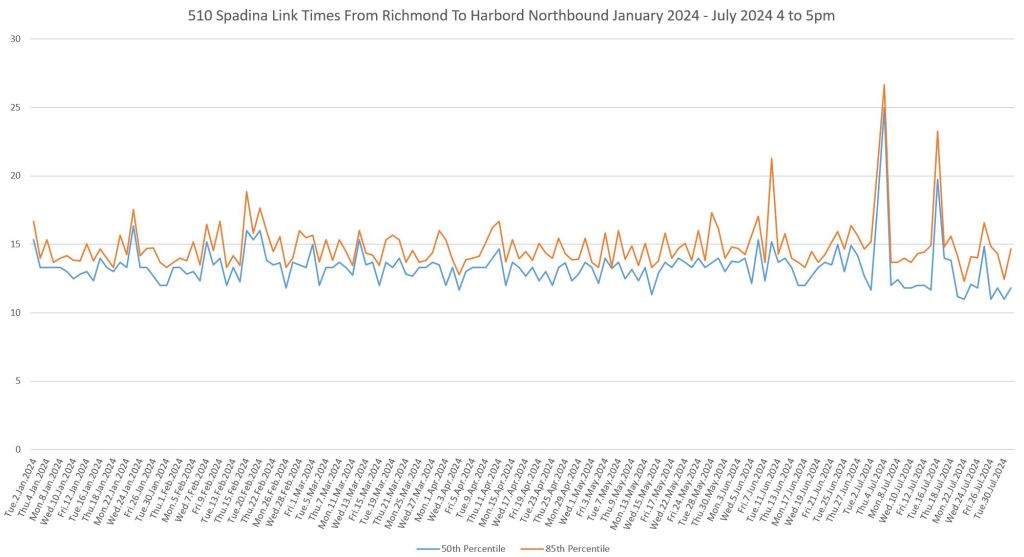
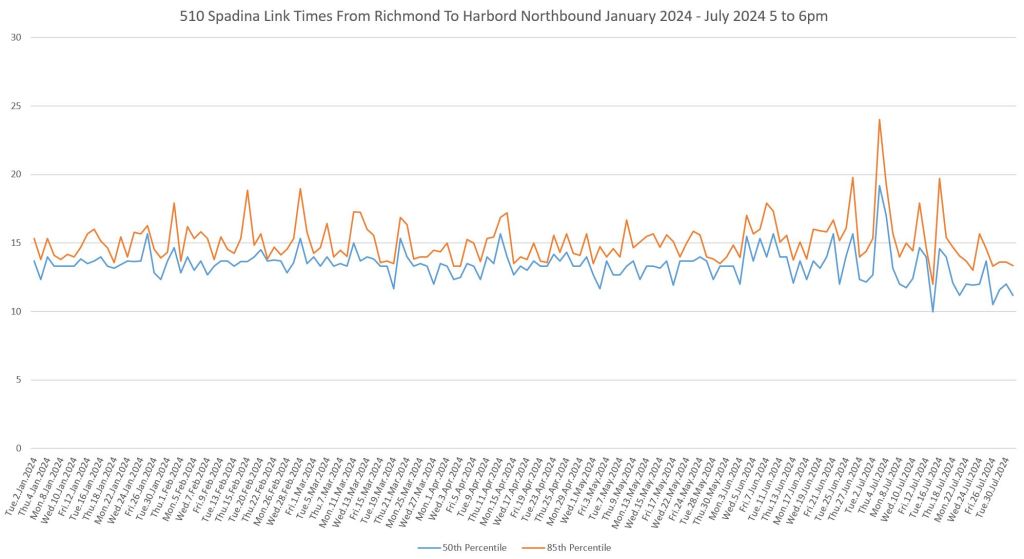
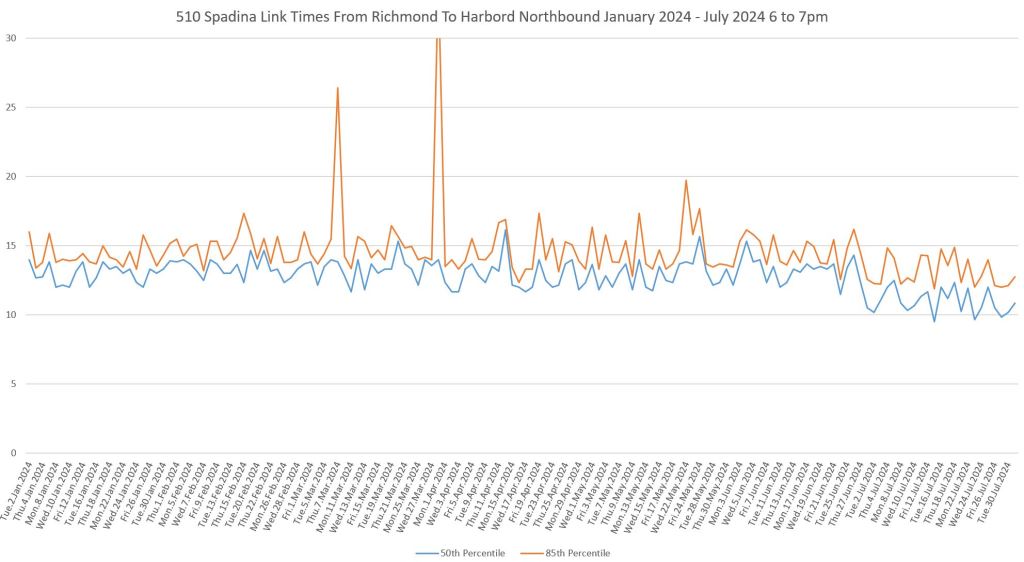
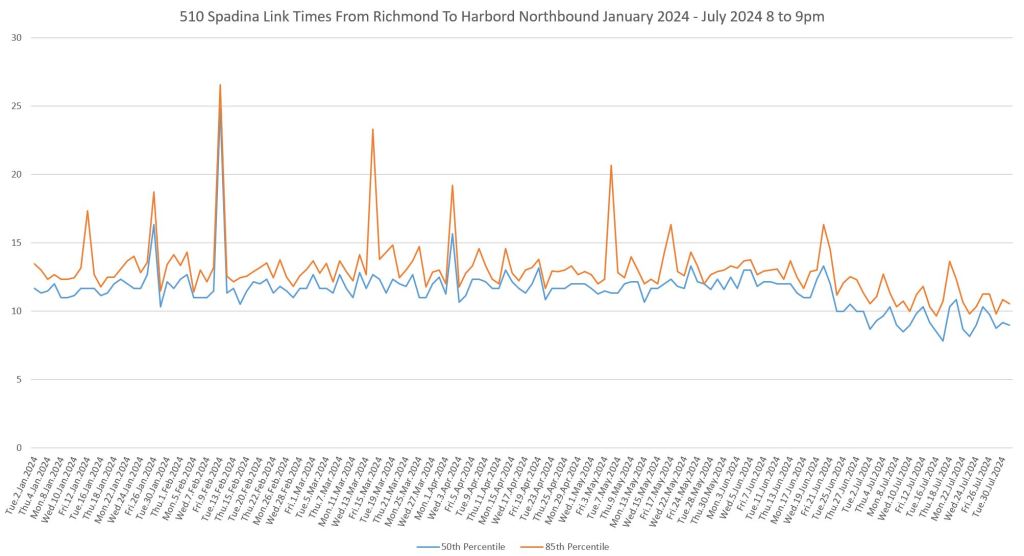
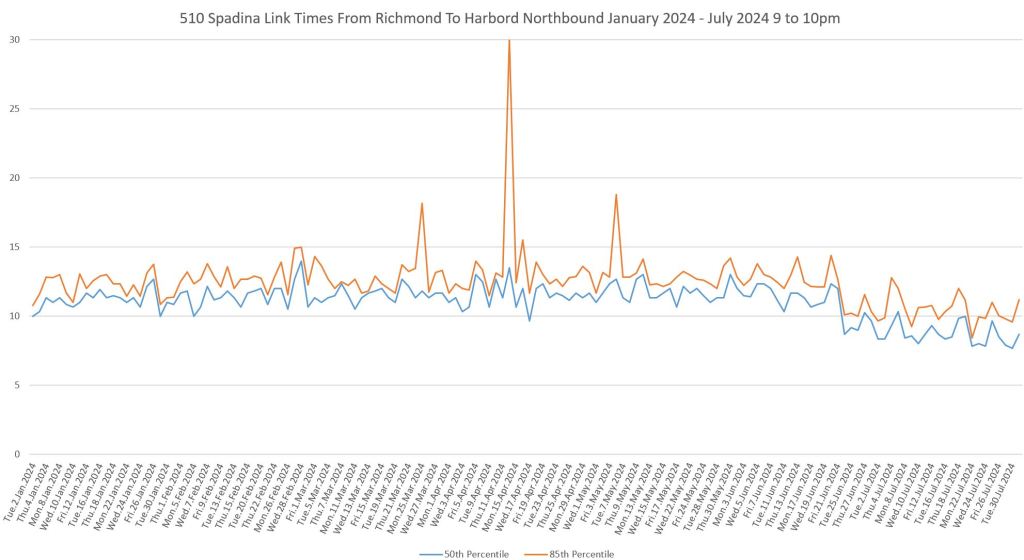
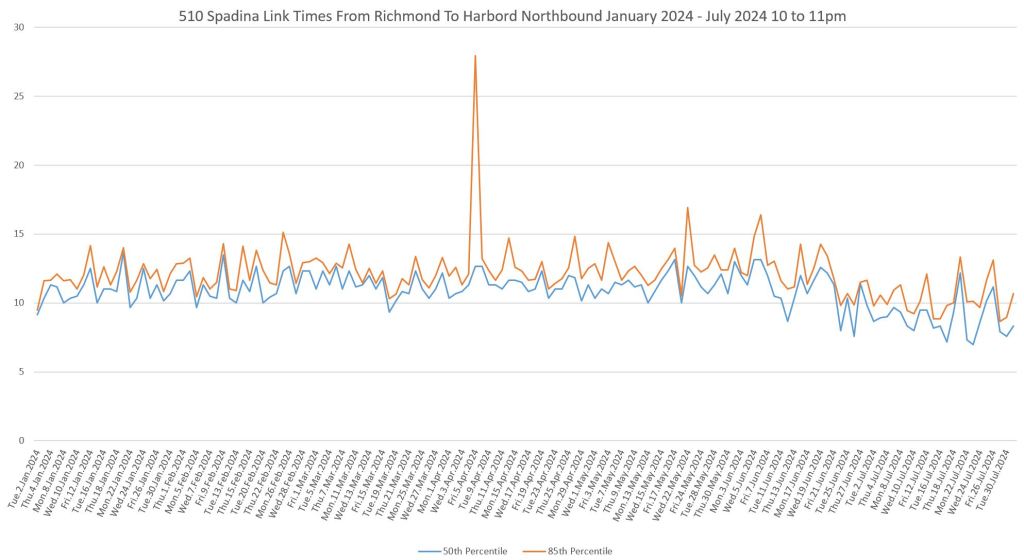
The charts which follow are in a format regular readers have seen before. For each weekday in 2024, the travel times of vehicles are broken out by hour with median and 85th percentile values shown in blue and orange respectively.
- Data are shown for 8-9am as representative of the AM peak, 1-2pm for midday. The PM peak is shown for the three hourly intervals from 4-7pm, and the mid-to-late evening by the intervals from 8-11pm.
- The 8am values drop to zero on June 12 because data for this period are not available.
- June 23 was the first day of bus operation, and the reserved lane was implemented one month later in the week of July 22.
Richmond to Front Southbound
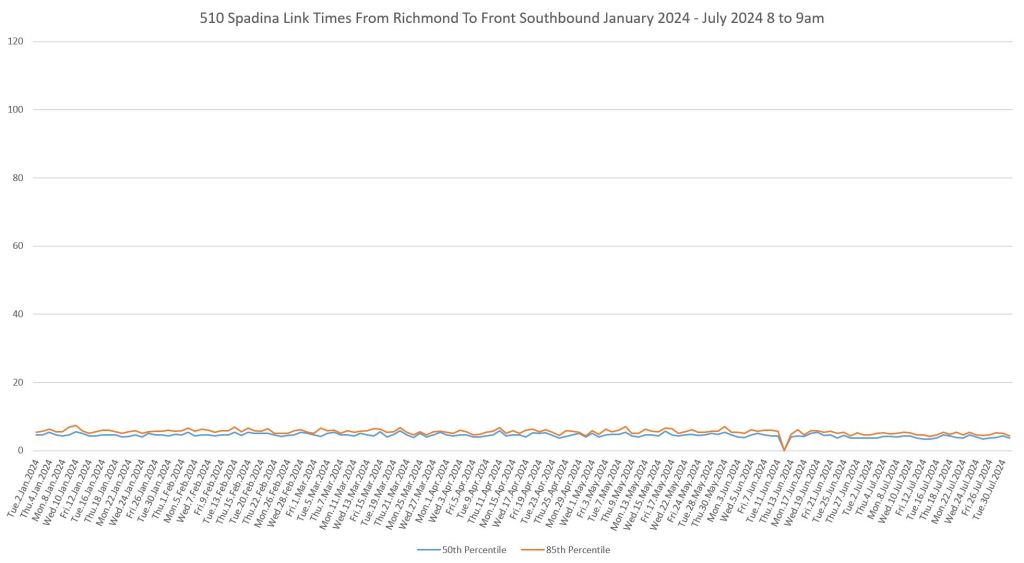
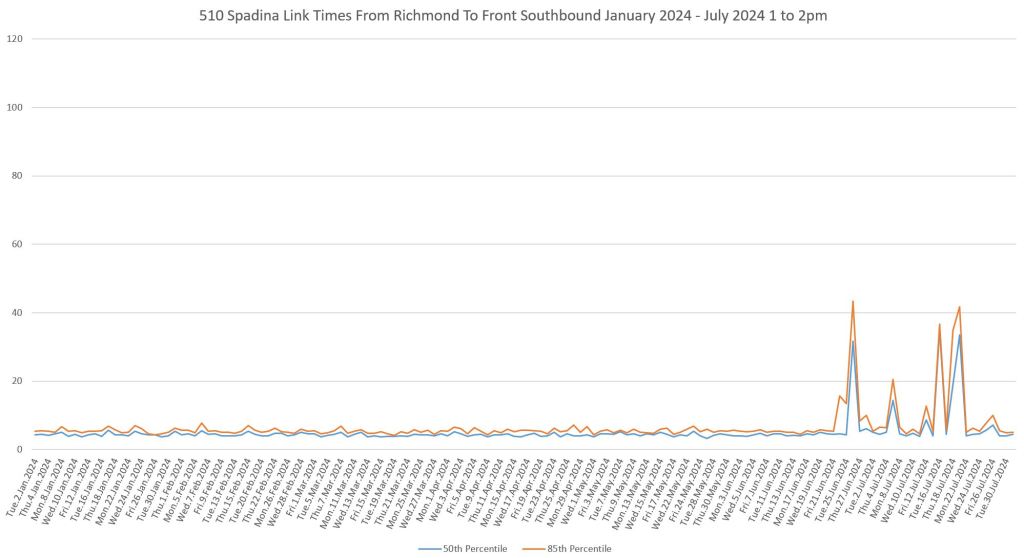
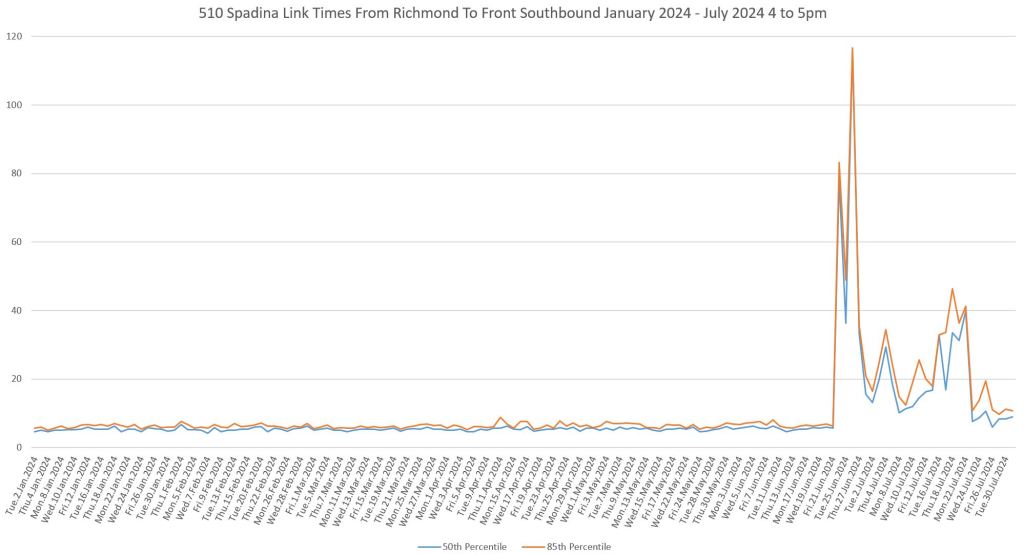
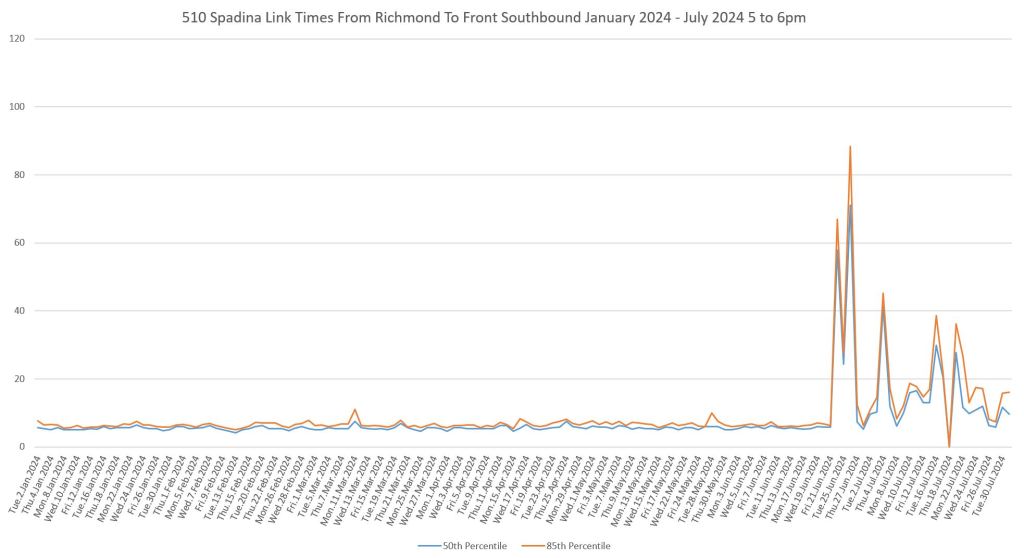
As a review of the problems approaching the Gardiner Expressway southbound, here are the travel time stats between Richmond and Front for 2024. The vertical scale is set at two hours simply to fit in the worst of the data points in the 4-5pm interval.
In the morning, there is no traffic queue, and buses made the same travel time as the streetcars. However, data for 1-2pm shows the beginning of congestion problems with the 85th percentile peaking at 40 minutes. By 4-5pm, the situation is much worse and it dwindles slowly into the evening. Even in the 10-11pm hour, some problems remain.
Notes:
Front to Lake Shore Southbound
Travel times from Front to Lake Shore were also affected by congestion at the Gardiner with times peaking at half an hour early in the bus operation. Once the short turn via Front and Blue Jays Way was implemented, most buses did not operate south of Front. In some cases there were none at all over a specific hour and this causes zero values on the charts.
The maximum value for these charts is 30 minutes.
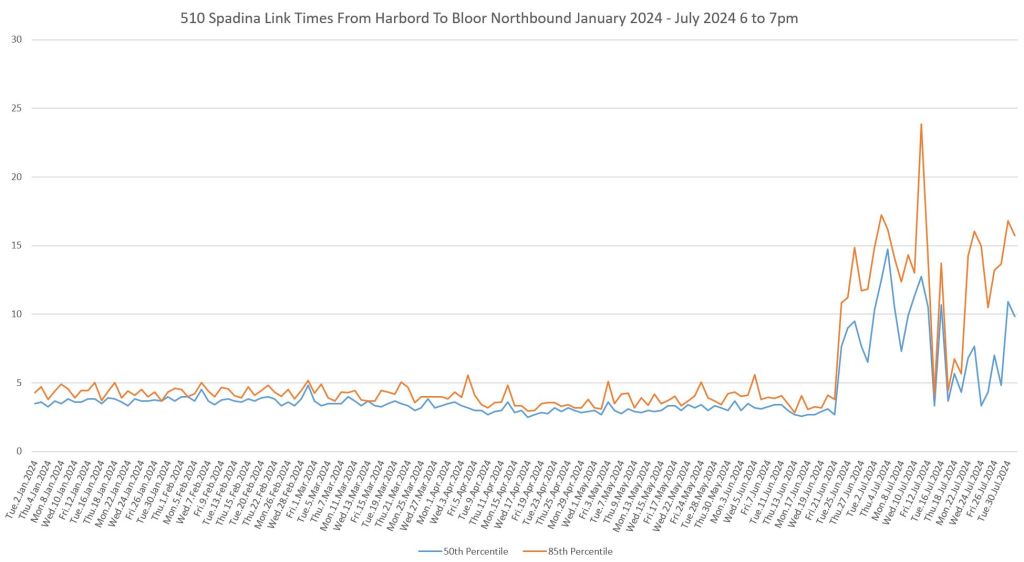
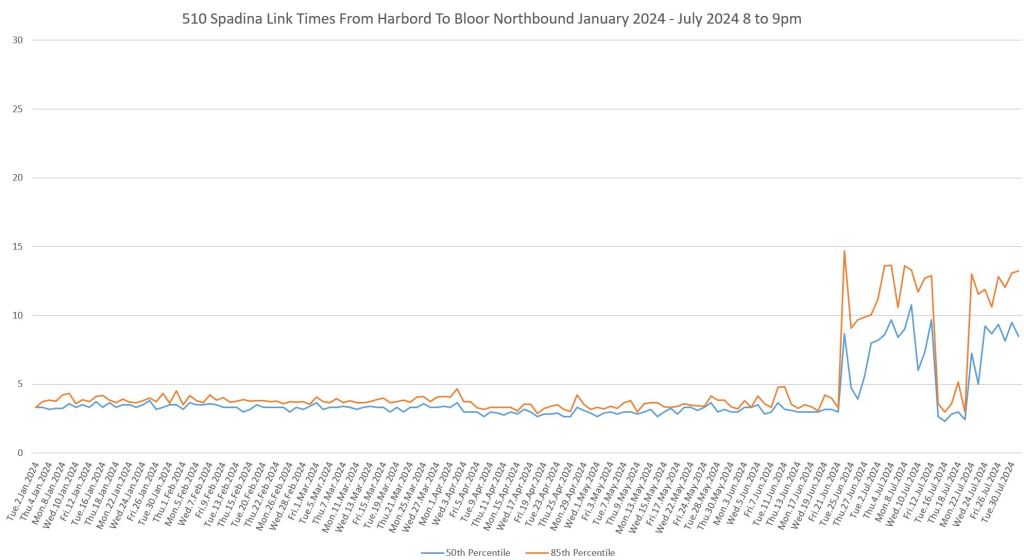
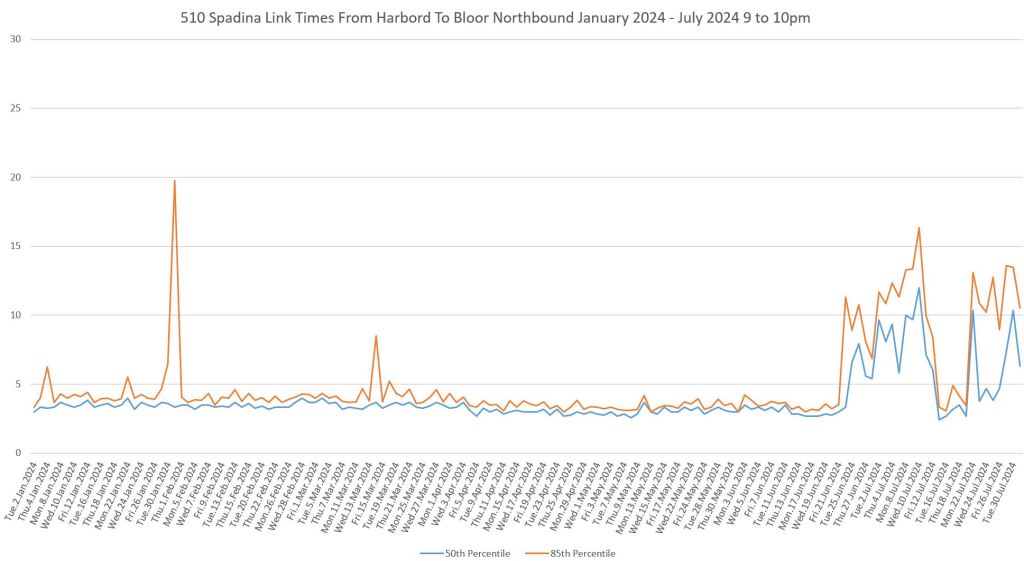
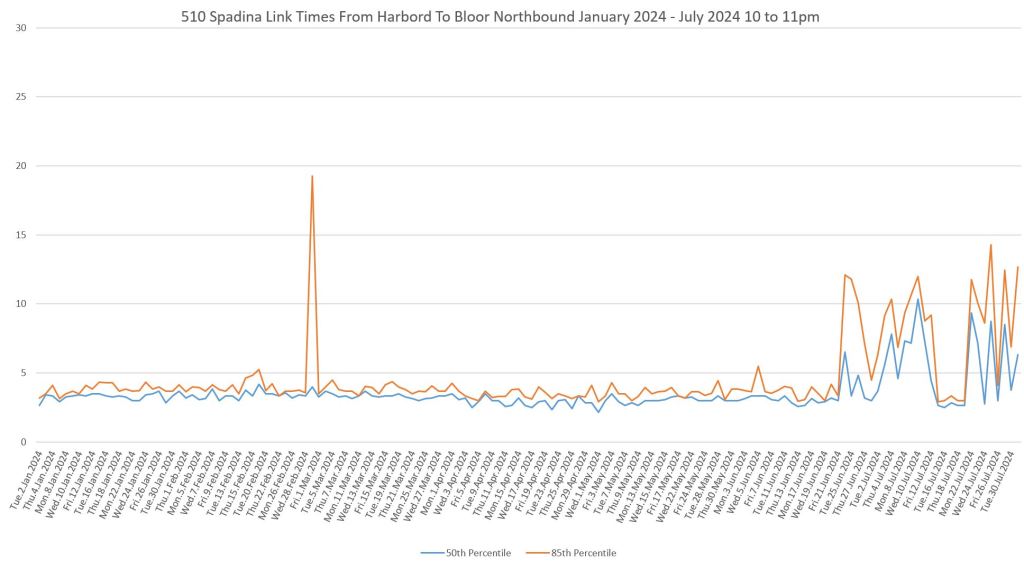
Harbord to Bloor Northbound
Travel times northbound from Harbord to Bloor were affected both by road construction on Bloor and by buses queuing to enter the station. For the week of July 15, buses diverted to St. George Station via Harbord. There was no congestion on this route, and if buses had extra time, they were able to lay over north of Bloor on the around-the-block loop at the station.
The screenline for Bloor Street is located on Spadina except for the week of July 15 when buses diverted to St. George Station. For that period, the screenline is at Bloor and St. George so that the entire loop route is north of the line.
The maximum value on these charts is 30 minutes.
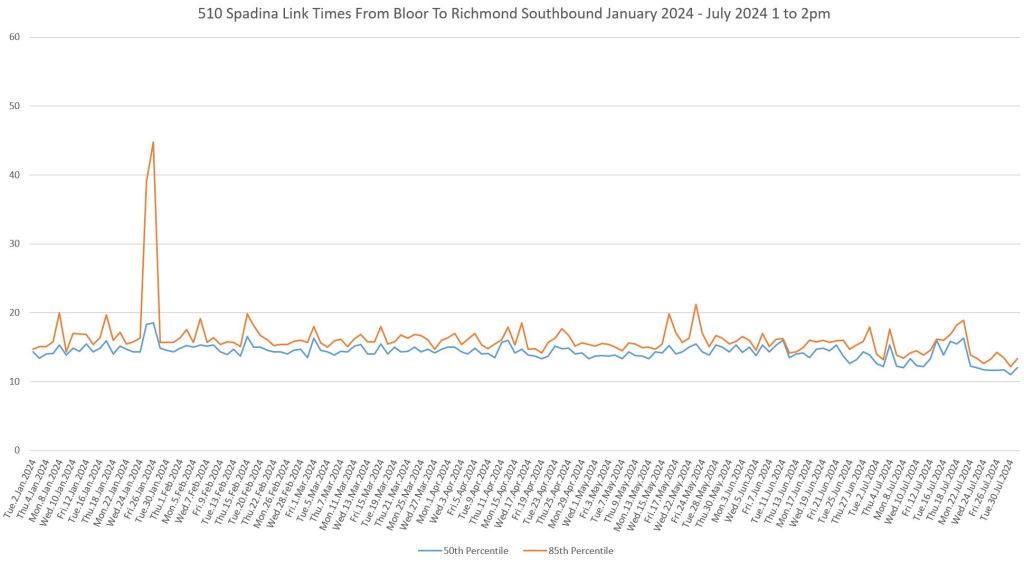
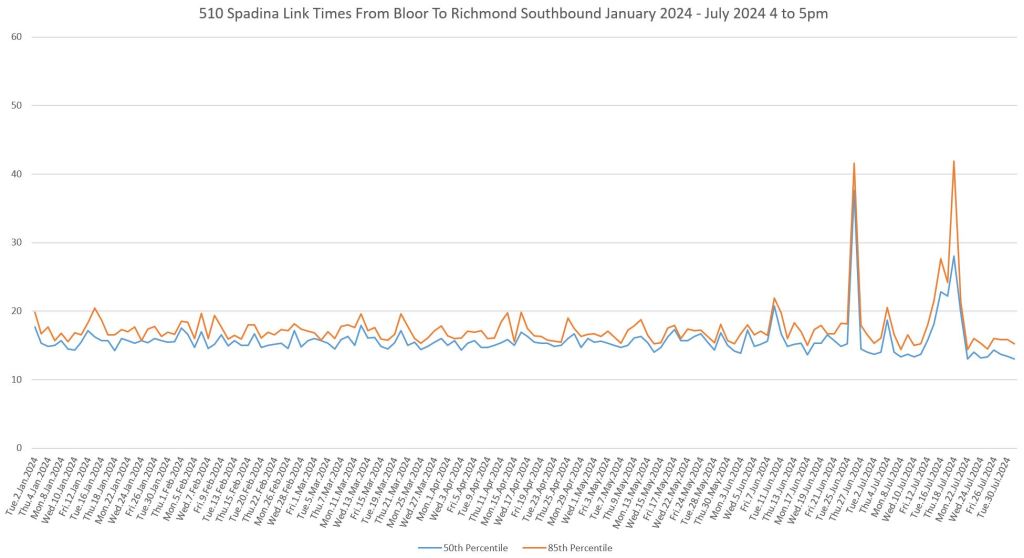
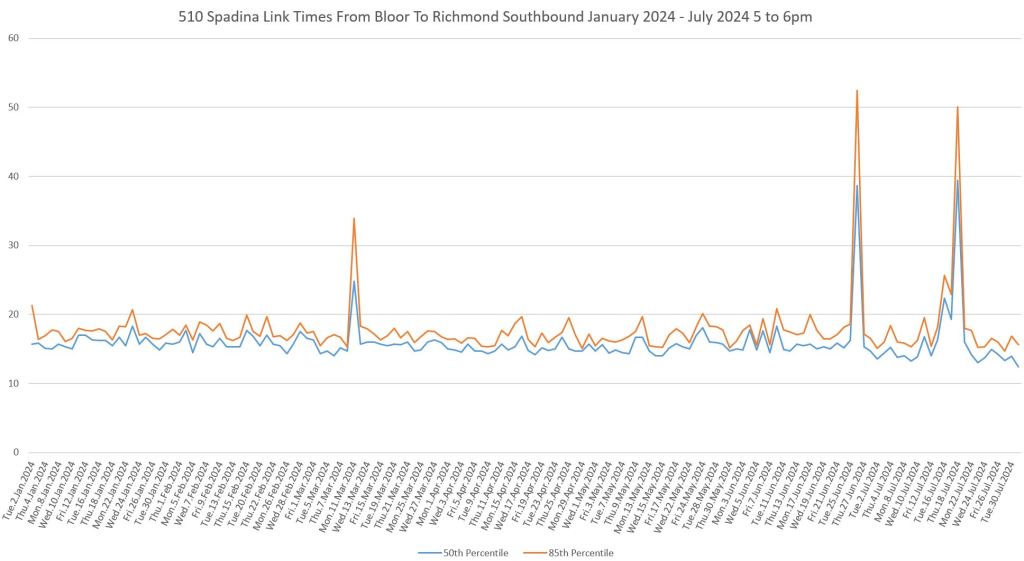
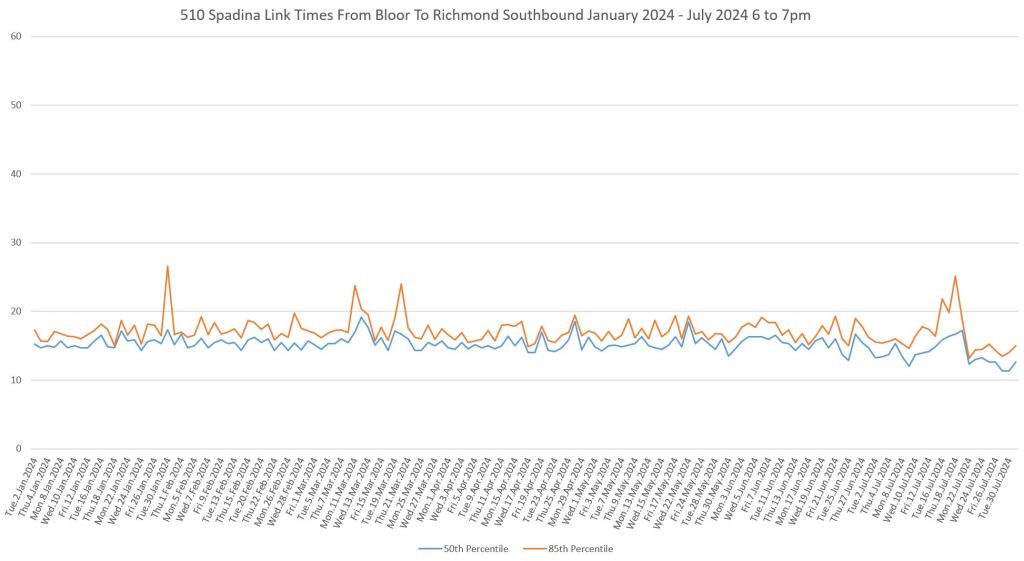
Bloor to Richmond Southbound
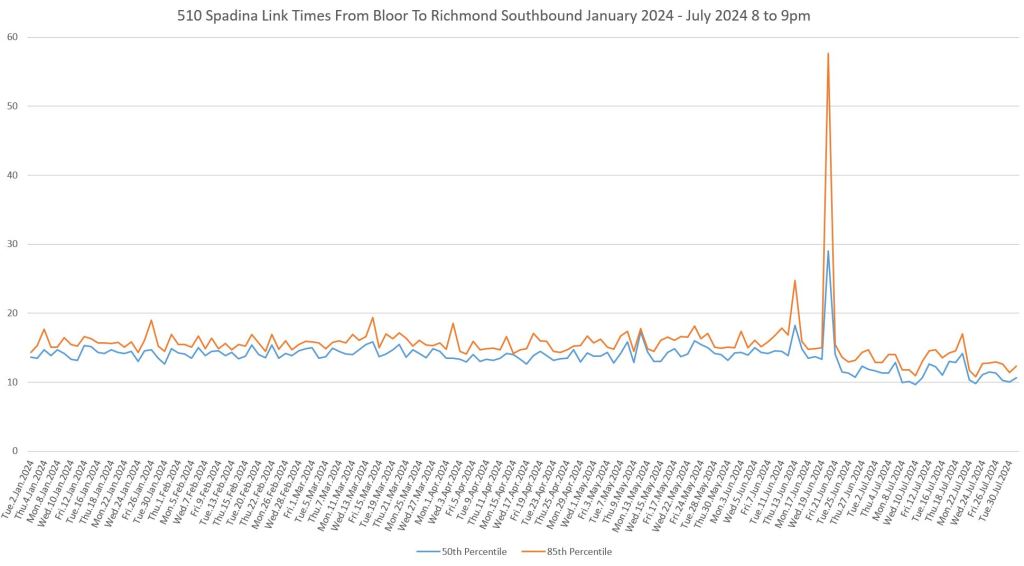
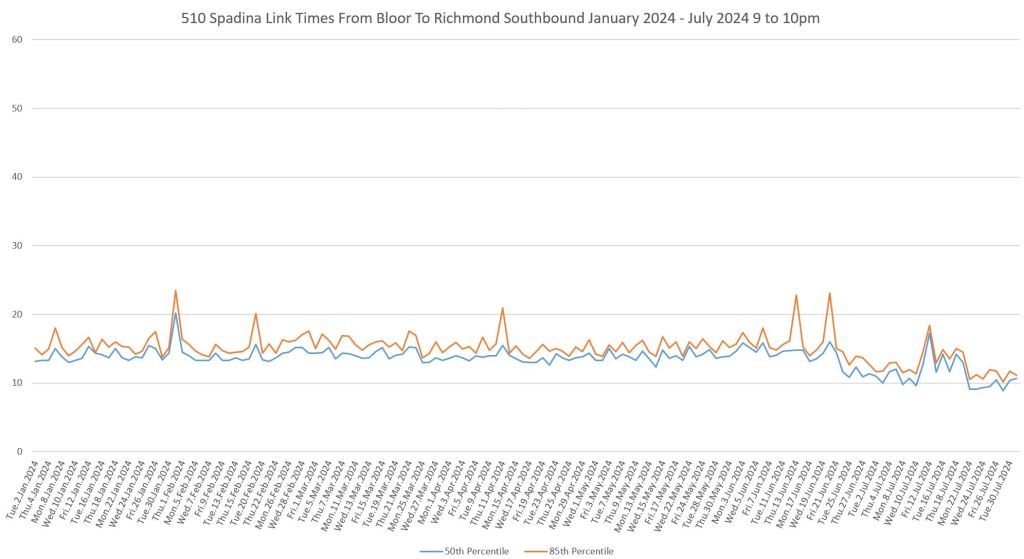
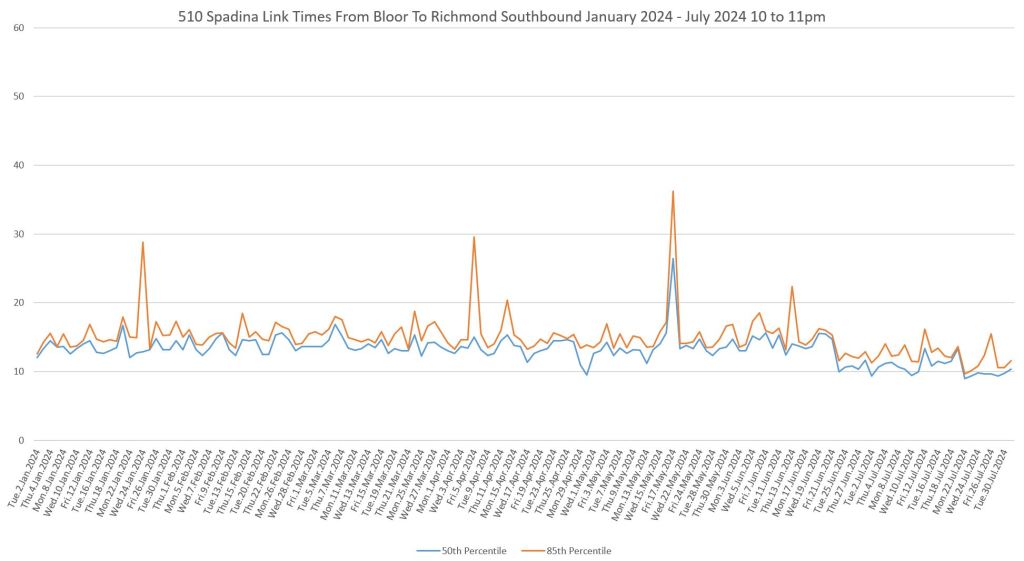
The southbound route from Bloor to Richmond encountered comparatively little congestion while operating with buses in the morning and midday. Of particular interest is the clear drop during off hours for bus travel compared to streetcars on the right end of the charts particularly evident in the evening. During other periods, bus travel times in mixed traffic are comparable to streetcars with “transit priority”.
Note that travel times are higher in the week of July 15 because of the extra length for the St. George diversion.
The maximum value shown on these charts is 60 minutes, and the spikes show a substantial increase in travel times on specific days.
- June 20: A delay held service southbound at Sullivan Street in the 8-9pm interval
- June 26: The congestion on Spadina was so bad that it backed up to north of Queen Street and therefore affected the Bloor-Richmond travel time values. A detailed chart is in my previous article on June operations.
- July 16: This was the day of heavy rainfall and flooding.
- July 18: This day saw extreme congestion which, as on June 26, backed up north of Richmond and affected travel times for this segment.

Front to Richmond Northbound
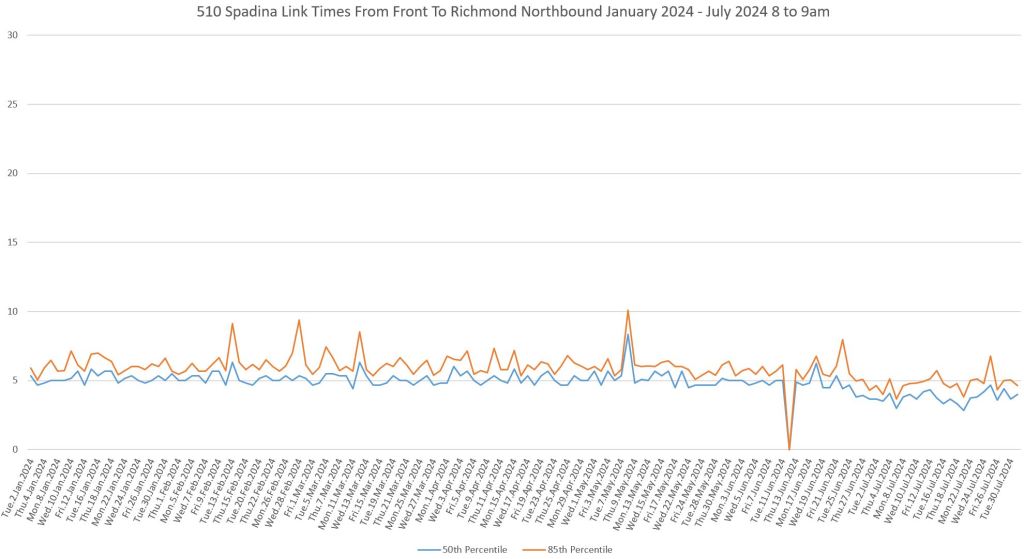
Although this segment of the route was plagued by traffic backups southbound, northbound times were much more reliable except in the PM peak. There is a small decline in bus travel times relative to streetcars mainly in the evening.
The maximum value shown on these charts is 30 minutes.
Richmond to Harbord Northbound
Northbound travel times from Richmond to Harbord shows some spikes in the afternoon peak, but otherwise the values are constant from day to day and lower than streetcar times in most periods.
The spikes in travel times in July are on days when the backlog south from Bloor extended south of Harbord and contributed to the Richmond-Harbord values.
The maximum time shown here is 30 minutes.
September 2014 vs May 2024
For comparison, here are the weekly average travel times between Bloor and Front for September 2014 (CLRV operation) and May 2024 (Flexity operation). Travel times in 2024 are considerably higher than in 2014.
 Steve Munro
Hi Steve
One of the issues I see & experience on the 510 Spadina, is the lack of consistency of where the buses are picking up/dropping off people using mobility devices, also people who are blind/legally blind, are having a horrible time finding the stops.
I do my absolute best to avoid Spadina as much as possible.
The travel times using streetcar are also affected by incompetent route supervision.
LikeLiked by 1 person
Now that Spadina’s track work is being done, would that be an opportunity for the TTC/City to fix some of the switches that cause the Stop&Go protocol along with adding TSP?
Steve: The only track work is within Spadina Station Loop, not the intersections.
I remember in another comment you mentioned that the TTC has to foot the bill for installing TSP enabled intersections, but shouldn’t that be a City-wide project?
Steve: It should be, but it’s not.
I find it frustrating about online discussions on the streetcar is mostly reactionary (particularly on Twitter by a few “big” transit accounts, but I’ve left that site for other reasons) instead of constructive discussions on the issues pertaining to our infrastructure.
Since you’ve been through multiple generations of streetcars, I would really love to hear your perspective on some of the challenges they had to face, and solutions.
Steve: The PCC was designed to run well on track in less than perfect condition, a common situation faced by the street railway industry. They were also designed to be easy to maintain.
The CLRVs had some design flaws thanks to UTDC’s stupidity (provincial bungling goes way back), but they were robust cars. The main problem with their wheels that they were originally spec’d with Bochum wheels which are fairly stiff and designed for resilient track. At the time, the TTC was building track in concrete with no vibration insulation and also with untreated wood ties. The concrete quickly broke up due to vibrations, water got in below ad rotted the ties. The cars were also noisy. The wheels were all changed out to SAB wheels which are similar to PCC wheels, but the damage had been done.
Both PCCs and CLRVs could run through intersections without slow orders.
When the Flexitys were being procured, the Project Manager flagged the need for better track maintenance. (The smaller wheels have less flange area in contact with rail on curves, and are less forgiving of worn track.) On top of this, the new switch electronics that were installed to deal with the longer ALRVs were never reliable. The project to replace them had low priority, and the “fix” was a go slow order. Replacement is still underway, and the ALRVs are now retired.
It’s a long history of bad choices, cobbled-together fixes and low priority to streetcar system integrity. For a time, this seemed to be confined to the surface network, but as we have learned, the rot set in on both the SRT and the subway network thanks to maintenance cuts.
Many CEOs had a hand in this decline, but it seems to accelerated under Leary who was content to balance the budget for John Tory and hope that nothing critical broke. That’s not quite how it worked out.
Thanks again Steve, I hope you had a wonderful weekend.
Steve: You’re welcome!
LikeLiked by 2 people
When you say “different stopping patterns”, are you referring to near-side stops for buses versus far-side for streetcars?
Steve: Yes. The buses stop once both for the traffic signal and to serve passengers. The streetcars often stop twice, once nearside and once farside.
LikeLike
> Steve: The buses stop once both for the traffic signal and to serve passengers. The streetcars often stop twice, once nearside and once farside.
Steve, earnest question: have you done analysis on this? Anecdotally I always want to comment that it’s also common for a vehicle to pull up to a nearside stop with a green signal, stop for passengers, then lose the green as the doors are closing, and the vehicle has to wait the entire duration of the red light. (Of course optimally this would be prevented by transit priority signals, but…)
I feel like it happens at least once per trip on every eastbound 504 I’m on. But I don’t know how common it is in absolute terms. Perhaps analyzing dwell times at stops would show this? Looking at the base dwell time for a given hour to account for load, then looking for dwells that are substantially longer, which would likely represent the missed lights? There’d be some other causes like ramp deployments, but those seem less likely.
(Another operational difference between streetcars and replacement buses could be time to close doors. The sliding doors on the Flexitys are super slow – they are probably designed for European stop spacing…)
Steve: Analyzing dwell times is tricky because of the sampling frequency of the GPS data, and the situation is also compounded by the faster speed of buses between stops which leaves them with more of the green time at the next signal than a streetcar might have. The overall prevailing traffic speed also has an effect.
I did this many years ago for the St. Clair car to identify locations where they commonly had to stop nearside. Maybe worth a revisit on Spadina.
I have encountered the problem you describe on 504 King frequently thanks to locations where there is no TSP.
LikeLike
Toronto refuses to use left turn crossing arms or give real priority to streetcars or light rail vehicles. It would upset the single-occupant luxury SUV drivers.
From Charlotte Area Transit.
“Red turn traffic arrows are also illegal in Ontario”.
LikeLike
I once worked on the signal coordination for Spadina Avenue for a consulting company hired by the City of Toronto. We were not instructed to consider the average speed of the streetcars. We just look at the road speed limit in deciding the offsets.
LikeLiked by 2 people
The Flexity doors are not (or at least were not) slow to close. They closed within three seconds in their as delivered configuration and operated like that until TTC management unilaterally decided in 2020 to throttle the sliding door closing time up to the five second mark.
LikeLiked by 1 person
Many of the “safety” precautions imposed on streetcar operations are really sabotage tactics by management and politicians. That includes the track switches, traffic signals priority for left turning single-occupant SUVs, “go slow” orders, parking fines lower than fare evaders, no “yield to streetcars” signs, slow door opening and closing, strict speed monitoring, etc..
LikeLike
Didn’t the CLRV doors close in less than a second.
Steve: I’m not sure of the exact spec, but yes they were much faster than the Flexitys.
LikeLike
I can’t stand the speed of the doors on either the streetcars or subways for that matter. I remember as a kid those doors closed fast. Common sense prevailed and people knew not to mess around. Now you have these ungodly slow doors which leads to all these other issues. One of them being the amount of time stupid people have in deciding if it’s a good idea to rush the doors, or when passengers push some nut job out only to have him make it back in because of how lethargic the doors are. I would argue the slower doors probably present a bigger safety risk than the fast ones did.
LikeLiked by 1 person