
The July 17 Board meeting was extraordinarily long thanks to three in camera items, plus extended discussions of the CEO’s Report and of use of buses as homeless shelters during the winter.
The confidential session dealt with:
- A collective bargaining update for two small groups of customer service and operations supervisor employees.
- An update on advice from External Counsel. On a recorded vote, this was adopted with all Board members except Councillor Saxe in favour. As of the publication of this article (July 28), there have been no leaks about the subject of this report.
- An update on the fare modernization program including the status of the Presto contract. The report was also discussed briefly in the public session later in the meeting.
The public meeting included:
- The July 16 storm, flooding and hardening of infrastructure against climate change.
- New subway trains and federal funding announced earlier the same day (July 17).
- Prioritization of State of Good Repair projects. This item received scant attention although the report contains much interesting background on capital plans.
- Safety on the TTC.
- Use of shelter buses.
- Transit network expansion update.
- Fare Compliance Action Plan: See the updated version of my previous article on this report which includes the debate at the Board meeting.
Not discussed was the issue of hydraulic fluid leaks from subway work cars of which one quarter are still out of service. A report is supposed to be coming to the Board soon. It is not clear how much this situation is affecting the TTC’s ability to stay on top of track maintenance issues and the growing list of slow orders for track that cannot be safely operated at full speed.
The discussion began with the July 16 rainfall and flooding. Thanks were extended to riders for their understanding, but especially to employees who worked to restore service across the city. Departing CEO Rick Leary welcomed former TTC Chair and Councillor Josh Colle as Chief Strategy & Customer Service Officer.
The Spadina bus reconfiguration between Front and Queens Quay in the PM peak has resulted in improvements, but there are issues for mobility through the dis-serviced area. A proposal for a reserved lane and traffic wardens was presented to Council by Deputy Mayor Malik, and it was approved on July 24. On Tuesday, July 30, the southbound curb lane of Spadina Avenue was converted to a priority bus and cycling lane until January 4, 2025.
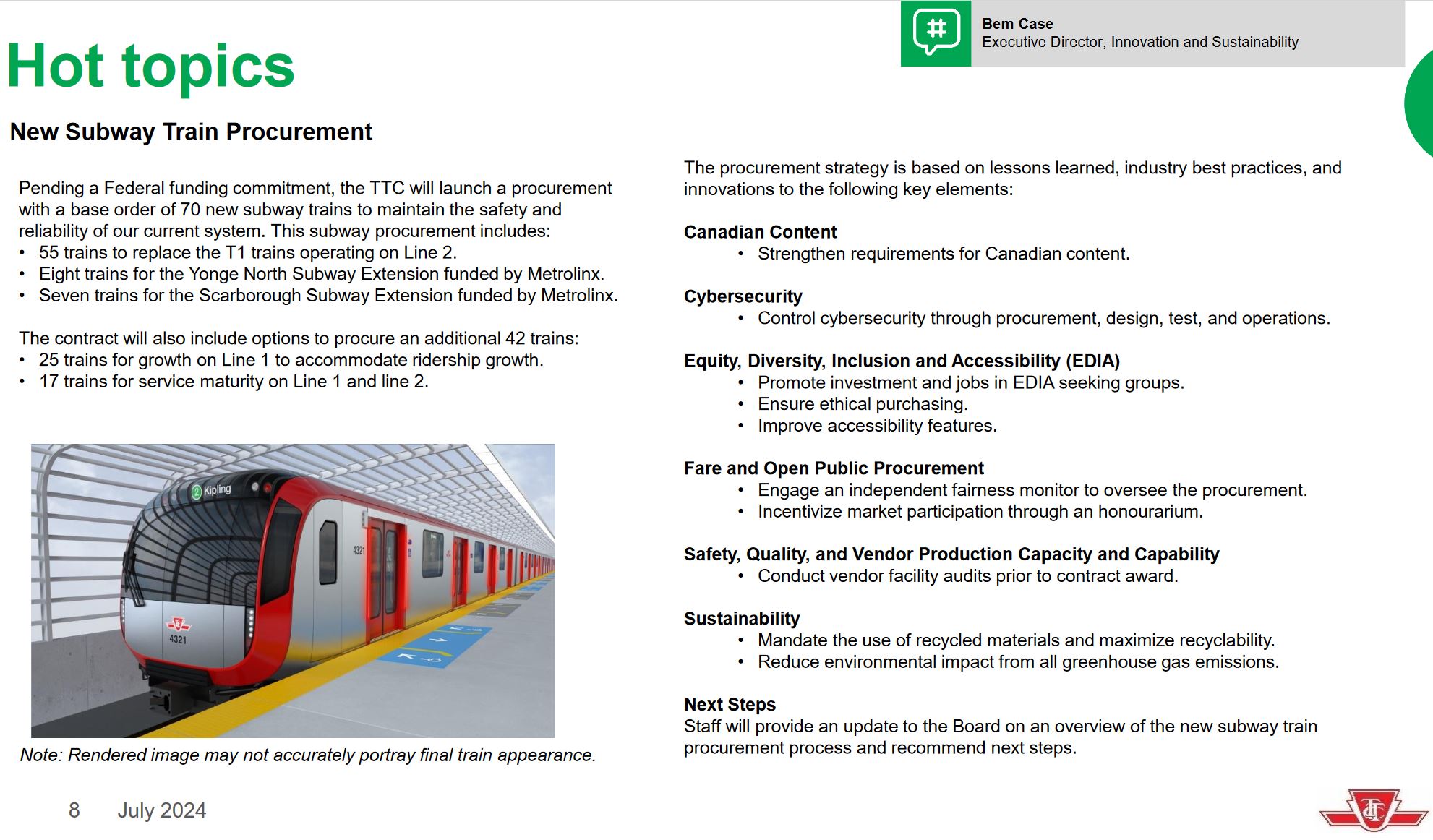
The federal government now accepts applications for the Canada Public Transit Fund, and this will help to pay for new Line 2 trains. Leary noted that this is the result of joint work by major transit properties including Vancouver and Montreal. Leary praised TTC staff for the 18-month effort behind the federal announcement.
The TTC filed its expression of interest in the new program at 3:45pm while the meeting was still in session. They hope to issue a Request For Proposals for new trains in the Fall, and a report will come to the Board later this year.
The current estimated cost is $2.27 billion for 55 trains to replace the Line 2 fleet. This is reduced from the original plan for 62 trains to match actual Line 2 service requirements at the pre-pandemic level, but at a substantially higher estimated cost. 15 trains, funded separately by Metrolinx, will be included for Yonge North an Scarborough subway extensions. A further option for up to 42 trains will be included to allow for growth and the more frequent service possible with Automatic Train Control.
The TTC claims that this will be “An open and fair procurement process that encourages market participation, encourages cost competitiveness”. Meanwhile, a joint statement from Unifor and Premier Doug Ford claims that this project will “offer the workers in Thunder Bay the certainty and stability they deserve”. This implies that Ontario views the contract award to Alstom’s Thunder Bay plant as a done deal. One wonders why they will bother with an open bid except for show, and with the hope of keeping Alstom in line with the market.
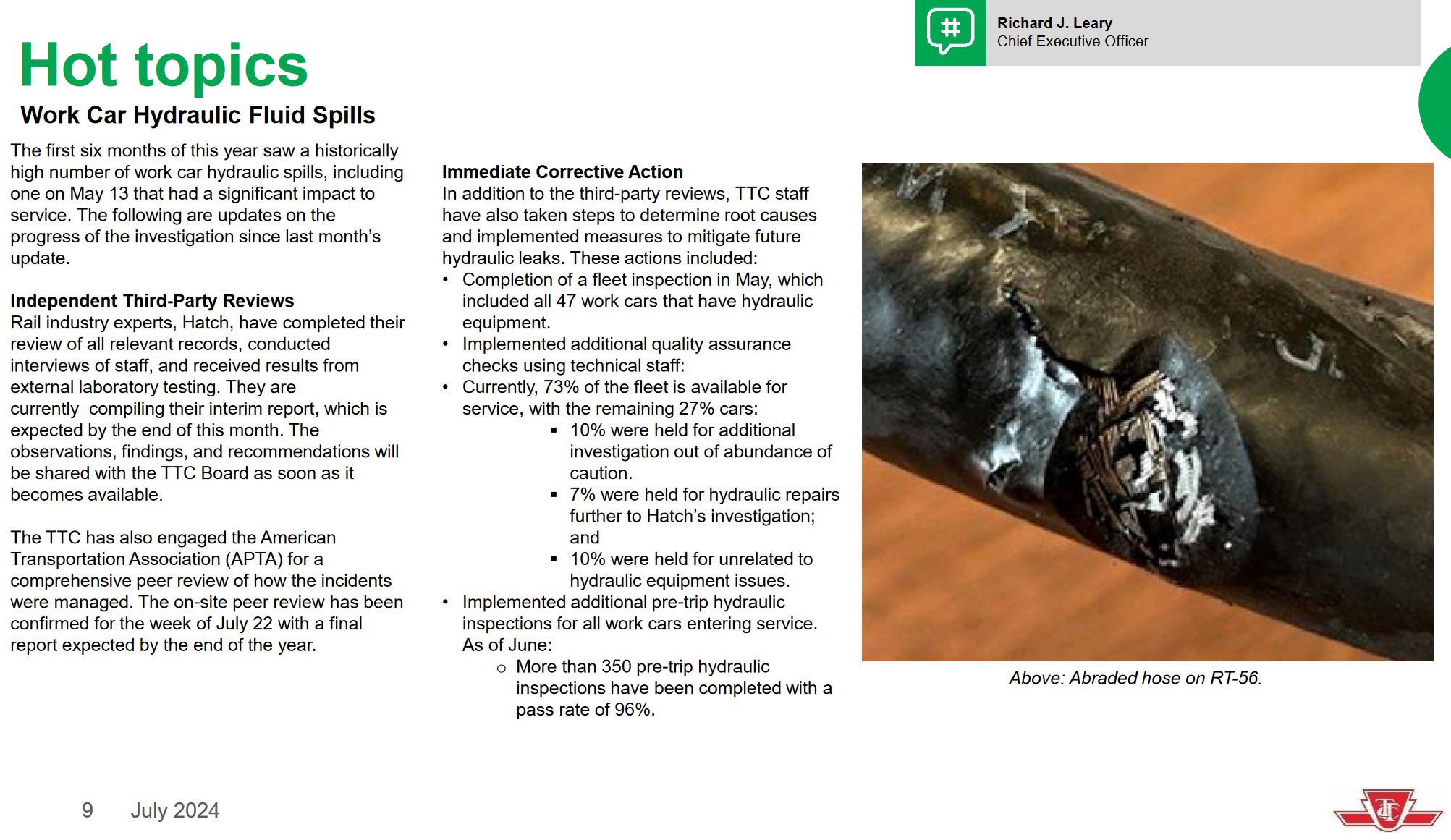
A status update on the hydraulic leak problem with several subway work cars includes some details, but the full report is not yet available. Conveniently, it will appear after Rick Leary is no longer at the TTC to answer for ongoing maintenance problems. Note that although two months have passed since this problem came to light, 27% of the work car fleet is still out of service.
See also:
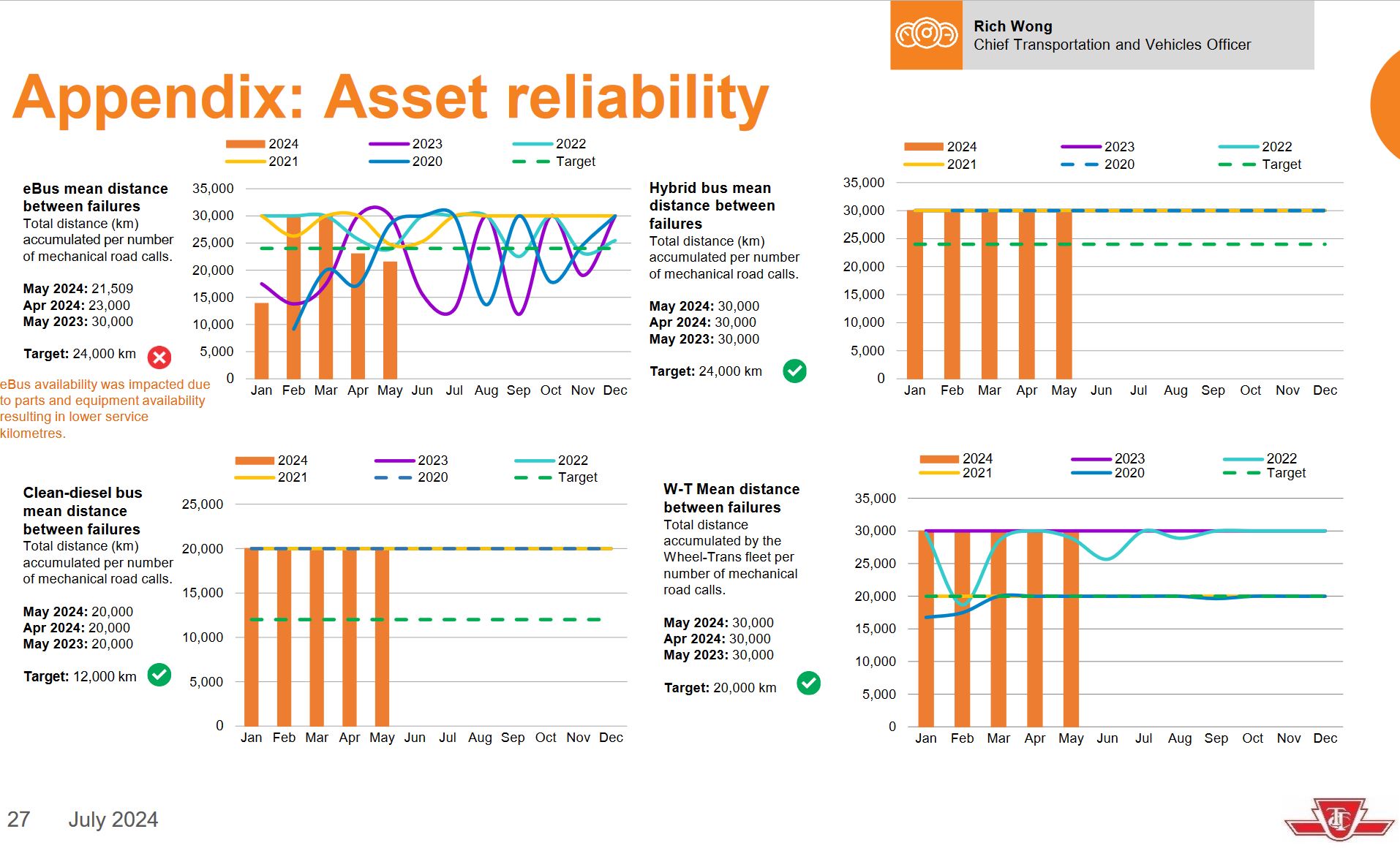
The statistics shown by the CEO still have problems of misrepresentation or selective reporting which I have detailed in previous articles. Correcting this will be one of the many tasks for a new CEO and, frankly, the Board should have demanded better information long ago.
Bus reliability stats are capped. Actual values, if they exceed a target, are not shown. This masks the true reliability of each fleet. For example, the clean diesel buses are capped at 20k while the hybrids and eBuses are capped at 30k. We cannot see by how much they might routinely exceed their targets, or what the comparison between them is. Even so, the eBus fleet has fallen below the target.
One important thing these charts do not show is the proportion of each fleet that did not operate at all, or operated very limited service. Such vehicles do not contribute to MDBF stats because they never fail while sitting in a yard. The actual utilization and availability of the bus fleet is not reported. This affects fleet and service planning because we do not know how much more service the TTC could operate reliably if only it had the budget headroom to hire operators.
Commissioner Saxe asked about the results from changes to Dundas Street traffic regulations implemented to assist transit during the period of work on Spadina Avenue. Staff reported that the changes had only been in place for one week, and that they will report when more data are available.
When I receive the July tracking data in early August, I will publish a before/after comparison.
Prioritizing Asset State Of Good Repair
This report lists the many items in the Capital Budget State of Good Repair backlog and highlights some of the most crucial in the immediate future. Notable by its absence is any reference to the Operating Budget. Much day-to-day maintenance just to keep the system in shape and, importantly, to prevent minor problems from becoming major ones, is paid for from the Operating budget. This has been squeezed through the pandemic era with the emphasis on preserving service, but there is almost no discussion at budget time on the trade-offs this entails.
Given the time constraints of a full agenda, this item received almost no debate, and what did occur was focused on two items:
Chair Myers asked about Platform Edge Doors and how these became part of the list. Management replied that there was earlier Board direction study this, and that there will be a report back later in 2024. Myers asked about alternative technologies such as motion sensors used on other systems. Management will look at these as part of the pending review. Line 5 Crosstown uses motion sensors, and it was suggested that a tour be arranged for the Board to see how they work.
One important detail not discussed is the exact purpose of isolating the platforms from the track area. Are they intended to prevent track walkers from disrupting service, suicides, ventillation control, debris management? The actual expectations vary from one discussion to another, but the goals affect the choice of technology. Myers asked for a breakdown of a possible mixed implementation with the station demand affecting the technology choice. However, some issues barriers are intended to control have little to do with riding counts and platform crowding.
Commissioner Holyday proposed a motion regarding weather hardening of the system. Management noted that they are working on scoping to begin mitigation works in the 2025 budget, but this will continue for 2-3 years. Some assets are owned by the TTC, some by others, and so this is not a purely TTC problem. Holyday’s motion:
Request the CEO to report to the Board by Q1 2025 on:
a. An update on identified current and long-term plans to harden infrastructure from risks associated with heavy rain events.
b. Details and lessons learned from the July 16, 2024 storm and other heavy rain and flooding events, including identification of the highest risk locations.
c. An update on the TTC’s emergency plans for heavy rain and flooding events, including decision-making, actions, communications, and temporary redeployment of resources.
d. Information for consideration on the latest climatic data and trends to help inform planning.
e. Integration with City of Toronto plans and processes, the City of Toronto Office of Emergency Management, Toronto Water, and other transit agencies that connect with the TTC.
Events on the SRT and subway system in recent years have shown the effect of just making do, and of deferring needed work. The TTC is still digging out of the backlog of subway track where slow orders are required for safe operation, and the extent of this problem seems to be growing, not receding. A July 30 news item on the TTC’s site describes the situation, but is not definitive about when slow orders will be rare and short-lived.
On the bus network, the TTC is now receiving replacements for older vehicles that see little use thanks to service cuts. Whether the TTC will actually operate more of its now-youthful fleet depends on operating funding, not capital.
The report reviews the history of fleet reliability and provisions for maintenance.
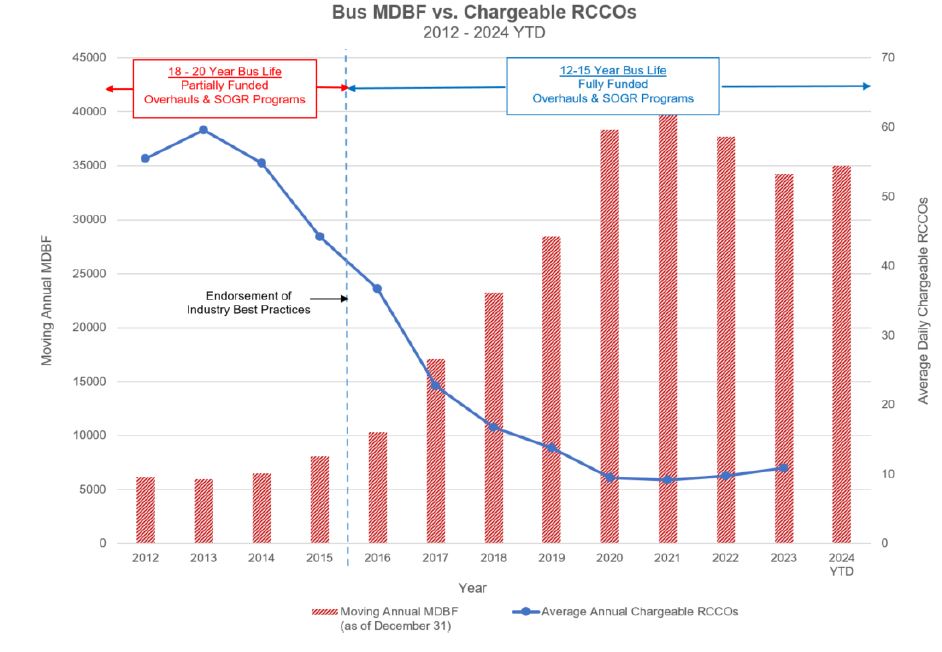
Until almost a decade ago, the TTC planned its bus service on the basis of a 12% spare ratio. For every 100 buses in peak service there would be 12 spares for maintenance. Also, at that time, bus life was typically 18 years (sometimes more) with two major overhauls at roughly the 7 and 12 year marks. Over the years, buses have become technically more complex, and the industry now builds for a shorter vehicle life. The combined effect is that more spares are required, and the annual rate of replacement is higher because 1/12 of the fleet is due for retirement rather than 1/18. (This process can also be upset by uneven rates of procurement in past years thanks to various incentive programs or austerity periods.)
In late 2015, the TTC adopted a 10-year bus fleet and facility plan including an industry standard 12 year life for buses (thereby saving the cost of one overhaul at the cost of more frequent replacement) and a target spare ratio of 20%. However, the TTC has typically operated at a higher spare ratio and this disguises problems with poor-performing vehicles that rarely are used in service.
As of May 2024, the fleet numbered 2,078 vehicles with a scheduled peak of 1,557 including 52 buses used on 501 Queen and 510 Spadina. This is a spare ratio of 33%, and leaves much room for service improvement especially when new bus deliveries replace the oldest vehicles in the fleet. Using a 20% spare ratio, a fleet of 2,100 buses should be able to support peak service of 1,750 buses (2100/1.2=1750). Even at a 25% ratio, the fleet could support a peak of 1,680 (2100/1.25=1680).
The TTC has room for service growth without acquiring more buses if only it had the budget headroom to operate them, and the fleet did not have a large number of aging, unreliable vehicles. The latter problem will be solve with new deliveries, but the budget issue is a challenge for funding in the operating budget. 2025 will be lucky to see a 2% bump, and some of that will be consumed just to deal with traffic congestion.
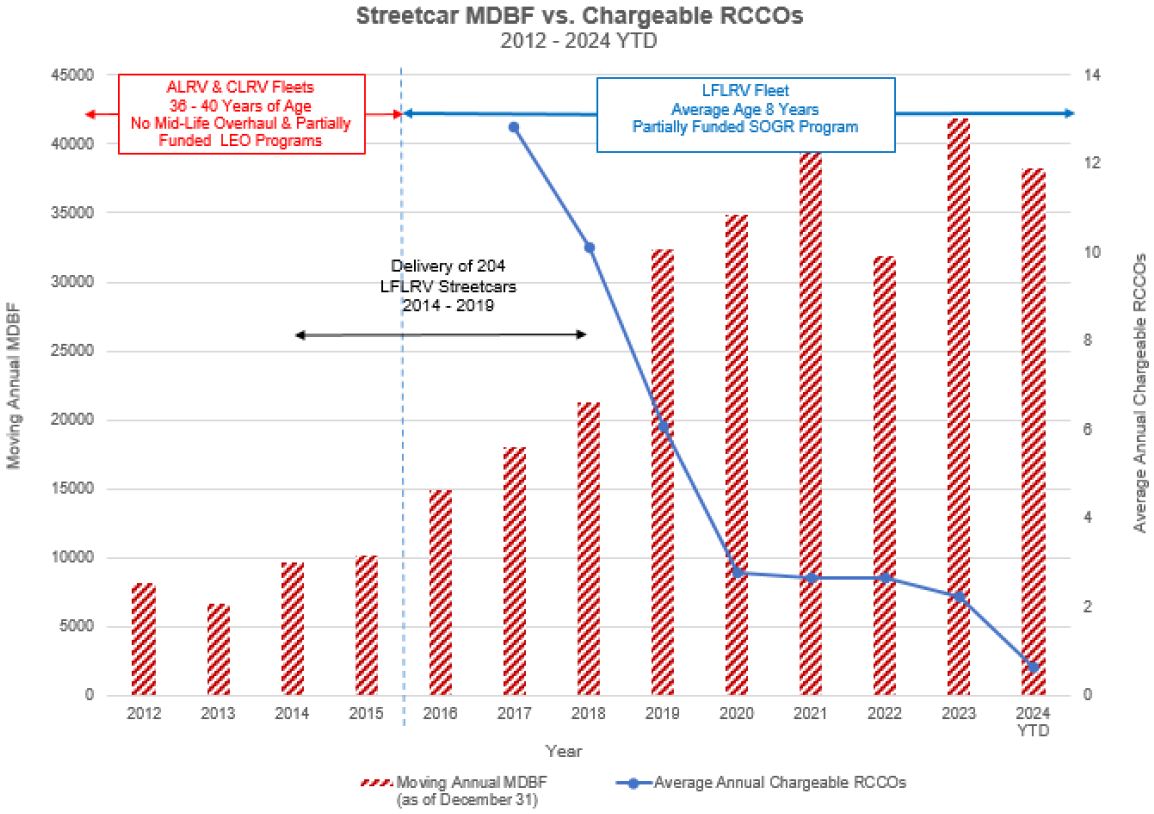
A similar issue with streetcar reliability was corrected with the fleet replacement as the CLRV/ALRV fleet changed over to the new Flexity low-floor cars.
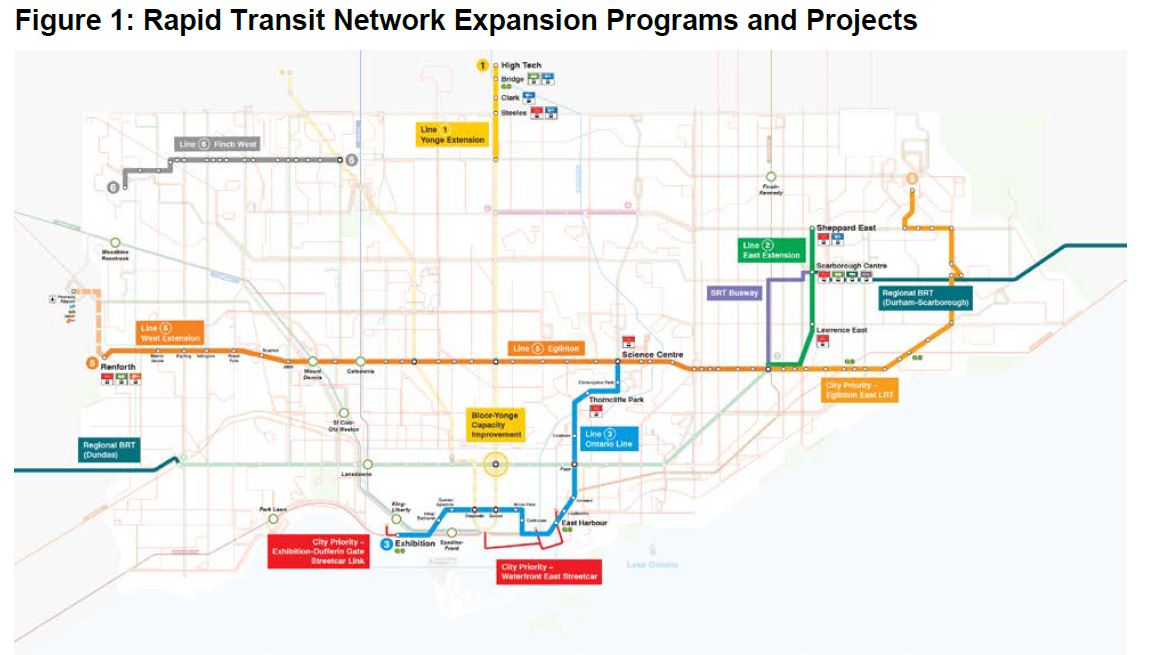
Although the title includes “Prioritization” this refers to the political love for shiny new projects in preference to keeping the existing system up to date. Beyond flagging immediate funding needs, the report does not attempt to rank priorities of line items. Meanwhile, politicians continue to draw lines on maps.
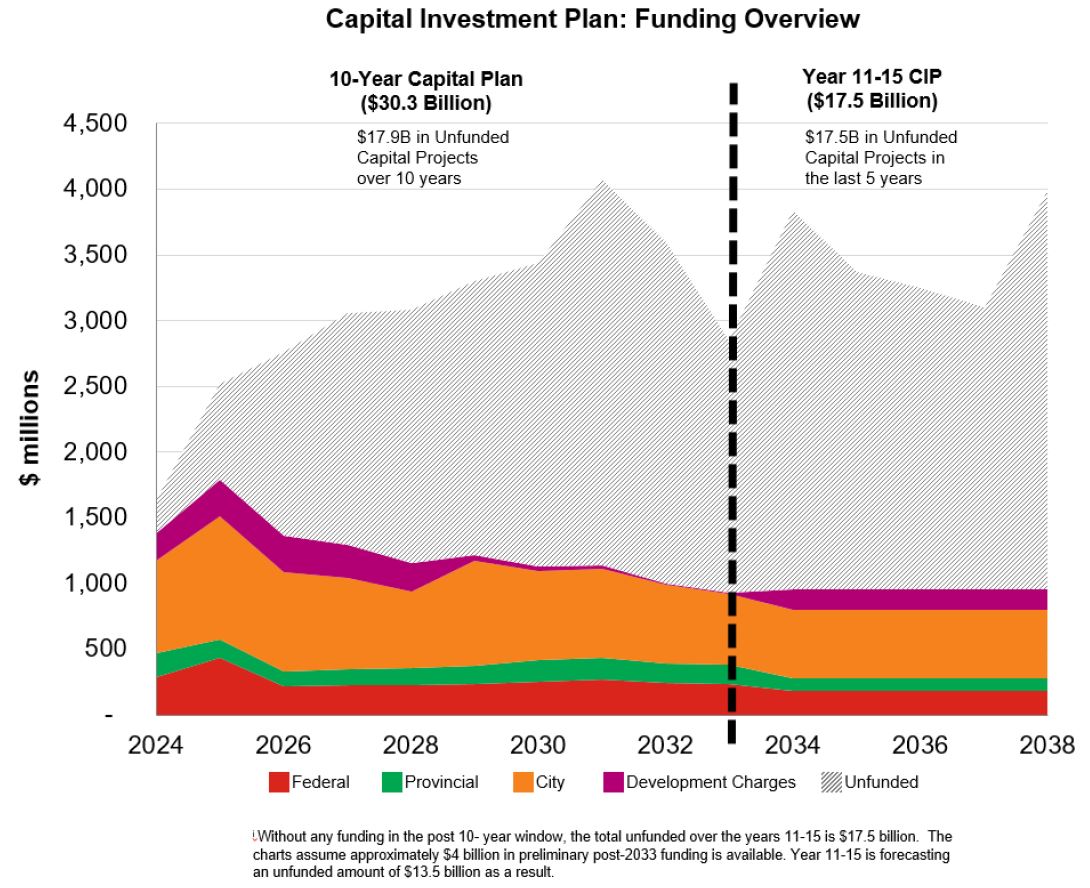
The chart below shows the shortfall between capital needs and available funding over the next 15 years. Note that this does not reflect the possible subway car federal funding because that was not available when the chart was created.
Regular budget watchers will recognize the “iceberg” chart often used by a former City Manager to illustrate the looming budget crunch. The edge of that iceberg stayed conveniently in the future thanks to various budgetary sleight-of-hand tactics including omission of key projects and deferrals of others to shift capital needs into future years. That iceberg now looms in the harbour and cannot be wished away.
Note that annual requirements dwarf the available funding and any of the announced plans by various governments. This chart does not include provincial programs under Metrolinx, and so total provincial spending on transit is higher than the green bar implies. However, if Metrolinx projects were rolled in, the total need would also rise and the large unfunded area would remain. This is not a question of governance, but of the sheer size of capital needs versus available funding.
The report reviews the list of projects in each major envelope and highlights key short-term (5-year) needs.
The full list is longer, and it includes items such as subway platform screen doors (PSDs) and a new Transit Control Centre which are not yet approved, but are listed to show the potential future cost. In past years, such “below the line” items were either omitted or not included in funding requirements with the result that Councillors and City financial staff had a mistakenly small picture of potential capital needs. Even with the 15-Year outlook, new items appear from time to time, and some old cost estimates (such as for new subway trains) prove to be well below their actual cost.
One major group of costs relates to electrification of the bus and Wheel-Trans operation. This produces a bulge in capital needs for more expensive buses plus charging infrastructure, and the numbers here only address replacement of the current fleets plus modes growth. They do not include goals in the City’s Net Zero 2050 plan (which Council has not yet endorsed) including a very substantial increase in transit service, notably on the surface networks.
This table shows only the unfunded costs. Within the subway portfolio are potential costs of future service expansion to accommodate growing demand (even more new trains, future subway yards). There is no equivalent provision for the surface modes.
The City, TTC and their funding “partners” have some serious work to do in prioritizing capital spending within this plan, and asking hard questions of which major projects will remain on the table. The TTC Board’s failure to engage with this issue in detail is an abdication of responsibility, but they are unwilling to create a Budget Committee that could deal with this type of issue.
| Mode | Item | Funding Required in 2025 Budget | 15-Year Unfunded |
|---|---|---|---|
| Bus | 580 buses | $1.056 billion | |
| Electrification infrastructure (680 charging points) | $574.2 million | ||
| 460 overhauls + 950 scheduled maintenance | $193.3 million | ||
| Total | $1.824 billion | ||
| Wheel-Trans | 118 buses | $52.2 million | |
| Charging infrastructure (113) | $31.5 million | ||
| Total | $83.7 million | ||
| Bus & W-T Total | Total | $1.912 billion | $6.315 billion |
| Streetcar | 8-year overhauls (121 cars) | $87.2 million | |
| 16-year mid-life SOGR | $62.0 million | ||
| Total | $149.2 million | $928.1 million | |
| Subway | 55 Line 2 Trains | $1.52 billion | |
| Lines 1 & 4 train SOGR | $96.2 million | ||
| Systems (signals, comms, etc) | $124.5 million | ||
| Facilities | $92.6 million | ||
| Total | $1.183 billion | $3.990 billion | |
| Facilities | Roofs, Paving, Masonry, New Control Centre Total | $637.0 million | $1.715 billion |
| Network Wide | Infrastructure and Fleet Total | $235.9 million | $590.4 million |
Community Partnerships: Safety, Security and Well-Being on the TTC
The report on safety and security sparked much debate, but only on a few topics within the larger report. One was the use of buses as homeless shelters last Winter, and the other was the sense of declining safety on the TTC for riders in general.
As I already wrote in my review of fare evasion issues, the TTC has many staff and contractors in the subway with a variety of duties and powers. This situation has evolved from a general desire to “show the flag” so that riders had a sense someone was watching for problems, and for specific issues with fare control. The intent for each group changes from time to time depending on what the perceived problem is “today”. Unfortunately, this can undo other initiatives and can raise false hopes about just what can be achieved.
Most staff deployed in stations do not have arrest powers, and the hope is that simply by being visible they will deter unwanted acts. Unfortunately, fare evasion is so widely practiced that riders know they will not be challenged by most staff, and walk-ins through transfer areas between surface and subway are common. (I will turn to this in more detail in a future article.)
An important role cited for station staff is passenger assistance including information and general directions. For riders in distress or with social problems, this can extend to rudimentary comfort, but again most station staff are not trained to provide specialized support.
On the other side are basic security issues: dealing with disruptive riders, track walkers and criminal activities. This is the domain of Special Constables, but their numbers are limited (less than 100) and they cannot be everywhere, all of the time.
A recent stabbing was mentioned by a deputant at the meeting as happening “in the subway”. In fact, as reported by the CBC:
“According to police, there was an argument between the suspect and victim on a TTC bus that was arriving at the station. Both got off the bus in the bus bay area, then the argument turned into a physical altercation between the two.”
This is not the first time an incident started on a bus and continued at a subway station, and it is important to recognize that the subway is not the only location where passengers can feel unsafe. However, the security presence on the surface network, especially buses, is minimal. Establishing more visibility there is not a trivial undertaking.
The question of whether the TTC should provide homeless shelters with buses in cold weather took up part of the debate. This practice began because Spadina and Union Stations stay open all night as termini of the 310 Spadina night car. Homeless people took to camping in these stations. Initially the TTC’s intent was to organize bus shuttles to take them to shelters, but space there was hard to come by, and the buses wound up being used as shelters in their own right.
Neither the TTC nor the City wanted to undertake this expense, and there is some doubt that it will be provided in Winter 2024-25 either for shelter or for transport. (As an aside, the TTC report made the predictable call for funding more buses if this practice continues even though the TTC has a large surplus of spare vehicles as discussed elsewhere in this article.) I would not be surprised to see the 310 become a Night Bus for the simple purpose of allowing the terminal stations to close their indoor facilities overnight.
Commissioner Saxe, whose ward includes Spadina Station, complained that there was no consultation with nearby residents and workers about the establishment of a homeless shelter there and the change in neighbourhood safety this brought. This issue will come back to the Board later in 2024 when they review plans for next Winter.
Management’s recommendations in the report were:
- Reaffirm its support for the TTC’s multidisciplinary approach to manage ongoing community safety, security, and well-being issues on the system, as outlined in this report; and
- Request TTC staff in consultation with the City’s Toronto Shelter and Support Services to report back by October 2024 on options to reduce dependence on the TTC transit network for shelter during the 2024/2025 winter season.
This was amended with additional clauses:
- Direct TTC staff to:
a. Establish, in consultation with City of Toronto staff, by the end of Q4 2024 a permanent System Safety and Wellbeing Advisory Committee, which includes residents with current or recent lived experience using public transit, advocates, representatives from the TTC’s labour unions, and experts to advise on the development, implementation, evaluation, and on-going performance monitoring of the 5-year Community Safety, Security and Wellbeing Plan.
b. Develop, as part of the TTC’s 5-year Community Safety and Security Plan, as per City Council Transmittal – EX3.13 Community Safety Issues and Response, dated June 12, 2023, a comprehensive 5-year Wellbeing Strategy, which thereafter shall be referred as the 5-year Community Safety, Security and Wellbeing Plan that includes actions, targets and measureable impacts and an integrated model of customer safety and wellbeing functions performed by Fare Inspectors, Special Constables, Community Safety Ambassadors and Customer Service Agents.
c. Develop and implement a campaign by the end of Q3 2024 that educates Torontonians about the improvements to safety on the TTC.
d. Forward a copy of the report “Update on TTC’s Partnership Approach to Community Safety, Security and Well-being on Public Transit” to City Council to highlight the safety improvements on the TTC.
Paragraph 3.b’s intent is to both provide goals and a tracking mechanism for safety issues, and to establish the roles of various groups in the overall program.
Transit Network Expansion Update
There was little discussion of this report. The only recommendations were to authorize management to enter into agreements regarding the operation and maintenance of the subway expansion projects.
There is still no announced date for opening of Lines 5 Crosstown and 6 Finch West. Instructor training is underway, and the TTC hopes to send Operators for training in early Fall.
I will not rehash all of the information in this report and leave it to readers to peruse sections of interest. Here are some specifics worth noting.
- Although the original intent was for Ontario to build Lines 5 and 6, and for Toronto to pay for their ongoing operations and maintenance, this cost is now covered by the “New Deal” with the province picking up the tab through a payment to Toronto for the 2024-2026 term. This includes initial mobilization costs such as training.
- Metrolinx construction causes extra service costs for the TTC through traffic delays and diversions. The report states “At this time, the TTC expects that service disruption costs will be funded by Metrolinx.” This implies that no specific agreement is yet in place.
- Design of the SRT Busway is still in progress and a final cost estimate is not available. However, “On June 14, 2024, the Province confirmed to the City that they will not set aside funds for the SRT busway.” The City is on the hook for building the busway.
- The estimated cost for decommissioning the SRT infrastructure was estimated at $150-175 million in 2018, and this is not currently funded. “The Province on June 14, 2024, advised they would only fund the portion necessary to facilitate the construction of the SSE.”
- The loading arrangement at Kennedy Station with a temporary bus terminal in the former parking lot will continue until Q4 2026 when conflicting construction for the SSE is complete.
- Design of the new Scarborough Centre station provides for fewer bus bays that the TTC requires. “However, the proposed designs have consistently fallen short of the TTC’s requirements. The TTC has made numerous attempts to collaborate with Metrolinx and other stakeholders to achieve an optimized design, from the number of bus bays and layover spots to the design features of the terminal. Yet the current design being advanced by Metrolinx still provides a suboptimal plan for TTC operations.” The TTC wants 17 bays, but Metrolinx proposes 11. The conflict lies in the amount of space to be dedicated to a transit terminal versus new development. Discussions continue.
- The Eglinton East LRT is currently working toward 30% design and a report will come to Council at the end of 2024 including options on how to proceed, for example to use a design/build contract.
- An outstanding issue for the the EELRT is the location of a maintenance and storage facility.
- The Waterfront East LRT is funded by the City for 60% design for Segments 2 and 3 from Queens Quay to Villiers Loop, plus early works for infilling at the Yonge and Parliament slips. Segment 1, the Bay Street tunnel and Union Loop expansion awaits further commitments and funding.
- The term sheet for the rapid transit program establishes the TTC as Operator for the Yonge North, Scarborough and Eglinton West projects, and that they will set fare policy and service plans. There is to be “further discussion” on the TTC role as Operator for the Ontario Line.
- Provision for on-route eBus charging in new projects is a TTC requirement, but there is no discussion of who will pay for this.
- Washrooms will be provided on the YNSE, SSE and Ontario lines only a major stations, primarily interchanges between routes: Steeles-Yonge, Bridge, High Tech, Scarborough Centre, Sheppard East, Science Centre, Pape, East Harbour, Osgoode, Exhibition.
- Work on the York Street portion of the 501 Queen diversion is underway and “The TTC is working closely with Metrolinx and the City on accelerating the construction schedule of the detour civil and streetcar track construction work to reduce the duration of shuttle bus service.” There is no announced date for operation of through service on 501 Queen.
- Ontario Line and GO works on the Lakeshore East corridor will affect streetcar services. “The Lakeshore East Joint Corridor related work … will require periodic short-term and extended shutdowns of the Queen East streetcar tracks. Bus replacement services will be required during the periods when streetcar tracks are non-operational.” The TTC has not provided any details on timing nor on service arrangements, including in the preliminary version of the 2025 Annual Service Plan.
- Updated August 3: The text about extended shutdowns appears to be recycled from previous versions of this report. When I asked about this, their reply was that “the work plans that have been submitted by Metrolinx for 2025 on Queen Street East at the Lakeshore East Joint Corridor are limited to a few shorter term (weekend) impacts to streetcar service.”
- The City seeks funding from the federal ad provincial governments for a Cummer-Drewry station on the YNSE. This is an example of a project that will test the City’s resolve about just which projects have priority calls on the new federal funding program.
- The Yonge-Steeles Station will include many bus transfers, and the various municipalities have pushed for centre median bus bays on Steeles as part of a future BRT project. Metrolinx recently advised that they will not build such a facility. The question becomes one of future-proofing the station so that this could be added later with minimal disruption.
- The recommended design for a Jane Street RapidTO implementation from Steeles to Eglinton, following public consultation, will be presented to the TTC and City for Fall 2024 approval.
 Steve Munro
About the new subway train procurement. If I was on the board, I would have asked about if there would be a “railfan window”. However, since few of the commissioners use the TTC, they wouldn’t notice. 😇
Steve: Alas, there is no railfan window and the cabs are full width.
LikeLike
Steve wrote: “The question of whether the TTC should provide homeless shelters with buses in cold weather took up part of the debate. This practice began because Spadina and Union Stations stay open all night as termini of the 310 Spadina night car. Homeless people took to camping in these stations. Initially the TTC’s intent was to organize bus shuttles to take them to shelters, but space there was hard to come by, and the buses wound up being used as shelters in their own right.
Neither the TTC nor the City wanted to undertake this expense, and there is some doubt that it will be provided in Winter 2024-25 either for shelter or for transport. (As an aside, the TTC report made the predictable call for funding more buses if this practice continues even though the TTC has a large surplus of spare vehicles as discussed elsewhere in this article.) I would not be surprised to see the 310 become a Night Bus for the simple purpose of allowing the terminal stations to close their indoor facilities overnight.”
It occurred to me before I read this far in Steve’s post that some of the TTC’s buses nearing retirement or so unreliable as to be out of service could be used as shelters.
I do not advocate that the TTC has a special responsibility to the community beyond providing reliable public transit. But, reality is that some kind of assistance to the needy must be provided where possible. The TTC is a taxpayer-funded government agency, after all.
I do not like it when indigents are sprawled all over many seats on the subway, often harassing or foul-mouthing, often drunk or stoned, sometimes vomiting. Obviously, many people avoid public transit late evening, but not everyone can afford taxis or cars-for-hire..
Recently I spoke to a man who is a refugee claimant who rode the Bloor bus all night. A bit of a bounder. I suppose that he did not tap his Presto card! The weather was warm, but the bus was better, safer than sleeping on filthy concrete in a laneway. I found him a bed & dinner for the night.
How do they heat the parked buses in cold weather? I cannot imagine running the engine all night, maybe they use space heaters? The bus will need to be drivable, and a driver available. If there is a medical emergency, and good odds of that, can the bus head to hospital? We are talking about buses as shelters because there are hardly enough permanent shelter spaces, with heat, beds, toilets, and showers.
There are many types of needy, and I described a couple. Many charities provide food. Society needs more fixes.
Steve: Using old buses presents the problem that they must still be fit to travel, and they need a driver, if they are going to be for anything other than a stationary installation (in which case they cannot be taking up space permanently at subway stations). Yes, the TTC had to run the engines to keep the buses heated.
LikeLike
“Washrooms will be provided on the YNSE, SSE and Ontario lines only a major stations, primarily interchanges between routes: Steeles-Yonge, Bridge, High Tech, Scarborough Centre, Sheppard East, Science Centre, Pape, East Harbour, Osgoode, Exhibition.”
Yesterday, wife and I were returning to the transit wasteland that is Bolton and Caledon, via GO train at Malton Station. We observed maybe 30 people attempting to access the restrooms. But, alas, doors locked. I did note, though, that dogs were provided with a toilet area.
LikeLiked by 1 person
At least some of the buses used as shelter buses have been retrofitted with some kind of large HVAC system in the very back. Last winter these buses could be seen fairly regularly later in the evening sitting on Front, either side of Bay. Also, to keep from having to idle the engines (still necessary) apparently some of the electric buses were pressed into shelter service.
LikeLike