
Updated July 22 at 11:10am: A section has been added at the end detailing the discussion and actions taken at the TTC Board meeting of July 17.
At its meeting of July 15, the TTC’s Audit & Risk Management Committee considered a staff report on the efforts underway and proposed to deal with the problem of fare evasion. This report, with amended recommendations, goes to the full TTC Board on July 17.
The debate video goes on for nearly three hours, and it revealed some troubling issues with the ARMC:
- There is an overwhelming emphasis on recovering “lost” revenue with little sense of what target might actually be achieved, or the cost of reaching that level.
- At least one member of the committee, a Commissioner since early 2021, does not know how the “Fair Pass” program for low income riders works.
- In response to a question about how the Two Hour Transfer works, something any Board member or transit rider should know, management provided incorrect information about riding past the two hour line. In turn, that interpretation appeared to justify actions by Fare Inspectors that violate TTC policy.
- There was no acknowledgement that the TTC Board, when it acquired vehicles with multiple entrances (including articulated buses and streetcars) and implemented Proof of Payment (aka POP), was quite aware of the tradeoff between vehicle utilization, service efficiency, labour costs and potential fare evasion. Some Commissioners act as if they just discovered this problem.
- It was quite clear that some Board members have little sense of the dynamics of passenger movements on TTC vehicles, notably problems with congestion at the front of buses due to baby carriages, shopping carts and other impediments, and the need for centre door loading simply to allow riders onto vehicles.
- There was also no acknowledgement that some riders do not tap immediately on entry because they do not have their card at hand, but do so after they have boarded, and not necessarily at the location where they entered. Discussions about ways to increase payment rates through constrained entry and monitoring were based on a faulty view of actual passenger behaviour.
Overall, the level of day-to-day knowledge of the transit experience was poor, and management was not particularly helpful in correcting assumptions made by Board members.
The report contains a lot of detail, and this obscures what might be useful work under a flood of activities that are shown as already completed. The table below shows almost 50 separate actions of which the majority are implemented (blue) or in progress (green). If they had any effect, this has yet to show up in a major bump from recovered fare revenue.
The basic problem is that some riders will habitually evade payment, and this will only be changed by practices that reduce opportunity or substantially deter their behaviour. This requires changes to passenger flow and enforcement regimes, but runs headlong into effects on system speed and capacity and consequences for occasional non-payers.

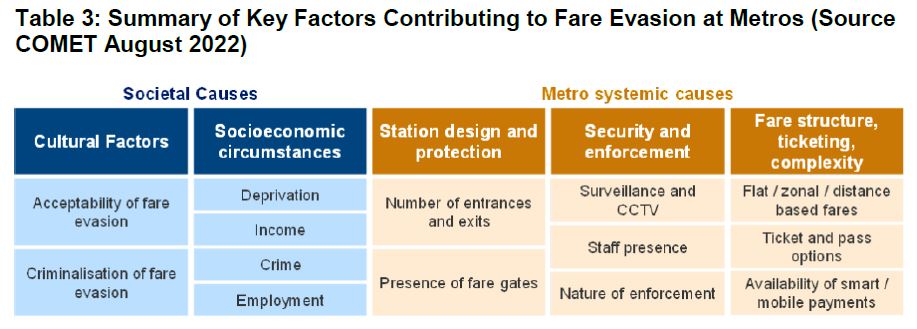
This list is somewhat different from the set of key factors from an industry report (TTC is a member of COMET).
Past studies of fare evasion and estimates of the problem scope appear in two tables. The evasion rate is highest on the streetcar system because of all-door loading, but the dollar losses are highest on the much larger bus network.
Note that there is no estimate of the revenue loss from walk-ins at subway bus and streetcar loops. When asked, staff replied that this is about $9 million, but it is unclear what the basis is for this number. “Partial fare” refers to riders who underpay their cash fare.


One issue revealing a fundamental misunderstanding of fare inspection is the low ratio of tickets issued per day per inspector. This implies that inspectors have no effect, and that their “job” is to issue tickets. That is completely wrong-headed. The idea is to deter non-payment by their presence or the probability that inspection will appear during a trip.
A related problem is the number of inspectors, currently under 100, and the locations they are deployed. How many inspectors would be required to give a pervasive presence on the system, and at what cost versus improved revenue? There are currently 99 fare inspectors of whom about 86 are active. The full complement is not in the field because a recertification program is underway.
A catch-22 in deployment is that for some high-volume locations such as transfer points in stations, a team that is busy issuing tickets cannot also scan the flood of passengers for non-payment. More inspectors per location are needed.
The TTC as an organization seems unable to make up it mind on just what function and powers Fare Inspectors should have. A common concern is that they have no power to compel people to provide identification or pay their fare. However, past experience using Special Constable powers has been poor with accusations of selective enforcement and excessive use of force. Should Inspectors be friendly representatives of the transit system helping riders in a variety of ways, or should they convey no-nonsense strength and a singular purpose.
Multiple door loading is essential to the use of vehicles with more than two doors (articulated buses and streetcars), and this trade off was understood by the TTC when they acquired these vehicles. Vehicle capacity can only be fully exploited, with associated improvement in the driver to passenger ratio, if the full length of the vehicle is available to riders. Over many years, with the move from high floor to low floor vehicles, the increase of baby carriages, shopping buggies and mobility devices can clog the front part of buses.
Without all door loading, stop service times will rise substantially, and route capacity will drop. Will the TTC run more service? Not very likely.
In a classic example of confusing coincidence with causality, Committee Chair Diane Saxe observed that the majority of disruptive customers don’t pay a fare. From this she jumped to the conclusion that these riders are a potential source of revenue. No. Many who do not pay behave just like any other riders. Indeed the last thing responders need to do with an ill-behaved rider is to go after a fare when the real need is to protect other riders, or to protect someone from their own actions such as walking at track level.
Commissioner Jagdeo, who spent part of the meeting apparently dozing in full view on the meeting video, admitted that he does not know how the Fair Pass program works. This City program offers reduced fares to low income riders, but is difficult for some to access and of no benefit to riders who already quality for a reduced fare like seniors.
Many stations have problems with people walking in off of the street unchallenged. It is common to see this occur even when TTC personnel (staff or contract) are present because fare enforcement is not their job. Indeed, over the years TTC has attempted to reduce potential employee assaults by placing them out of harm’s way with barriers and changing the fare system to eliminate complex disputes such as whether a transfer is still valid. The recent increase in staff and security on the system is not intended for fare inspection, but at overall passenger reassurance and monitoring of all parts of stations, not only potential fare evasion locations.
The Station Transformation program shifts the Collectors out of their booths and is intended to shift them more to a general role for rider assistance and station management. Leaving aside how successful this has actually been, the scheme falls apart if they are redeployed as monitors for fare evasion at entrances.
Legacy fares (the remaining tokens and tickets in circulation) and cash are seen as impediments to locking down entrances because provision is made for entry via “crash gates” with an honour system of dropping fares in the farebox at a collector’s booth. There is also the matter of cash underpayment, and of the lack of machine readable fare receipts/transfers. The “solution”? Get rid of these fares except on surface vehicles, and install new fareboxes capable of counting the fare and issuing receipts. Anyone who has dealt with fare machines on streetcars know how time consuming this can be. Again, the question is what new cost this would represent versus the revenue gained especially for those who simply don’t pay.
Commissioner Osborne floated the idea of getting a revenue per passenger number, looking at riders from a business analysis point of view. This idea has been around for a long time, but it runs aground on the fact that trips have segments and the revenue per segment (or “boarding”) is influenced by many factors. The other side of that coin is the cost per boarding, and this varies immensely particularly depending on route length. Long routes have longer trips, and so a rider consumes more service for their fare. Fare policy has moved over the years to charging on a bulk basis for transit use all the way from monthly passes down to the two-hour transfer. Asking for revenue per ride betrays a fundamental misunderstanding of this evolution.
Another issue is the question of where revenue from fines goes. Today it flows to the City’s Court Services as a matter of City policy (this applies to any City agency), but some Board members would like to see this revenue come to the TTC to offset the cost of enforcement. This could have unintended consequences such as the implication that ticketing is a revenue stream and should be encouraged. Quotas for issuing tickets would not be far behind.
One option raised at the meeting is to have an “administrative fee” charged on the spot for non-payment rather than issuing a ticket for the offense. It is not clear how this fee would be collected from a rider who does not have a Presto card, or whose card does not have adequate funds. This would especially be a problem for graduated “fees” which require history of past behavior.
Some Commissioners advocated targets for improved revenue as an indication that enforcement activities are working. How this would be tracked separately from other improvements, notably ridership recovery, is hard to explain.
A big problem lies in the absence of fare enforcement on the bus network, and plans to expand enforcement are not proceeding quickly. Part of this, of course, is a budget issue, and one must ask whether it is more important to have more inspectors or to have more service. Buses are notoriously difficult to navigate when they are full, and it is unclear how fare inspectors would actually operate in cramped quarters.
The largest group of “opportunistic” fare evaders are students, although the lost revenue per rider is lower thanks to their discount. How the TTC would handle inspections, as opposed to simply challenging each rider as they board to tap on, is unclear, not to mention the problem of challenging students to prove they are younger than the 12-year “child” cutoff.
Commissioner Osborne asked if there could be a detection mechanism so that someone boarding would be challenged by a message. Commissioner Jagdeo asked if there could be some sort of sound when someone does not tap.
Again this betrays a lack of knowledge of how riders actually behave. Some do not tap immediately on boarding because they do not have their cards at hand, but rather board and then tap, possibly at another location. Some riders legitimately board without paying including children and those who will move to a fare machine elsewhere in the vehicle.
Josh Colle, the newly minted head of Customer Service, made a passing remark about tracking riders via their digital devices. This is the narrow Metrolinx-type view of a typical rider that everyone has a trackable smart phone. The idea raises privacy issues, not to mention the problem of associating individual taps with specific riders and their devices.
A deputant at the meeting raises the issue of a forced re-tap within a paid area triggering an extra fare charge because the two-hour transfer window had passed. Once passengers are in a paid area — on a vehicle or within the subway system — their fare does not expire.
Commissioner Saxe, not knowing how the two-hour transfer works, asked for an explanation. Management — incorrectly — stated that there was a 20 minute grace period after which a rider would be deemed not to have a valid fare. This directly contradicts TTC policy as shown on their own website.

At the end of a lengthy meeting, the Audit Committee amended staff recommendations to include a status update report in Q1 2025, and a collection of other measures shown below.

The Audit & Risk Management Committee can provide a useful function in oversight for the transit system and in challenging management to account for their actions. They are hobbled by their lack of knowledge about and familiarity with the transit system and how it actually works. This might be excusable in a rookie member, but those who have sat on the TTC Board for some time should do much better. It is time for some housecleaning.
TTC Board Meeting July 17
Discussion at the Board meeting continued the pattern seen at Audit & Risk Management Committee. The Board has a poor understanding of the environment in which fares are collected, and limited feedback from management left the debate to ramble through poorly thought-out schemes. TTC management appears willing to let the Board debate flounder and leave any analysis to an eventual report looking at options.
This was compounded by the item coming near the end of a day-long meeting with a possible loss of quorum, and extended debate was discouraged by the Chair.
One basic problem is that there are multiple types of evasion. Potential recovery rates and revenue vary and there is no “one size fits all” change. The annual revenue loss is now pegged at about $140 million, but it is not clear that all of this can actually be recouped, nor offsetting cost and other challenges.
A common thread in proposals is that if only riders were forced to tap their fare card more often, this would reduce evasion and establish the premise that a “non-tapper” is likely a fare evader. There is much hand-wringing over poor supervision of riders “tapping on” to vehicles, and it is not clear how “tapping off” would be monitored if this were added to fare enforcement policy.
An “always tap” policy includes a bit of early Presto mythology – extra taps will allow rider tracking for planning purposes. The idea that vehicle loading data needs taps is false as automatic passenger counters already provide crowding data. Full trip planning would require both tap-in and tap-out across the system, a major change in expected rider behaviour and fare system infrastructure. Further, a gaping hole in “always tap” capability lies in the subway where stations are designed for barrier-free movement from surface routes.
All of this represents extra capital and operating cost, but with no sense of how it would increase fare payment by those who are determined to evade.
An important issue in fare enforcement is that the TTC has a scattershot approach to safety and security with multiple different types of staff and powers including:
- Transit Special Constables have the greatest powers including arrest and search, but their primary role is closer to policing. Indeed, if they were tasked with fare enforcement one might ask whether they would approach this with the same disdain regular police have for traffic bylaws.
- Fare Inspectors are intended to check for valid fares, and can issue Provincial Offenses Notices, but they have no power to demand identification or detain scofflaws.
- Sundry station staff including Collectors, Station Managers and “red smock” Customer Service Agents provide information and assistance, not security beyond being “eyes on the station”. They have no enforcement role. Similarly, private security guards have no enforcement role.
A large number of these employees and contractors are concentrated at stations, although few of them actually enforce fare checking. Moreover, their duties are not necessarily at fare lines, and they cannot supervise what might happen there including abuse of the “crash gate” entrances.
Their numbers have more to do with providing a sense of security and a TTC presence. Notably they do not usually monitor entrances such as bus loops where walk-ins are common. TTC estimates the revenue loss from such riders at about $9 million per year, but does not include this in their fare enforcement stats.
There is a legitimate question of whether the fare inspector position should be upgraded to Special Constable status, but equally one of deployment across the system and how aggressive fare inspection should be. Should a rider without a valid fare be allowed to tap (about half who are challenged do this now), or should they be subject to a penalty without exception? The TTC Board is notorious for sending mixed messages to staff ranging from a zero tolerance policy to a kinder, gentler approach of individual discretion depending on the situation. They cannot have it both ways, and this confusion puts Fare Inspectors in the position of never being “right” in their judgement.
This brings us to the question of a graduated fine wrapped in the cloak of an administrative fee akin to GO Transit’s incremental charges for non payment. An important difference here is not just the varying levels, but that the revenue would come to the TTC, not to City Court Services.
Under the graduated fine structure:
- First time offenders will be issued a $35 fine, reduced from $100 to add a middle ground between warnings and large fines
- Second offences, the fine will be $50
- Third offences, a $100 fine will be issued
- Passengers with four or more offences would be automatically served a Provincial Offence Notice, with a set fine of $200.
See Dealing With A Fine on GO’s site.
Note that the maximum GO Transit fine is less than half the TTC fine even though GO fares are considerably higher.
Students have been flagged as a major group of non-paying riders, but in previous discussions a problem has been raised by TTC Legal that staff cannot challenge a minor for identification as easily as an adult. Meanwhile, in a completely separate policy initiative, some TTC Board members would extend free transit to all students.
The idea of a “second” offence depends on knowing a rider’s history. This is relatively easy if they have a Presto card that shows no valid fare was paid, but not as simple if they do not have, or will not show, a card. This ties in with the limits on Fare Inspector powers.
If fines or fees come to the transit agency rather than to a general revenue pot, quotas might be established with the inevitable targeting of “likely suspects”. The question of Fare Inspectors productivity measured by tickets/day has come up a few times ignoring the fact that frequent inspection can deter non-payment which, after all, is the primary reason the Inspectors exist.
“Legacy media” (tokens and tickets) come up regularly as a potential problem because they cannot be “read” by subway fare gates, and a “crash gate” allowing free passage is provided for riders using them. With the availability of Presto tickets, vending machines in stations and the replacement of tokens used by social agencies to give free transit rides to their clients, there is no further need for legacy media.
Cash fares are another matter because riders cannot obtain a fare receipt on buses, only on streetcars, and even that is a tedious procedure. The TTC is considering obtaining registering fareboxes to provide this, and one might wonder about the existing streetcar fare machines that are more complex than needed if only cash fares were supported.
The issue is not non-payment, but under-payment of cash fares, and the question of how much net new revenue will be obtained.
Affordability is often raised in fare debates, and this brings us to the Fair Pass program which is now used by only 29% of those who are eligible for it, according to stats cited by TTCRiders in a deputation at the meeting. The application process for a Fair Pass is a barrier for some riders, and there is also the challenge of loading money onto the card for those who are unbanked or live in an area with limited access to reload services.
Although it is called a “Pass” it also provides discounts on single adult fares slightly below the senior/student discount and offers only a small benefit to riders entitled to those fares. Some may not be able to afford even that fare. The extent of this program is determined by the City, not by the TTC.
All-door boarding continues to trouble Board members more concerned with maximizing revenue than operating efficient service. TTC wrings its corporate hands about the cost of traffic congestion, but seems oblivious to the delays its own procedures might create. How much worse is the TTC prepared to make its service in the name of getting every possible fare?
There were no questions of staff from Board members, and the only amendment was proposed by Chair Myers. The consolidated approved actions include:
- A report request for the September 2024 meeting on plan aiming at the end of 2024 to:
- Close subway “crash gates”
- Phase out cash fares at stations, and legacy media system-wide
- Strategies for counting cash fares on buses
- Phase out undated Child Presto cards (creating a requirement to obtain new ones annually)
- A report request for Q1 2025 to develop a system of cautions and graduated fines, and in consultation with employee unions a strategy to respond to non-compliant riders.
- Develop and implement by Q3 2024 an education and advertising campaign on the benefit of the Presto mobile app, and of the need for riders to tap when transferring.
 Steve Munro
One wonders if at least a week’s worth of riding the TTC should be a prerequisite to having a soft, cushy seat on the TTC Com’s Board?
Steve: Years ago, when David Gunn was being interview for the job of what was then called Chief General Manager, he came to Toronto a week early and spent his time riding around the system. At the interview he had a list of all the problems he had seen and what needed to be fixed.
LikeLiked by 2 people
How do other cities tackle this problem? Why reinvent the wheel?
Steve: It’s a two part problem. First, management has downplayed the extent of fare evasion until they were called on this by the City Auditor General. Now they are trying to be seen to “do something”, but with limited resources. Second, the Board is split on just what sort of approach should be taken. Horror stories of poor passengers or people in distress hassled by Fare Inspectors, not to mention selective enforcement, sit on one side while on the other there is a “take no prisoners” attitude to enforcement. These positions can vary from one meeting to the next depending on current events.
The industry wide attitude is summarized in that chart from COMET which concentrates on reducing the opportunity for evasion, makes the likelihood of being challenged meaningful and dealing with economic cases where some riders do not have the means to pay some if not all of the time.
LikeLike
Just make the transfer window 3 hours but advertise it as 2. Will that reduce income by 0.2% or something? Or even make it 3 hours. How many fares happen within 2 to 3 hours of the previous fare.
Steve: It depends on trip patterns and the degree to which people make multi-stop trips (aka “trip chaining”). It should be easy to figure out from Presto data how many fares were charged for people who had passed the two-hour mark, but made their third tap within three hours. Also we know that variable free transfer windows exist because they are different for GO Transit trips.
LikeLike
To be (somewhat) fair, the TTC’s implementation of the 2-hour transfer policy has always been a little bit grey around the edges. Even in the excerpt from the above, it seems to suggest that if you transfer from a bus or streetcar to the subway after your 2 hours are expired you would be required to go hunt down a fare get and tap?
Further, the guidance has always been a bit iffy on if tapping on a vehicle-vehicle or subway-vehicle transfer was mandatory or good practice. And if it’s the latter, how is a fare inspector to know if a rider on an expired transfer boarded the specific vehicle they’re on before the 2 hour window ran out.
Now, I would argue that we should probably not sweat these rare cases and just instruct inspectors to be understanding where reasonable, but in the current environment of hunting for change the Board is sure is under the couch cushions, that seems unlikely…
Steve: The policy should be easy to understand. As long as you stay in a paid area (vehicle or the subway system and stations) the clock should not run out.
Equally importantly, any decision on changing the rules is a policy decision for the Board, not for management to invent for their convenience.
LikeLiked by 1 person
From the Fare Compliance Action Plan
This is akin to tying a knot with two left hands, both broken, with a transfer in each.
Here’s a novel idea, albeit I have only glanced at this report, possibly the idea of seeing how others do things might be a good course of action?
I was about to proclaim the K/W system that does just that, Googled, and found the first hit wasn’t even what I was looking for, it was for Guelph:
What a concept! Actually it’s been extant for decades, but I demur. I wonder if the Fare Com Cmte know where Guelph is? Perhaps they could take a GO train there and learn some lessons?
Steve: The TTC is considering installation of registering fareboxes with the capability of issuing machine readable transfers. The question is whether the revenue gained will justify the cost. If someone just walks past the Presto reader today, they will walk past the farebox tomorrow.
LikeLiked by 1 person
Study those cities that have free transportation…how is that accomplished?
Steve: Big subsidies. Also these tend to be small systems, not something on Toronto’s scale.
LikeLike
Apologies for serial posting, but I couldn’t help but dig deeper on the Absurdity at Hillcrest:
Note the date:
Improving control of fare revenues
Steve: The issue is whether there is enough cash fare revenue and associated losses from partial payment to make registering fareboxes worthwhile now that the vast majority of riders has migrated to non-cash/token payment.
LikeLike
Great writeup. It’s embarrassing that these decisionmakers know less about the actual workings of the TTC than any random rider.
I am a habitual payer, but I have friends who feel financially insecure that avoid paying as much as they can. Their logic is that even if they’re occasionally caught and fined, the money that costs is less than the money they’d saved from avoiding it until that point. I certainly don’t advocate for increased fine amounts, as the prospect of a fine being financially crippling would probably just lead them to avoid the TTC in general. And an attempt to increase the frequency of fines will always cost more than it produces.
The only other variable we have access to in this equation is to make the fares cheaper. I think we should make the fair pass easier to qualify for. The cost of living in Toronto is very high, and many people not typically considered “poor” are feeling the pinch. Having mobility in the city is one of the few ways we can drive down our individual costs of living, and no one should feel that taking public transit is a luxury or beyond their means. Imo anyone who is paying more than 1/3rd their income in rent and/or taking the TTC to travel to their low-paying job should qualify for reduced fares.
LikeLiked by 1 person
The ttc should implement a Qr or barcode on the paper proof of payment, because the station gates and vehicles already have optical devices in them to read that; it’s just a matter of enabling the software.
LikeLike
The Eglinton bus entrance/exit on Duplex is designed for fare evasion. Entire classes from the “language schools” stream in all day long.
Steve: It is not the only place with that problem.
LikeLike
Why does Toronto did use “cash fares” as an option? I’ve been to Europe, and many cities do not accept cash when they board buses or trams. People who need to purchase tickets (IE. tourists) from machines near the bus or tram stops, if they don’t have passes or electronic means.
Steve: Once upon a time there were plans to put fare machines out on the surface network. That didn’t happen.
Many times I’ve been on the buses and noticed that people who are elderly or poor are the ones paying with coins. Social workers need to educate their clients on getting how to stop using cash fares. Many of the poor use smartphones, so the social workers could get PRESTO onto them (including Apple iPhones now).
Steve: Some of the poor have phones, not necessarily smartphones that could download apps, but not all. Also, having a Presto app implies having the funds available to pay fares.
LikeLike
Hi Steve
One issue with the tapping when boarding a streetcar with a mobility device, is even getting to a machine while trying to navigate up the ramp & into the streetcar, especially when it’s busy, there’s serious safety issues doing it.
It makes me so angry when I see the total lack of respect for their [operators’ ?] position, when commissioners can’t even show up to meeting in business causal attire or stay awake through the meeting. Especially at Board Meetings, this shows a complete disregard & lack of respect, to all TTC users, employees & fellow members.
Mobility Devices are not an impediment to ppl at the front of the bus, there are 2 positions for ppl using those devices..
The biggest problem is strollers, especially large ones & especially when the user of them, refuses to go past the wheel well (hump) of the bus, it’s the most narrow point of the bus, & most of these ppl act like entitled, spoiled brats when asked to move back, another issue is large wheeled wagons, that ppl are using, including as strollers.
All in all, it’s a matter of common courtesy & respect, for each other, but that seems to be completely gone in this city.
As for fare evasion, the “students” are the worst part, filling buses, rude, large backpacks & many young adults trying to pass off as 12yr olds, as many of my bus driver friends say, sorry but 12yr olds do not have full grown beards.
Stand at the end of the 32A platform at Eglinton, or the 89 bay at keele, fare evasion is rampant, by able-bodied people…
E.D – Fed up TTC user.
Steve: My intent was not to blame users of mobility devices, but to enumerate these among large items competing for space on vehicles.
LikeLiked by 1 person
How did these grandpas and grandmas that barely know their head from their arses make it onto the TTC as commissioners??
Chow and Myers drop the ball again…
Steve: Most were appointed when John Tory was Mayor. Indeed there was an attempt to defer appointments made in the last day’s of the Tory era before Chow took office, but this was blocked by Tory loyalists.
LikeLike
I’m lazy and stupid. How do I get to be a TTC Commissioner? Will the fact that I’m not woefully uninformed about transit (because I’ve been reading your site for years) work against me?
LikeLiked by 2 people
The low income discount should not have been called the Fair PASS discount. Some people confuse it with a Metro Pass and think they don’t have to tap as they consider it an unlimited Pass for the month.
LikeLike
Steve, Jeff is right……the Duplex side of the Eglinton station loop has people constantly dodging their fares. The 13 Avenue Road bus platform is at that end and there is nothing resembling any kind of barrier.
From the zones being eliminated to scholars/student tickets going from 7AM to 4PM, Monday to Friday to 24/7…..the TTC would be losing money Everytime each one of these kind of policies gets implemented.
Now, it fare evasion. Whatever the decision is to do, the Commission has to be ready to accept whatever blowback will be coming their way……and there will be , no matter what they do. Thank you for all you do Steve!!!
Steve: I use the bus loop at Eglinton fairly regularly and see people walking in the Duplex end, as well as the south end of the loop at Berwick.
LikeLike
Place security on every bus, street car doors and check everyone. No money no ride. Same at every station entrance. Hand out heavy fines.
LikeLike
House cleaning must start with upper management.
LikeLiked by 1 person
Let see how many pay $3.50 or $4 because they don’t exact change see how much profit is made on the fare box.
Steve: There was a time when TTC did not want to get rid of cash fares explicitly because they collected more than the nominal amount through rounding up.
LikeLiked by 1 person
TTC is stuck in the 1950s. It is crazy that the ttc still has a fare cash box on their subway system. If you travel to any world class transit system there are no fare cash boxes in their subways. If you want to ride you will use a travel card or buy a ticket at a vending machine.
Toronto should reverse that 12 under free policy. It is a stupid policy. I have seen people white males in their 20’s and 30’s just say they are 12 and walk in. EVERYONE should pay a fare.
Steve: It is worth remembering that the free child’s fare is the product of our former Mayor John Tory who wanted to appear to be “doing something” about transit costs without spending a lot of money. At the time the estimate was only for lost child revenue which was small, but with no allowance for evasion by older riders.
LikeLiked by 1 person
There is a sticker beside every Presto machine on a streetcar saying “You must tap every time” you board, presumably. However, on some buses, there may be a sticker at the rear door saying “You must tap / Tap every time you enter a station or board a vehicle on the street.” The bus sticker implies that if you board that bus in a fare-paid zone, you do not need to tap. This seems to contradict the TTC website: “Tap … when you enter a station or board a vehicle.” I have noticed that most riders do not tap when boarding a bus in a fare-paid zone.
Steve: There is no policy requiring tap on within a fare control area. Moreover, there is no mechanism to check fares for people transferring into the subway unless we implement mandatory tap off, something that most riders will ignore.
LikeLike
IT seems to be the norm that boards tend NOT to be familiar with what is taking place because no member is using the transit system, so are out of touch with reality.
Time and money are always wasted on the ‘boards’ as the members most times serve no purpose and cannot meaningfully contribute because as I said, out of touch with reality.
Steve: FWIW the board members who are Councillors receive nothing extra for their duties. The “citizen” members get a small honourarium for attending meetings, but they won’t get rich from it.
LikeLiked by 1 person
Let every rider tap. The PRESTO card or credit card or what ever card should be tapped. For those below 12 years old, they should also tap, but non paying card. For reduced price, card should properly register the date of birth using proper ID. All entry should be at the front door. Before the PRESTO tapping, riders has to show to the driver the pass, or pay, or the transfer. But now drivers don’t care, they just open/close doors and drive. It’s understandable that there are dishonest riders but TTC is giving them so much opportunity to continue this bad behavior. To recover from revenue losses, they simply increase the price and probably subsidized from City.
LikeLiked by 1 person
When the likelihood of getting kicked off the streetcar because of short turns and construction notices exceeds the likelihood that you’ll actually make it to your destination undisturbed, you have a problem.
Why enforce a payment system when the system itself is crumbling?
Fix your service before forcing and punishing people who live in poverty and live paycheck to paycheck.
Steve: The TTC seems to forget that an essential part of the two-hour transfer is to enable trip chaining where someone makes a series of small journeys on a single fare. This can be disrupted by unreliable service, or a forced transfer-and-tap where one was not expected.
LikeLiked by 1 person
A system is as strong as it’s weakest link. The Walmer road entry to Spadina station is always unattended. While waiting there for 15 minutes one afternoon, I saw 12 people jump the gate. I would have reported it but there wasn’t a TTC worker in sight.
LikeLiked by 1 person
This all stems back to Andrew Byford aka “Andy” and his new fare collection policy.
But the nail in the coffin was allowing people to board rear doors when prior to the pandemic was deemed unsafe practice and when operators where on TWP/ light duties (transitional work program) were loading rear doors for safety and fare inspections …..
AND ADVERTISING FREE TTC during the pandemic LITERALLY TELLING PEOPLE ITS OK
all of you are asleep.!!!!!
Remember “work safe home safe”?? With assaults….And the service interruption regarding fare evasions and specifically buses going out of service???
When operators said pay or get off they either got off without incident or they went out of service with some sort of altercation. BUT…it was effective and people second guessed and sized up which operators looked mean or could get away with it.
Like children raising children NO RESPECT for the system or the law and TTC plays right into the demographics game.
This is scatological
The board members are doltish and this has become nonsensical.
LikeLike
A passenger with the so-called Transit Pass, the successor to the Metropass, simply does not have to tap his or her card except to open a gate. You’re paid up for that month with unlimited travel. I do so anyway in the ordinary course of events, but not e.g. when my hands are full or I’m going a distance of two stops.
Asking six different fare inspectors what the written procedure is when they encounter a Transit Pass that shows as not having been tapped in a very long time has resulted in no fewer than four responses made up on the spot. The only answer that made any sense (and that was expressed in anything under a two-minute monologue) boiled down to “If it says ‘Transit Pass,’ I just go on to the next passenger.”
LikeLike
The TTC needs to use the method I saw in some cities in France;
This may sound brutal but it seemed to work. People stand near a Presto machine and tap when the fare checkers get on. The French fare checkers dressed in ordinary clothes and looked like thugs, as did their border agents on trains.
LikeLike
In London England you can’t enter nor exit the tube without sufficient funds on your card. To exit you must tap and the gate won’t open unless you have the $$$ on your card. JUST AN IDEA LOL.
LikeLike
Something makes me think that exit fare gates which exist in London for purpose of charging fare by distance wouldn’t be very popular with fiscal hawks on City Council who mostly represent suburban wards that fare-by-distance would hit the most. JUST AN IDEA LOL.
Steve: There is a further problem that the barrier free surface-subway transfers in Toronto are possible because of a unified fare structure. There is a mythology about how “tap out” will somehow solve our fare problems.
LikeLike
When I was in Paris (many years ago) the fine was 10 times the unpaid fare. If you were in first class with a second class ticket, the fine was 10 times the difference.
We took a train out of town and they gave us two turnstile tickets and a computer card. I asked what it was for and it was to be put in an orange box. I assumed it was a box after we got off for some sort of survey. The ticket checkers on the train told me that I should have cancelled it at the first station. They probably noticed my accent and just punched the card there.
LikeLike
As much of a commie downtown liberal elite as I am, I still (grudgingly) see the need for fares. An extensive, well-maintained service costs a lot to run. The idea that it can all be paid from the farebox is ridiculous, but the idea that nobody should have to pay for their use of the system is equally ridiculous. If nothing else, a fare is a rationing mechanism. If it costs nothing to get on the TTC, then anyone can hop on for even the shortest ride. For an example, I live about a 10-15 minute walk from my nearest subway station. If I’m coming home and I’m within my two-hour transfer window, and the bus will be by shortly, I might hop on the bus and take that home. If I don’t have a free transfer, I’ll walk instead of paying the fare.
My single, occasional case on a minor bus route won’t have much effect on the system, but if everyone can get on anywhere for free, that could add thousands of trips per day that would otherwise not have been taken. Those riders who have those other choices could crowd out riders who don’t have those options. There’s a similar problem with extending the subway out to Vaughn and Richmond Hill and turning it into a substitute for GO service. Those 905ers plunk down in a seat and ride it all the way into the city centre, ensuring packed trains for anyone who actually lives in the city and pays taxes to operate the TTC. I used to travel up to Finch for work and I’d see the 905ers streaming in and filling southbound trains at 7:45 in the morning, ensuring that anyone boarding south of Sheppard-Yonge couldn’t hope to get a seat (if they could get on the train).
I’d also caution any suggested solution that starts with “Why don’t we just…” Those words almost always indicate a very superficial understanding of the factors at work. I know they have whenever I’ve uttered them.
LikeLike
How in God’s name is it the taxpayer’s problem when someone doesn’t have their card/fare handy. How selfish do you need to be when you can see that there are dozens of others on the bus/streetcar waiting for you to pay you fair share and get inside?
Liberal attitudes have only made the problems worse. Stop tippy toeing around the real problems.
Steve: It is easy to dismiss “liberal attitudes” here, but one big hole in the discussion is any stats on how many fares we are providing at a discount for the less well off and how much, including evasion or underpayment that might be ascribed to these riders actually costs.
If I wanted to talk about paying a fair share, I might ask about riders from the 905 who no longer pay an extra fare to ride in the 416 (and vice versa). There is no means test, it just happens in part because Ford wants to be popular, but also because it greatly simplifies the fare system. Fare by distance within the 416 would be a disaster, very inequitable, because proportionately more of the working poor take long trips because of where they are forced to live. Those of us who live downtown always take short trips and would get a fare cut if we pay “our fair share”.
That phrase is tricky to reckon with and the actual meaning depends on a lot of assumptions including someone’s definition of “fair”. And don’t get me started about how we have billions for new subways and GO expansion, but can’t afford to run all of the vehicles the TTC owns because of budget limitations.
There are certainly those who do not pay and could well afford to. I see them all the time, such as walking into subway stations via the bus/streetcar loop. Nobody stops them even when there is a TTC employee standing on the platform. People don’t pay on buses and streetcars too, but most of them are dressed well enough I assume that they can afford the fare. These riders are the “real problem”.
LikeLike
I guess “liberals” are also to blame for aggressive me-first driving on the roads? When someone in a Ram pickup pulls into the exit lane on the 401, floors it for 200 metres, and cuts back into the through lane at or a bit past the last moment….am I to assume that the “F*ck Trudeau” sticker on the tailgate means that the driver loves the Prime Minister?
I know that “kids these days” and “things were really better people had respect in the past” are easy things to say–they have been said back to the start of recorded history. But civility does likely go in cycles, and we are likely in a down cycle.
And if so, it’s foolishness to think that some fare inspectors, or the entire TTC organization, can stop and reverse this society-wide trend. But it certainly allows rants from curmudgeons that blame all those “others”.
LikeLiked by 1 person
When I was in high school in the 1960’s, we had to buy “scholar tickets” from the school or subway stations. Only could use them on school days until 5 PM. Not weekends. Not holidays. Not summer, Christmas, or spring break.
If you were using the TTC after hours, you had to deposit TWO “scholar tickets”.
LikeLike
This was incredibly painful to read but sadly not surprising. There seems to be a deep and systemic culture of incompetence and arrogance at City Hall and the various arms-length Boards. I have been watching council and various board meetings closely since the Dundas Square renaming debacle and am disturbed by the apparent ineptitude on display. Many of these Commissioners are simply not fit to be in their position. Jagdeo, I’ve been told was hired for factors not related to core competencies, skill-set and experience. So not surprised he took a nap. The TTC board needs a complete overhaul.
LikeLike
Hi Steve, very interesting article. Lately I’ve seen more fare enforcement officers on the streetcars (501, 503), and in bigger groups then in the past, usually 4 of them.
I’ve tried asking them a question about fares, and noticed in your post the chart for tapping, so maybe you can help – many times I have to use my debit card, but just today noticed that it didn’t say ‘free transfer’ (quick trip to Leslie and back). so I’m guessing that I paid full fare both ways, and why I don’t tapping each and everytime. Also, are they able to read a debit card to see if you’ve paid your fare? Many thanks!
Steve: I think that the transfers are ironed out in the back end without echoing that back to the reader for credit/debit cards. You should easily be able to tell by looking at your card statement. Yes, they are able to query whether a fare has been paid by your debit card because the transaction is sitting in Presto’s system. The difference from a branded Presto card is that they cannot “write” history onto your debit/credit card, but depend on their central system to keep track of when you use it.
LikeLiked by 1 person
I have taken a few downtown-type bus routes lately, and all-door boarding seems to be defacto practice at busy stops. And these are plain old regular 13 metre buses.
Unlike technical details of vehicle operation, any Commissioner interested in this topic could see for themselves what’s going on by taking a short ride around downtown on a few streetcars and buses, and then maybe hang around at any subway station and observe–I’d suggest Wellesley for its off-street bus loop driveways.
Then perhaps the Commissioners would have some idea what they are talking about.
Extra points if they get fare inspected and have forgotten to tap their Presto card. “But, but, but, I’m a TTC Commissioner!!!”
LikeLiked by 1 person
Credit and debit cards and tap-to-pay on mobile phones (basically anything not Presto-branded) always display “Accepted” on the Presto fare readers when tapped. In contrast, Presto cards will display the actual cost deducted (either the fare, or “Free transfer”, or I’m not sure exactly what it displays for the monthly passes) and the remaining pay-as-you-go balance if applicable.
As Steve says, technically this is because all the Presto reader is doing is registering the card tap and verifying that it’s a valid card. (For credit cards, it does the verification by placing a $1 hold, which you sometimes can see online in your credit card account, and which is later cancelled.) After some time, the card’s taps are tabulated by the Presto backend systems, any free transfers are calculated, and the daily total fare is charged to the card. If you make two TTC trips on a free transfer during a day, your credit card gets one charge of $3.30. If you make two separate TTC trips during a day (say one morning commute, one afternoon commute), your credit card gets one charge of $6.60.
Beyond possible hassle from fare inspectors and giving the TTC board sad numbers when you don’t tap, there is one case when not tapping on a subsequent trip can bite you. Consider the following time sequence:
In this case, your free transfer is valid until 3:00pm. If the return trip takes 30 minutes, then not tapping on the return trip has no practical effect. But consider the case when the return trip is delayed (or if you got on at 2:45pm instead). If you get controlled during that trip at, say, 3:10pm, that’s past the nominal 2 hour free transfer window. If you had tapped when entering the vehicle at 2:30pm, the controllers see that you tapped on this vehicle (I think there’s actually a vehicle ID on the record) and your fare remains valid. But if you didn’t, your card only shows one tap at 1:00pm and nothing since, and your transfer has expired. Maybe you’d get leniency from a controller if you explained what you did, but maybe not, and it’s not clear to me how you’d prove your trip history to appeal.
This gets a little more complicated if the return trip includes a fare-paid transfer (like from subway to streetcar at a loop) but I believe the principle holds. Tapping when appropriate creates a tap history that could help you one day.
(Now if only we could get on-vehicle GPS to be accurate, so that my taps in Parkdale don’t sometimes register as being at Kipling station or at Long Branch loop or at Pickering GO…)
LikeLiked by 1 person
I feel like they should install a Presto reader at the Duplex entrance at Eglinton station. So many people use that entrance anyway, maybe a few would pay if there were an easy way to tap there.
LikeLike