
Updated July 22 at 11:10am: A section has been added at the end detailing the discussion and actions taken at the TTC Board meeting of July 17.
At its meeting of July 15, the TTC’s Audit & Risk Management Committee considered a staff report on the efforts underway and proposed to deal with the problem of fare evasion. This report, with amended recommendations, goes to the full TTC Board on July 17.
The debate video goes on for nearly three hours, and it revealed some troubling issues with the ARMC:
- There is an overwhelming emphasis on recovering “lost” revenue with little sense of what target might actually be achieved, or the cost of reaching that level.
- At least one member of the committee, a Commissioner since early 2021, does not know how the “Fair Pass” program for low income riders works.
- In response to a question about how the Two Hour Transfer works, something any Board member or transit rider should know, management provided incorrect information about riding past the two hour line. In turn, that interpretation appeared to justify actions by Fare Inspectors that violate TTC policy.
- There was no acknowledgement that the TTC Board, when it acquired vehicles with multiple entrances (including articulated buses and streetcars) and implemented Proof of Payment (aka POP), was quite aware of the tradeoff between vehicle utilization, service efficiency, labour costs and potential fare evasion. Some Commissioners act as if they just discovered this problem.
- It was quite clear that some Board members have little sense of the dynamics of passenger movements on TTC vehicles, notably problems with congestion at the front of buses due to baby carriages, shopping carts and other impediments, and the need for centre door loading simply to allow riders onto vehicles.
- There was also no acknowledgement that some riders do not tap immediately on entry because they do not have their card at hand, but do so after they have boarded, and not necessarily at the location where they entered. Discussions about ways to increase payment rates through constrained entry and monitoring were based on a faulty view of actual passenger behaviour.
Overall, the level of day-to-day knowledge of the transit experience was poor, and management was not particularly helpful in correcting assumptions made by Board members.
The report contains a lot of detail, and this obscures what might be useful work under a flood of activities that are shown as already completed. The table below shows almost 50 separate actions of which the majority are implemented (blue) or in progress (green). If they had any effect, this has yet to show up in a major bump from recovered fare revenue.
The basic problem is that some riders will habitually evade payment, and this will only be changed by practices that reduce opportunity or substantially deter their behaviour. This requires changes to passenger flow and enforcement regimes, but runs headlong into effects on system speed and capacity and consequences for occasional non-payers.

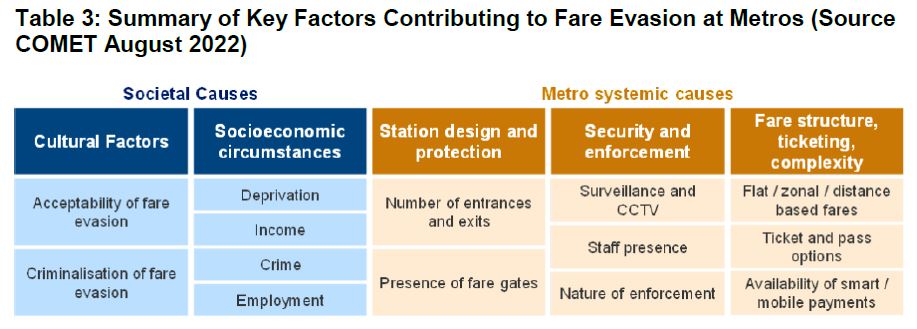
This list is somewhat different from the set of key factors from an industry report (TTC is a member of COMET).
Past studies of fare evasion and estimates of the problem scope appear in two tables. The evasion rate is highest on the streetcar system because of all-door loading, but the dollar losses are highest on the much larger bus network.
Note that there is no estimate of the revenue loss from walk-ins at subway bus and streetcar loops. When asked, staff replied that this is about $9 million, but it is unclear what the basis is for this number. “Partial fare” refers to riders who underpay their cash fare.


One issue revealing a fundamental misunderstanding of fare inspection is the low ratio of tickets issued per day per inspector. This implies that inspectors have no effect, and that their “job” is to issue tickets. That is completely wrong-headed. The idea is to deter non-payment by their presence or the probability that inspection will appear during a trip.
A related problem is the number of inspectors, currently under 100, and the locations they are deployed. How many inspectors would be required to give a pervasive presence on the system, and at what cost versus improved revenue? There are currently 99 fare inspectors of whom about 86 are active. The full complement is not in the field because a recertification program is underway.
A catch-22 in deployment is that for some high-volume locations such as transfer points in stations, a team that is busy issuing tickets cannot also scan the flood of passengers for non-payment. More inspectors per location are needed.
The TTC as an organization seems unable to make up it mind on just what function and powers Fare Inspectors should have. A common concern is that they have no power to compel people to provide identification or pay their fare. However, past experience using Special Constable powers has been poor with accusations of selective enforcement and excessive use of force. Should Inspectors be friendly representatives of the transit system helping riders in a variety of ways, or should they convey no-nonsense strength and a singular purpose.
Multiple door loading is essential to the use of vehicles with more than two doors (articulated buses and streetcars), and this trade off was understood by the TTC when they acquired these vehicles. Vehicle capacity can only be fully exploited, with associated improvement in the driver to passenger ratio, if the full length of the vehicle is available to riders. Over many years, with the move from high floor to low floor vehicles, the increase of baby carriages, shopping buggies and mobility devices can clog the front part of buses.
Without all door loading, stop service times will rise substantially, and route capacity will drop. Will the TTC run more service? Not very likely.
In a classic example of confusing coincidence with causality, Committee Chair Diane Saxe observed that the majority of disruptive customers don’t pay a fare. From this she jumped to the conclusion that these riders are a potential source of revenue. No. Many who do not pay behave just like any other riders. Indeed the last thing responders need to do with an ill-behaved rider is to go after a fare when the real need is to protect other riders, or to protect someone from their own actions such as walking at track level.
Commissioner Jagdeo, who spent part of the meeting apparently dozing in full view on the meeting video, admitted that he does not know how the Fair Pass program works. This City program offers reduced fares to low income riders, but is difficult for some to access and of no benefit to riders who already quality for a reduced fare like seniors.
Many stations have problems with people walking in off of the street unchallenged. It is common to see this occur even when TTC personnel (staff or contract) are present because fare enforcement is not their job. Indeed, over the years TTC has attempted to reduce potential employee assaults by placing them out of harm’s way with barriers and changing the fare system to eliminate complex disputes such as whether a transfer is still valid. The recent increase in staff and security on the system is not intended for fare inspection, but at overall passenger reassurance and monitoring of all parts of stations, not only potential fare evasion locations.
The Station Transformation program shifts the Collectors out of their booths and is intended to shift them more to a general role for rider assistance and station management. Leaving aside how successful this has actually been, the scheme falls apart if they are redeployed as monitors for fare evasion at entrances.
Legacy fares (the remaining tokens and tickets in circulation) and cash are seen as impediments to locking down entrances because provision is made for entry via “crash gates” with an honour system of dropping fares in the farebox at a collector’s booth. There is also the matter of cash underpayment, and of the lack of machine readable fare receipts/transfers. The “solution”? Get rid of these fares except on surface vehicles, and install new fareboxes capable of counting the fare and issuing receipts. Anyone who has dealt with fare machines on streetcars know how time consuming this can be. Again, the question is what new cost this would represent versus the revenue gained especially for those who simply don’t pay.
Commissioner Osborne floated the idea of getting a revenue per passenger number, looking at riders from a business analysis point of view. This idea has been around for a long time, but it runs aground on the fact that trips have segments and the revenue per segment (or “boarding”) is influenced by many factors. The other side of that coin is the cost per boarding, and this varies immensely particularly depending on route length. Long routes have longer trips, and so a rider consumes more service for their fare. Fare policy has moved over the years to charging on a bulk basis for transit use all the way from monthly passes down to the two-hour transfer. Asking for revenue per ride betrays a fundamental misunderstanding of this evolution.
Another issue is the question of where revenue from fines goes. Today it flows to the City’s Court Services as a matter of City policy (this applies to any City agency), but some Board members would like to see this revenue come to the TTC to offset the cost of enforcement. This could have unintended consequences such as the implication that ticketing is a revenue stream and should be encouraged. Quotas for issuing tickets would not be far behind.
One option raised at the meeting is to have an “administrative fee” charged on the spot for non-payment rather than issuing a ticket for the offense. It is not clear how this fee would be collected from a rider who does not have a Presto card, or whose card does not have adequate funds. This would especially be a problem for graduated “fees” which require history of past behavior.
Some Commissioners advocated targets for improved revenue as an indication that enforcement activities are working. How this would be tracked separately from other improvements, notably ridership recovery, is hard to explain.
A big problem lies in the absence of fare enforcement on the bus network, and plans to expand enforcement are not proceeding quickly. Part of this, of course, is a budget issue, and one must ask whether it is more important to have more inspectors or to have more service. Buses are notoriously difficult to navigate when they are full, and it is unclear how fare inspectors would actually operate in cramped quarters.
The largest group of “opportunistic” fare evaders are students, although the lost revenue per rider is lower thanks to their discount. How the TTC would handle inspections, as opposed to simply challenging each rider as they board to tap on, is unclear, not to mention the problem of challenging students to prove they are younger than the 12-year “child” cutoff.
Commissioner Osborne asked if there could be a detection mechanism so that someone boarding would be challenged by a message. Commissioner Jagdeo asked if there could be some sort of sound when someone does not tap.
Again this betrays a lack of knowledge of how riders actually behave. Some do not tap immediately on boarding because they do not have their cards at hand, but rather board and then tap, possibly at another location. Some riders legitimately board without paying including children and those who will move to a fare machine elsewhere in the vehicle.
Josh Colle, the newly minted head of Customer Service, made a passing remark about tracking riders via their digital devices. This is the narrow Metrolinx-type view of a typical rider that everyone has a trackable smart phone. The idea raises privacy issues, not to mention the problem of associating individual taps with specific riders and their devices.
A deputant at the meeting raises the issue of a forced re-tap within a paid area triggering an extra fare charge because the two-hour transfer window had passed. Once passengers are in a paid area — on a vehicle or within the subway system — their fare does not expire.
Commissioner Saxe, not knowing how the two-hour transfer works, asked for an explanation. Management — incorrectly — stated that there was a 20 minute grace period after which a rider would be deemed not to have a valid fare. This directly contradicts TTC policy as shown on their own website.

At the end of a lengthy meeting, the Audit Committee amended staff recommendations to include a status update report in Q1 2025, and a collection of other measures shown below.

The Audit & Risk Management Committee can provide a useful function in oversight for the transit system and in challenging management to account for their actions. They are hobbled by their lack of knowledge about and familiarity with the transit system and how it actually works. This might be excusable in a rookie member, but those who have sat on the TTC Board for some time should do much better. It is time for some housecleaning.
TTC Board Meeting July 17
Discussion at the Board meeting continued the pattern seen at Audit & Risk Management Committee. The Board has a poor understanding of the environment in which fares are collected, and limited feedback from management left the debate to ramble through poorly thought-out schemes. TTC management appears willing to let the Board debate flounder and leave any analysis to an eventual report looking at options.
This was compounded by the item coming near the end of a day-long meeting with a possible loss of quorum, and extended debate was discouraged by the Chair.
One basic problem is that there are multiple types of evasion. Potential recovery rates and revenue vary and there is no “one size fits all” change. The annual revenue loss is now pegged at about $140 million, but it is not clear that all of this can actually be recouped, nor offsetting cost and other challenges.
A common thread in proposals is that if only riders were forced to tap their fare card more often, this would reduce evasion and establish the premise that a “non-tapper” is likely a fare evader. There is much hand-wringing over poor supervision of riders “tapping on” to vehicles, and it is not clear how “tapping off” would be monitored if this were added to fare enforcement policy.
An “always tap” policy includes a bit of early Presto mythology – extra taps will allow rider tracking for planning purposes. The idea that vehicle loading data needs taps is false as automatic passenger counters already provide crowding data. Full trip planning would require both tap-in and tap-out across the system, a major change in expected rider behaviour and fare system infrastructure. Further, a gaping hole in “always tap” capability lies in the subway where stations are designed for barrier-free movement from surface routes.
All of this represents extra capital and operating cost, but with no sense of how it would increase fare payment by those who are determined to evade.
An important issue in fare enforcement is that the TTC has a scattershot approach to safety and security with multiple different types of staff and powers including:
- Transit Special Constables have the greatest powers including arrest and search, but their primary role is closer to policing. Indeed, if they were tasked with fare enforcement one might ask whether they would approach this with the same disdain regular police have for traffic bylaws.
- Fare Inspectors are intended to check for valid fares, and can issue Provincial Offenses Notices, but they have no power to demand identification or detain scofflaws.
- Sundry station staff including Collectors, Station Managers and “red smock” Customer Service Agents provide information and assistance, not security beyond being “eyes on the station”. They have no enforcement role. Similarly, private security guards have no enforcement role.
A large number of these employees and contractors are concentrated at stations, although few of them actually enforce fare checking. Moreover, their duties are not necessarily at fare lines, and they cannot supervise what might happen there including abuse of the “crash gate” entrances.
Their numbers have more to do with providing a sense of security and a TTC presence. Notably they do not usually monitor entrances such as bus loops where walk-ins are common. TTC estimates the revenue loss from such riders at about $9 million per year, but does not include this in their fare enforcement stats.
There is a legitimate question of whether the fare inspector position should be upgraded to Special Constable status, but equally one of deployment across the system and how aggressive fare inspection should be. Should a rider without a valid fare be allowed to tap (about half who are challenged do this now), or should they be subject to a penalty without exception? The TTC Board is notorious for sending mixed messages to staff ranging from a zero tolerance policy to a kinder, gentler approach of individual discretion depending on the situation. They cannot have it both ways, and this confusion puts Fare Inspectors in the position of never being “right” in their judgement.
This brings us to the question of a graduated fine wrapped in the cloak of an administrative fee akin to GO Transit’s incremental charges for non payment. An important difference here is not just the varying levels, but that the revenue would come to the TTC, not to City Court Services.
Under the graduated fine structure:
- First time offenders will be issued a $35 fine, reduced from $100 to add a middle ground between warnings and large fines
- Second offences, the fine will be $50
- Third offences, a $100 fine will be issued
- Passengers with four or more offences would be automatically served a Provincial Offence Notice, with a set fine of $200.
See Dealing With A Fine on GO’s site.
Note that the maximum GO Transit fine is less than half the TTC fine even though GO fares are considerably higher.
Students have been flagged as a major group of non-paying riders, but in previous discussions a problem has been raised by TTC Legal that staff cannot challenge a minor for identification as easily as an adult. Meanwhile, in a completely separate policy initiative, some TTC Board members would extend free transit to all students.
The idea of a “second” offence depends on knowing a rider’s history. This is relatively easy if they have a Presto card that shows no valid fare was paid, but not as simple if they do not have, or will not show, a card. This ties in with the limits on Fare Inspector powers.
If fines or fees come to the transit agency rather than to a general revenue pot, quotas might be established with the inevitable targeting of “likely suspects”. The question of Fare Inspectors productivity measured by tickets/day has come up a few times ignoring the fact that frequent inspection can deter non-payment which, after all, is the primary reason the Inspectors exist.
“Legacy media” (tokens and tickets) come up regularly as a potential problem because they cannot be “read” by subway fare gates, and a “crash gate” allowing free passage is provided for riders using them. With the availability of Presto tickets, vending machines in stations and the replacement of tokens used by social agencies to give free transit rides to their clients, there is no further need for legacy media.
Cash fares are another matter because riders cannot obtain a fare receipt on buses, only on streetcars, and even that is a tedious procedure. The TTC is considering obtaining registering fareboxes to provide this, and one might wonder about the existing streetcar fare machines that are more complex than needed if only cash fares were supported.
The issue is not non-payment, but under-payment of cash fares, and the question of how much net new revenue will be obtained.
Affordability is often raised in fare debates, and this brings us to the Fair Pass program which is now used by only 29% of those who are eligible for it, according to stats cited by TTCRiders in a deputation at the meeting. The application process for a Fair Pass is a barrier for some riders, and there is also the challenge of loading money onto the card for those who are unbanked or live in an area with limited access to reload services.
Although it is called a “Pass” it also provides discounts on single adult fares slightly below the senior/student discount and offers only a small benefit to riders entitled to those fares. Some may not be able to afford even that fare. The extent of this program is determined by the City, not by the TTC.
All-door boarding continues to trouble Board members more concerned with maximizing revenue than operating efficient service. TTC wrings its corporate hands about the cost of traffic congestion, but seems oblivious to the delays its own procedures might create. How much worse is the TTC prepared to make its service in the name of getting every possible fare?
There were no questions of staff from Board members, and the only amendment was proposed by Chair Myers. The consolidated approved actions include:
- A report request for the September 2024 meeting on plan aiming at the end of 2024 to:
- Close subway “crash gates”
- Phase out cash fares at stations, and legacy media system-wide
- Strategies for counting cash fares on buses
- Phase out undated Child Presto cards (creating a requirement to obtain new ones annually)
- A report request for Q1 2025 to develop a system of cautions and graduated fines, and in consultation with employee unions a strategy to respond to non-compliant riders.
- Develop and implement by Q3 2024 an education and advertising campaign on the benefit of the Presto mobile app, and of the need for riders to tap when transferring.
 Steve Munro
Do the Presto machines in subway stations vend single-ride tickets in solo or multiple quantities? Do the machines accept notes & coins?
Obviously I’m referring to the large, newer Presto machines.
As an aside, I dislike the term “fare media”.
Steve: If you looked at a fare machine, or even a picture of one online, you would know that they accept coins and notes as well as credit cards.
There are three types of Presto tickets: single ride, two ride, and day pass. I don’t know if the machines will vend multiple tickets in one transaction, but this should be easy to test the next time you pass by a machine.
LikeLike
I feel like the underpayment of cash fares is a non-issue. If someone is making an attempt at paying something, I feel that’s good enough, and if they make more money in the future, then they will hopefully graduate to paying the full fare. It’s the people who habitually don’t pay anything who need to be stopped.
I think the TTC needs to develop a system that can track warnings given to people. There are a lot of people who are given warnings and allowed to tap after being caught by fare inspectors. It’s unclear if these people are habitual evaders who know how to game the system with clever excuses or just people who made honest mistakes. It would be good if the system could track how many “warnings” these people are given, so that they can be fined if they are abusing the system. Perhaps face biometrics could be used instead of requiring ID, so ID powers won’t be required of the fare inspectors.
LikeLike
I was in Budapest a few weeks ago, and their transit system has a zero tolerance fare inspection. Plain clothes inspectors hop onto buses, driver shuts all doors and they quickly slide on an ID badge and yell out fare inspection. If you have an expired fare/pass…or nothing at all, you have to have to pay a fine on the spot.
Although, it should be mentioned that their system does operate on a trust system where there are no fare gates at stations, and like many systems in Europe and the world – all-door bus boarding.
It will be interesting to see what the TTC will ultimately decide regarding this issue.
LikeLike
Except the lure of paying nothing at all would be so ingrained by that time, someone could make a seven-figure income and still not pay their fare if they could get away with it. Your suggestion is ridiculous.
LikeLike
I got a laugh when City-boy at heart criticized the TTC’s decision to drop its 2-zone system, and to allow students to use their student card outside of regular school hours.
Those decisions were made over 50 years ago!
I started using the bus to go to school in 1971 or 72, when I was 16 years old. Student tickets were 15 cents, half the price of an adult fare. Student cards stopped being valid when a student turned 18, and weren’t valid after, um, 4:30pm, or 5pm. I could take the Anglesey bus to Royal York station, and then walk several blocks to Prince Edward Avenue, to catch a southbound 66. But I would have had to pay a 2nd fare to get on the subway, to go one stop to Old Mill, to board the 66 at its terminus, because getting on the subway was crossed into Zone One.
The rules were changed in 1972, thank goodness.
The strange thing was that, even two years later, in 1974-75, there were several drivers who would try to make me pay an adult fare, because they had figured out I had turned 18, even though the TTC had dropped that restriction. They hadn’t gotten the memo that adult high school students had been entitled to pay a student fair for several years.
I think Steve will confirm this. The TTC’s original mandate was to serve Toronto – old Toronto. Its service extended into Etobicoke, North York, Scarboro, Mimico, as a courtesy to its riders, and so an extra fare was defensible. However, the extra fare was less defensible when the TTC’s mandate was expanded to serve all of what was then Metropolitan Toronto. Even then some TTC routes crossed into Markham or Mississauga. IIRC riders were expected to pay an extra fare, when they got off, in those foreign lands.
What if riders had their card read, (1) when they got on; (2) when they got off; and (3) when they transferred? Could the fare system be granularized so a trip of only a few stops, with no transfers, cost less than a trip across the city, requiring several transfers?
I think the anwer is yes. But changing the underlying basis of the fare system requires a huge paradigm shift. And there are just too many different alternate schemes to make thinking about it easy.
Would a scheme where the fare charged to you, when you exited, was based solely on how many minutes you were on the vehicle be “fair”? What if your vehicle was made to stop or slow down due to congestion, or an accident? Would it be more “fair” to base the charge on the distance travelled?
When you get in a taxi, the driver flips the meter, and you start off with a substantial minimum charge. If we exploit technology to finely granularize fares, can we expect riders to accept a base charge, merely for getting on a vehicle? Do they get a second base charge, to pay for amortizing the fleet, when they transfer to a second vehicle?
I remember when Presto was intoduced to the GO train system. If you flashed your card when you got on, and forgot, or were unable to flash your card, when you got off, you were charged as if you travelled to the end of the line. It was highly annoying when this happened.
I think reverting to a zoned system, or a system where fares were even more finely granularized, would leave riders confused and angry.
WRT the idea that a granularized fare should start with a substantial fraction, just for getting on a vehicle, based on the argument you have to help amortize the depreciation cost of vehicles on standby, or that end up empty… I hope Steve will let me share an anecdote.
Some decades ago the food coop I was a member of, got sold a pig in a poke, and agreed to change our fee structure, and almost went bankrupt.
My coop was small, about 150 members. Everyone paid a refundable membership fee, when they joined, and there was a relatively fixed markup on every purchase,
Then we had a charming ambitious guy join the coop, and join its Board. He was an MBA student. He called for a complete change in how members paid the coop’s ongoing costs.
He claimed, at the time, that “All the large coops do it this way”, and we believed him.
A 50 percent majority was all it took, and he convinced enough people to get the change adopted. But it wasn’t that popular. Sales took a big drop, and we couldn’t balance our books.
The reason this anecdote is relevant is that people get used to one fee or fare paradigm, and they aren’t adaptable when it is changed. They can hold a grudge for a long time. Maybe city-boy is still cross over dropping the zone system, even though that was over fifty years ago?
The funny/sad part of the story about food co-op? Mr Charming MBA student’s claim, that “all the big coops do it his way”? His claim was proof that 90 percent of statistics are made up. The food coop he had previously been a member of, one working out of UWO, was the ONLY food coop in Ontario that used his alternate fee model.
Steve: The whole idea of a fare based on service consumed has been debated to death, and we are now on a single regional fare thanks to Ontario finally creating the subsidy for cross-border travel. Forcing people to tap on and off for each leg of their journey would be a huge paradigm shift and would also require major changes in the way subway stations operate for transfers that now occur within the paid area. This is a complete non-starter.
I am always amused when people cite London, UK, as a zoned, loosely distance based system. Yes, the Tube and the regional trains are zoned, but the buses are a flat fare.
Metrolinx has a fetish for zoned systems because of its origins as a commuter railway, but they finally seemed to have realized that the cost and complexity of fare-by-distance for urban transit is not worth the effort.
LikeLike
I almost always use my presto.. I live right downtown, and many of my trips pass homeless shelters. Those guys never pay.
I just wrote a long message, trying to defend sticking to the existing fare structure, where paying a single fare gives a rider a 2 hour window of travel…
There is one exception, where I stop relying on my presto card, as my proof of payment…
If I finish my errand, with a couple of minutes left on my 2 hour window, once I am back in the fare paid zone, I will push the transfer machine for a paper transfer. When I subsequently transfer to a bus or streetcar I do not use my presto card.
I keep my paper transfer handy. I have never had a fare officer ask for my proof of payment, when I suspect my 2 hour window expired, but I have that paper transfer. Should I feel like a hypocrite for planning to exploit this paper transfer loophole, to extend my window?
Steve: TTC is likely to get rid of legacy fares soon, and when this happens transfer machines will disappear too. Anyone coming into a subway station will have to pay via some form of card, and “cash” fares will require that you buy a limited use Presto ticket. It’s not yet clear what would happen on buses if they got rid of the fareboxes.
LikeLike
TTC should remove all cash fares from all TTC transportation service vehicles altogether especially with TTC buses. It will make things much more safer for TTC bus drivers, safer for passengers, reduce operating maintenance costs and cut down on fare disputes. TTC vehicles should only accept PRESTO media as the form of payment, nothing else. Cash can still be used to purchase and load PRESTO cards or purchase 1 ride, 2 ride or day pass PRESTO TTC tickets at PRESTO vending machines in TTC subway stations and via third-party retail stores with hundreds of stores setup across Toronto. Your thoughts Steve?
Steve: The TTC already plans to eliminate cash fares in subway stations, and riders will have to buy a Presto ticket. On surface vehicles it’s not as simple because many trips don’t start at a subway station, and places to buy fares are thin on the ground. Streetcars already have machines that accept cash, but the transfers they issue are not machine readable. The TTC is studying installing fareboxes on buses that can accept cash and issue transfers.
LikeLike
I was wondering has the TTC looked at moving the fare pay zone at station to put bus bays outside of the paid zone. I know a lot of European transit connections use this approach rather then what we use on the ttc placing busy bays in paid zones. Looking at a lot of station with this issue of fare evasion it can help I think, and it looks technically feasible from my view. It would mean less convenice for some passengers and will not eliminate fare evasion but I think it could help with a lot of the issue at subway station. Case in point at Greenwood station, while the bus bay has been freed from construction, the TTC made the call to keep bus loading on danforth for the 31 Bus, since they are still running it to Coxwell station. But on occasion I see people trying to get into the station from the bus bay, but they can’t since the doors are locked.
Steve: There are some very large stations with several routes now in the paid area. New fare lines would have to be set up to charge riders entering the subway station. This would also affect passenger flow through the station. It is not a trivial change. Also, the TTC has always prided itself on the efficiency of the free transfer movements between surface and subway lines at stations. This is not a trivial change.
LikeLike