
With the June 23, 2024 schedule change, streetcars were replaced with buses running from Spadina Station at Bloor to Queens Quay. Buses operated in the regular traffic lanes, not on the streetcar right-of-way.
To no surprise, during periods when Spadina Avenue is congested, primarily with traffic queued for the westbound Gardiner Expressway ramp at Lake Shore, the buses made glacial progress. This was not, however, the only place where buses were delayed by traffic.
The TTC has announced that it will change the south end loop in an attempt to speed service during the PM peak. No buses will operate between Blue Jays Way and Queens Quay, but instead they will loop via Front eastbound, then south and west via Blue Jays Way to Spadina. Traffic Wardens will assist with the turn at Front Street.

However, the congestion on the south end of Spadina can extend north to King and sometimes beyond Queen Street. It is not clear whether the new loop will address much of the problem. Buses will not be using the streetcar right-of-way, even though it has no centre poles north of Bremner Blvd. to bypass the traffic jam.
The TTC advises that this is an interim arrangement, and that they are working with the City on further, unspecified, changes to the bus operation.
It’s Not Just the Gardiner
An effect unexpected by some, I am sure, was that at uncongested parts and times, the buses make faster trips than the streetcars had only a week before the changeover. Anyone who rides the 510 Spadina car will know of their glacial progress through intersections thanks to the system wide slow order on all special trackwork. Spadina has many intersections. This type of pervasive delay is seen all over the streetcar system, but is worst on rights-of-way where one would expect streetcars to operate as quickly as possible.
Buses have a further advantage in that they are stopping nearside, and therefore can serve stops while awaiting a green signal, and then leave without a second farside stop.
The absence of priority with extended green phases for Spadina transit service affects the modes differently because an extended green would allow streetcars to reach their stops before a signal turns against them. Even if bus is caught on the nearside of an intersection, it will be stopping to serve passengers.
The left turn phase for auto traffic that blocks streetcars also blocks buses, and so this particular delay is common to both modes.
In addition to congestion at the south end of the route, buses also encounter problems during some periods approaching Bloor Street northbound.
The remainder of this article reviews travel times and service reliability on the main part of the 510 Spadina route over June 2024. (There is a companion article about the return of streetcars replacing buses on 512 St. Clair.)
Bloor to Front
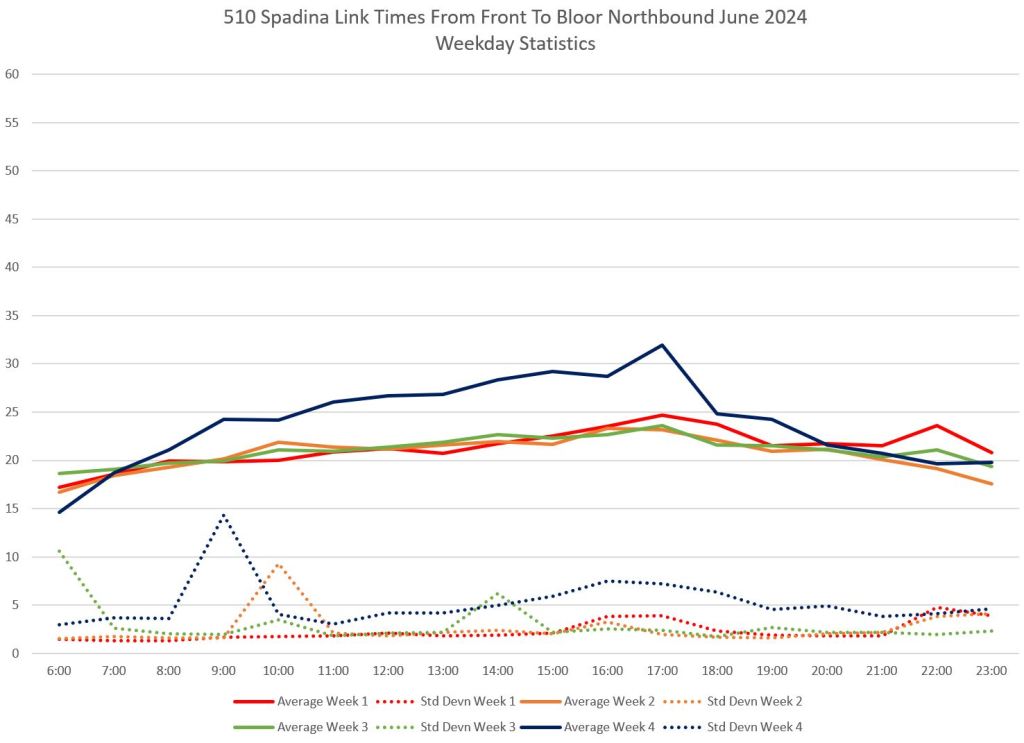
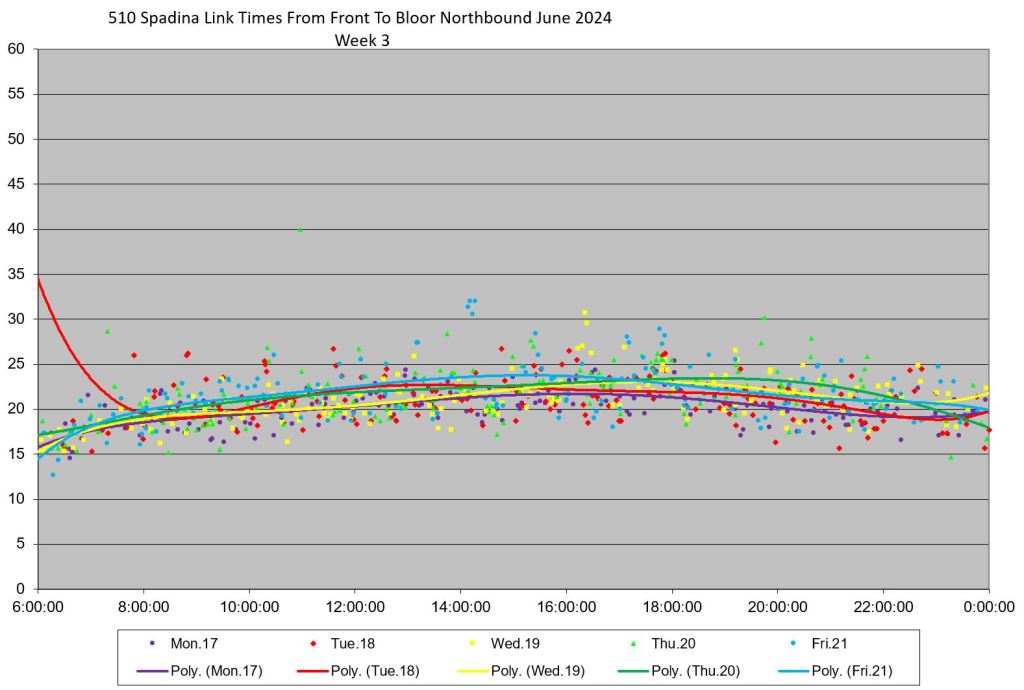
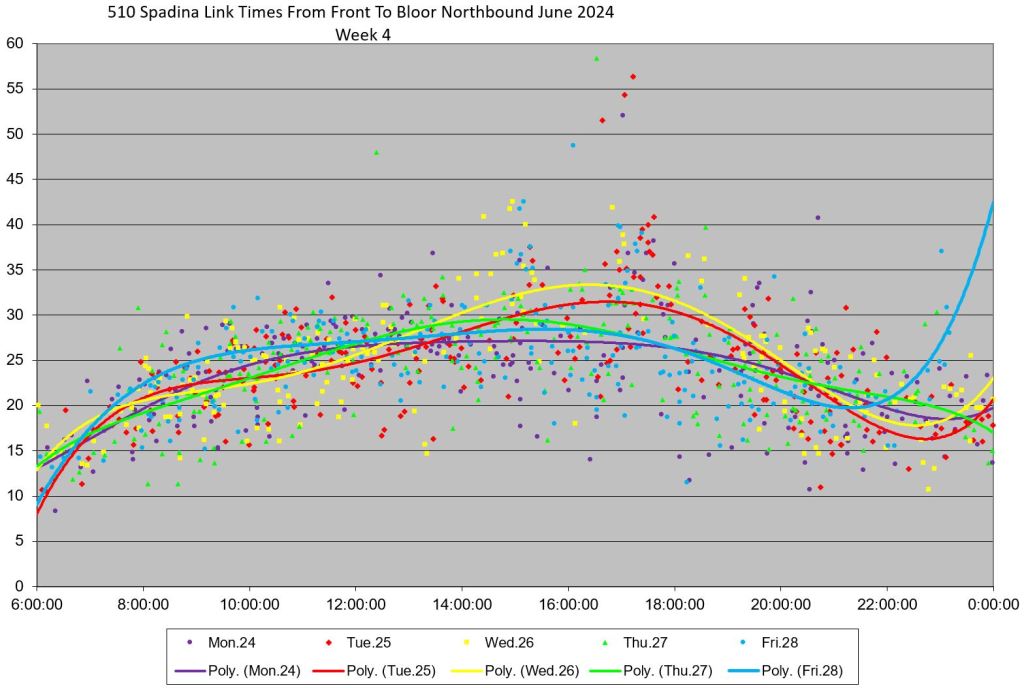
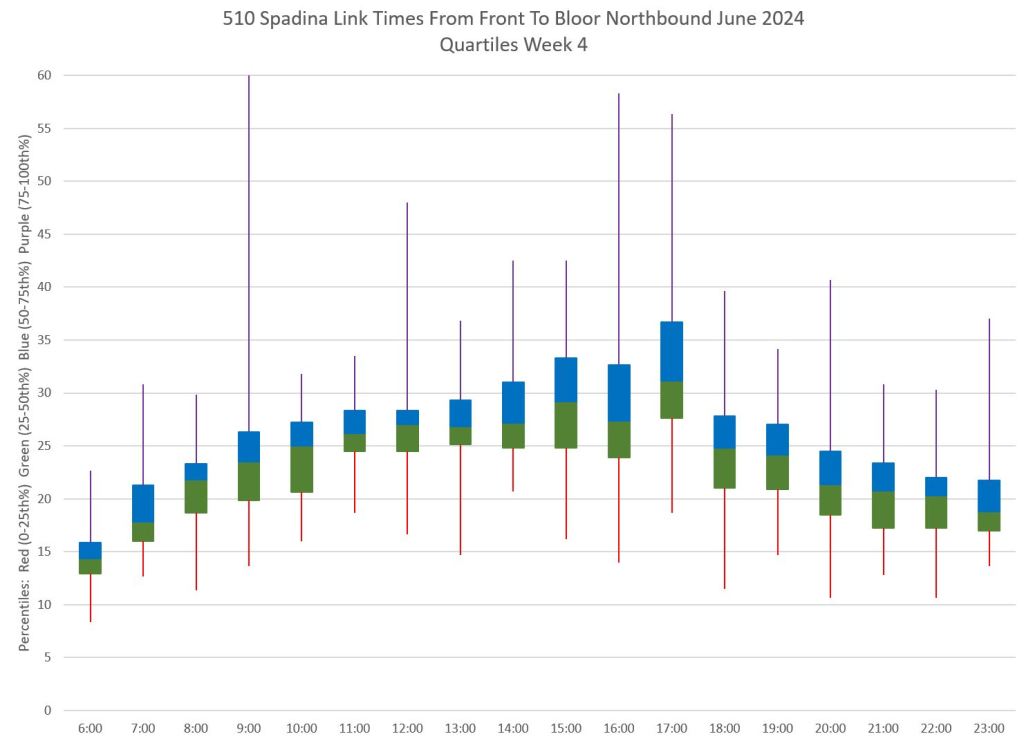
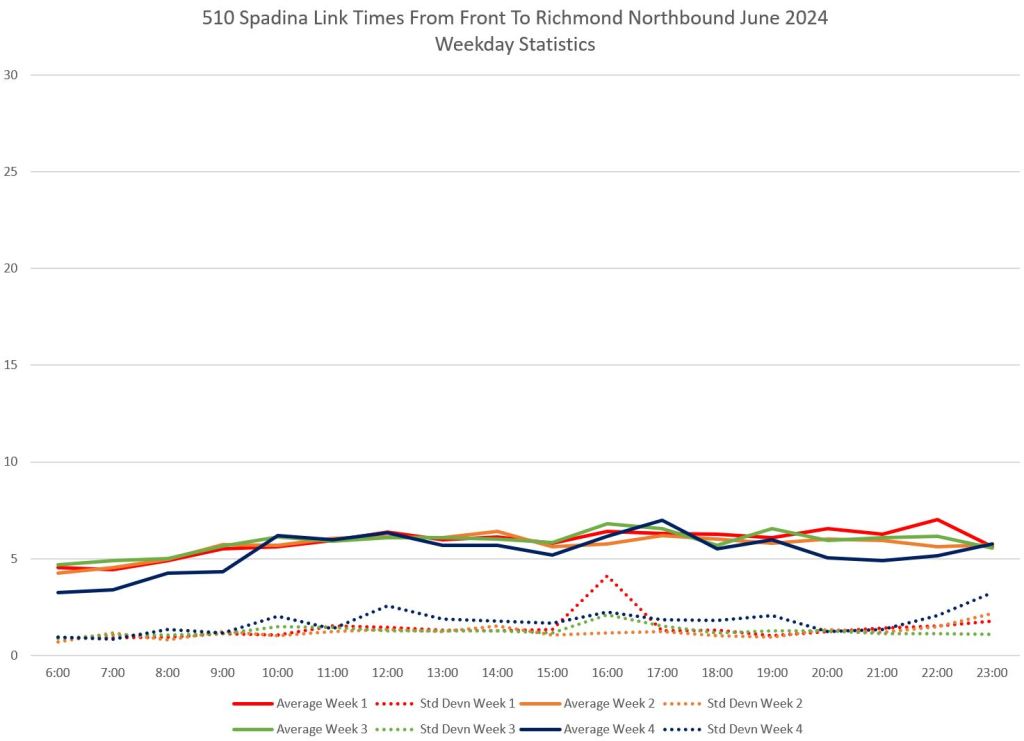
The charts in this section show travel times between Bloor Street and Front Street. This is the portion of the route that is not changing with the new south end loop. Note that the maximum Y-value here is 150 minutes — 2.5 hours (!) — for southbound weekday data in order for all it to fit. Northbound and weekend charts have a maximum Y-value of 60 minutes.
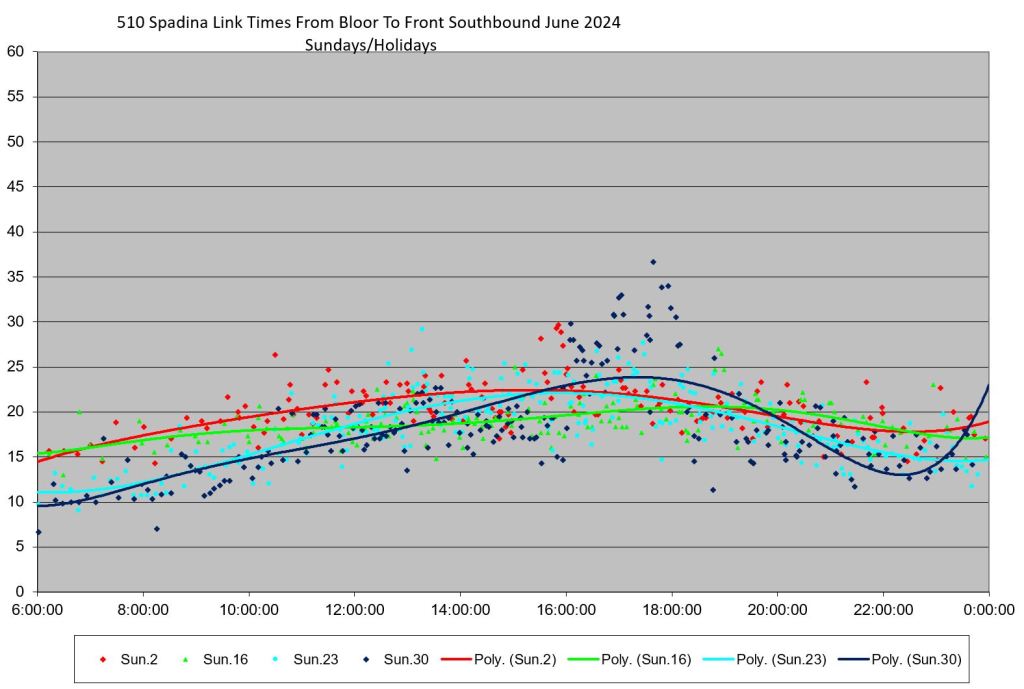
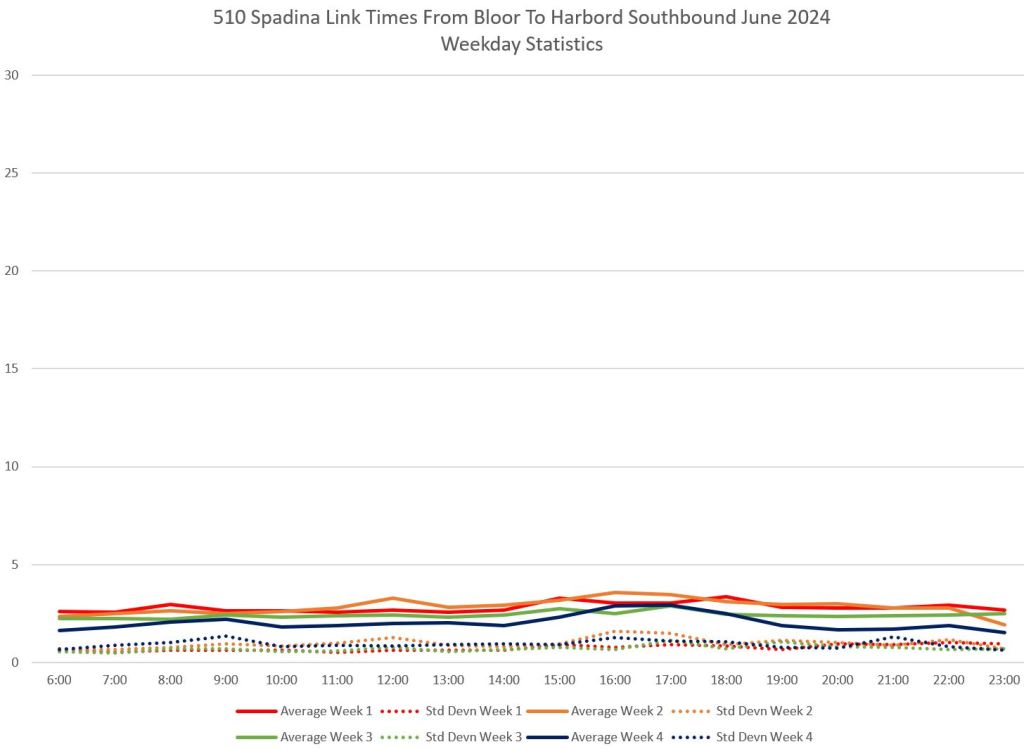
Weeks 1-3 of June were operated with streetcars (red, orange and green lines), while week 4 was operated with buses (dark blue line). There are no data for Sunday, June 9 because all streetcar service turned back at Adelaide/King.
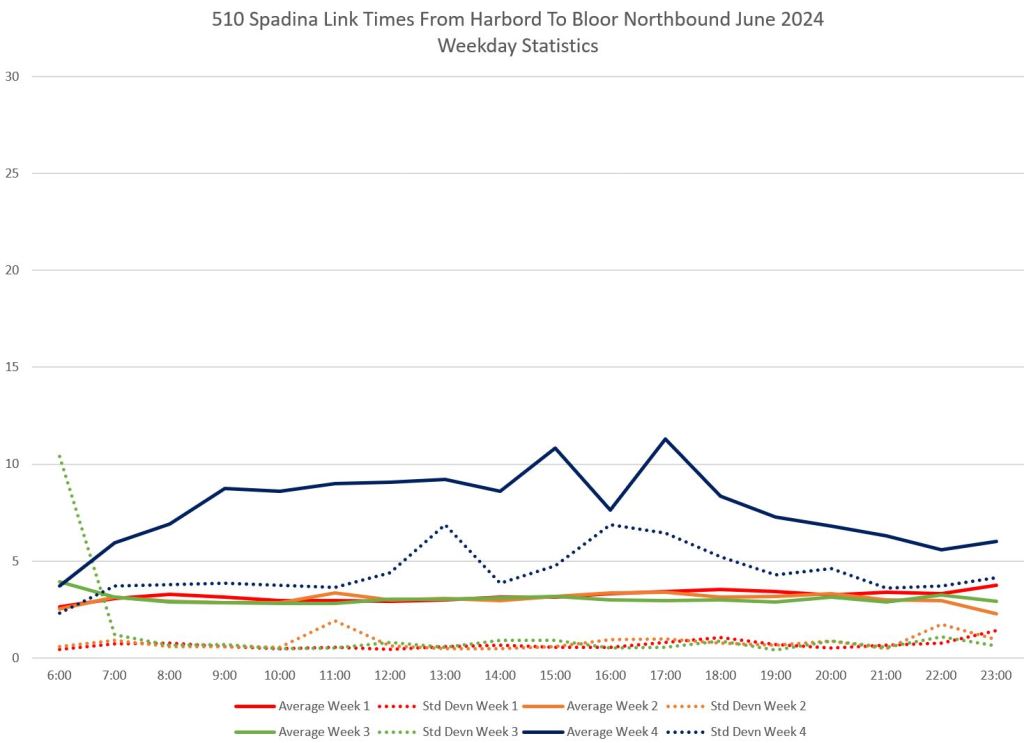
The first pair of charts show the weekday statistics — averages and standard deviations by the hour — for each direction. Note that week 4 lines above the other weeks, but not during all periods. Again, note that the northbound chart has a maximum Y of only one hour while southbound has a 2:30 maximum.
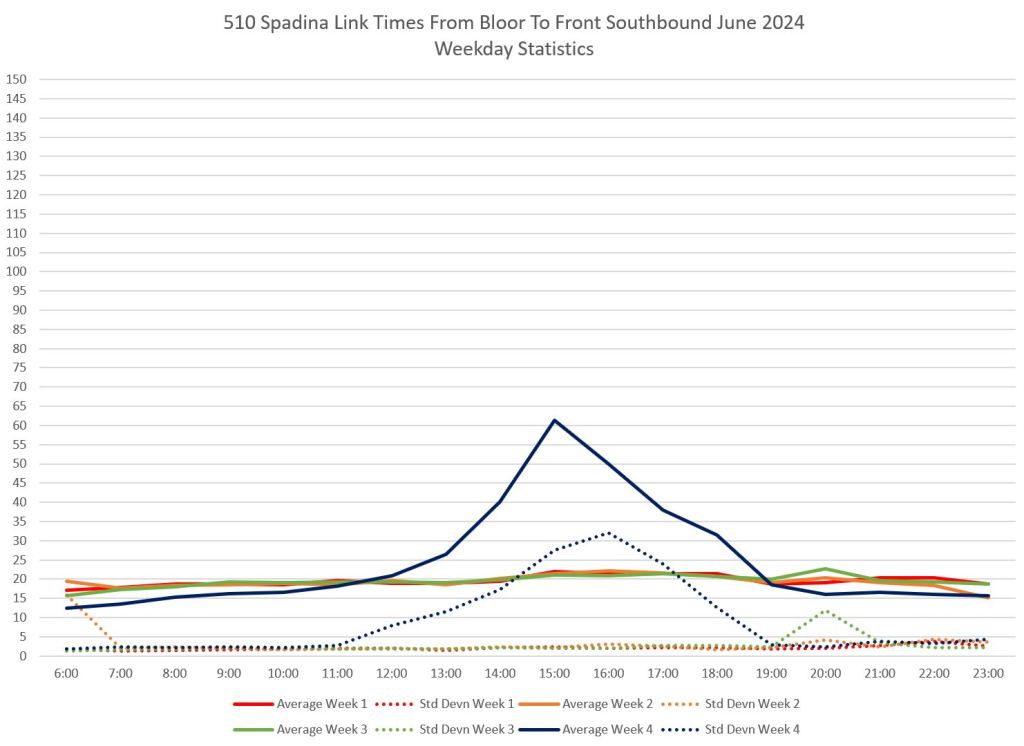
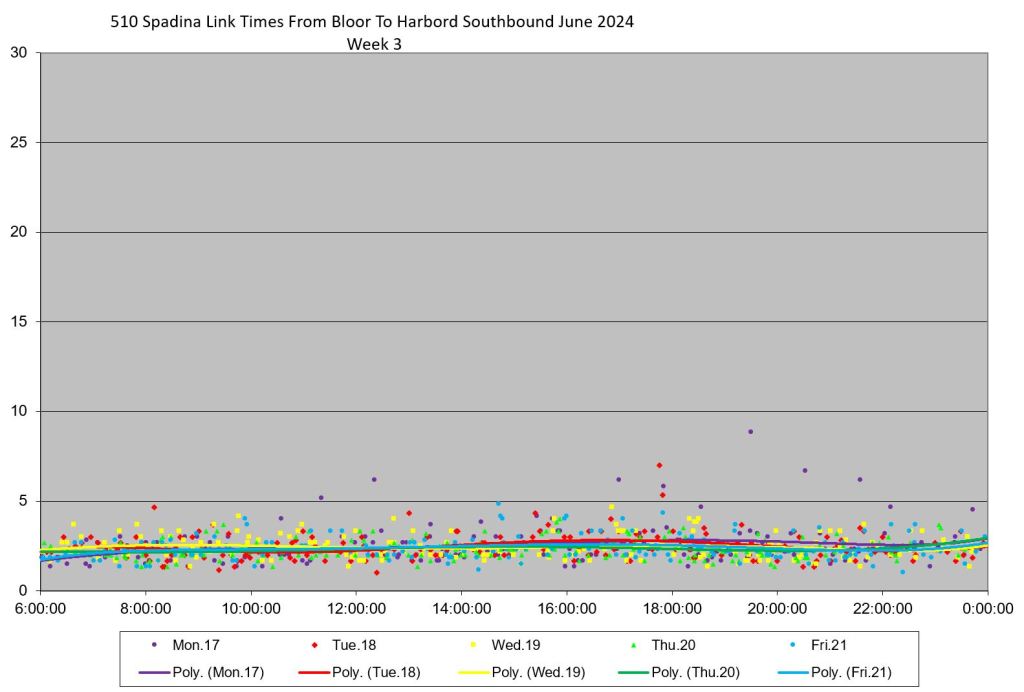
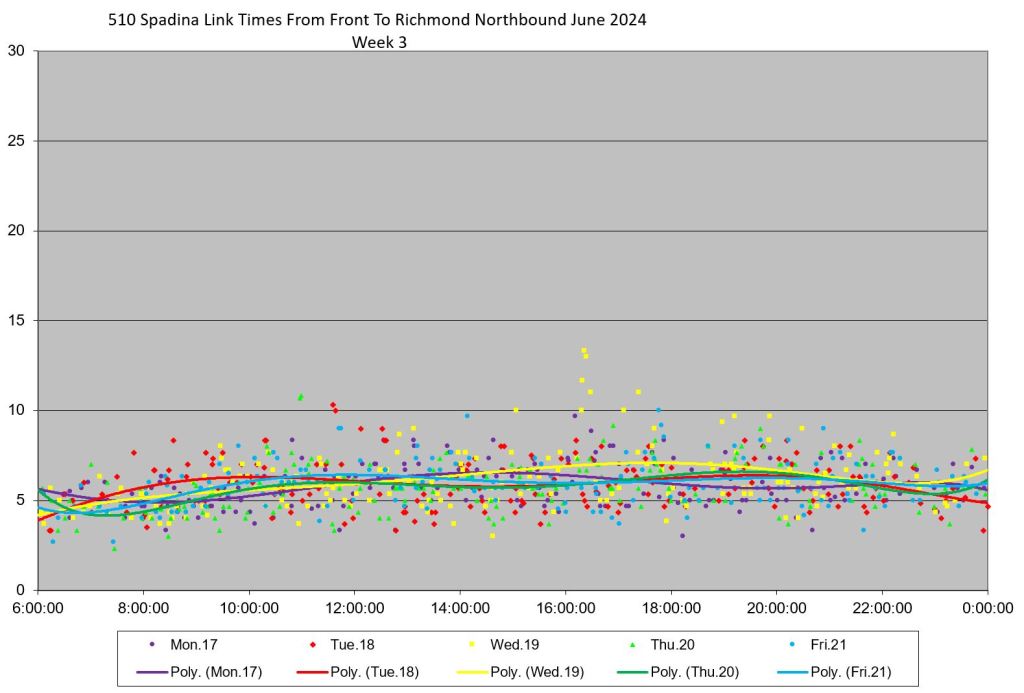
The next set of charts shows the data for weeks 3 and 4, as well as the weekends southbound. Quartile plots are included for the weekday data, and they show how much more regular travel times were with the streetcars, not to mention much faster.
However, weekend travel times for buses were generally faster except in the late afternoon.


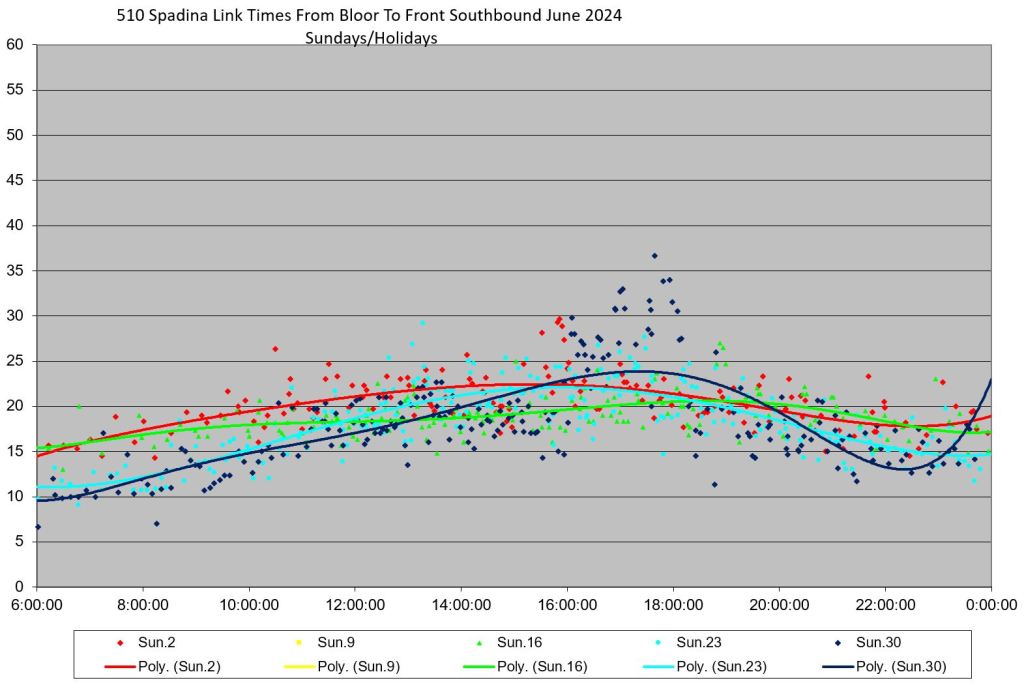
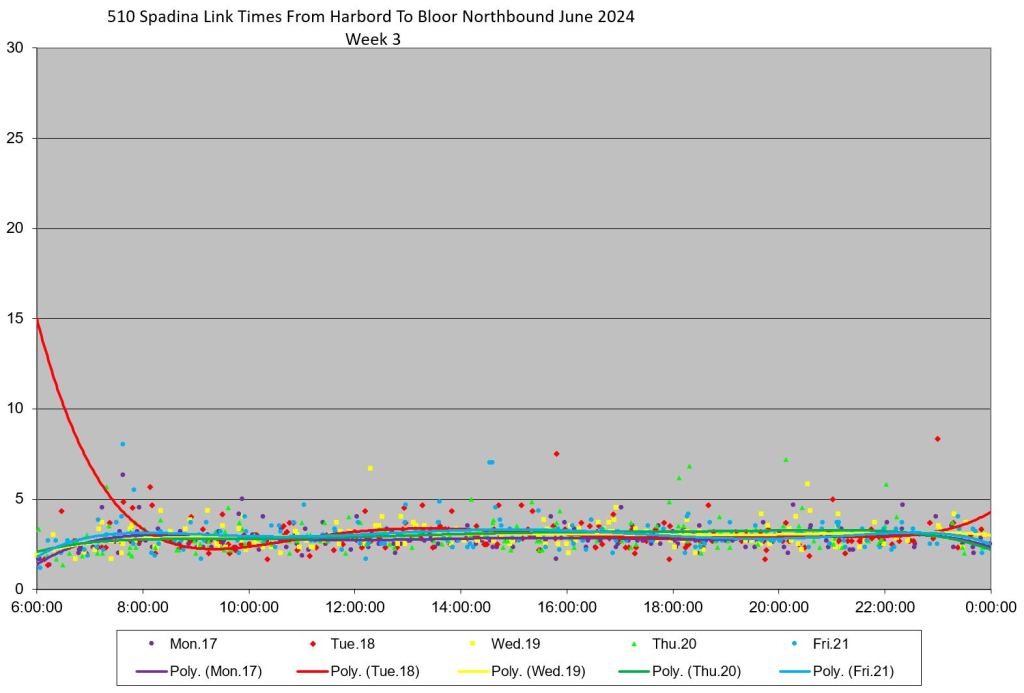
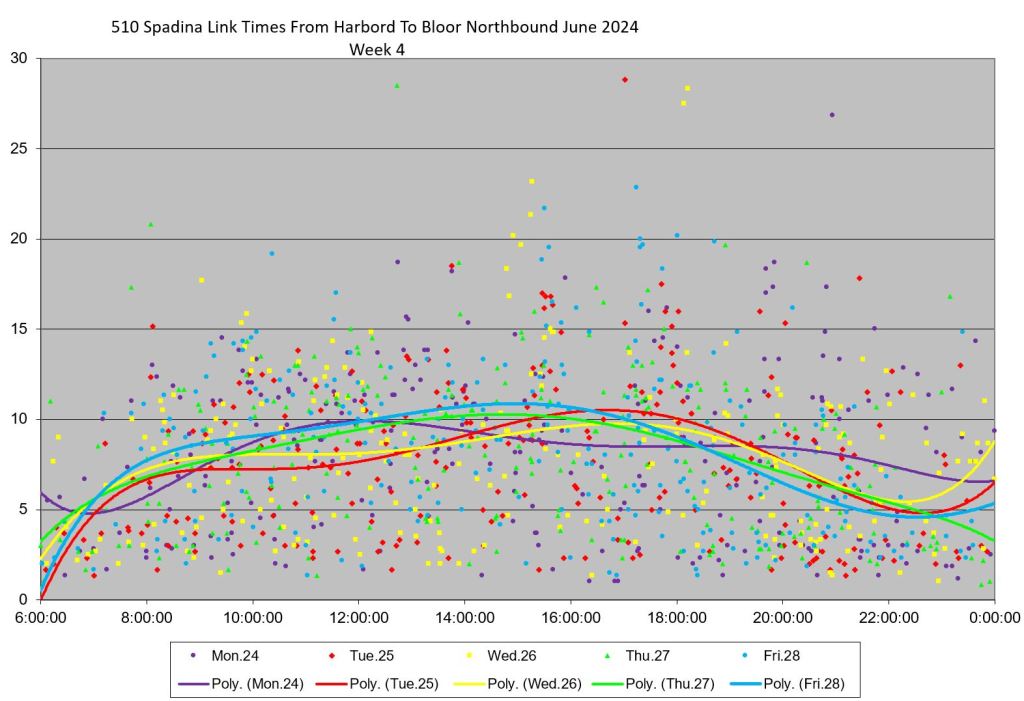
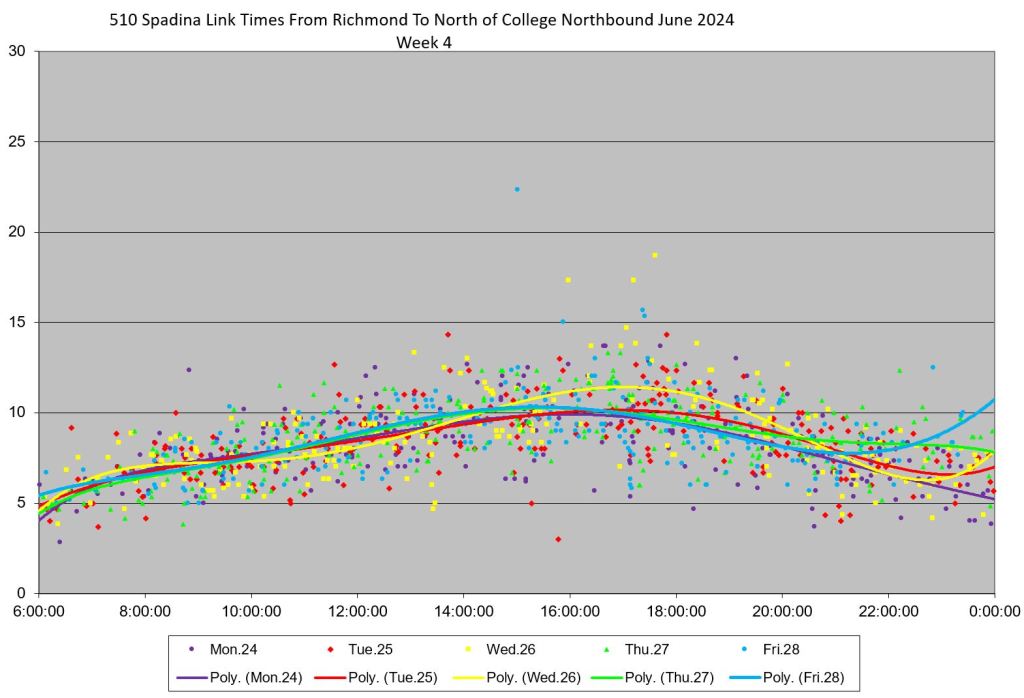
Here are the corresponding charts for northbound service. Running times are not as extended as for southbound trips, but the values are more dispersed in week 4 than week 3. Weekend northbound trips have similar trendlines for the bus trip times (June 23, 29 and 30) but with wider scatter.



Bloor to Harbord
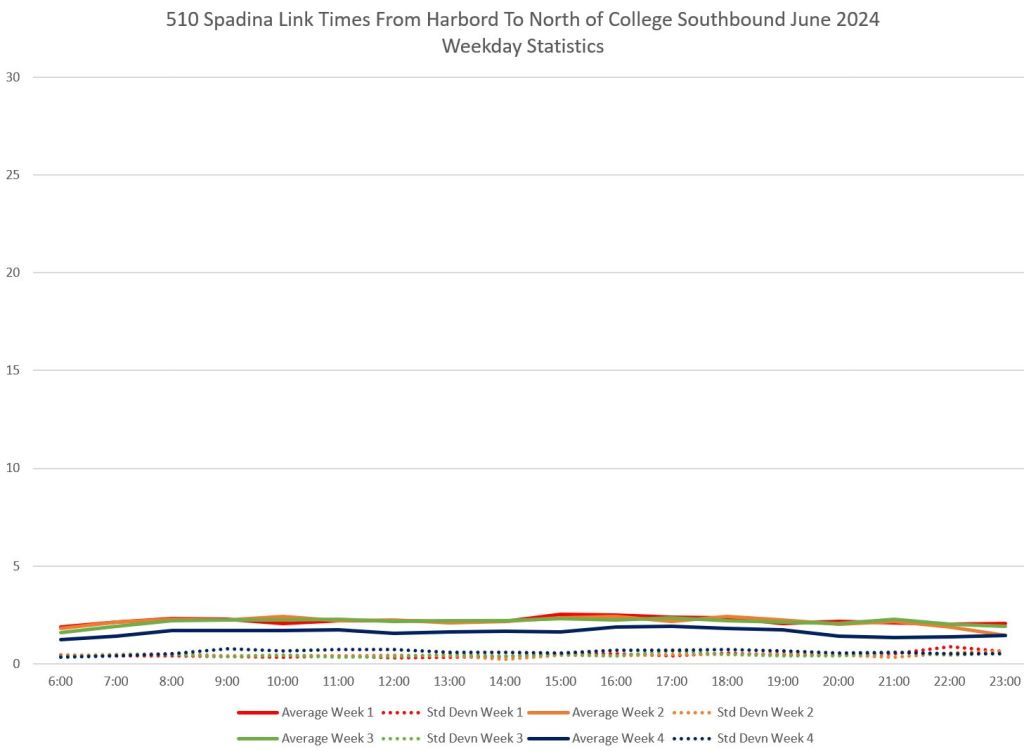
Southbound over this segment, the average bus time is slightly better than the streetcar time. However, northbound the buses are often caught in traffic, and there is a wide range of travel times for most of the day.

Harbord to College
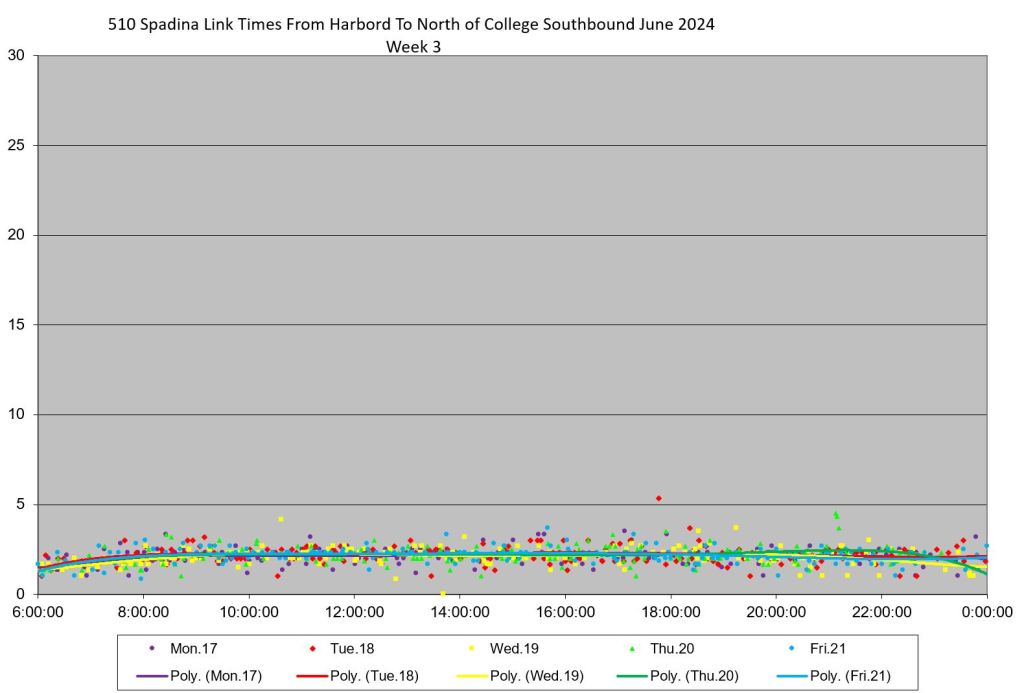
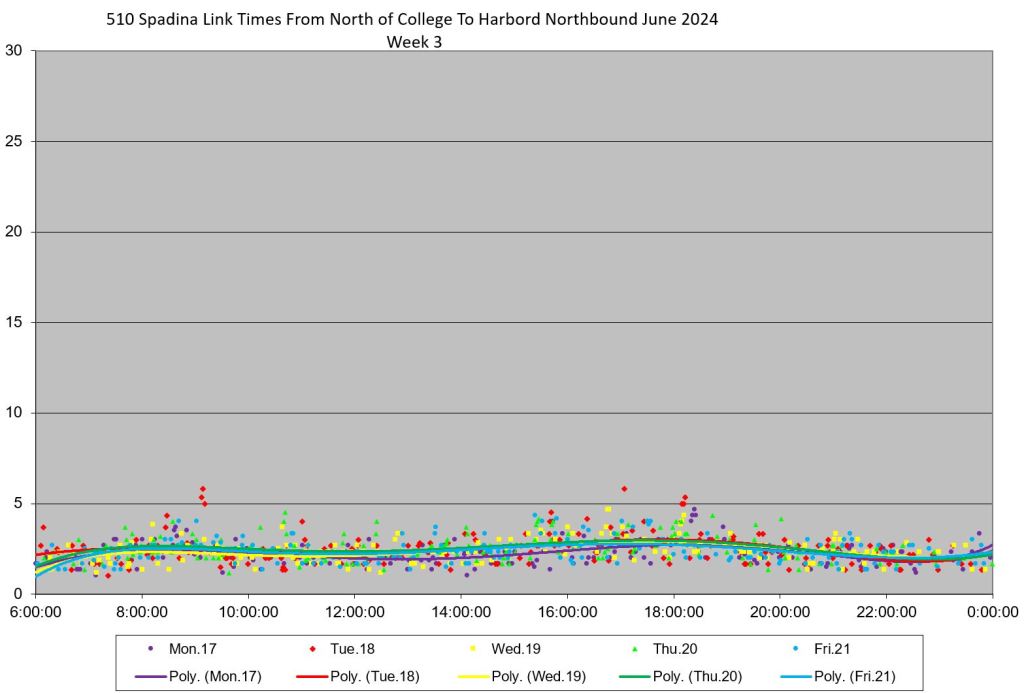
In this short segment, there is little difference in travel times between streetcars and buses in both directions.



College to Richmond
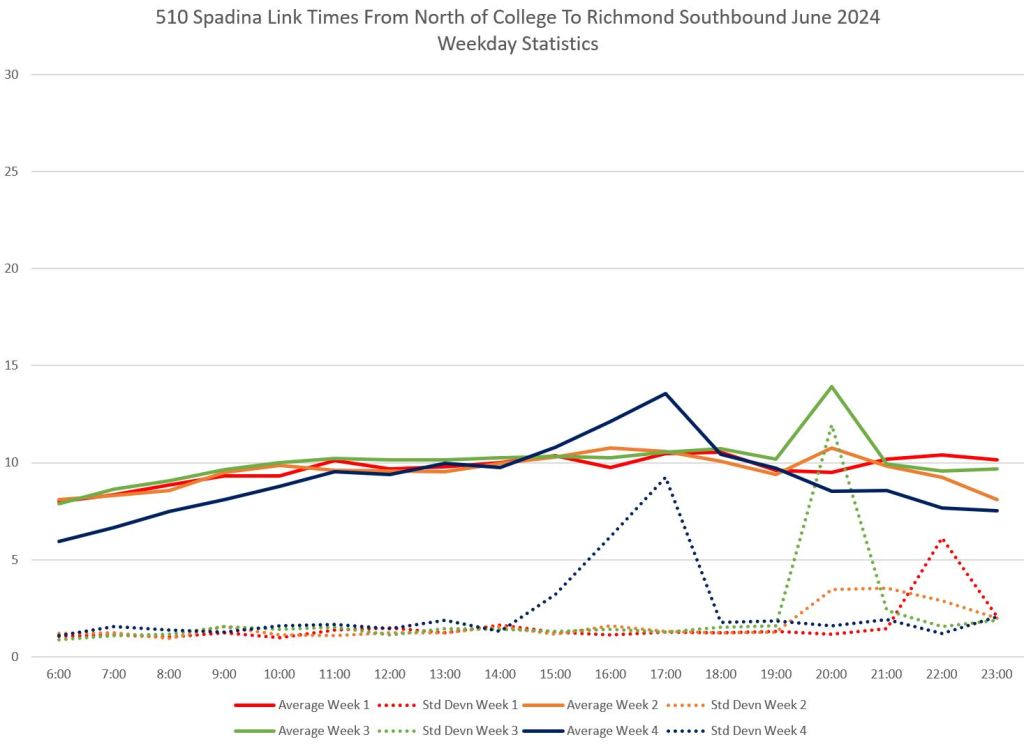
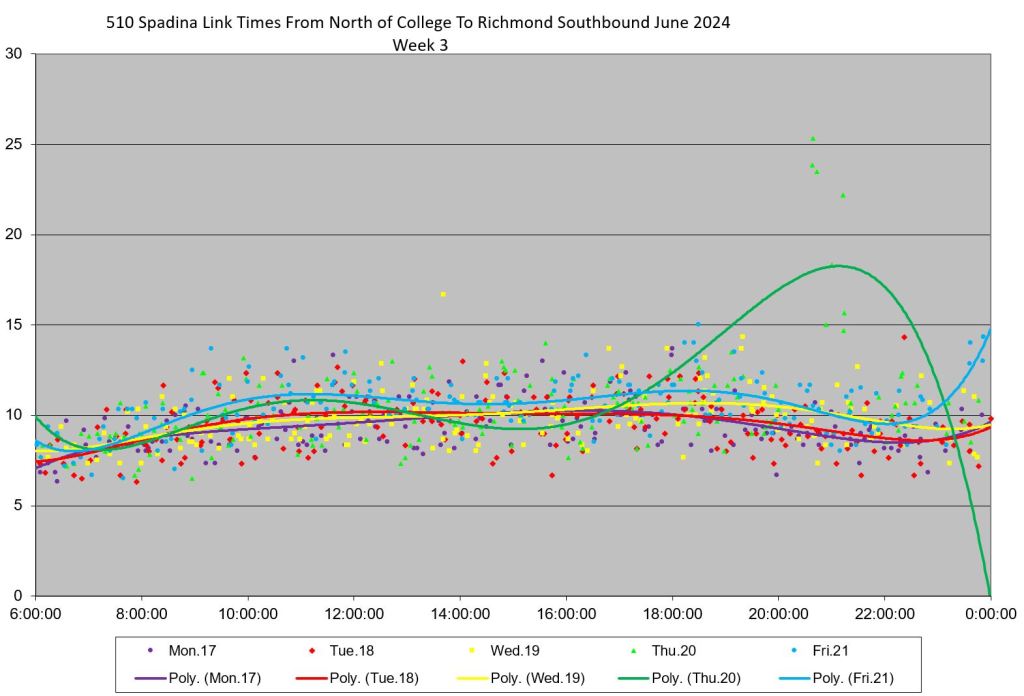
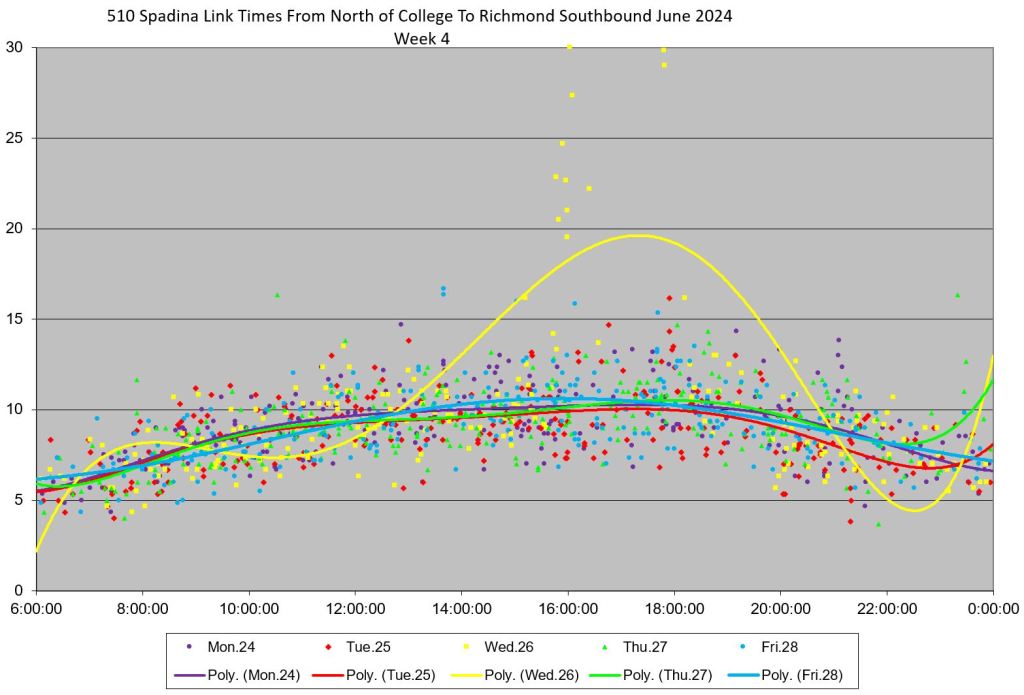
From College to Richmond, buses win out most of the time except late afternoon southbound when congestion from the Gardiner ramp can back up to Queen Street.
The rise in streetcar travel times southbound on June 20 (green) was caused by a service hold for a security incident.
The rise in bus travel time on June 26 (yellow) was caused by congestion from the Gardiner ramp backing up, at its height, to about Sullivan Street (see detailed charts of this day’s operation later in the article).


Richmond to Front
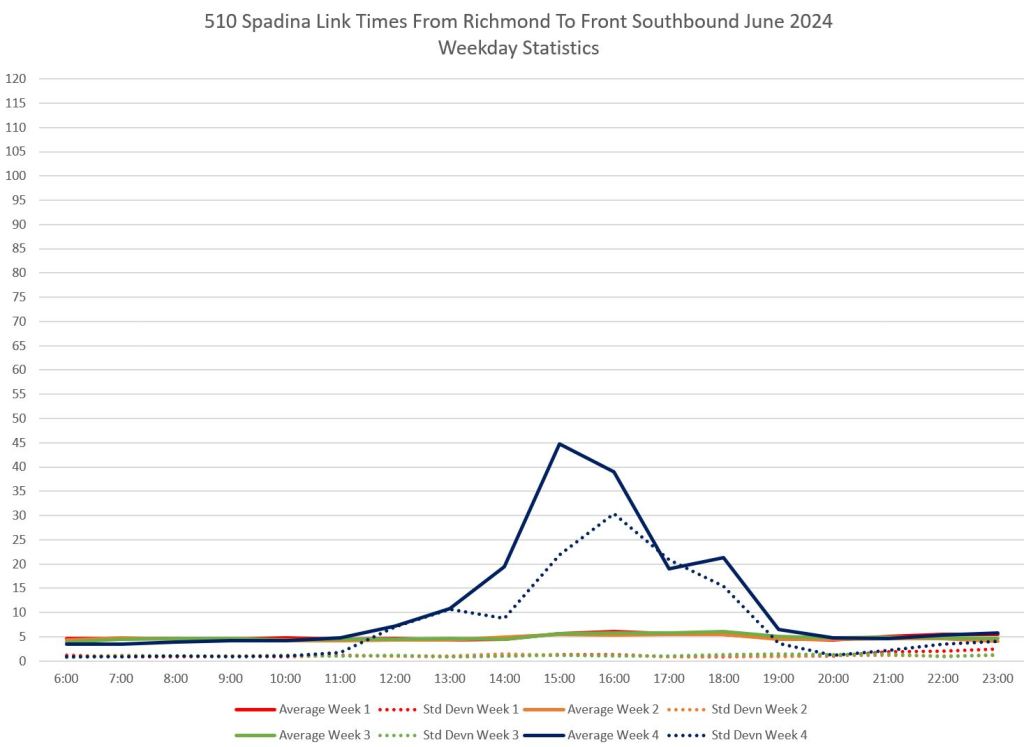
Southbound travel times here in week 4 were appallingly bad with the average hitting 45 minutes between 3-4pm. Northbound times for buses were similar to streetcar times.
Note that the southbound maximum Y value is 120 minutes so that all of the data points will fit.


Tuesday, June 18, 2024
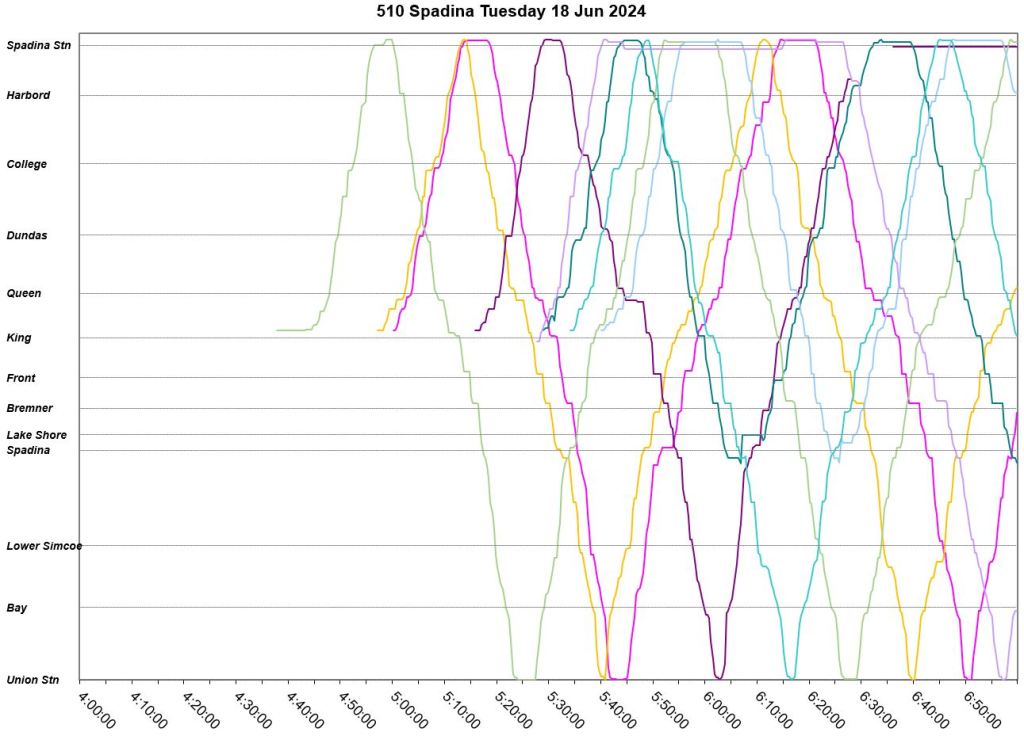
This chart shows the details of streetcar operation on Tuesday, June 18. There are no service interruptions, but there is some unscheduled short turning southbound via Adelaide, Charlotte and King in the PM peak and early evening.
Note that cars do not spend long at Union Loop (bottom of the charts) because this is shared with 509 Harbourfront, and layovers are taken mainly at Spadina Station (top of chart). There are a few cases where cars sit for extended periods in the runaround track at Spadina Station (long horizontal lines)




Tuesday, June 25, 2024
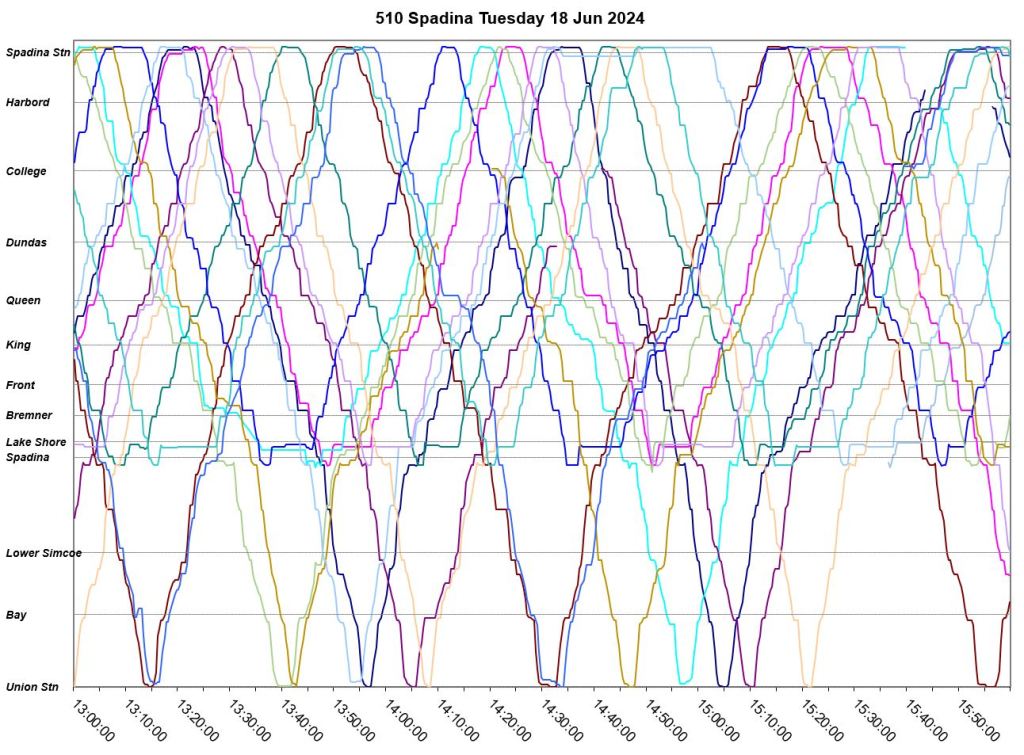
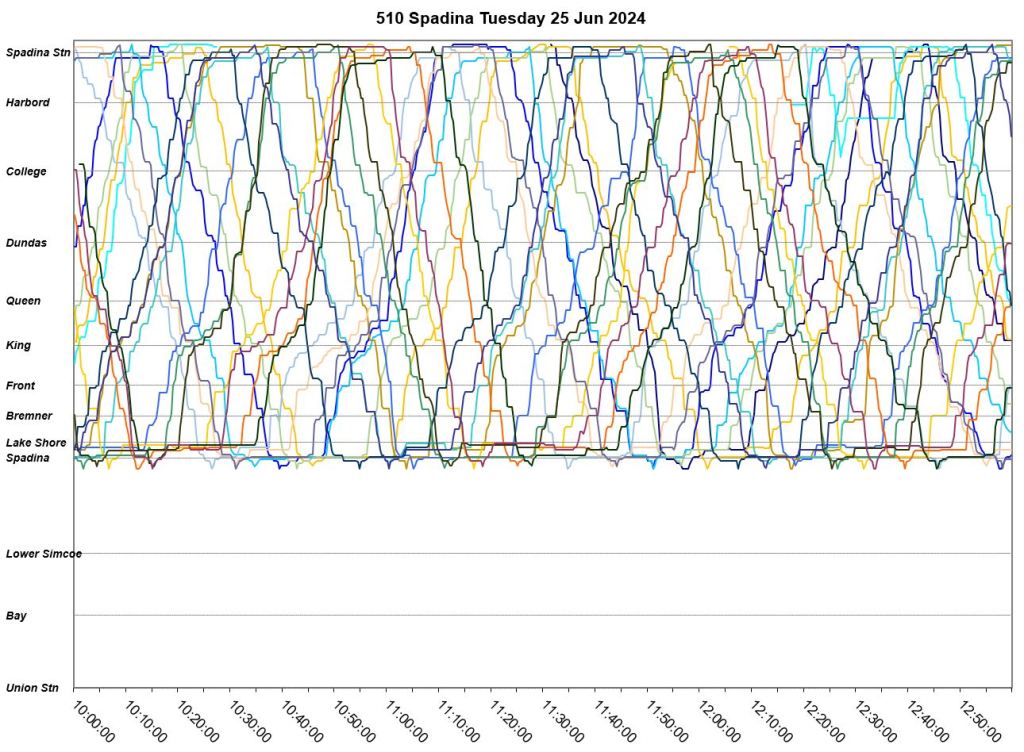
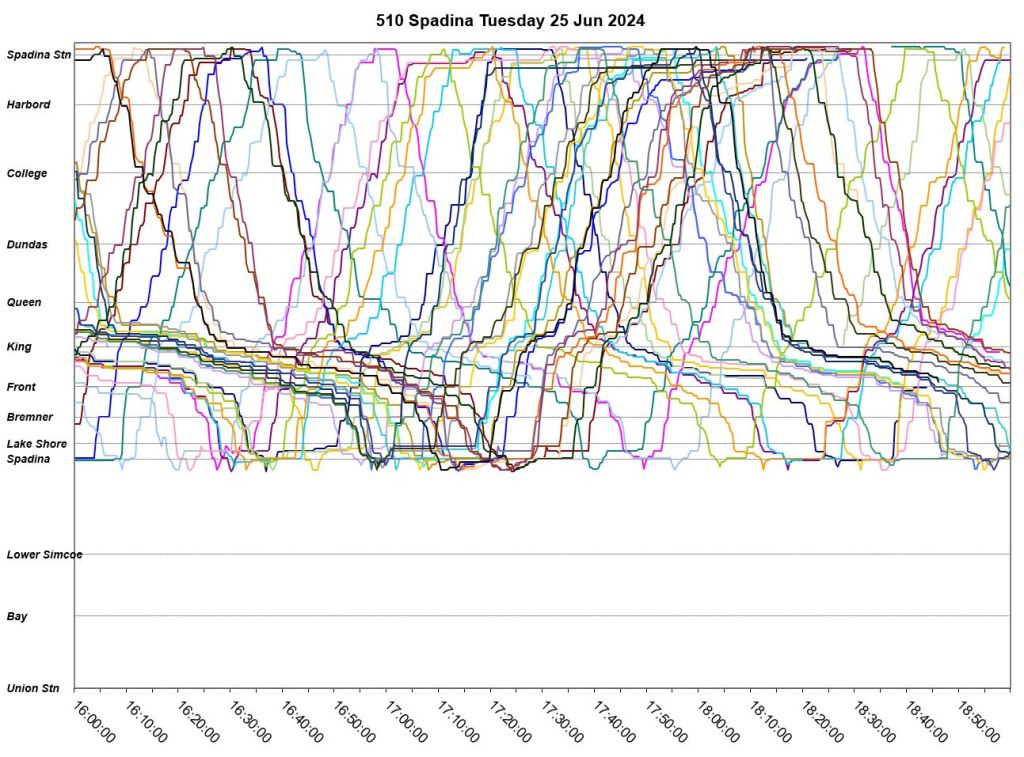
One week later, on June 25, this is the operating chart for the bus service. A small amount of congestion (visible by the change in the slope of the lines) appears northbound between King and Queen in the late morning, but this dissipates. The real problem shows up just before 2pm southbound with very slow progress from King to Front, then later from north of King to Bremner. This persists until early evening. There is also a small amount of congestion northbound from Harbord to Bloor late in the PM peak. It appears that this is in part caused by buses being unable to reach Spadina Station Loop.
A consistent point in the charts of bus operations is that the primary congestion occurs southbound on Spadina north of Front. This is likely caused by traffic from Front Street turning onto Spadina and filling any available space in the Gardiner queue making it impossible for traffic from Spadina north of Front to cross the intersection. Unless buses were to use the streetcar right of way (which is not encumbered by centre poles north of Front), they will would be stuck in this queue regardless of any transit priority at the Front Street intersection for the proposed alternate route east on Front to Blue Jays Way.





Wednesday, June 26, 2024
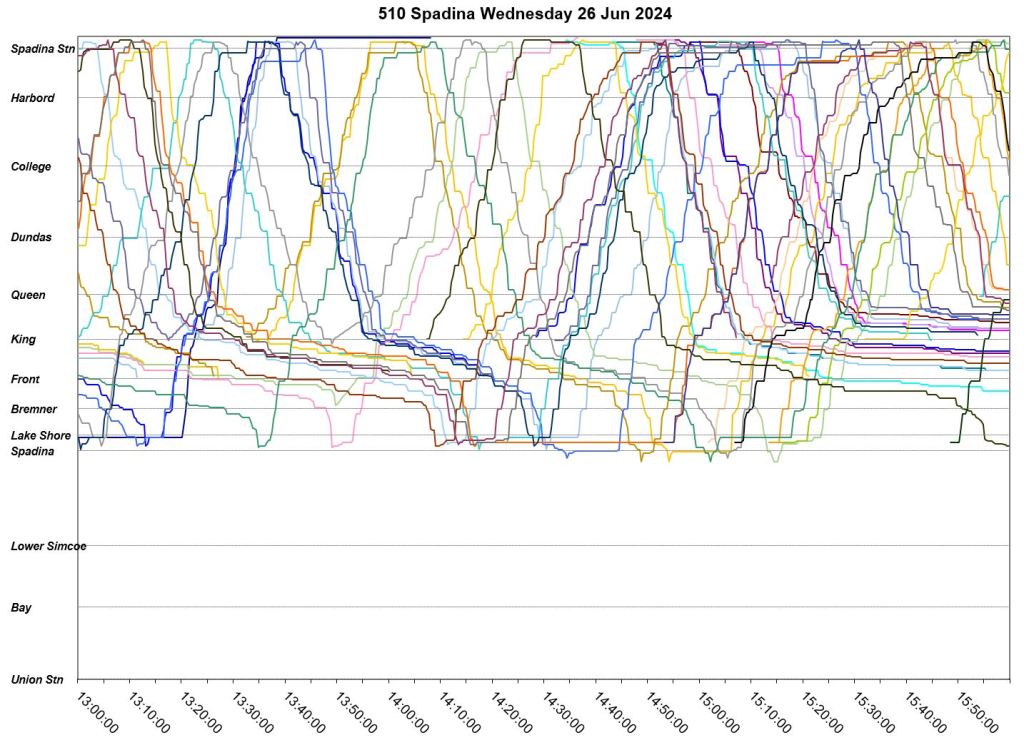
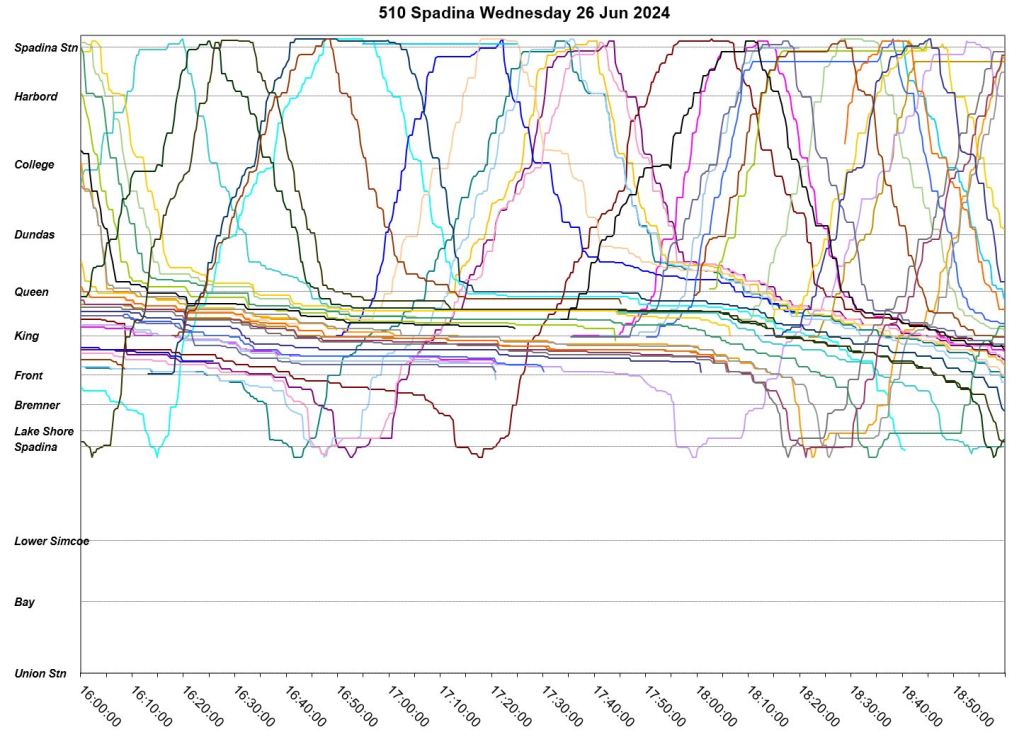
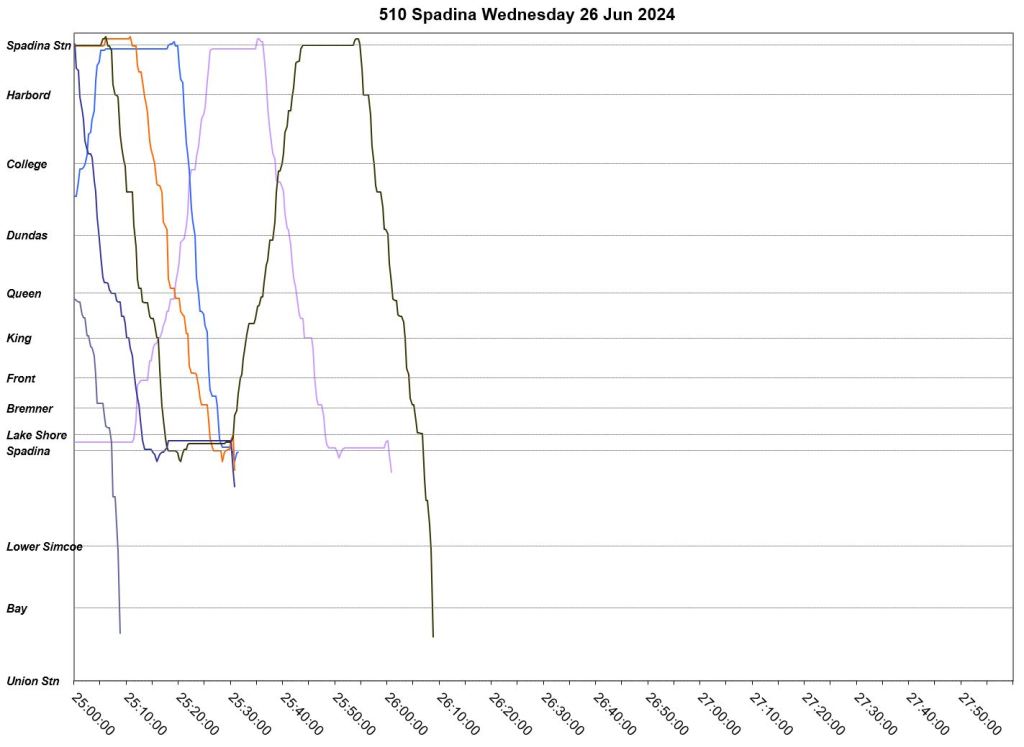
June 26 was the worst day for congestion on the south end of Spadina within week 4 (see day-by-day charts above). The congestion begins at about 12:30 and quickly spreads north of Front to King, then to Queen. Between 3 and 6pm, many buses are almost motionless, and the gridlock does not start to break up until after 6pm, clearing finally by 8pm. As on Tuesday, there is slow operation northbound to Spadina Station that appears to be caused by bus congestion. This problem disappears because most of the service is stuck in the south end traffic jam.




Saturday, June 29, 2024
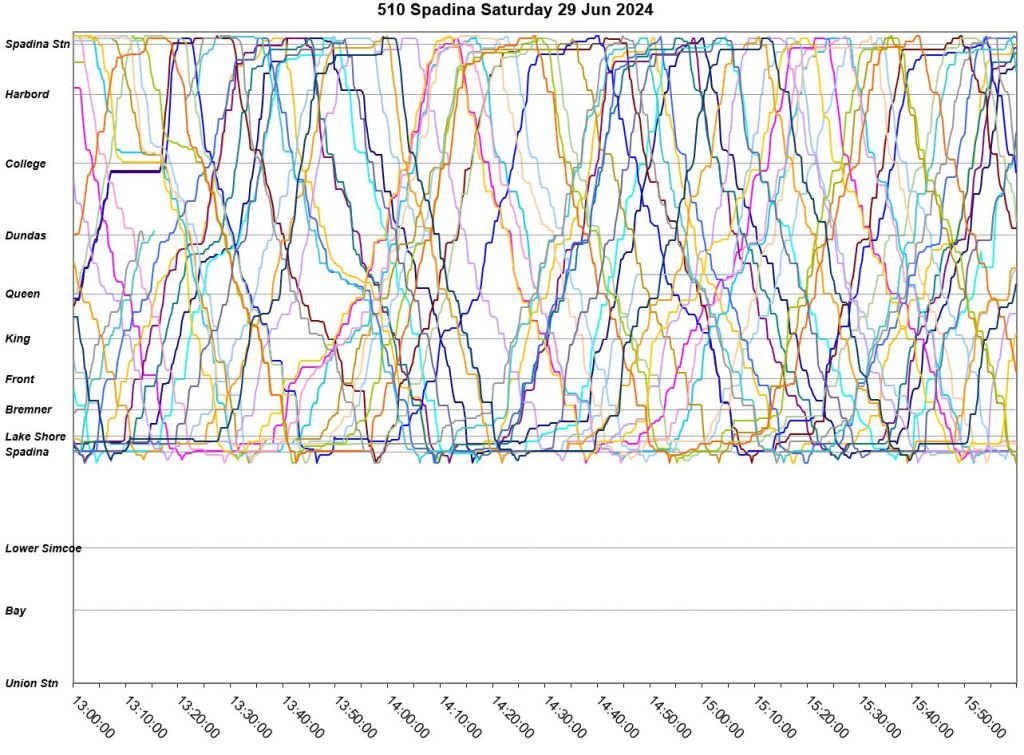
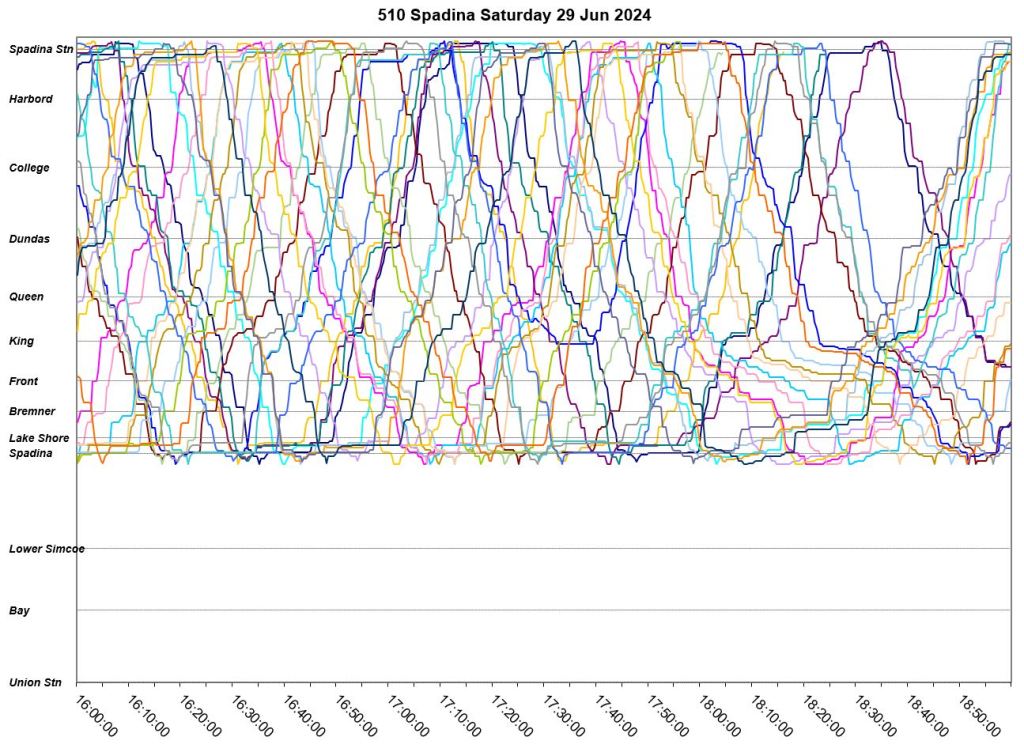
The only Saturday in June that operated with buses was June 29. Some Gardiner congestion effects are visible late in the afternoon, and the problem lies mainly between King and Front Streets. Later in the evening, there is severe congestion between Queen and King southbound causing bunching of most service in a pack after midnight.




 Steve Munro
Jarek left this comment in another thread:
LikeLike
It’s good start, trying to avoid the worst stretch of Spadina at the worst time of day. However, I can say from experience the routing the TTC picked might as well have been the status quo.
On two consecutive weekdays in June, I had to drive in that exact area. In the 6pm hour, it took 30+ minutes to get from Peter and Front to the Spadina onramp for the Gardiner. It took ~5 minutes to cross Front St (so good luck making a right turn on Blue Jays Way), and I was staring at the bronze sculptures of the Rogers Centre for 15 minutes, with me moving an inch at a time down Blue Jays Way. Unless the City plans to temporarily closed Blue Jays Way in the PM rush save for TTC, emergency vehicles, and local vehicles, this will just be an exercise in futility.
Also, after reading the link times between Richmond and Front southbound, I had to check: Google Maps suggests an typical walking time of 9 minutes. Much shorter than a 45 minute average spent sitting on the 510 replacement bus.
LikeLike
How did you get tracking data for June 24-29? I believe NextBus was down/unavailable between these dates. I still can’t see the 510 tracking history for these dates on Transsee (I ask because when I saw the TTC announcement I also wanted to check just how bad was the gridlock but I couldn’t).
Steve: I get the tracking data in a separate extract from the Vision data archive as a monthly block export for specifically requested routes, not from the live feed. TransSee was down because NextBus, on which it depends for its feed, was not receiving data from the TTC.
There are two real-time data feeds, one to NextBus and another that is only available to a few apps such as TransitApp. Something happened to the NextBus stream when TTC switched to the June 23 schedules, but I have not heard anything definitive about what it was.
LikeLike
For the delays northbound between Bloor and Harbord, there is currently construction at the intersection of Spadina and Bloor on the South-East and North-East corner. This has caused a reduction by one lane.
This is likely partially to blame for the delays as usually this section of road isn’t too bad even during traffic.
Hopefully when construction is done the buses won’t be delayed too much.
Steve: Thanks for the info.
LikeLike
Why not use the regular 510B loop at Charlotte or if not that use the right-of-way southbound to King and loop via Peter and Richmond? It’s too bad they can’t use the old 77A rush hour loop at Clarence Square.
Too late as always.
Steve: I really don’t think that they understood how far north the congestion backlog reaches. I think that they’re trying to minimize walking distance, but if the loop were Adelaide, Peter-Blue Jays Way to Spadina, they would wind up at the same place without driving through the worst traffic.
LikeLike
There’s so many possible options here that I really do wonder if the route planners get out at all. Like, I get that running buses on right-of-way isn’t easy, but run them on ROW southbound to Front (there’s no centre poles north of Front), and return in traffic lanes northbound, or something.
How much of a fit problem are the centre poles, anyway — what’s the clearance, what’s the width of the buses? From what I could find (admittedly, 3 minutes on Wikipedia), Flexitys are 2.54 m wide and Nova LFSes are 2.59 m wide. 5 cm more? Are the bus mirrors wider? I understand that rail vehicles are guaranteed to always be on the right alignment, but a bus carefully going down the ROW at 10 km/h would still be much better than not moving at all in the car sewer.
LikeLike
The TTC posted a couple of pictures on X illustrating how tight the clearance is when two buses pass each other on the ROW, even when there aren’t any centre poles. Fair enough. But if the biggest problem is southbound, could you not run southbound service in the ROW (at least as far as Front) and northbound service in mixed traffic?
Steve: Yes, they could.
LikeLike
We get to watch the Front/BlueJay intersection from several stories up. The routing change will likely only help because it avoids service completely on Spadina south of Front. The re-route, however, will add to the congestion on BlueJay southbound after Front. This is already badly congested, and is only a single lane.
Drivers passing through that area indicate that they are seeing an additional problem where traffic from Bremner westbound turns south on Spadina. The traffic agents there are overriding the traffic advanced green, holding the westbound, left-turning, traffic, and starting pedestrians crossing against a pedestrian no walk signal. Once the light goes full green, the west/left traffic is further held up. This backup pushes back across Bremner, up Navy Wharf Court, then back up Blue Jay, stalling the Front/BlueJay intersection, and pushing congestion well up BlueJay towards King. The re-routed buses will be in this congestion between Front and Navy Wharf.
LikeLike
I would expect the naysayers (aka streetcar safety crew) to point out that that the streetcar proceeds straight through Front, with no provisions for turning. I suspect that making a left turn from the streetcar ROW will be tricky anyway, given traffic and the lack of a turning signal for the ROW. So in this case the naysayers may have a valid point.
Steve: All that is needed is a new aspect on the signal for a transit left (a white bar). The TTC should have thought of and asked for this months ago while this scheme was in the preliminary stage. Far too often with diversions we muddle through half-assed implementation and make modifications after screwing up service for weeks.
LikeLike
Unfortunately I’m not surprised at all that it takes 45 minutes to go *600 meters* on an average afternoon rush.
That’s 0.8 km/h. Zero. Point. Eight.
Drivers have been complaining about this for years and, while I have a lot less sympathy for single occupant vehicles in most cases, this level of congestion is simply unacceptable even for them.
LikeLike
One would think that if it was unacceptable, drivers would use other methods of transit. Weekday afternoons there is good GO train service heading into the western suburbs. We rightfully grouse about GO’s parking palaces, but workweek drivers heading to and from downtown core is actually the one target market that GO does serve well today.
LikeLike
I don’t think anyone at TTC planning (or whatever group) would have considered installing transit movement signals at Spadina and Front. After all, the brilliant plan was to send buses south to Queens Quay loop. Why would they need to turn at Front? From the right of way? That would be sheer madness!
LikeLike