
Subway service on the central portion of Line 2 Bloor-Danforth was suspended for over 12 hours on Monday, May 13 due to a spill of hydraulic fluid on the tracks. The replacement bus service was swamped by the combination of subway demand and congestion on Danforth Avenue and Bloor Street. The situation was compounded by changing and incomplete information about the extent and potential duration of the problem.
This was initially described as a spill somewhere between Sherbourne and Castle Frank Stations with the impression that the directly affected area was small. In fact, the volume was large, 200L of hydraulic fluid, and the area ran from Spadina to Greenwood Yard (east of Donlands Station). Trains could not operate safely until the rails were cleaned and operators could brake with confidence that trains would actually stop correctly.
This was not the first such incident. At a TTC Board Meeting earlier in 2024, ATU Local 113 had raised the issue of operational safety after a similar, albeit smaller problem in January at Eglinton West Station. Following the May 13 spill, the ATU wrote to the TTC Board raising basic questions about the incident, and by implication how well-informed the Board actually was about ongoing issues with subway safety.
At the May 16 Board meeting, management gave an extensive presentation about hydraulic fluid leaks and the recent increase in the frequency of these events. It is not clear whether such a detailed presentation would have occurred without the ATU going directly to Board members. Management’s credibility and transparency have been open to question following a near-miss incident at Osgoode Station that went unreported to the Board for almost a year, as well as track and infrastructure problems including the SRT derailment, and the need for ongoing slow orders due to problems with subway track.
CEO Rick Leary has retained external consultants, Hatch LTK, to review these incidents, and there will be a peer review by APTA (American Public Transit Association).
A much broader concern is subway delays of various types and how they are handled. Some have external causes (passengers wandering at track level, for example), but some are “own goals” in the sense that they arise from operational or infrastructure issues that could have been prevented. Whatever the reason, all of them strain the subway’s ability to provide reliable service. This works directly against the drive to restore transit’s credibility and attract new and returning riders.
Far more is needed than free Wi-Fi here and a new kiosk there. Creature comforts are nice, but the service must be trustworthy. The TTC’s fundamental job is to move people. The lion’s share of delays might be due to external factors beyond the TTC’s control, but how they react to delays is key.
The Work Car Fleet and Leak Incidents in 2024
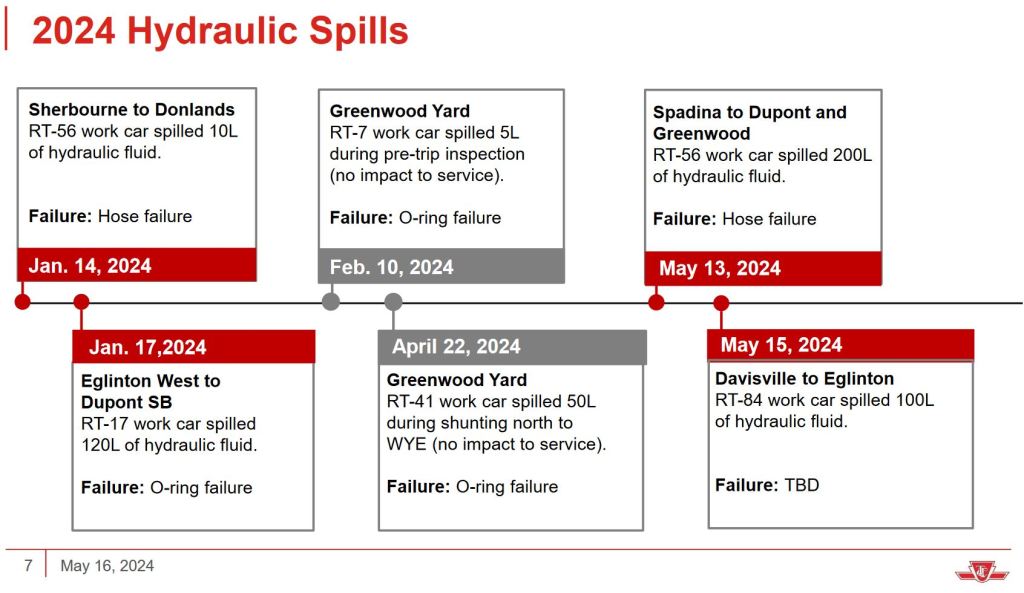
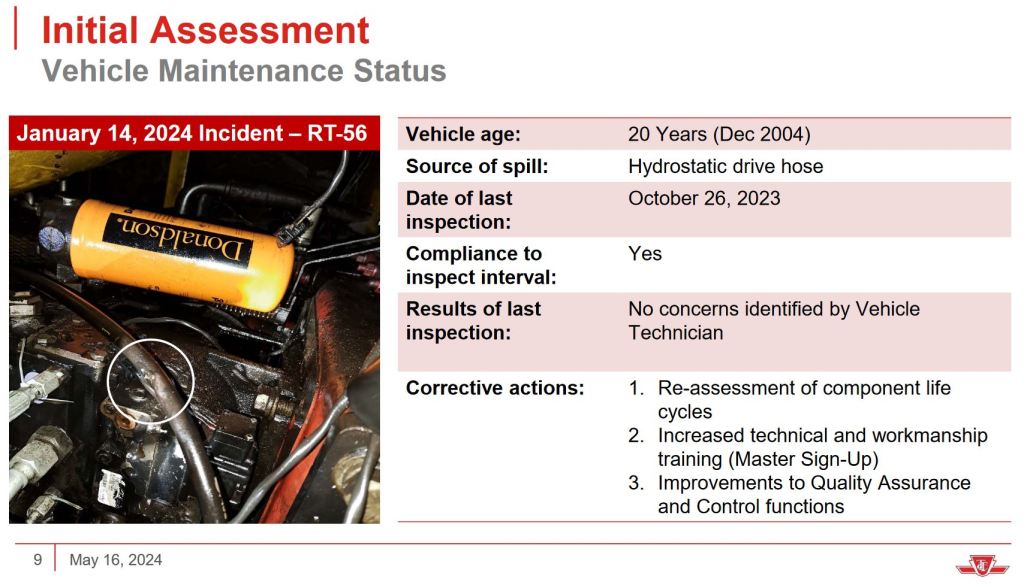
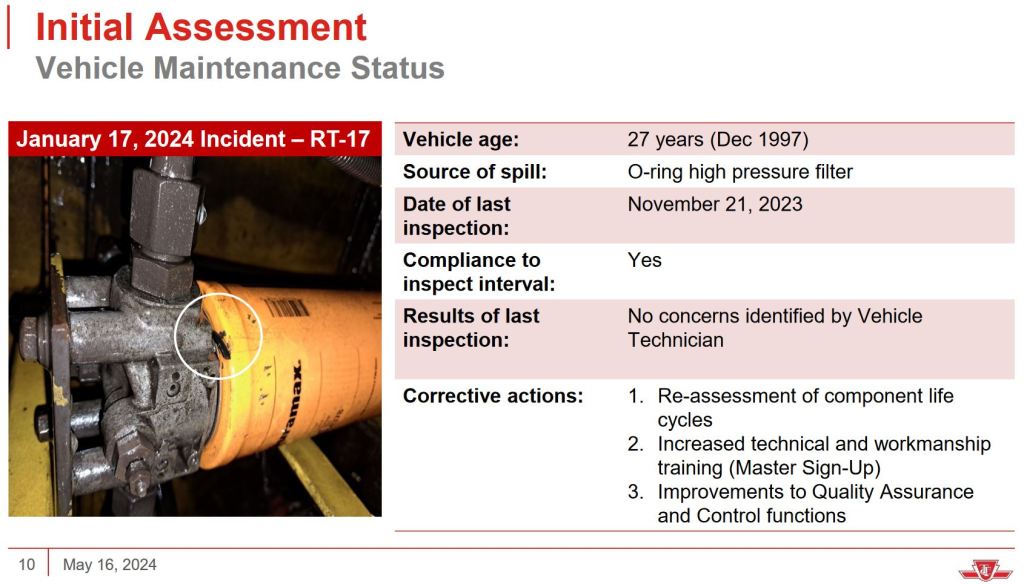
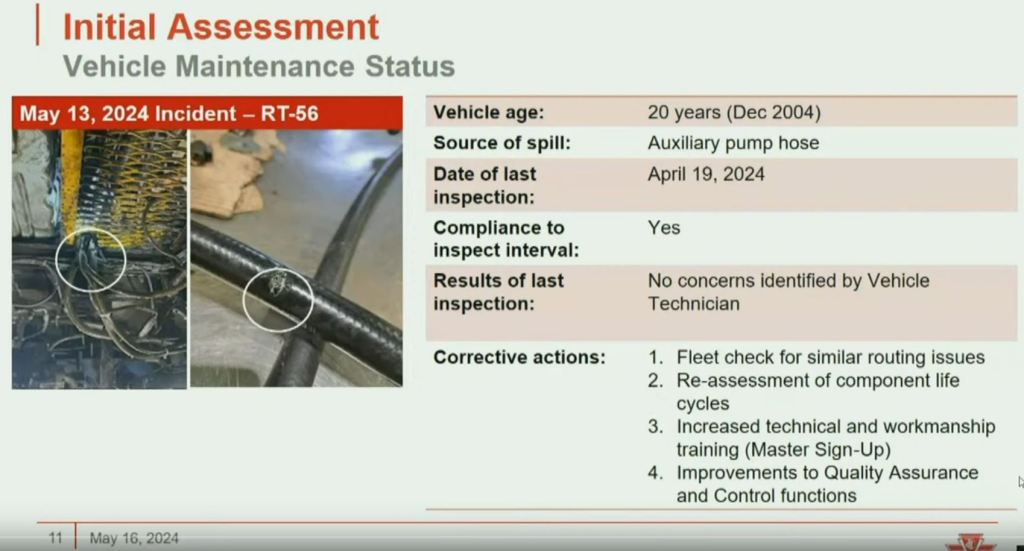
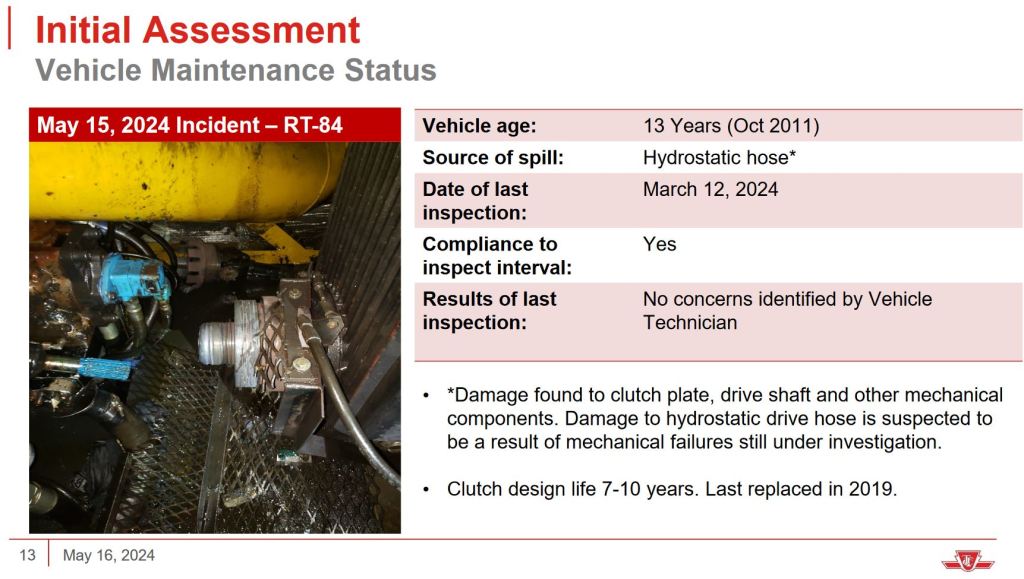
The illustrations below are taken from the presentation deck shown at the May 16 meeting.
The TTC has a large fleet of work cars used for many different types of subway maintenance. Some are designed for specific tasks such as RT-27, the beam replacement car for maintaining the lower deck of the Prince Edward Viaduct. Some are electrically propelled, but many use diesel power for operation in areas where traction power has been cut. Of this fleet, 47 cars include hydraulics either as part of the propulsion system, or to operate equipment. The average age of the fleet is 17 years, roughly mid-life for subway equipment.
Problems with hydraulic leaks occurred on multiple cars.

The May 13 spill was not an isolated event and was the fifth in 2024. Two more on May 15 and 16, showed that there is an ongoing problem and recent escalation in the rate of problems. There were only three other spills in the period 2019 to 2023. A basic question is what recent changes have triggered a rise in failures. Both hoses and O-rings figured in the leaks, but one incident (RT-84, March 12) had a hose failure that might have been caused by other mechanical problems on the car.
The normal practice when a spill occurs that fouls track is for trains to operate at reduced speed through the area pending cleanup. However, the May 13 incident covered a very large section of the line making continuation of revenue service impossible.
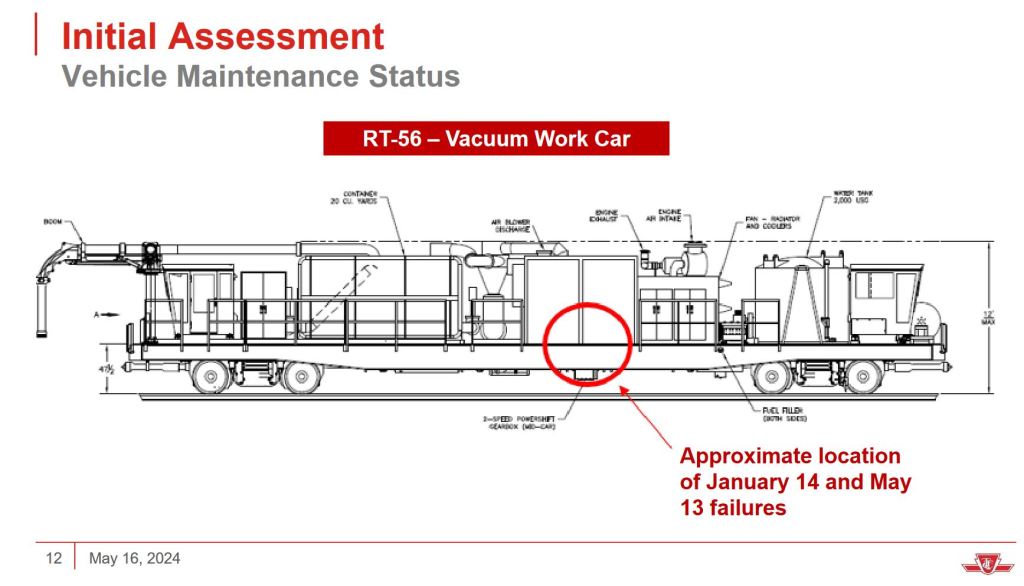
The May 16 event is not in the presentation deck. It involved car RT-41 with a spill of under 1L. The leak was capped by the night shift supervisor on the car.
A full fleet inspection is in progress, and a pre-departure inspection is now part of regular procedures before a work car leaves the yard.
A significant contribution to the May 13 shutdown was the decision to move the leaking car back to Greenwood Yard rather than holding it at Lower Bay station. Only a small part of the main line would have been affected after moving the car from Spadina station compared with the extent all the way east to Donlands Station and Greenwood Yard. This greatly extended the scope of cleanup needed to restore service.
According to TTC management, the crew shifting the car thought that the leak was stopped, but this proved not to be the case. One procedural change that has been implement is for any towed car to be followed by another as a “spotter” for problems.
A related question, however, is whether there is a culture within the TTC affecting decisions balancing the reaction to equipment failures, service restoration, and safety for revenue operations.
Other types of slippery rail events include the effect of foliage in open cut sections, and the “black rail” that can develop in humid conditions. Slower operation, including manual control on sections with automatic control, is the standard response. For spills, a complete cleanup and test train operation will be required before revenue service resumes.
Diversion Management
When there is a planned event such as a weekend subway shutdown for infrastructure maintenance, the service plan and resources including shuttle buses, extra station staff and service management can be organized in advance. Everyone involved knows (or should know) the plan’s details, and advance publicity to riders is possible with media announcements, online updates and posters at key locations. In some cases, special traffic arrangements are set up to aid with shuttle bus operation.
For an unplanned event, the situation is completely different. Not only are the resources not in place when it occurs, decisions about alternative service (routes, how many buses) have to be made on the fly. With the subway, there are only a few options for turnback locations, and shuttle operations tend to be between locations where the TTC has done this many times before such as the recent St. George to Broadview shuttle. On May 13, this was complicated by a decision to turn back some service at Woodbine thereby extending the scope of the shutdown, but also confusing riders about where subway service was and was not running.
When riders hear the dreaded words “shuttle buses have been ordered”, they know that a long slog faces them. In most cases, it is better to just wait out the delay because the time needed to field replacement service can be as long as or longer than the subway service interruption. May 13 was a very different case, and it showed how chaotic the situation at subway-surface transfer points can become very quickly.
Peak period trains arriving every few minutes might drop 800-1000 riders, enough to pack many, many buses. Moreover, operations at the turnback stations are constrained by their configuration (centre vs side platform, full crossover vs centre track, number and type of paths between platforms and the surface, ability to use off-street loops vs on-street loading for shuttle buses). Unless a station was designed as a terminal, its capacity to handle full transfer volumes between trains and surface routes will be limited.
Street operations can be limited by construction, lane reconfiguration (e.g. addition of bike lanes, Cafe-TO and other curb lane occupancy) and other day-to-day traffic and pedestrian volumes to which the shuttles and their passengers are added. Supporting staff from TTC and from the Police Service take time to reach the site(s) and the first hour of operation occurs with less than ideal staffing to manage crowds, TTC vehicles and traffic. All of this works against running substantial capacity, let alone speed, with any replacement service.
As future service levels build back to pre-covid levels and beyond, the divide between the demand the subway will carry and the limitations of shuttle buses will only grow.
Communications
A common complaint with TTC service changes is that communication of changes to riders can be inconsistent, at times inaccurate, or simply missing.
Within the subway network, the communication system primarily consists of announcements on trains and in stations that may, or may not, be both audible and comprehensible depending on local PA quality and the speaking style of the announcer. As riders move out of stations, this method of advising riders what is happening dwindles, and is replaced by online sources such as social media and email alerts. These are only accessible by those with devices and the knowledge of how to reach TTC information. The timeliness of these notices varies a great deal, and circumstances can change faster than updates are posted.
Of particular note, riders will commonly ask TTC staff and contractors for authoritative information, but at times, they know little more than what other riders have told them of ongoing problems.
Another issue raised by the Board is the promptness with which they are advised of serious incidents. It appears that emails went out for each of the major incidents on revenue service, but not for events in yards. How well Board members monitor their email, or whether special flagging is used to emphasize the emergency nature of these notices, is another matter. Anyone who receives a large volume of email will know the challenge of creating filtering tactics so that key items are not lost in the shuffle.
Media were briefed at various times, although the initial report implied that the problem was much less severe than the actual situation. There are also questions of who should routinely deal with the media (by analogy to the always front-and-centre former CEO, Andy Byford), but also of the quality of information provided to the spokesperson, whoever that might be.
In an interview on CBC’s Metro Morning on May 17, TTC Chair Myers said that the decision of who acts as the media voice is up to management. That might be so, but for serious events, a more senior spokesperson can speak authoritatively, take responsibility and talk of how the organization will react and improve.
ATU’s List of Questions
Members of the Board thanked ATU Local 113 for providing information about spill incidents and asked CEO Leary if answers to the ATU’s questions would be provided. Leary agreed to do this. For reference, here are the questions:
- We now have three separate reports of trains running on tracks that we knew were slippery, and that they were unable to brake safely. Is that correct?
- When was senior management made aware of the issue?
- When did they first take steps to address it?
- What steps did they take?
- Information about the January 17 hydraulic fuel leak was only made available to the TTC Board by the TTC workers’ union. When was management planning on reporting this to the Board?
- The January 17 leak was discussed at the April 10 TTC Board meeting. We just learned, again from the union, about another incident on January 14. Why was this second, prior, incident not shared with the Board when the January 17 incident was discussed?
- On January 17, management was aware of the issue and had sent a crew to remediate it. Was this first step sufficient?
- Later that morning, trains were traveling to their starting points and discovered they could not brake safely. How was it assessed to be safe when clearly it wasn’t?
- We had two nearly identical incidents days apart. What steps were taken after the first incident to ensure similar leaks had been caught and addressed?
- We now have three nearly identical incidents of hydraulic fluid spills disrupting subway service. We know Work Car 56 was responsible for the May incident. What vehicles were responsible for the January incidents?
- After the January incidents what steps were taken to ensure that no work cars were leaking hydraulic fluid?
- After the second, January 17, incident was made public by the union, did TTC implement new procedures to make sure trains were not put in service on slippery tracks?
- When the May 13 incident occurred, were these new procedures followed?
- At 4:17am on May 13 a leak in Work Car 56 was discovered at Spadina Station on Line 1. Instructions were issued to send it to Lower Bay Station. Instead, it was put on Line 2 and towed, leaking, all the way to Greenwood, which caused a twelve hour service interruption. Who made the decision to tow the disabled car on Line 2?
- Who made the decision to keep running trains over track on which they could not stop safely?
- On May 13, TTC told CBC’s Metro Morning that trains were “experiencing a small but not significant overshoot” of their stopping point. At 6:53am a train overshot the platform by four doors, or a full car length. If this is “not significant” what qualifies as “significant”?
- Who is ultimately responsible for the decision to continue running trains on track where we know they cannot stop safely?
- If trains were directed to operate where they could not brake safely, what accountability has there been for that decision?
 Steve Munro
I happened to be listening to a scanner when the May 13th leak occurred.
The reason some trains turned back at Woodbine was because of overcrowding caused by backed up trains. Trains were so backed up that the stations east of Broadview were also slammed with people. This necessitated turnbacks at Woodbine to alleviate overcrowding.
For example, it took me over an hour to get from Warden to Broadview that morning.
Steve: Yes this is not surprising. It would be hard to maintain peak headways with a single platform turnback at Broadview even without having to offload and then load passengers. I also suspect that the exits from the platform would not be able to clear the load from one train before the next one came in during the westbound AM peak.
Just before 5:30 pm when they started running test trains, they noted that parts of the lead car were going past the end of the platform when stopping. They were using wayside markers but the issue seemed to get better when the trains were using their snow brakes. The use of snow brakes meant having a mechanic there to coordinate that. It was time consuming from my understanding which is is one reason why service only ran Westbound.
In the morning, around 8:30 am just as the delay started they were trying to stage trains. I was on a train that went as far as Broadview, then stayed in service until Castle Frank when it was given permission to proceed into Sherbourne. Once we got into Sherbourne, the operator was not sure when we would be moving off. He suggested going to get a shuttle at street level.
One thing I did hear a lot of on the scanner was a focus on the area between Bay and Sherbourne. On the Scanner, it appeared that the issue was primarily between Yonge and Sherbourne heading eastbound. Yes the issue occurred near Spadina Station however it appeared to me anyway that the stretch between Yonge and Sherbourne was the focus. The TTC Staff kept running test trains with a focus on that section.
Sorry for the long post Steve, I thought it may provide some insight.
Steve: No problem. Thanks for the details.
LikeLike
I’m still floored that there isn’t a city wide PA system in the style that London or Disney has for major events and for issues like this. There are obvious places it is needed – waterfront, Union, Yonge, Church, Queen and King for major events…but it obviously could be extended to the external areas around transit stations that are likely to see this sort of emergency event…not having eyes is critical to knowing what is happening, but also not having a war room, and ability to put out clear announcements is crazy…the tech to do this now is so cheap – wireless, solar power, batteries, and with high quality speakers and simple control systems both locally and for district announcements or event sound.
If I was fire/police, I would want this in yesterday for large crowds/events. If I was TTC, I would want it in yesterday as well, and for BIAs it would be a no brainer for things like New Year’s, Santa Claus parade, Pride, etc etc.
Steve: TTC does have a central control room but it is completely separate from the City’s main control room for traffic monitoring.
LikeLike
Steve, when there is an oil spill, why can’t the TTC bring deploy the tunnel washer car to clean the tracks? Soap and water cleans up hydraulic oil pretty well.
Steve: Two issues. First, the TTC is not allowed to flush contaminants like this out of the tunnel. There are environmental regs about spill controls. Second, it’s not clear that the tunnel washer would do a thorough job of cleaning the railhead as opposed to the tunnel walls and floor.
LikeLike
Any day now there will be a Spadina Subway Crash-type incident.
LikeLike
We are actively watching the destruction of the TTC under Rick Leary and he is STILL MIA. How has city council not summoned him to answer to all the issues going on?
LikeLike
I sure felt sorry for ALL of the people trying to get places, and we haven’t got to a point where we can discourage the private vehicles from being on Bloor/Danforth, let along tell them ‘off’, as the street grid isn’t good enough. And the bike lanes had to be a certain width as the decisions to narrow Bloor in Yorkvile by just a metre for wider sidewalks meant there was a loss of flexibilities in what could be done for bike safety as well as the vehicular demands, which are often a single occupant. Glad nobody was hurt and yes, we need a ‘Relief’ function, for sure decades, which the OL won’t necessarily be.
LikeLike
While I appreciate having the TTC, and the many fine people that work there, it seems to be that problems on the subway network are becoming awfully routine. Back in the day, trains were always 100% reliable. Just this past week, I encountered –
Considering that subway disruptions are now routine, ought not the TTC plan for rapid deployment of shuttle buses? And, restoring streetcar service on Bay and Church to Dupont?
Mid-day Carlton and Dundas car service must be doubled or better, especially as these routes are alternates to east-west subway service. Twenty minute service is inadequate.
Transit priority as a concept ought to be strengthened. Drivers blocking intersections should be fined $1000 and 3 demerits on a first offence and the police need to be there to enforce. Left turns from atop streetcar tracks should be made illegal in many more situations.
Can you believe, I used to think that my wife was being silly taking buses and streetcars but avoiding the subway!?
Speaking of new track being installed on York, the track installation on Adelaide to Church is now complete, including the junction at York. However, there are several places where the new track is covered by adjacent & unrelated construction projects. Clearing these off and installing overhead is all that is needed to make it functional. I cannot remember if Adelaide track starts at Bathurst or at Spadina.
Steve: At Spadina.
LikeLike
Add another hydraulic spill to the list. RT-18 yesterday in the Line 2 closure between Woodbine and Kennedy. It would appear ATU’s question #11 was not addressed fully.
LikeLike