
Once again, streetcar service in the east end will be disrupted for construction diversions, although this will not be as long lasting as projects in recent years.
Updated April 27, 2024: The diversion for work at the Don Bridge on Queen Street finished early and all streetcar routes returned to their normal routes today.
505 Dundas Late Night Diversion
On Friday, April 19 and Saturday, April 21, service after 11pm on 505 Dundas cars will divert both ways via the Carlton route (College, Carlton, Parliament, Gerrard) between Bay and Broadview. Replacement bus service will cover the missed portion of the streetcar route. This work is for track drain repairs at Mutual Street.

501/503/504/508/301/304 Don Bridge Diversion
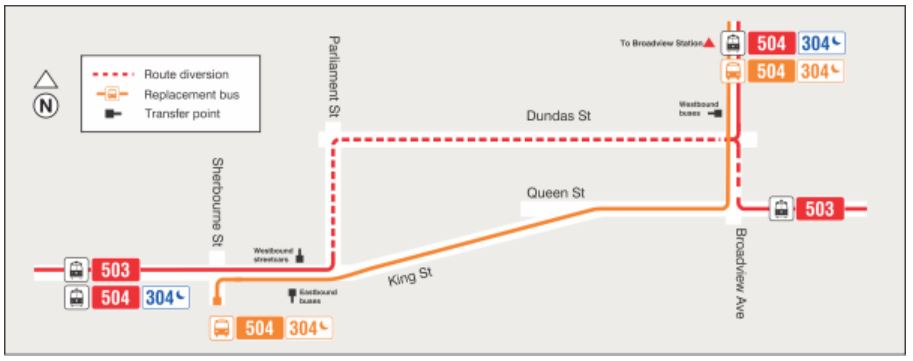
From Monday, April 22 at 4am to Monday, April 29 at 4am, all streetcar service will divert via Dundas between Broadview and Parliament to bypass expansion joint replacement on the Queen Street bridge at the Don River. The work finished early and normal routings across the bridge were restored on April 27.
Shuttle bus service will operate on Queen between Carlaw and Sherbourne, and on the King route between Broadview Station and Sherbourne.
As of 7am on April 20, the TTC has posted a Service Change notice for King Street services (503, 504 and 304), but has not yet posted one for 501/301 Queen or 508 Lake Shore although these are also affected. The 501B bus service between Broadview and Bathurst should continue on its normal route. There is also an item on their News page describing this change.
Although not shown on this map, the diversion should not affect the 504A Distillery service.
Expansion joint replacement on this bridge occurs from time to time as this is a high traffic area, and the bridge can be damaged if the joint is in poor condition from vibration of passing streetcars.
 Steve Munro
Curious. How do the Europeans handle tram track reconstruction projects? Do their switch over to buses, so as to not upset the motorists? Or do they detour onto the curb lane or side streets, and ignore the rumblings of the motorists?
Steve: This is a comment I’m sure others will chime in on, but the situation likely is “it depends” a lot on the specific situation. What is most annoying about the TTC is that ever since the “streetcar shortage” days of the C/ALRV fleet, they have taken any chance they could get to bus streetcar lines, often for considerably longer than actually required. Part of this comes from linking the shutdowns/substitutions to signup periods for work (typically 6 weeks), but also to unpredictability of other parties who don’t quite get around to doing things when they said they would.
It has been a long time since the entire streetcar system was operating at once, and even then, there were routes that had service cuts to fit with the available fleet. Now, the problem is having enough operators and budget headroom, but of course service constraints and uneven quality drive away riders, and it’s a self-fulfilling prophecy. I am hoping to see a brief period of full service near the end of 2024 when work on King finishes (St. Clair is much sooner) and before they find something new to tear up, or to rebuild overhead on.
LikeLike
Though I realise that it is complicated, it always amazes me how the TTC manages to avoid having one slightly longer closure so that all work in an area can be completed at once. They only seem capable of scheduling one thing (track, overhead, concrete repairs etc) at one time and in one location. Though I am sure there will soon be a need to upgrade the overhead or fix other track problems somewhere between Parliament and Broadview, I bet that when there are no streetcars running on that section of Queen (or on King east of Cherry) they do nothing except the work on the Don bridge. No doubt the TTC silos could not cope with working together!
Steve: When the TTC has tried to consolidate work, the cock ups both internally and externally have led to long periods where nothing appears to happen. The KQQR project is the grand daddy of that.
LikeLike
Here’s a current example from Berlin, world’s third-largest tram network. There’s certainly things to complain about Berlin cityscape and their operation of trams but it is definitely a serious operation, an integrated part of the transit network with subway and regional rail.
The tram platform and loop around Schöneweide station (approx coordinates 52.455, 13.51) is being rebuilt since September 2023, as is Treskowbrücke, the nearby road and tram bridge over the Spree. BVG’s best information about this is https://www.bvg.de/de/verbindungen/bauinfos (archive.org link), search for “M17”, there’s a little map.
In that case, trams are rerouted by following existing tracks, in some cases combining ends of two existing routes. Orphaned parts of the tracks are served by buses, including the entire ~3.5 km stretch between Schöneweide and Adlershof stations. These are generally less-busy parts of the routes, particularly of the M17 high-throughput line, but I can imagine no one is particularly thrilled about having bus replacements for months on end.
One cultural difference in Europe is that it’s generally accepted that replacement service might use a different route, or a different nearby transit route would be used. This results in shorter journeys for most passengers, at cost of less accessible service to those uncomfortable with walking 5-10 minutes.
When a street with a streetcar track (relatively minor streetcar line) was being rebuilt near my place in inner Berlin last decade, service was shut down on a ~1.5 km stretch with no replacement, for a few weeks as I recall. Nearest other transit stops were 300 to 500 m away, though not necessarily going in the same direction, so for some trips walking 800-1000 metres was faster.
The flip side is that it’s also more culturally acceptable to entirely close down roads to cars, and this can speed up construction because material deliveries are easier and crews have more space to work and don’t have to keep on reconfiguring temporary car lanes.
But certainly I would be surprised to see temporary track of any considerable length laid for a closure that’s less than a year in duration, except for an absolutely critical part of the network. Building a temporary track right next to the permanent track (“curb lane” as you wrote) would never happen. That’s probably more due to cost of construction rather than motorist relations, though.
LikeLike
Is it just my imagination, or is this an issue on that bridge in particular..it seems that it is closed to streetcar traffic every year or so, is it too many streetcars using this bridge that is the problem? I’ve noticed lately while on the 501 the noise and vibration, especially when another streetcar is going the other way.
Steve: That bridge is less robustly built (and also older) than the bridges at Dundas and at Gerrard. No, it is not your imagination. Too many streetcars is not quite the problem considering the level of traffic there some decades back. However, the maintenance has not been as good and expansion joints have deteriorated to a point where the vibration from passing streetcars harms the bridge.
LikeLike
For anyone living in the area, have the signals for the protected streetcar turns along Broadview been reactivated for this diversion?
Steve: I was just at Broadview & Dundas (Apr 24) and the transit signal is still masked.
LikeLike
Why am I not surprised? An entire week of 501 and 503 cars holding up 504 cars because no one cared to do their jobs.
Steve: There is already TSP eastbound on Dundas at Broadview, but not northbound. There are other intersections along the diversion route that never had any TSP, and the signal timings on Parliament favour east-west traffic especially at Adelaide and Richmond causing traffic snarls on Parliament. The City talks about adjusting signals for situations like this, but there is no sign of it.
LikeLike
They installed the new signals for the north to west turn at Dundas precisely because this particular diversion caused huge bottlenecks with all the streetcars at the intersection.
When multiple northbound 501/503 cars meet with any southbound 504 cars there’s a very good chance all of one car would be able to make it through the intersection without the priority signals thanks to the short green time given to Broadview and TTC safety procedures.
Incredible that they would leave the already existing transit signals off.
LikeLike
The scope of the work during the week long shutdown seemed to only include the expansion joint on the approach from the east side. Other problem spots on the bridge such as the broken concrete at the streetcar junction were left unaddressed. Really.
Steve: Yes, I was disappointed that such limited work was done while they had the bridge available for repairs. Why close it once when you can do it twice or more?
LikeLike
Steve: Expansion joint replacement on this bridge occurs from time to time as this is a high traffic area, and the bridge can be damaged if the joint is in poor condition from vibration of passing streetcars.
Streetcars on this ancient bridge are a serious hazard. I am glad that the TTC is considering to ban streetcars from this bridge once the Ontario Line negates the need for streetcars east of the mighty Don river.
Steve: That is simply your fantasy, not actual policy.
LikeLike