
This is the second part of a review of headway reliability on the routes serving the former SRT corridor.
Routes included here are:
- 903 Kennedy-STC Express
- 939 Finch Express
- 954 Lawrence East Express
- 985 Sheppard East Express
For other routes, and an introduction, see Part 1 of this article.
The common thread through these reviews is that although there is transit priority in place between Kennedy Station and Ellesmere on Midland and on Kennedy, these routes have reliability problems. The red lanes benefit riders once they are on a bus, but their wait for a vehicle could delay their trip.
I do not expect that most readers will take a brief look at routes they use. However, some with an absolute passion for Scarborough bus service and lots of time might dive into details for every route.
903 Kennedy-STC Express
The 903 Kennedy-STC Express operates between Kennedy Station and Centennial College via STC. Before mid-November, this route provided very frequent service between Kennedy and STC. This was replaced by extensions of the other routes reviewed in this series.

West/Southbound
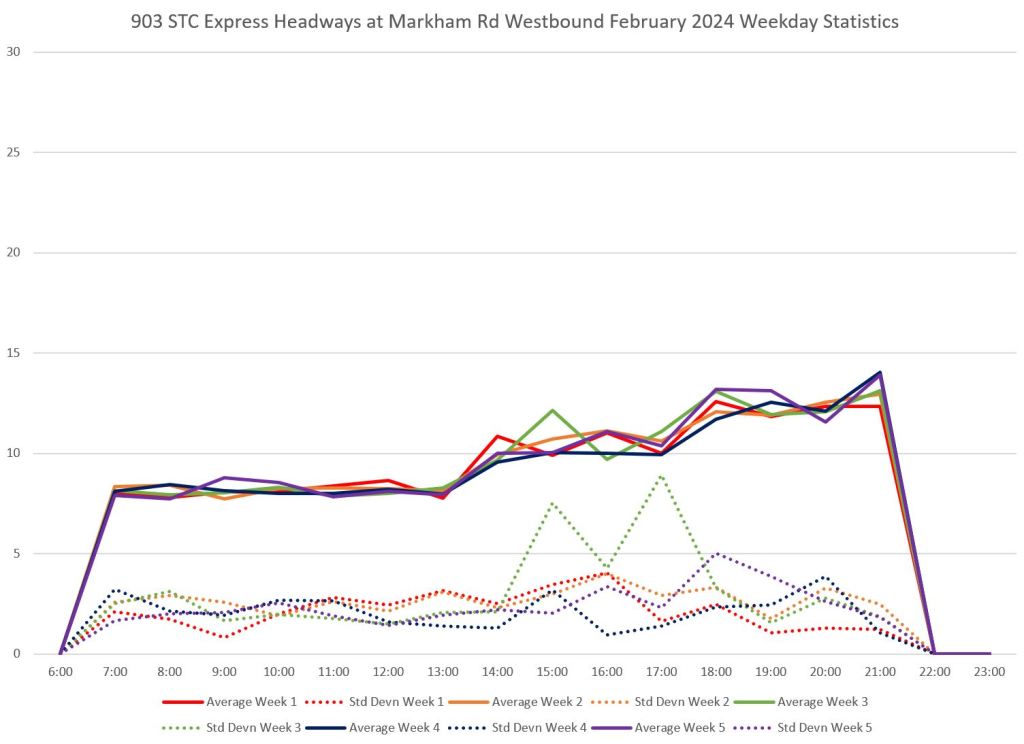
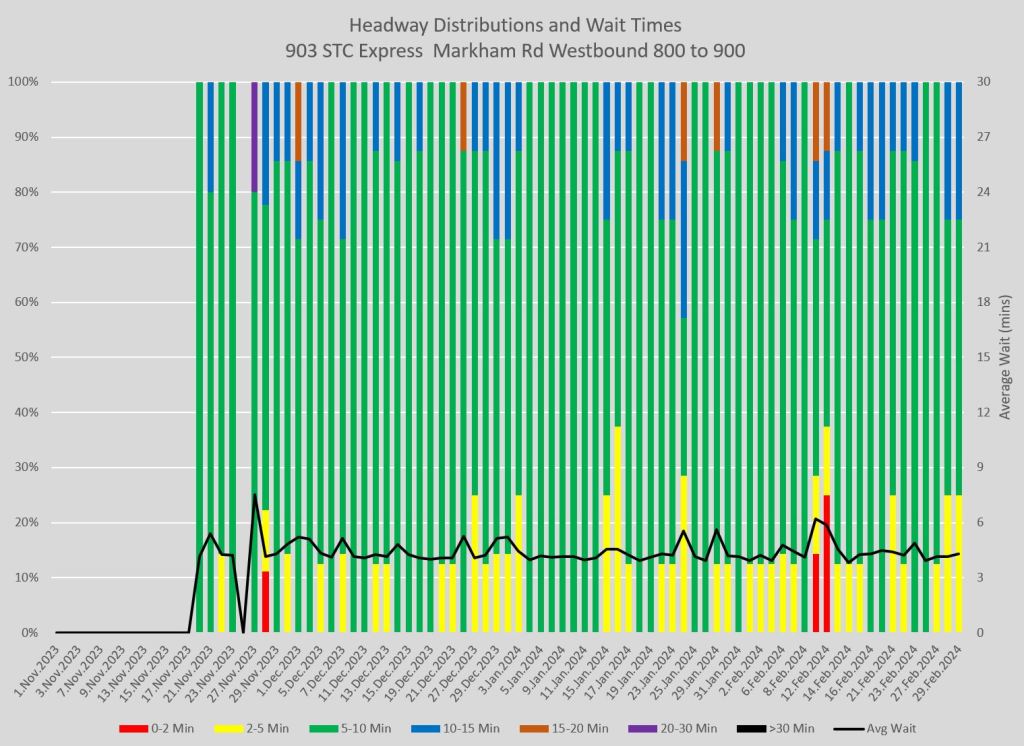
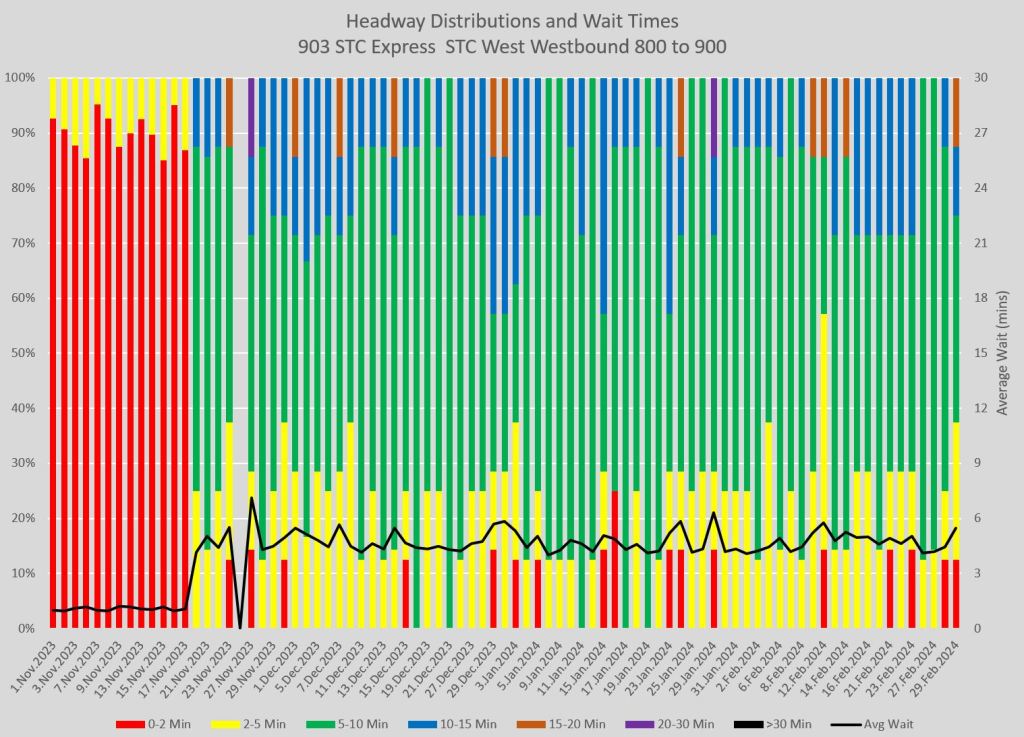
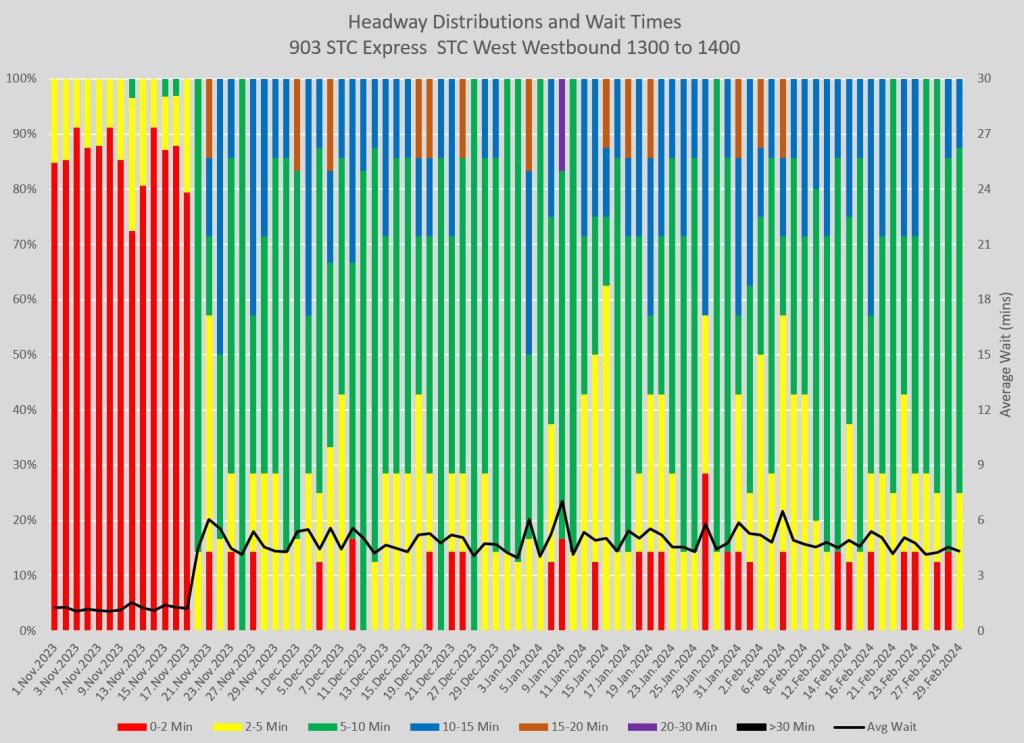
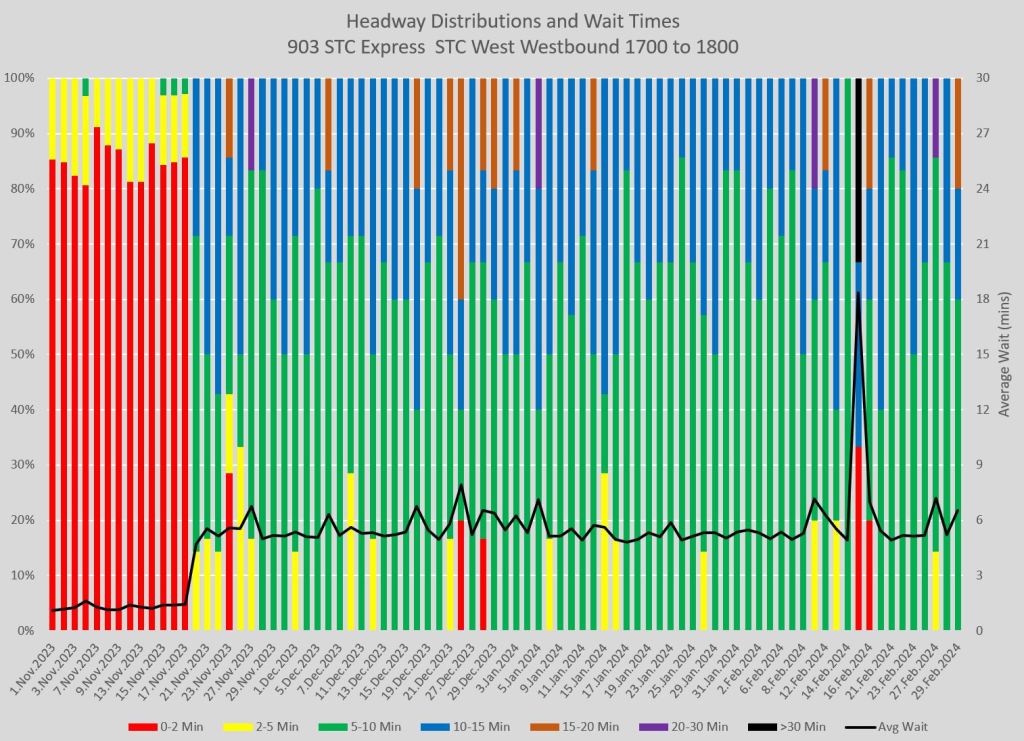
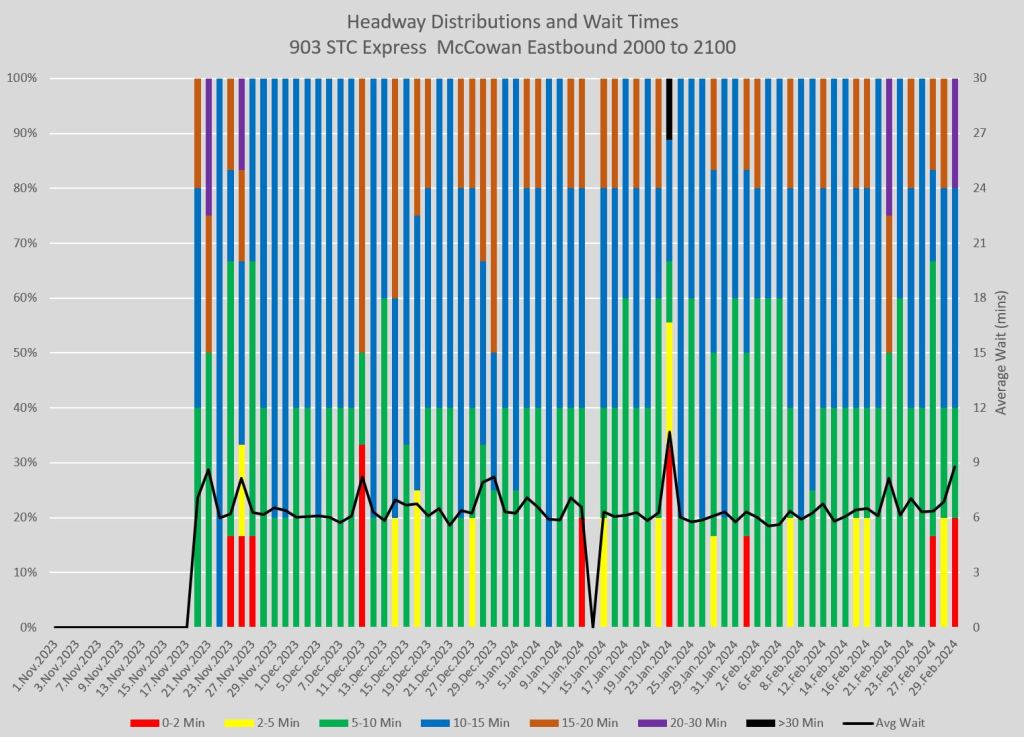
The standard deviations in headways from Markham Road (outside of the Centennial College terminus) are fairly low except in the late afternoon and early evening. Although this could indicate bunching, the scheduled headway is wider (see summary above) and few trips show up in the “red” part of the headway distribution. There is slightly more bunching westbound from STC, but as noted elsewhere in this series, this has a lower effect on riders because many routes provide service in the SRT corridor.





North/Eastbound
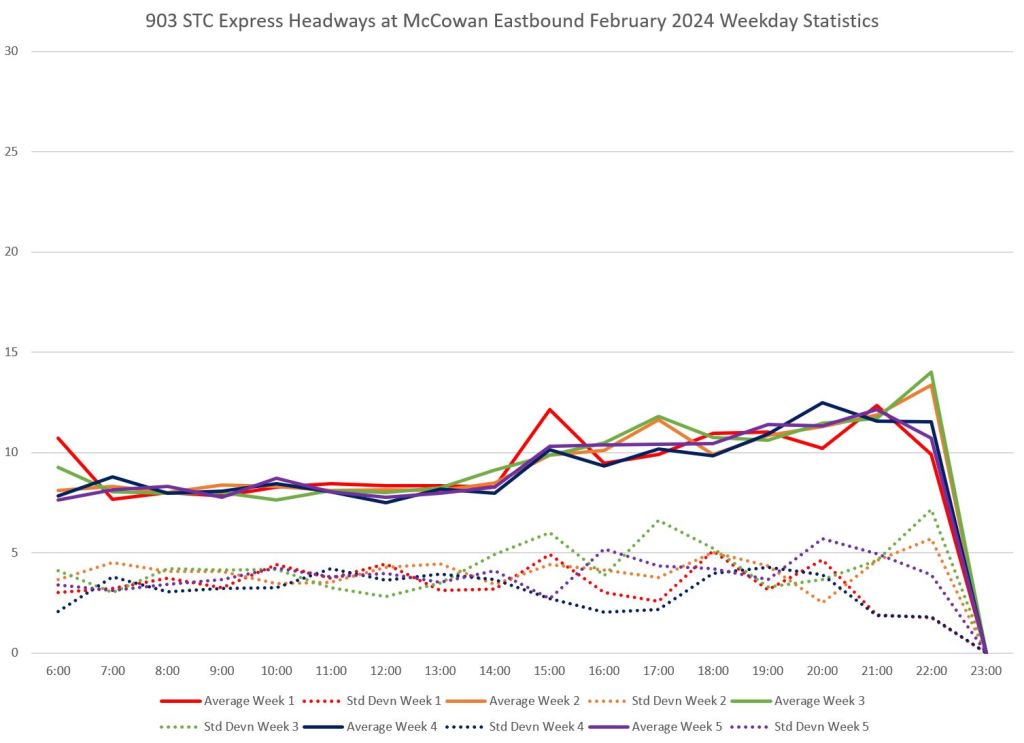
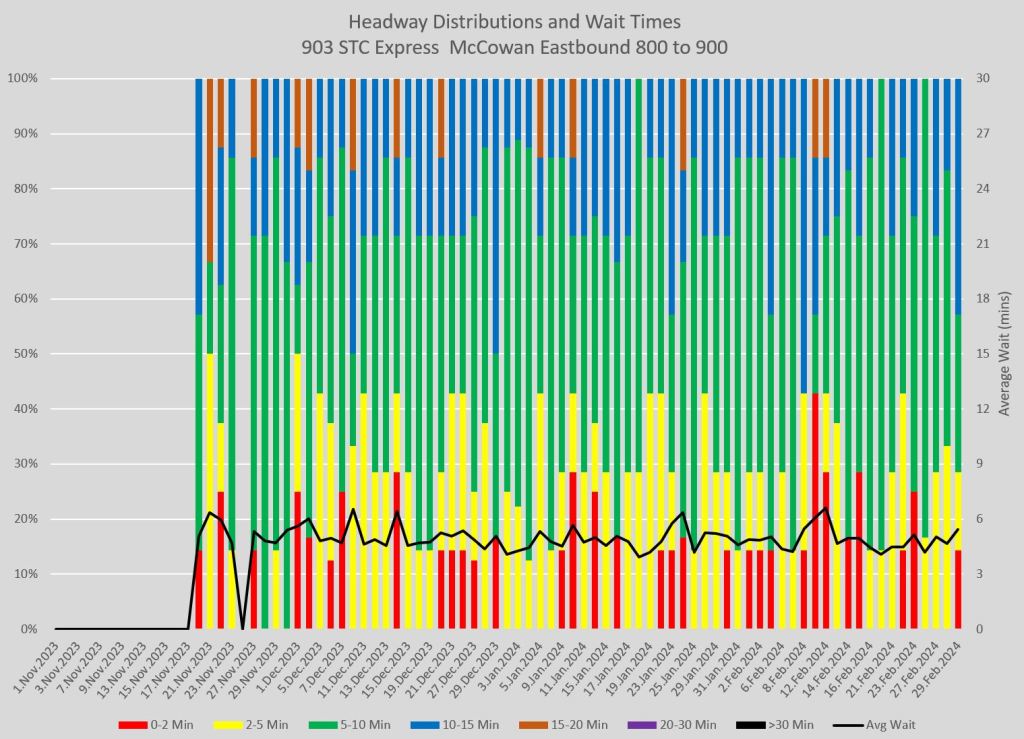
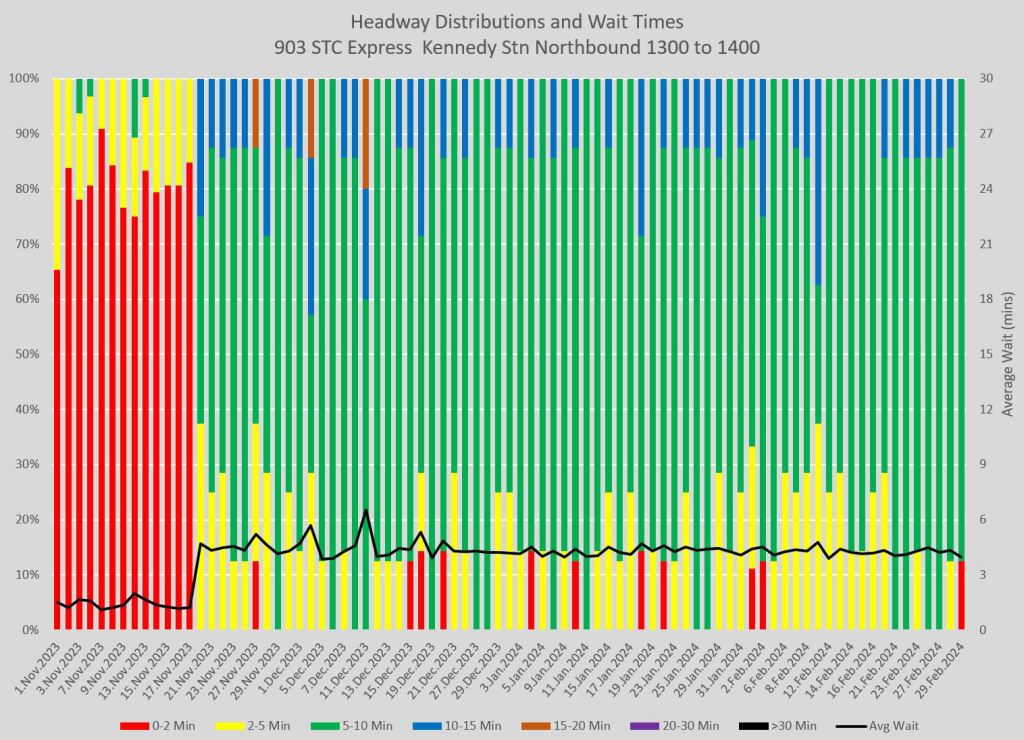
As with the westbound service, the standard deviation values at Kennedy Station are low and there is not much bunching. However, by the time the service leaves STC eastbound, bunching is evident in most p periods. There are also some fairly wide gaps in service particularly in the PM peak and early evening when scheduled service is less frequent.


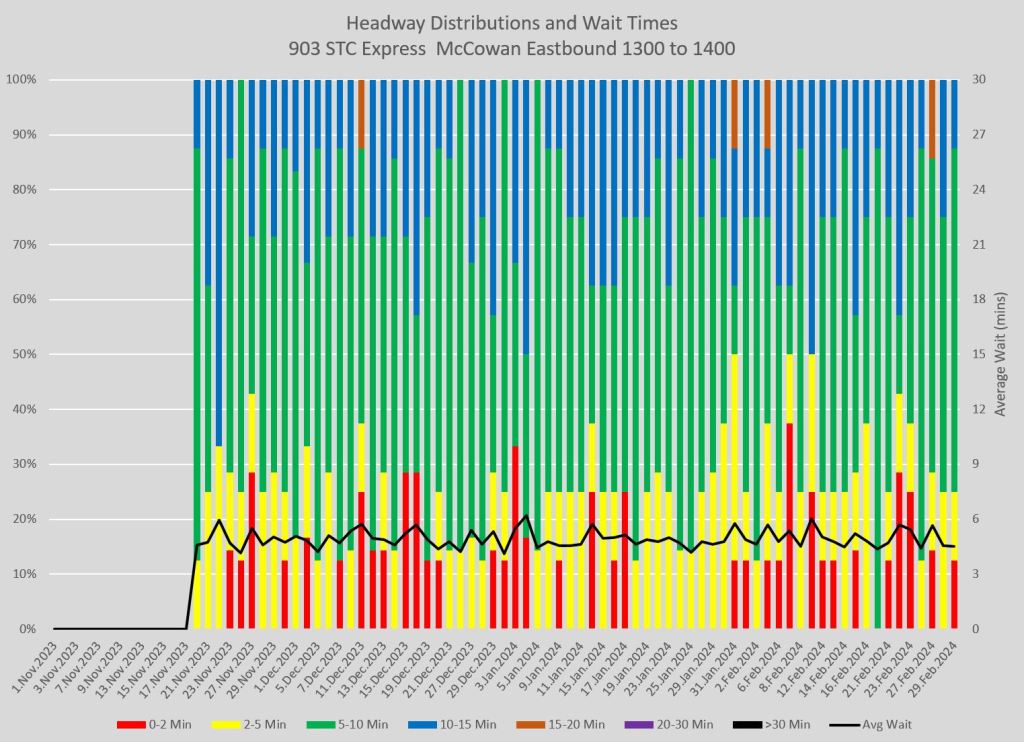
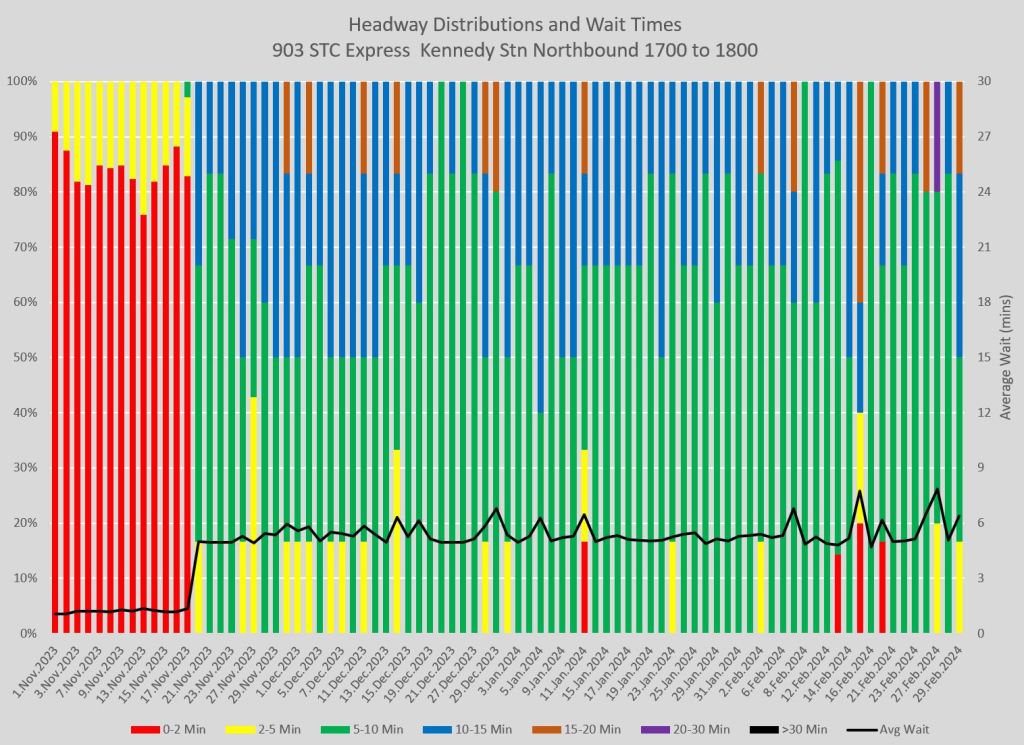
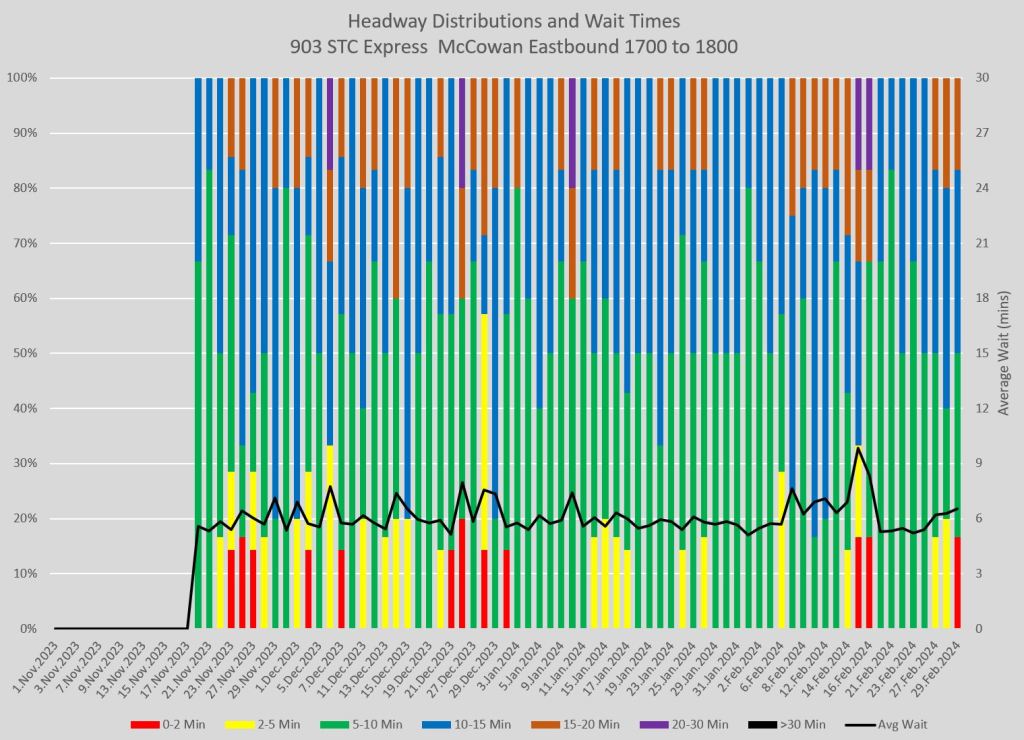
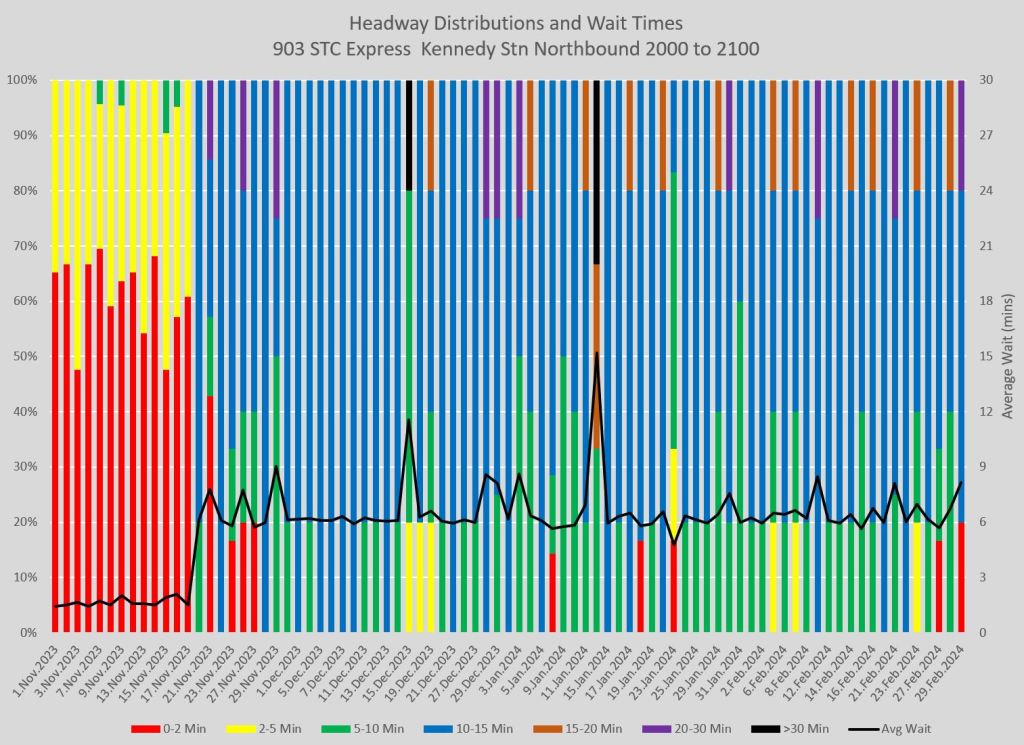
Full Chart Sets
939 Finch Express
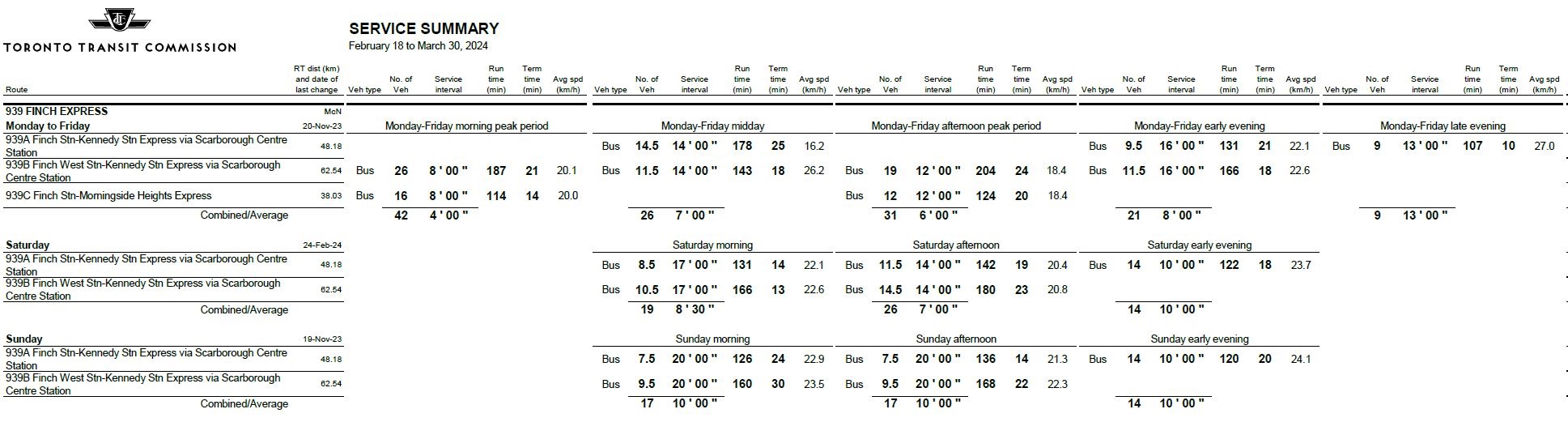
The 939 Finch Express operates primarily on Finch as its name implies, but the 939A and 939B branches turn south via McCowan to STC. From there, they run south to Kennedy Station.
Southbound
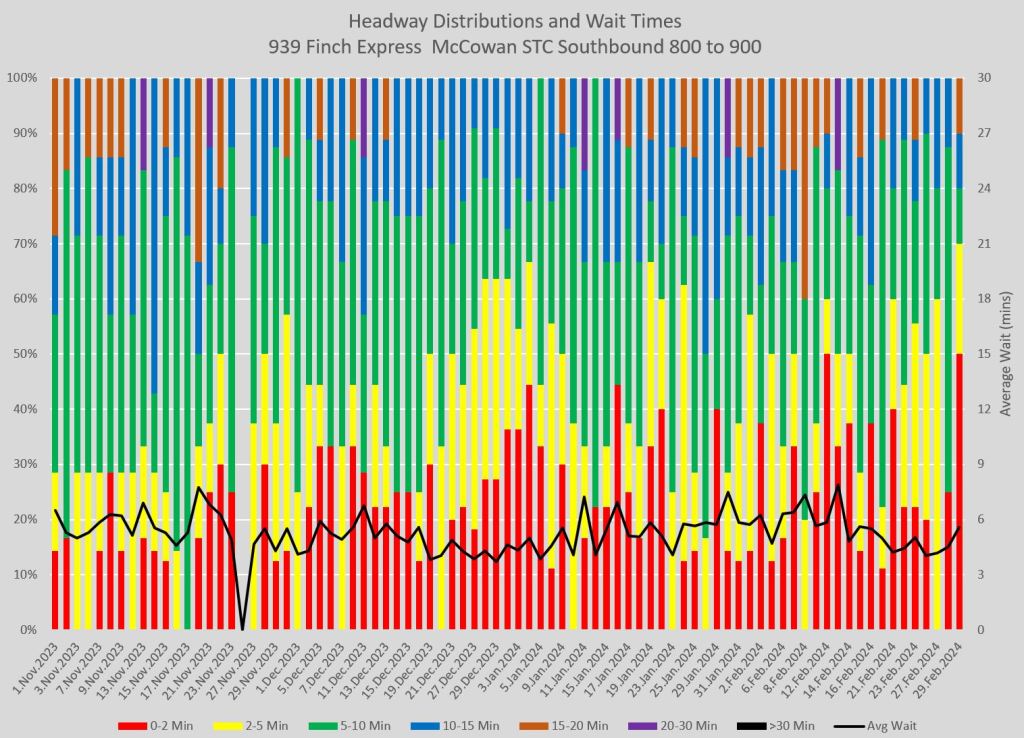
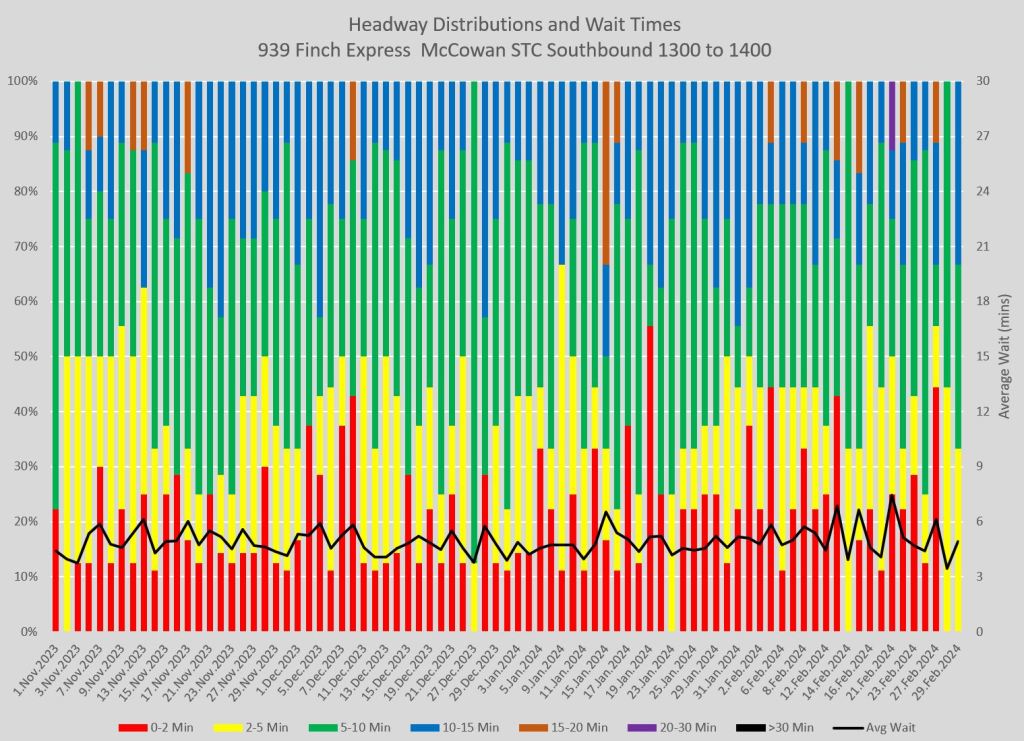
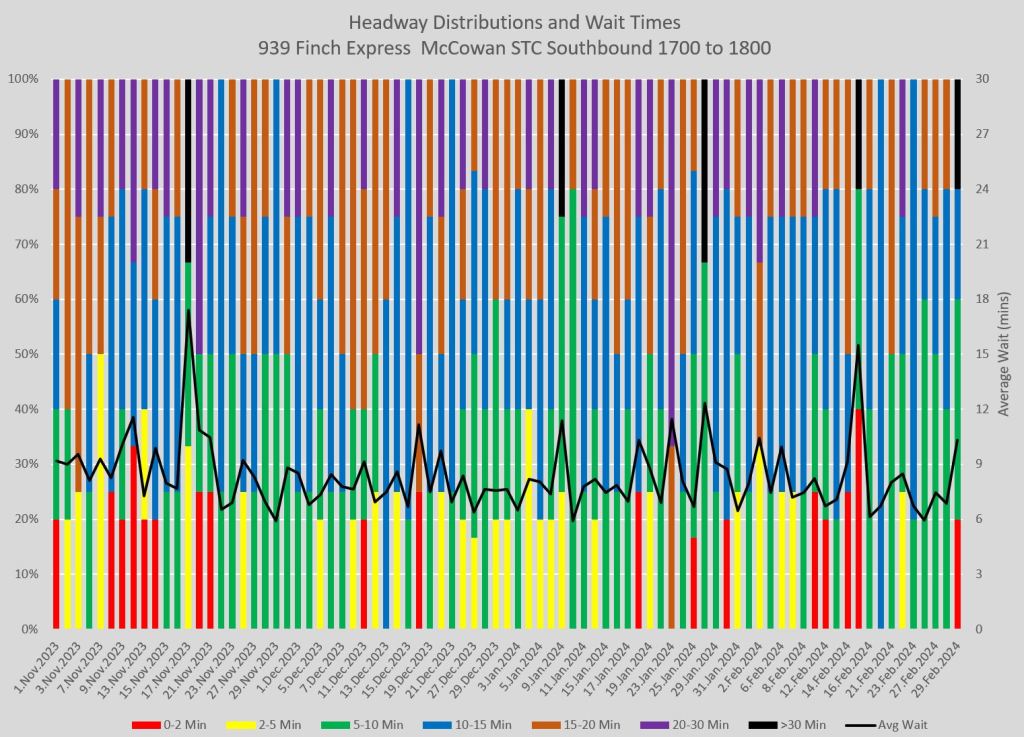
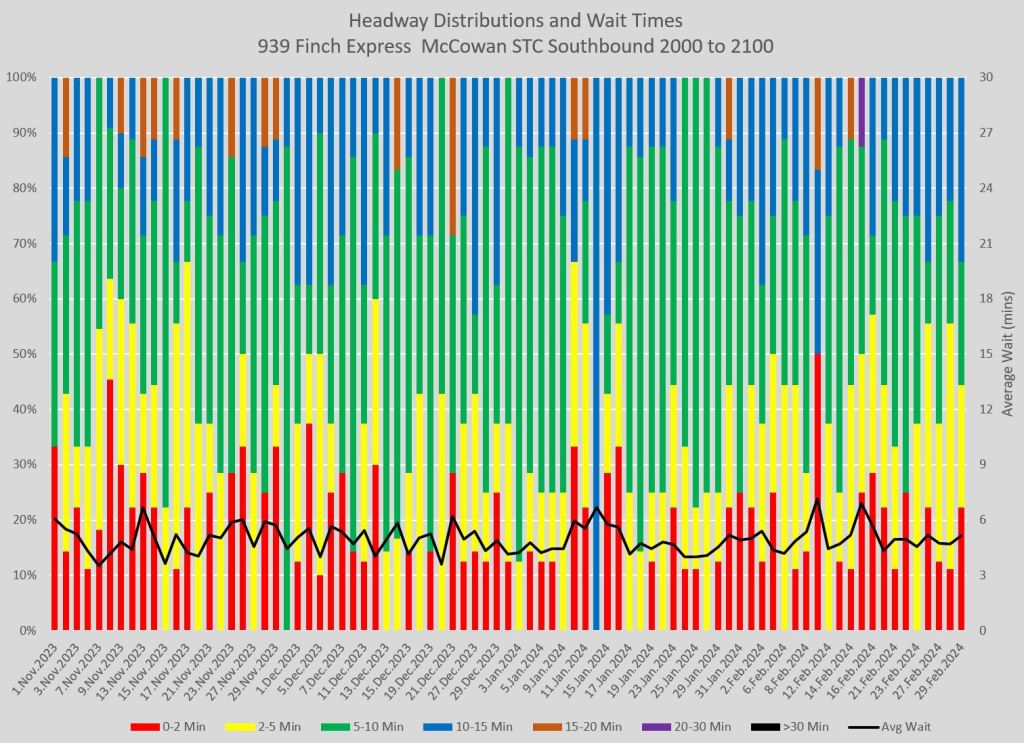
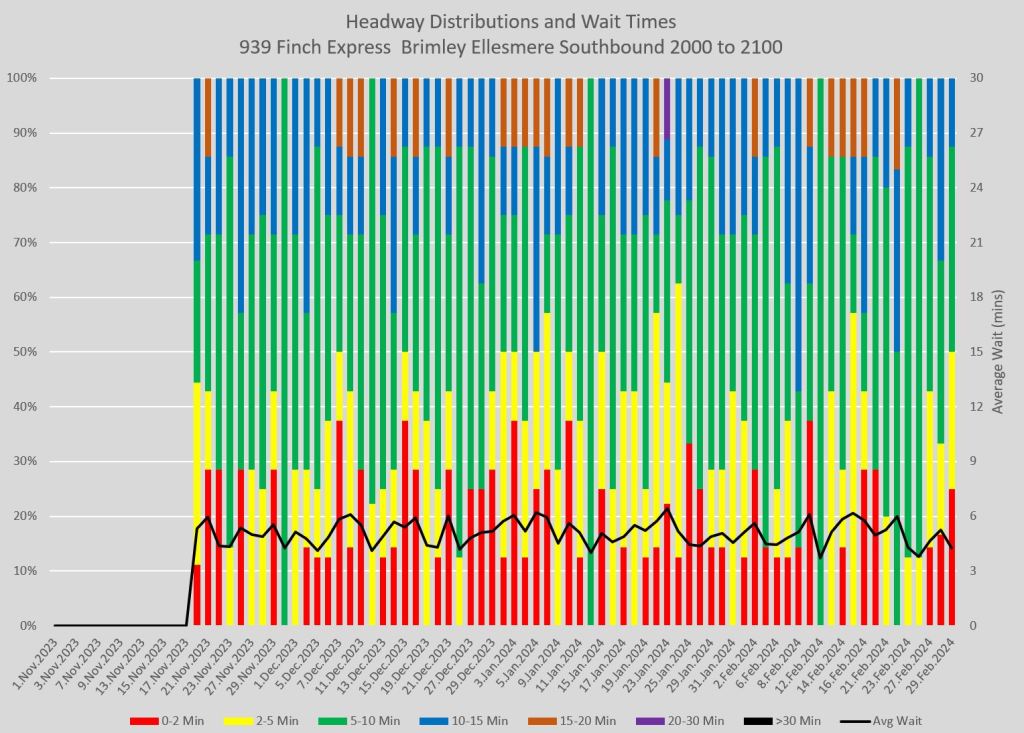
Service to Kennedy Station originates either at Finch Station (939A) or Finch West Station (939B). By the time it reaches the east side of STC on McCowan, the frequency is quite erratic. This continues west of STC showing that there is no attempt to reorganize service at that point, although as mentioned before this does not matter much inbound because so many services overlap in the corridor.
There is less bunching in the PM peak because the scheduled service less frequent and a larger swing from scheduled to actual headway is needed to produce a bunch. However, wide gaps during this period are also evident.





Northbound
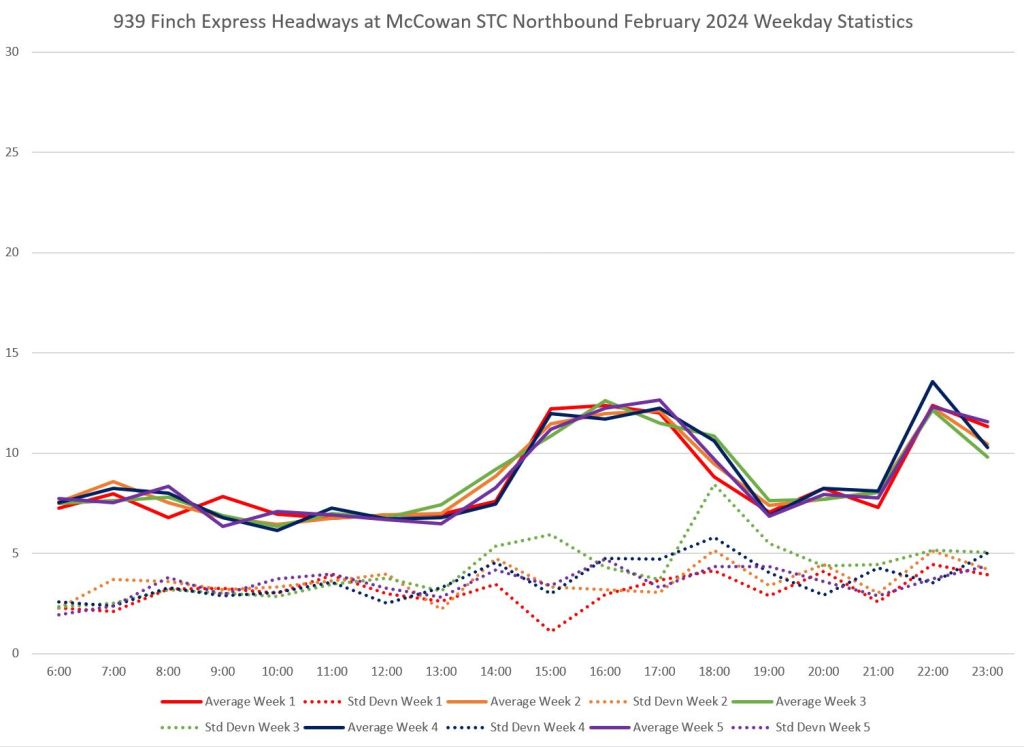
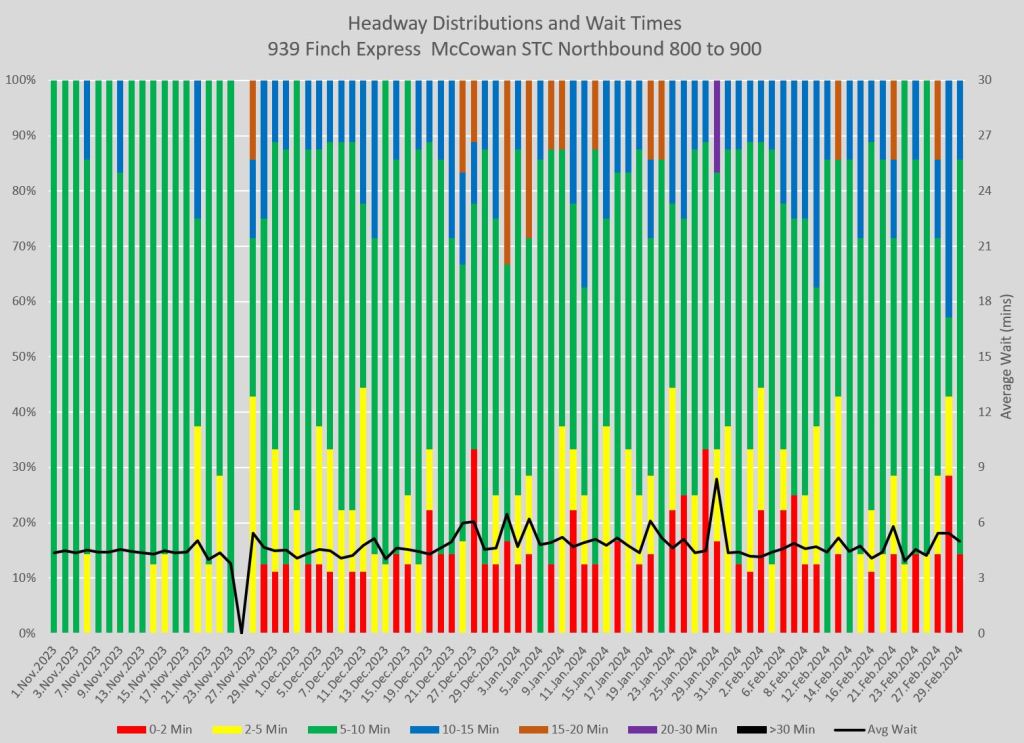
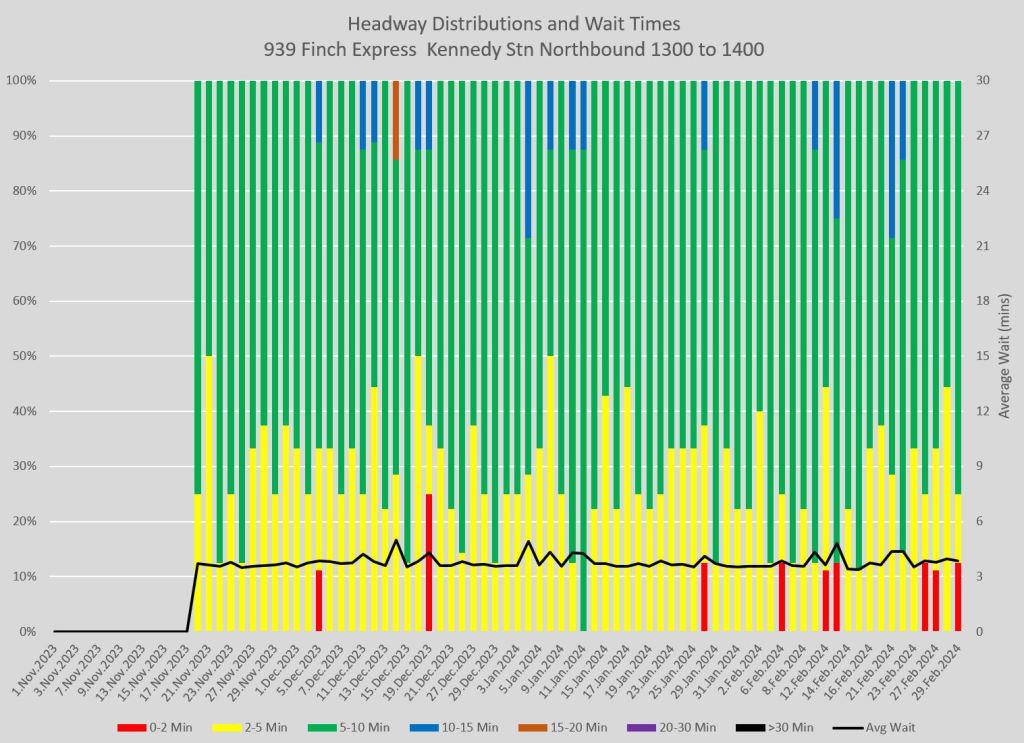
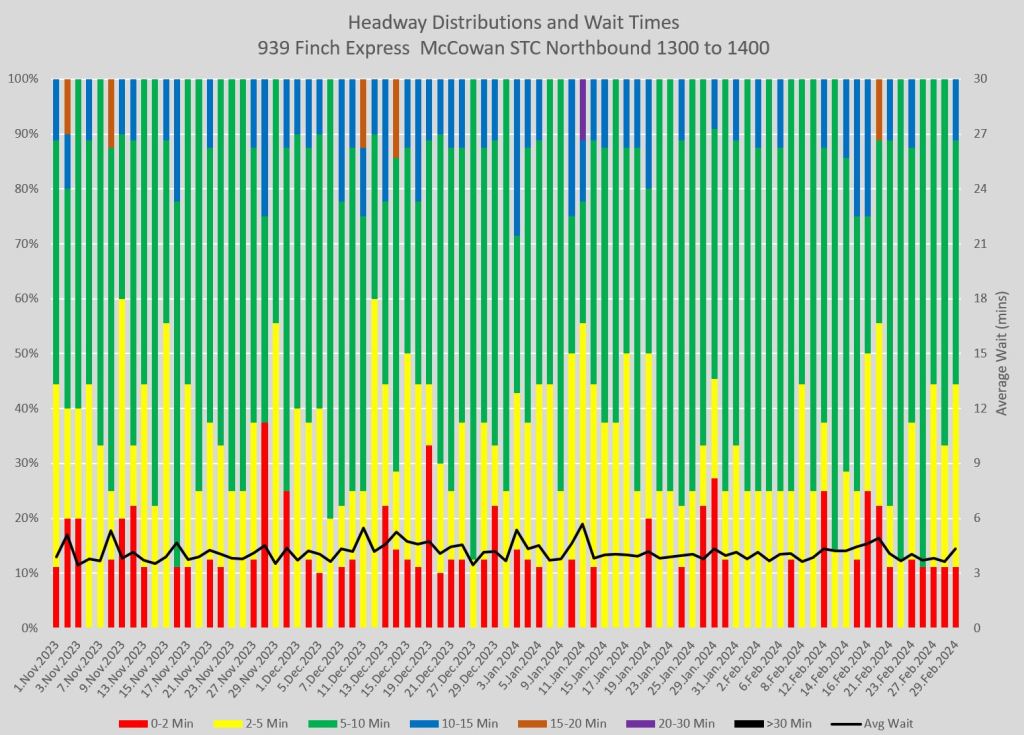
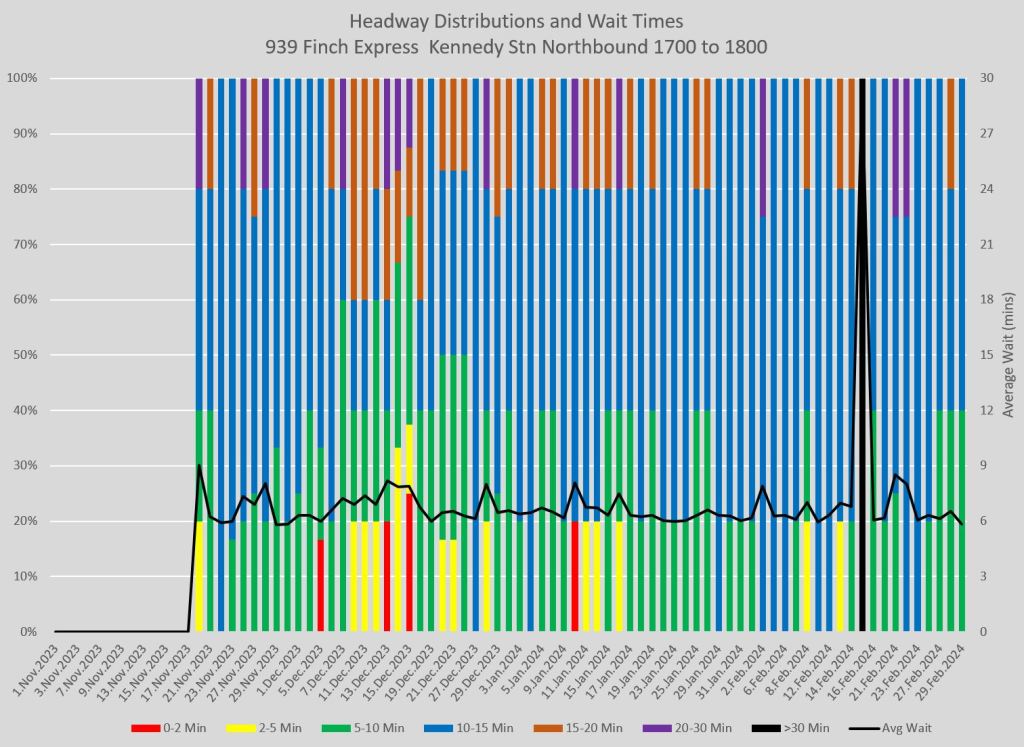
The northbound Finch service originates at Kennedy Station and headways are fairly well-behaved there, although this deteriorates in the evening. However, by the time buses leave STC northbound, bunching is evident on most days.


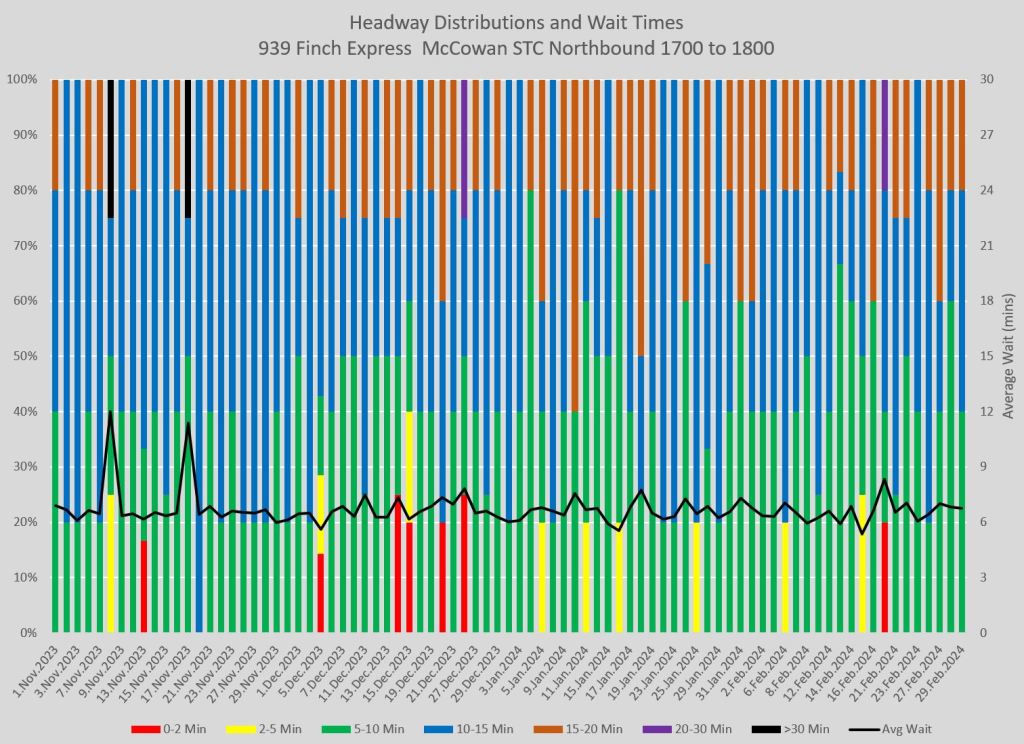
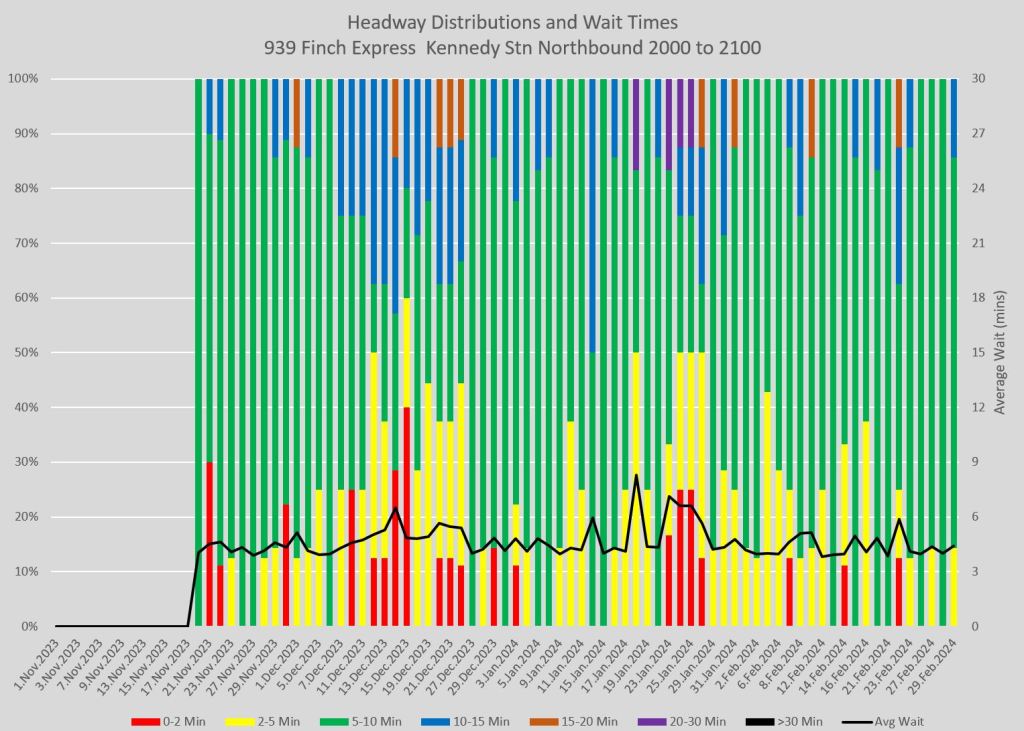
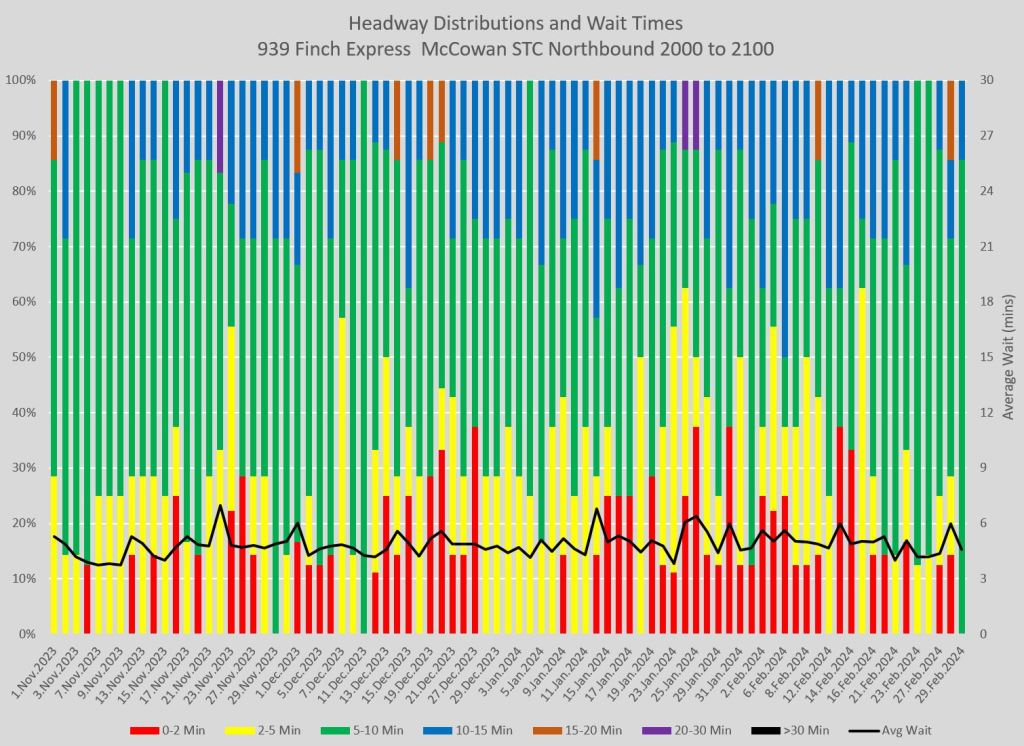
Full Chart Sets
- McCowan at STC Southbound
- Brimley & Ellesmere Southbound
- Kennedy Station Northbound
- McCowan at STC Northbound
954 Lawrence East Express
The 954 Lawrence East Express operates during weekday peak periods between Starspray Loop and Kennedy Station using the Midland/Kennedy pair south of Lawrence.
(For the purpose of this analysis, I have used Port Union as the screenline for westbound trips because of inconsistencies in the location where buses take their layover near Starspray.)

The headway summary charts are very “spiky” because of the timing of buses entering and leaving service on either side of the peak period.
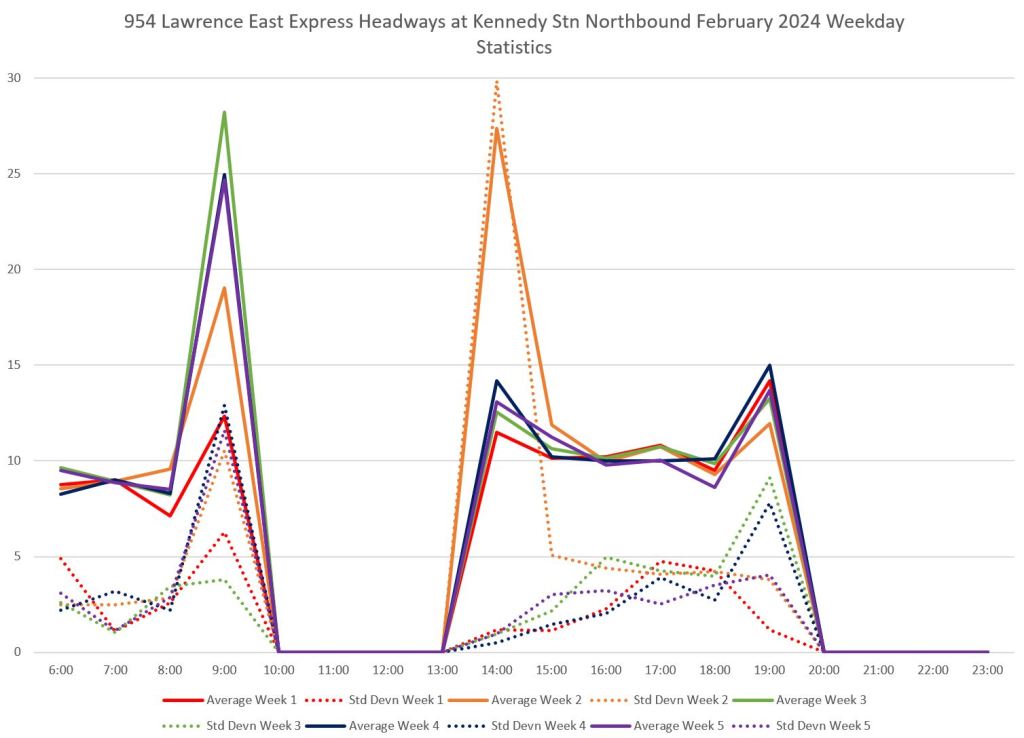
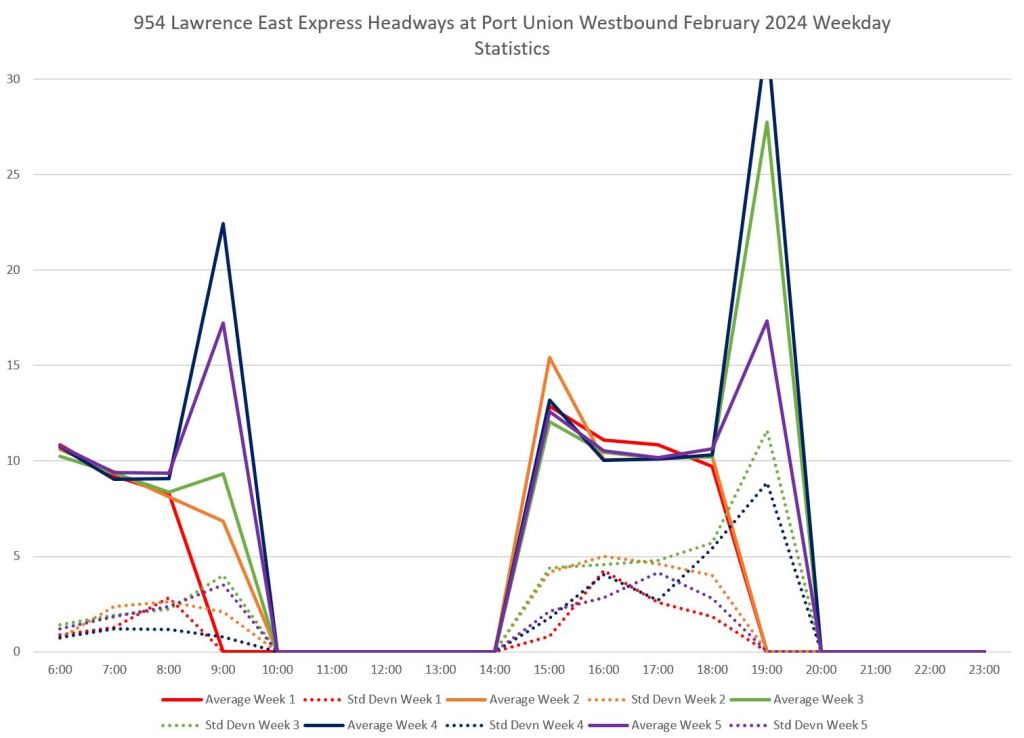
The headway distribution charts show the range of values leaving Kennedy Station and Port Union during the 8:00 am and 5:00 pm hours.
Service from Kennedy Station in the AM peak was erratic in the fall, but settled down in January-February, although there was no schedule change.


985 Sheppard East Express
The 985 Sheppard East Express operates primarily on Sheppard, but the 9985A branch turns south to STC via Midland. From there, it runs south to Kennedy Station.

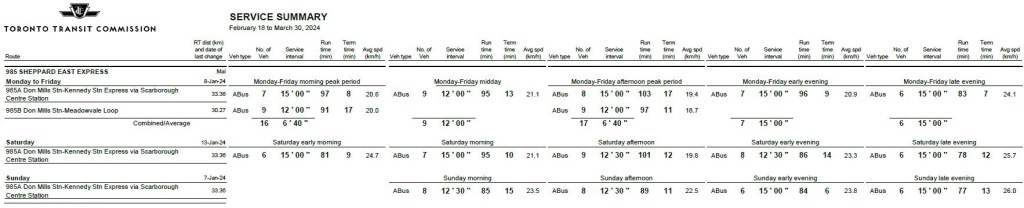
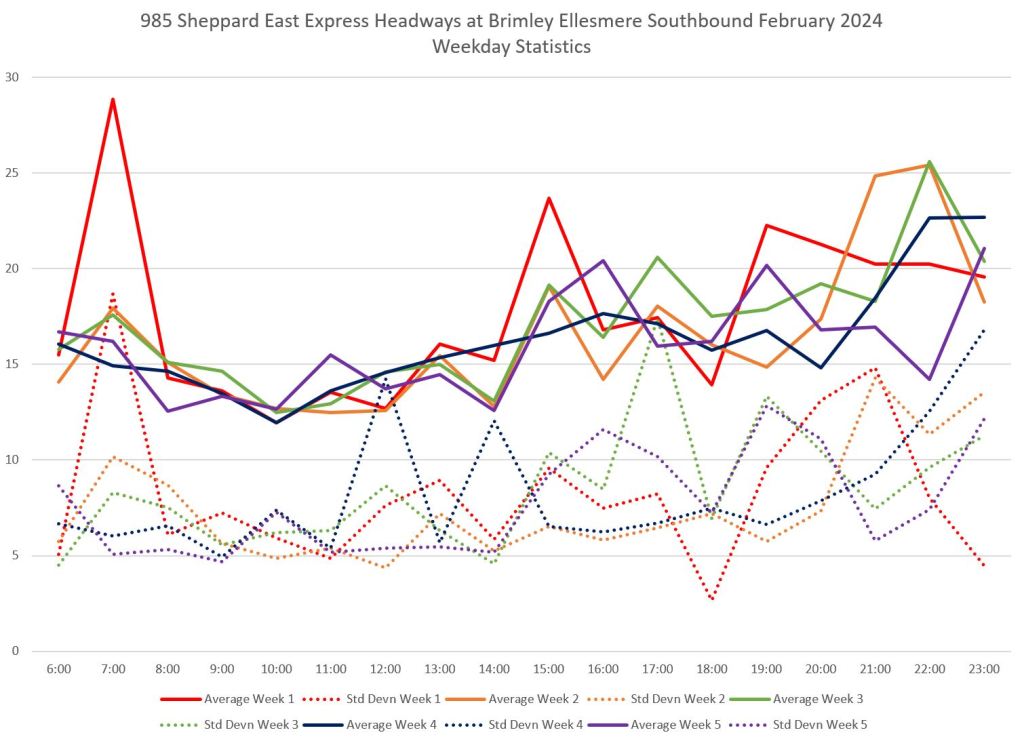
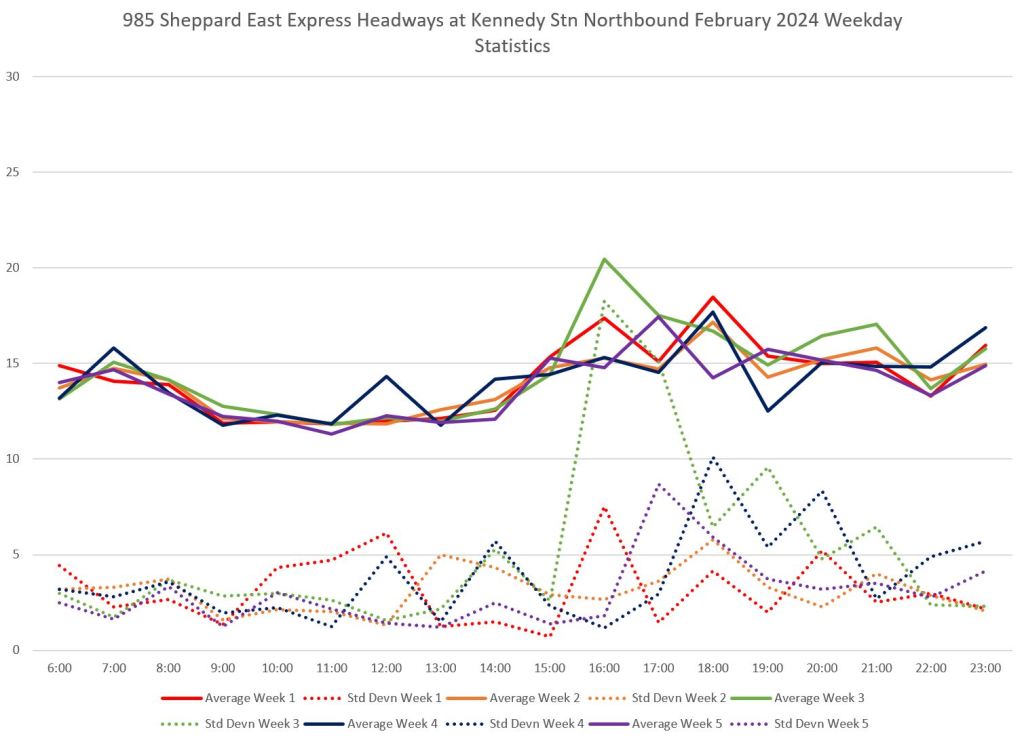
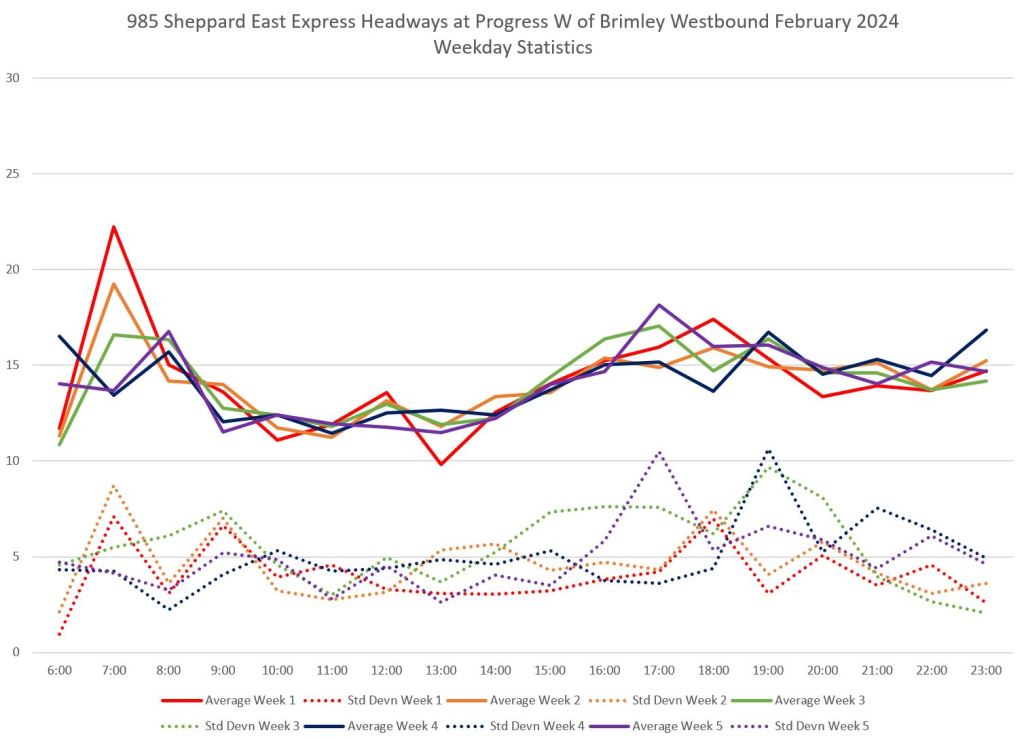
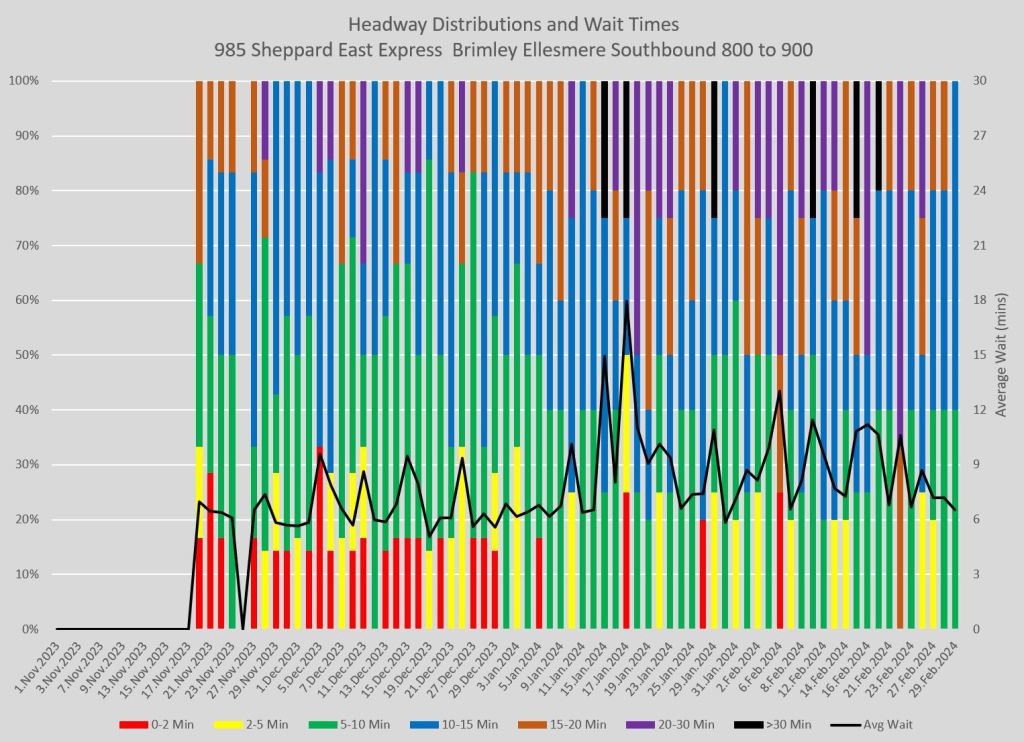
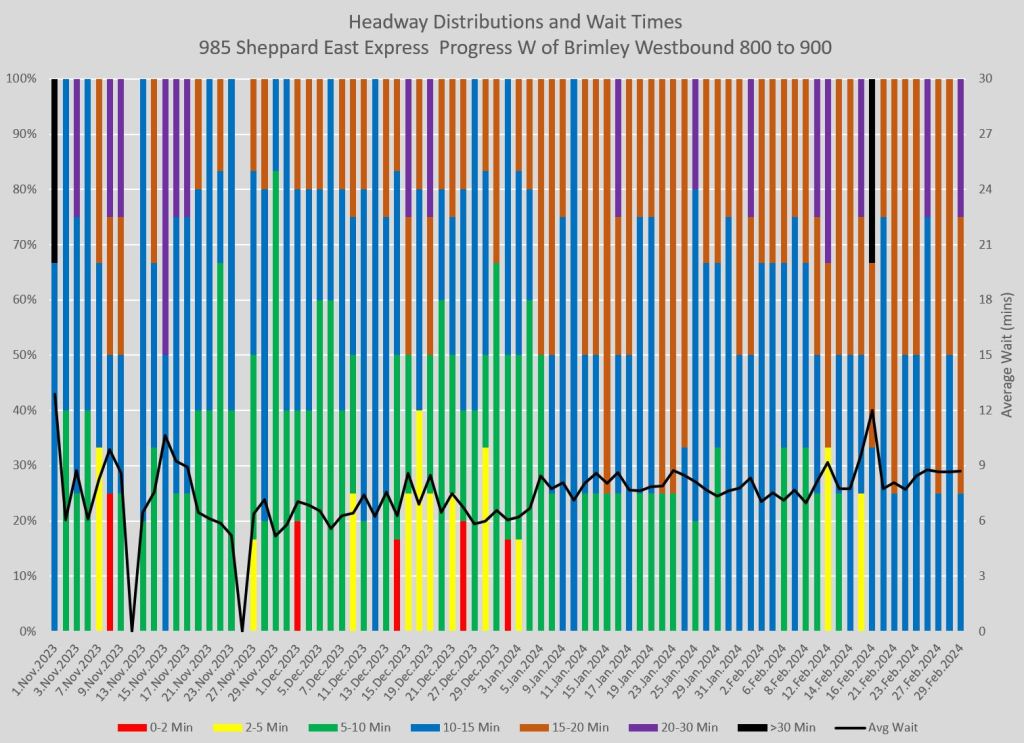
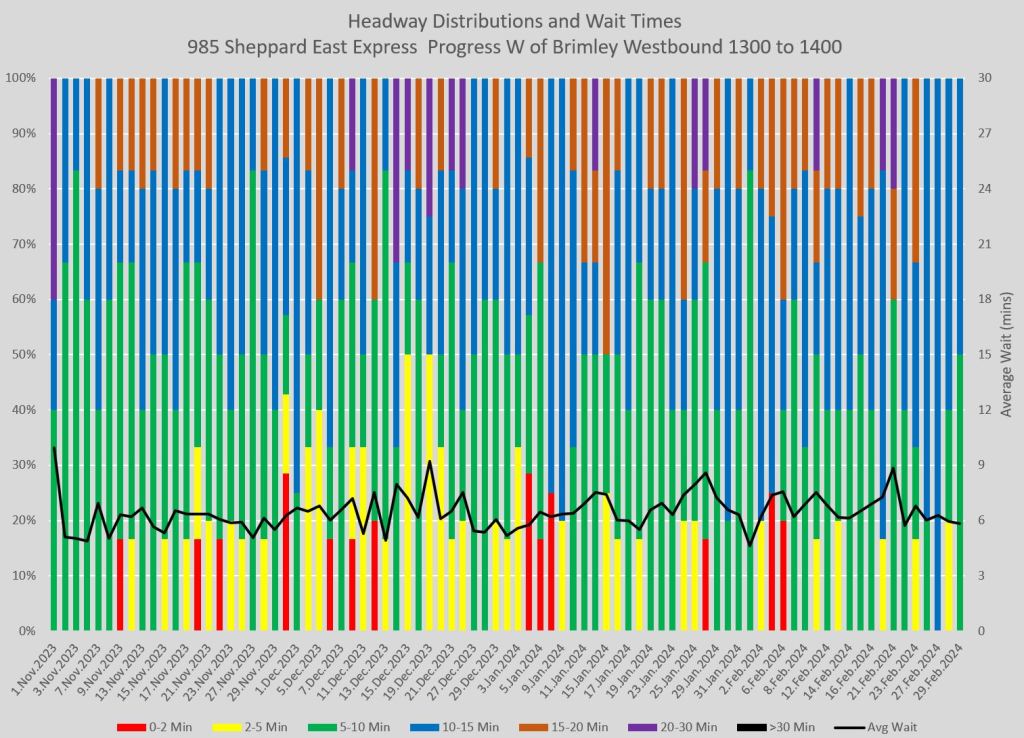
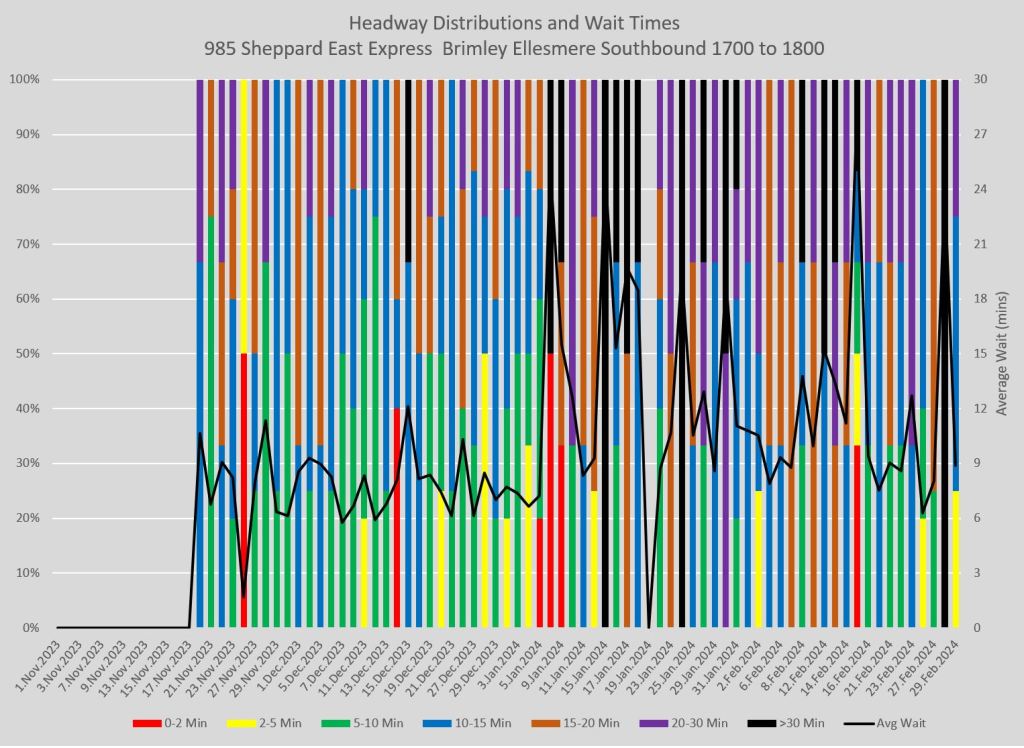
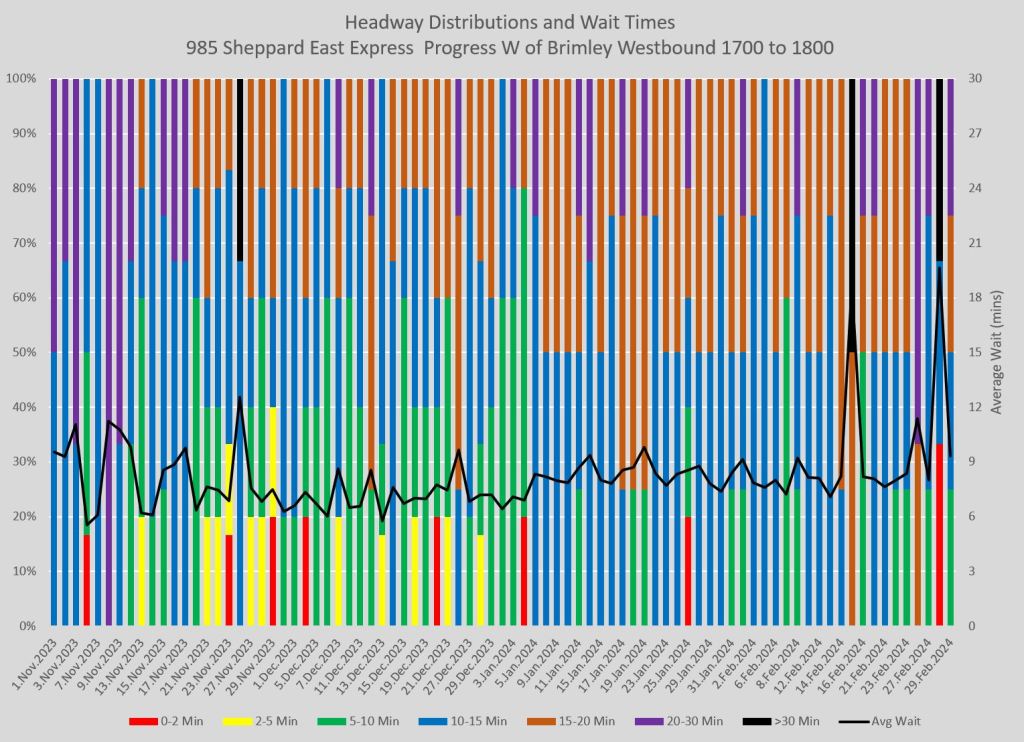
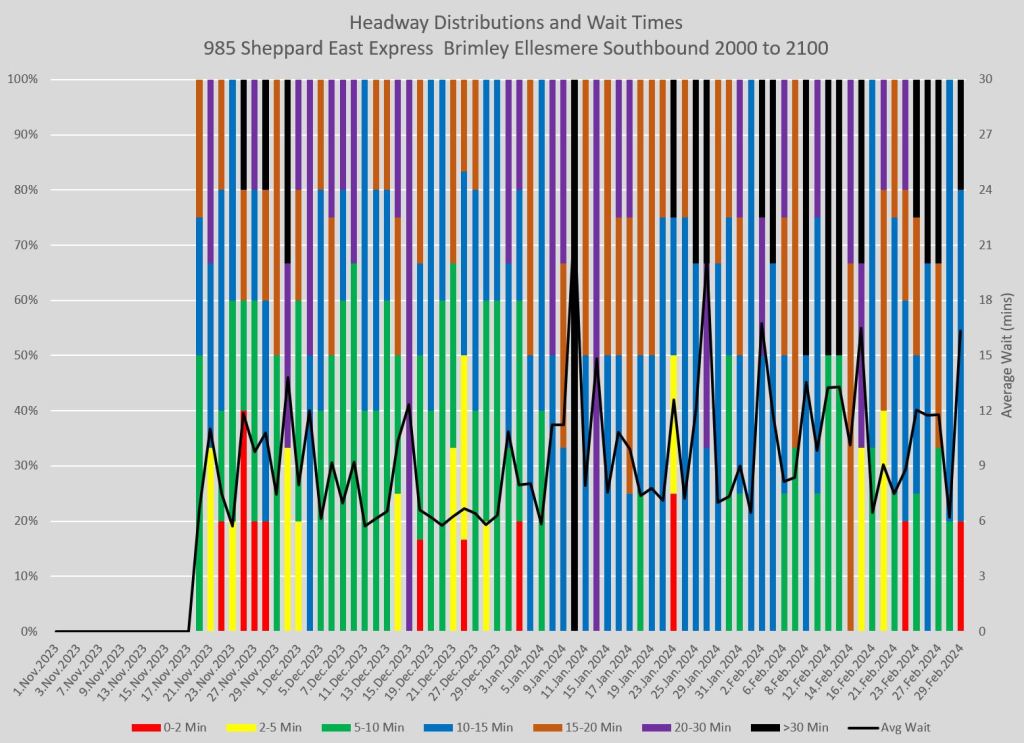
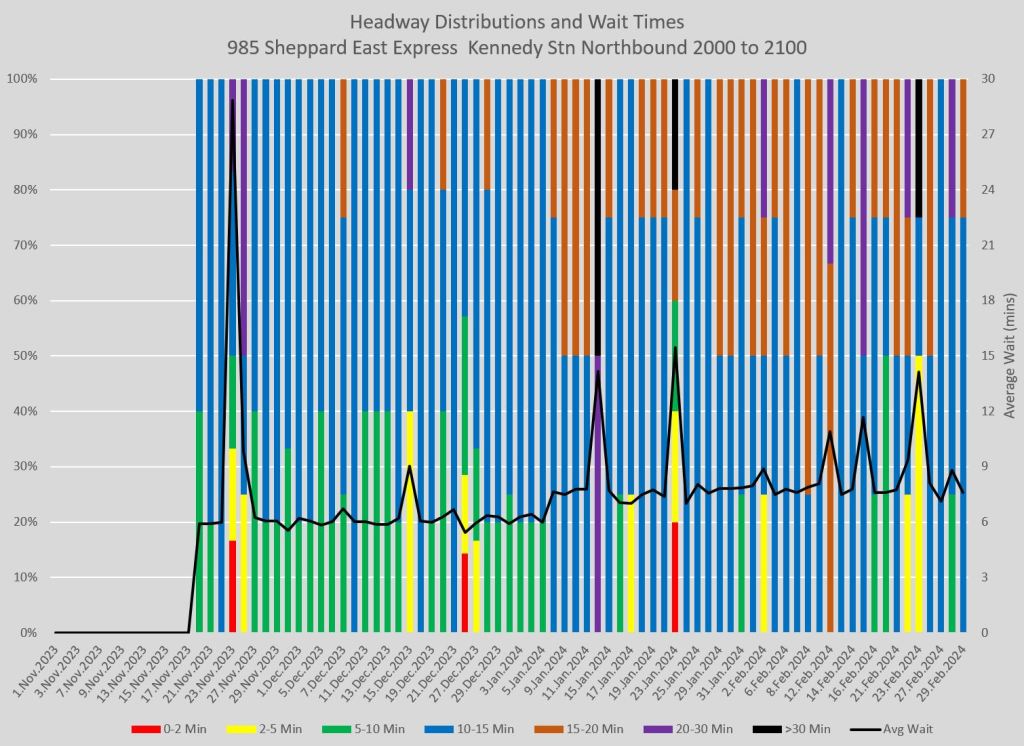
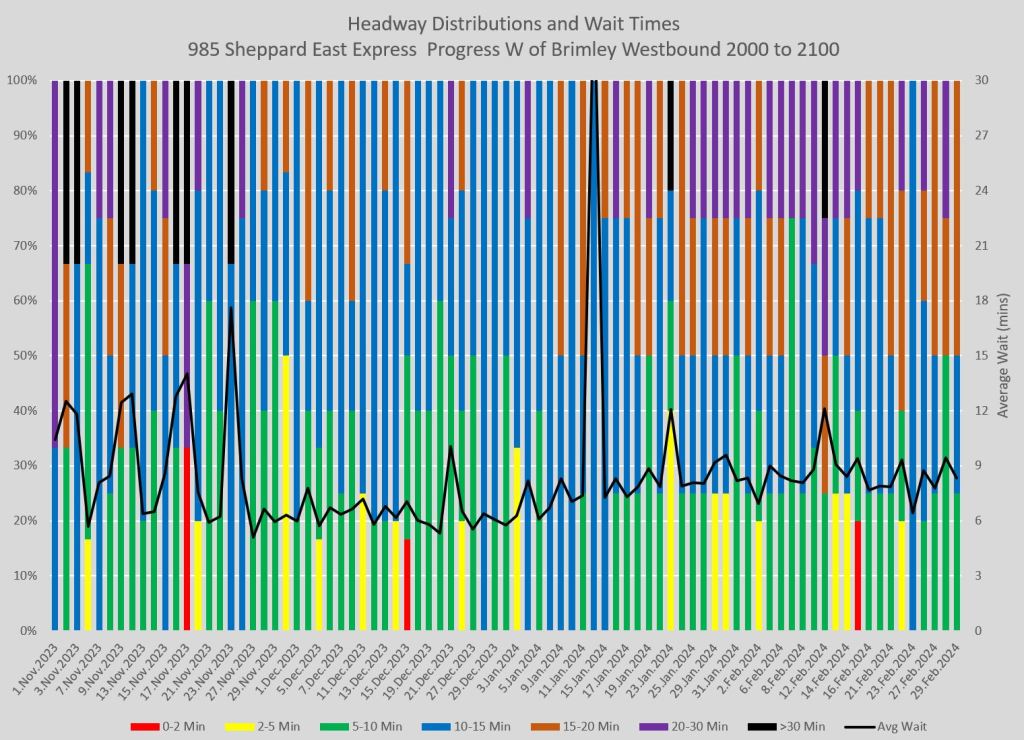
The charts below follow the service from the point it leaves STC southbound on Brimley (left column), leaves Kennedy Station (middle column), and leaves STC westbound for Sheppard Station via Progress.
The standard deviation values at Brimley & Ellesmere southbound are very high and erratic, a typical situation near the end of a route. This is only tolerable because service on the SRT corridor is provided by many overlapping routes. Bunching and gaps are quite severe particulalry in the PM peak and early evening starting in January.
Leaving Kennedy Station, the SD values are moderate through the early afternoon, but then grow both in value and in their own variability through the PM peak and early evening. The bunching problem for buses enroute to Kennedy (left column) has been smoothed out by recovery time and more regular departures.
By contrast, the service westbound from STC via Progress has somewhat better-behaved, but still high, SD values indicating swings of 10 minutes or more within about two-thirds of the service




Full Chart Sets


Malvern operators don’t follow schedules and do whatever the hell they want, supervisors don’t do anything either because they’re buddy buddy with them.
It’s why routes like the 939 have much less worse headways and gaps compared to the 985 even thought the 939 is a much higher demand and longer route. Finch is also a way busier street.
TTC needs to do a full audit of this division and disperse the current workforce across the other divisions, there’s way too many bad apples there. Investigate supervisors and managers too.
LikeLike
By this time the TTC has had a chance to try out two different approaches to service on the SRT corridor (extremely frequent service on one shuttle route, vs. less frequent service on each of several overlapping routes). I don’t ride it frequently but have used it a few times in both configurations… and ride one of these express routes away from the SRT corridor.
I’m wondering if your data tells much about dwell time at STC for through-routed buses.
Of the two route arrangements, it seems like the only thing that the current arrangement has in its favour is the elimination of transfers at STC for riders carrying on to Kennedy, and the claimed travel time reduction of 3 minutes. Otherwise:
It’s the last item that I’m wondering about. Sure, maybe a layover is only a matter of a few minutes, what’s the problem? Well, the TTC justified a more complicated routing arrangement on a time savings of only 3 minutes due to not having to transfer from a 903 shuttle to another bus at STC. When I’ve been through there under the new arrangement, it seems like there are many buses that chew up that time savings through layovers. For that matter, I would argue that the TTC may have overstated the transfer penalty associated with a shuttle than runs every 1 or 2 minutes.
(On top of that, it seems like there are not as many riders that actually make use of the through-routing as the TTC may have suggested… either because riders really are traveling between Kennedy and STC, or because riders are transferring to other routes… but perhaps that’s a function of when I’ve ridden through there.)
I’m curious whether there is anything in your data that indicates layover duration and whether how much of the vaunted 3-minute time savings riders are actually experiencing.
Steve: Yes I can pull out the layover times at STC and Kennedy, although it’s a tad tricky to see it from a rider’s point of view. A bus on route X might lay over for 10 minutes, but it might not be the next one to leave, and no rider would wait for this bus until it was the only one in the queue. As with other transit priority schemes, there has been too much emphasis on the “minutes saved” which on average tend to be small, versus the consistency of travel time and only minor swings from one trip to another. But the “time saved” message is the one both management and the pols latch onto as it’s easy to understand and market.
LikeLike