
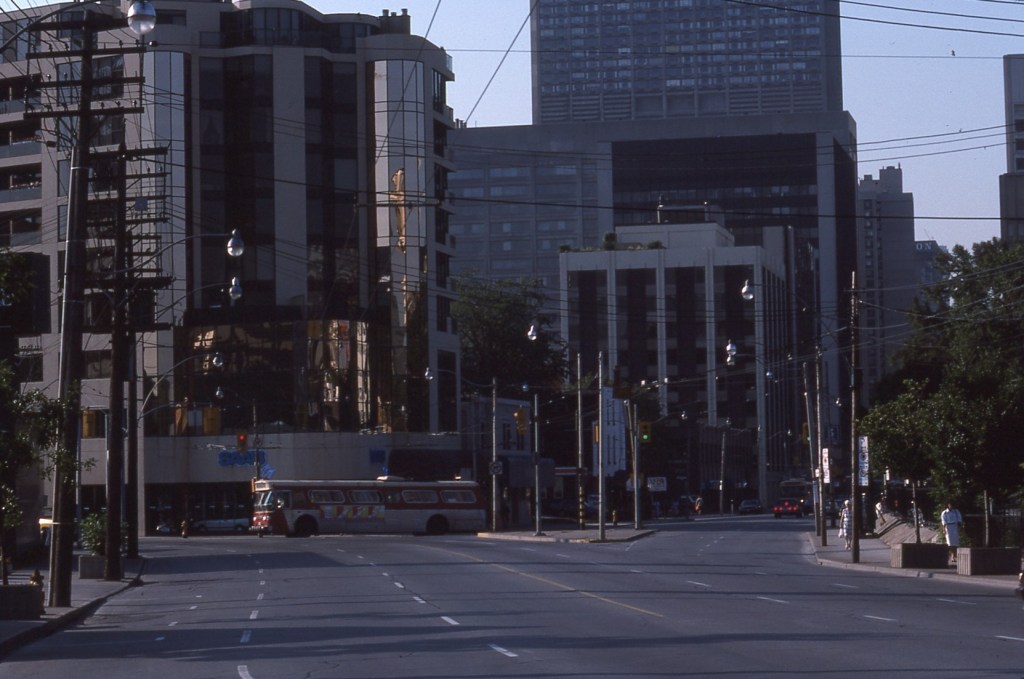
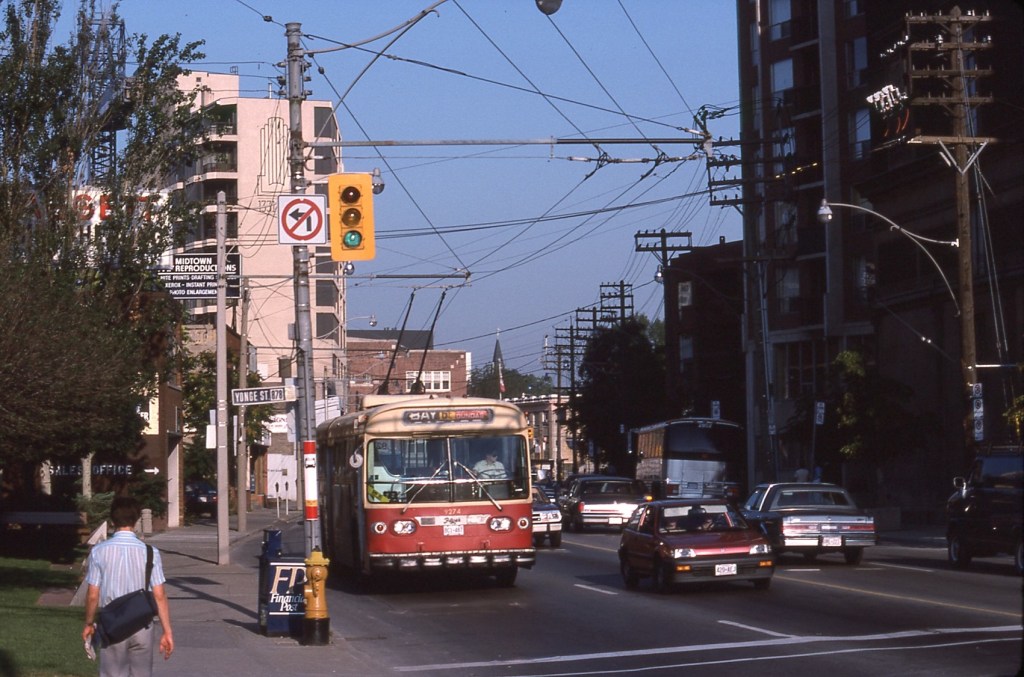
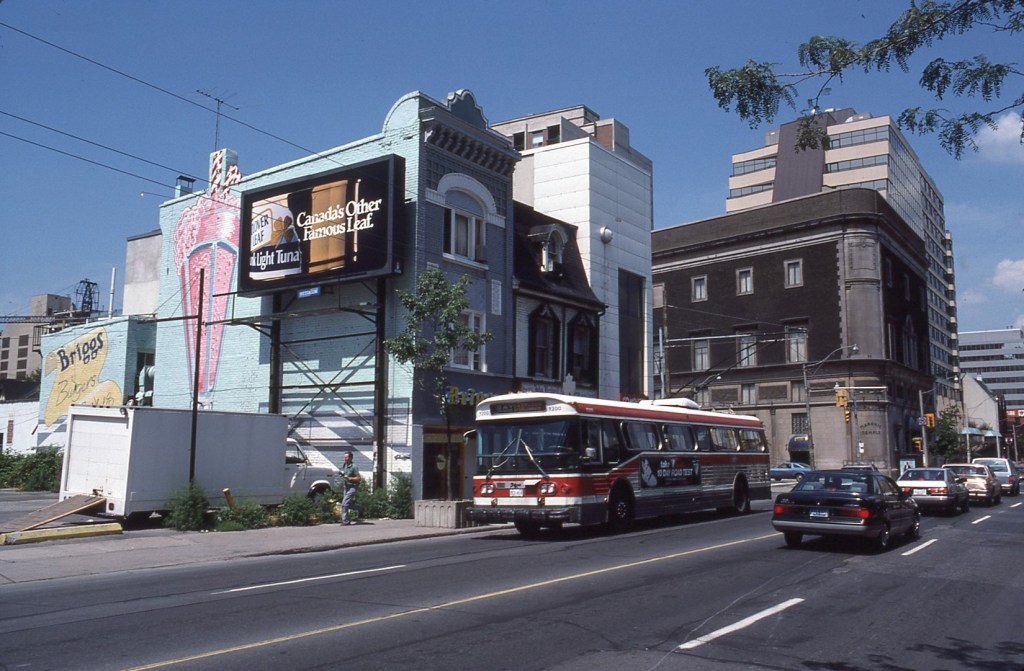
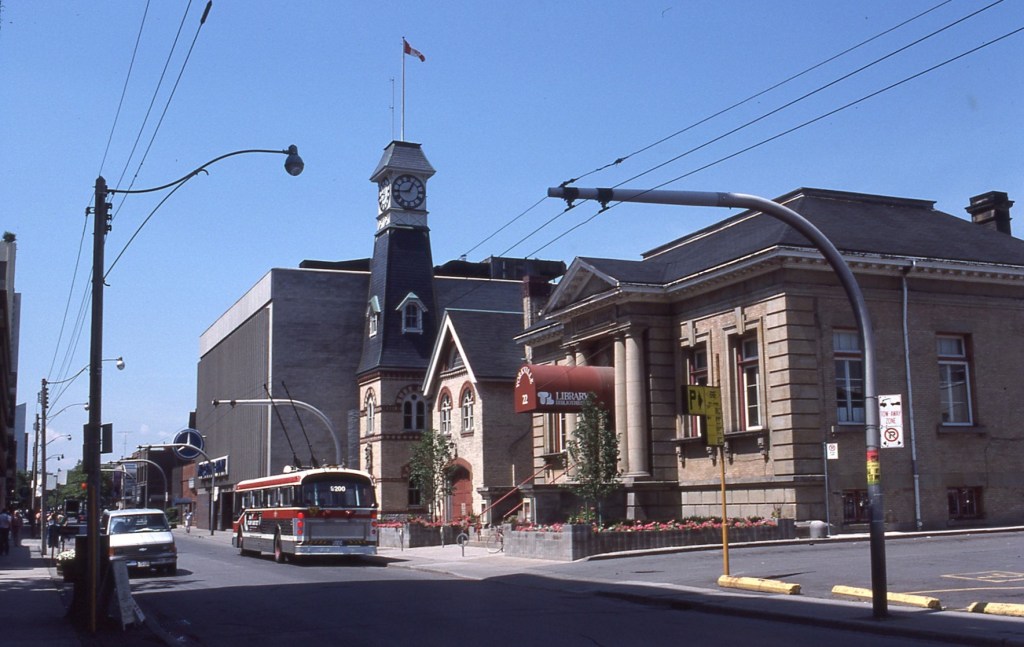
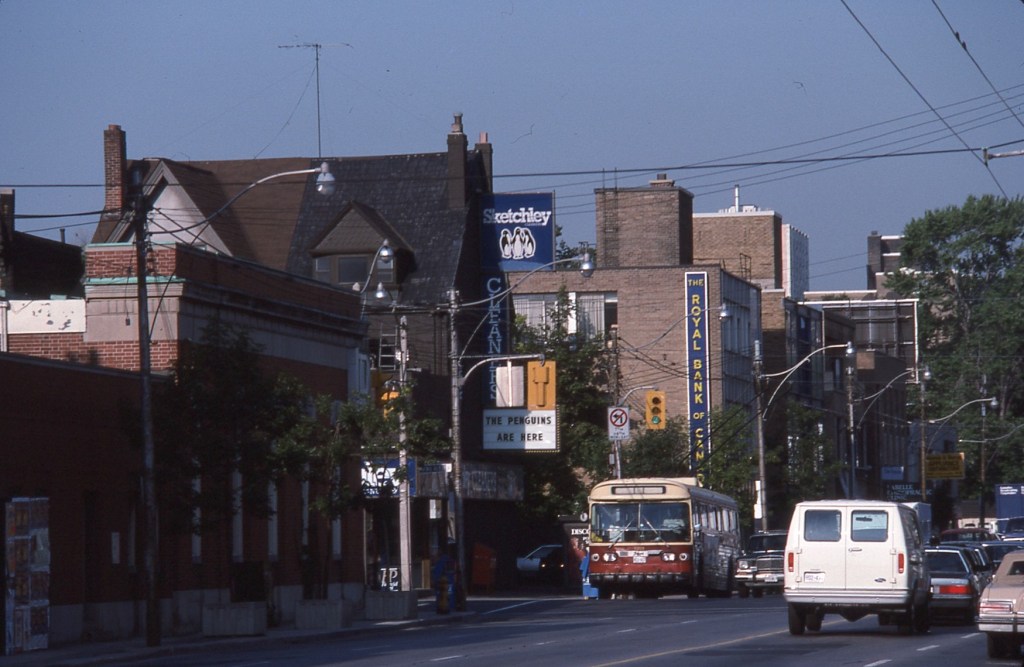
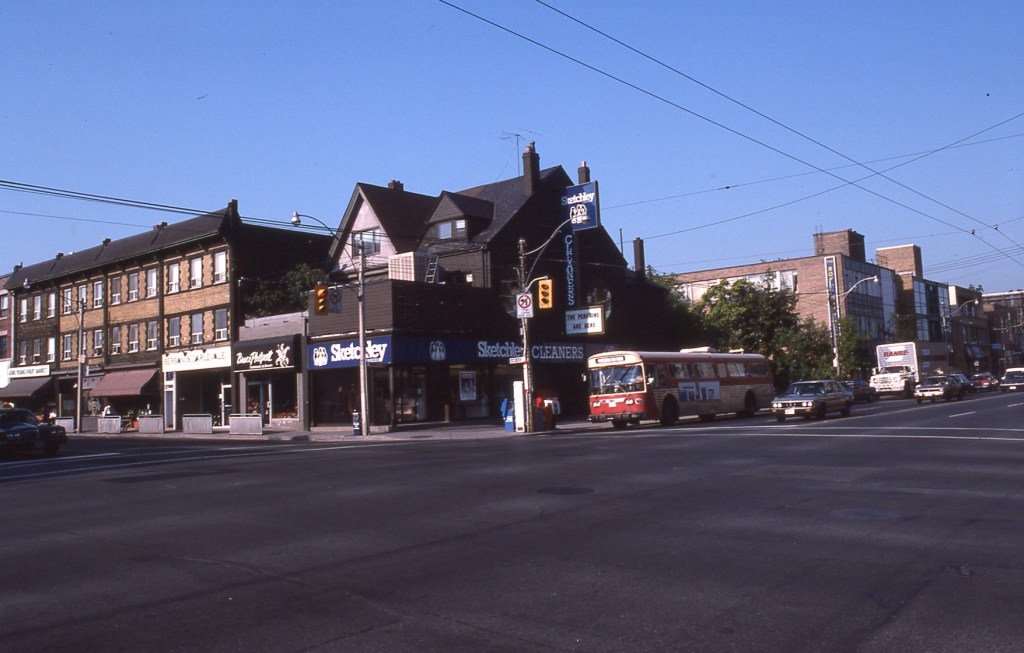
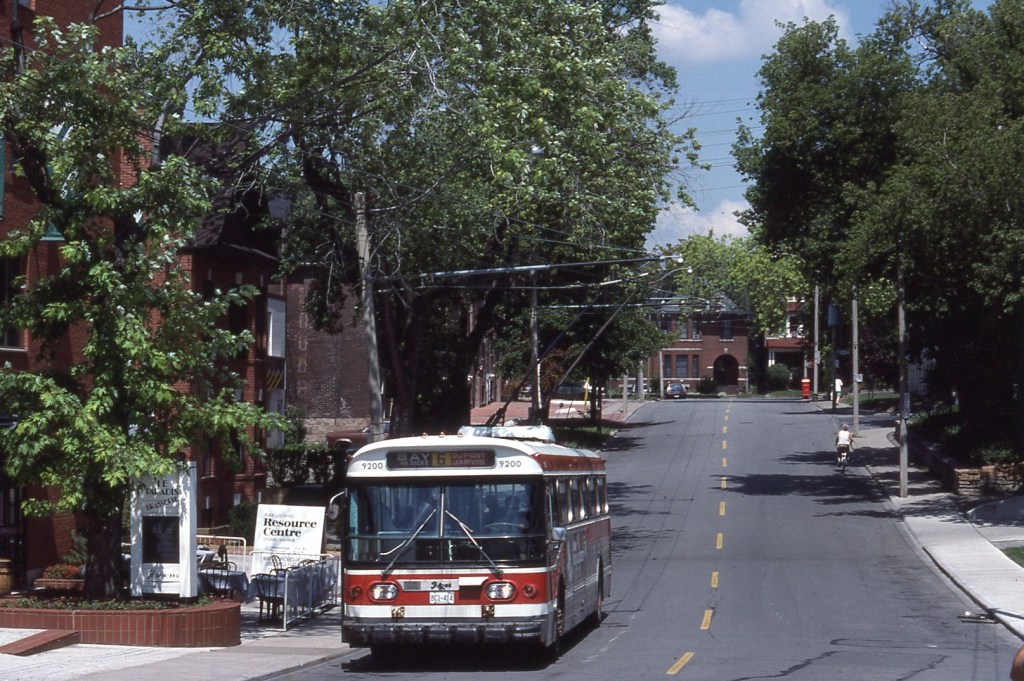
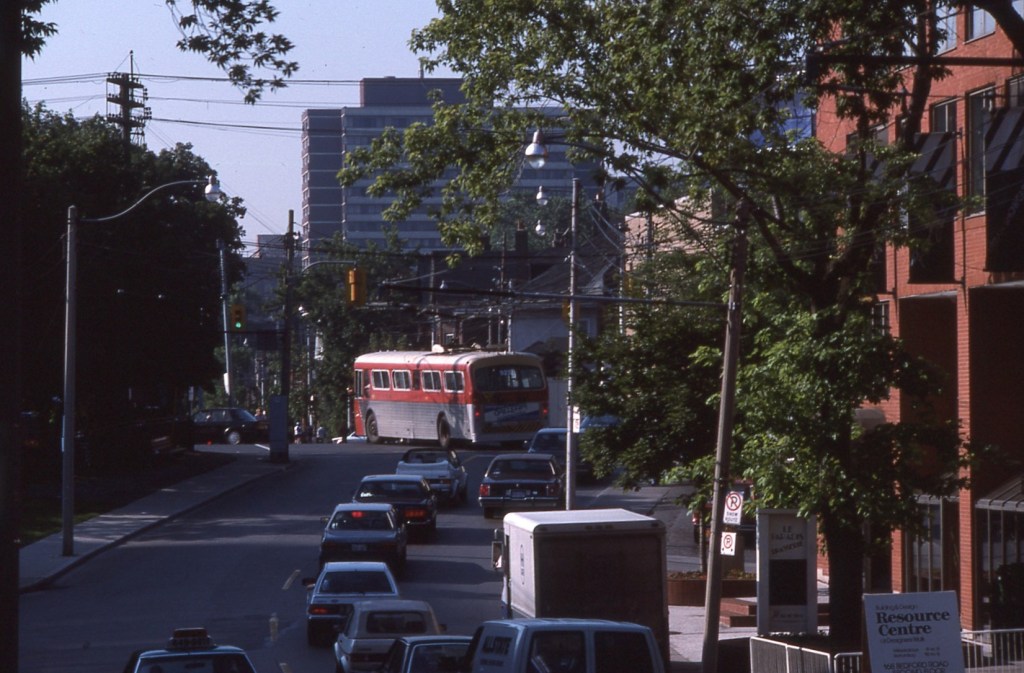
Back in 1987-88, I photographed the Bay trolleybus a lot. The route was threatened for a time by a proposed one-way pairing with Yonge Street, and the south end of the route went out of service for construction of the Harbourfront line.
Looking at these photos 36 years later, two things are quite striking: the changes all along the route where the canyon of newer buildings had not yet materialized, but also the frequency of service. Getting shots with two or three buses at a time was easy, far different from today when the service is infrequent with the “best” being a 14-minute PM peak headway, and 20-30 minutes at other times. This route saw a vicious downward cycle of riding loss and service cuts, and now is simply not worth waiting for.
For a history of the route, see the Transit Toronto site.
The route’s conversion to trolleybus was an offshoot of the 1972 decision to retain streetcars. The surplus TBs from 97 Yonge, released when the subway extension to York Mills opened, were originally intended for the St. Clair streetcar route, although the proposed service level would have been worse than the streetcars to be replaced. The Streetcars for Toronto advocacy group (which I chaired for a time) pushed for deployment of the surplus TBs on Bay given its frequent service and downtown location well placed to use the existing power distribution infrastructure. (A less obvious motive was to eliminate a potential threat to any other streetcar lines with the TBs looking for a home.)
The galleries below run from south to north along the route with photos from Fall 1987 and Spring-Summer 1988. Photos of 9200, the first production bus of the “new” TBs, are from a fan excursion.
Jarvis to Front
The south end loop of 6 Bay (as it then was) circled the block formerly occupied by the LCBO warehouse via Cooper Street, Lake Shore Boulevard and Jarvis, returning west on Queens Quay.
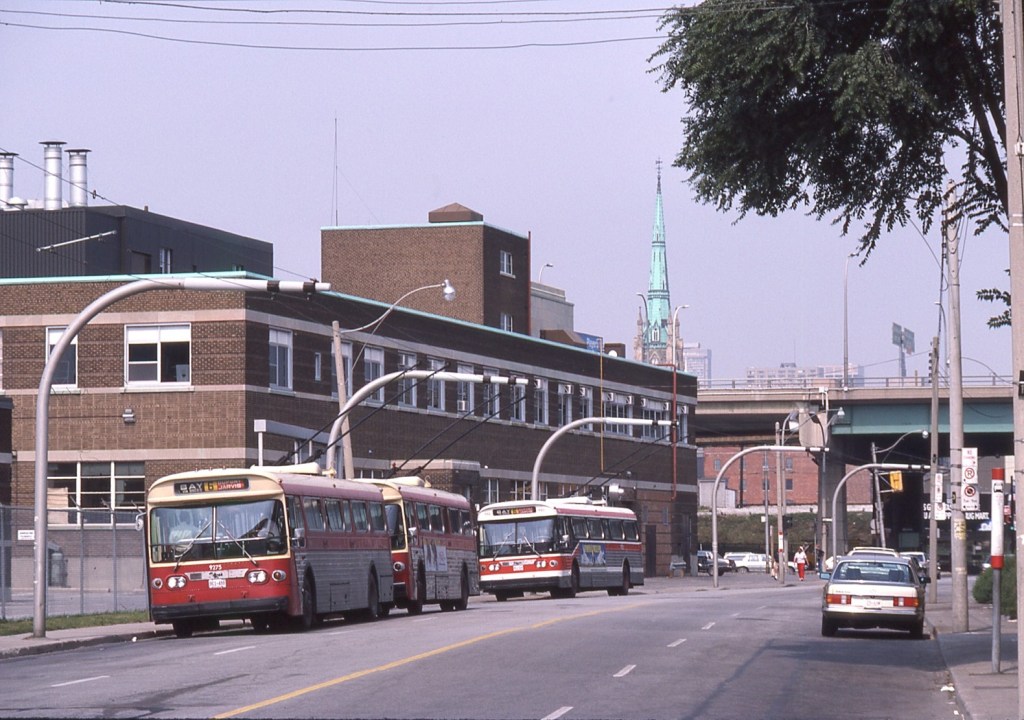
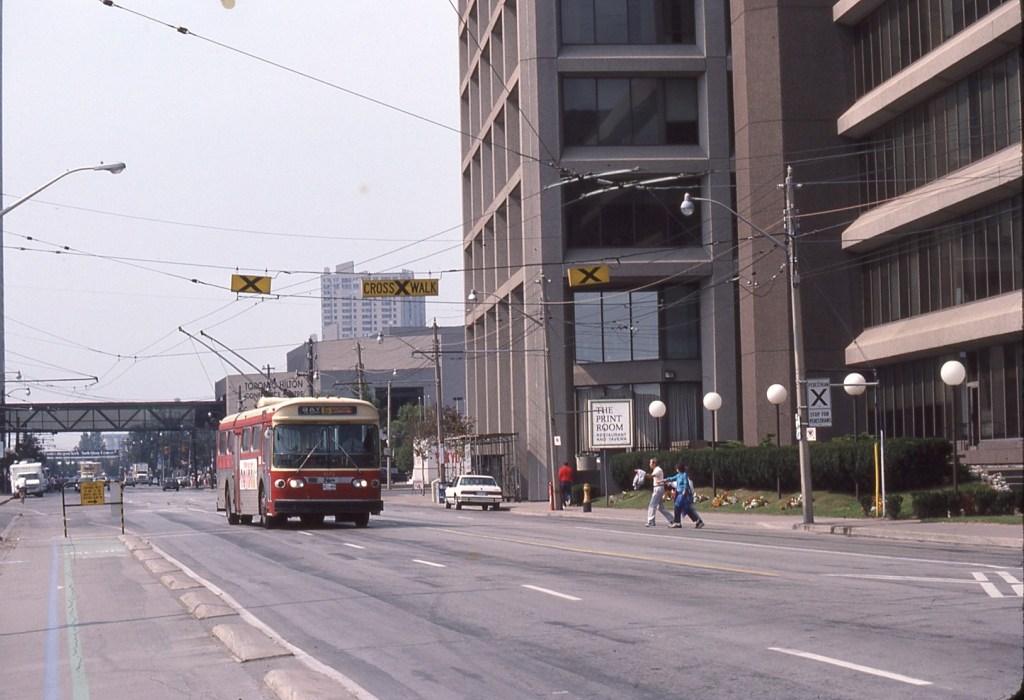
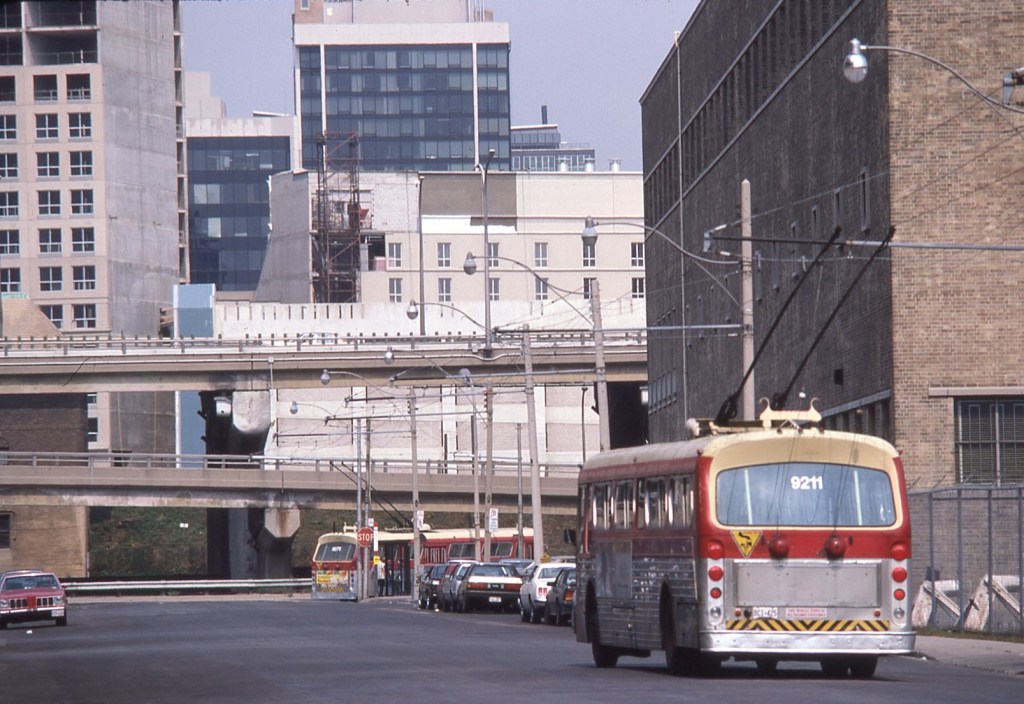
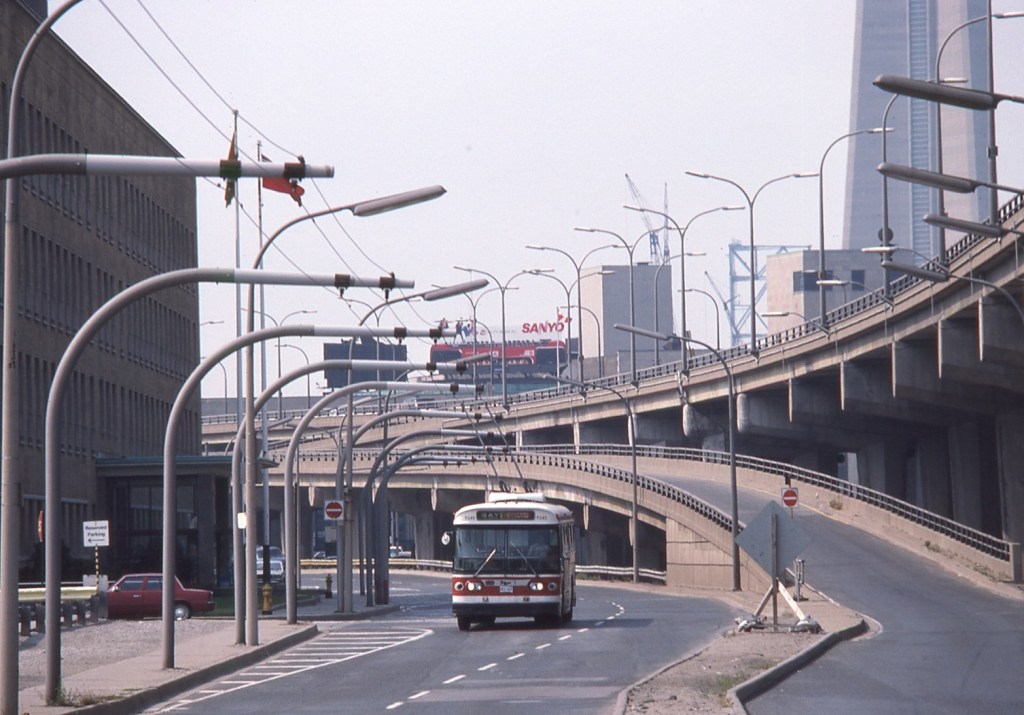
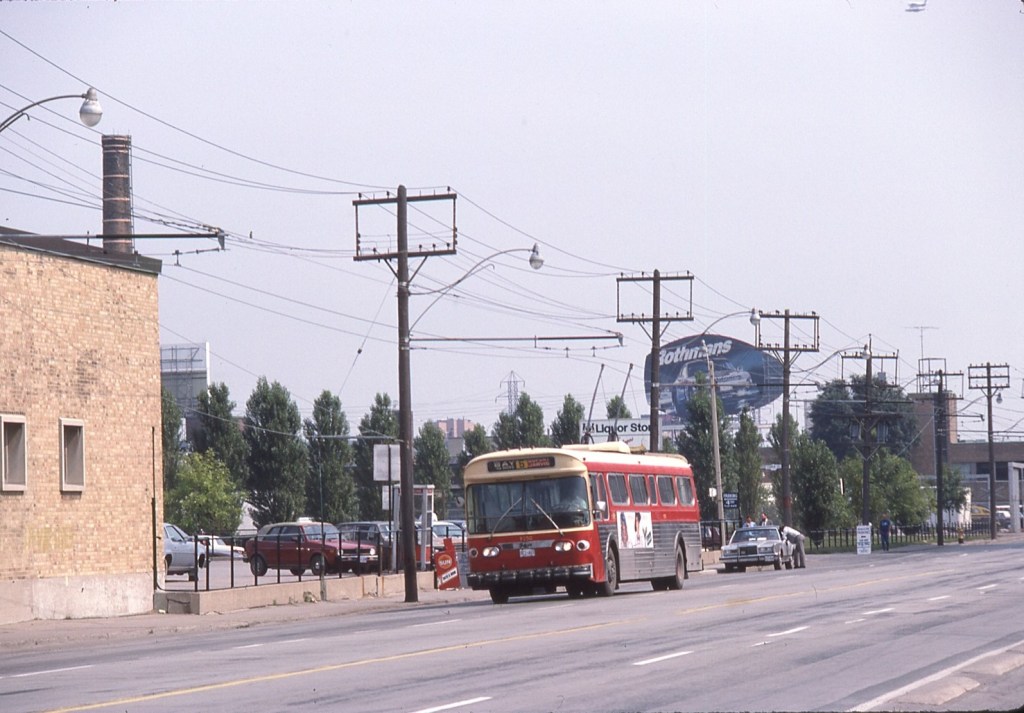
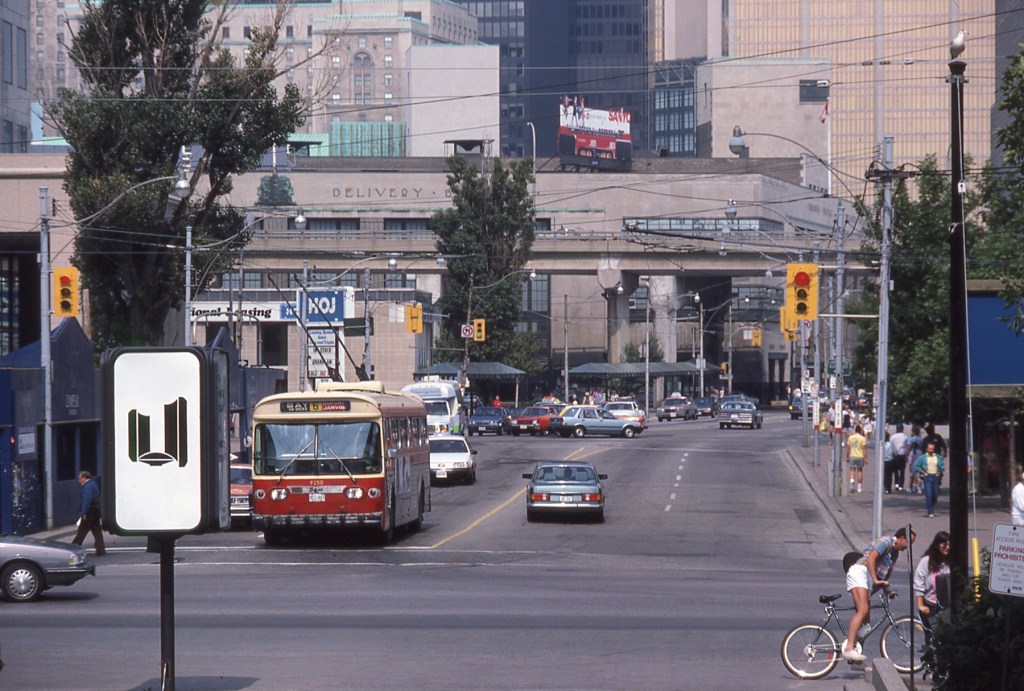
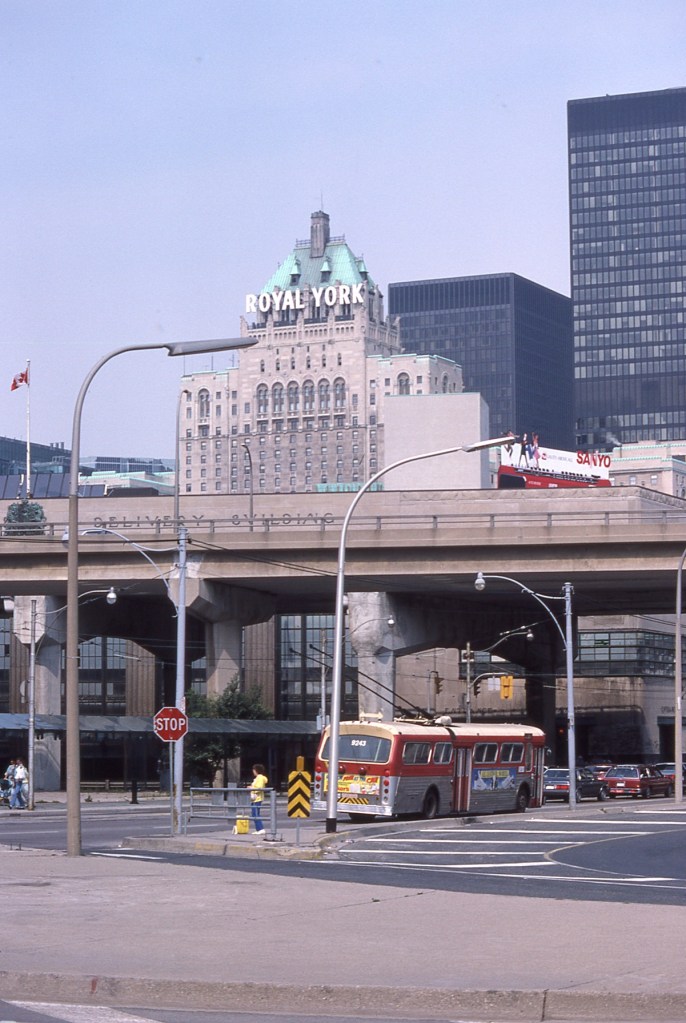
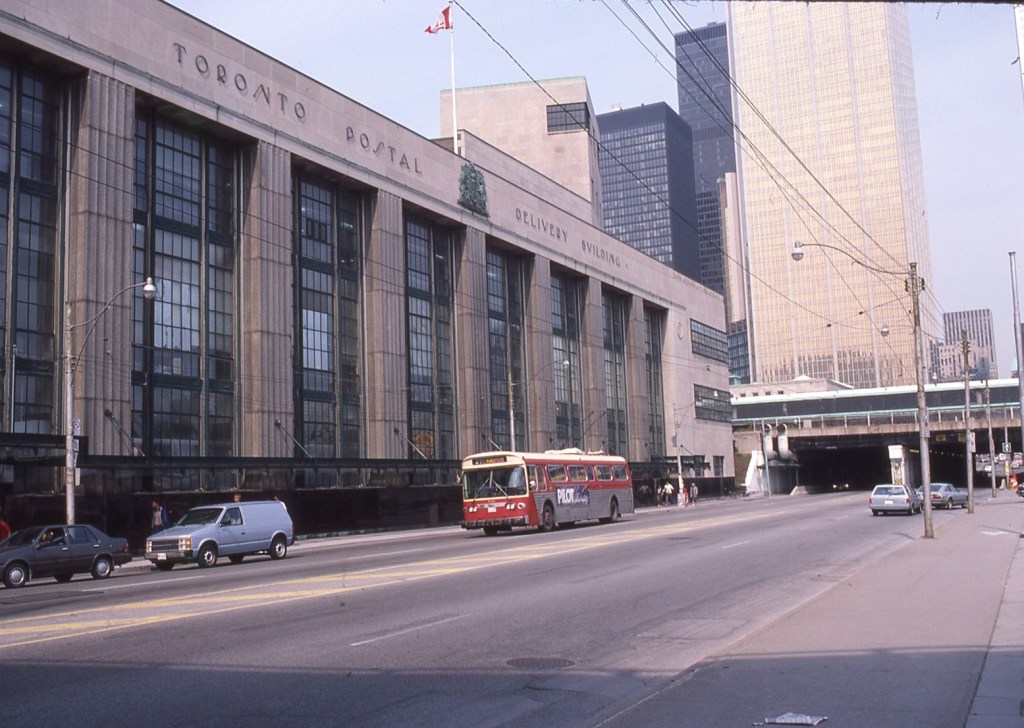
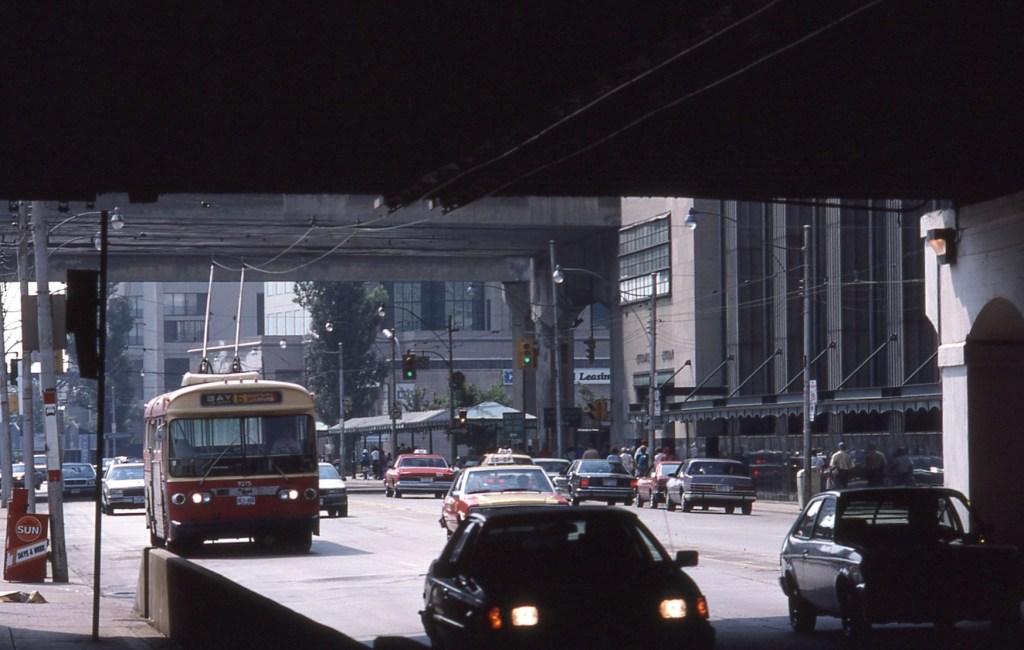

Front to Dundas
The short turn loop at the south end of the route operated via Front, Yonge and Wellington.
I could not resist a few shots of the Hydro substation south of Dundas named “Terauley”, the original name for this section of Bay Street.


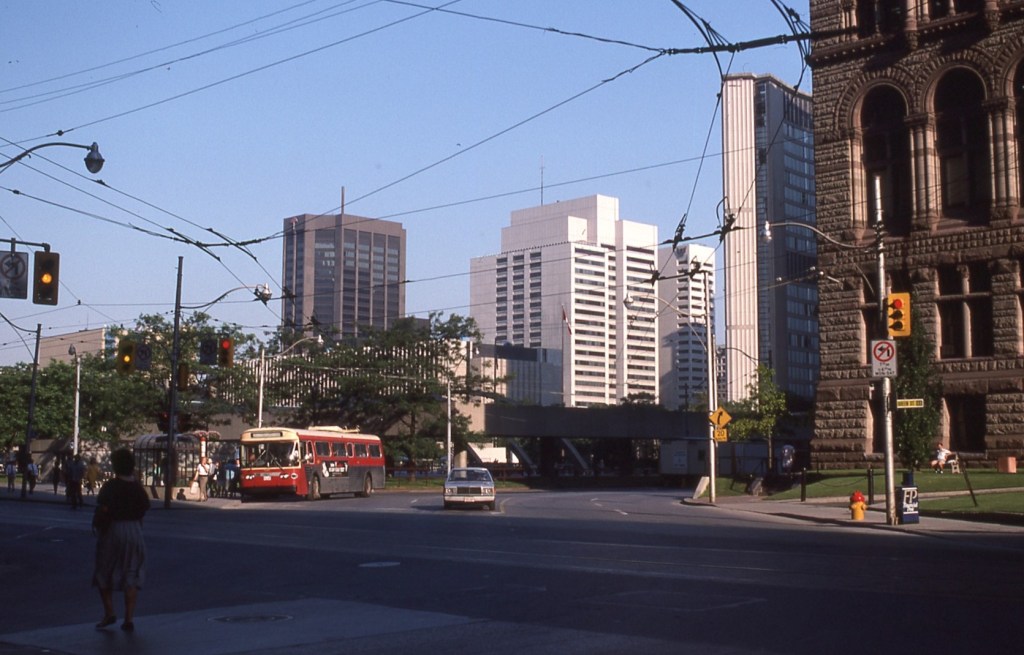

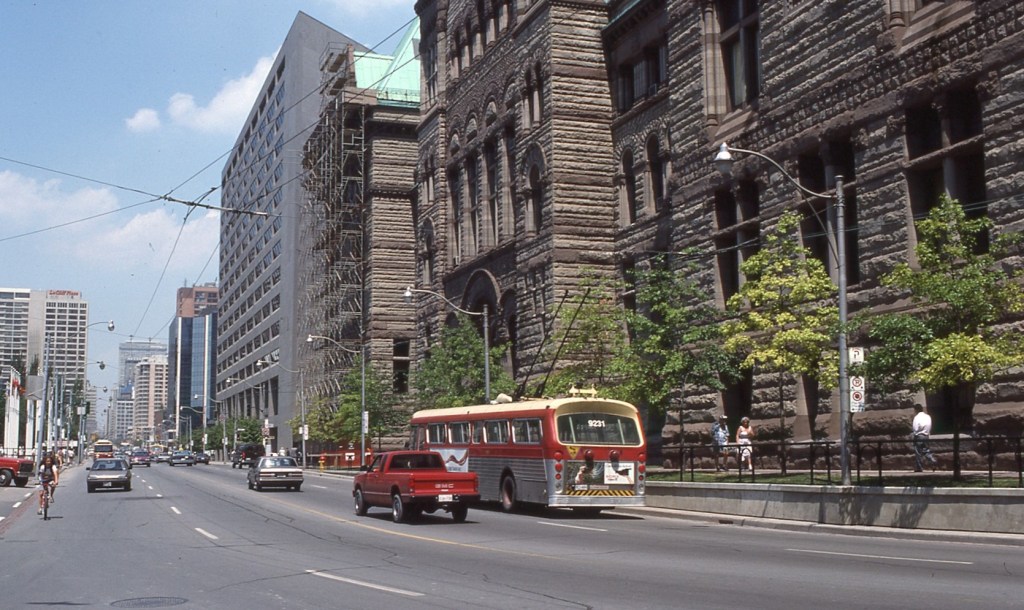
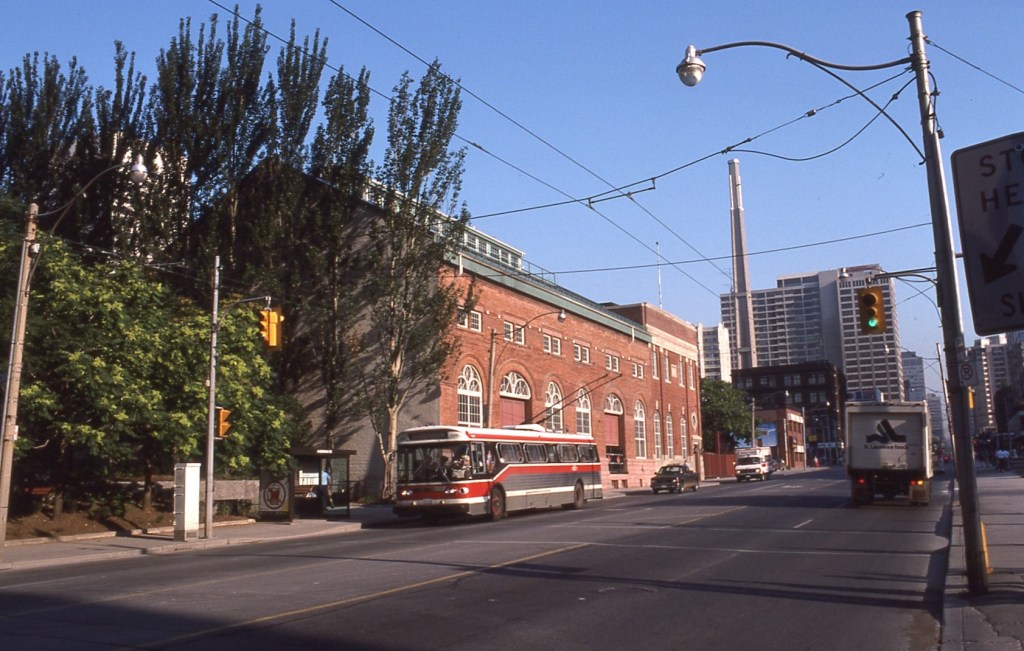
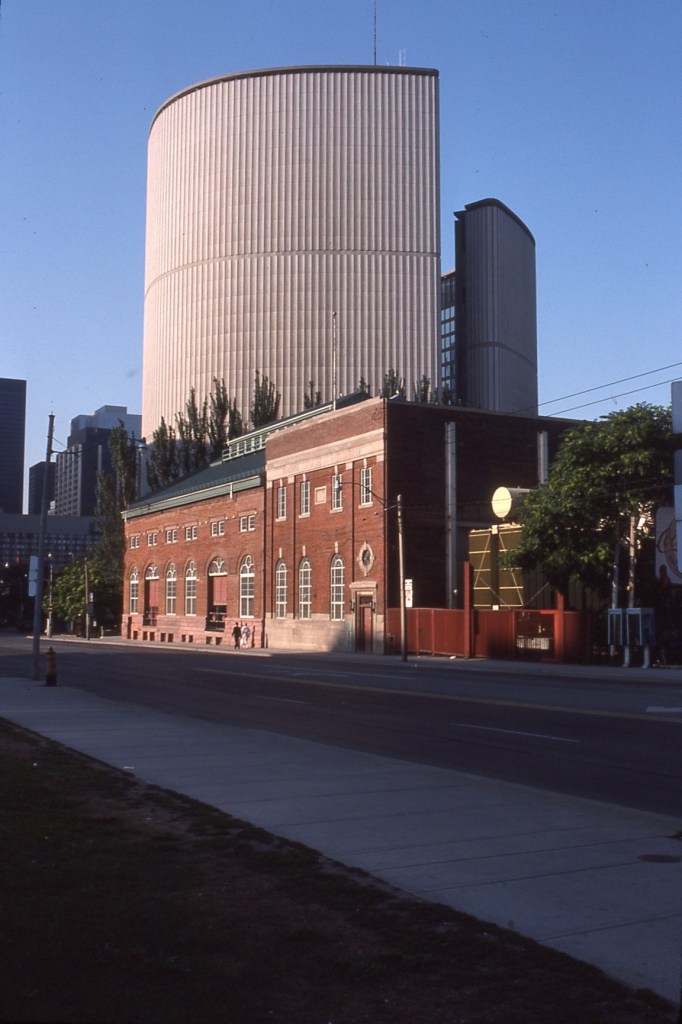
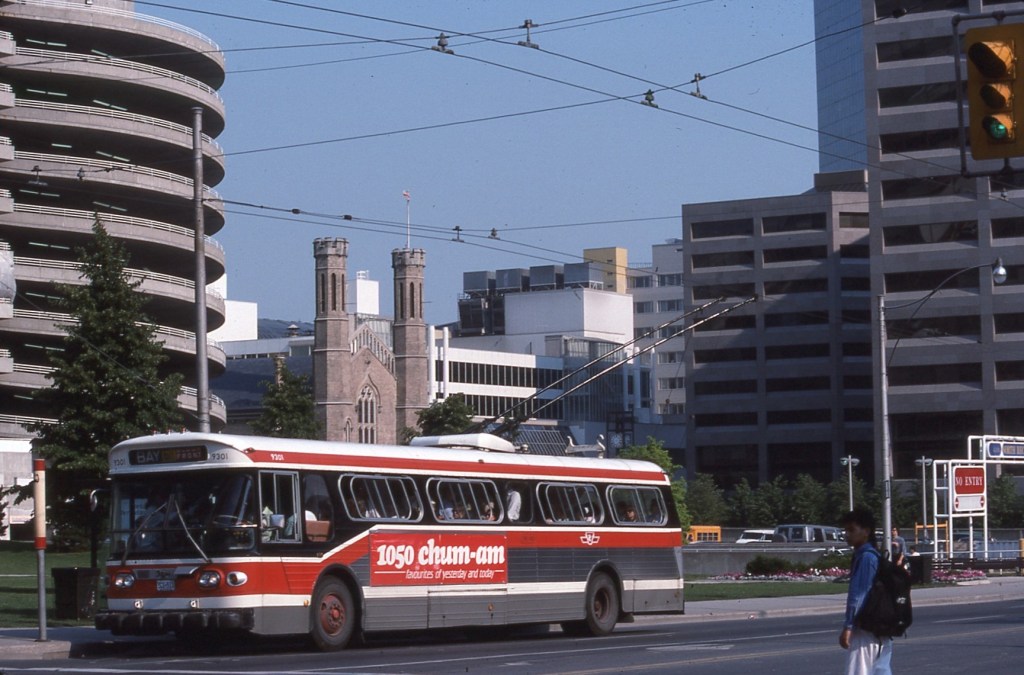
Dundas to Bloor
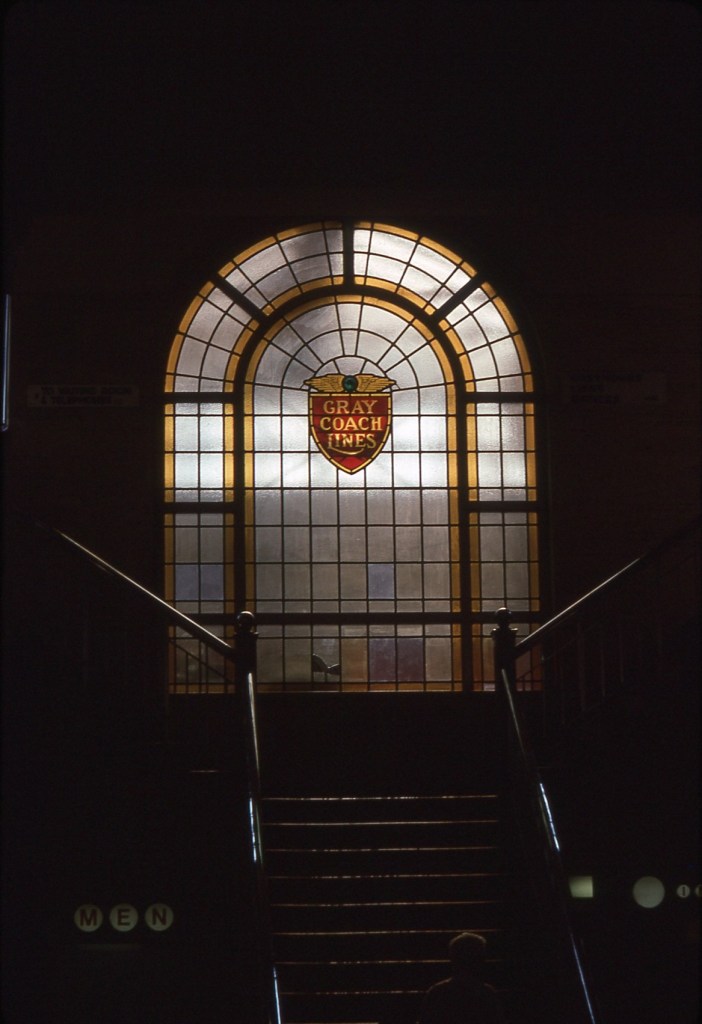
Just north of Dundas is the old Gray Coach Lines bus terminal which has been replaced, less than successfully, by a new terminal south of Union Station. Another former GCL building is Edward Street Garage.
A mid-route short turn loop operated via Edward, Elizabeth and Elm Streets.
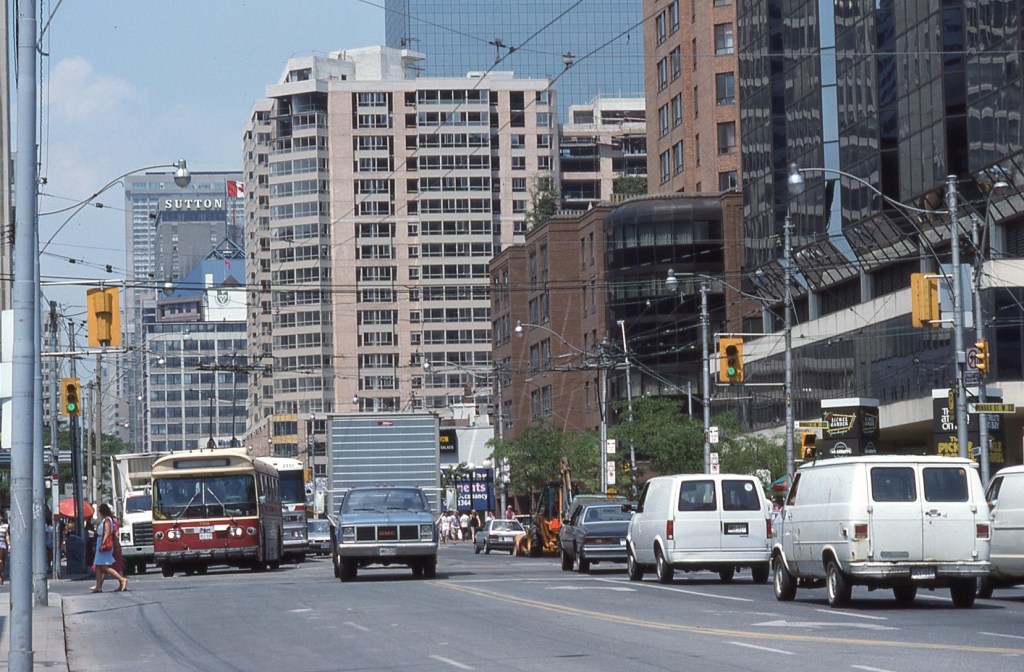
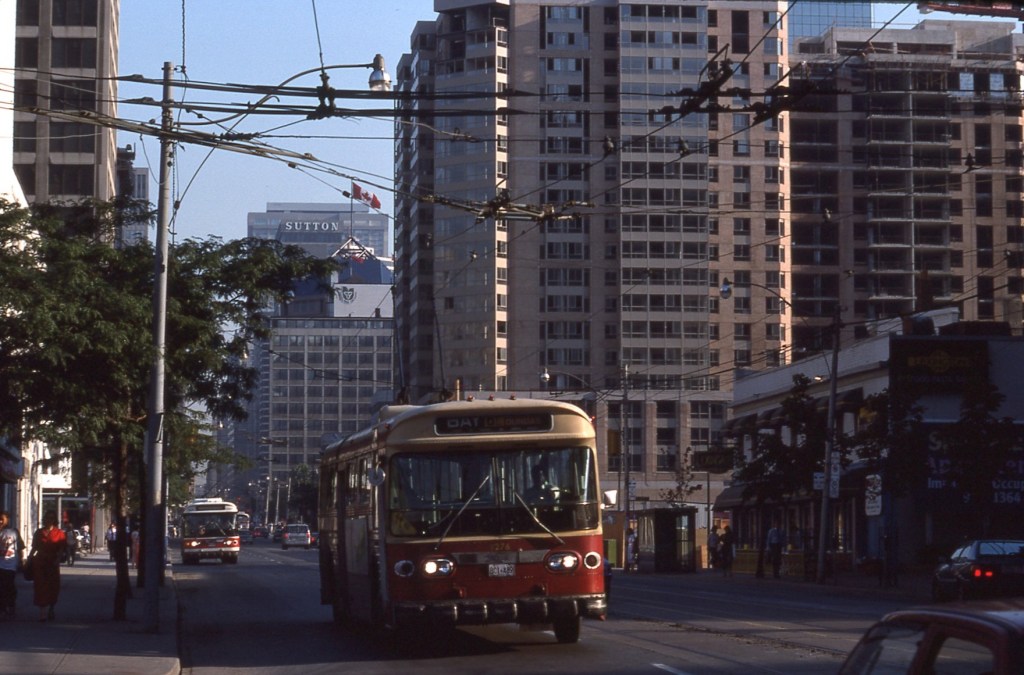


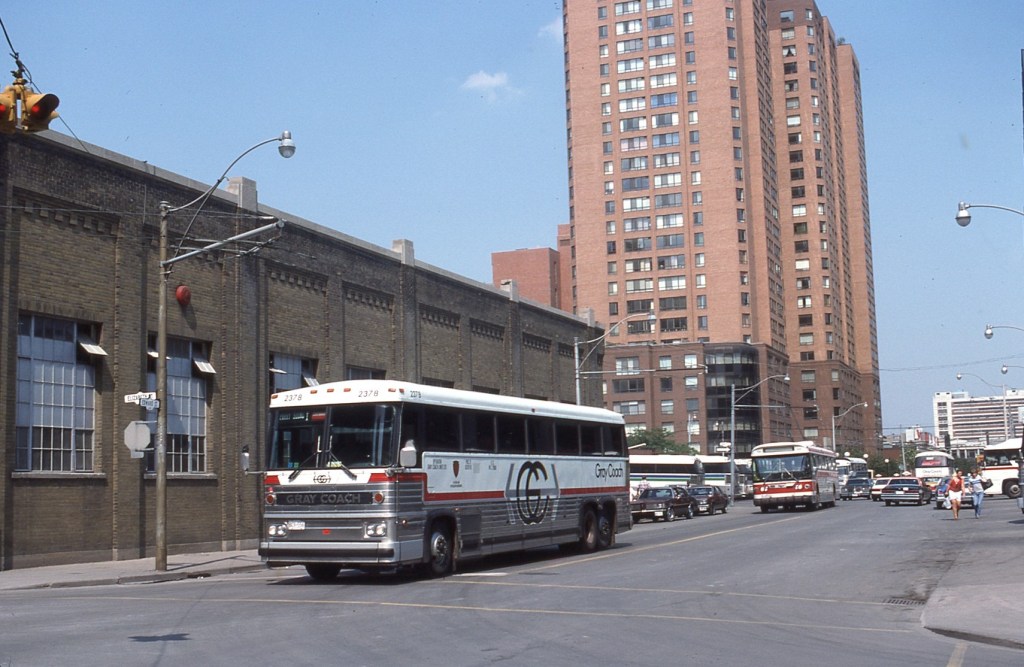
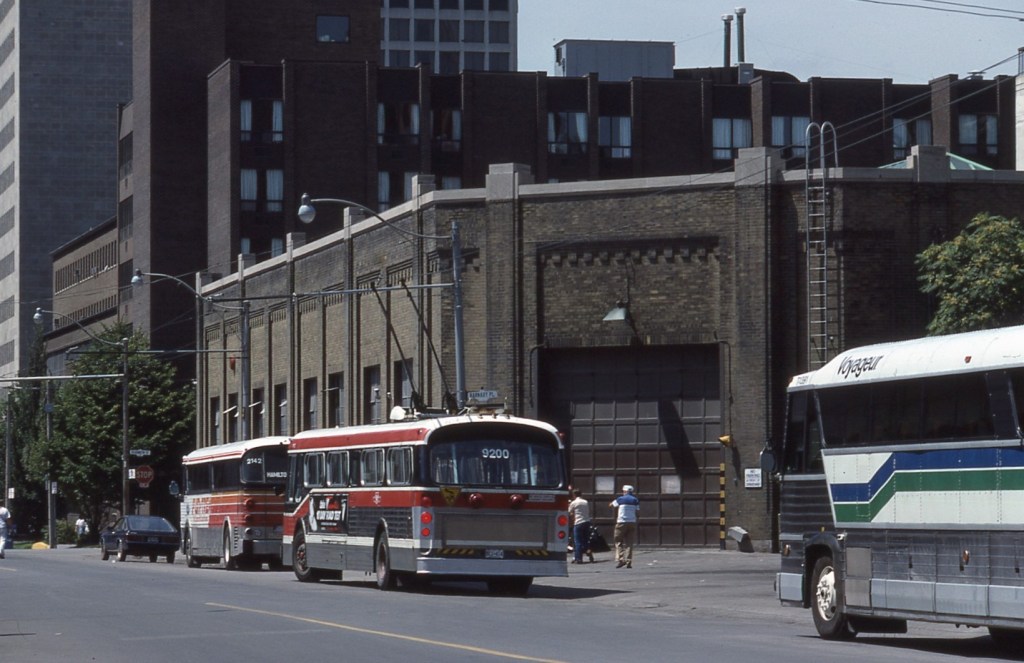
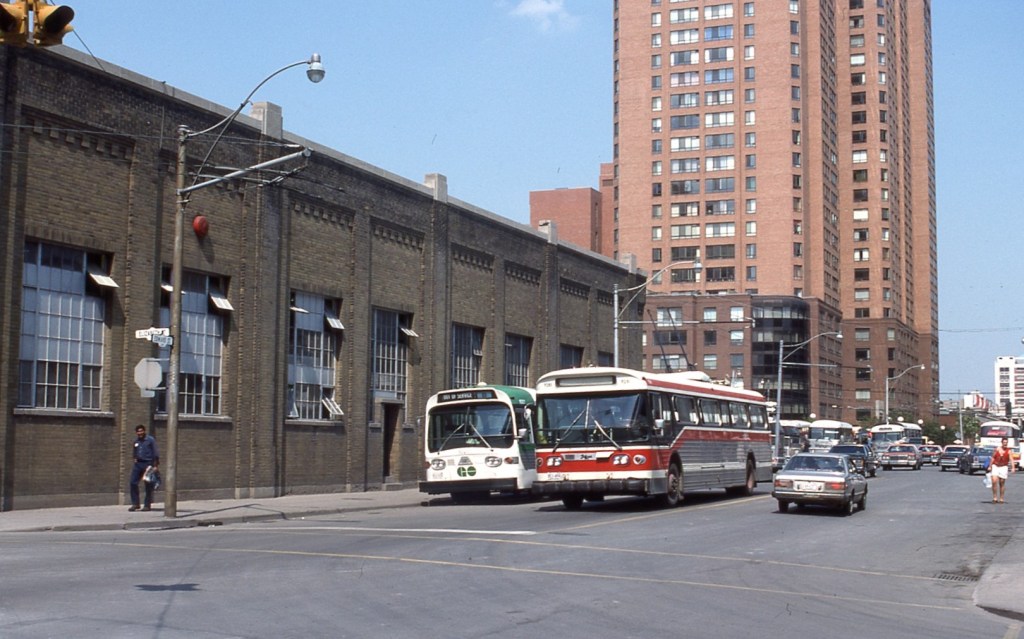
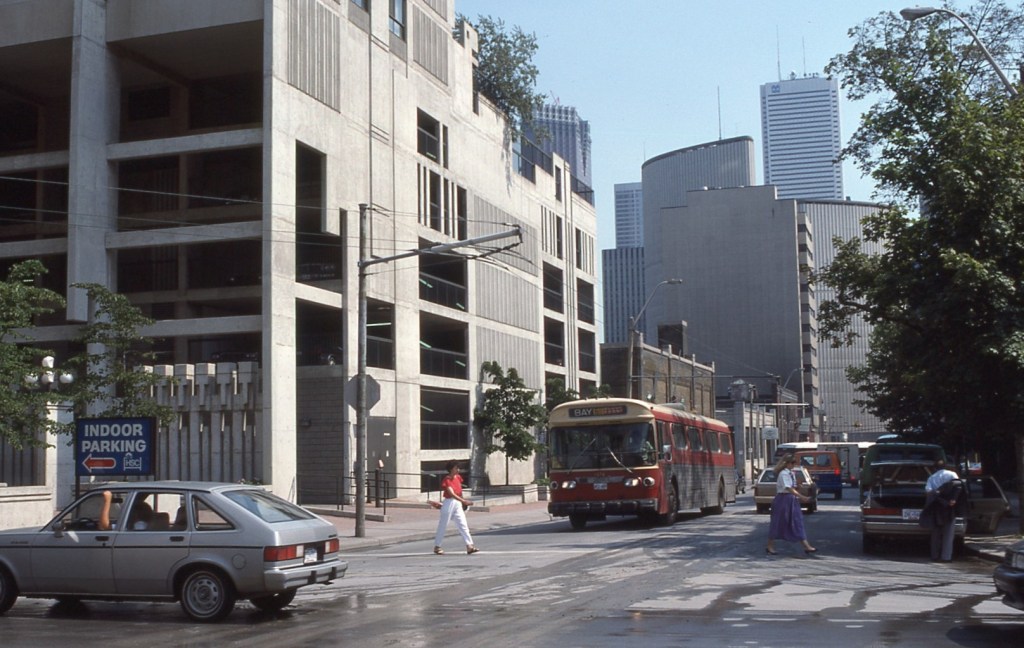
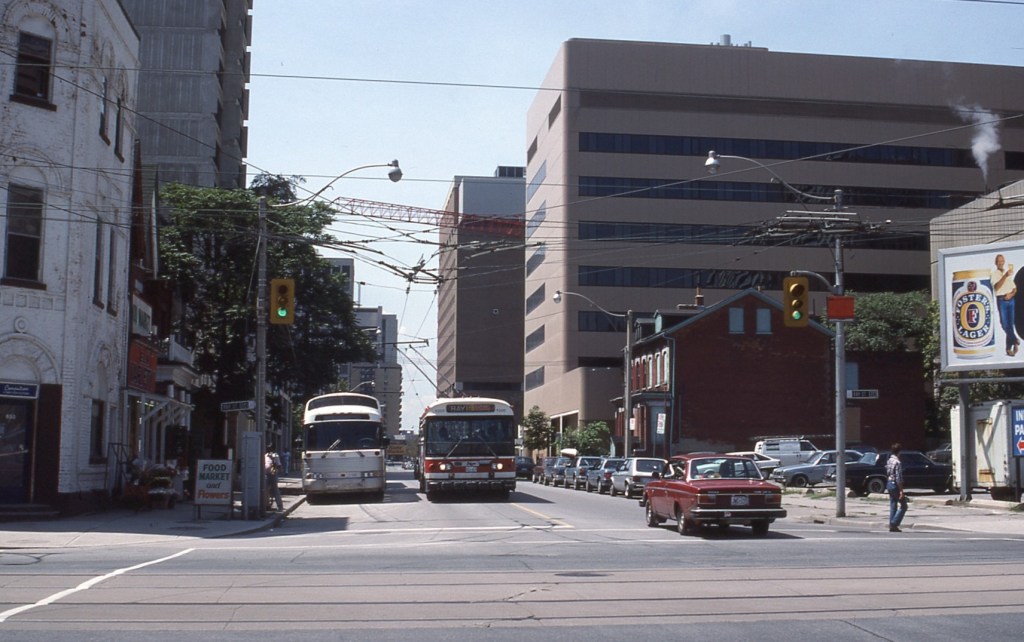
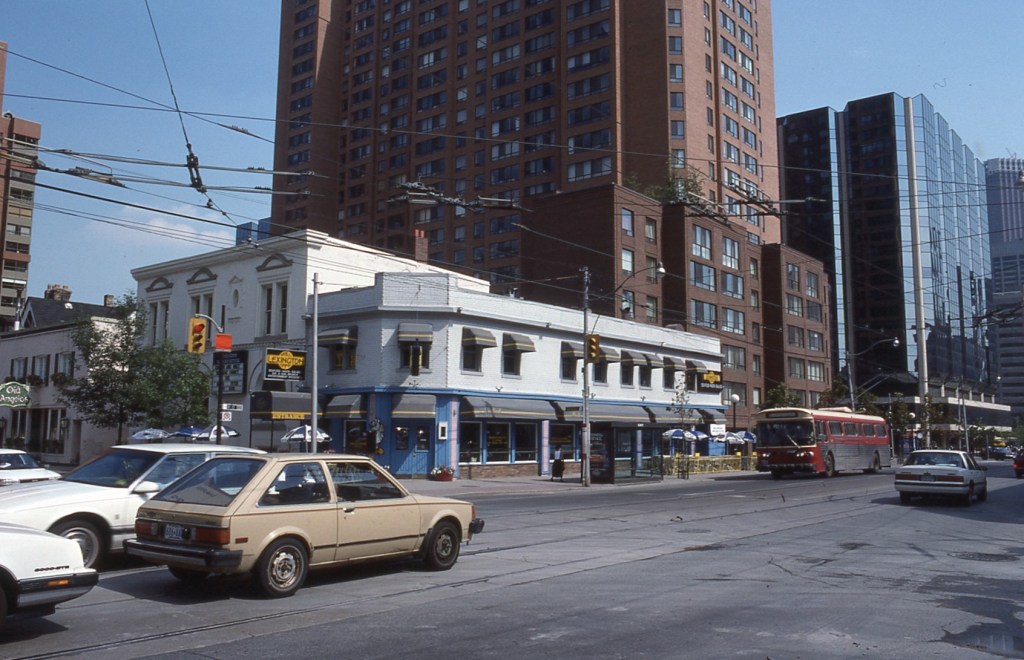
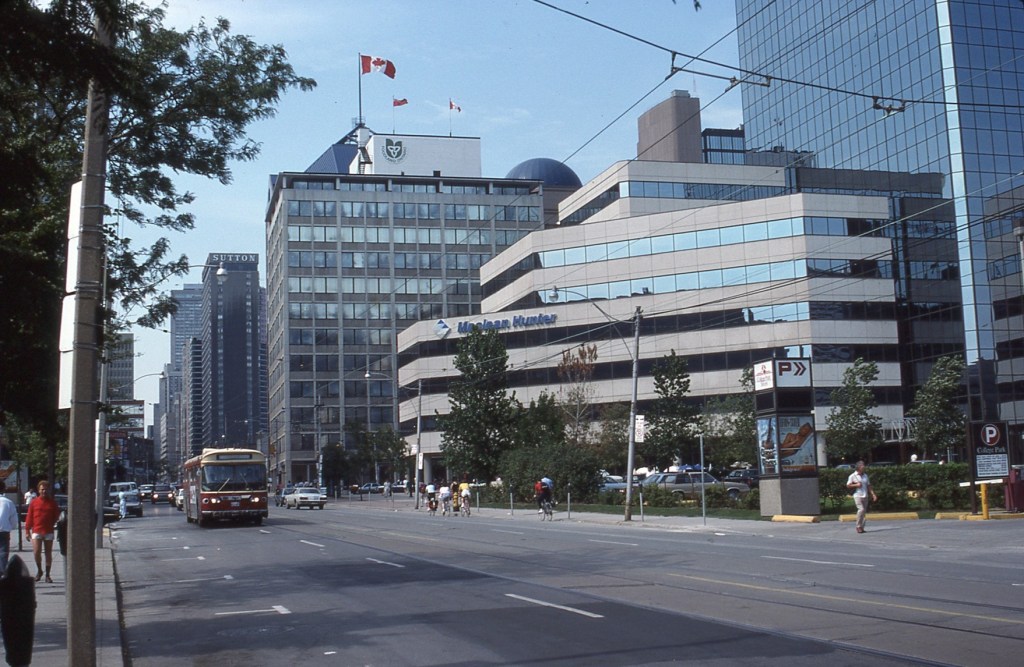

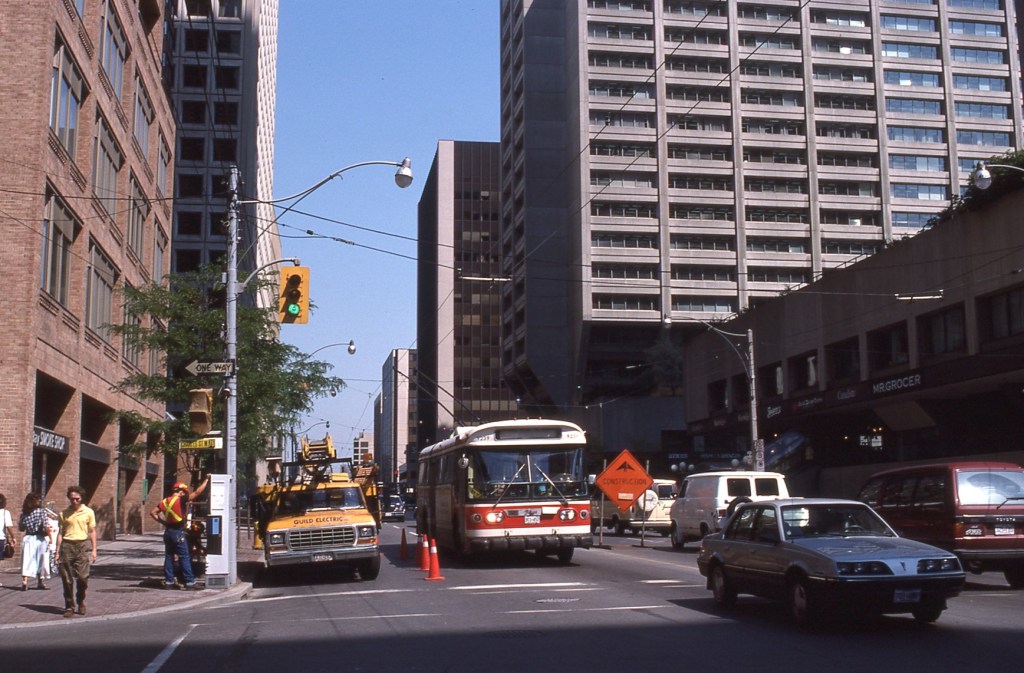
Bloor to Dupont
The north end loop via Davenport, Dupont and Bedford is the same today as it was in 1988.
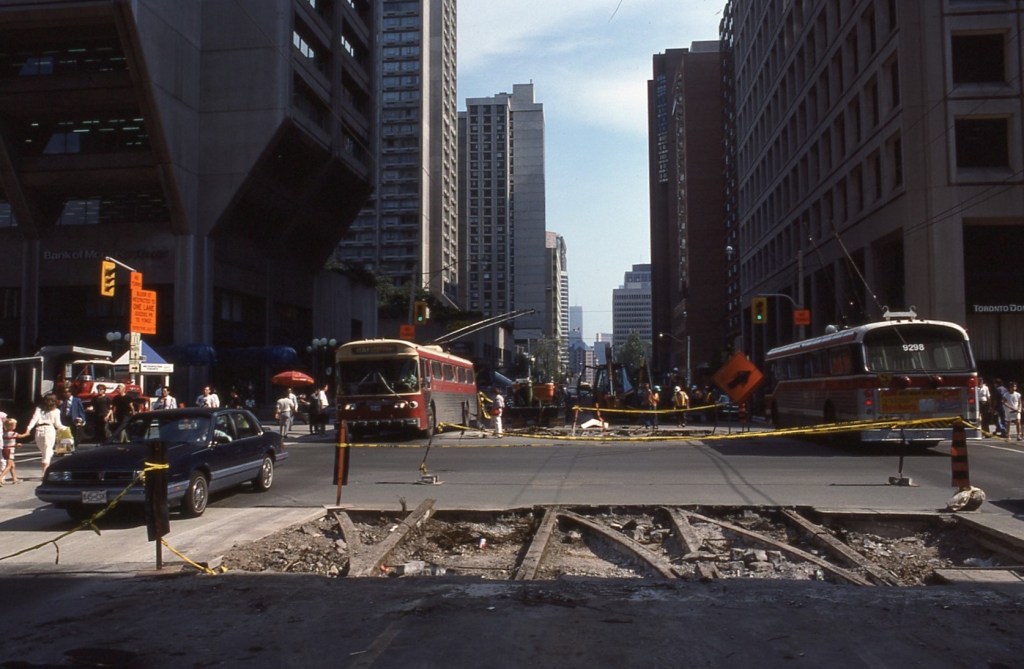
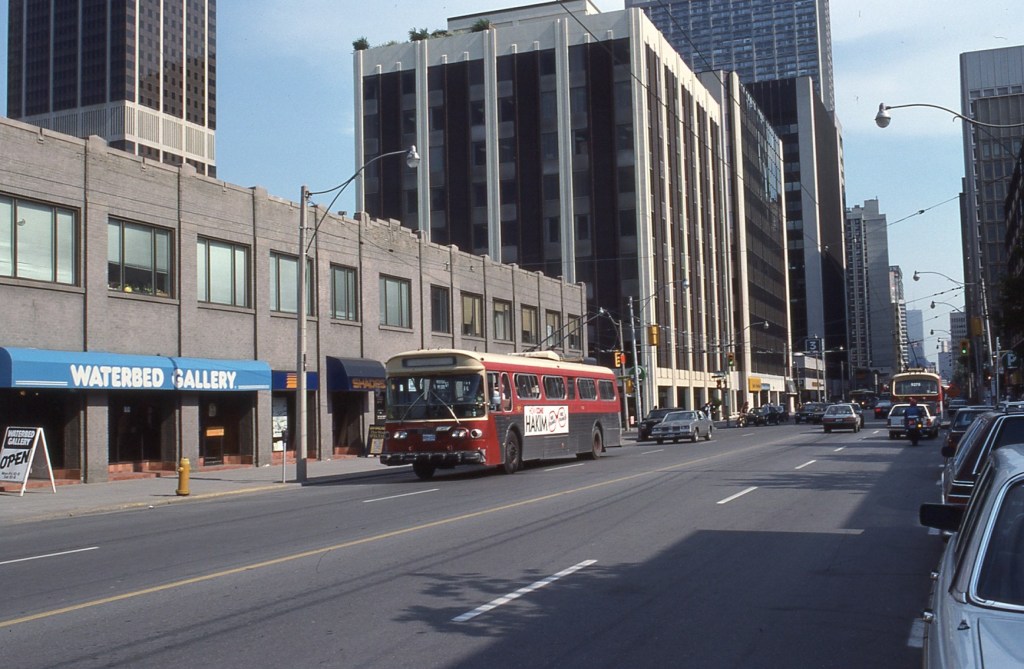
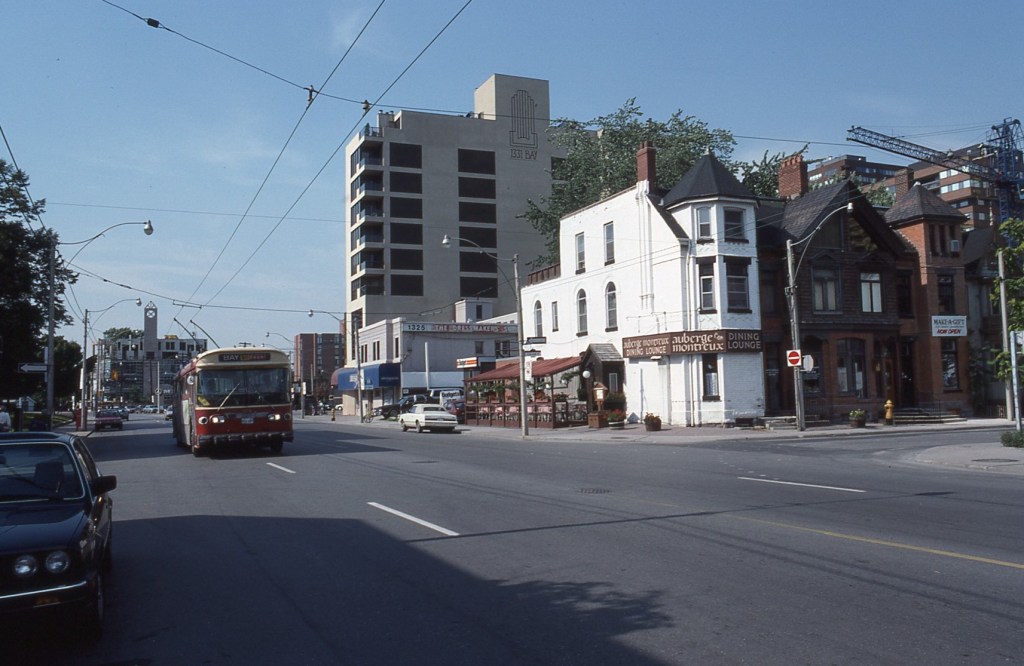
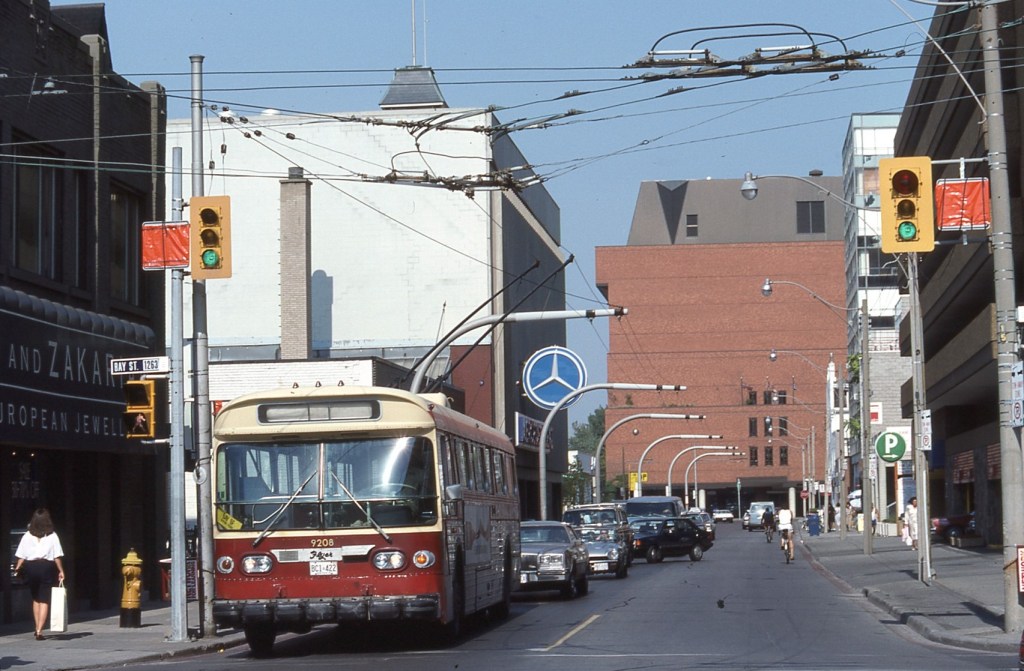
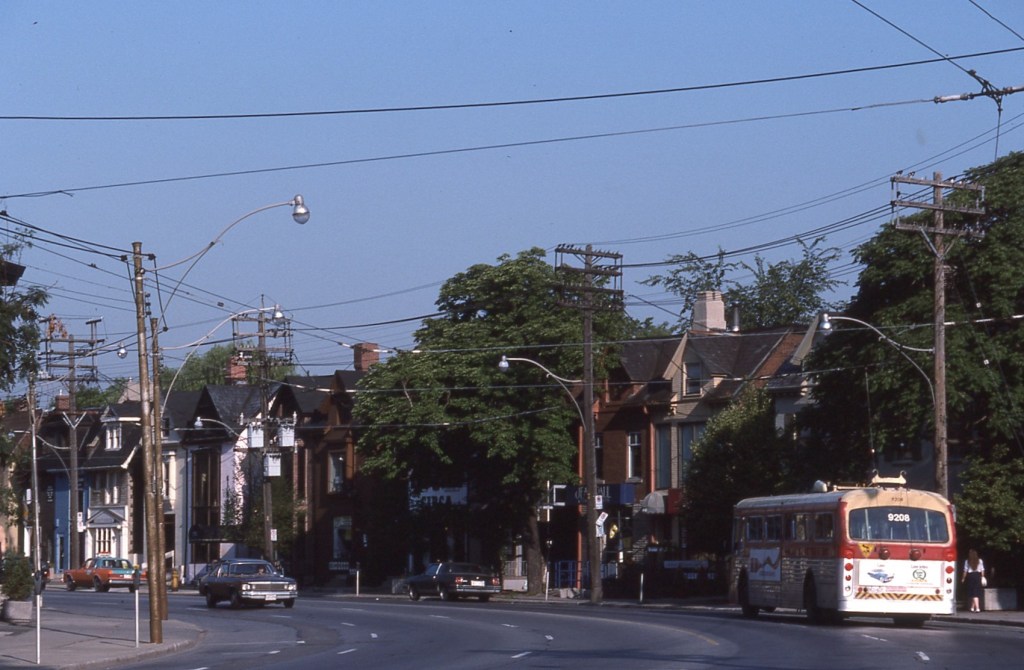
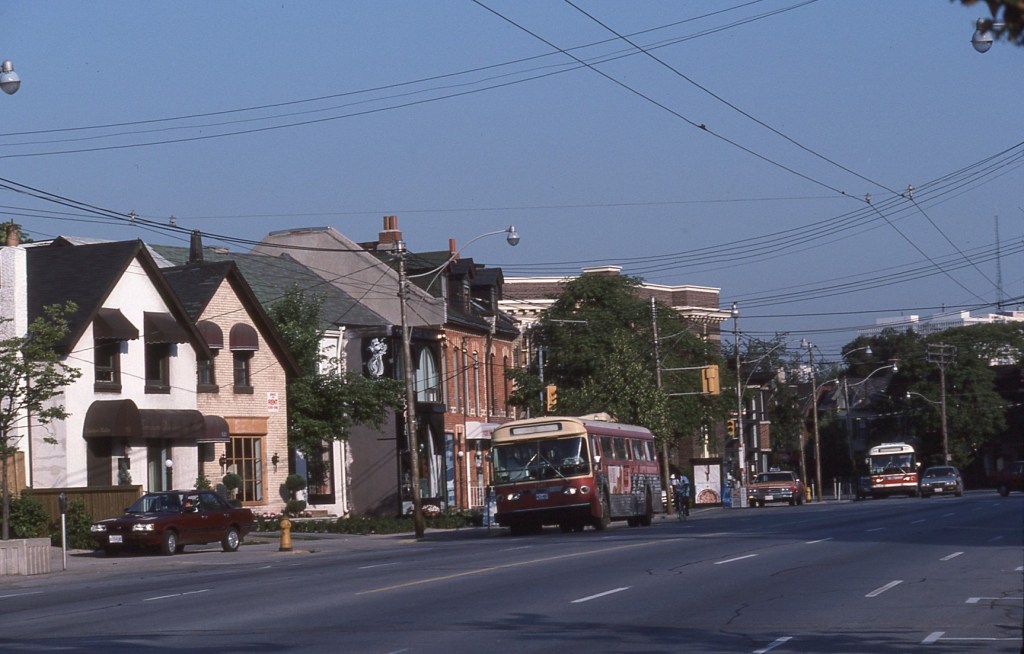
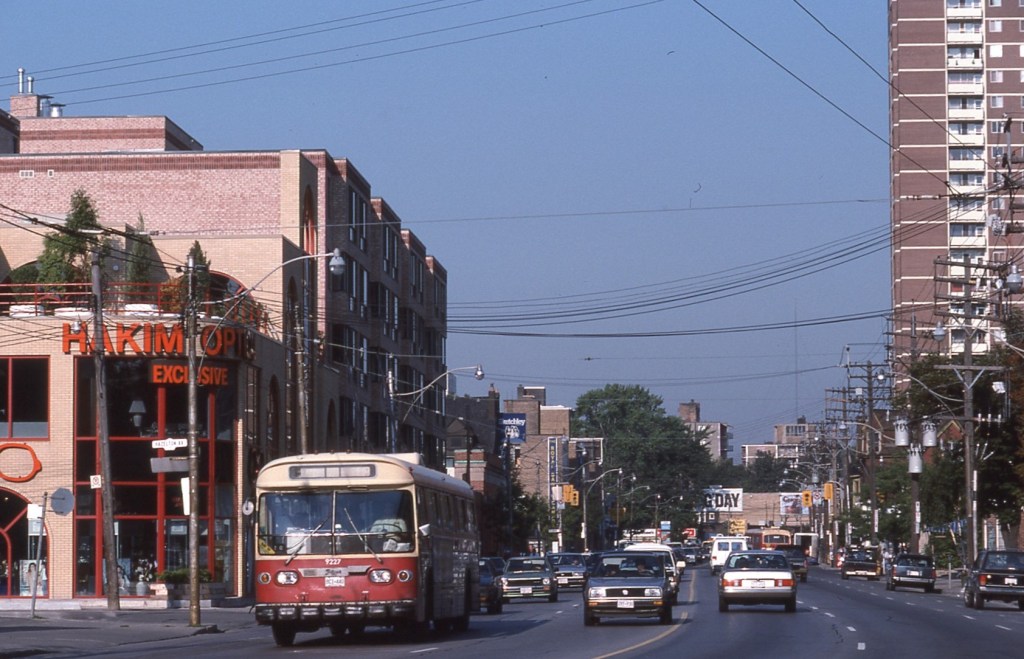



One outcome of the switch from trolley buses to diesel buses is the reduction in headway frequencies. Saw that with 74 Mt. Pleasant, 4 Annette (now 26 Dupont), and the 6 Bay (now 19 Bay) buses. Riders preferred the trolley buses over diesel buses. Just as riders prefer the streetcars over diesel buses.
LikeLike
When 89 Weston was temporarily replaced by diesel buses, ridership sank. When the Trolley Buses were operating, it was almost impossible to get a seat from Keele Stn to Lawrence.
LikeLiked by 2 people
Thanks for the trip down memory lane.
I have to admit that the degree of physical changes to the city is hard to fully grasp.
How soon I’d forgotten the classic unobstructed view of the Royal York.
LikeLike
Steve, I have seen a couple other comments about how ridership sank after the trolleybuses were removed, but at the same time the 6 Bay (now 19 Bay) route does operate in the middle between the University Line and Yonge Line from Front St. (Union Station) and Bloor St. As such, could some of the low headways not be due to people having a preference for the subway over a bus route? Do you think that more frequent service on Bay St. would result in more people using the service?
But, as usual thank you for your article and sharing your wonderful pictures.
Steve: The Bay bus got its demand from people who did not want to face the transfer to the Yonge or University lines in the peak period, and it had reasonably good off-peak ridership too. But as the scheduled service dwindled, and reliability worsened thanks to congestion on the lower end of the route, big gaps became common. That hurt demand, which “justified” less service. More recently, with the lower occupancy in the business district and the government offices around Wellesley and more room on the subway, the demand has stayed down, and service is now virtually non-existent. I feel sorry for people who wait for it as a service to the Ferry Docks or the eastern waterfront.
LikeLiked by 2 people
My Dad drove those: loved the route, hated those buses. They had no power steering, terrible drivers’ seats and he had to go out every so often to rewire the trolley poles as by that time the infrastructure had become decrepit.
LikeLike
Of course, you KNOW how I feel about the Judas approach to the trolley bus the TTC had. 🙂
LikeLike
Nice shots of 9200 btw.
LikeLike
I regret moving to Toronto at the end of 1993, only to discover the trolleybuses stopped running in July that year. For a while, I would explore the routes with the overhead still intact. I did, however, explore other North American cities 6 years later with trolley bus networks (e.g., Edmonton, Vancouver, Seattle, San Francisco, Pittsburgh, Boston, Philadelphia). I had visited Dayton, OH on another trip. As a kid, I enjoyed rising the trolley buses in Halifax before they were discontinued at the end of 1969.
LikeLiked by 1 person
Those were the days, The TTC should never have gotten rid of the trolley buses and should bring them back as the backbone of electric bus operations in Toronto. Other cities have done, and Toronto could be the first in, indeed, the Americas, or even the new world, to do so. It would set an example for other cities. Spend the resources and it will pay dividends. Also improve the Bay bus service once more.
LikeLiked by 1 person
I remember watching the southbound morning rush hour at Bay and Bloor. At the nearside S/B bus stop a BAY trolleybus would load quickly, since most people had transfers. There were so many people, a TTC employee (loader) was at the rear doors to collect transfers and board passengers. With each change of the traffic signal to green, the trolley would close doors and head south, as the next trolley in line pulled up to load in a similar fashion. “Always a bus in sight.”
I thought the trolley overhead poles on the south end of the route along Lakeshore Blvd. and Jarvis Street were massively overbuilt. They certainly did not help the appearance of the street; combined new trolley/streetlight poles on a smaller scale would have lessened the clutter. Removal of disused street poles in Toronto seems to proceed at a glacial pace.
As a Vancouver trolleybus driver I spoke at a City Hall committee meeting about the TTC trolleybus overhead as being archaic and neglected, and praised the drivers for managing to use it at all. The TTC was still using round trolley wire with “bang around” hangers, with seven splices in a 3 metre section of wire at College and Bay. It was clear that damage was occurring on a regular basis, but no improvements were made in the design of the special work to prevent it.
LikeLike
One person’s trolley overhead eyesore is another’s paradise.
Steve: A friend of mine referred to this as “celestial hardware”. Of course with the advent of TBs with batteries for offwire operation (that already existed when the TTC got rid of their fleet citing inflexibility among other excuses), complex junctions with many curves for use in emergencies are not required.
LikeLiked by 1 person
I am one who’d love to see trolley buses come back but there’s zero chance of that happening, especially with the coming of battery buses. It seems that battery vehicles of all types are gradually slowly becoming common little by little and that includes streetcars in certain places like Detroit and Dallas. Whatever you do don’t be surprised if a light rail system dispenses with overhead wires and goes totally with battery cars.
LikeLike
The TTC pretty consistently referred to these as trolley coaches. The abbreviation was “TC”, as in “Ossington TC”.
Steve: Yes, I know, but the common usage is as “buses”. A rose by any other name …
LikeLike
The old trolley buses that the TTC used did not have power steering. They had to use larger steering wheels. Modern trolley buses (and battery buses) use power steering. Of course power steering is more expensive, but few would go back to the old steering to save money.
Similar to using single-point track switches. They were fine with the Peter Witts and PCC streetcars, but not so well with the ALRVs and Flexity Outlook streetcars. Should be going with double-point track switches with the newer streetcars, which is the same as going with power steering with the buses. But saving money is the excuse used for not going with double-point track switches.
Steve: I would say this has less to do with saving money than with “we’ve always done it that way”.
LikeLike
I’m curious why the Union Station Bus Terminal “less than successfully” replaced the old Gray Coach Lines bus terminal.
Steve: Because extreme traffic congestion around the new terminal can make it very difficult for buses to serve to the extent that GO has occasionally redirected trips to rail stations outside of the core rather than trying to get the buses into downtown.
LikeLike
All that “extreme traffic congestion” is caused by single-occupant automobiles, SUVs, and empty non-commercial private pickup trucks. There should be bus only lanes along Lake Shore Blvd. AND roads leading to and from the Union Station Bus Terminal.
Stop giving priority to the single-occupants and give priority to buses (and streetcars and light rail vehicles). Designate them as “fire routes” as well, so that the emergency vehicles can use them to get past the traffic congestion.
LikeLike
But the traffic congestion also affects the Edward Street terminal. It was never exactly a traffic-free ride up York Street and University Avenue. We traded 10 blocks up York and University for 3 blocks east on Harbour and north on Yonge.
LikeLiked by 1 person
Jarek: The original bus terminal was never close to the present example in terms of local congestion [some of it caused by the never ending construction in the area.] A bus can sit within sight of the new east side of Bay monstrosity for a good half hour with any luck; and achieve 20 meters of movement in the PM rush hour.
LikeLike
That might be so, but that terminal closed in mid-2021, when car congestion in the area was near pre-covid levels. That isn’t the case in 2023 or 2024. What route would buses take to get to Bay and Edward now? University Avenue which is often reduced to 1 lane Queen to Armoury for Ontario Line construction? Spadina and try to turn onto Dundas? Northbound on Bay Street in the AM rush? Richmond Street off the DVP? None of these are exactly smooth sailing these days.
And honestly, I’ve taken buses to and from the Edward Street terminal, and it was annoying to have to spend 10 or 15 minutes in a bus waiting at stop lights and taking a scenic trip of University – Armoury – Chestnut. The new location is better in principle — get off the highway and it’s right there, next to trains and subway — though evidently it needs some… decongesting.
Incidentally, Ontario Northland now starts some bus trips at Yorkdale (and stopping at Hwy 407 station) rather than at Union…
LikeLiked by 1 person