This article began as a Twitter/X thread responding to a post from Mayor Olivia Chow.
From the better way to the *best* way. This budget will restore 97% of pandemic-era TTC service cuts and get the city back on track.
There is a big problem with this claim, and I fear riders will be disappointed by what they actually see. Here is my consolidated thread.
It pains me to write this, but this post by Mayor Chow is simply not true. Either her spin doctors cannot read a budget, or she has been bamboozled by TTC’s misleading use of “restoring” service.
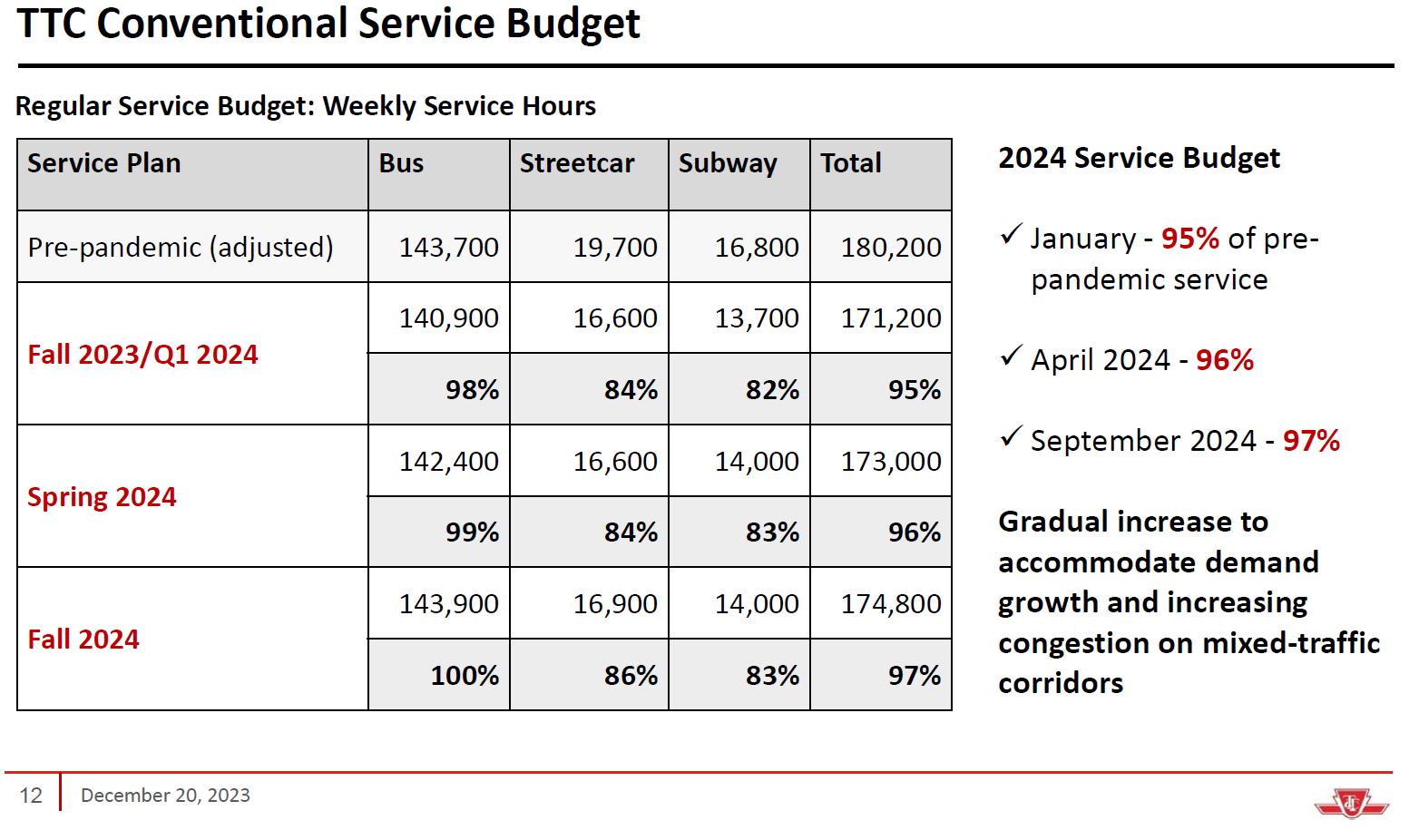
This chart is right out of the TTC budget and shows the planned service restoration by mode. Note that only the bus network gets back to 100%.
Because the values are based on vehicle and train hours, and buses (with relatively small capacity per vehicle) account for most of the hours, the total gets to 97% while leaving streetcars and the subway far behind.
But 97% is not really 97% as seen by riders. Many routes run more slowly than they did in 2019, and so it takes more hours to provide the same frequency and capacity of service.
For added clarity, “100%” of service hours will *not* reverse all pandemic era cuts because some hours go to routes running over 100% while others stay below that level. But spin doctors don’t do pesky details like that.
On top of that, crowding standards brought in by management without advance approval in 2023 mean that off peak service can be more crowded before triggering service improvements. These might be reversed in 2025 but only if there is budget headroom.
Talk about prepandemic service levels forgets that there were major problems with overcrowding and inadequate service back in 2019. Actual planned service in 2020 was higher than 2019, but was cut due to covid.
The shift in commute patterns means that total ridership is less than 2019 levels, but it is concentrated on a shorter work week. Off peak riding is already at or above former levels.
The TTC does not break out service frequency and capacity as metrics, but using vehicle hours hides deeper cuts in these areas.
The February 18 schedule changes include cuts on many routes which are described as “adjustments” on the TTC’s website. A few of these are erroneously called “improvements”.
One reason for the February cuts is that service in January was actually *over* budget and the cuts back that out.
The TTC has no public measurement of crowding conditions and service quality including gaps and bunching. That 97% number will be broadcast far and wide, but will hide many problems.
Service Budgets
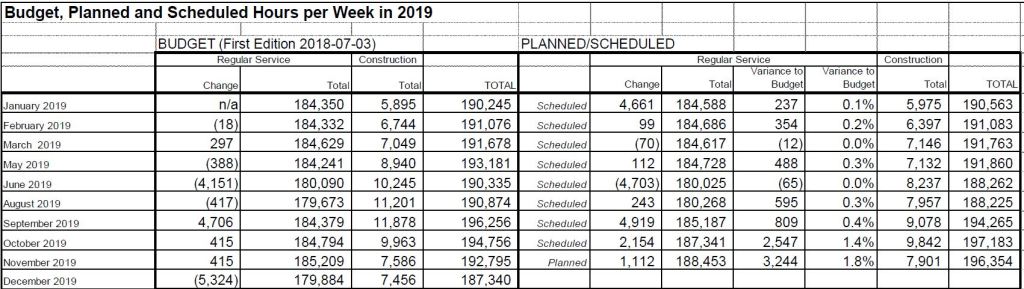
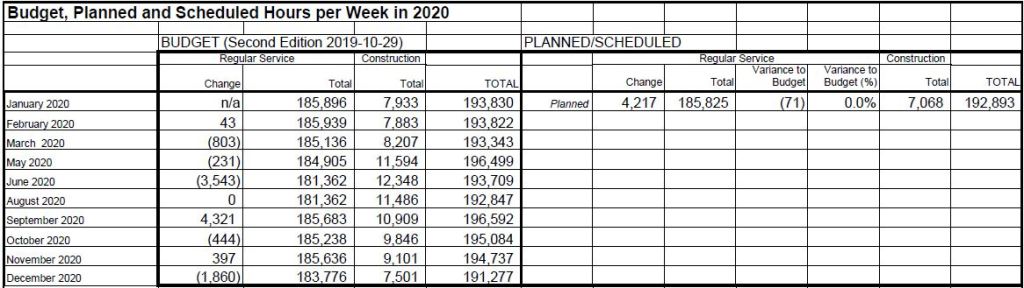
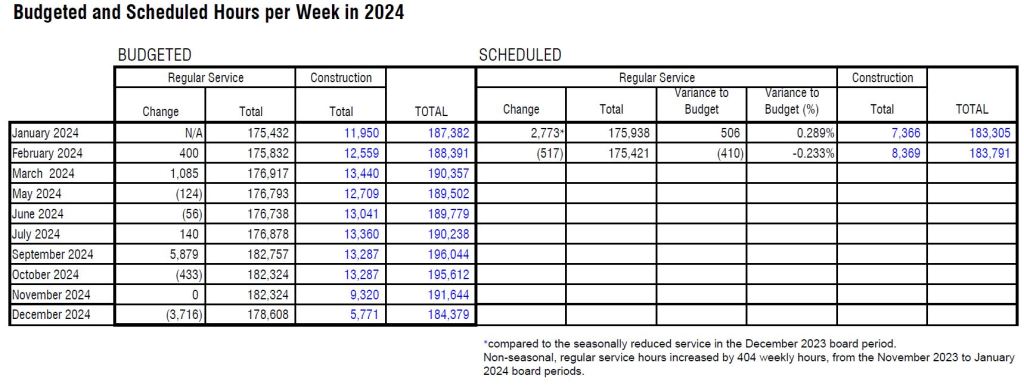
For comparison, here are the 2019, 2020 (pre-covid) and 2024 service budgets. The important column is the third from the left, “Regular Service Total”.
For a comparison of January 2024 service levels to January 2020, see this article:
There is work to be done, and a vital first step is to understand just what is needed and what is possible. The TTC Board plans a strategy session in March, and their Budget Committee will probably start meeting in June-July.
Soon I will publish an article about a Ridership Growth Strategy for 2024 that will set the stage for the kind of debate that should be on the agenda.
Can we hope that these meetings will not be consumed by self-serving management dog-and-pony shows, but rather will be an open discussion of the state of and options for our transit system.
Thanks for the clarity on the service percentage. I do find it a bit baffling that they’re using service hours in general, instead of comparing single routes to its pre-pandemic levels; it comes off as lying by omission. I never knew that streetcar & subway service went down tremendously, but I assume it’s during off-peak times.
What I don’t understand is the design philosophy behind service cuts & improvements along the bus routes. Anecdotally speaking, I do occasionally take the 46 Martin Grove from Kipling Station to Eglinton and the bus is incredibly packed during peak hours. I don’t understand the justification on cutting service on an already strained route. Does the TTC Board publish their methodology for the public to see? It would be nice if I can somehow give feedback to the board.
Thank you again for the article.
Steve: The TTC does not publish loading stats nor do they provide access to an archive of these data. I have asked and got nowhere. Clearly they have the info as it shows up now and then in reports. Some cities publish this via an open data portal, but not TTC.
Thanks. Great post. I ride far less frequently these days because I like riding my bike and I don’t like to share breathing space with the mostly unmasked. But there have been a few trips lately, mostly for medical appointments, and it’s clear subway service needs to be restored, peak and off-hours. The streetcars are irritatingly unreliable. SteveW
Thank you for being so consistently methodical. It’s great to get a clear and ongoing explanation of why what the TTC claims to be doing doesn’t match my actual experience. There’s no way they have more than anecdotal bus and streetcar crowding data themselves if it’s based on fare payment, given the huge number of people who wouldn’t be counted because they paid elsewhere and got on at a station, didn’t pay, are 12 and under, or are unable to access the card reader because of the damn crowding.
Three of the four buses I’ve taken today were very crowded. Two of them were packed to the point that looks dangerous. There was another one I couldn’t even get on because it was wall-to-wall human, and that’s what it’s like almost every day. I seriously think this is an(other) accident waiting to happen.
Steve: Riding info comes from automatic passenger counters on the buses and streetcars, although TTC does cross check this with Presto data to get a sense of evasion stats. One point about APCs is that they can be confused when vehicles are very crowded.
Thanks once again for the detailed analysis and breakdown of information for the general public. I have to ask, how is it possible that the TTC keeps getting away from being unaccountable and verging on the edge of ignoring City Hall when it is the City that provides funding? Such as hiding data when the City has an open data policy or hiding the metrics used to get values. Does the City not have any sway to force directives at the TTC? Lately I have been pondering how the power relationship works between the City and the TTC considering that the TTC is owned by the city.
Not sure if you had ever published a post about the relationship dynamics between the TTC and the City. Would be a fascinating read and probably open Pandora’s box.
Steve: The relationship between TTC management, the Board and the City has changed during the pandemic because the pols were scrambling just to keep the lights on and ceded a lot of authority to management. Taking it back will be hard, in part, because some of the pols simply don’t know there was a time when they exercised more control.
Will TTC management ever face any type of reprimand for their absolutely piss poor performance. How can they be so inept and still keep their jobs. A crack smoking monkey addicted to painkillers, preoccupied with an obsession for video poker and porn could do a better job. But they just keep their jobs. The CEO could probably go missing for a month before anyone would notice.
I do occasionally take the 46 Martin Grove from Kipling Station to Eglinton and the bus is incredibly packed during peak hours. I don’t understand the justification on cutting service on an already strained route.
Mels writes:
Three of the four buses I’ve taken today were very crowded. Two of them were packed to the point that looks dangerous. There was another one I couldn’t even get on because it was wall-to-wall human, and that’s what it’s like almost every day.
Very good comments by all posters and replies from Steve.
I too am befuddled by the claims of ‘restored service’ on the TTC. I won’t go into details of my experiences of late, save to say that Steve has quantified what we’re all experiencing, TTC claims to the contrary.
As an abstract illustration as to how ‘parlous’ aspects have become on the TTC, something as absolutely basic as communication systems are next to hopeless in many cases. “Next Stop” announcements are very good, highly intelligible, well voiced (in the technical sense, I’m an audio tech) and well distributed.
One then has to ask why the ‘control’ or ‘operator/guard’ announcements are so pathetically unintelligible? Obviously the equipment on-board buses and trains is very good as proven by the “next stop” announcements. Then if the local com infrastructure is so good, why is system com so horrendously bad?
Steve: A lot depends on the source of the announcement. Stops and a few other stock announcements are generated digitally on board, and tend to be uniform and clear. Announcements from the train crew are made using telephone style handsets with varying degrees of clarity boh from the set itself, and the speaking skills of the crew. Announcements from transit control are transmitted, I believe, still via a signal through the third rail. Signal quality and pickup vary, and again there are also uneven speaking skills depending on who is making the announcement.
Beyond that, remember for a couple of years the abysmal added announcements, ostensibly meant for the blind, via transducers well beyond clipping level that were presented on the outside of subway cars?
How is it even remotely possible that someone in the Org for those years didn’t notice?
A crack smoking monkey addicted to painkillers, preoccupied with an obsession for video poker and porn could do a better job.
Yikes! Here I was, writing while that post went up, trying to carefully choose my words while thinking the same as N writes!
As to the external subway car “Next Station” severely overloaded clipping announcements for the visually challenged I made in my last post, I bit my tongue not to write: “The deaf leading the blind”.
As we all well know, Rogers have not only bought the existing 5G network in the tunnels and stations, it’s being expanded system-wide.
There’s absolutely no excuse for the TTC not to ‘up their game’ with their customers coms.
As a tech, I can tell you that much of what would be needed to replace the ‘front-end’ of the com system is ‘off-the-shelf’ and highly affordable. The biggest cost would be the labour to install it.
Maybe Rogers could offer an introductory offer….phhhhh…
Steve: The 5G service is not available system wide yet, but TTC should be planning to put its comms link between Transit Control and train passengers onto a service that provides reliable, quality voice announcements.

 Steve Munro
Thanks for the clarity on the service percentage. I do find it a bit baffling that they’re using service hours in general, instead of comparing single routes to its pre-pandemic levels; it comes off as lying by omission. I never knew that streetcar & subway service went down tremendously, but I assume it’s during off-peak times.
What I don’t understand is the design philosophy behind service cuts & improvements along the bus routes. Anecdotally speaking, I do occasionally take the 46 Martin Grove from Kipling Station to Eglinton and the bus is incredibly packed during peak hours. I don’t understand the justification on cutting service on an already strained route. Does the TTC Board publish their methodology for the public to see? It would be nice if I can somehow give feedback to the board.
Thank you again for the article.
Steve: The TTC does not publish loading stats nor do they provide access to an archive of these data. I have asked and got nowhere. Clearly they have the info as it shows up now and then in reports. Some cities publish this via an open data portal, but not TTC.
LikeLiked by 2 people
Thanks. Great post. I ride far less frequently these days because I like riding my bike and I don’t like to share breathing space with the mostly unmasked. But there have been a few trips lately, mostly for medical appointments, and it’s clear subway service needs to be restored, peak and off-hours. The streetcars are irritatingly unreliable. SteveW
LikeLiked by 1 person
Thank you for being so consistently methodical. It’s great to get a clear and ongoing explanation of why what the TTC claims to be doing doesn’t match my actual experience. There’s no way they have more than anecdotal bus and streetcar crowding data themselves if it’s based on fare payment, given the huge number of people who wouldn’t be counted because they paid elsewhere and got on at a station, didn’t pay, are 12 and under, or are unable to access the card reader because of the damn crowding.
Three of the four buses I’ve taken today were very crowded. Two of them were packed to the point that looks dangerous. There was another one I couldn’t even get on because it was wall-to-wall human, and that’s what it’s like almost every day. I seriously think this is an(other) accident waiting to happen.
Steve: Riding info comes from automatic passenger counters on the buses and streetcars, although TTC does cross check this with Presto data to get a sense of evasion stats. One point about APCs is that they can be confused when vehicles are very crowded.
LikeLiked by 2 people
Hi Steve,
Thanks once again for the detailed analysis and breakdown of information for the general public. I have to ask, how is it possible that the TTC keeps getting away from being unaccountable and verging on the edge of ignoring City Hall when it is the City that provides funding? Such as hiding data when the City has an open data policy or hiding the metrics used to get values. Does the City not have any sway to force directives at the TTC? Lately I have been pondering how the power relationship works between the City and the TTC considering that the TTC is owned by the city.
Not sure if you had ever published a post about the relationship dynamics between the TTC and the City. Would be a fascinating read and probably open Pandora’s box.
Steve: The relationship between TTC management, the Board and the City has changed during the pandemic because the pols were scrambling just to keep the lights on and ceded a lot of authority to management. Taking it back will be hard, in part, because some of the pols simply don’t know there was a time when they exercised more control.
LikeLiked by 3 people
Will TTC management ever face any type of reprimand for their absolutely piss poor performance. How can they be so inept and still keep their jobs. A crack smoking monkey addicted to painkillers, preoccupied with an obsession for video poker and porn could do a better job. But they just keep their jobs. The CEO could probably go missing for a month before anyone would notice.
LikeLiked by 1 person
Ahmed writes:
Mels writes:
Very good comments by all posters and replies from Steve.
I too am befuddled by the claims of ‘restored service’ on the TTC. I won’t go into details of my experiences of late, save to say that Steve has quantified what we’re all experiencing, TTC claims to the contrary.
As an abstract illustration as to how ‘parlous’ aspects have become on the TTC, something as absolutely basic as communication systems are next to hopeless in many cases. “Next Stop” announcements are very good, highly intelligible, well voiced (in the technical sense, I’m an audio tech) and well distributed.
One then has to ask why the ‘control’ or ‘operator/guard’ announcements are so pathetically unintelligible? Obviously the equipment on-board buses and trains is very good as proven by the “next stop” announcements. Then if the local com infrastructure is so good, why is system com so horrendously bad?
Steve: A lot depends on the source of the announcement. Stops and a few other stock announcements are generated digitally on board, and tend to be uniform and clear. Announcements from the train crew are made using telephone style handsets with varying degrees of clarity boh from the set itself, and the speaking skills of the crew. Announcements from transit control are transmitted, I believe, still via a signal through the third rail. Signal quality and pickup vary, and again there are also uneven speaking skills depending on who is making the announcement.
Beyond that, remember for a couple of years the abysmal added announcements, ostensibly meant for the blind, via transducers well beyond clipping level that were presented on the outside of subway cars?
How is it even remotely possible that someone in the Org for those years didn’t notice?
LikeLike
John N writes:
Yikes! Here I was, writing while that post went up, trying to carefully choose my words while thinking the same as N writes!
As to the external subway car “Next Station” severely overloaded clipping announcements for the visually challenged I made in my last post, I bit my tongue not to write: “The deaf leading the blind”.
Good post John. You nailed it.
LikeLike
I had composed a technical answer to post on the communications issue, only to realize its futility and erased it.
Suffice to say that it’s a very well known issue with the public.
Example:
As we all well know, Rogers have not only bought the existing 5G network in the tunnels and stations, it’s being expanded system-wide.
There’s absolutely no excuse for the TTC not to ‘up their game’ with their customers coms.
As a tech, I can tell you that much of what would be needed to replace the ‘front-end’ of the com system is ‘off-the-shelf’ and highly affordable. The biggest cost would be the labour to install it.
Maybe Rogers could offer an introductory offer….phhhhh…
Steve: The 5G service is not available system wide yet, but TTC should be planning to put its comms link between Transit Control and train passengers onto a service that provides reliable, quality voice announcements.
LikeLike