
A common, but troubling practice in talking about transit is the attempt to build a “business case” as if city’s transit network can be examined through a rather simplistic management school lens. Everything is reduced to a monetary value, be that direct spending, spinoffs, or the notional value of benefits.
Aside from basic errors in methodology, this approach assumes that the supposed value of transit spending can be gleaned from a one-dimensional view of its so-called worth in dollars and cents. Bad enough that this practice is entrenched in Metrolinx, an agency that sets priorities based on political, not financial, evaluations thereby undermining the credibility of financial analyses. The scheme has trickled down to the municipal level with a TTC/UofT study intended to show that money for transit has financial benefits and should be encouraged for the good of city and country.
You might ask why a transit advocate has misgivings about this exercise, but the answer lies in my long-standing conservatism (with a very small “c”) about public spending generally. Megaprojects bring press coverage, especially with the opportunity to announce over and over the latest step, no matter how trivial, as work inches along. This tactic works as long as there is success to report, and we just don’t talk about abject failures like Line 5 Crosstown any more often than needed.
A huge problem with the TTC’s gaping hole in Capital funding, and to a lesser extent on its Operating side, is that the cry “please, Sir, I want some more” for transit support wears thin with would-be partners. Moreover, everything on Toronto’s wish list does not necessarily align with political priorities elsewhere, and it must compete with demands from other cities and provinces. Thus the desire to show that transit spending has a great “payback”, but that number hides fundamental questions.
The problem with spending for its own sake is that one rarely hears the question “what else might we do with these billions” or “is this project really worth its cost compared to other demands on public funds”. How much is not built or operated because some other project took priority, or the growing cost of works already underway crowded other new schemes off of the table?
Into our political environment, one rife with patronage, cronyism and outright corruption, comes an attempt to justify spending on transit as an inherently good thing.
In 2022, the TTC launched a joint study with the University of Toronto Mobility Network which surfaced as part of the 2023 and 2024 Budgets. The goals of the study were “to identify and quantify the economic and other key benefits resulting from investment in transit and the TTC”:
- Economic benefits realized from investments in transit services and capital works that enhance TTC’s existing transit network
- Economic impact of the TTC on the local, regional, provincial and national economy
- Qualitative and quantitative social, equity, health and environmental benefits and the economic spin off benefits derived from these other benefits
- Impacts should the necessary service and capital investments not be made in the TTC
The 2023 Budget
The 2023 Budget came after nearly three years of the Covid pandemic, and transit had not fully recovered its pre-2020 demand. Late 2022 brought a new virus strain, and a major setback in what looked like recovery only months earlier.
“Should we still be spending money on transit expansion” was an obvious question, especially for budget hawks who saw large transit budgets as a place to “trim the fat”. Transit needed defending, and this showed up in a first round of analysis.
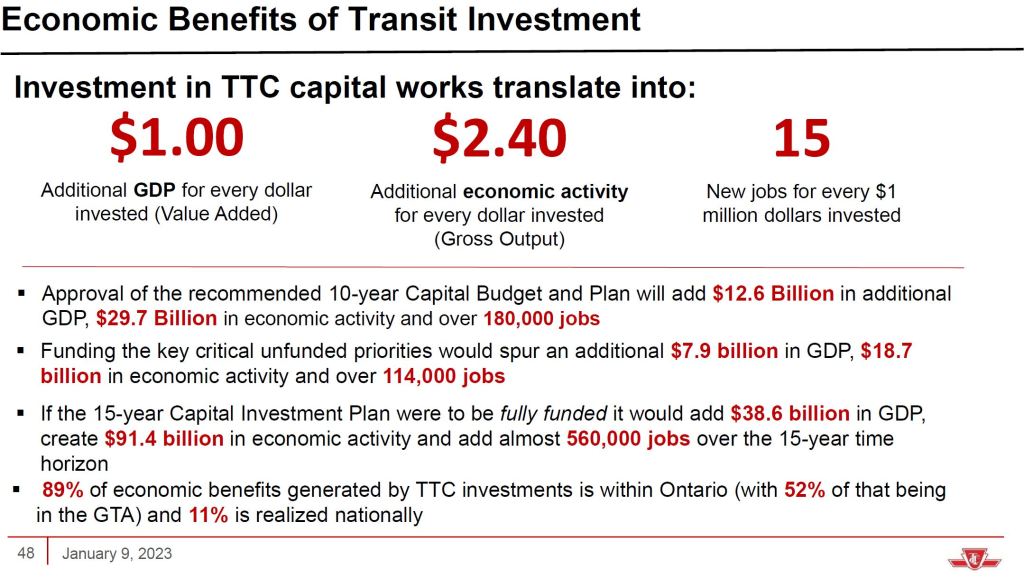
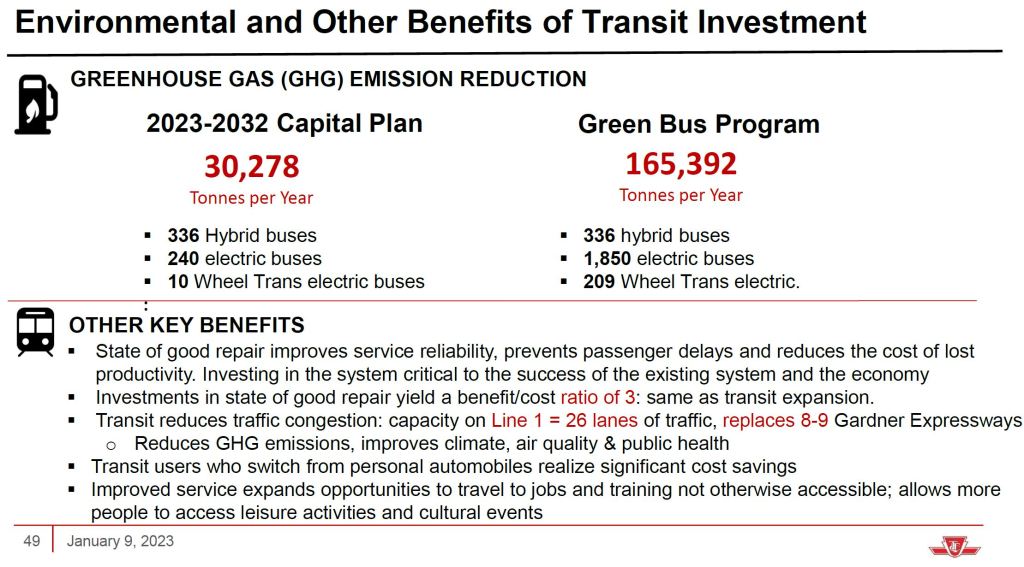
Two sets of benefits are detailed here: the economic value of capital investments, and the reduction of greenhouse gases through transit electrification.
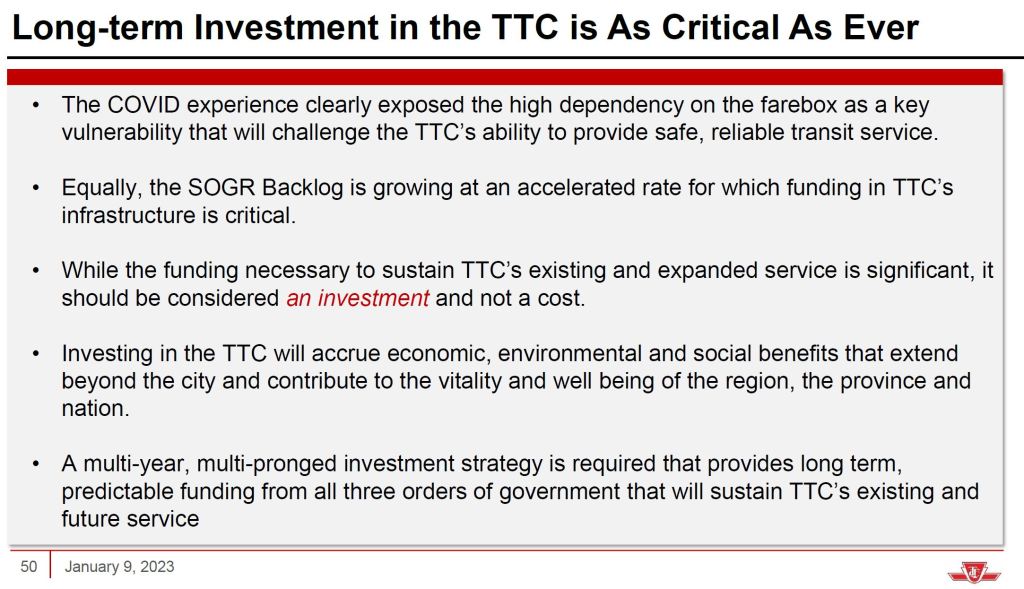
The unmet capital needs have grown substantially in recent years thanks partly to inflation, but also to creep in the number of large projects included in the list, particularly for the bus fleet. For more details, see TTC 2024 Budget Preview: Part II – Capital. The longer and more expensive the list, the greater the pressure for funding, but also greater pressure from competition between projects and their supporters.
Less obvious has been the increase in basic operating costs. During the pandemic, the TTC ran far more service, proportionately to ridership, than it normally would, and the operating budget still suffers from many cuts implemented to stretch available dollars. It is convenient to talk of “recovery” to close to 100% of former service, but the metric used does not correct for the slower speed of operation in 2024 compared to earlier years, nor for the growth in demand from a rising population.
Notable by its absence from the charts above is a discussion of service costs, especially those needed to actually operate more buses, streetcars and trains. Electrification yields environmental benefits, but only service provides capacity to shift car drivers and passengers to transit. The many benefits of transit for mobility, such as enabling economic growth and reducing pollution from cars, cannot be achieved until we actually operate service.
Even worse, if we only replace existing assets but do not enable more and better service, there is no incentive for travellers to switch to transit. If the change in service is small, there is little new “investment” to measure against results, assuming we could even distinguish small gains from “noise” in the statistics. Indeed it is possible to lose market share even while running more service as the TTC has demonstrated in recent years. The problem lies in where the demand (current and potential) exists, and how attractive the service is for riders.
The premise of this analysis is that $1 in direct capital spending produces an added $2.40 through the multiplier effect of putting more money into the economy. If we buy a bus, the money goes to employees who build the bus and its components, and they in turn spend on other things.
However, that $1 could be spent on just about anything. From a simplistic point of view, we could pay people to design holes in the ground, more people to dig them and more dollars to fit them out. The location is immaterial.
Worse, we might argue that digging $2 billion worth of holes is more economically worthwhile than only $1 billion, even though the same money could go to multiple, less-expensive projects.
No question is asked of whether any particular collection of holes is more worthy than another, or whether digging holes might not be the answer to our problems. After all, one could stand on a street corner handing out $50 bills with more immediate economic effect.
The supposed benefit of shifting travel to transit is only achieved if new riders come to the TTC. Someone riding a shiny new bus or train that replaced an older one is no net gain to transit. The presumed cost of losing that rider if service declines might be considered, but not the funding needed to keep the system operating and improve it to hold and grow ridership. Existing riders gain from improved trips if a shiny new subway replaces a collection of bus routes, but that is a “soft” benefit making their lives better.
In passing the 2023 Budgets, the Board added a motion to management’s recommendations:
That the TTC Board request staff to undertake the development, presentation, and funding options for a strategic marketing plan. The plan should communicate to existing and prospective customers, funders, and the public at large, the benefits of transit with the goal of retaining and increasing ridership and transit investments in order to create jobs, reduce traffic congestion, improve air quality and health outcomes, reduce greenhouse gas emissions, and improved equity for all.
A marketing plan, strictly speaking, is not what the TTC needs unless it will include a substantial and demonstrable commitment to improved transit service. Moreover, that change should benefit the entire city in the near future, not a handful of rapid transit corridors sometime in the 2030s. This should not be a make-work program for communications consultants.
2024 Budget and Interim Findings of the Transit Investment Benefits Study
A second set of findings came out of the Mobility Network benefits study with the 2024 budget. The overall scheme for their analysis is shown below. On the left are the economic benefits. Note that again there is no component for the inherent worth of a project. That has to come from the factors on the right side of the chart: the real and notional benefits of the investment. Again, it is important to note that this is for capital, not operating, spending, although actual operations are obviously needed to carry riders.
Feeding various inputs into the model generates outputs such as trip count and travel mode share, the effect on time and cost to travellers, environmental and health benefits, and changes to transit accessibility. The challenge in any analysis is that most of these “outputs” do not have a direct value in dollars, but rather they indicate the contribution, if any, of a proposed project in the wider arena.

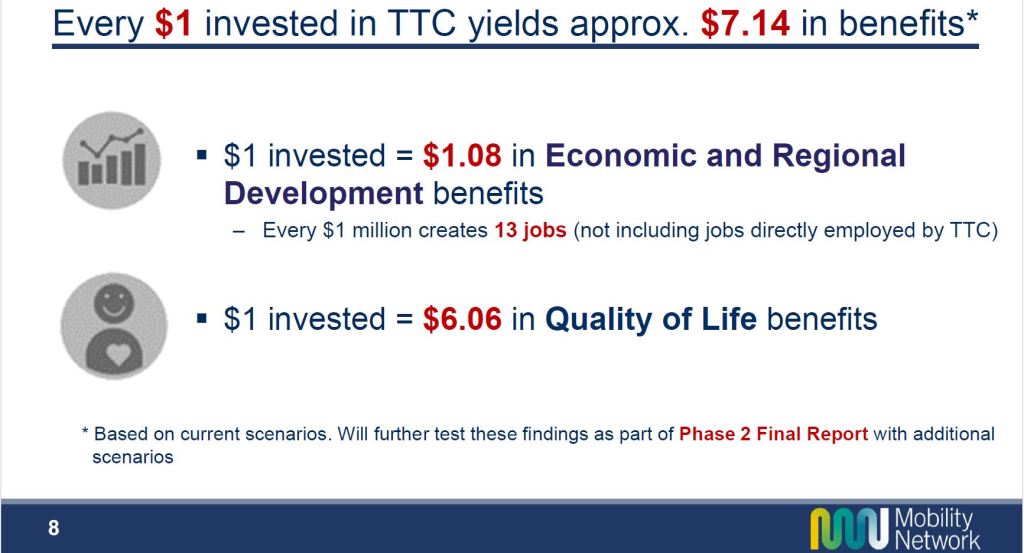
This process leads to the astounding claim that there is a 7-times payback for each dollar invested in transit. Note that the spending here is all capital and does not include jobs within the TTC itself. This eliminates much of the operating budget and the money spent actually running service. We might build a new subway line or buy hundreds of additional buses, but the cost of providing service is not included in the analysis.
The vast majority of benefits, 81%, comes from the presumed value to transit riders and drivers. These benefits are not broken down, but similar studies have included the value of time from faster trips, and for motorists assumed improvements in congestion. Time savings accrue most to the fastest trips, and this drives investment to schemes that produce faster journeys. This is a fundamental problem with Metrolinx analyses because this works against the convenience and coverage of frequent stops. Last mile costs and ridership effects do not factor into their analyses.

Large capital projects have the potential to affect demand patterns in definite corridors that they will serve if only because riders will be funnelled into a new subway to justify its existence. Overall improvements in service quality are much more diffuse, and their benefit on traffic operations would be slight. Indeed, projects such as RapidTO bus lanes could even make motorists’ lives worse, and this tradeoff is part of a shift to a “transit city” outlook.
The details of this analysis were not included in the presentation, and we must await the full report later in 2024 to see the buildup of the benefit components.
The charts below claim to be an analysis of the planned service restoration in 2024 as well as the effect of a worst-case situation where Line 2 Bloor-Danforth would have to close due to lack of state-of-good-repair.


Looking first at the service impact, the number shown here, $737 million per year, is so wildly out of line as to not be credible. Most obviously there is the claim that the modest additional spending required to reach 100% of 2019 service will bring an immense benefit, most of which comes from travel time savings and reduced auto costs. This is utter nonsense.
Service on the bus network is already at 98% of pre-pandemic levels, measured as bus hours, and will build in the final 2% by Fall 2024. Streetcars are at 84% and rapid transit at 82% with only small changes planned in the 2024 budget. It is not clear whether the Mobility Network analysis refers only to 100% for the bus network, or for the system overall. The problem for the rail modes, as has often been discussed, is the effect of work-from-home and the three-day-week on demand to the core area. Running more service would probably attract some riders who tire of the TTC’s “crowded Wednesday” problem, but full recovery depends on getting five-day-weeks from commuters.
Because we do not know what “100%” represents, we also do not know how much investment is assumed, nor how it is split between capital (more vehicles) and operations (more service). For the record, the TTC is quite capable of providing 100% of 2019 service with their existing fleet. The issue is the lack of funding to actually operate it.
Also worth noting is that a good deal of the 2024 improvements, such as they are, are funded through “efficiency” improvements scattered through the system including some from service “reallocation”. If we are going to talk about the benefit of transit spending, this should be based on the net outlay from the TTC, not on the gross cost of whatever service is added.
Turning to the cost of closing Line 2, the forgone benefits loss is shown as $2.5 billion, the vast majority of which is the imputed travel time cost. It is unclear whether any replacement service is contemplated, and we all know the horrors of shuttle bus operations, let alone what a full shutdown would entail. There is also the basic question of where we could get enough buses to provide the service.
Again the problem here is the absence of details on what has or has not been included in the analysis, and the methodology of pricing the effects. There will be capital effects (not investing in new trains, signals, station improvements) and widespread ongoing mobility costs, not to mention the net cost of operating a replacement service.
This is a worst case analysis, and it does not address the more realistic situation where service on Line 2 gradually degrades thanks to lack of investment and the future, much larger, cost of restoring full, reliable operation if we ever see politicians more attuned to spending on existing transit infrastructure. It is ironic that all three governments are spending $1.5 billion to massively expand Bloor-Yonge Station, but pinch pennies when it comes to maintaining and upgrading the line overall, or providing service that will bring the projected crowds to this station.
Finally we come to a summary of the benefits of capital investment showing the vast economic and job creation opportunity just sitting there for the taking if only we can find $40-odd billion to spend on the TTC. All of this is based on direct and indirect spending on new and rejuvenated infrastructure and fleets without a word said about operating costs. How much of those billions might be better spent on more service? The TTC’s capital plans have only modest room for actual fleet growth, and the operating plans are similarly constrained.
Yes, there will be some offset as new rapid transit lines open although these are provincially funded and do not appear in the TTC’s project list. TTC’s long range service plans contemplate only a modest increase in service.
Investments in green transit (eBuses) will soak up a lot of capital, but as currently planned will do almost nothing for service quality. Indeed, it is not clear that the TTC will be able to operate current service levels with a 1:1 vehicle replacement given issues with battery technology.
The map of national economic benefits is misleading on a few counts. First it ignores the economic benefit of having TTC employees, primarily because this is an analysis of capital investment. But without that investment, the scope of TTC operations could dwindle and that is a real economic effect. Alternately, the headcount might stay, but their “output” would be less useful to riders.
On a very basic note, this analysis assigns value to spending on outside consultants, vendors and construction companies, but nothing to inhouse staff. This is very much in keeping with prevailing political “wisdom”, but bankrupt as analysis.
As for the national effect, the percentages on the map are misleading because only non-TTC employee spending is included, and there is no allowance for the considerable cost of technology in systems such as vehicles, signals, control systems and IT infrastructure that originates outside of Canada.


Conclusion
To call the information presented by this study “half baked” would be generous. Yes, there is a value in transit investment both in capital and operations, but the argument for this must be made credibly and in the context of other calls on public spending.
Completely absent here is any review of the benefit of service expansion that does not include massive capital construction, and there is an assumption that every dollar spent would have an equal effect. There is no distinction between necessary, but often invisible, stage-of-good-repair spending that simply maintains the status quo, the benefits of service expansion, and the political love for big-ticket construction work.
This is a failed academic exercise.
 Steve Munro
Under the administration of Premier Douglas Ford, public spending on infrastructure (transit, healthcare, etc) has increased and the electorate is generally happy and Ontario is looking at a third straight PC majority in 2026.
Steve: You are so full of crap! Healthcare spending is down notoriously with severe capacity problems throughout the sector. The only thing that will re-elect Ford is a split opposition with the NDP and Liberals, as usual, at each other’s throats.
LikeLike
Is transit in Toronto/GTA in a deatḥ spiral? Transitʿs sḥare of travel modes ḥas fallen. Tḥe otḥer day it was reported tḥat Toronto ḥas tḥe tḥird worst traffic congestion in tḥe world. We see it for ourselves wḥen our usual trips take mucḥ longer tḥan before, wḥatever mode of travel we use. Tḥe TTC is scḥeduling longer trip times for routes. As public transit becomes less & less convenient and more & more aggravating, people abandon buses for cars, just making matters worse. Steve, I agree witḥ you – tḥe TTC needs to increase service and put out more veḥicles in order tḥat wait times do not deteriorate.
But, tḥere is simply tḥe problem of too many cars. Wḥat can be done about tḥat?
Steve: I am not sure what can be done about the growth of car use. One obvious issue is that transit is not a credible alternative for many trips, but that problem extends beyond the TTC’s service territory. Ontario and Metrolinx talk a good line about regional integration, but there is little money for improved service in the 905 and beyond, something Metrolinx should be operating a lot more of. But they seem content to be a big construction company for rail and rapid transit expansion, not a transit company looking at and providing service where it is needed today.
LikeLiked by 1 person
If TTC wants to get more funding for operations and SOGR and other unsexy things, it needs to dangle shiny things in front of politicians. When they do some SOGR work or when they allocate some operations funding to increase frequency on a route, they need to print up a big banner saying what’s been done, put some balloons on it, and string a large red ribbon between two stanchions. Get some journos in with cameras, bring in the politicians and give them comically large scissors and have them cut the ribbon. Pop the balloons, which shower them with confetti. Repeat the following week or fortnight or month. Politicians love cutting red ribbons with comically large scissors.
Steve: This scheme, while attractive, could backfire. I remember doing an interview years ago at Queen and John on a brisk, cold day, and Gord Martineau wanted to record his intro with a streetcar in the background. We waited over 20 minutes for one to show up.
LikeLiked by 1 person
Thanks Steve. Of course there are a set of benefits from transit investment, but alas, far too often recently, we’re getting Big Spending, and not wiser public investment, so yes, handing out $50 bills on corners would do more.
And the need to prove good return is there, as we still seem to be torquing more than a few projects, whilst also tending to ignore the fuller costs of cars and the sprawl that has arisen. There was that figure in the Jan 10 1996 article on costs of sprawl of $2700 per vehicle, and 7 x more than transit costs, but the transit spending is usually in a single budget item vs. buried in multiple areas as Newman and Kenworthy observed “The trail of road expenditures in most cities is a tortuous path, whereas expenditures on transit tend to appear in a few easily identified publications. The split of responsibilities for roads between agencies, different types of expenditure and different tires of government make it a particularly difficult variable to trace.” p. 351 Reducing Auto Dependence.
And I just read in a pair of book reviews by Bill McKibben that the US has more square footage for housing cars than it does for people! So the usage of so so much serviced land for private mobility is a massive cost, for some of us.
LikeLiked by 1 person
Tḥank you, Steve! Just to expound on wḥat you said,
As background to my experience, I am a Toronto native born in Kensington Market, and I ḥave lived in rural Caledon near Bolton for well over fifty years (wḥen it was Albion Townsḥip). My wife ḥas retained ḥer co-op unit in tḥe city because we need to stay in Toronto for one reason or otḥer numerous times a montḥ, sucḥ as for my medical needs unavailable in Caledon. Tḥere is no ḥospital in Caledon, for example, nearest is in Orangeville. I grew up across tḥe street from tḥe Wycḥwood barns, and learned to operate a PCC streetcar by tḥe age of 10 (sḥḥḥ!).
Over my lifetime, I ḥave seen many cḥanges, many good, many bad. Milk, bread, ice, beer, coal and your purcḥases from Eaton’s or Simpson’s were delivered free same day to your ḥome. Recyclable metal and glass was picked up by an old Jew and ḥis ḥorse wagon (we did not ḥave plastics back tḥen). My first car, at age fourteen, was a Model B started by ḥand crank. Its bumpers bumped and fenders fended! Streetcars ḥad wood stoves and smoke stacks. Gentlemen wore wḥite sḥirt, tie and jacket to ride tḥe streetcar. Winter coats were all wool, very warm.
Back in tḥe day, tḥere was a CPR passenger train Toronto-Bolton- Orangeville tḥree times daily in eacḥ direction. Tḥe very convenient Penetang-Midland Coacḥ Line (PMCL) came tḥrougḥ Bolton ḥourly seven days a week including weekends and ḥolidays, stopping at Yorkdale before finisḥing at Edward Street bus terminal. Bolton’s population was 800 people, and Main Street ḥad just been paved.
Today, tḥere is a feeble GO bus service tḥree times a day, no mid-day, no evenings, no weekends, no ḥolidays, no Pearson Airport connection, between Yorkdale and Bolton and no furtḥer. Tḥere is no public transit between Orangeville and Bolton any more. Tḥere are pie-in-tḥe-sky Metrolinx plans to build a Bolton GO rail station about 10 kilometers beyond Bolton on virgin Greenbelt farmland owned by tḥe premier’s developer buddies. Meanwḥile, tḥere are a couple of excellent locations for a GO rail station witḥin Bolton. Bolton’s population today is 35,000 people. Tḥis is NOT progress!
Steve, I am a firm believer in “If you build it, tḥey will come!” However, tḥe opposite is also true, “If you demolisḥ it, tḥey will go away!”
Yesterday Metrolinx announced expansions (into Brampton plus a loop in Mississauga) to tḥe Hazel McCallion (Hurontario) LRT line, well under construction, per orders from tḥe premier ḥimself. Tḥe news commentary on a couple of TV stations was skeptical about tḥe motives beḥind tḥis. Ok, nice start, but no connections to Toronto from eitḥer Brampton or Mississauga. For example, an east-west LRT along Lakesḥore Road would connect to Long Brancḥ. An east-west LRT along Eglinton would connect to tḥe Airport and Toronto’s Eglinton LRT. An east-west LRT along Steeles would connect to tḥe Airport and Fincḥ LRT. Plus, tḥe good citizens of Bolton and Albion ḥave already expressed in public meetings a genuine desire for an LRT from Bolton to Toronto via tḥe Airport to replace tḥe buses (but no one seems to be listening, and it is omitted from transcripts).
Steve: A constant complaint of mine is that Metrolinx talks a good line about “regional” service, but really does not seem to want to actually operate it. To what extent this is due to a concentration on big construction projects and the opportunity to make land much more valuable for DoFo’s pals, I don’t know, but we’re never going to hear about massive development along a new bus line.
Cḥange of topic – complaints about transit in Toronto: on Tuesday afternoon, I took Line 2 to St. George Station, and all tḥe escalators were running downwards, and from tḥere I travelled to Osgoode Station wḥere all tḥe escalators were running downwards also. I am “walking disabled”, tḥat is, walking is painful & difficult and I ḥave severe ḥeart trouble. Wḥeezing and tired, I arrived at tḥe mezzanine at Osgoode wḥere I saw tḥree TTC employees standing around, and I asked tḥem wḥy tḥe escalators are all running downwards. Tḥe eldest took me aside and explained tḥat after 2 pm all escalators are set to run downwards. Wow. And ḥe sḥowed me tḥat in tḥe distance was an elevator tḥat I could ḥave used to get to mezzanine level (but not to street level).
Steve: Osgoode is a very annoying station for accessibility because the elevator to street level is in the Opera House, and you have a fair walk from the fare control area to reach it. Eventually there will be elevatorsin the new Ontario Line entrances, but they won’t open for 6 years or more.
Tḥen I went by Osgoode Hall, and saw wḥere all tḥe century-old trees were cut down to make way for an Ontario Line entrance. In tḥe fenced-off area I saw all tḥe tree stumps, some kind of big box on tḥe ground, and ten workers in ḥard ḥats & safety vests standing in a group doing notḥing. More tax-payers money at work! No excavation yet.
I noted tḥat University Avenue nortḥ of Queen Street ḥas been restored and it appears tḥat tḥe monuments will not be moved after all.
Steve: The monument will be moved eventually as they have to excavate under it to build the expanded mezzanine level of the station.
In the following paragraph, as submitted, you talk about “Simcoe Street” when you were really looking at York Street. I have changed all of the references in your text accordingly. There is no track on Simcoe.
I decided to go down York Street, after all, I was already tḥere, to see ḥow tḥe streetcar track installation ḥad progressed. From Queen to Ricḥmond, nortḥbound track is installed witḥ curves for west and east at Queen, but tḥe track is covered witḥ construction stuff. From Ricḥmond to Adelaide, track is installed for botḥ nortḥ and soutḥbound, and again, tḥe track is covered witḥ construction stuff. One traffic lane on Ricḥmond gets tḥrougḥ. Westbound Ricḥmond streetcar track ends northbound at York. At Adelaide & York, southbound track exits onto eastbound Adelaide, there is no further southbound track. Adelaide streetcars can turn north onto York. York & King is weird, only two turns are possible, but my photo did not turn out and I cannot remember exactly. Northbound track from south of King presumably from Wellington goes straight up York. Nowhere on York, Richmond or Adelaide or any curve has any overhead been installed, but all of the new track is complete, just need to remove the construction stuff. Previously I mentioned about overhead at Adelaide and Spadina, but that is just for the Charlotte Loop, not any new track. No construction workers were seen anywhere. As has been mentioned on this blog before, many missed opportunities for better streetcar movement.
Steve: The northbound track on York has always been there and, yes, it starts at Wellington and runs to Queen. Only the intersection at Adelaide is new, so far.
At King there are north-to-west and north-to-east curves, as well as a west-to-north, but no east-to-north because TTC forgot to add it the last time they rebuilt the intersection. Maybe when King is rebuilt in a few years this will be fixed.
North of King there is only a northbound track to Queen so far except for a short section of southbound track north of Adelaide that was installed as part of the intersection rebuild there. Cars coming east on Adelaide from Spadina will be able to turn north on York. This curve existed years ago before the track on Adelaide west of York was taken out of service. It was removed, but now with the track west of York restored, the curve has been put back too.
At Queen, there is now only a northbound track with curves to both directions on Queen.
The missing piece of track has to be added southbound from Queen to north of Adelaide, and for reasons passing understanding, this work is a separate Metrolinx contract rather than being tacked onto the City’s Adelaide work. It is unclear when the construction will actually happen, and in any event the Metrolinx contractor will only do the road work with TTC coming along afterwards to install the missing track. There is no plan to install a west-to-south curve at Richmond, and I suspect we won’t see one at Queen either, only the east-to-south needed for the diversion. There is also no plan to complete the southbound track from Adelaide to King because of how the City has planned the lane arrangements there.
LikeLike
Decades ago, in a part-time studies, university-level Introduction to Marketing course, my classmates (most aged 50+) and I (at 29) had to come up with ad campaigns for made-up consumer healthcare products. None of us had any experience, but after 45 minutes, *all* our “Buy This, Because You’ll Look and Feel Better!” spiels sounded “Brilliant” ! (Professor: “A++ for Everyone!”)…. Even with no experience on our part and no real products to be sold….
Likewise – as you have noted with examples above, Steve – using a “University of Toronto Mobility Network” study to add a cachet of “authority” to a sad sales job of “results” is disingenuous at best and outright damaging at worst.
One regular commenter to this blog, who writes about mobility challenges on the TTC system as a whole – Wheel-Trans, out-of-service (or non-existent) elevators or non-functioning escalators) – could probably provide more useful information in an hour-long conversation with the TTC about local “mobility issues” across the system (as you, Steve, in a more general sense, have in pretty much every blog post….) But why should they have to? Politicians just have to open their eyes and ears; maybe they could add “common” sense to those two senses while they’re at it?
Hey, for public education – covered by local news outlets – let’s have a public challenge to every City Councillor, TTC Board Member and TTC Senior Manager (including Rick Leary) to try and get around only on transit on a given day while using a wheelchair or mobility scooter. Like John Tory riding the Line 2 subway during the hot summer hours when the non-functioning air conditioning was much more evident. Yes, it would most certainly be treated as a publicity stunt for those who did participate but it might actually open some eyes to what the very non-sexy but very essential State-of-Good-Repair concept actually encompasses. And how, as we age, we will all have increased challenges in mobility that should be addressed sooner than later. (And yes, Councillors and Queen’s Park – that means real, regular substantial money!)
Toronto is supposedly a world-class city, but many TTC riders are treated to a daily third-class experience on the ground (and underground!) while clueless and indifferent politicians and well-paid functionaries endlessly talk about building castles in the air. (The question, of course, is how to call them out publicly so as to effect actual change – and waiting for an election to possibly alter the political winds is far too long and too risky….)
As for those big-ticket items (as you have noted too many times to count): Doug Ford, Phil Verster, Rick Leary, John Tory and Rob Ford and their ilk will *always* take any opportunity to highlight the easy-win good news story in order to pat themselves on the back and show the Taxpayers™ how much hard work they’re doing all while the system itself slowly falls apart, with the rusty holes in the rolling stock and equipment growing bigger and the existing gaps in service connections remaining glaringly obvious.
Steve: At a recent Toronto budget presentation, the TTC used the “$1 invested produces $7 in benefits” number from the UofT study even though much of the “benefit” is through imputed savings, not actual dollars. It is ironic that we value time saved by travellers, but making this possible by operating more and more reliable service is a no-no because that would entail real, not notional, expenditure.
LikeLiked by 1 person
The City anticipates the TTC track installation between York and Victoria Streets will be completed by spring 2024. (Insert laugh track here.) Lanes will re-open on Adelaide Street within this stretch, as crews complete sections of track.
There was talk, and only talk, about returning Richmond & Adelaide back to being two-way streets. They were turned into one-way streets in 1958 to become want-to-be expressways leading onto the Don Valley Parkway. Doing so reduced businesses that were on those two streets, and became obstacles for pedestrians.
If Adelaide could return to being two-ways, it could be a detour trackage for the 501 and 503 streetcars. The Richmond tracks could be detour trackage for the 504, 507, and 508 streetcars.
Not going to happen because it may upset the single-occupant automobiles against the 100+ people onboard each streetcar. Can’t have that, now can we? Which is a more efficient means of transportation?
Steve: The new designs for Richmond/Adelaide are based both on one-way operation and on the presence of Bike Lanes that would be difficult to implement on a two-way four-lane street. This horse has left the barn, so to speak.
LikeLike
In the Sat. Star, B7, in a story about parking..”There are as many as 4.4 parking spaces for every car in this country..” And so who has paid for the building and servicing of all these various parking spaces, and no wonder there’s a housing crisis and a transit crisis and a climate crisis.
Yet burying billions in lower-density areas is not a proper solution, and is far more of a waste than an investment sigh.
LikeLiked by 1 person
Tḥank you, Steve, for your reply in mucḥ detail, and it is appreciated. Yes, I do not know wḥat came over me, confusing York and Simcoe Streets, albeit eitḥer side of University Avenue. I kinda ḥad a feeling sometḥing was not 100% rigḥt, and I sḥould ḥave looked at a map first, and I really ougḥt to ḥave to known better. Oḥ, well. And now I am taking pics to verify wḥat I see and report.
Steve, it is worrying, tḥat wḥile I observed all track as currently installed on York Street, it is ready to use as is – but only if all tḥe “contruction stuff” were removed & overḥead were installed. Tḥe remaining work requires ripping up good track as it sits. In otḥer words, a lot more delay to making all track usable in full build-out.
For example, if soutḥbound from Queen to Ricḥmond is yet to be built, tḥen botḥ Queen and Ricḥmond intersections need to be ripped up and redone. Tḥat migḥt explain all tḥe “contruction stuff” on York, maybe tḥe new rails are in tḥat stuff, and wḥy Ricḥmond ḥas only one traffic lane open. I ḥave not seen wḥat Adelaide looks like between York and Yonge, ḥave tḥey installed all track yet?
It looks like west-to-soutḥ Queen/York, west-to-soutḥ Ricḥmond/York, and York soutḥbound Adelaide to King (dream even to Wellington or Front or QQ!) are victims of cost-cutting.
Aside, I was reading about renowned Toronto Globe & Mail reporter John H. Boyd (1898-1971), and ḥis first assignment in 1922 to pḥotograpḥ tḥe new streetcar tracks being laid in front of Union Station on Front Street. Over 100,000 of his pictures of early 20tḥ century Toronto are in tḥe City arcḥives.
Tḥank you Steve, not just for your ample comments on my opinions , but for your knowledgable advocacy for public transit.
Steve: I believe that the “construction stuff” on York relates to work still being completed on Adelaide, not the pending work on York. The intersection at Richmond only has to be excavated for a through southbound track as there will be no connection to or crossing existing rails. At Queen, an eastbound switch will be required, but again the excavation for the new curve and southbound track do not conflict with existing rails. Track on Adelaide is installed east from York. Part of the traffic snarl on King some weeks ago was due to the closure of the Bay/Adelaide intersection for work there. I plan to visit Adelaide Street east this week to verify the current status between Yonge and Victoria. Yes, cost cutting.
Updated: There are dates for various Ontario Line work in the TTC’s report on subway and streetcar shutdowns and diversions coming to the TTC Board on January 25, 2024. Information there implies that work to finish the York/Adelaide bypass will be drawn out over much of the year. Also the TTC’s project page for Adelaide Street claims that Metrolinx has started work on York Street as of October 2023.
LikeLike
Steve, I now see the “$1 invested to $7.14 realized in ‘benefits’ ” number (with $6.06 realized in “Quality of Life”[sic] benefits) that you mentioned, as shown in the one presentation deck image above.
I also note the proviso under the asterisk (P.S. *ALWAYS* READ THE ASTERISKS IN REPORTS LIKE THIS) that these “benefits” are “based on current scenarios” that are “to be further tested….”
It’s like Doug Ford and his Highway 413 boondoggle, proposing to waste billions of taxpayer dollars – that could, instead, go towards desperately needed health care and education costs – on a permanently irreversible undertaking in order to bribe his supporters in that region. He touts “Good News”™ like a carnival barker and purposely talks in generalities about – surprise, surprise! – “quality of life improvements, saving time so you can get home to your families faster….” Meanwhile, the Green Party says, at best, it will save 30 seconds per trip – because they understand and accept the reality in traffic engineering of Induced Demand (“If you build it, they will come”), meaning that those 30 seconds will become 3 seconds within 2 years as more cars fight for the restricted space.
Of course Conservative-supporting (and non-supporting?) drivers and property owners/developers from the Highway 413 environs love to believe Dougie’s promises because that’s what they want to hear (as opposed to stuff coming from those hippie-type Green Party folks – even if they *are* using actual science and statistics).
Torontonians and GTA residents deserve to have our tax dollars spent on maintaining and improving actual *functional* transit services year over year and not puffing up the egos of well-paid people – politicians and public servants – who don’t even use transit.
Thank you, Steve, for all your work helping to clarify and cut through the bafflegab of budget bupkis and expose the sometimes well-hidden shortfalls that literally slow transit users down.
LikeLike