
This article continues the series about the December 20, 2023 TTC Board meeting with details of the budget discussion.
Items discussed here:
- Staff Recommended 2024 TTC Conventional and Wheel-Trans Operating Budgets and 2024-2033 Capital Budget and Plan
- TTC’s 2024-2038 Capital Investment Plan: A Review of Unfunded Capital Needs
This article deals mainly with the Q&A session at the Board meeting as I have already written about the 2024 budgets in detail elsewhere.
The 2024 Operating and Capital Budgets
A major problem with TTC budget “debates” is that they are quite perfunctory compared with the size and importance of the reports, and the spending involved. There has been no TTC Budget Subcommittee for years, and even when it existed, it rarely met. The idea of at least part of the Board doing a deep dive into budgets seems to be utterly beyond their idea of “good governance”, at least until the recent change in the Mayor’s and Chair’s offices.
Commissioner Ainslie asked that the Chair work on creation of Budget Committee with a report in 2Q24. He observed that agencies with much smaller budgets than the TTC have budget committees, and the TTC should too. The Board asked staff to report in Q2 2024 on the establishment of a Budget Committee.
It should not be for staff to report on creation of such a committee, but for the Board to say “we need this” and immediately canvass members for their interest. An informed committee will be essential for review of the 2025 budget priorities before the budget is struck. The budget should not come to the Board as a fait accompli based on discussions at the staff level. Moreover, the Mayor’s Office should have visible input to the process. If the level of so-called review by the Board amounts to a once-a-year dog-and-pony show by staff, there is no opportunity for Board input and queries about the underlying policies, assumptions and options available.
Some TTC Board members are strong in their belief that the role of the Board is to provide policy and oversight, and of management to manage. That is a great model provided that the Board actually engages in its role, but for many years there was no sense that the TTC Board actively developed policy, let alone held management accountable.
By the end of the budget debate, Board members were very concerned about the financial status of the TTC, even though quite complimentary about the detail of work presented by staff. Some of these members sat through the years when Mayor Tory ran the show, and the primary message was “everything’s just fine”. They bear some responsibility for problems that have festered for years.
After the staff presentation on the two budgets, there were many questions from the Board. The items below have been consolidated by topic. Illustrations are taken from the presentation deck.
Service & Service Standards
Over 2024, ridership is forecast to grow to 80 percent of the pre-pandemic level with a range of 78-83 percent. The growth is uneven with commuter traffic down a great deal, but other demand is up strongly. This shows the folly of average numbers giving the impression that better service might not be required.
A related problem is the use of Weekly Service Hours as a metric for the quantity of service. Over recent years, the scheduled speed of vehicles has declined, in some cases substantially, due to a combination of traffic congestion and generous travel times to reduce the need for short turns. From a rider’s point of view, service is less frequent even though the same number of vehicle hours might be operated. Overall, most of the additional service hours will go to the bus network.
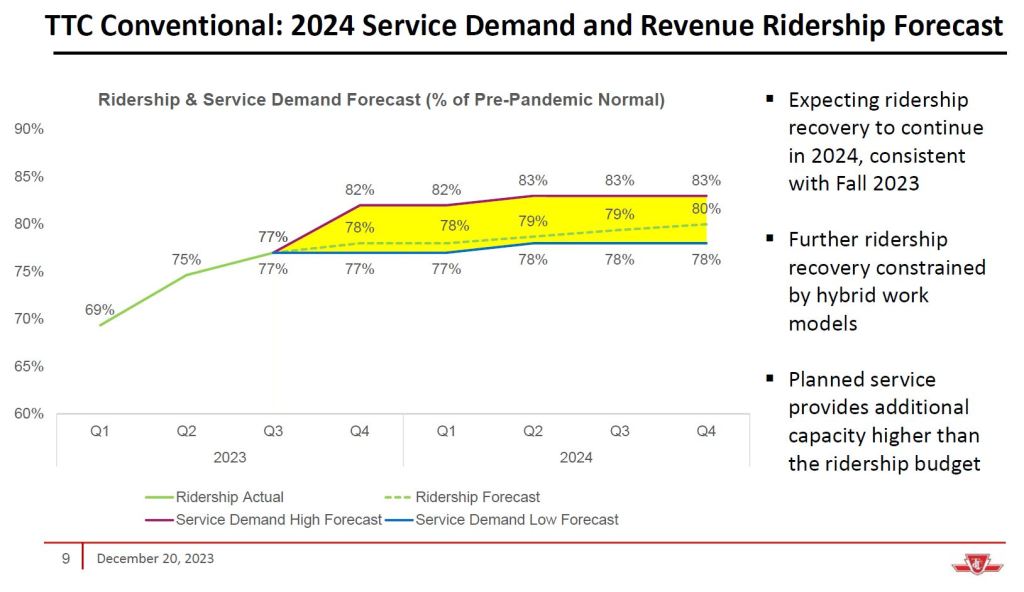
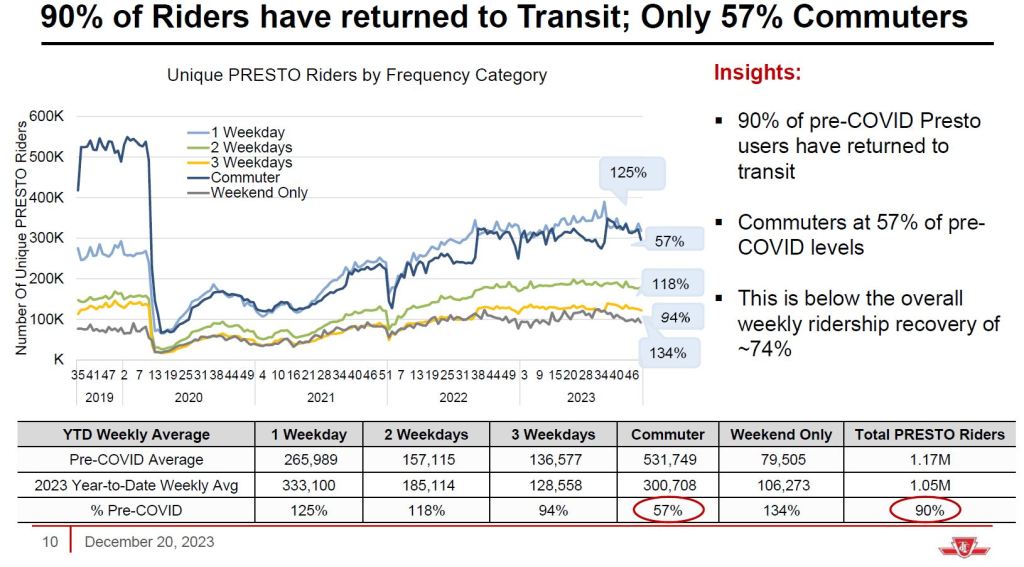
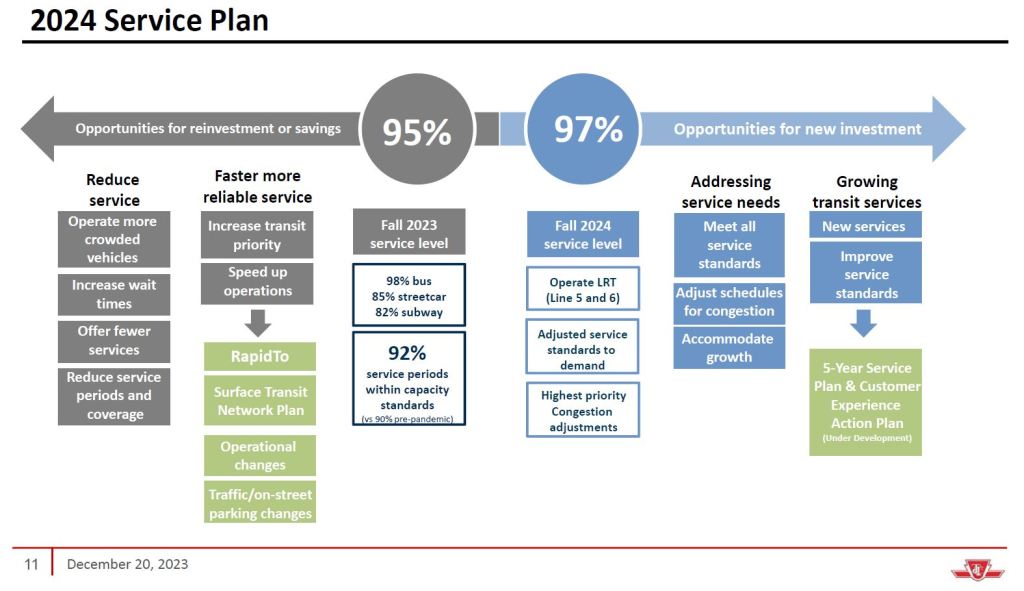
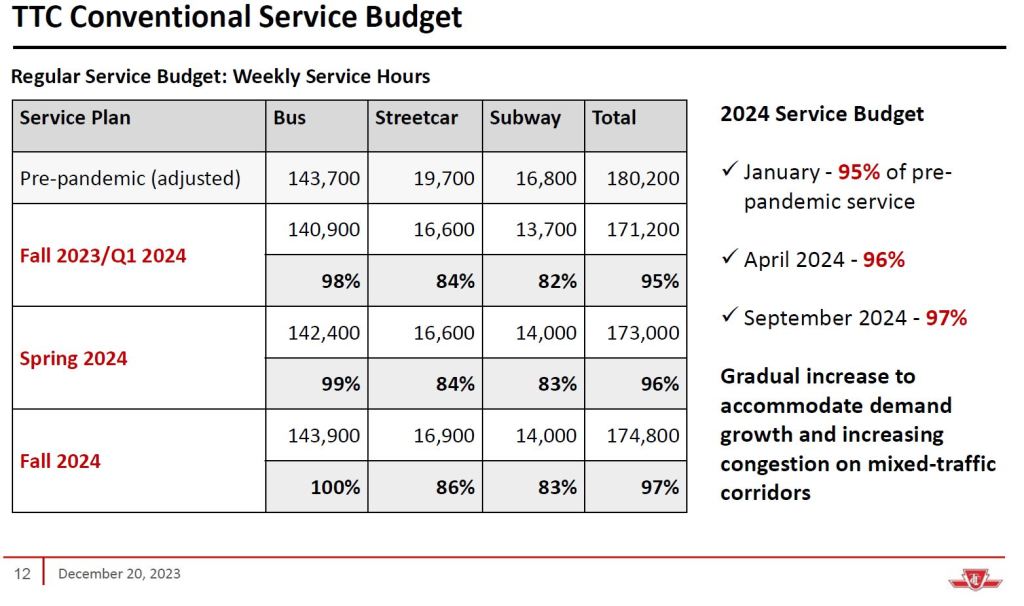
- Commissioner Matlow asked whether the 97% number cited for recovery by fall 2024 was based on 2023 or 2022.
- Staff confirmed that the Service Standard changes implemented in the 2023 budget continue into 2024. They claim that there have been no service cuts to bring existing routes up the the new, more crowded, level, but new service in not added until a route hits the new standard. If they had implemented the change in all cases, there would have been service cuts to bring routes to the new, more crowded standard.
- However, there have been reallocations of service between routes to remove service on lesser-used lines and transfer the budget headroom to busier routes. The TTC does not publish loading statistics, and so it is impossible to know the net effect has been in each case.
- Staff are reviewing the Service Standards as part of the 5 year Service Plan which will come to the Board in 2024.
- Commissioner Matlow spoke about the lack of transparency and trust in the way that service standards were changed in the 2023 budget. There was no accountability for this decision. He moved a budget amendment requiring a report to Board on the effects of this change and of a potential reversal in the 2025 budget.
- Chair Myers asked various questions about service growth:
- How much service might we see from new buses? Staff replied that if state-of-good-repair funding stays up, then bus reliability will continue to be good. This did not actually answer the question about higher availability of newer buses. Staff did not speak to retirement of very old buses (see above) and improvement in average age/reliability of fleet.
- Myers also asked about the service possibilities with the expanding streetcar fleet. Staff replied that they are looking into this, and service levels will be based on the Service Standards.
- It should be noted that the budget contains funding and staff only to maintain the expanded fleet, not to actually operate more service. Moreover, there is no sense of the riding lost to erratic service caused by a combination of traffic, construction and the TTC’s laissez-faire attitude to service reliability.
- Myers asked how much service growth would restore the pre-2023 crowding standard. Staff replied that 2-3 percent more service would be needed. About 2-3% was added in recent years for congestion, with another 1 percent in 2024. The coming Service Plan has a commitment to report on crowding achievement vs service.
- Commissioner Jagdeo asked if TTC provisioned for growth beyond a few percent, notably from stronger return-to-work travel?
- Staff replied that if they budget for more service it makes the deficit worse. The 5 Year Service Plan plus fare integration could lead to more growth, but not necessarily more revenue.
- This does not really answer the question about planning for growth at least to know the potential effects and cost, even if the budget does not actually include provision for better ridership.
- Councillor Kandavel asked if TTC is making a 97% commitment based on 2019 demand and population, what is the effect of population on demand.
- Staff replied that they are monitoring all routes. On bus services, there is a very high level of return. 65% of service periods have the same service as pre-pandemic.
- For reader context, a “service period” is one segment of the weekday, Saturday or Sunday schedule. Each of these is broken into five segments by time of day, and a route has 15 service periods overall (not including overnight service). I recently published a table comparing January 2020 and 2024 service levels as measured by service frequency. See When 95% Really Isn’t 95%.
- Staff replied that they are monitoring all routes. On bus services, there is a very high level of return. 65% of service periods have the same service as pre-pandemic.
- Kandavel asked, in the context of population growth, what federal subsidies TTC gets for operations.
- Staff replied that the only federal funding was for Covid relief, and the City is still waiting on payment of the promised support for 2022.
- Commissioner De Laurentiis observed that the experience of service varies. Although staff claims that service will be at 97 percent, this is relative to prepandemic conditions, and the figure is 80 percent overall.
- Staff replied that the system will be at 100 percent on bus, less on streetcar and subway. They have loading stats on all bus trips and use these to identify routes needing service.
- De Laurentiis noted that traffic congestion, delays and reliability affect the benefits of transit.
- Commissioner Saxe asked what the TTC is doing to ensure that funding goes to the best place – bus vs subway?
- Staff replied that more operating funding goes to bus service where the demand is, but on capital side the dire need is on the subway.
- Commissioner Holyday asked for a comparison of ridership and service.
- Staff replied that on average boardings sit at 78 to 80 percent with bus in the mid 90s, streetcar mid 60s and subway low 70s. The majority of service hours go to the bus network, and more service is protected, relatively for rail modes with service standards of 10 minute maximum headways on streetcars and 6 on subways in spite of lower ridership.
- Commissioner Saxe asked how much streetcar ridership loss is due to construction.
- Staff replied that they expect riders will come back as construction on routes like St. Clair ends. The 5 Year Service Plan will look at what increases are needed on the streetcar network. Ridership on weekends is strong compared to peak periods because it is the commuting trips by office workers that have been lost, and weekends have hit 129 percent of prepandemic demand.
- Commissioner Holyday, noted for his conservatism on budgets, is aware of the effect of bunching on service attractiveness and talked of the frustration of a half-hour wait for two buses to appear. He did not, however, carry this argument on to the issue of service management and irregularity.
TransformTO
TransformTO is a City program to reduce emissions including those from the transportation sector. The majority of these come from autos and trucking, but transit also makes a contribution. This comes both from direct emissions (e.g. diesel buses) and from the potential reduction of auto trips through diversion of trips to transit. Current trends in Toronto are going the wrong way in that the TTC has lost market share and is not well-positioned to exploit demand growth for trips that are not core-oriented.
The staff presentation addresses capital requirements for vehicles, electrification and garaging, but does not speak to the operating cost of much larger fleets and service levels.
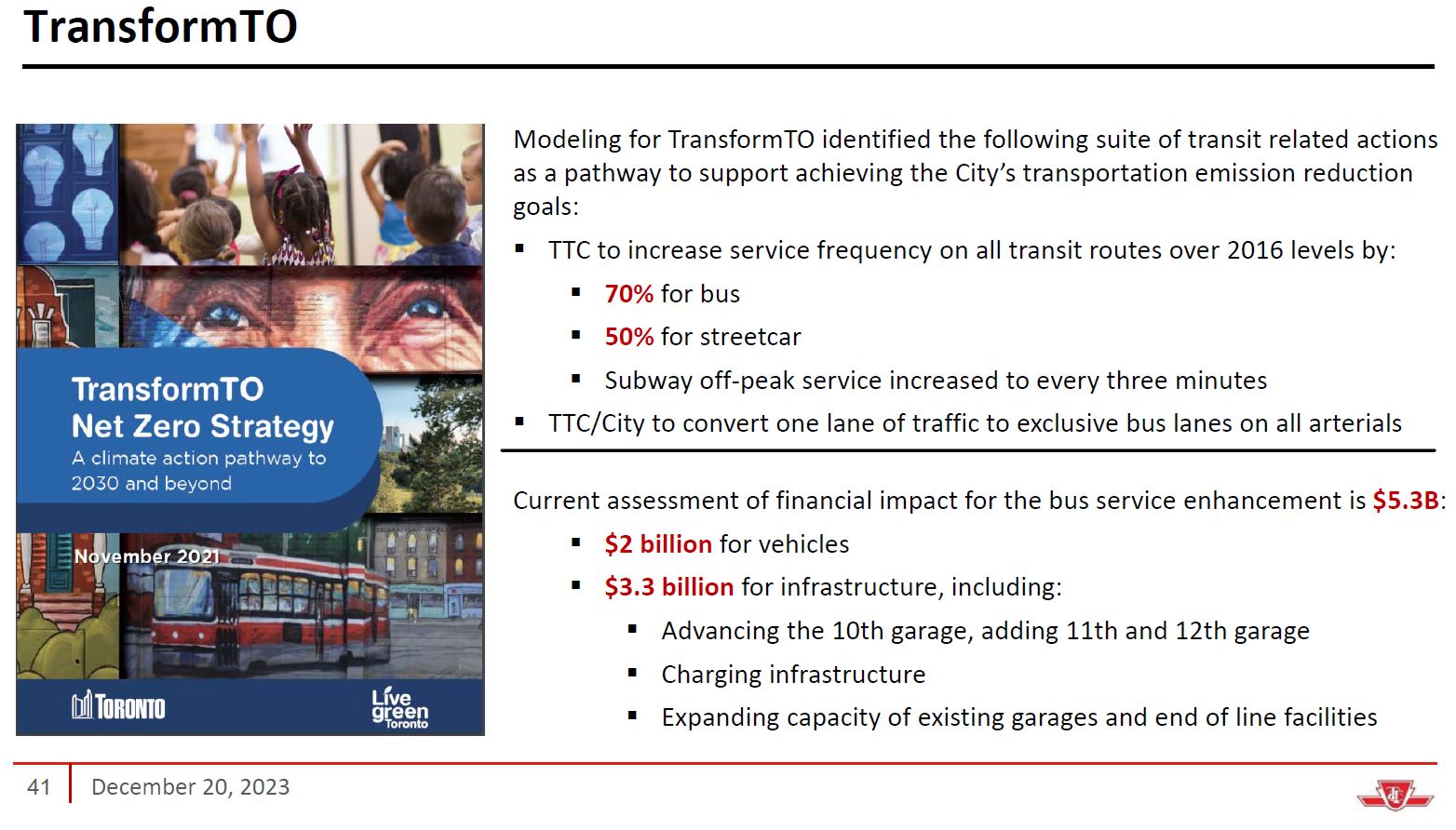
- Commissioner Orborne asked what the rationale was for the percentage increase in service due to TransformTO’s Net Zero program.
- Staff replied that this was in response to a City model that showed how they might achieve the NZ2040 goals. Additional work pending will be new models of achieving Net Zero.
- Readers should note that this achievement was spread over improvements in many areas notably emissions from building construction and operation, and that getting to NZ2040 was not all on the transit system’s back.
- For the record, Council has not yet approved the proposal for an aggressive increase in transit service. The December 7, 2023 agenda included a report about the TTC’s role under TransformTO that explored the bus fleet implications of such an increase. See Moving to Electric Buses: TTC Plan Update.
- The issue here is whether the spending needed to implement this scale of change should be included in the Capital Plans for coming years, and whether the Plan is bloated by projects that have not been formally embraced as a City priority.
Fares
- Commissioner Saxe asked about the cost of free off-peak student travel.
- Staff replied that this is a work in progress, and the TTC is in discussion with the City about whether this is a fare change or a group benefit. A report may come to the Board in February.
- The distinction is arcane, but there are two larger questions:
- How do we decide which group is deserving of a fare subsidy, or conversely what is the best way of spending City resources on reducing fares selectively?
- How would a new fare structure fit into the planned regional fare consolidation?
- Behind Saxe’s request is the assumption that there is spare off-peak capacity that could be used by students at no marginal cost to the TTC. Given that Service Standards now call for close to standing loads on off-peak vehicles, this may not be a valid premise.
- Commissioner Holyday noted the strong growth of Open Payment for fares and asked if this was affecting revenue.
- Staff replied that this is a zero-sum situation where riders migrate between fare media. Revenue growth from increased convenience is unknown.
- Councillor Kandavel asked if staff had a model of what happens if the “break even” price for a monthly pass goes down? How would that be compensated by single fare payers?
- Staff replied that they had looked at fare capping to bring down the break-even point, but this work was deferred during pandemic.
- Commissioner Holyday asked whether TTC has optimized the fare structure for maximum ridership and equity?
- Staff replied that, yes, fares are optimized, but the TTC has other options.
- The TTC had a fare strategy study underway that touched on many issues, but it has been dormant since before the pandemic. This issue is also affected by recent announcements of regional fare subsidies and integration.
- Commissioner De Laurentiis asked whether if fares were “optimized”, what happens to state of good repair and would the level of service endangered.
- Staff replied that, yes, we should worry and the issue is not long term, but now. (Day-to-day maintenance is funded in the Operating budget which in turn gets substantial revenue from the farebox.)
Fare Evasion
- Commissioner Osborne noted that the headcount for fare inspections is rising, but there is no offsetting revenue benefit listed in the budget.
- Staff replied that they are working on re-calibrating savings, and have improved technology through Presto for detection. Effective in April 2023, TTC resumed ticketing for evasion. Staff hope to have updated numbers later in 2024.
- In response to a later question from Chair Myers, staff replied that an explicit $6 million in target revenue was included in 2022, but not in previous years. Staff are working on this issue going forward including a mode-specific study. No added incremental revenue until they bring report. Only fares come to TTC, not the fines.
- Note that fare evasion rates differ across the system and one cannot pro-rate the situation on some downtown streetcar routes with all-door boarding to the system as a whole.
Consultation
Opportunities for public and political input have been limited leading up to this meeting. Although the City undertook some consultation in November, this was without benefit of an actual budget document on which anyone could comment.
Looking ahead to the 2025 budget, the existence of a Budget Committee will allow discussion of policy options much earlier in the process and will provide transparency that has been missing for many years.
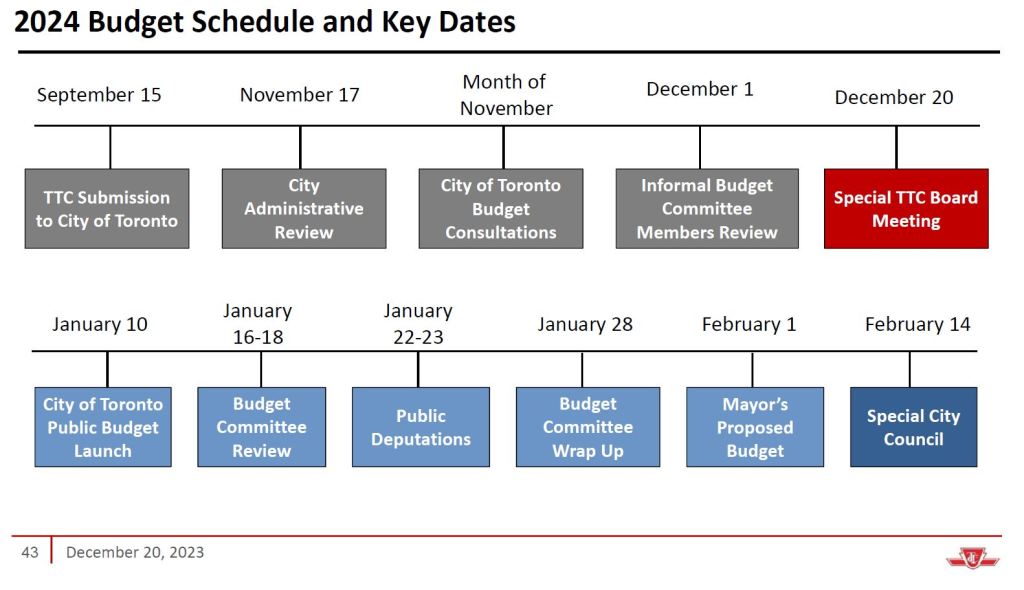
- Commissioner Saxe reported that the Amalgamated Transit Union Local 113 says that they were not consulted on the budget.
- Staff replied that they were not officially consulted, but that they could have participated via the City’s process. Saxe replied that there was no stakeholder process, nor is one shown on the budget calendar (page 43 of the budget presentation).
- Although the City undertook some consultation in November, this was without benefit of an actual budget document on which anyone could comment.
- CEO Rick Leary advised that he is now involving the union in review of the budget.
Reserves
- Commissioner Jagdeo asked about funding from reserves.
- Staff replied that the City’s transit stabilization reserve is being depleted for the fare freeze, but this is not a sustainable approach. By 2026, the reserve would be in a negative position.
- (For clarity to readers unfamiliar with the TTC and City budgets, these reserves sit in City accounts, not within the TTC.)
- Commissioner Holyday moved a budget amendment to monitor financial performance and reduce the call on reserves. This effectively duplicates past year practices where a reserve draw is included in the budget to make the numbers come out, but final results are better than expected (or service growth is constrained) so that some or all of the reserve is not required.
Capital Funding
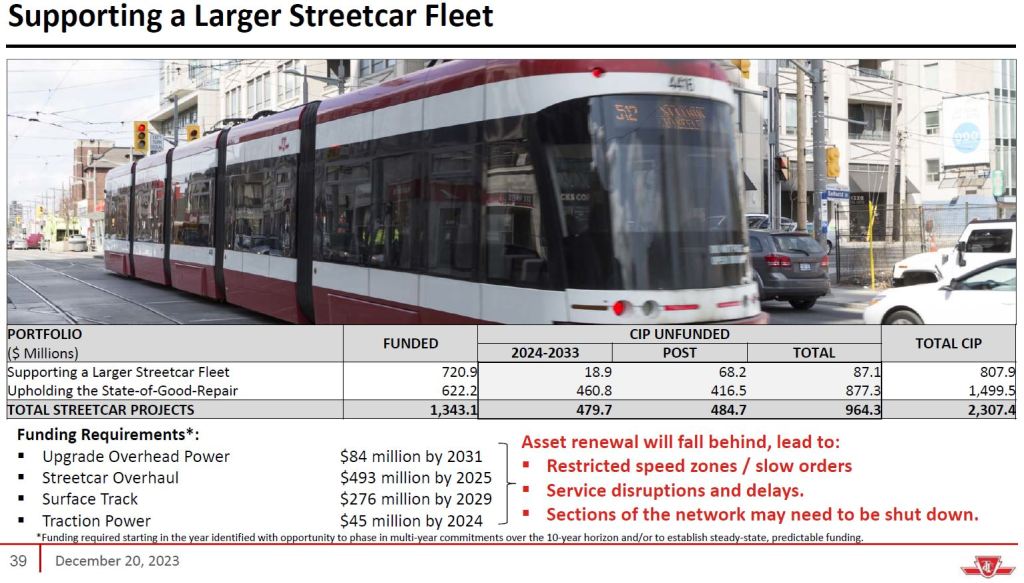
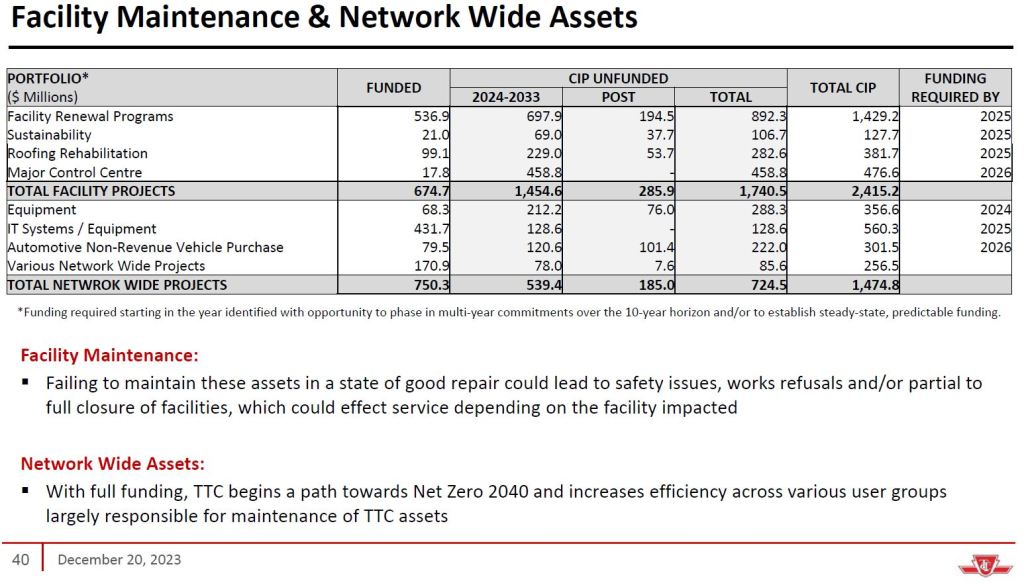
The $12.4 billion 10-Year plan covers only works for which funding is available. The funding does not cover all of the needed State of Good Repair, and the backlog of work grows substantially over the decade. This is particularly driven by vehicle purchases, mainly buses, through the combined effect of the shift to electric buses and the shift from an 18 to 12 year replacement cycle.
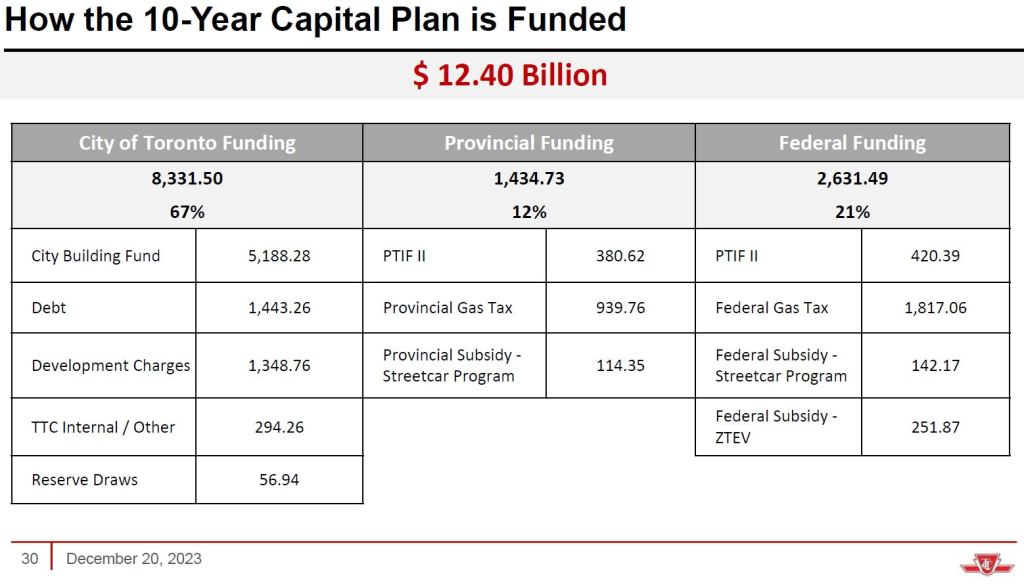
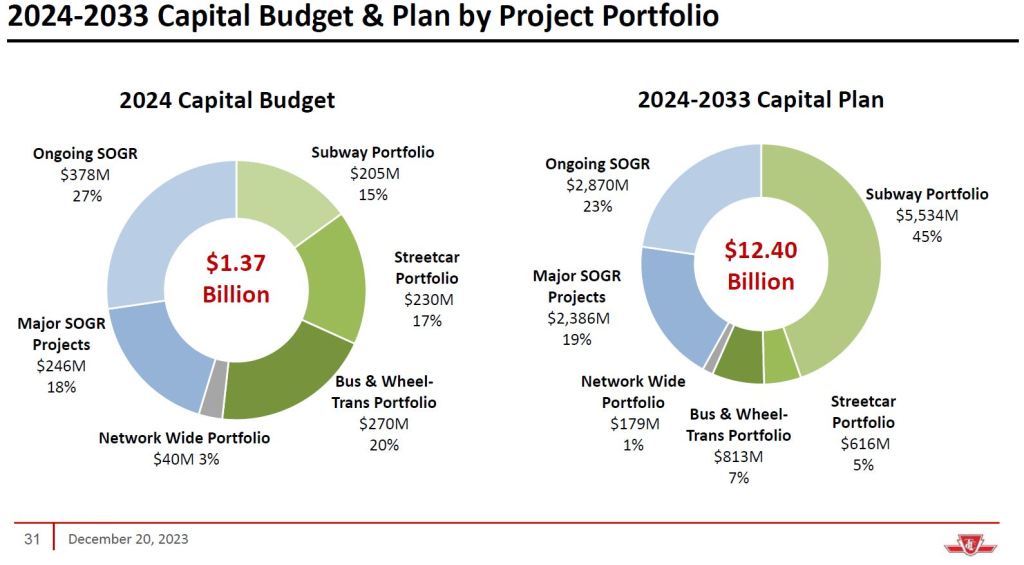
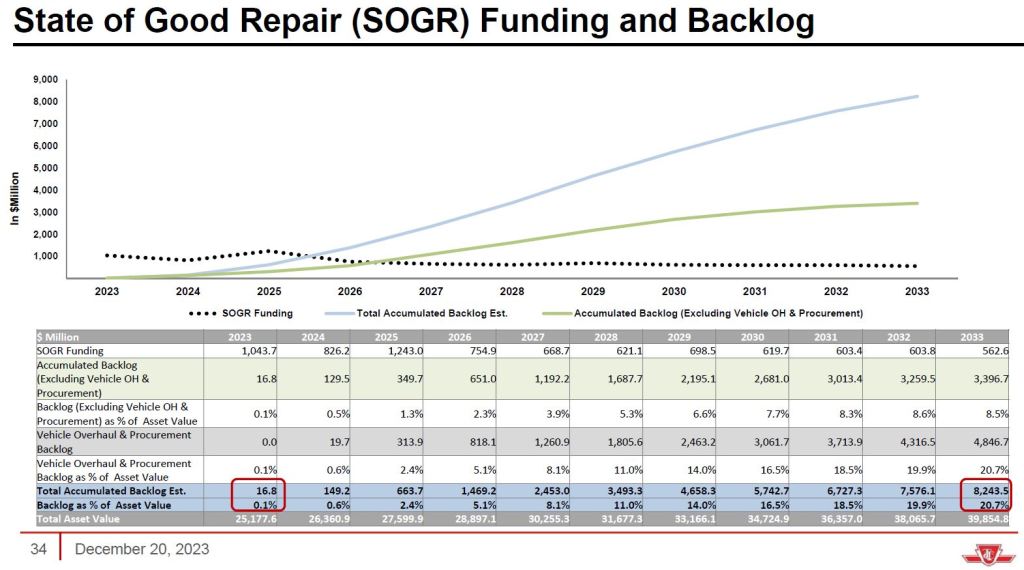
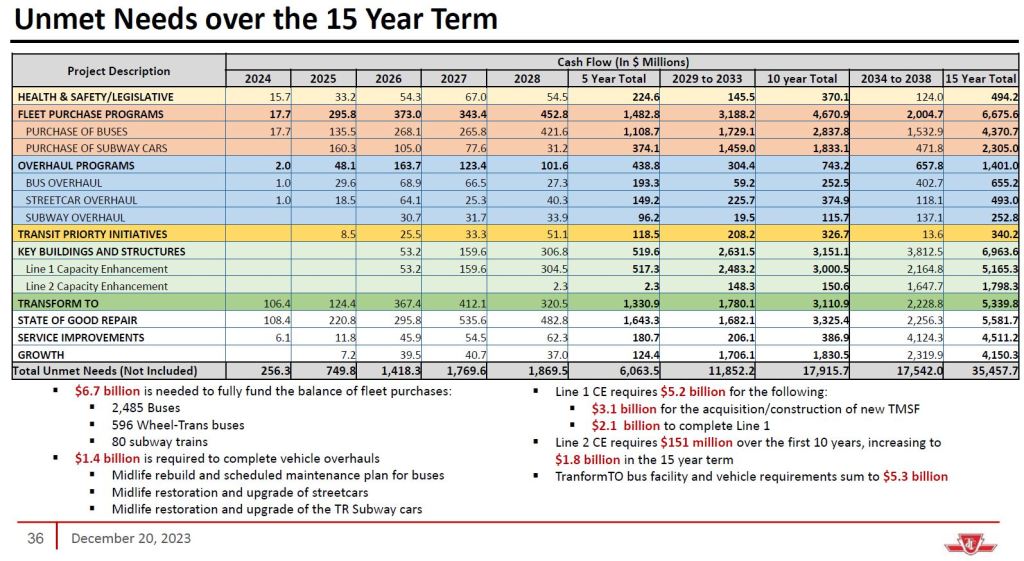
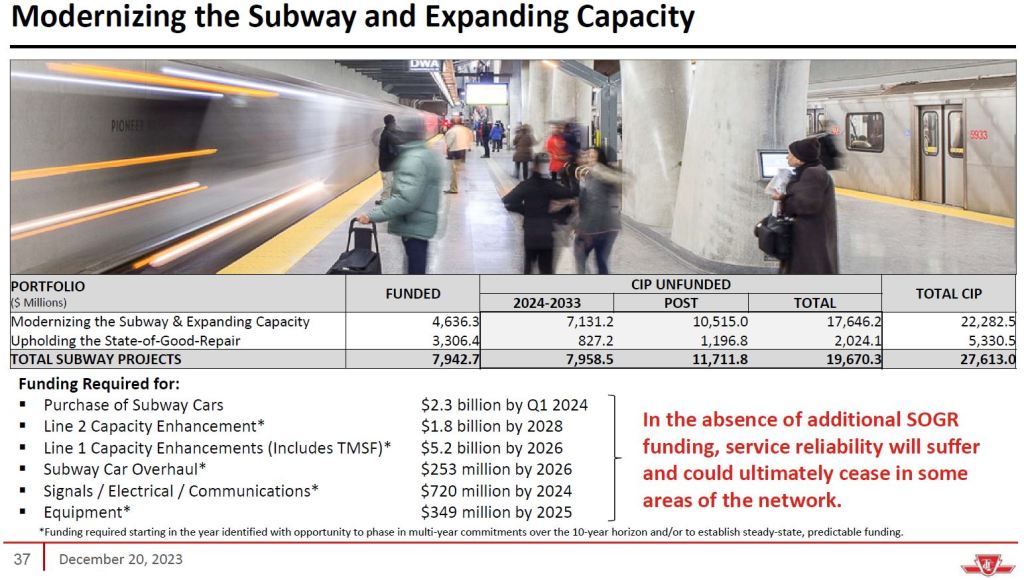
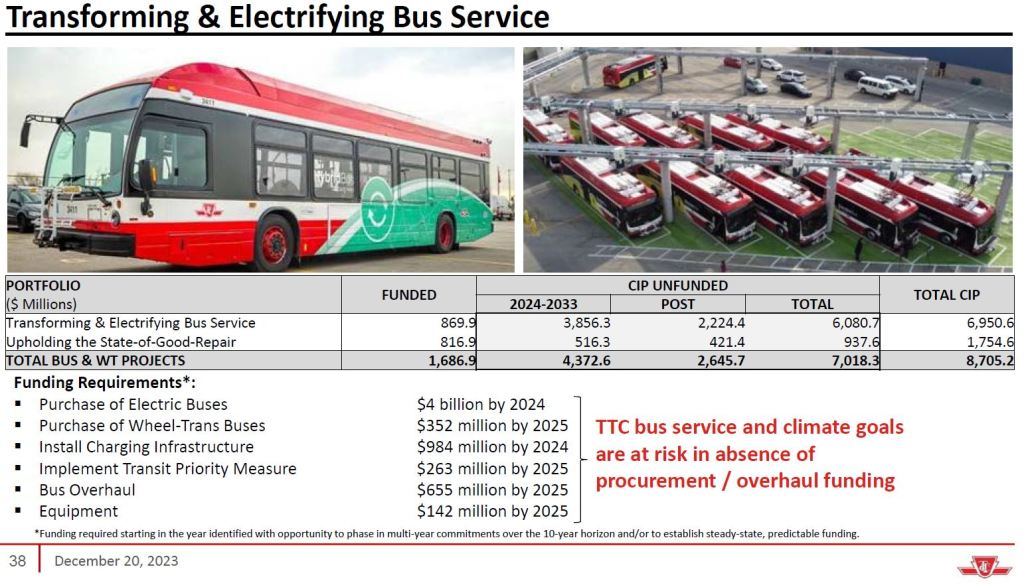
Unmet capital needs are roughly triple the size of the 10-year capital plan, although they include some big-ticket projects that have not yet been approved by Council such as the full TransformTO fleet buildup and subway platform screen doors.
- Commissioner Osborne asked if the new Federal transit program is a replacement for project specific funding such as new subway cars.
- Staff replied that based on ridership we would get about $650m of $3b annual allocation on a ridership share 23%. However, the actual model for the new program has not been published yet, and funds will not flow until 2026.
- Commissioner Ainslie asked why the Waterfront East and Eglinton LRT projects are not in the TTC budget.
- Staff replied that these are City projects, and until a decision is made about who leads them, they will sit in the City’s budget.
- Ainslie asked if this would be a big hit on the TTC budget.
- Staff replied that, yes, it would, but the first priority is state of good repair.
- The problem here is that other projects that are even less committed than the LRT lines are in the TTC budget, while the LRT lines are not. This both understates the total exposure the TTC faces to more funding and the potential competition with ongoing maintenance this reflects.
- Ainslie also asked about the potential effect of provincial changes to Development Charges.
- Staff replied that the TTC is waiting to hear how much of the existing DCs the province will claw back, but alternate funding has been promised.
- This is far from certain and the Province has been dragging its feet on the issue of “making municipalities whole” on the DC revenue stream. That, in turn, was based on the premise that there are millions if not billions sitting in reserves that the City should be spending rather than depending on DCs. The Province has since discovered that its assumptions about City finances were riddled with holes, but their friends in the development industry are hoping for a reduction in these charges.
- Commissioner Saxe asked if Council extends City Building Fund (launched under Mayor Tory to help fund capital projects), what does this do to the unfunded project list.
- Staff replied that this depends on how new allocation is split between the TTC and housing portfolios.
- Saxe wondered if the TTC has asked how much they will be getting.
- Staff replied that they have been very clear about TTC needs, but there is no formal request from the Board to Council on this. Saxe described the situation as one of “learned helplessness” on the TTC’s part, although past history suggests that City Hall preferred not to know how bad the situation was at TTC.
- Saxe asked how the capital needs would affect fares if funding had to come from that stream. “A lot”, came the reply. A ten cent fare increase would generate only a tiny amount of money compared to the total need.
- Saxe observed that about $500 million worth of land has gone from the TTC to the City for housing.
- Staff noted that the City buys property on the TTC’s behalf, most recently property on Kipling for a future bus garage.
- Commissioners Matlow and Osborne both asked about the status of the SRT replacement busway.
- Staff replied that it is on the TTC’s unfunded list and they are actively seeking funding.
- Staff advised that TTC is making the case to all potential funders that the current model is not sustainable. They are showing the benefits of transit investment, and “educating” governments about the interdependencies among projects. State of good repair is now getting more attention vs a previous focus on expansion.
Transit Priority
- Commissioner Saxe asked what specific changes do staff want the City to make for traffic improvement.
- Staff replied that they are identifying changes for St. Clair and Queen West to improve vehicle flow.
- CEO Leary advised that there have been recent discussions with the City regarding the RapidTO plan including where queue jump lanes and signal priority can be added. There is a report going to Council in next quarter.
- Saxe moved a budget amendment consolidating a desire that Councillors be informed of the TTC’s requests to the City so that Commissioner/Councilllors can advocate on the TTC’s behalf.
Amendments to Management Recommendations
The Board approved four actions in addition to the management recommendations for the budget:
- The TTC Board requests the TTC CEO to report to the Board in Q3 2024 on the service crowding standard change made in the 2023 budget, including the impacts on riders and TTC finances, and the cost and service implications of reversing that decision in the 2025 budget. (Commissioner Matlow)
- That TTC Staff report back in Q2 2024 on the establishment of a Budget Committee. (Commissioner Ainslie)
- That staff advise the TTC Board of their specific requests to the City in relation to traffic, on street parking, and the City Building Fund. (Commissioner Saxe)
- TTC Board resolve to closely monitor the 2024 financial performance and the resulting draws of the TTC Stabilization Reserve fund, and commit to making in-year adjustments to reduce reliance on the reserve fund as a first priority should there be favorable variances to financial performance. (Commissioner Holyday)
 Steve Munro
I asked TTC Board Member Councillor Josh Matlow if he ever reads reports. Matlow was honest enough to admit that he does NOT but that he gets the gist of every report through his staff verbally summarising the same and also from watching the news.
LikeLike
Concerning transit priority, St Clair and Queen are obvious ones, but what about Eglinton? Without drastic priority measures like gates, eastern Eglinton will not have nearly the capacity of the western part. Traffic signals are designed to bunch traffic, and bunch them it does, including transit vehicles.
LikeLike